Bone and Cartilage: Anatomy and Composition
 Call Kai
 Learn
Learn Practice Test
 Spaced Repetition
 Match
Match Flashcards
 Knowt Play
1/21

There's no tags or description
Looks like no tags are added yet.
Name | Mastery | Learn | Test | Matching | Spaced | Call with Kai |
|---|
No analytics yet
Send a link to your students to track their progress
22 Terms
Describe the function of osteocytes in bone
Matrix maintenance
Remodelling
Describe the function of osteoclasts in bone
Responsible for bone resorption
Secrete proteases, which destroy the organic matrix
Release protons, creating an acidic environment, causing demineralisation
Describe the function of osteoblasts in bone
Synthesise and secrete osteoid
Active in mineralisation process
Describe the function of the matrix in bone
Mechanical support
Structural integrity and rigidity
Lubrication
Nutrition
Describe the function of minerals in bone
Structural integrity and rigidity
Compressive strength
Hardness
Describe the function of collagen in bone
Provide toughness and flexibility
Provide framework for mineralisation
Describe the function of cells in cartilage
Maintain tissue
Synthesise and organise extracellular matrix
Describe the function of the matrix in cartilage
Mechanical support
Structural integrity and rigidity
Lubrication
Nutrition
Describe the function of collagen in cartilage
Providing tensile strength
Stability
Elasticity
Describe the formation of osteocytes
When mature osteoblasts become trapped within the matrix they secrete during bone remodeling or formation
Describe the formation of osteoclasts
Hematopoietic stem cells from the myeloid/monocyte lineage fuse to form giant, multinucleated bone-resorbing cells
Describe the formation of osteoblasts
From mesenchymal stem cells (MSCs) through a process called osteogenic differentiation, which occurs in the bone marrow and periosteum
Describe the formation of the matrix
Osteoblasts secrete organic materials, primarily type I collagen, to form a soft framework called osteoid, which is subsequently hardened through mineral deposition
Describe the formation of collagen
By osteoblasts, in a multi-step process involving intracellular synthesis and extracellular assembly
Describe how bone undergoes a constant remodelling cycle
Bone undergoes continuous renewal, where old or damaged tissue is resorbed by osteoclasts and replaced by new, mineralized matrix deposited by osteoblasts
Continuous remodeling ensures that the skeleton can adapt, repair, and maintain structural integrity
Describe how bone is involved in mineral and endocrine homeostasis
Bone acts as a vital reservoir for calcium and phosphate, releasing them into the bloodstream as needed
Also functions as an endocrine organ, releasing molecules like osteocalcin to regulate energy and glucose metabolism
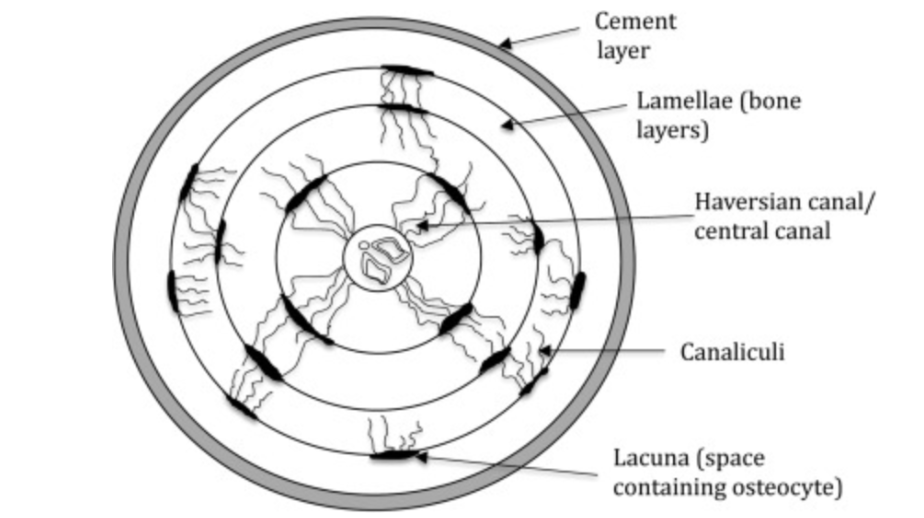
Draw out the different layers of a cross-section of the bone, including:
Cement layer
Lacuna
Lamellae
Haversian canal
Canaliculi
List the minerals that are stored in bone tissue
Calcium
Phosphorous
Magnesium
Sodium
Potassium
Citrate
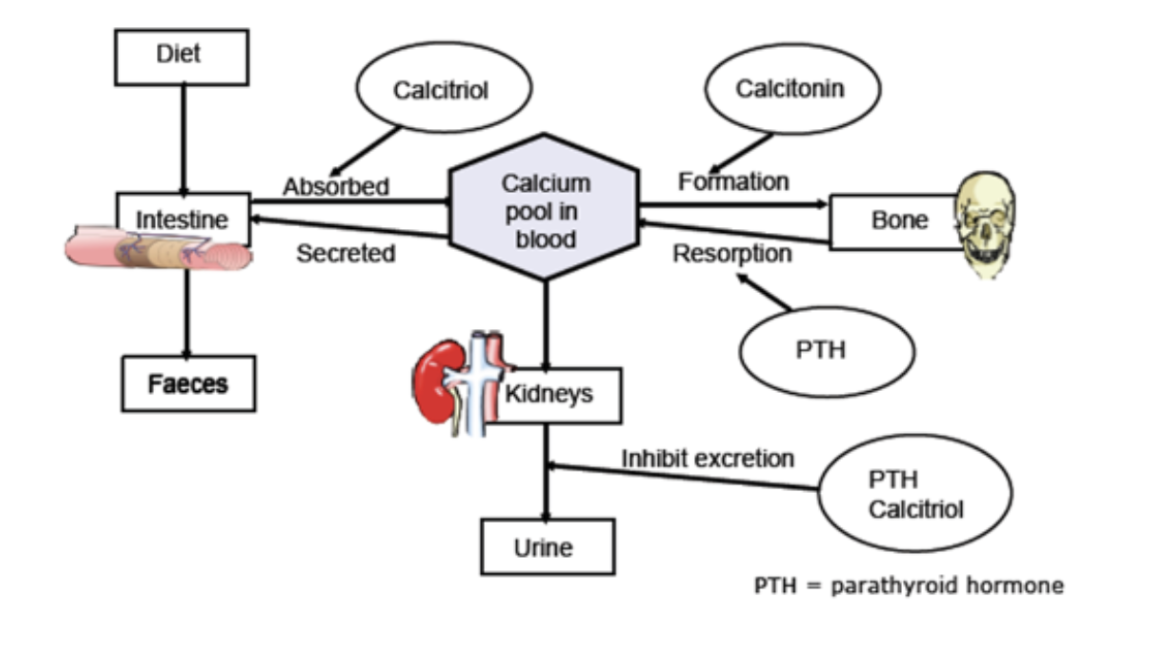
Describe the role of calcitriol in calcium regulation
Stimulating intestinal calcium absorption
Promoting renal reabsorption of calcium
Assisting in bone mineralization or resorption
Describe the role of parathyroid hormone in calcium regulation
Raising low blood calcium levels by stimulating bone resorption
Increasing renal calcium reabsorption
Increasing intestinal calcium absorption by vitamin D activation
Draw out the cycle of calcium regulation