Lecture 2.16 - Cadiac/Smooth, MuscIII; Ca2+, Twitch, SO/FOG, Gap Junction, Intercalated Disc, Myogenic

0.0(0)
Studied by 0 people
call kaiCall Kai
learnLearn
examPractice Test
spaced repetitionSpaced Repetition
heart puzzleMatch
flashcardsFlashcards
GameKnowt Play
Card Sorting

1/23

encourage image

There's no tags or description

Looks like no tags are added yet.

Last updated 7:48 PM on 2/28/26
Name
Mastery
Learn
Test
Matching
Spaced
Call with Kai

No analytics yet

Send a link to your students to track their progress

24 Terms
1
New cards
<p>iClicker</p>

iClicker

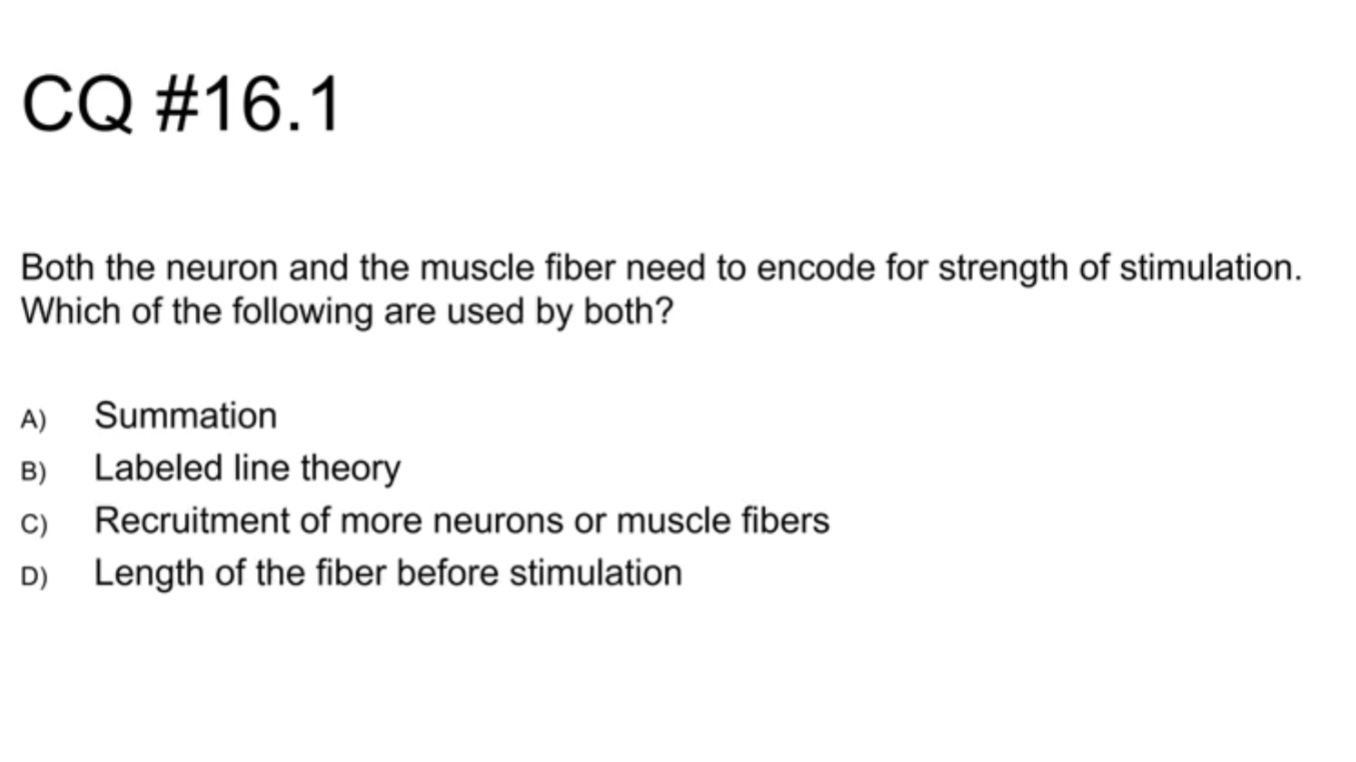
  • A) Neurons : spatial, temporal, or both = more likely to reach AP ; Muscles : recruiting more neurons

  • B) Only for neurons

  • C) More neurons not necessary for strength - only more frequent action potentials ; is true for neurons

  • D) Only for muscles

2
New cards

Summary of skeletal muscle contraction

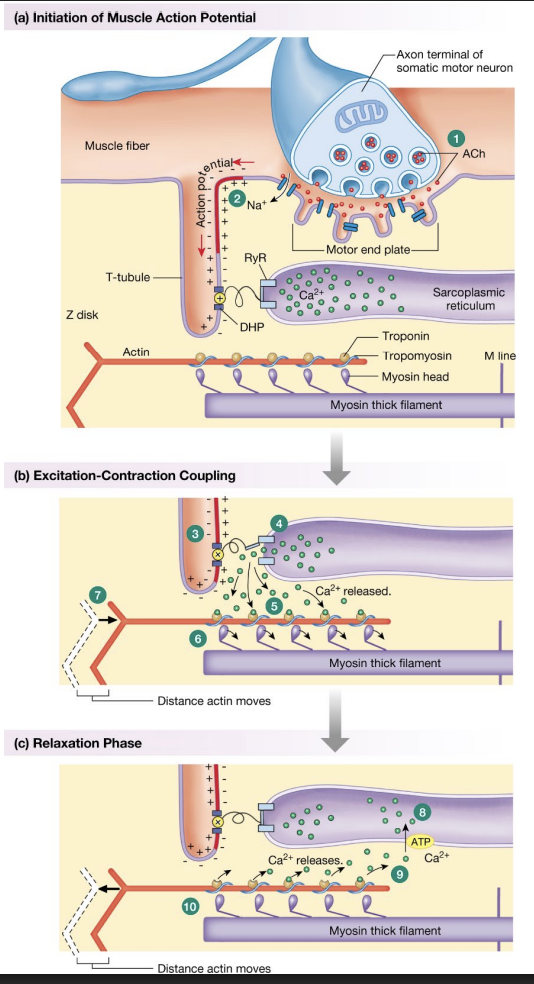
  • NMJ - where neuron meets sarcolemma at motor end plate

  • ACh released from motor neuron via exocytosis

  • ACh binds to nicotine receptor, opens, allowing Na+ in and causing an AP if large enough

  • AP passes down sarcolemma into T-tubules, allowing AP to enter muscle fiber by reaching DHPR / L-type channel

  • DHP(voltage-gated Ca2+ channel) connected to RyR channel (in skeletal muscles), allows Ca2+ to rush into sarcoplasm and Ca2+ to be released from intracellular stores

  • Ca2+ binds to troponin C, pulls on I, T →moves tropomyosin

  • Tropomyosin reveals myosin binding sites

  • Cross-bridge cycling

  • Myosin flexes, closing distance between actin fibers, causing contraction

  • Ca2+ removed via ATP (AChE), goes back into sarcoplasmic reticulum via SERCA, tropomyosin cover binding sites…
<ul><li><p>NMJ - where neuron meets sarcolemma at motor end plate</p></li><li><p>ACh released from motor neuron via exocytosis</p></li><li><p>ACh binds to nicotine receptor, opens, allowing Na+ in and causing an AP if large enough</p></li><li><p>AP passes down sarcolemma into T-tubules, allowing AP to enter muscle fiber by reaching DHPR / L-type channel</p></li><li><p>DHP(voltage-gated Ca2+ channel) connected to RyR channel (in skeletal muscles), allows Ca2+ to rush into sarcoplasm and Ca2+ to be released from intracellular stores</p></li><li><p>Ca2+ binds to troponin C, pulls on I, T →moves tropomyosin</p></li><li><p>Tropomyosin reveals myosin binding sites</p></li><li><p>Cross-bridge cycling</p></li><li><p><strong>Myosin flexes, closing distance between actin fibers, causing contraction</strong></p></li><li><p>Ca2+ removed via ATP (AChE), goes back into sarcoplasmic reticulum via SERCA, tropomyosin cover binding sites…</p></li></ul><p></p>
3
New cards

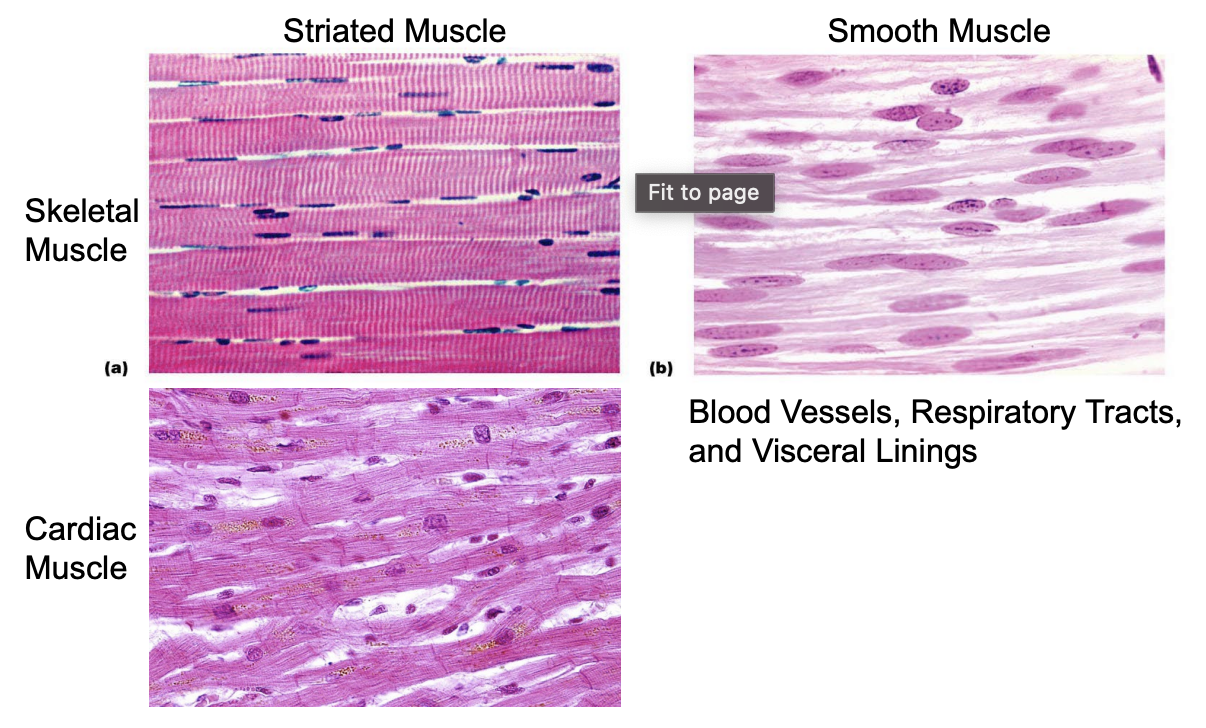
Striated muscle

  • Due to organization of Actin and Myosin

    • Dark spots - nuclei

  • Skeletal muscles = Linear, contracts in same direction

  • Cardiac muscles = branch

  • Smooth muscles - not striated

<ul><li><p>Due to organization of Actin and Myosin</p><ul><li><p>Dark spots - nuclei</p></li></ul></li><li><p>Skeletal muscles = Linear, contracts in same direction</p></li><li><p>Cardiac muscles = branch</p></li><li><p>Smooth muscles - not striated</p></li></ul><p></p>
4
New cards

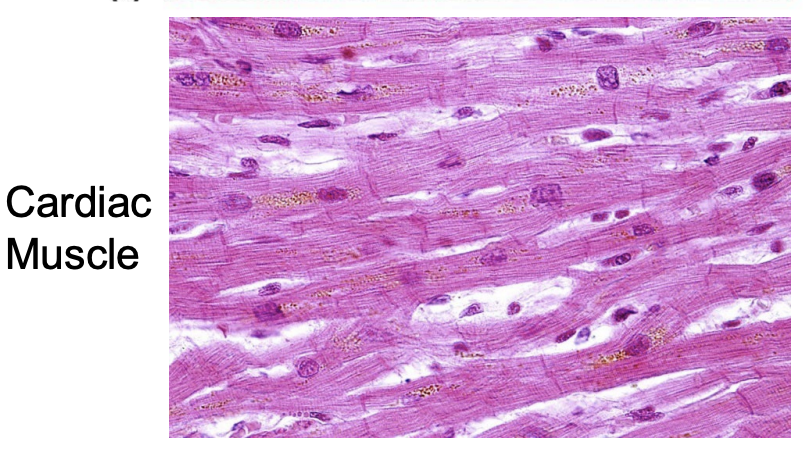
Cardiac muscle, striated

  • Striated, but branches

  • Can be multi-nucleated, sometimes binucleate nucleated, but usually mono-nucleated

  • Dark lines - Z

  • Light lines - M

<ul><li><p><strong>Striated</strong>, but <strong>branches</strong></p></li><li><p>Can be multi-nucleated, sometimes binucleate nucleated, but <strong>usually mono-nucleated</strong></p></li><li><p>Dark lines - Z</p></li><li><p>Light lines - M</p></li></ul><p></p>
5
New cards

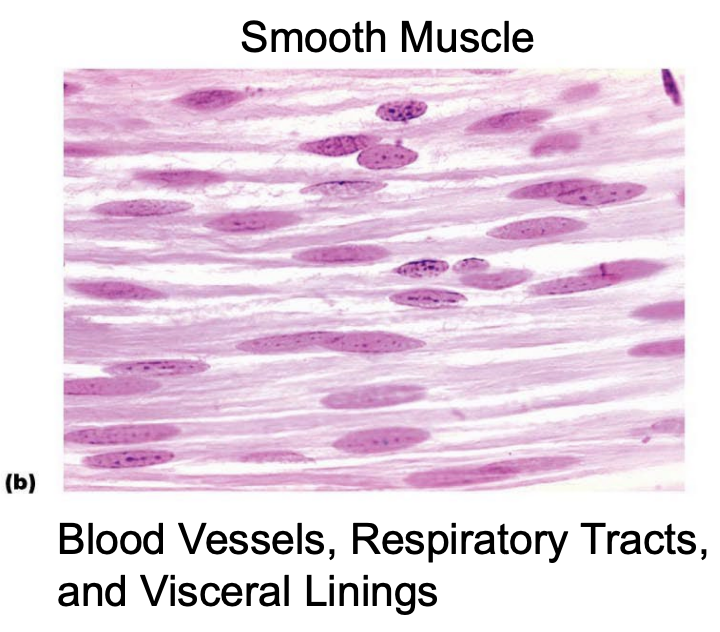
Smooth muscle

  • NOT STRIATED

    • Mon-linear organization of Actin and Myosin

  • Mono-nucleated

<ul><li><p>NOT STRIATED</p><ul><li><p>Mon-linear organization of Actin and Myosin</p></li></ul></li><li><p><strong>Mono-nucleated</strong></p></li></ul><p></p>
6
New cards

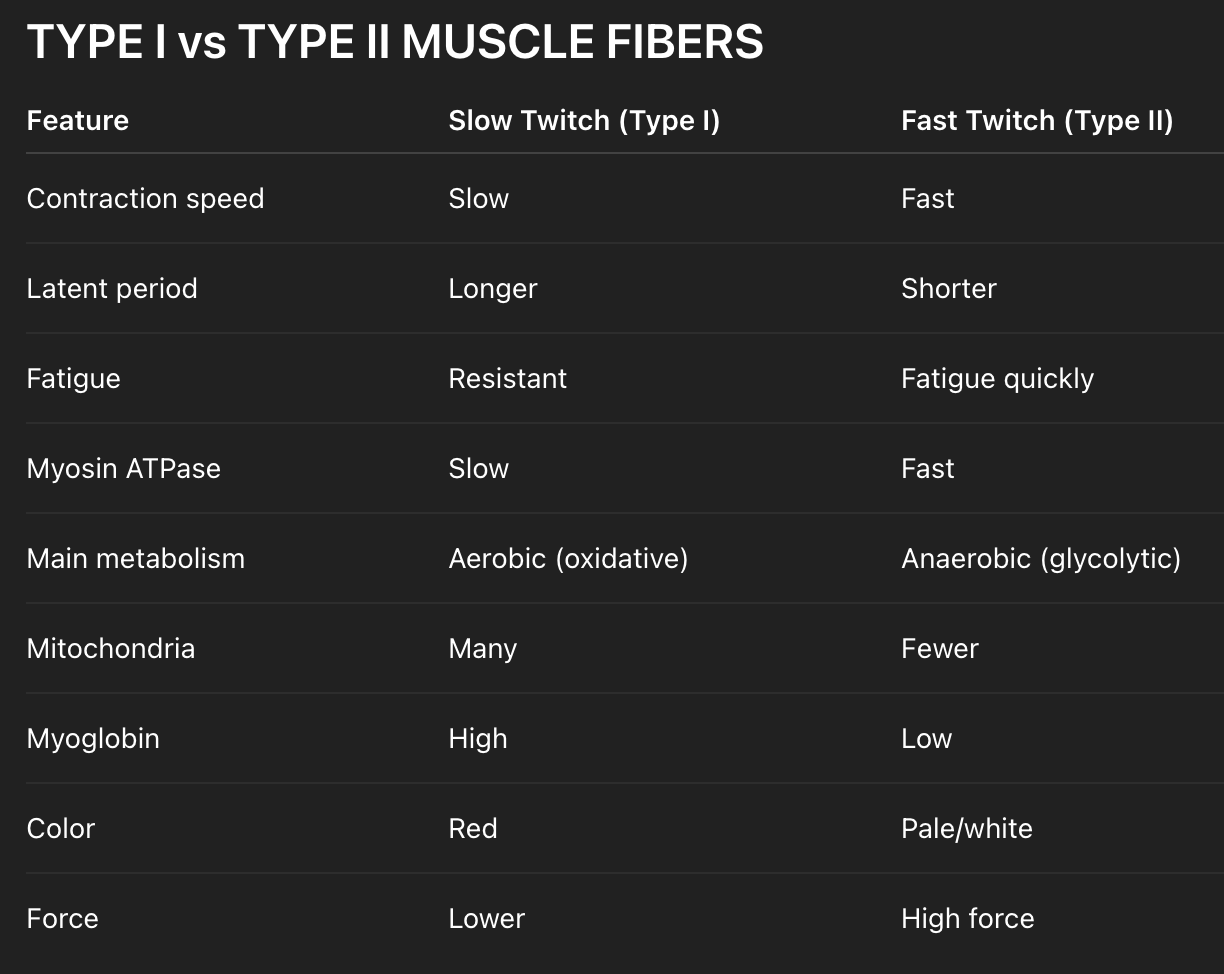
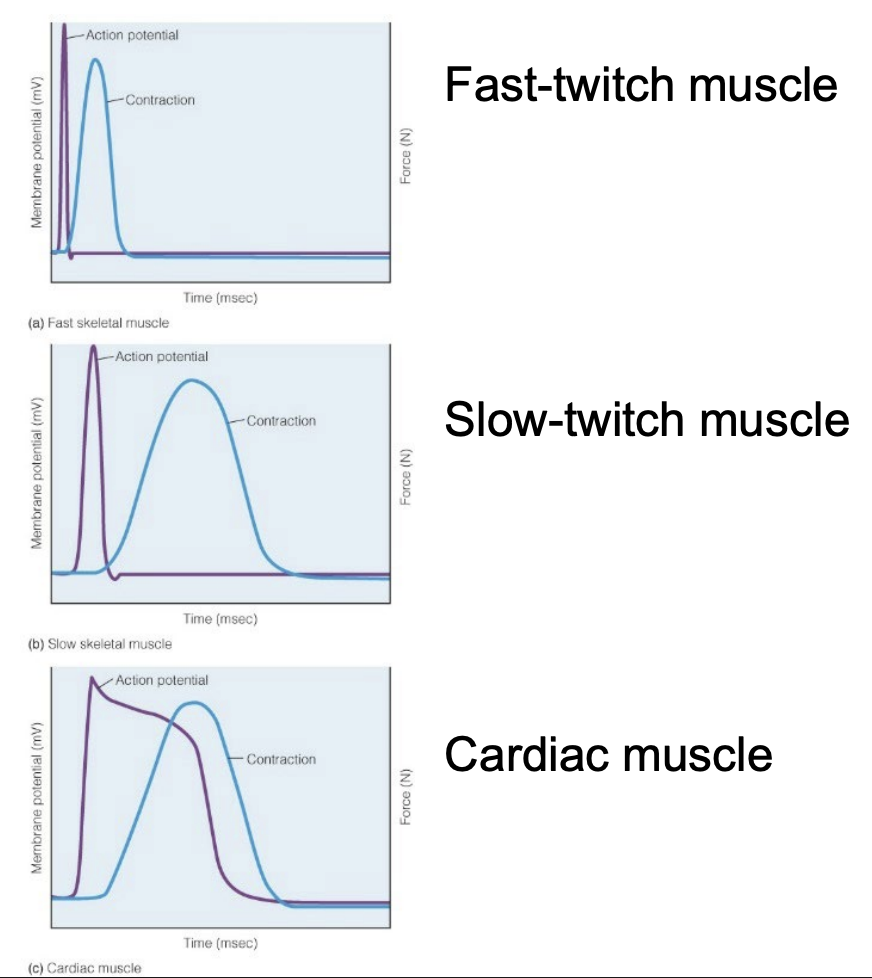
Differences - AP + Twitch speed

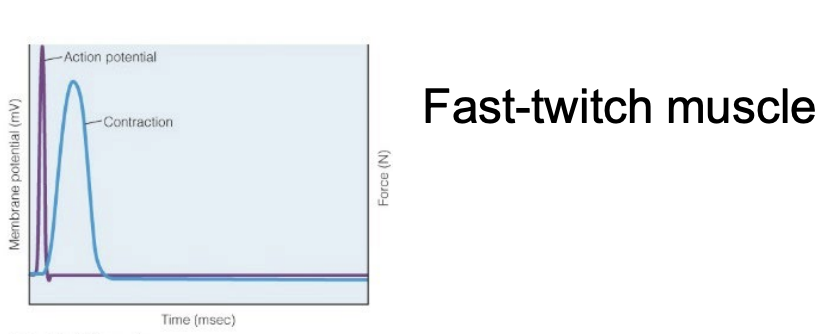
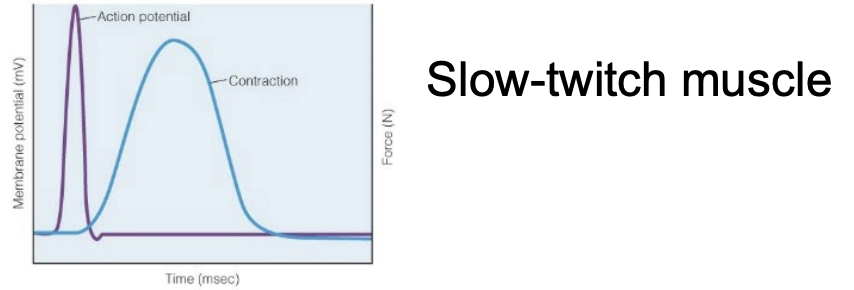
  • Not all skeletal muscle is the same - latent period between AP and Contraction can vary

    • Fast Twitch / FG (Type 2)- contraction right after AP

      • Faster depolarization

      • Shorter latent period

      • Shorter contraction

    • Slow Twitch / SO (Type 1)- contraction a little after AP

      • Slower depolarization

      • Longer latent period

      • Longer contraction

  • Muscles can have combinations of slow/fast twitch fibers with some predominating

  • Smallest force out of the 3 Twitch types
<ul><li><p>Not all skeletal muscle is the same - latent period between AP and Contraction can vary</p><ul><li><p><strong>Fast Twitch / FG</strong> (Type 2)- contraction right after AP</p><ul><li><p>Faster depolarization</p></li><li><p>Shorter latent period</p></li><li><p>Shorter contraction</p></li></ul></li><li><p><strong>Slow Twitch / SO</strong> (Type 1)- contraction a little after AP</p><ul><li><p>Slower depolarization</p></li><li><p>Longer latent period</p></li><li><p>Longer contraction</p></li></ul></li></ul></li><li><p>Muscles can have combinations of slow/fast twitch fibers with some predominating</p></li><li><p>Smallest force out of the 3 Twitch types</p></li></ul><p></p>
7
New cards

Fast-twitch muscle (Type 2) / Fast Glycolytic (FG) and Fast Oxidative Glycolytic (FOG)

  • PURPOSE:

    • quick bursts

    • large force output

  • Reaches depolarization faster

    • Due to number and properties of Na+/K+ channels

    • Short latent period

  • Contraction occurs right after AP

  • Fatigue quickly

  • Fewer mitochondria

  • Pale/While color

  • High force

  • **TWO TYPES:

    • FOG - Fast Oxidative/Glycolytic

      • Medium force

    • FG - Fast Glycolytic

      • Greatest force

EXAMPLES

  • Gastrocnemius (jumping calf muscle)

  • Biceps brachii

  • Finger flexors

  • Eye muscles (extraocular muscles — extremely fast)
<ul><li><p><span style="color: blue;"><u><span>PURPOSE</span></u><span>:</span></span></p><ul><li><p><span style="color: blue;"><span>quick bursts</span></span></p></li><li><p><span style="color: blue;"><span>large force output</span></span></p></li></ul><p></p></li><li><p>Reaches depolarization faster</p><ul><li><p>Due to number and properties of Na+/K+ channels</p></li><li><p>Short latent period</p></li></ul></li><li><p>Contraction occurs right after AP</p></li><li><p>Fatigue quickly</p></li><li><p>Fewer mitochondria</p></li><li><p>Pale/While color</p></li><li><p>High force</p></li><li><p><strong>**<u>TWO TYPES:</u></strong></p><ul><li><p><strong><mark data-color="blue" style="background-color: blue; color: inherit;">FOG - Fast Oxidative/Glycolytic</mark></strong></p><ul><li><p>Medium force</p></li></ul></li><li><p><strong><mark data-color="blue" style="background-color: blue; color: inherit;">FG - Fast Glycolytic</mark></strong></p><ul><li><p>Greatest force</p></li></ul></li></ul></li></ul><p></p><p><u>EXAMPLES</u></p><ul><li><p><strong>Gastrocnemius (jumping calf muscle)</strong></p></li><li><p><strong>Biceps brachii</strong></p></li><li><p><strong>Finger flexors</strong></p></li><li><p><strong>Eye muscles (extraocular muscles — extremely fast)</strong></p></li></ul><p></p><p></p>
8
New cards

Slow-twitch muscle (Type 1) / Slow Oxidative (SO)

  • PURPOSE:

    • maintain posture

    • repeated activity

    • low-force endurance

      • Can last all day

  • Slower depolarization

    • Longer contraction cycle

    • Longer latent period

  • Electron Transport chain - Use Oxygen, unlimited ATP

  • Resistant to fatigue

  • More mitochondria

  • Red color

  • Lower force

EXAMPLES

  • Soleus (calf postural muscle) → standing

  • Back extensor muscles (erector spinae) → posture

  • Neck stabilizers

  • Diaphragm (important!) → continuous breathing
<ul><li><p><span style="color: blue;"><u><span>PURPOSE:</span></u></span></p><ul><li><p><span style="color: blue;"><span>maintain posture</span></span></p></li><li><p><span style="color: blue;"><span>repeated activity</span></span></p></li><li><p><span style="color: red;"><span>low-force endurance</span></span></p><ul><li><p><span style="color: red;">Can last all day</span></p></li></ul></li></ul><p></p></li><li><p>Slower depolarization</p><ul><li><p>Longer contraction cycle</p></li><li><p>Longer latent period</p></li></ul></li><li><p><span style="color: blue;"><strong>Electron Transport chain - Use Oxygen, unlimited ATP</strong></span></p></li><li><p>Resistant to fatigue</p></li><li><p>More mitochondria</p></li><li><p>Red color</p></li><li><p>Lower force</p></li></ul><p></p><p><u>EXAMPLES</u></p><ul><li><p><strong>Soleus (calf postural muscle)</strong> → standing</p></li><li><p><strong>Back extensor muscles (erector spinae)</strong> → posture</p></li><li><p><strong>Neck stabilizers</strong></p></li><li><p><strong>Diaphragm (important!)</strong> → continuous breathing</p></li></ul><p></p>
9
New cards

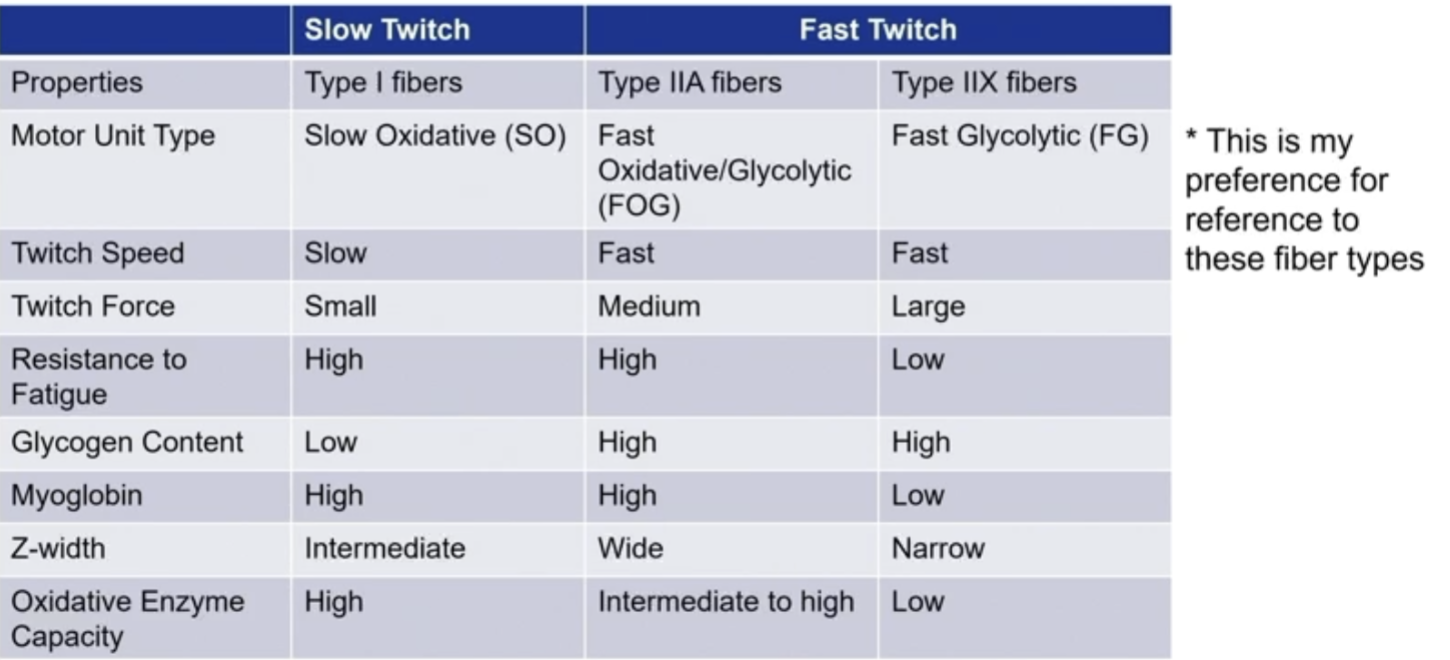
Slow vs Fast Twitch muscle chart

knowt flashcard image
10
New cards

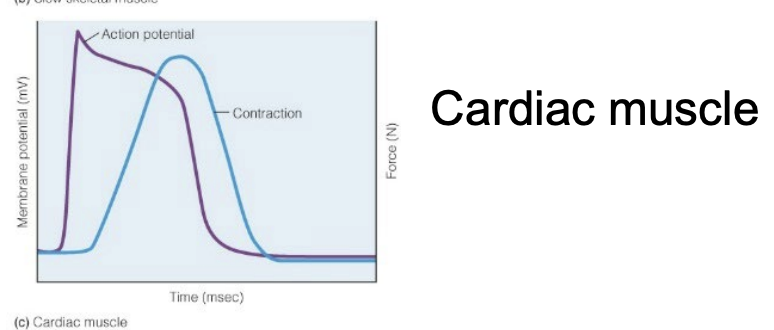
Cardiac Muscle - Twitch

  • Normal depolarization phase, but very long strangely shaped repolarization phase, that goes into the contraction

    • Contraction resembles that of the Slow Twitch
<ul><li><p>Normal depolarization phase, but very long strangely shaped <strong>repolarization</strong> phase, that goes into the contraction</p><ul><li><p>Contraction resembles that of the Slow Twitch</p></li></ul></li></ul><p></p>
11
New cards
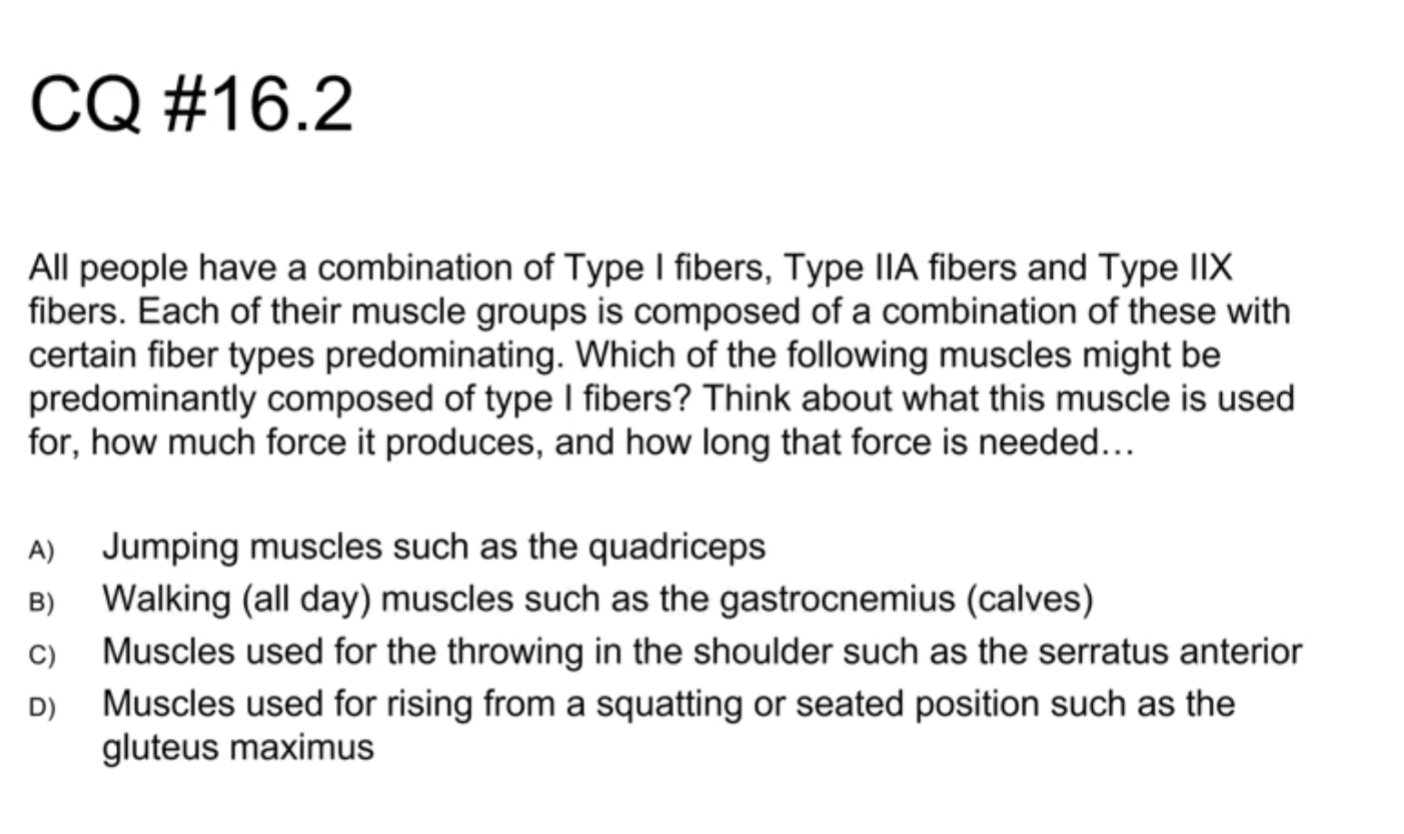
<p>iClicker</p>

iClicker

  • Predominantly Type I = Slow Twitch?

    • → Think of ALL DAY things

  • Answer = B

12
New cards

SO vs FOG/FG Chart (MEMORIZE - Glycogen, Myoglobin, Z-width, Oxidative Enzyme Capacity)

  • SO use oxygen via ETC (SLOW), can last all day (continuously generate energy)

  • FOG use ETC (slow) and glycolysis (fast!)

    • Hybrid of slow and fast fibers

      • Contract fast, resist fatigue longer than FG

      • Activities:

        • Walking up hill, repeated lifting, middle distance running

  • FG uses only glycolysis (FAST)

    • Greatest force, fastest fatigue

      • Activities:

        • Sprinting, jumping, throwing


Non-obvious stats

  • SO and FOG have much higher resistance to fatigue than FG

  • FG/FOG have higher glycogen amount than SO (energy)

  • SO and FOG have higher myoglobin amount than FG

    • SO and FOG are darker meat, FG is lighter meat

    • Also more fat storage on SO/FOG

  • Z-width: FG < SO < FOG

    • FOG require force AND repetition

    • SO only requires repetition

    • FG only requires force

  • SO > FOG > FG for oxidative enzyme capacity
<ul><li><p><span style="color: blue;"><strong><span>SO</span></strong></span> use oxygen via ETC (SLOW), can last all day (continuously generate energy)</p></li><li><p><span style="color: purple;"><strong><span>FOG</span></strong></span> use ETC (slow) and <strong>glycolysis</strong> (fast!)</p><ul><li><p>Hybrid of slow and fast fibers</p><ul><li><p>Contract fast, resist fatigue longer than FG</p></li><li><p><u>Activities</u>:</p><ul><li><p>Walking up hill, repeated lifting, middle distance running</p></li></ul></li></ul></li></ul></li><li><p><span style="color: red;"><strong><span>FG</span></strong></span> uses only glycolysis (FAST)</p><ul><li><p>Greatest force, fastest fatigue</p><ul><li><p><u>Activities</u>:</p><ul><li><p>Sprinting, jumping, throwing</p></li></ul></li></ul></li></ul></li></ul><div data-type="horizontalRule"><hr></div><p>Non-obvious stats</p><ul><li><p>SO and FOG have much higher <u>resistance to fatigue</u> than FG</p></li><li><p>FG/FOG have higher <u>glycogen</u> amount than SO (energy)</p></li><li><p>SO and FOG have higher <u>myoglobin</u> amount than FG</p><ul><li><p><span style="color: red;">SO and FOG are darker meat, FG is lighter meat</span></p></li><li><p><span style="color: red;">Also more fat storage on SO/FOG</span></p></li></ul></li><li><p><span style="color: purple;"><strong><mark data-color="yellow" style="background-color: yellow; color: inherit;">Z-width</mark>: FG &lt; SO &lt; FOG</strong></span></p><ul><li><p>FOG require force AND repetition</p></li><li><p>SO only requires repetition</p></li><li><p>FG only requires force</p></li></ul></li><li><p>SO &gt; FOG &gt; FG for <u>oxidative enzyme</u> capacity</p></li></ul><p></p>
13
New cards

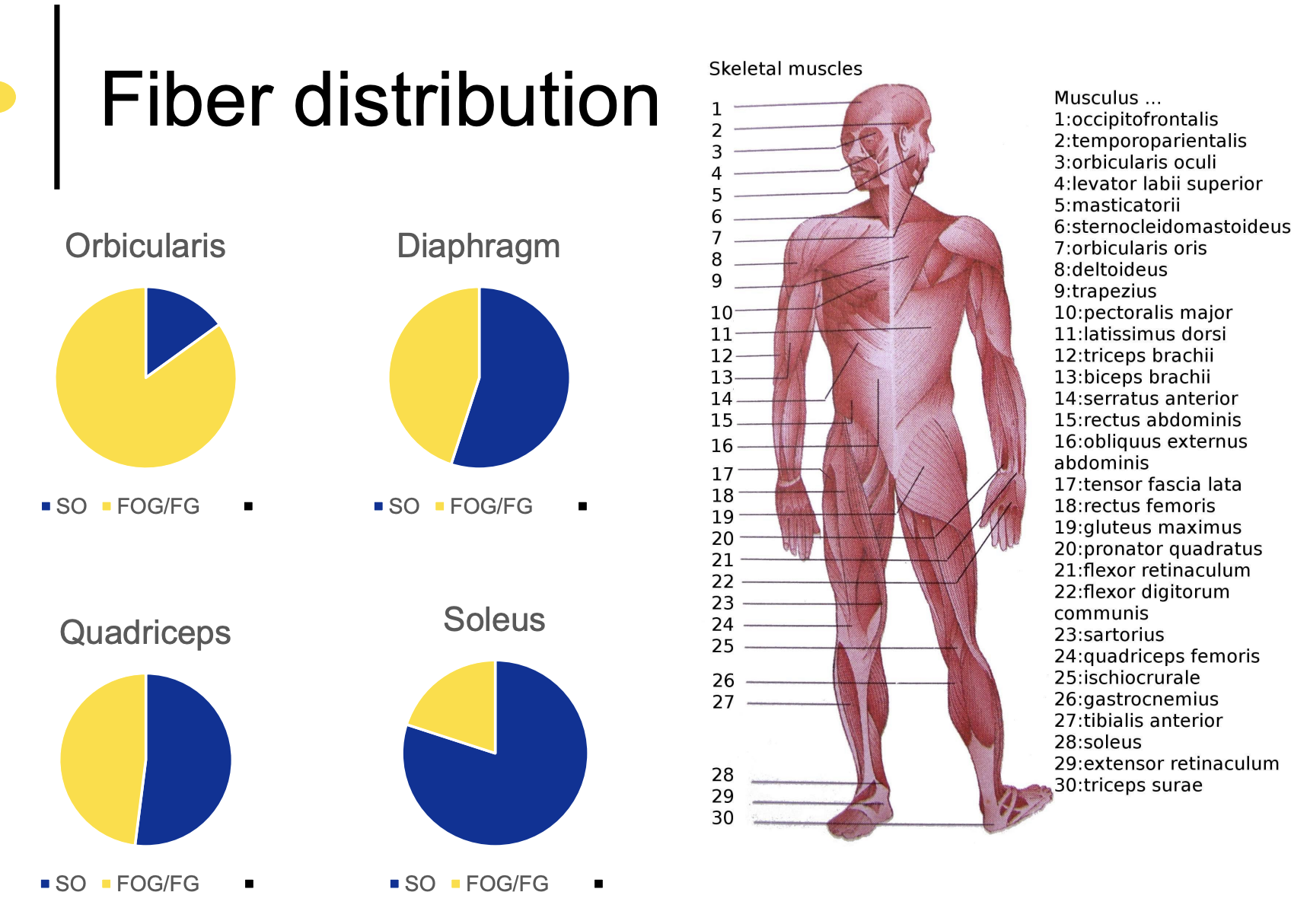
Fiber distribution

  • Orbicularis - Eyes

    • Majority FOG/FG, less SG

      • Fast movements

  • Diaphragm

    • ~ 1:1 SO to FOG/FG, though more SO

  • Quadriceps

    • ~1:1 SO to FOG/FG

  • Soleus - Calves, walking, all-day muscle

    • All-day walking muscle, mostly SO

<ul><li><p><span style="color: blue;">Orbicularis - <strong>Eyes</strong></span></p><ul><li><p>Majority FOG/FG, less SG</p><ul><li><p>Fast movements</p></li></ul></li></ul></li><li><p><span style="color: blue;"><strong>Diaphragm</strong></span></p><ul><li><p>~ 1:1 SO to FOG/FG, though more SO</p></li></ul></li><li><p><span style="color: blue;"><strong>Quadriceps</strong></span></p><ul><li><p>~1:1 SO to FOG/FG</p></li></ul></li><li><p><span style="color: blue;">Soleus - <strong>Calves</strong>, walking, all-day muscle</span></p><ul><li><p>All-day walking muscle, mostly SO</p></li></ul></li></ul><p></p>
14
New cards
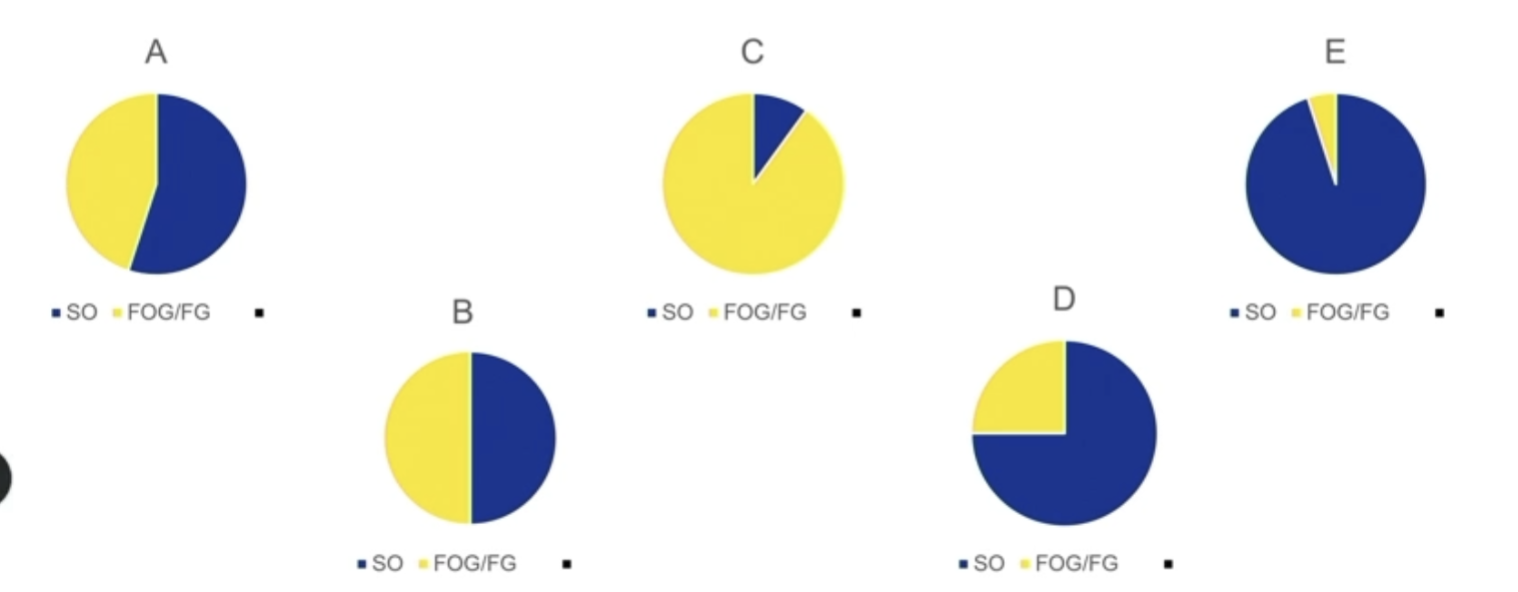
<p>iClicker</p>

iClicker

  • Cardiac - E

  • Heart is always pumping, can speed up, but mostly same rhythm

15
New cards

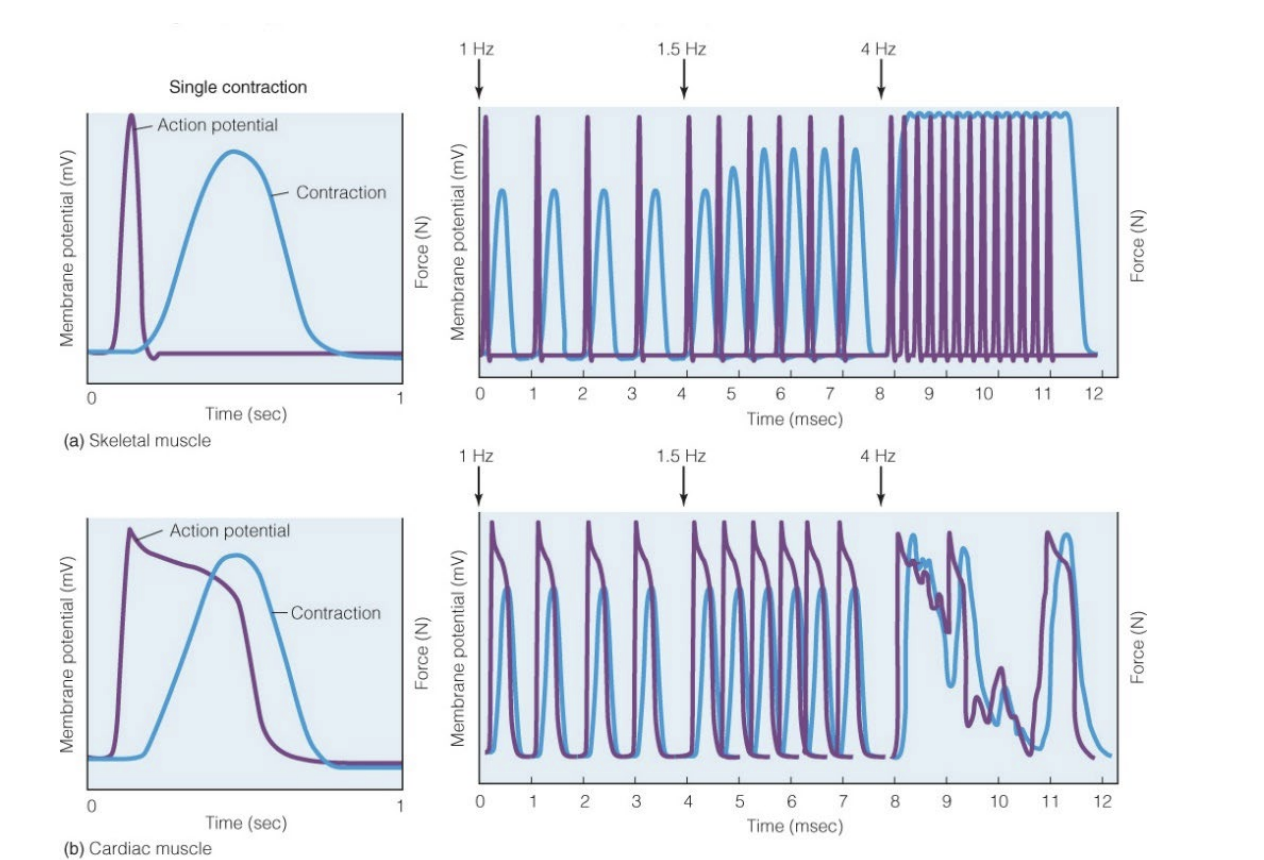
High frequency stimulation in Cardiac muscles

  • High frequency stimulation causes arrhythmic cardiac muscle contractions

  • Heart muscles CANNOT stay in tetanus

    • If heart cannot relax, it cannot fill with blood and cause a contraction to send blood out

  • Thus : RyR channel is not connected to DHPR channel / L-Type channel
<ul><li><p>High frequency stimulation causes arrhythmic cardiac muscle contractions</p></li><li><p>Heart muscles CANNOT stay in tetanus</p><ul><li><p>If heart cannot relax, it cannot fill with blood and cause a contraction to send blood out</p></li></ul></li><li><p>Thus : RyR channel is not connected to DHPR channel / L-Type channel </p></li></ul><p></p>
16
New cards

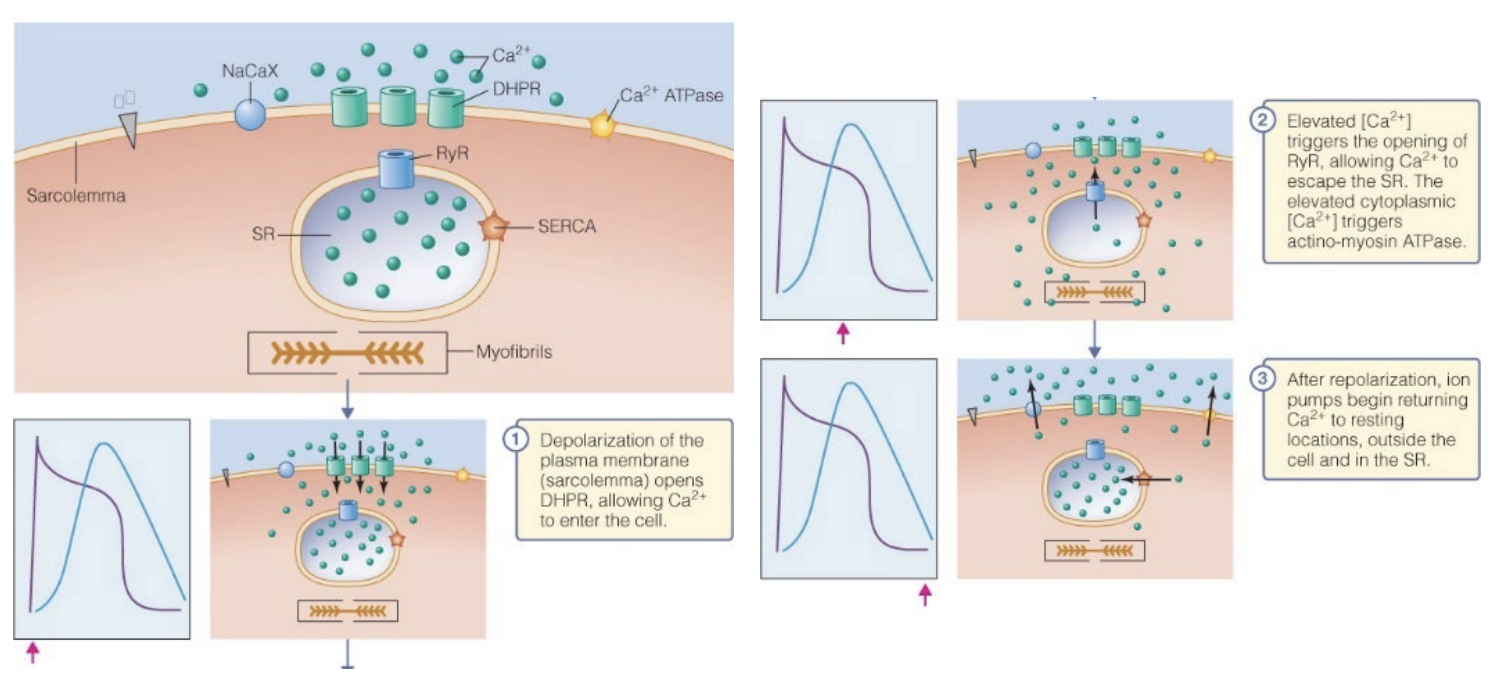
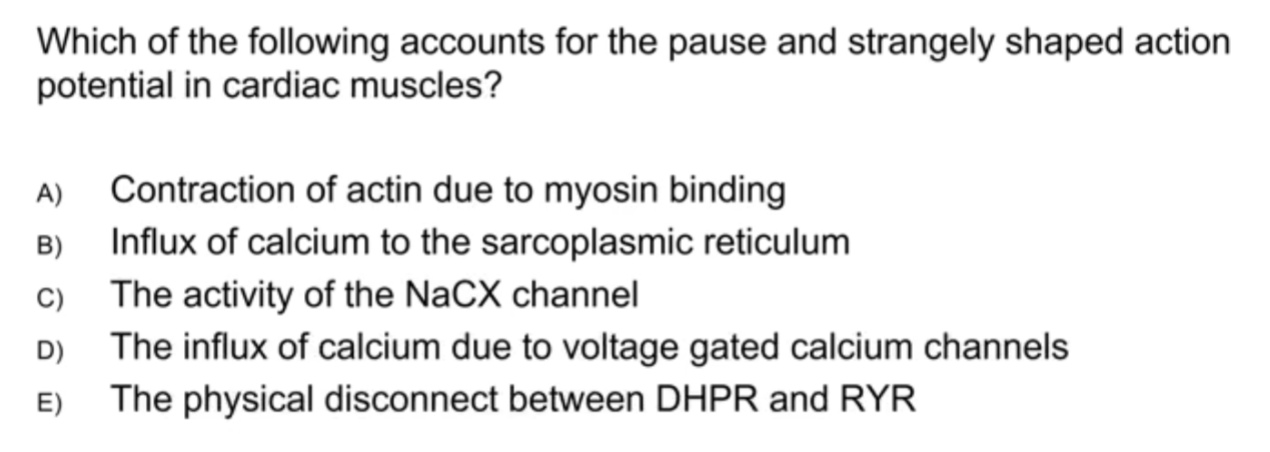
Cardiac muscle: Ca2+ Pathway

  • RyR channel is separated from DHPR channels

    • In skeletal, they are physically attached

  • 1) AP spreads along sarcolemma and into T-tubules, reaches voltage-gated DHPR channel, opens due to DP

  • 2) Ca2+ enters cells through the DHPR channel

  • 3) Ca2+ level gets high enough, THEN RyR channels open DEPOLARIZATION OPENS SARCOPLASMIC RETICULUM (RyR)

    • Ca2+ levels in sarcoplasm sharply rise

  • Increases latency period between AP and contraction, which is important for the heart to relax and refill with the next beat

  • Cardiac RyR is similar to a voltage-gated channel in Cardiac muscle, but not in skeletal muscle, where it is more like a mechanically gated channel
<ul><li><p><u>RyR channel is separated from DHPR channels</u></p><ul><li><p>In skeletal, they are physically attached</p></li></ul></li></ul><p></p><ul><li><p>1) AP spreads along sarcolemma and into T-tubules, reaches <strong>voltage-gated DHPR channel</strong>, opens due to DP</p></li><li><p><span style="color: red;"><strong><span>2) Ca2+ enters cells through the DHPR channel</span></strong></span></p></li><li><p><span style="color: blue;"><u><span>3) </span></u><strong><u><span>Ca2+ level gets high enough</span></u></strong></span><span style="color: blue;">, </span><span style="color: blue;"><span>THEN RyR channels open </span></span><span style="color: rgb(0, 0, 0);"><span>→ </span></span><strong>DEPOLARIZATION OPENS SARCOPLASMIC RETICULUM (RyR)</strong></p><ul><li><p>Ca2+ levels in sarcoplasm sharply rise</p></li></ul></li><li><p></p></li></ul><ul><li><p><strong>Increases latency period between AP and contraction</strong>, which is <span style="color: green;"><strong><span>important for the heart to relax and refill with the next beat</span></strong></span></p></li><li><p><span style="color: blue;"><strong><u><span>Cardiac RyR</span></u><span> is similar to a voltage-gated channel in Cardiac muscle, but not in skeletal muscle, where it is more like a mechanically gated channel</span></strong></span></p></li></ul><p></p><p></p>
17
New cards
<p>iClicker</p>

iClicker

  • E

18
New cards

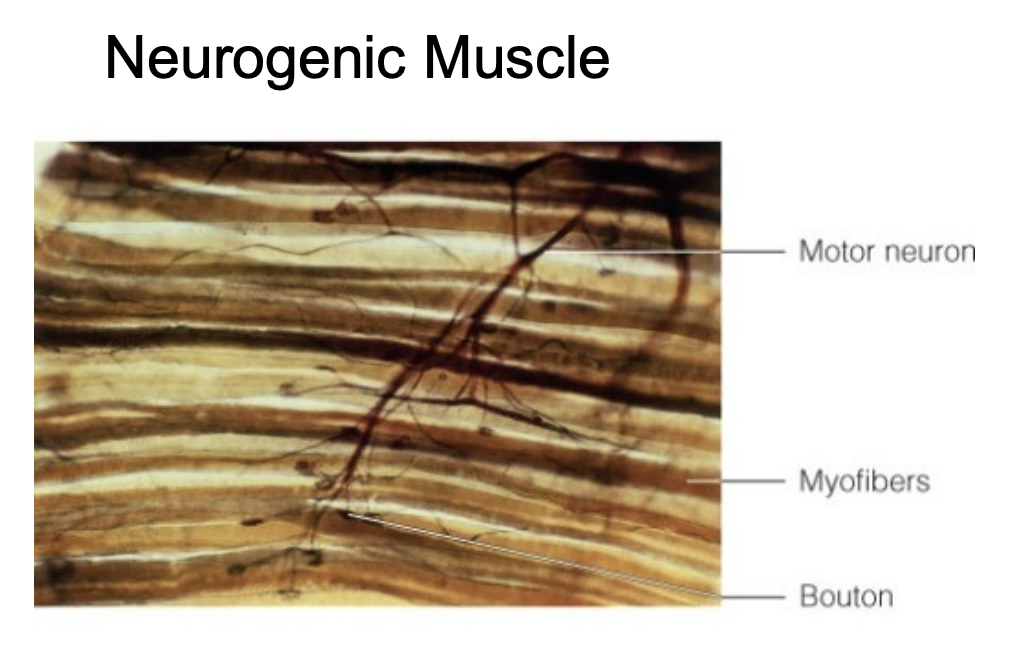
Neurogenic muscle

  • Muscle is triggered by nerve

    • Nerve sends message to NMJ → depolarization → contraction

      • Skeletal

<ul><li><p>Muscle is triggered by nerve</p><ul><li><p>Nerve sends message to NMJ → depolarization → contraction</p><ul><li><p>Skeletal</p></li></ul></li></ul></li></ul><p></p>
19
New cards

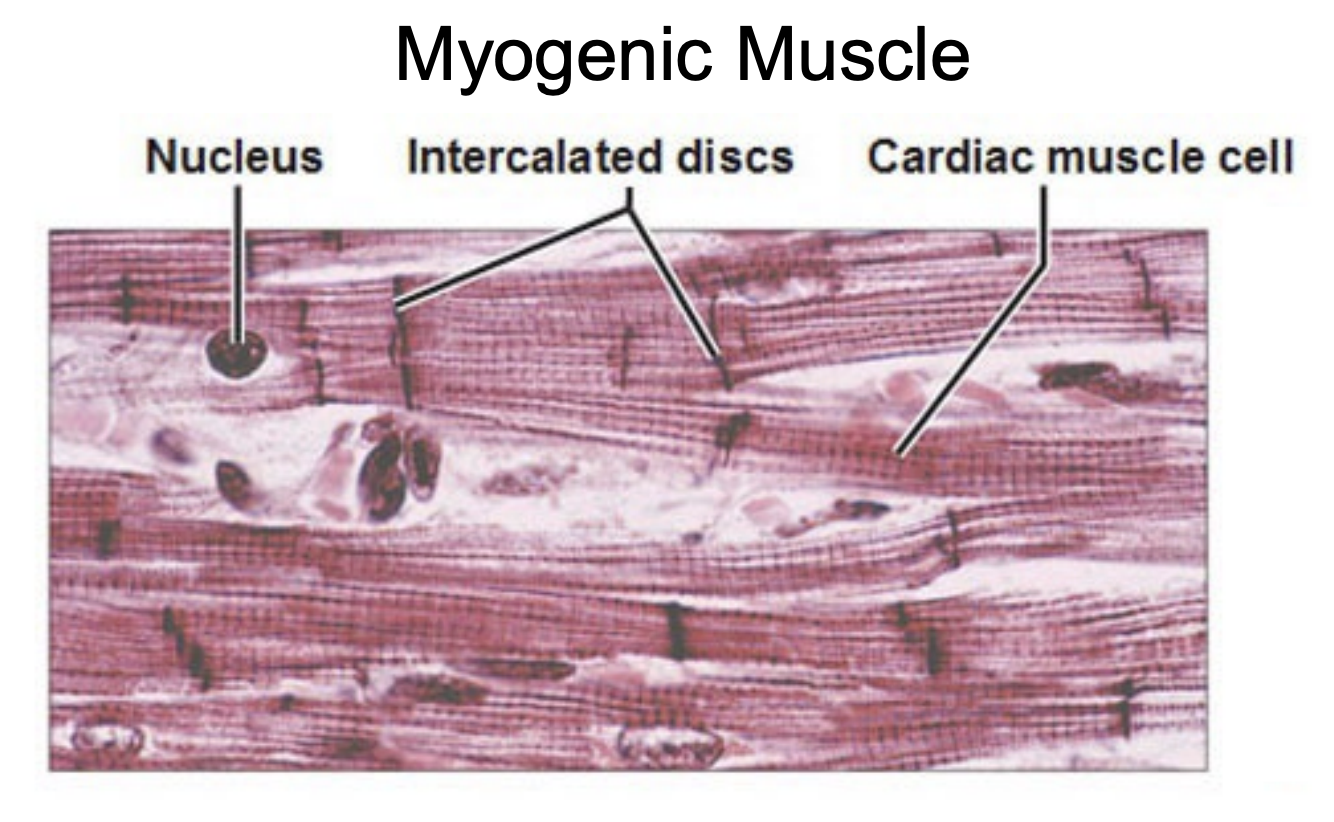
Myogenic myscle

  • Triggered by muscle next to it

    • Sometimes neurogenic muscle

  • GAP JUNCTIONS between myogenic muscles

    • Like cardiac muscles

    • Cardiac muscles cause adjacent cardiac muscles to contract, allowing heart to contract as one

      • Pacemaker cells cyclically release AP to cause heart cells to contractions
<ul><li><p>Triggered by muscle next to it</p><ul><li><p>Sometimes neurogenic muscle</p></li></ul></li><li><p><span style="color: red;"><strong>GAP JUNCTIONS</strong> between myogenic muscles</span></p><ul><li><p>Like cardiac muscles</p></li><li><p>Cardiac muscles cause adjacent cardiac muscles to contract, allowing heart to contract as one</p><ul><li><p><strong>Pacemaker cells</strong> cyclically release AP to cause heart cells to contractions</p></li></ul></li></ul></li></ul><p></p>
20
New cards

Neurogenic / Myogenic for Smooth muscles

  • Smooth muscle can be myogenic or neurogenic

21
New cards

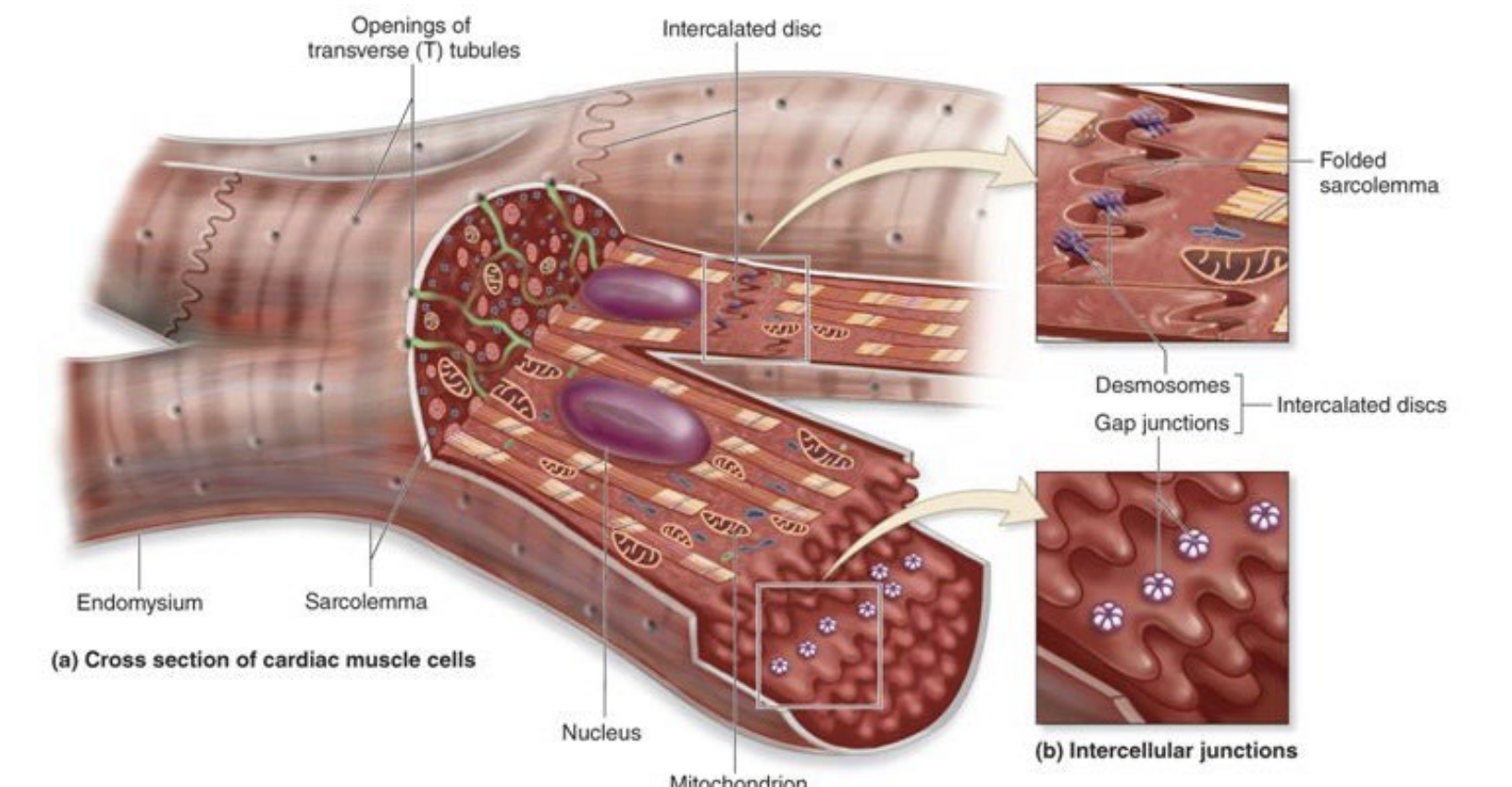
Cardiomyocyes have unique structures that distinguish them

  • Nucleus is inside cardiac cells

  • Bi/single nucleated

  • Branched; not long and skinny - allows them to contract in multiple directions at the same time

  • Intercalated disc - where 2 cardiomyocytes are attached and where gap junctions are

    • Connected via gap junctions (AP spread cell to cell) and desmosomes (velcro)

      • Skeletal muscles are NOT connected by gap junctions

        • Each muscle fiber must be stimulated separately via a motor neuron
<ul><li><p>Nucleus is <u>inside</u> cardiac cells</p></li><li><p>Bi/single nucleated</p></li><li><p>Branched; not long and skinny - allows them to contract in multiple directions at the same time</p></li><li><p><span style="color: blue;"><strong><span>Intercalated disc</span></strong></span> - where 2 cardiomyocytes are attached and where <strong>gap junctions</strong> are</p><ul><li><p>Connected via <span style="color: rgb(10, 216, 0);"><strong>gap junctions</strong></span> (AP spread cell to cell) and <span style="color: rgb(191, 0, 255);"><strong>desmosomes</strong></span> (velcro)</p><ul><li><p><u>Skeletal muscles</u> are NOT connected by gap junctions</p><ul><li><p>Each muscle fiber must be stimulated separately via a motor neuron</p></li></ul></li></ul></li></ul></li></ul><p></p>
22
New cards

Smooth muscles

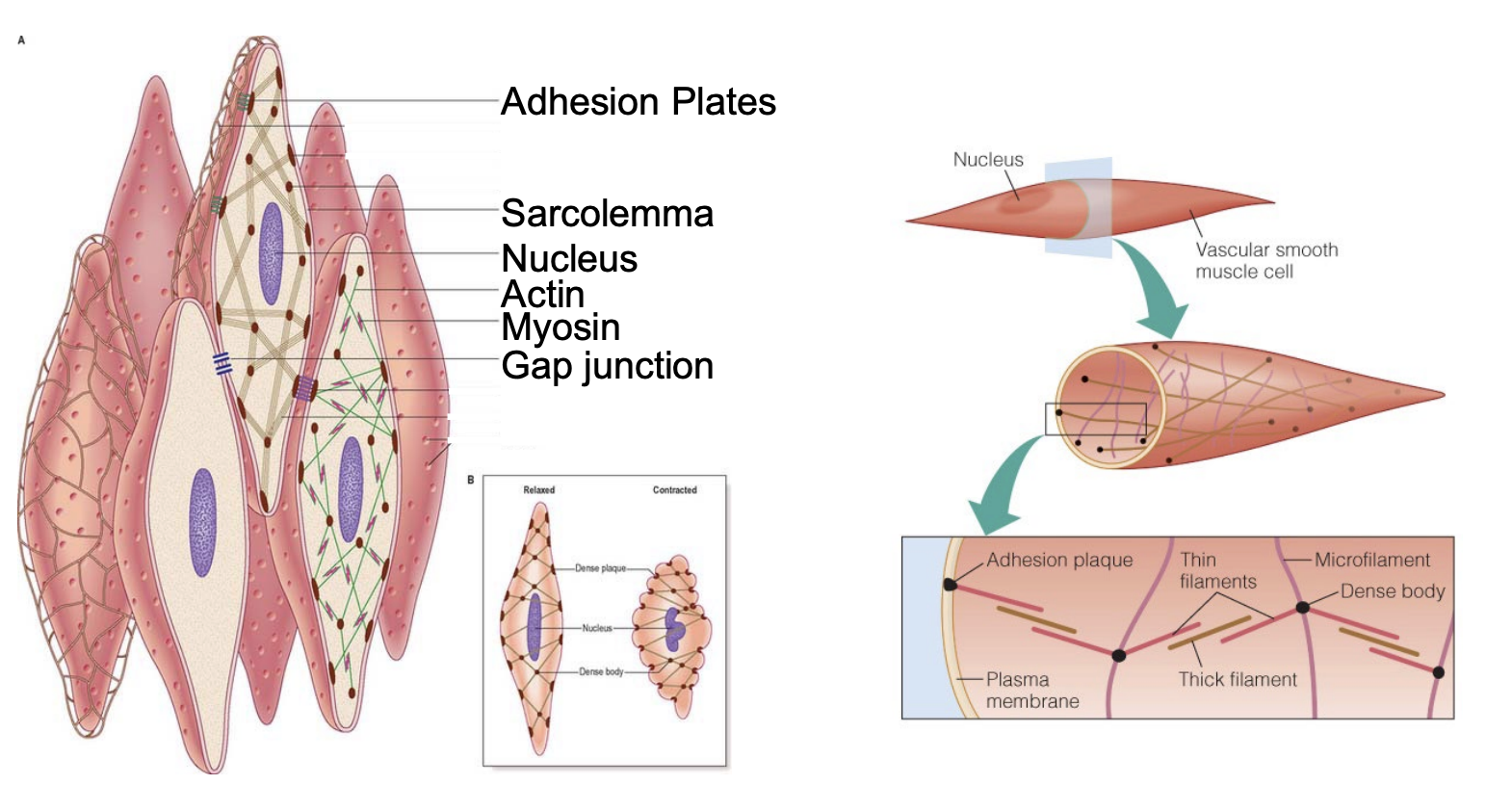
  • Present in cardiovascular system, but not herat - arteries, veins; gut

  • Adhesion plates allow them to connect together

    • Myosin/Actin pull on the Adhesion plates on all directions = no pattern

      • Means that cell can contract in multiple directions at same time

  • Ex: Allows stomach to get smaller to contract, get smaller, and mechanically grind up food

  • Ex: Small intestine can move digested food throughout itself

  • Mono-nucleated

  • Sometimes have gap junctions

<ul><li><p>Present in cardiovascular system, but not herat - arteries, veins; gut</p></li><li><p><span style="color: red;"><strong>Adhesion plates</strong></span> allow them to connect together</p><ul><li><p><span style="color: rgb(119, 0, 158);"><strong>Myosin/Actin</strong></span> pull on the Adhesion plates on all directions = no pattern</p><ul><li><p>Means that cell can <u>contract in multiple directions</u> at same time</p></li></ul></li></ul></li></ul><ul><li><p>Ex: Allows stomach to get smaller to contract, get smaller, and mechanically grind up food</p></li><li><p>Ex: Small intestine can move digested food throughout itself</p></li></ul><ul><li><p>Mono-nucleated</p></li><li><p><strong>Sometimes have gap junctions</strong></p></li></ul><p></p>
23
New cards
<p>Ca2+ binding to move Actin/Myosin in SM: Calmodulin</p>

Ca2+ binding to move Actin/Myosin in SM: Calmodulin

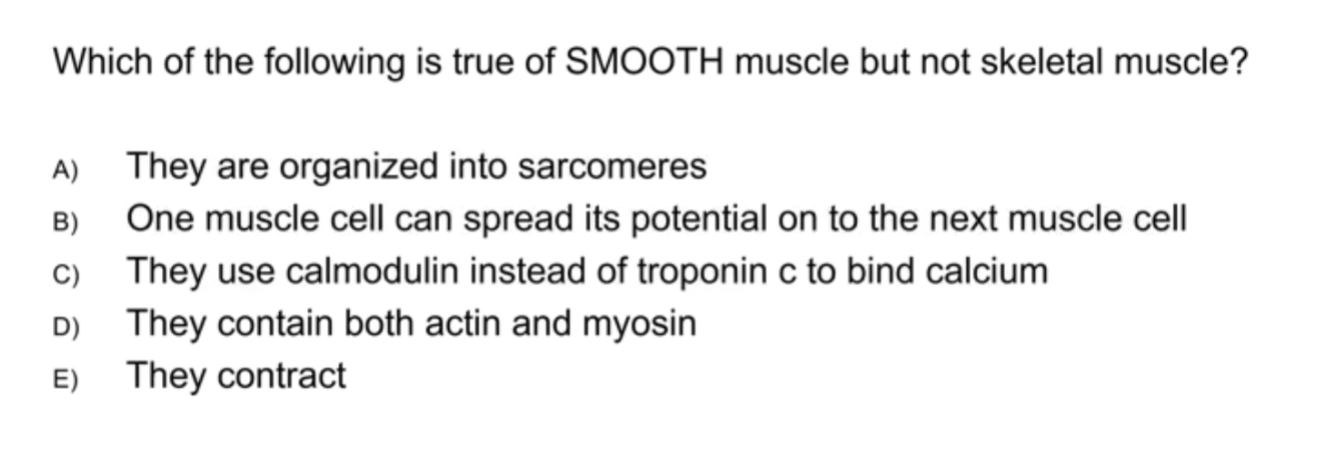
  • Smooth muscles, instead of using Troponin C, use Calmodulin

    • Ca2+ binds to Calmodulin instead of TnC, causes movement of tropomyosin → contraction

24
New cards

Smooth muscle is in…

  • Digestive tract

  • Large blood vessels

    • Smooth muscles in organized in 2 layers:

      • Circular muscles, in circles

      • Longitudinal muscles, linearly - peristaltic contraction

        • Shortens and lengthens