Mood disorder pt 1 (MOST IMPORTANT)
 Call Kai
 Learn
Learn Practice Test
 Spaced Repetition
 Match
Match Flashcards
 Knowt Play
1/21

There's no tags or description
Looks like no tags are added yet.
Name | Mastery | Learn | Test | Matching | Spaced | Call with Kai |
|---|
No analytics yet
Send a link to your students to track their progress
22 Terms
Major depressive episodes
Most commonly diagnosed and most severe mood disorder
Anhedonia → Inability to feel pleasure (things that should be or have been pleasurable in the past are not anymore)
Mania
Extreme pleasure in every activity; excessive euphoria
Hypomanic episode
Less severe version of manic episode
Lots of positive emotions but doesn’t create as much dysfunction as mania
Unipolar mood disrder
Either depression or mania
Bipolar mood disorder
Alternate between depression and mania
Mixed features
Experience of both, feel depressed and manic at the same time
Major depressive disorder main symptoms
Depressed mood for most of the day, for more days than not for 2 weeks
Physical and cognitive symptoms
Disruptions in sleep, appetite, sexual drive (can be too much or too little, sexual is always too little)
Feelings of worthlessness, guilt
Major depressive disorder duration
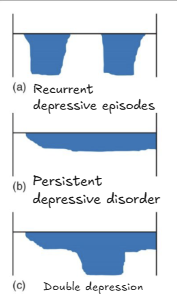
Single episode
Average duration of first episode if untreated = 9 months
Recurrent episodes
Two or more depressive episodes separated by at least two months
Chronic course
Median number of episodes 4-7
Median duration of recurrent episodes is 4-5 months
Major depressive disorder DSM criteria (1-4)
Five or more of the following symptoms during the same 2 week period (at least one has to be depressed mood or loss of interest or pleasure)
Depressed mood most of the day
Diminished interest or pleasure in all, or almost all activities most of the day
Weight loss or weight gain (not dieting)
Insomnia or hyper insomnia
Major depressive disorder DSM criteria (5-9)
Psychomotor agitation or retardation
Agitation = severe restlessness
Retardation = low amount of movement
Fatigue or loss of energy
Feelings of worthlessness
Diminished ability to think or concentrate
Recurrent thoughts of death
Persistent depressive disorder
Also known as Dysthymia
Last 2+ years and the individual is never without symptoms for more than 2 months
Chronic state of depression (20-20 years)
Symptoms are same as MDD but less severe
Double depression
Individuals who suffer with both major depression episodes and PDD
Most challenging disorder to treat within depressive disorders
Depressive disorder specifiers (1-4)
with:
Psychotic features
Anxious distress
Mixed features
Melancholic features
Depressive disorder specifiers (5-8)
with:
Atypical features
Catatonic features
peripartum onset
Seasonal pattern
MDD with peripartum onset (main symptoms)
Mother’s functional impairment
Involves temperamental, social, emotional, cognitive, behavioral difficulties in children
rates peak 2-6 months after delivery
MDD w Peripartum etc.
rates increase if there is an unsupportive partner
Can also be non birthing parent
Rare subtype:
Postpartum mood episodes with psychotic features
Depressive disorders epidemiology pt 1
Depression carries a large burden for both individuals and society
Depression ranks 4th in terms of global burden of disease
People with depression are five times more likely to take time off of work
Depressive disorder epidemiology pt 2
Mean age of onset for MDD is 25
There is a trend developing depression at increasingly earlier ages
Adolescent onset of PDD
More risk of being chronic
Not as responsive to treatment
Suggests genetic reasoning which is why it’s harder to treat
Reasons?
We develop our sense of self during this time period → ingrains certain parts of depression into our identity
Depressive disorders: sex differences pt 1
MDD → twice as many females than males
May be because:
men don’t seek help bc of culture
Different presentation in males (more aggresive)
More socially acceptable for women to feel emotions and get treatment
Depressive disorders: sex differences pt 2
Depressive symptoms are more common among women who:
have few financial resources
Have less education
Are unemployed
Women’s reproductive events are risks for mood disturbances (Because of hormones?)
Depressive disorder: other depressive disorders:
Premenstrual dysphoric disorder (PMDD)
Characterized by severe emotional reactions during the few days leading up to a women’s period
Criticized because it’s normal for mood to change due to hormones
Disruptive mood dysregulation disorder:
Children and adolescents who have repeated verbal and behavioral outbursts that are not appropriate to the situation 3 or more times a week
Treatment may involve an individual education plan
Depressive disorder: grief to depression
Integrated grief:
Typical experience of grief
Acute period of grieving that we learn to live with
Complicated grief
Grief lasts beyond expected amount of time
More intense symptoms