Bio 161 W4 Cellular Respiration & Metabolism
 Call Kai
 Learn
Learn Practice Test
 Spaced Repetition
 Match
Match Flashcards
 Knowt Play
1/79

There's no tags or description
Looks like no tags are added yet.
Name | Mastery | Learn | Test | Matching | Spaced | Call with Kai |
|---|
No analytics yet
Send a link to your students to track their progress
80 Terms
Cellular Respiration & Fermentation
Metabolic process by which cells convert potential energy found in macromolecules into function (USABLE) energy accessible to cellular machinery
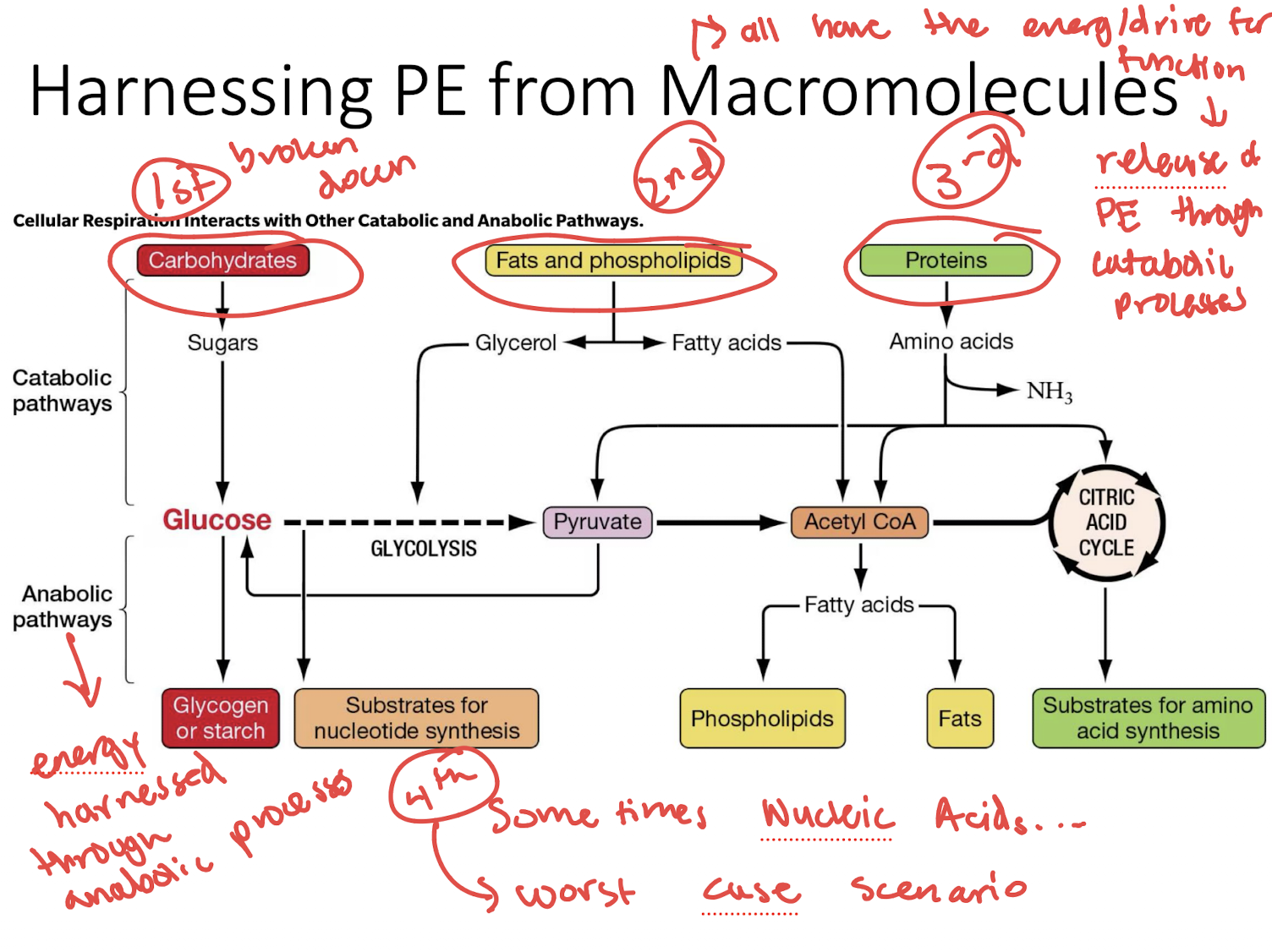
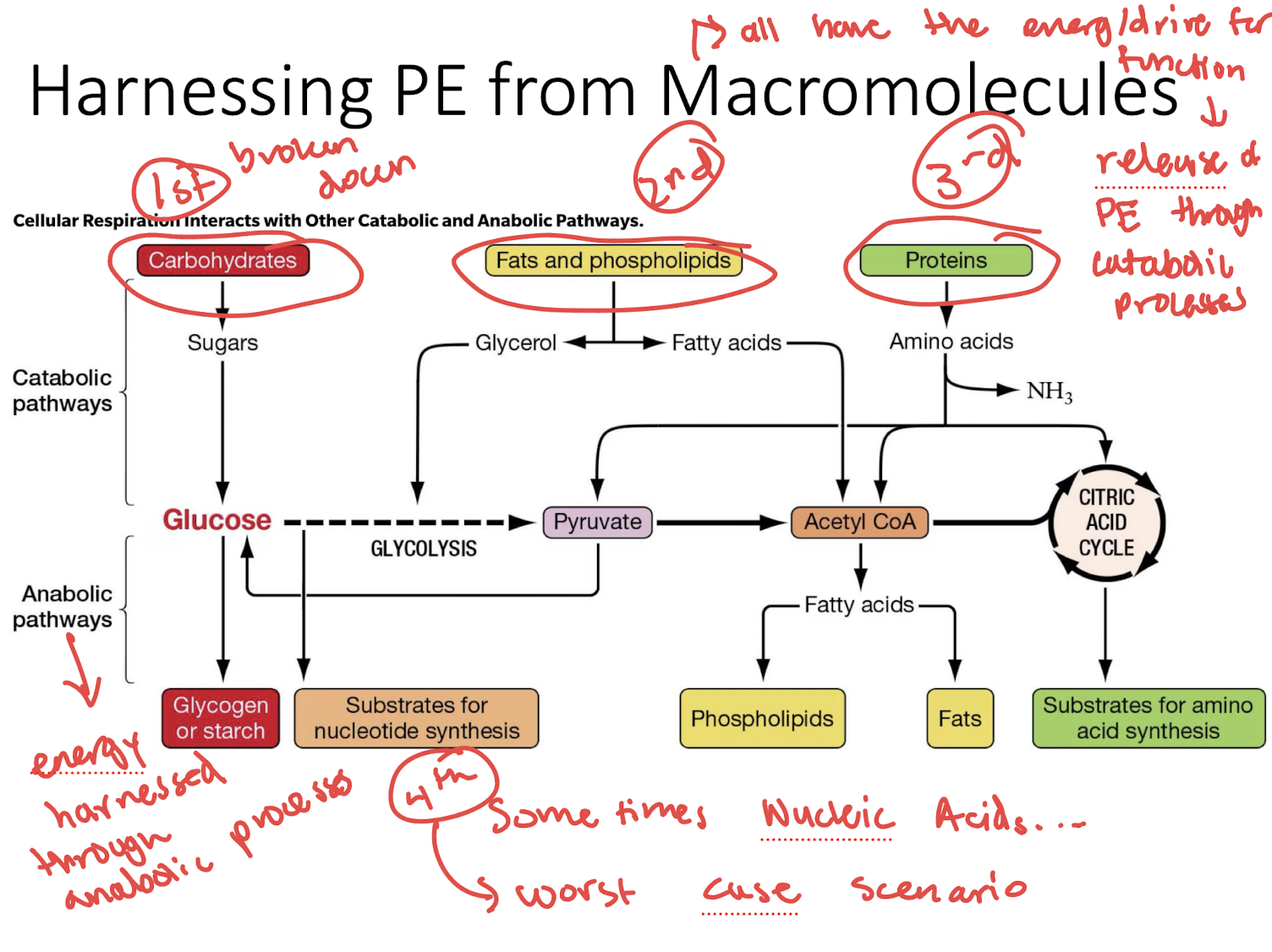
Harnessing PE from Macromolecules
Catabolic processes BREAK down marcomoleucles, release potential energy
Anabolic pathways synthesize molecules in which energy can be harnessed through anabolic processes
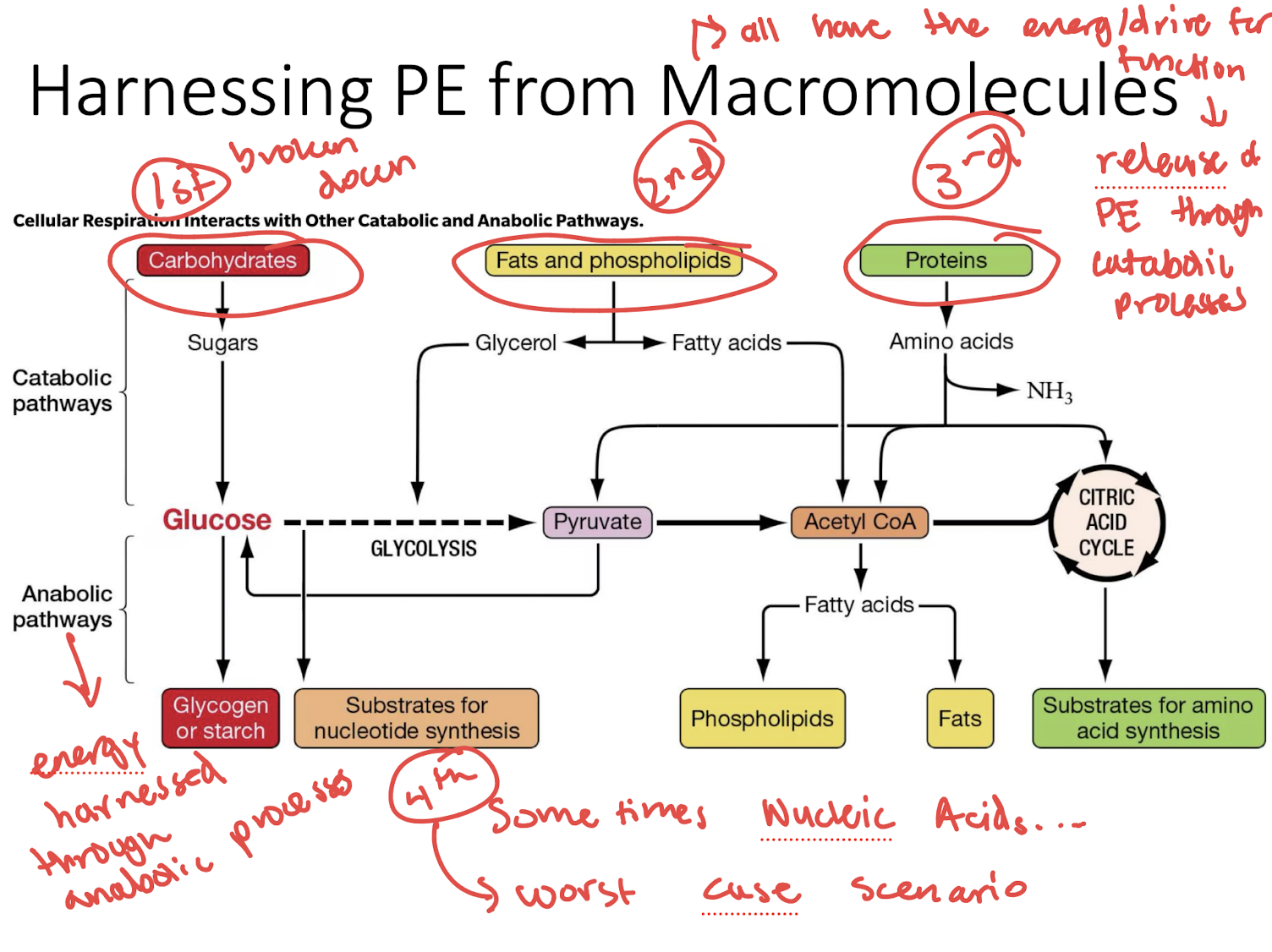
Harnessing PE from Macromolecules: 1st broken down?
Carbohydrates
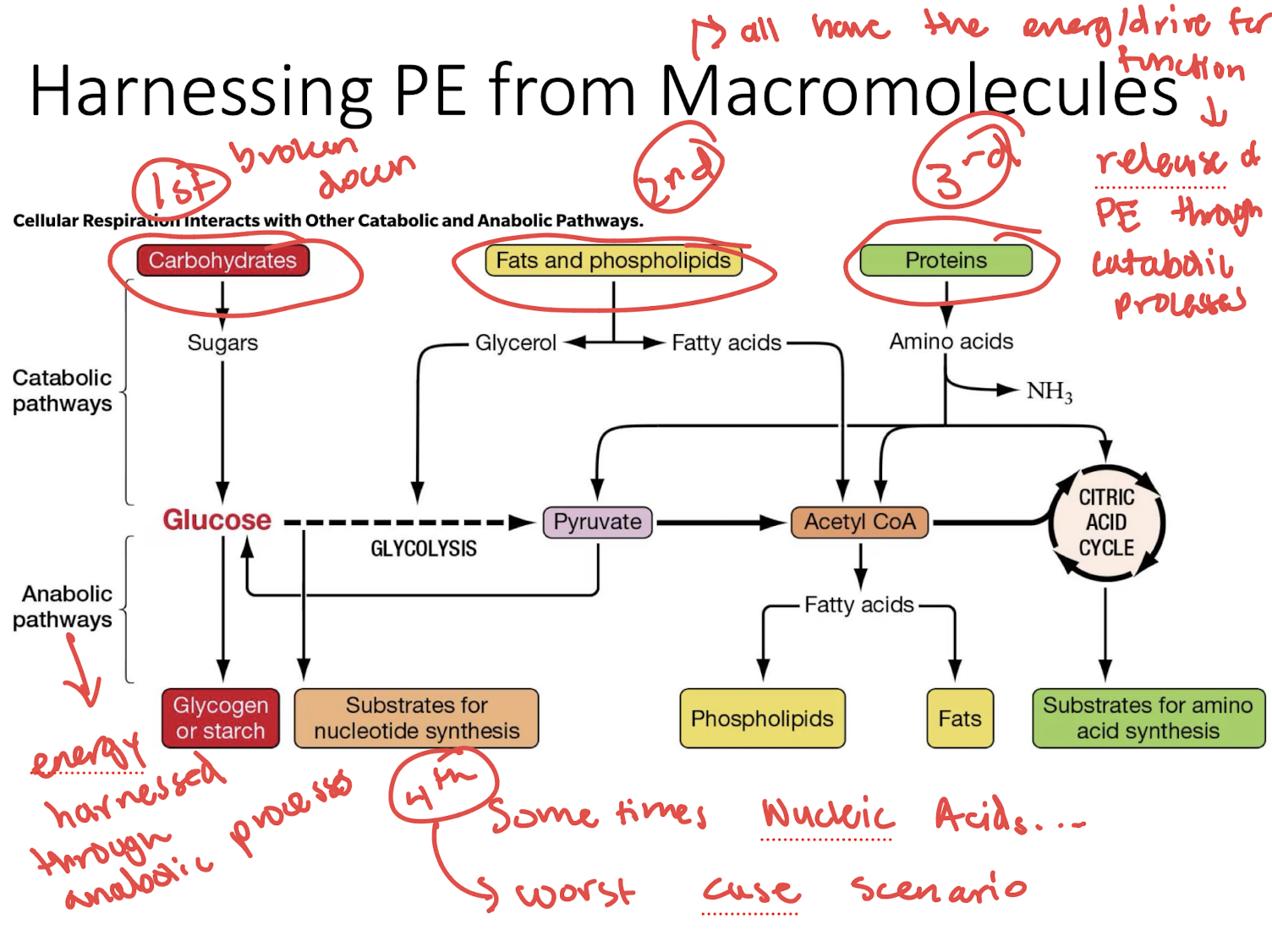
Harnessing PE from Macromolecules: 2nd broken down?
Fats and Phospholipids
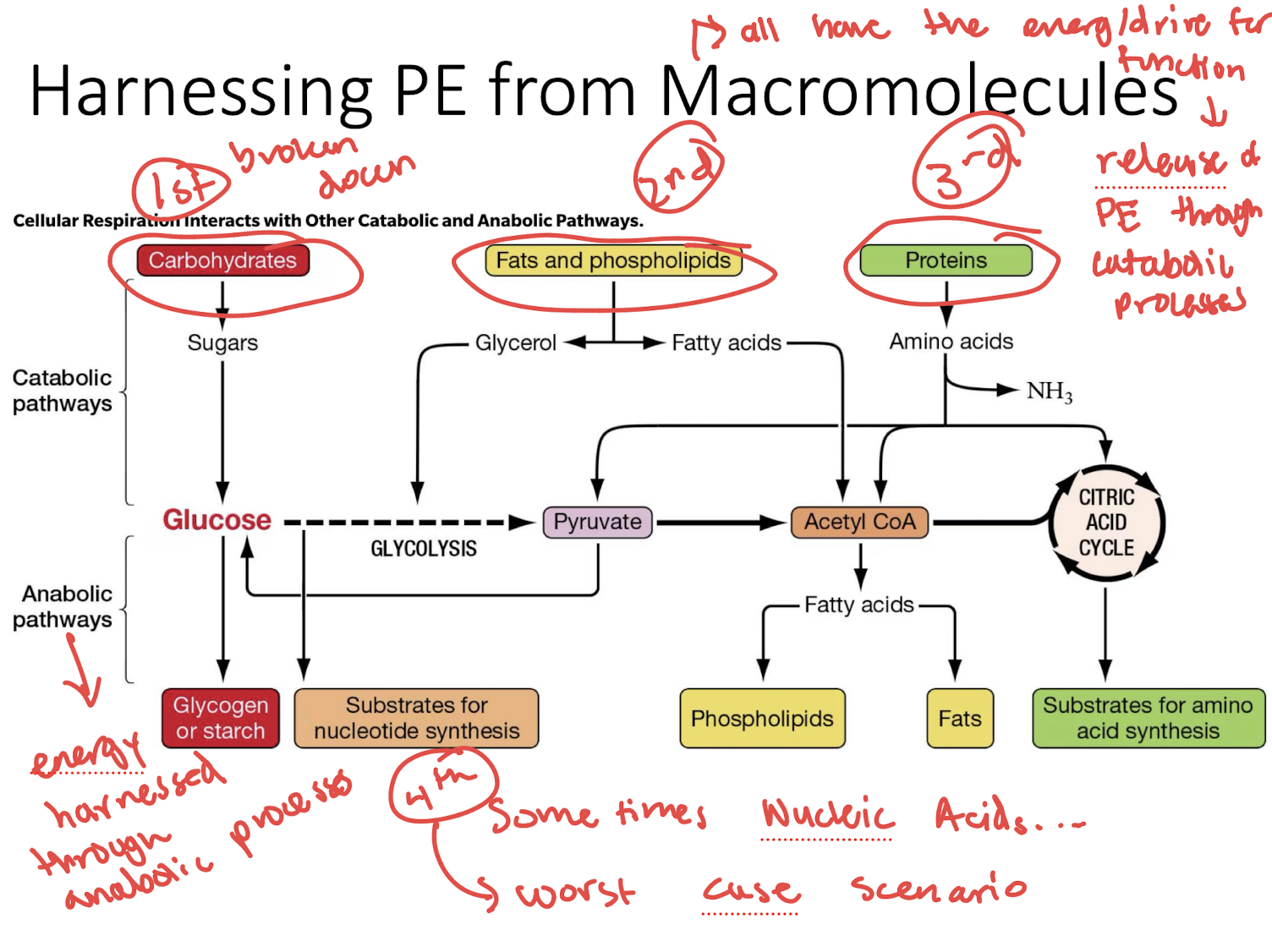
Harnessing PE from Macromolecules: 3rd broken down?
Proteins
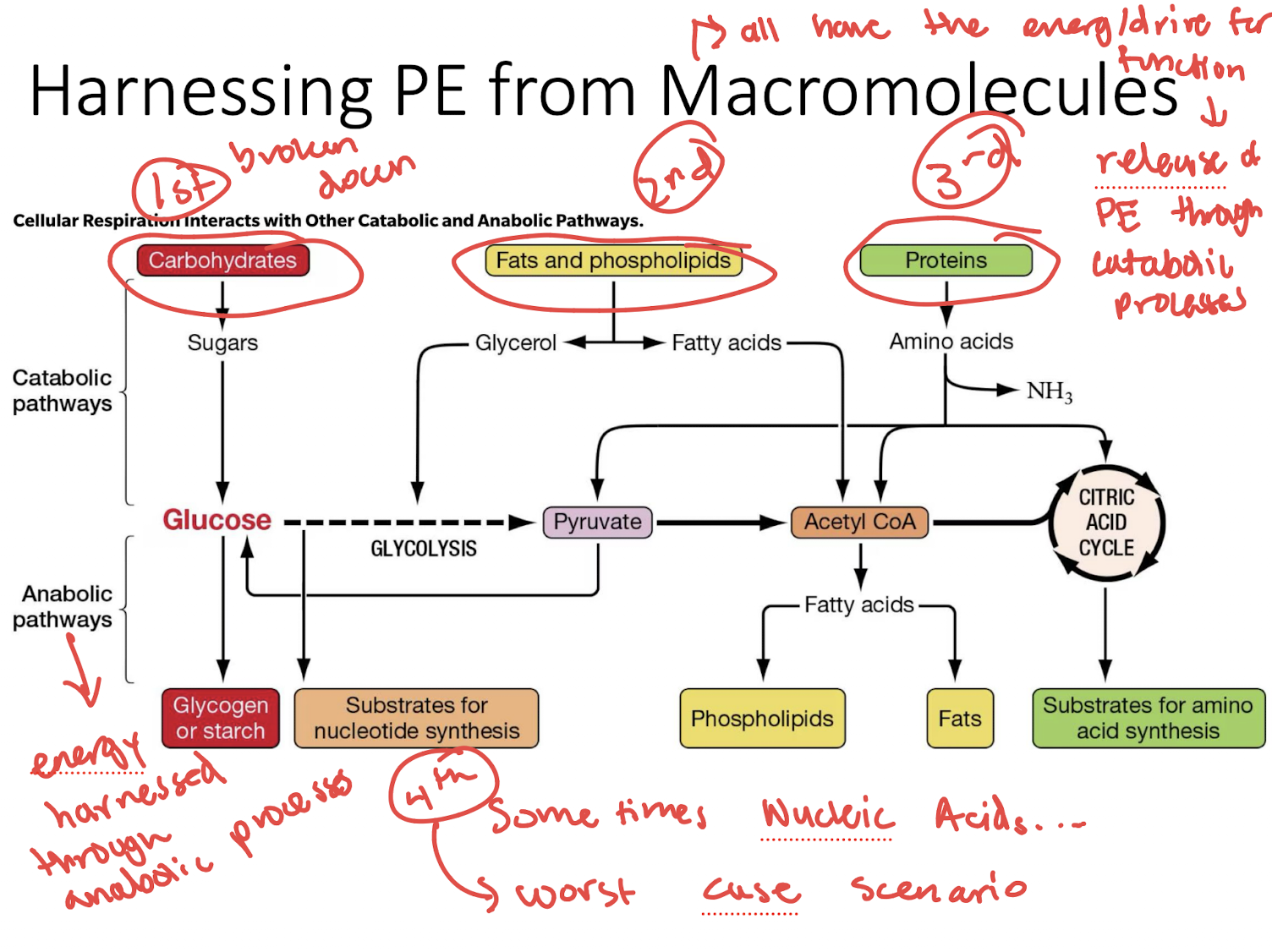
Harnessing PE from Macromolecules: 4th broken down?
Nucleic Acids
worst case scenario!!!
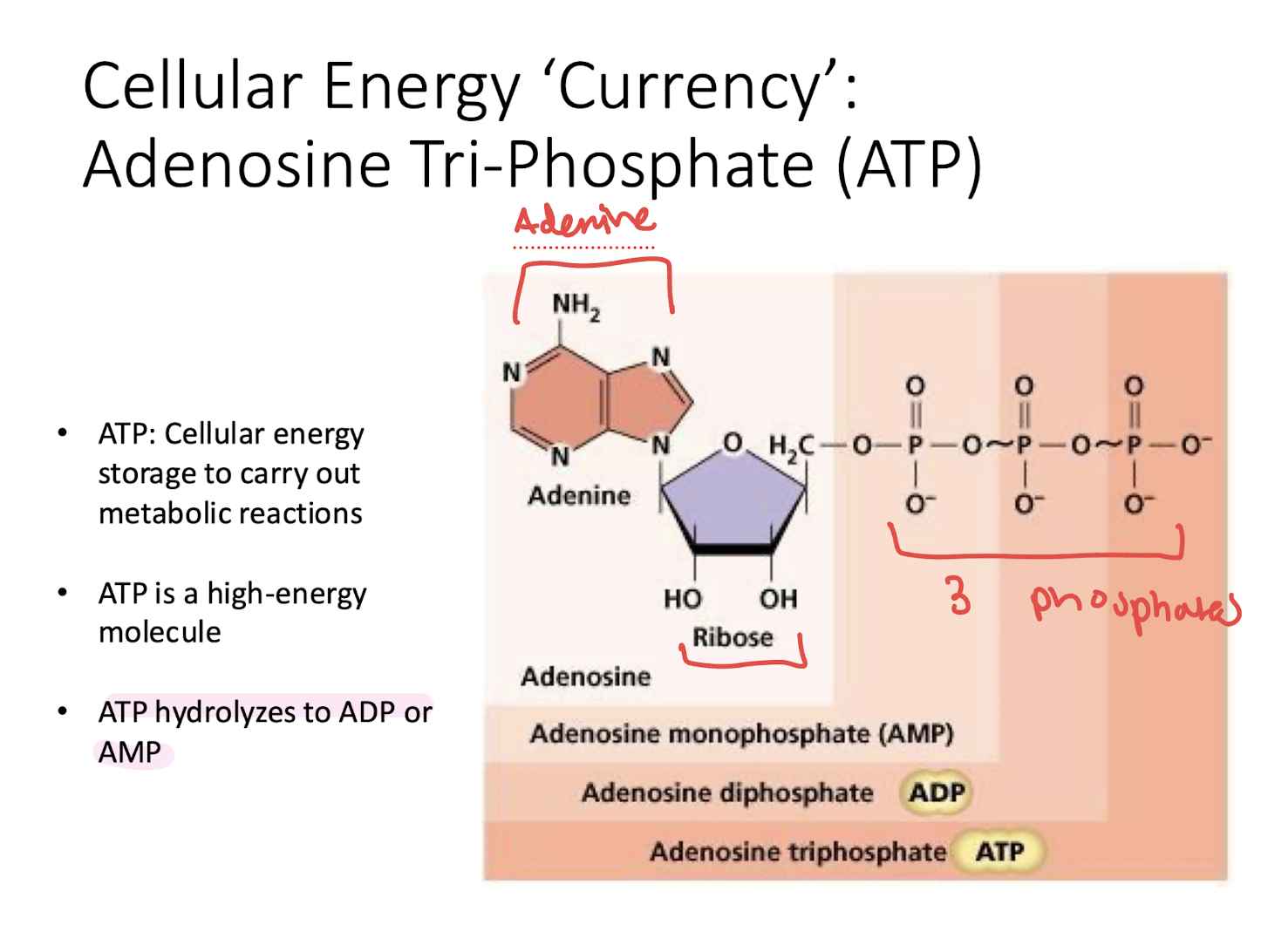
Cellular Energy Currency
Adenosine Tri-Phosphate (ATP)
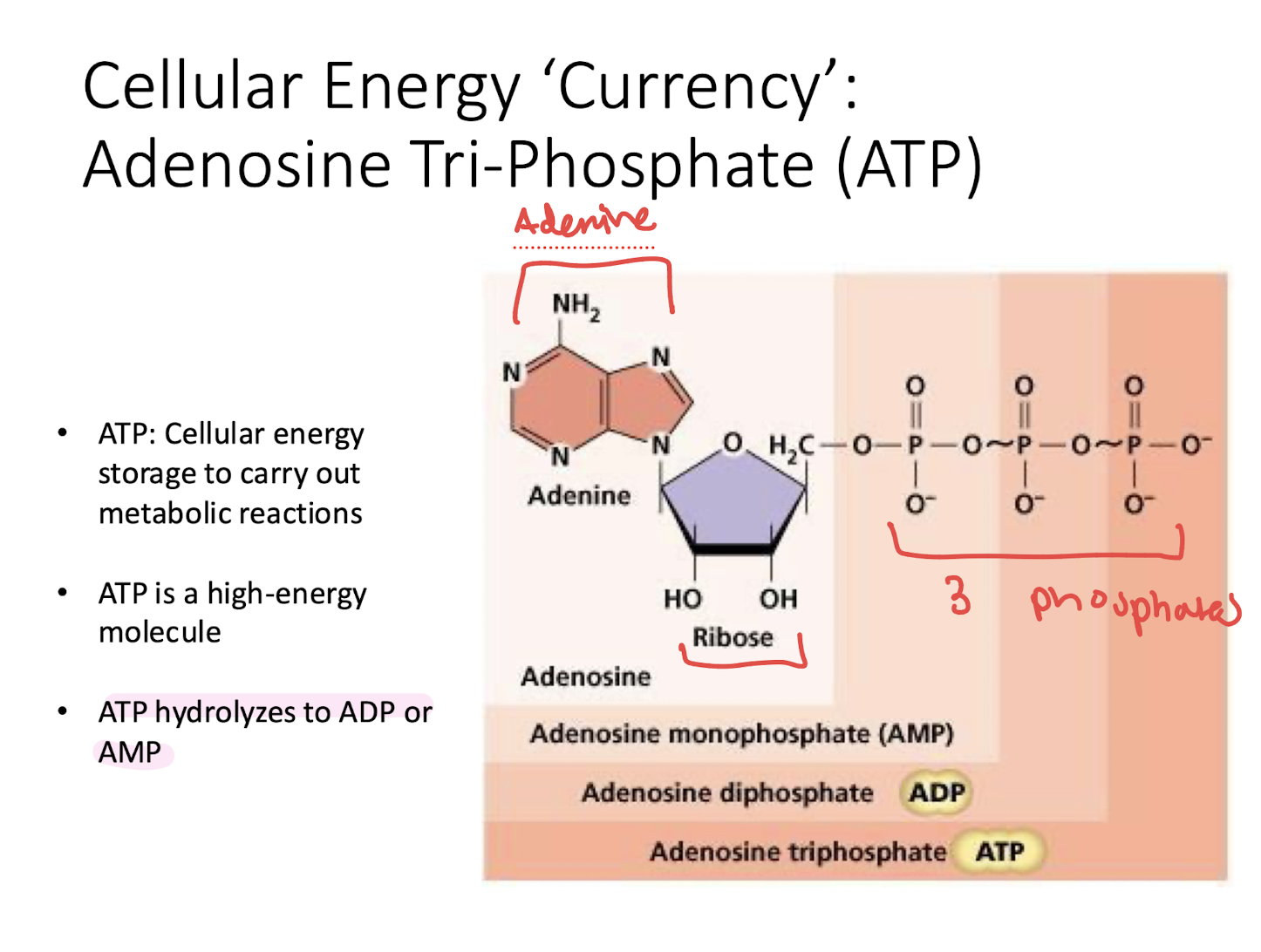
ATP: is a
high energy molecule
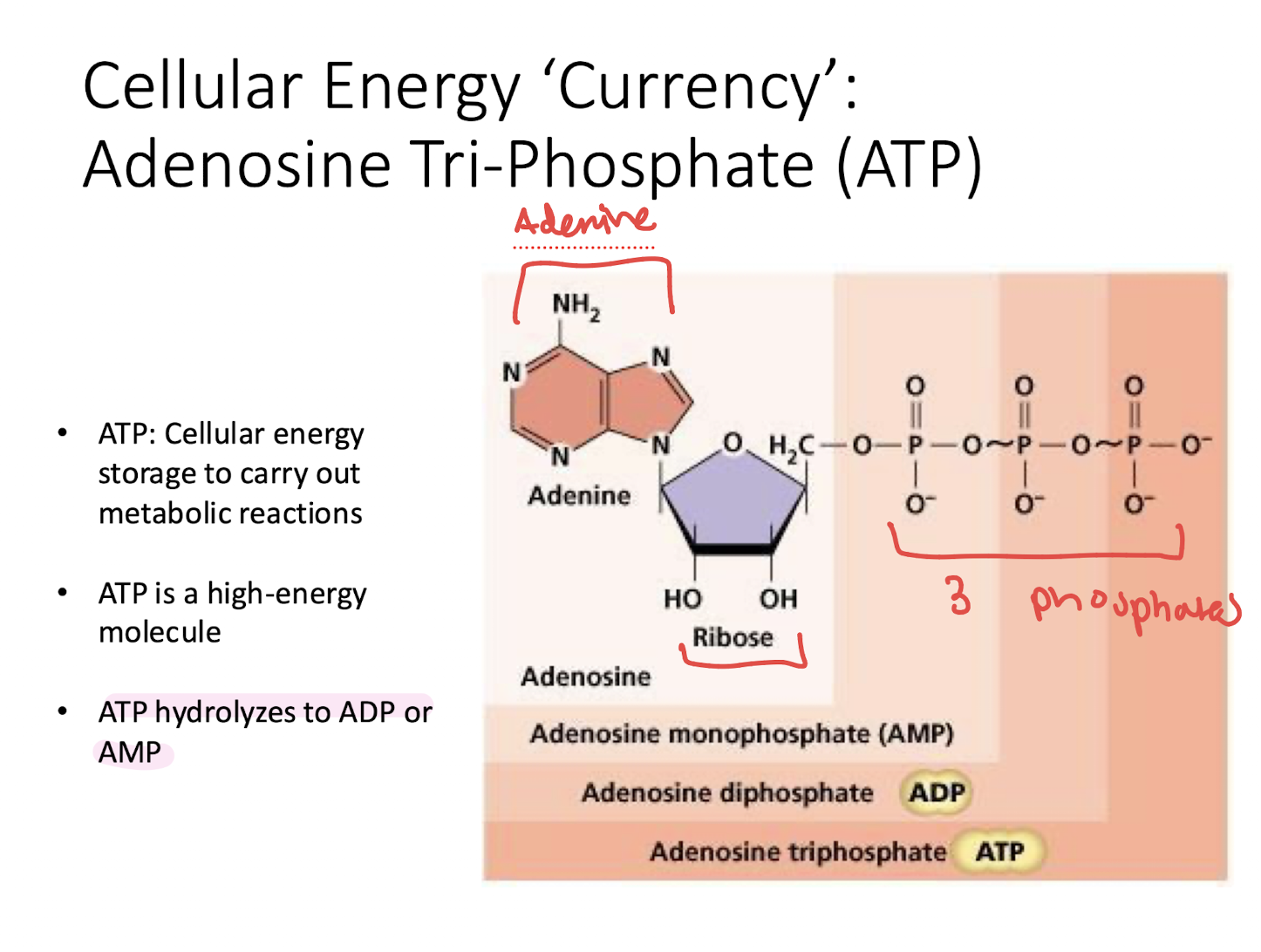
ATP hydrolyzes to
ADP or AMP
Temporary Intermediates are
Required (storage of energy)
take macromolecule w/Potential energy w/transition states & intermediates & turn into chemical energy
Important Cellular Energy Storage
Adenosine Tri-Phosphate (ATP) —> most common nucleotide used
Guanosine Tri-Phosphate (GTP)
ATP & GTP are based on
phosphorylation & dephospho-rylation
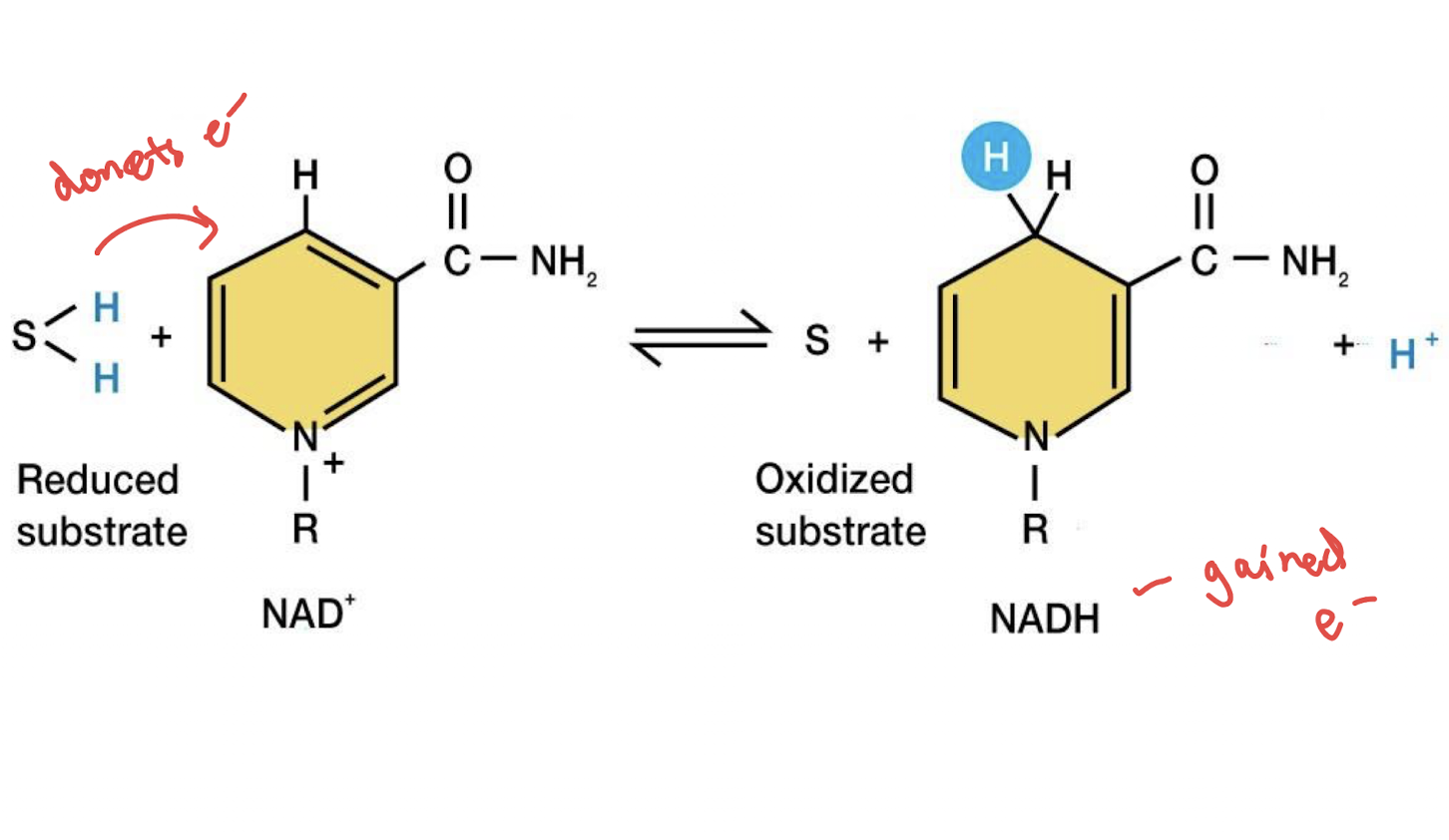
NADH, NADPH, and FADH2 are based on..
Redox reactions!
losing or gaining e-
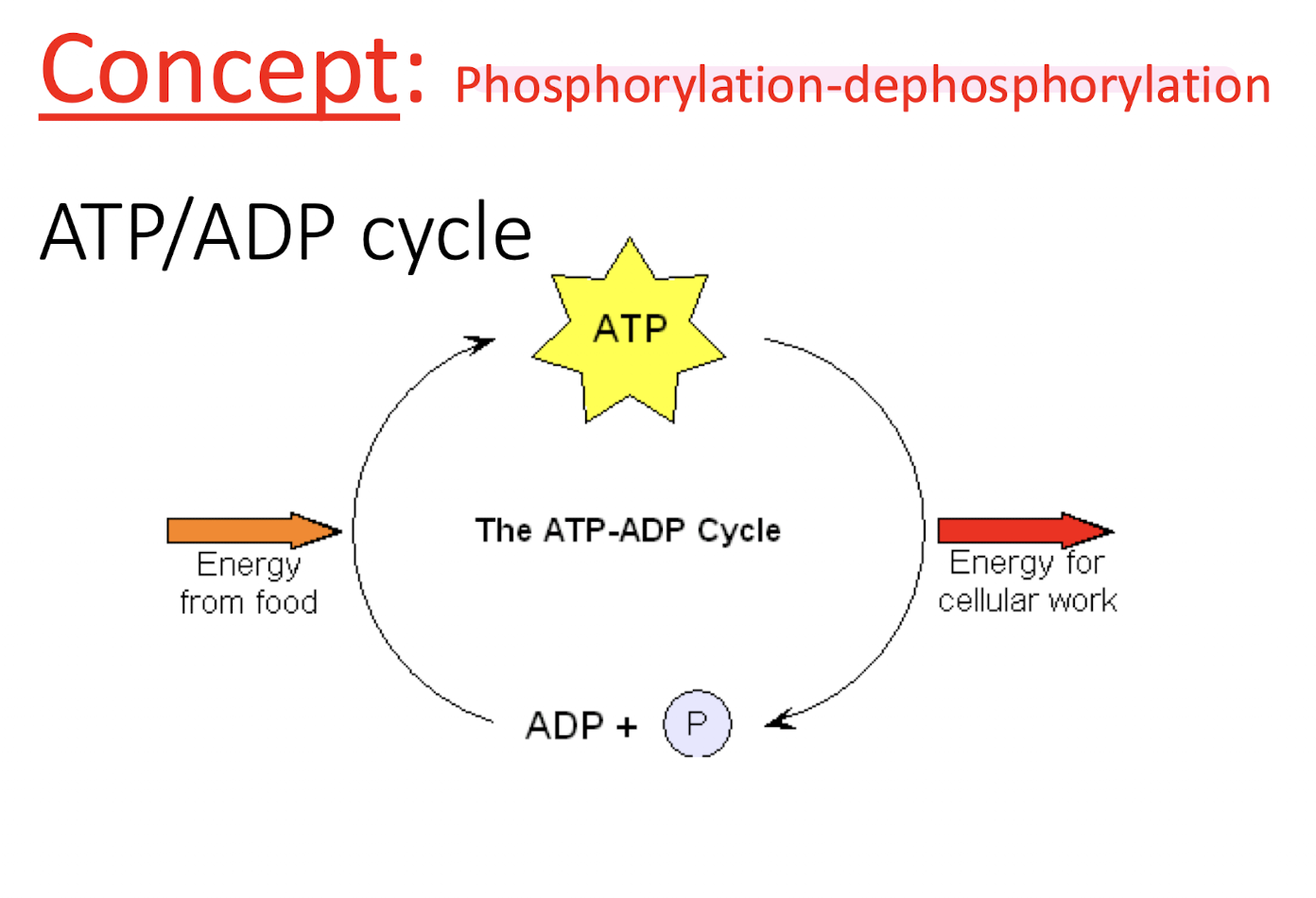
Phosphorylation-dephosphorylation: ATP/ADP cycle
Energy from food used to phosproylate ATP, ATP dephosporylated to ADP to produce energy for cellular work
Reducing Agent
what gets oxidized (loses electrons)
Oxidizing agent
what gets reduced (gains electrons)
Oxidation is
loss of e-
Reduction is
gain of e-
NAD+ gets reduced to
GAINS e-
reduced to NADH
Who carries out cellular respiration & fermentation?
all cells will carry out some form of respiration or fermentation
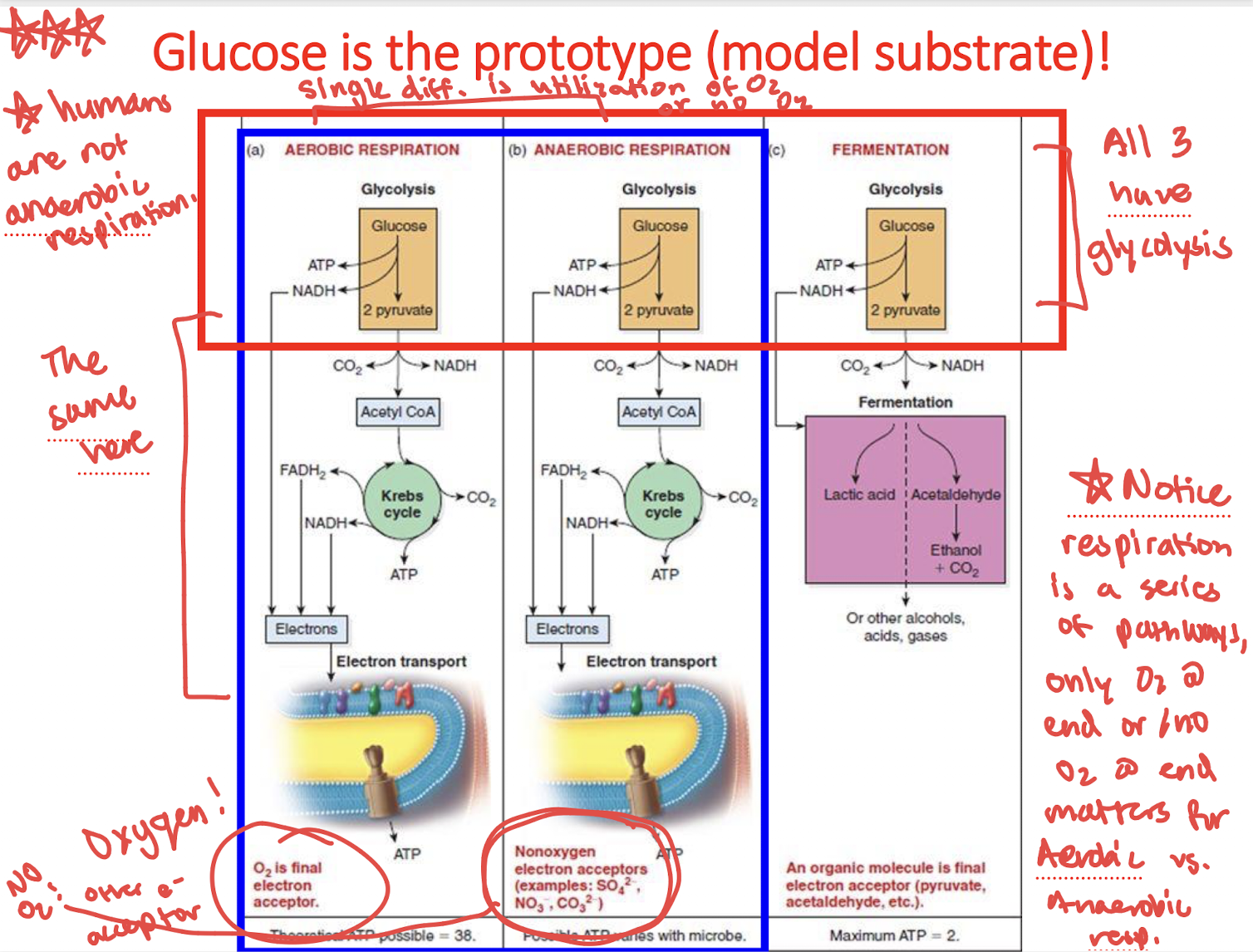
Glucose is the prototype!
Model substrate
All of the macromolecules are able to go through cellular processes to derive energy from them, but glucose is most studies
Aerobic Respiration
Glycolysis —> Pyruvate —> Acetyl CoA —> Citric Acid Cycle —> Electron Transport Chain —> OXYGEN IS FINAL ELECTRON ACCEPTOR
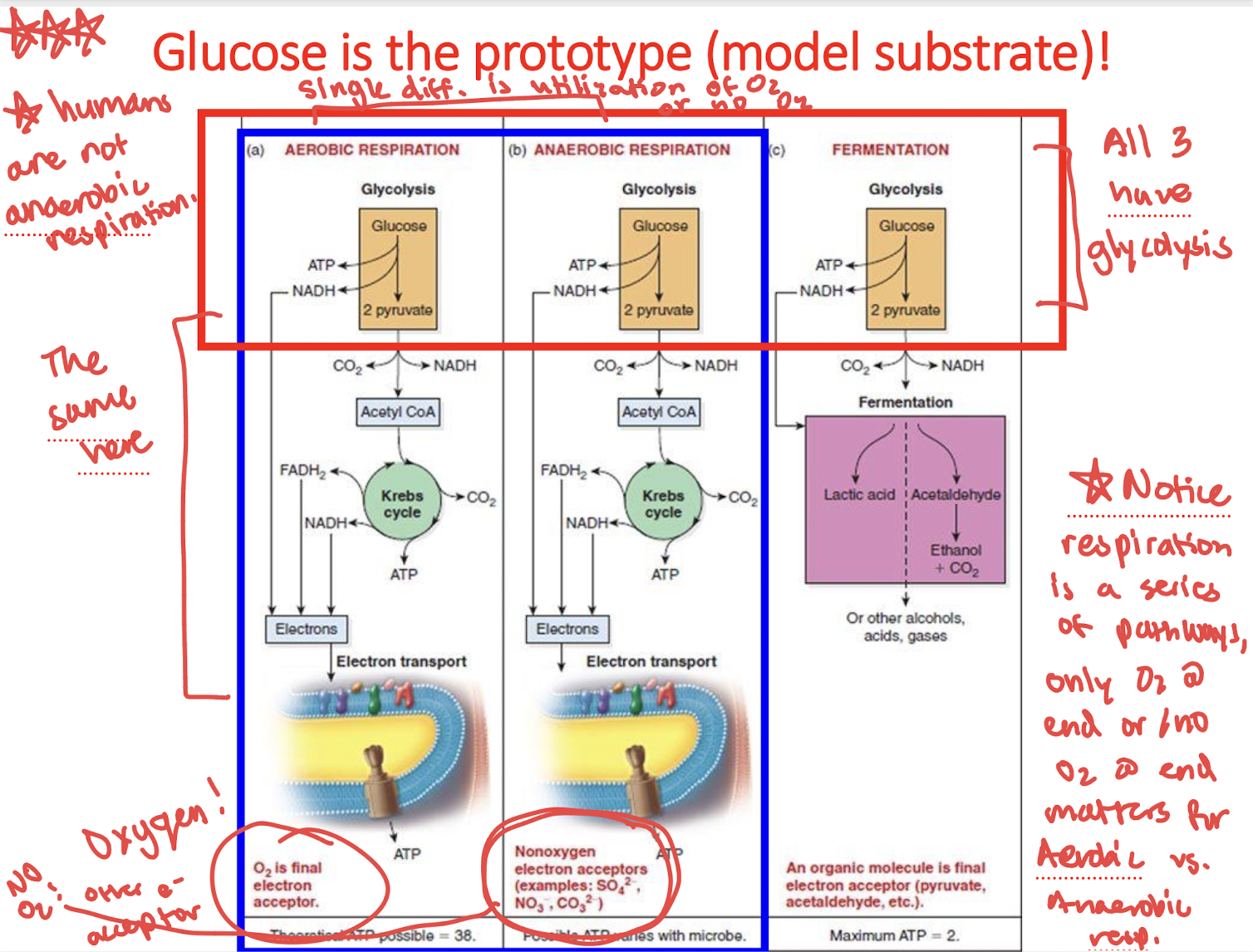
Anaerobic Respiration
Glycolysis —> Pyruvate —> Acetyl CoA —> Citric Acid Cycle —> Electron Transport Chain —> NONOXYGEN MOLECULE IS FINAL ELECTRON ACCEPTOR
Fermentation
Glycolysis —> Fermentation —> Either Lactic Acid or Alectaldehyde to Ethanol & CO2
Aerobic Respiration, Anaerobic Respiration, and Fermentation all initially go through
Glycolysis !
Eukaryotes:
can undergo aerobic respiration & fermentation
Prokaryotes
can undergo aerobic respiration, anaerobic respiration, & fermentation (some can do all 3)
Anaerobic respiration does not automatically equal
does not automatically equal fermentation!
Fermentation and Anaerobic respiration are
both in the absence of oxygen but have DIFFERENT pathways
Glucose is a good
a good electron donor
inherent potential energy
Oxygen is the best
the best electron acceptor
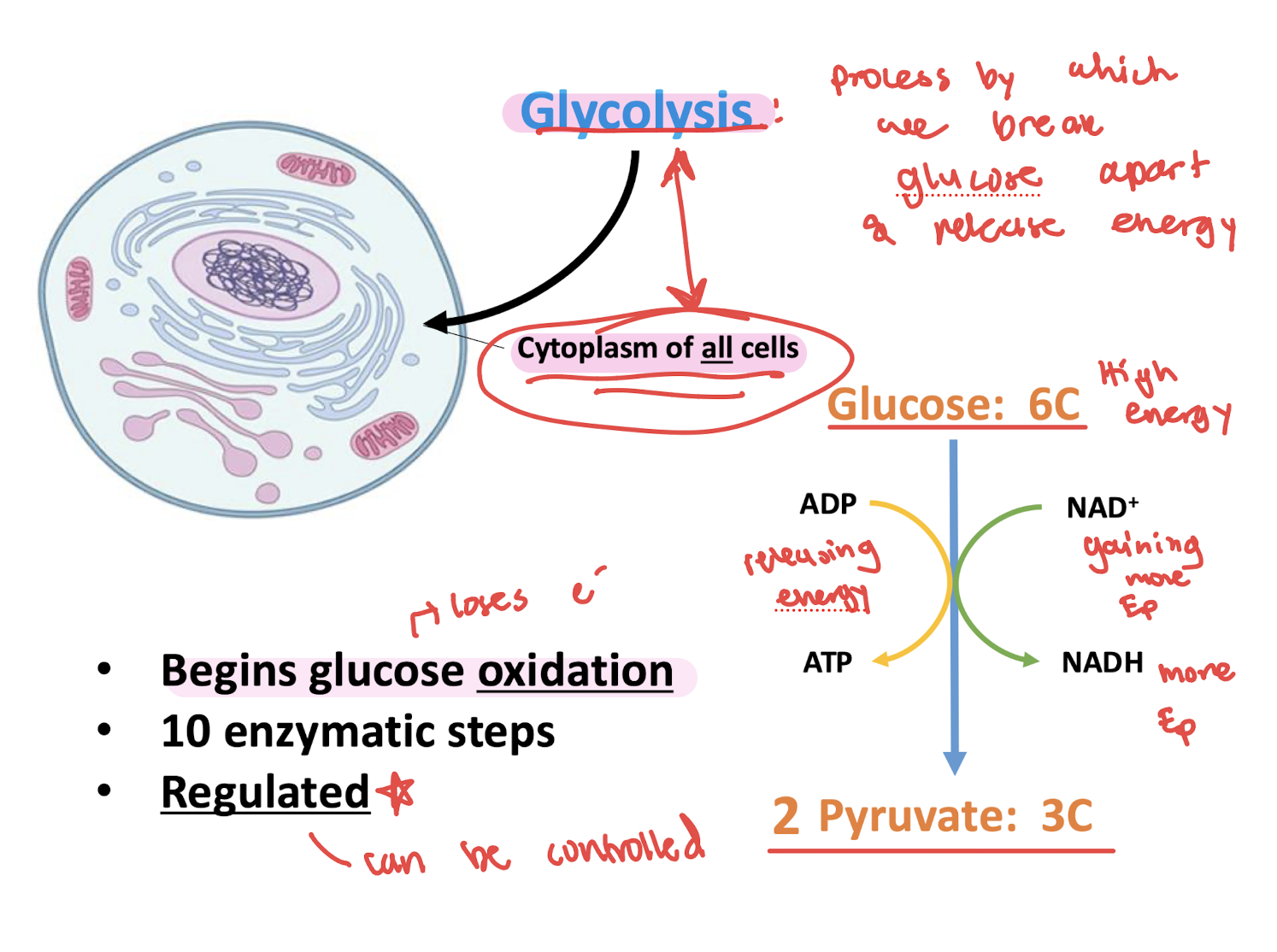
Glycolysis
process by which we break glucose apart & release energy
Beings glucose oxidation (loses e-)
10 enzymatic steps
Regulated
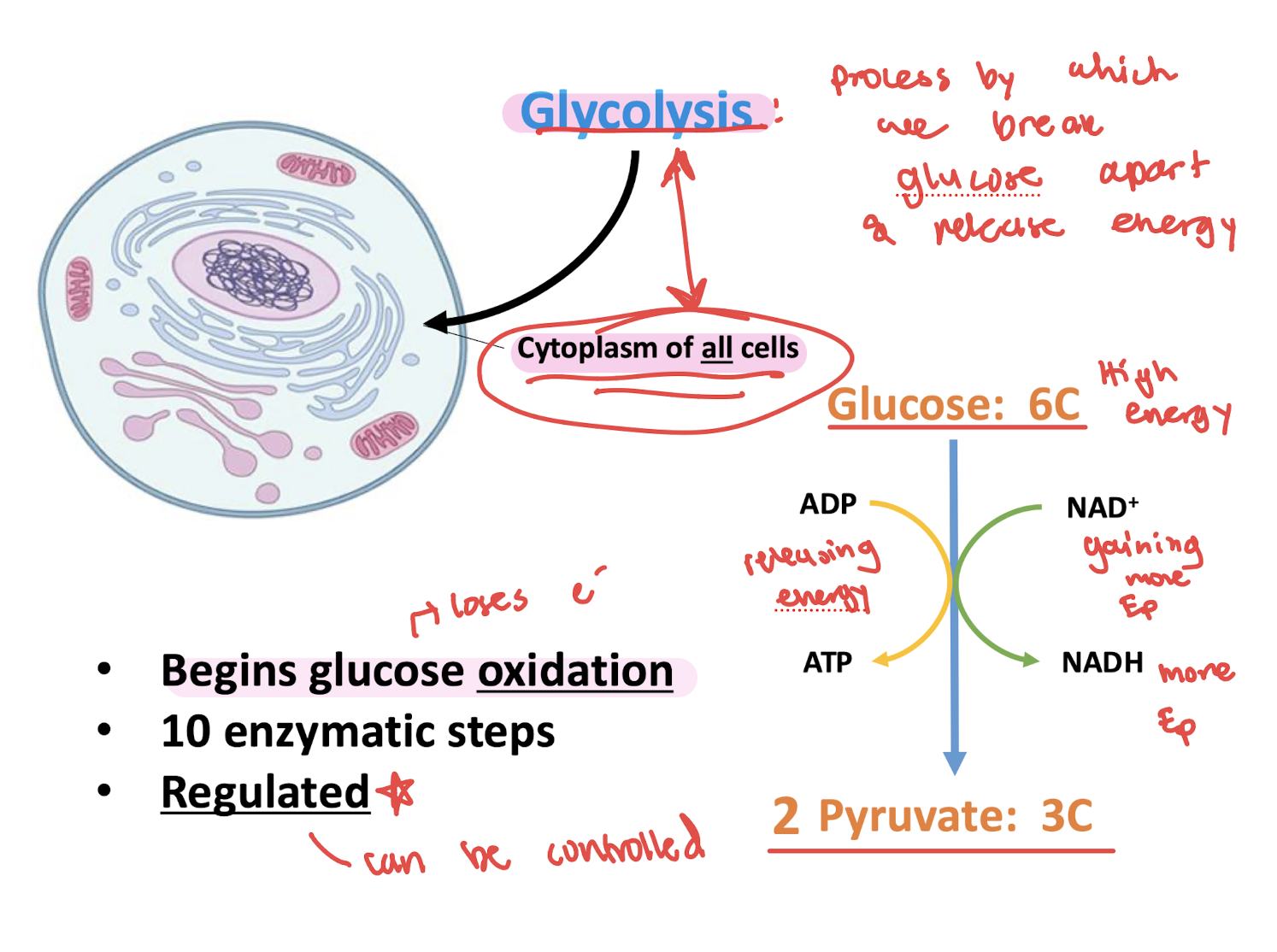
Where does glycolysis occur?
Cytoplasm of ALL cells
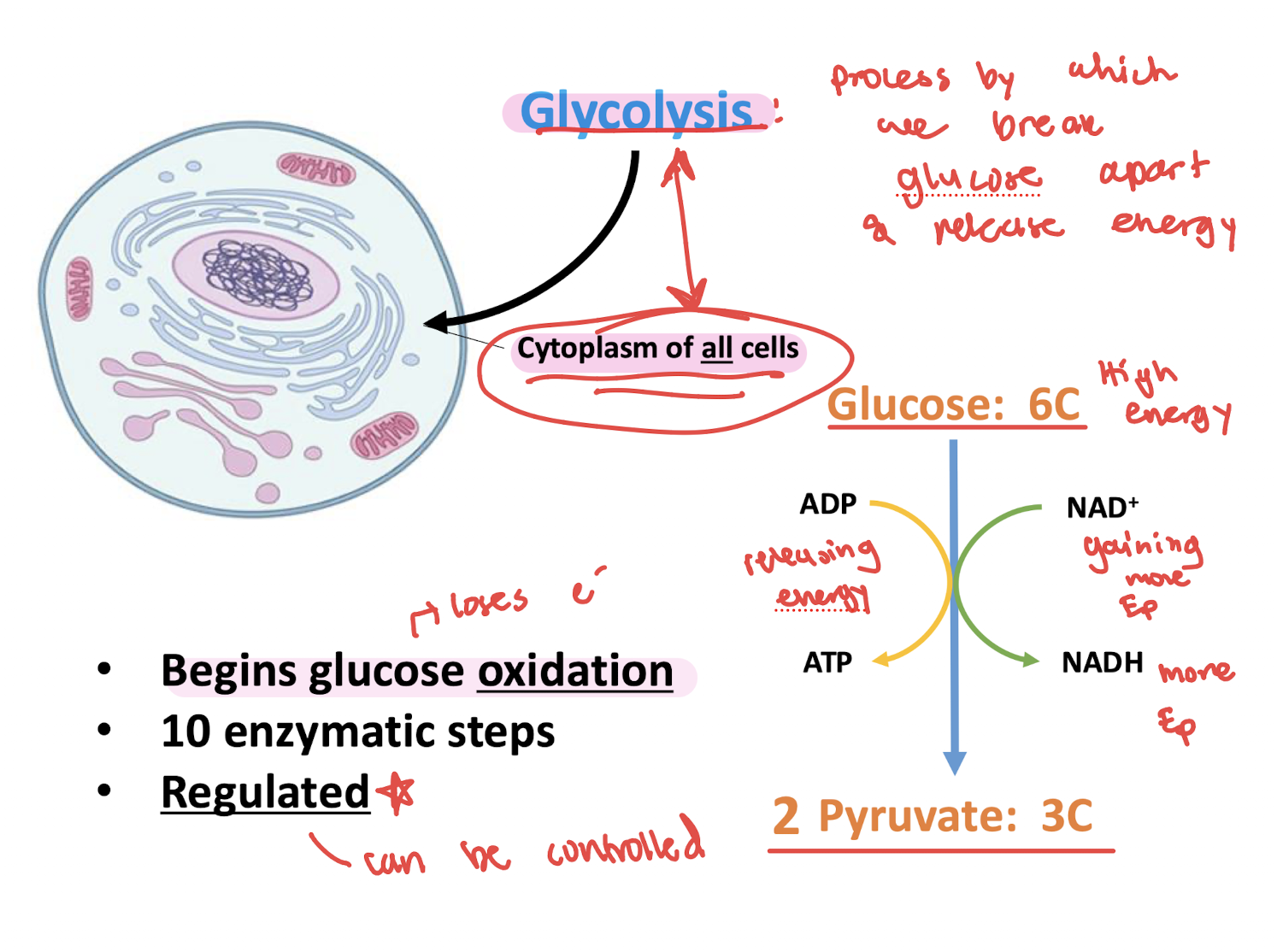
Glycolysis Process
Glucose 6 carbon molecule (high energy) broken down into 2 Pyruvate (3 carbon molecules)
ADP —> ATP
NAD+ —> NADH (reduced, more potential energy)
Glycolysis Brief
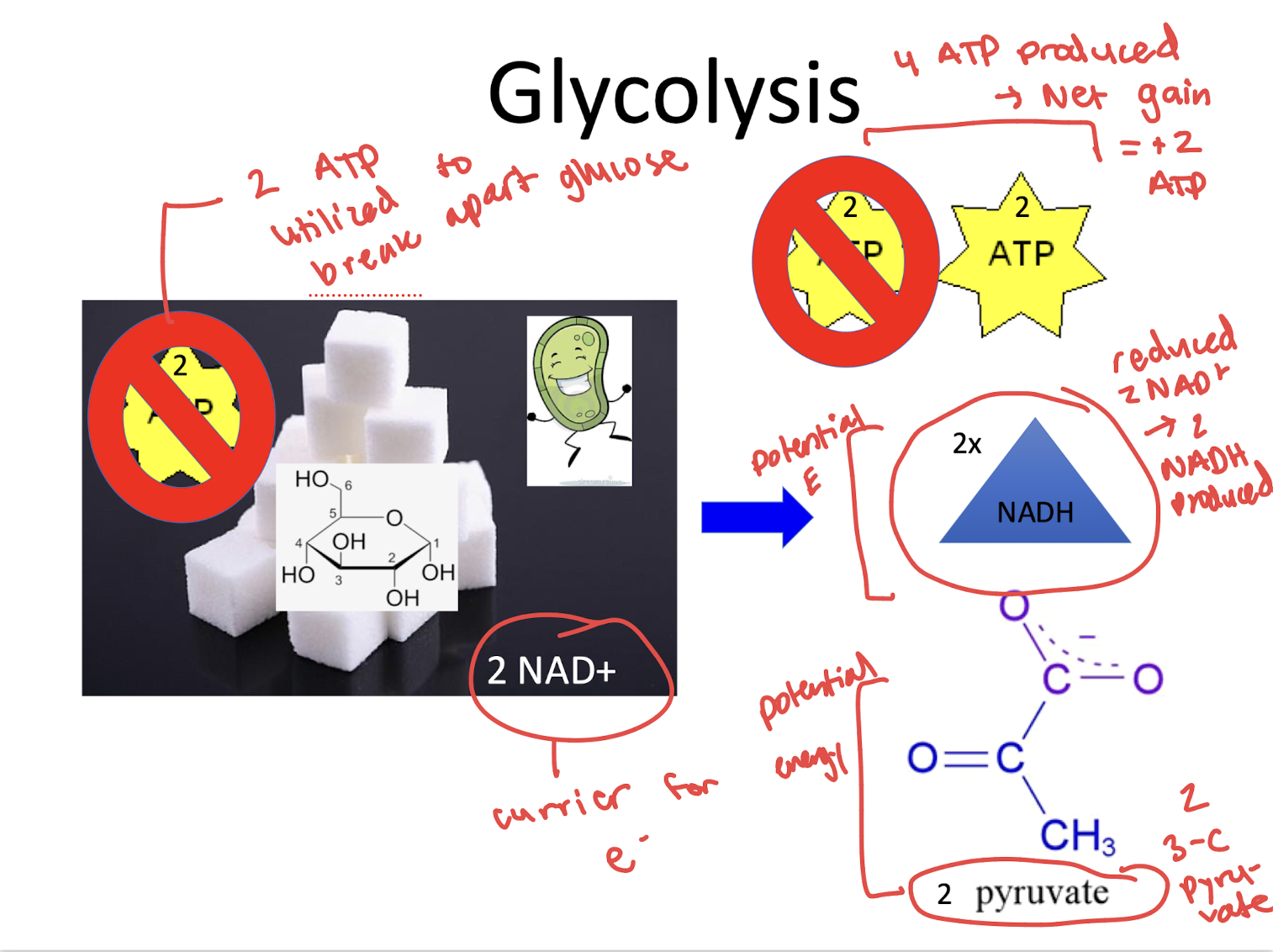
2 ATP used to break apart glucose
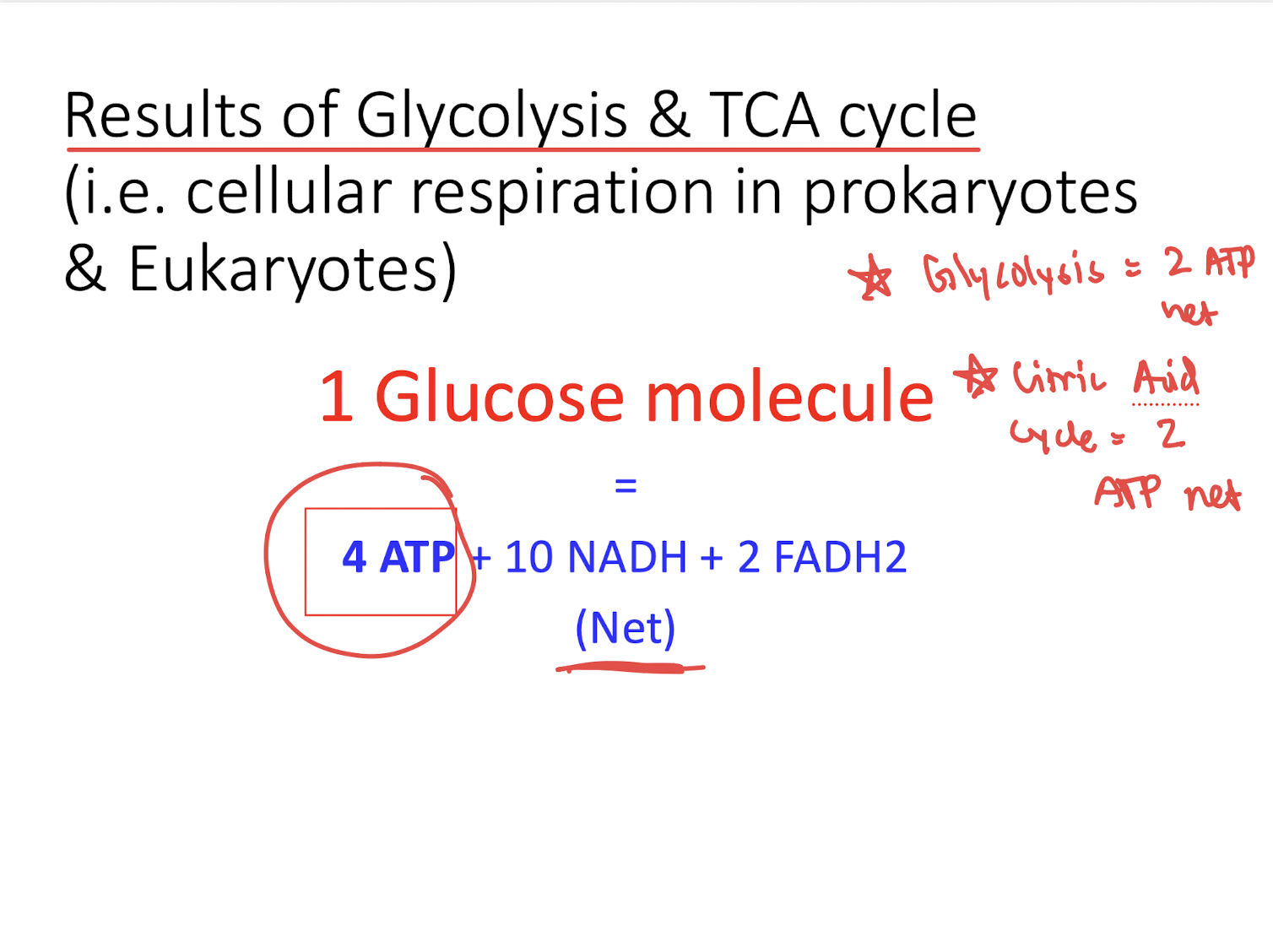
4 ATP produced = NET GAIN +2 ATP
2x NADH
2 Pyruvate
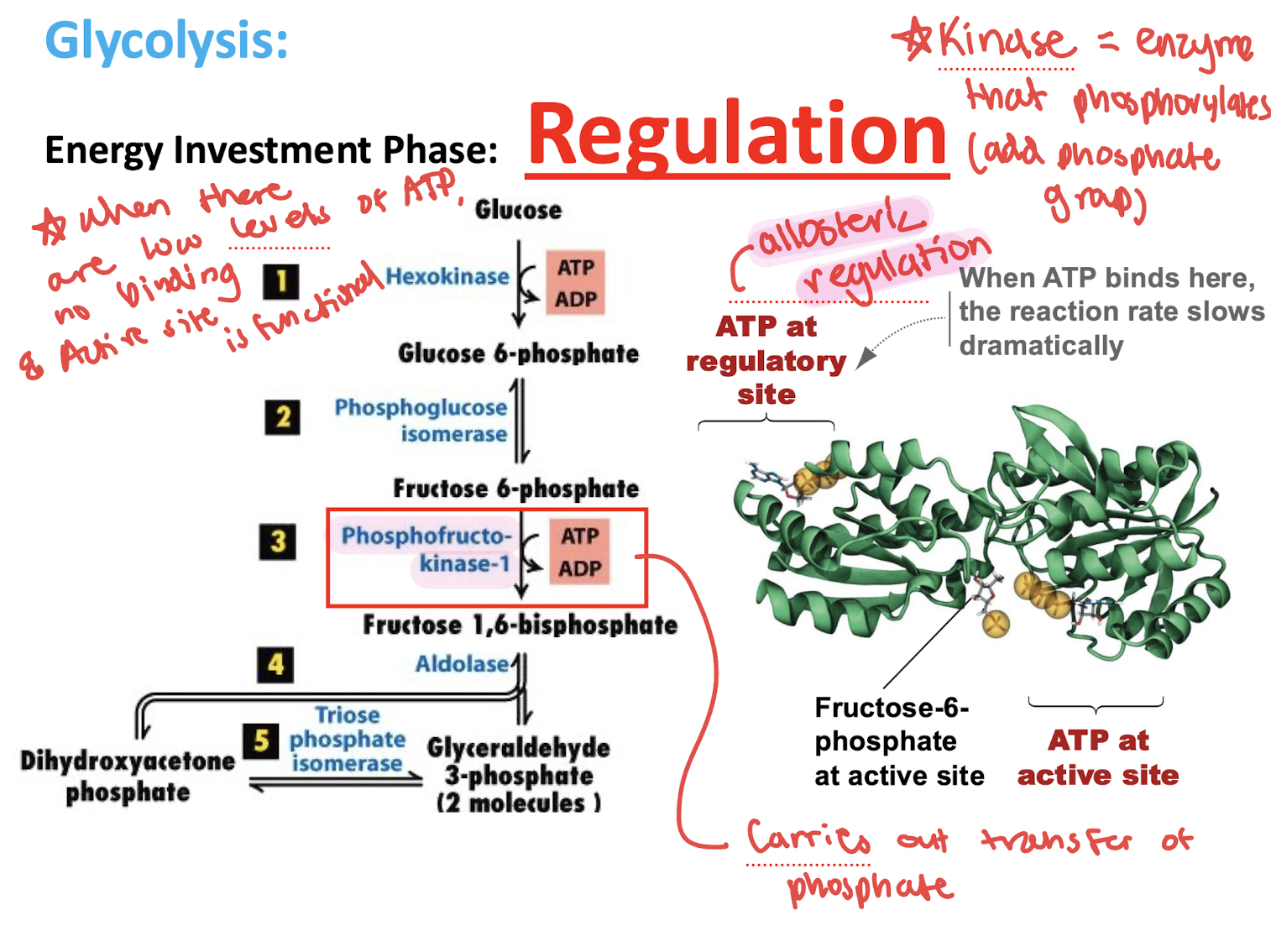
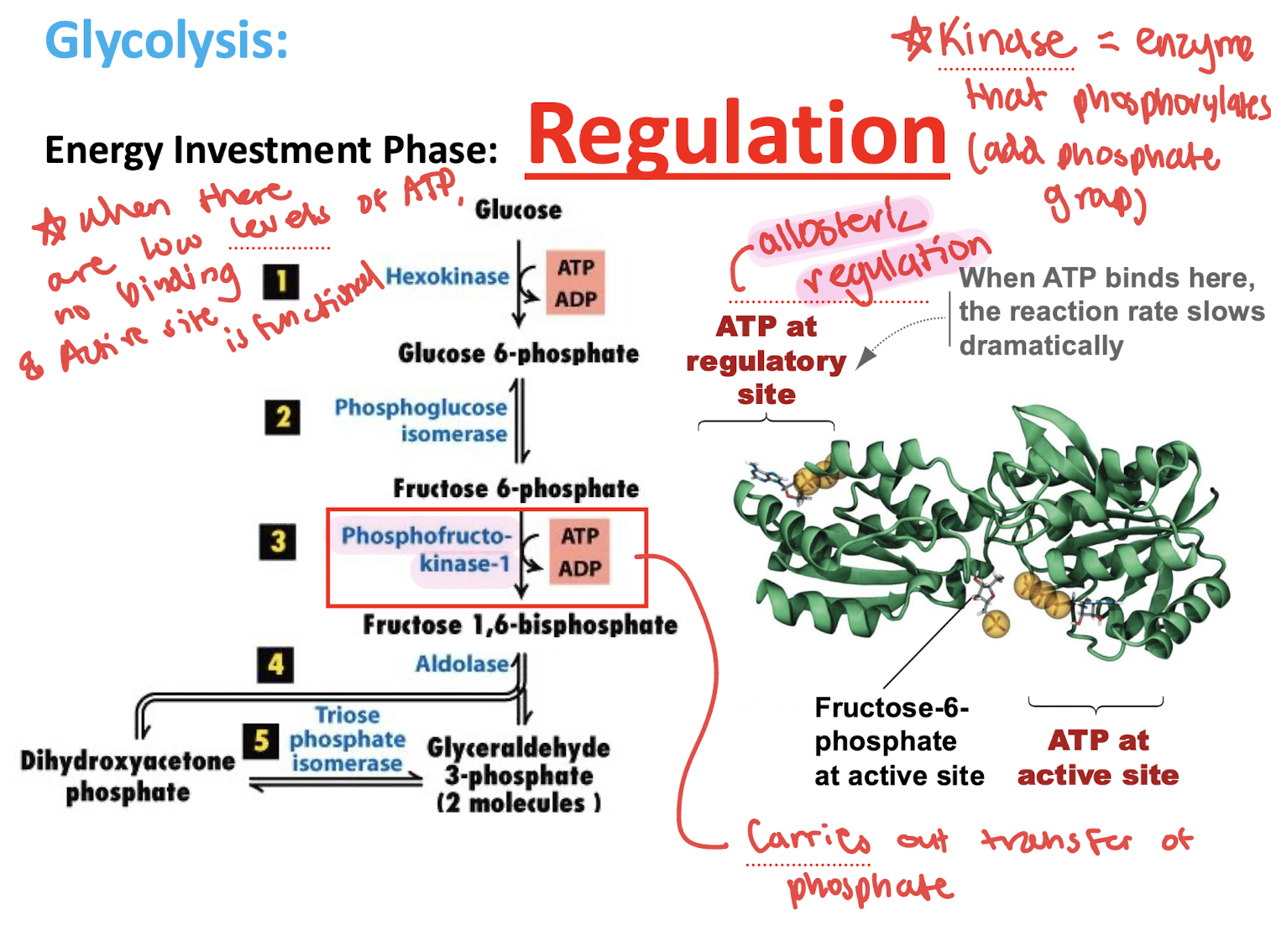
Kinase
enzyme that phosphorylates
Glycolysis Regulation
Enzyme: phosphofructokinase (PFK)
ATP high → inhibits PFK
ATP low → activates PFK
What kind of regulation is used for glycolysis?
Allosteric regulation!
ATP binds to regulatory site (NOT ACTIVE SITE)
When ATP levels are low, no binding & Active site is functional
Enzyme: phosphofructokinase (PFK)
carries out transfer of phosphate
Limiting Reagent of Glycolysis
NAD+ !!!!
need NAD+ to capture e-
NAD+ is replenished by oxidation or synthesis?
oxidation —> easier (synthesis takes time)
Fates of Pyruvate: 1) (W/enough energy)
(w/enough energy) we use pyruvate to synthesize other things: amino acids, sugars, fat metabolites (Anabolic pathways)
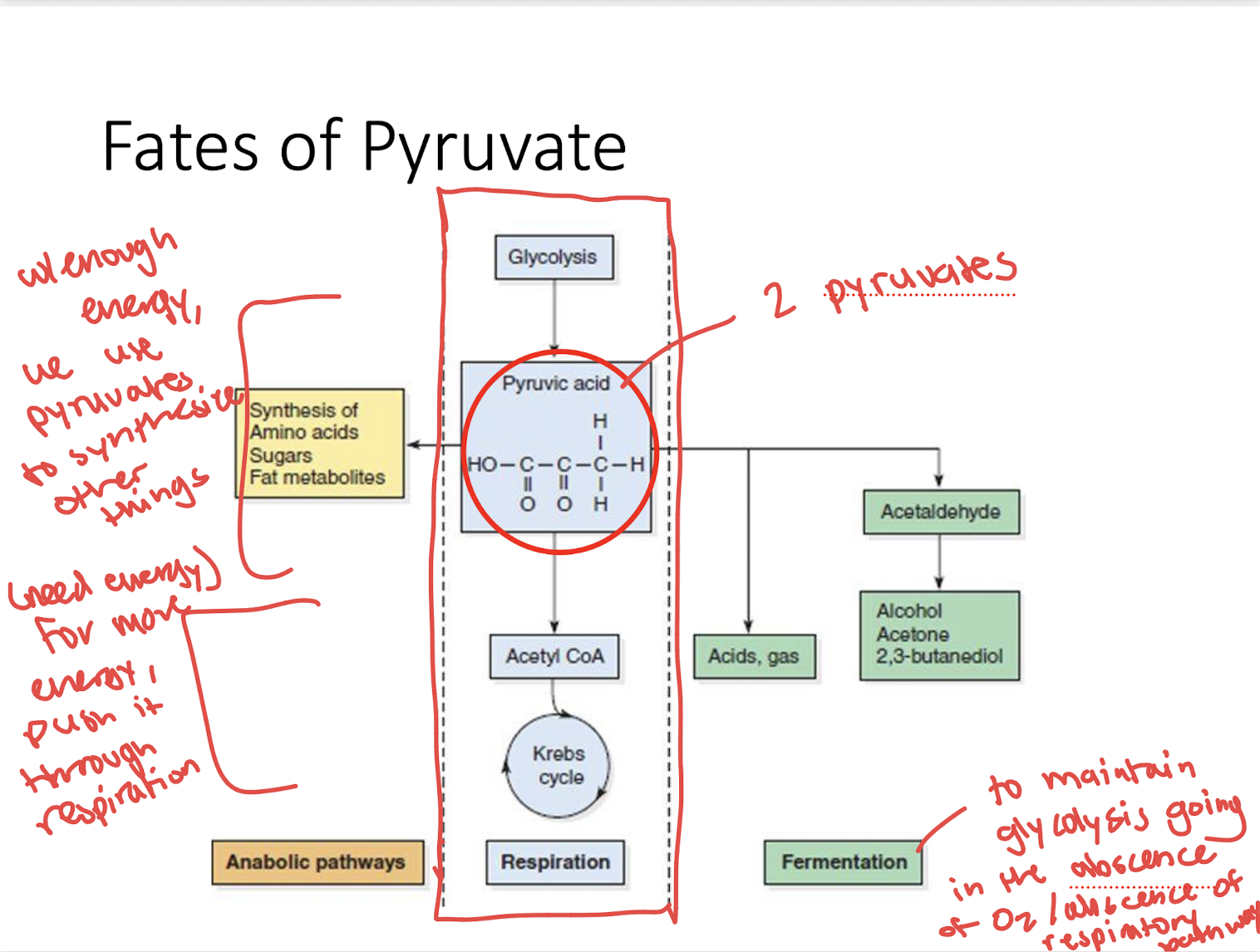
Fates of Pyruvates : 2 (w/oxygen)
2 pyruvates turned into Acetyl CoA which then goes into citric acid cycle (respiration)
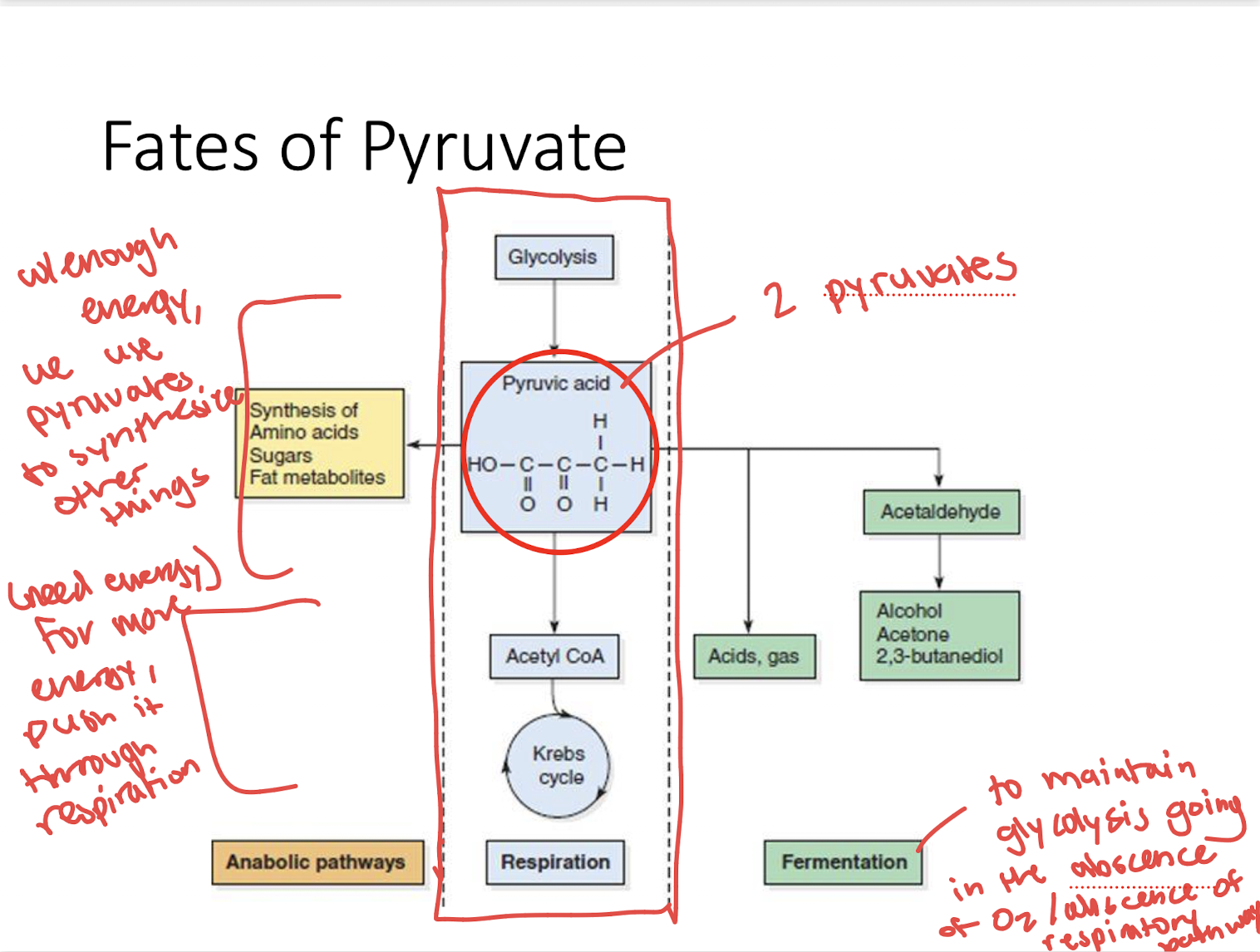
Fates of Pyruvates : 2 (w/o oxygen)
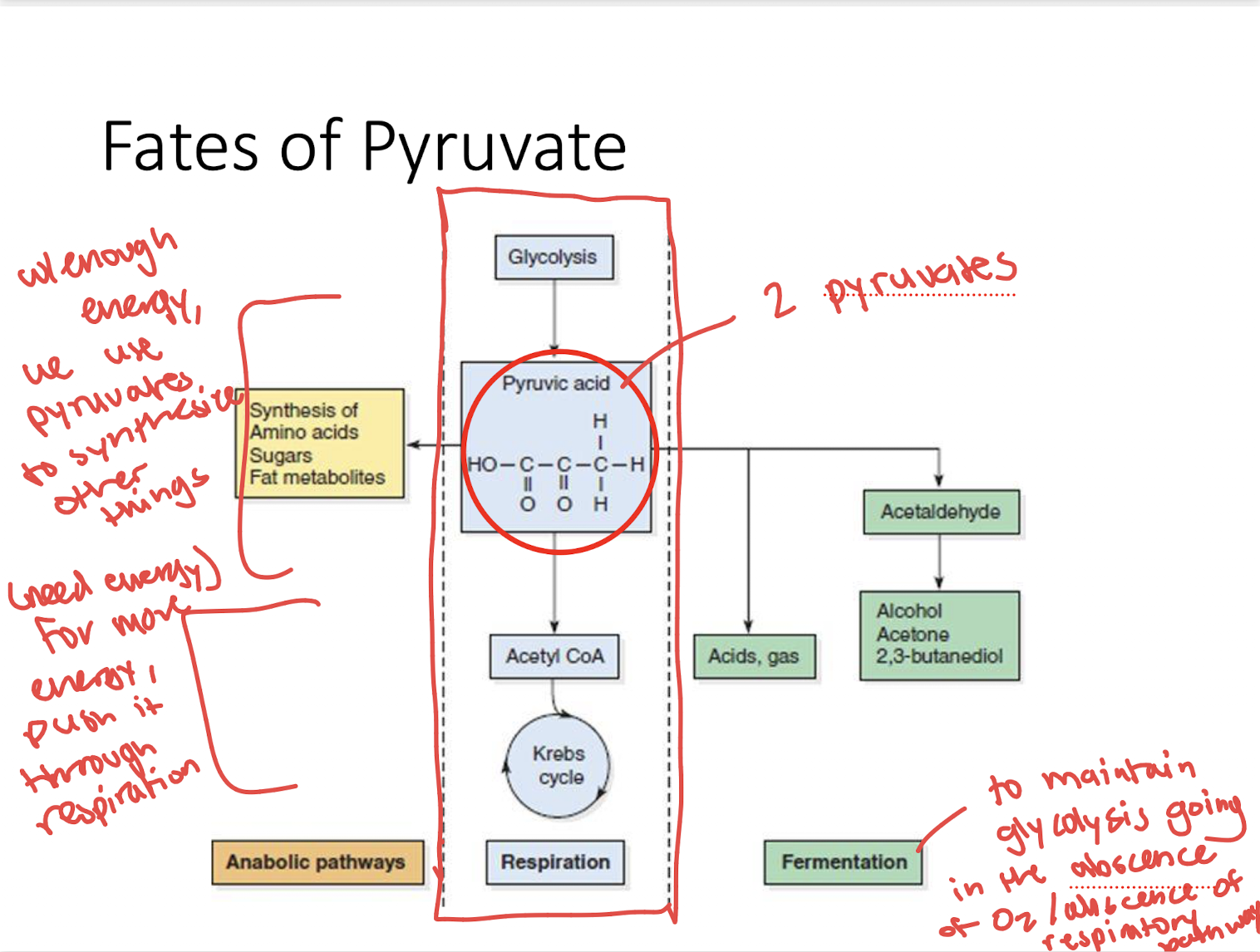
can be turned into acids, gas or acetaldehyde which then turns into —> alcohol, acetone, 2. 3-butanediol (fermentation)
What is central metabolism?
where we get the MOST ATP
carrying out respiration
Pyruvate processing, citric acid cycle, electron transport, chemiosmosis
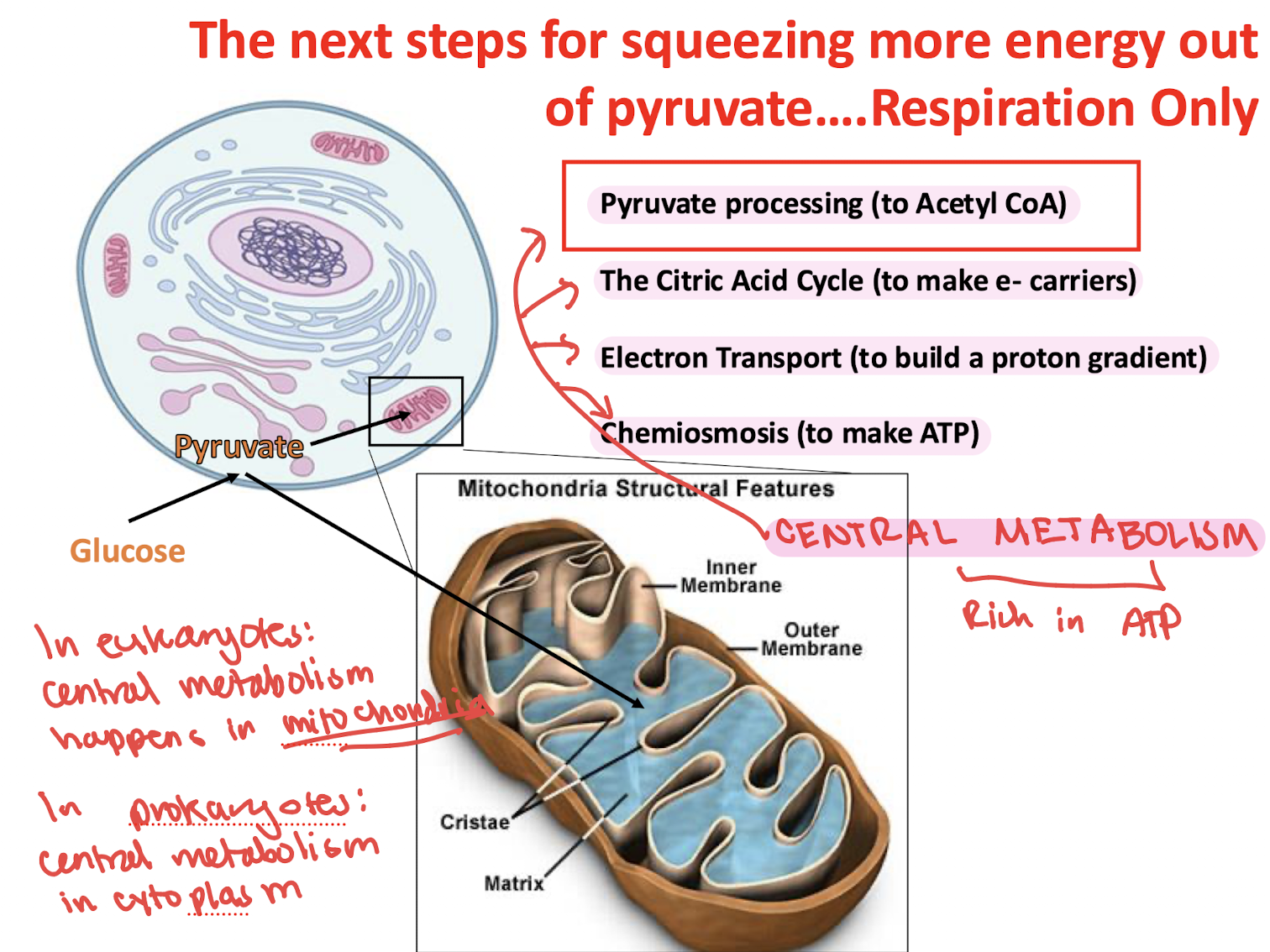
Pyruvate Processing…..
… to Acetyl CoA
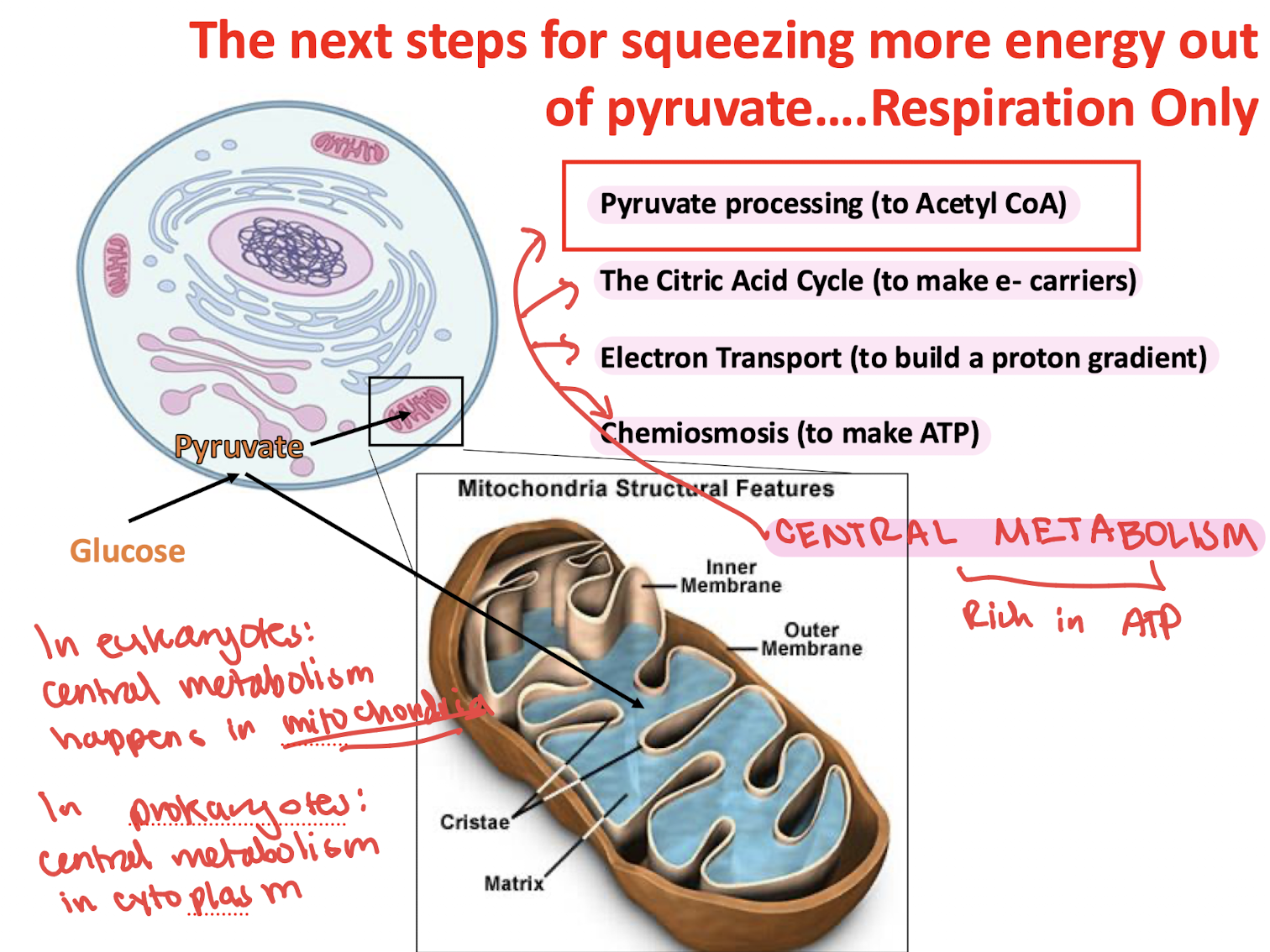
The Citric Acid Cycle….
to make e- carriers
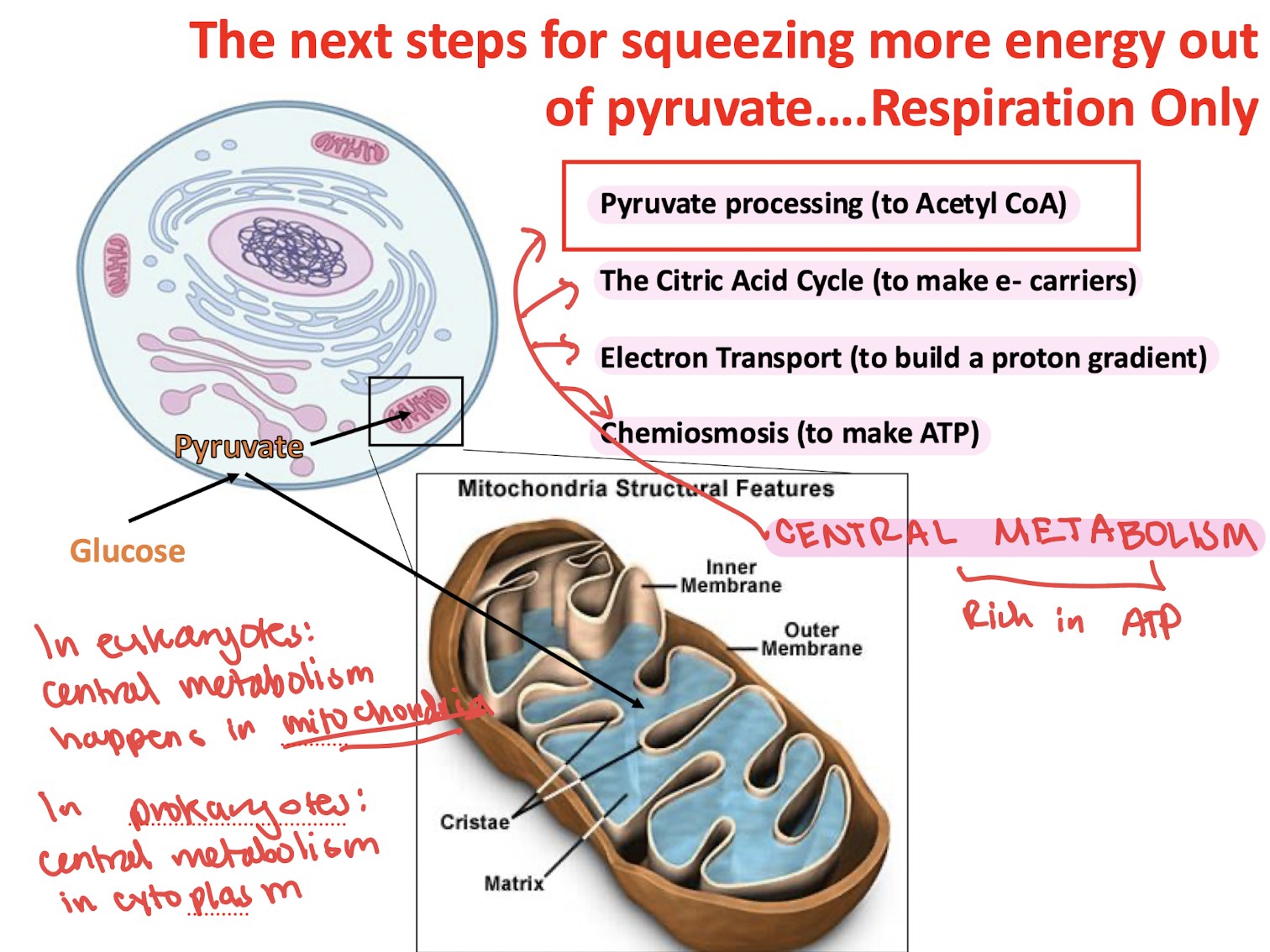
Electron transport chain to….
to build a proton gradient
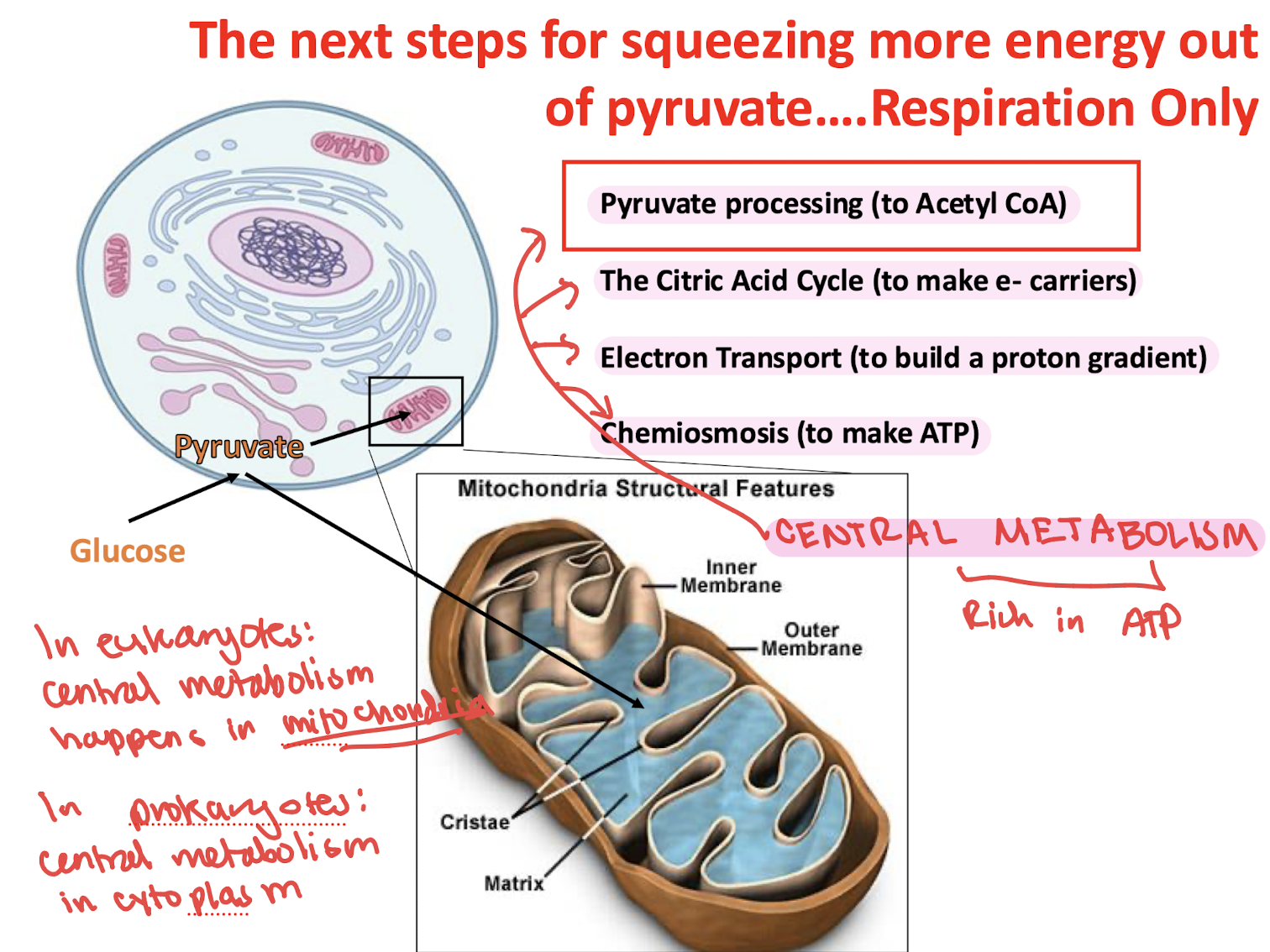
Chemiosmosis to…
to make ATP
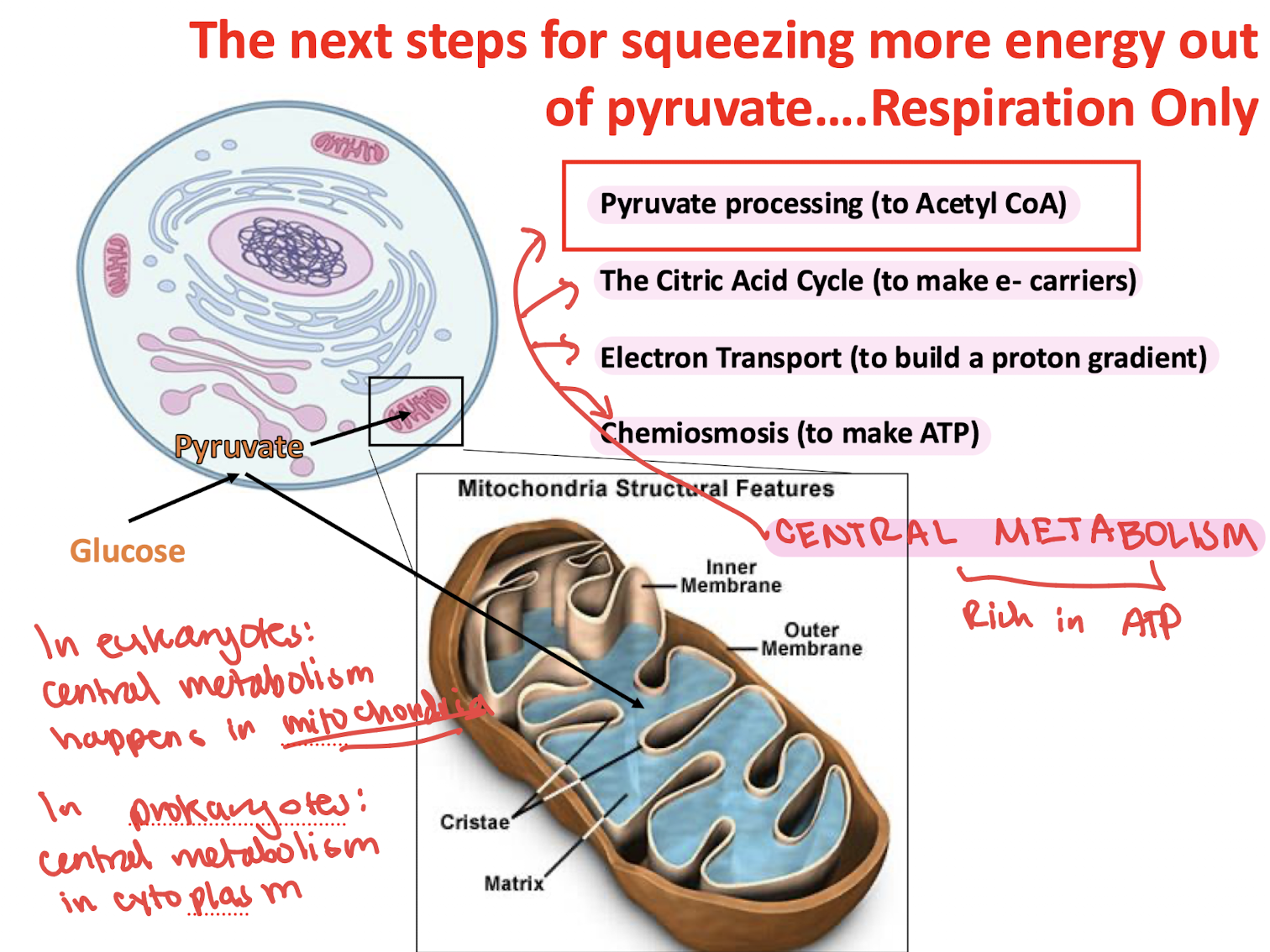
Where does central metabolism occur in eukaryotes?
in mitochondria
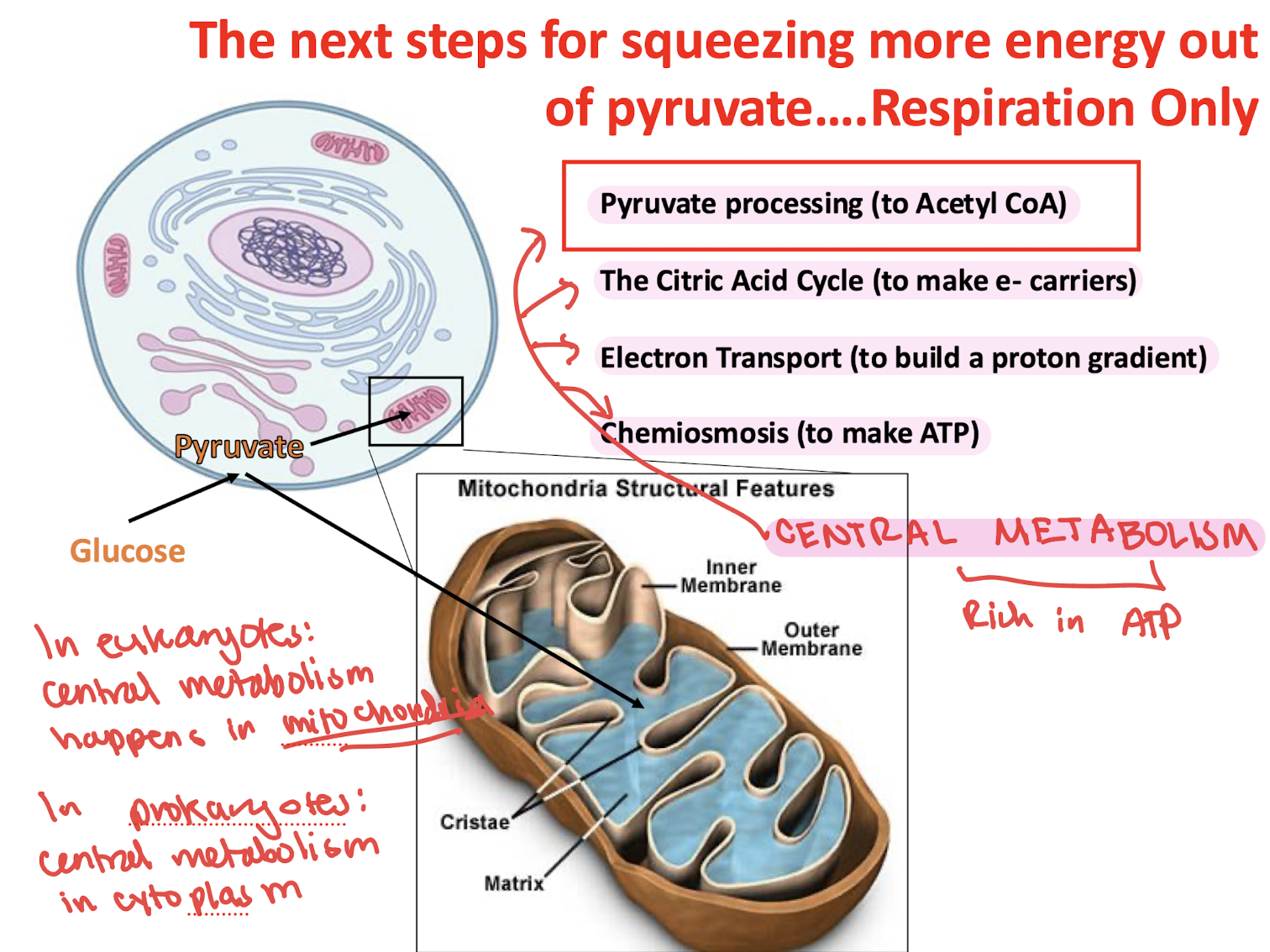
Where does central metabolism occur in prokaryotes?
in the cytoplasm
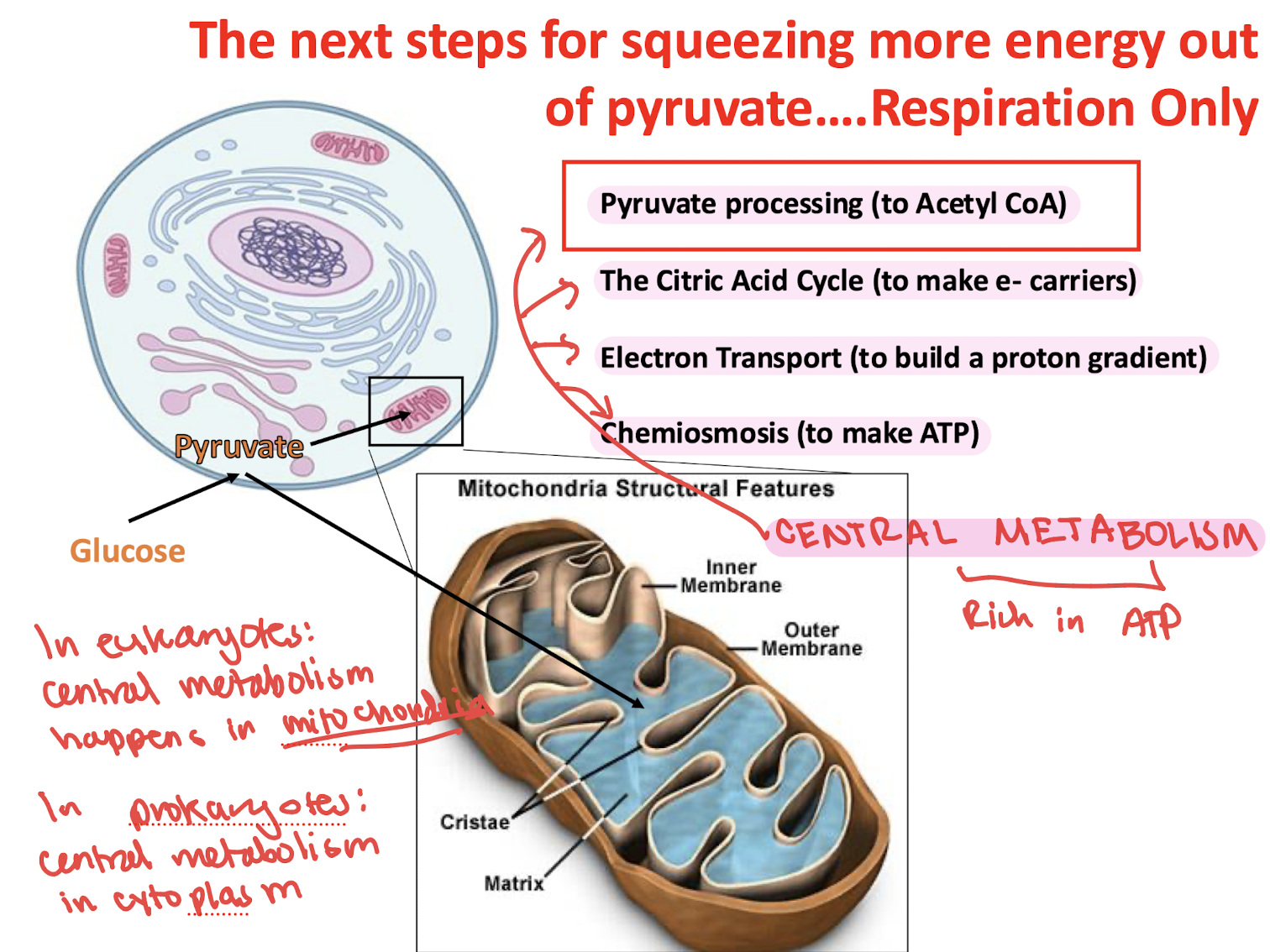
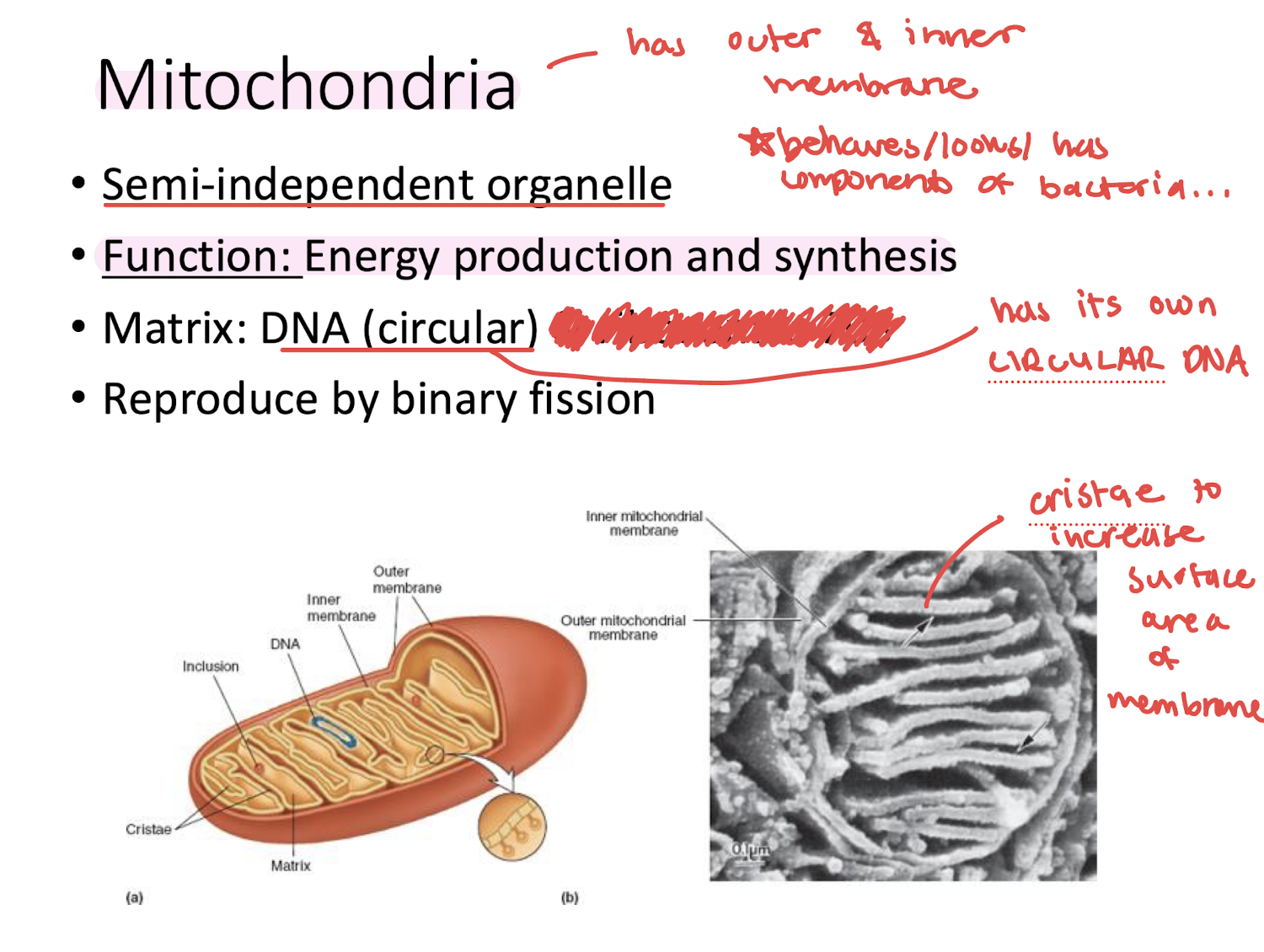
Mitochondria
has outer & inner membrane
Semi independent organelle
behaves/looks/has components of bacteria..
HAS ITS OWN CIRCULAR DNA
reproduce by binary fission
cristae to increase surface area of membrane
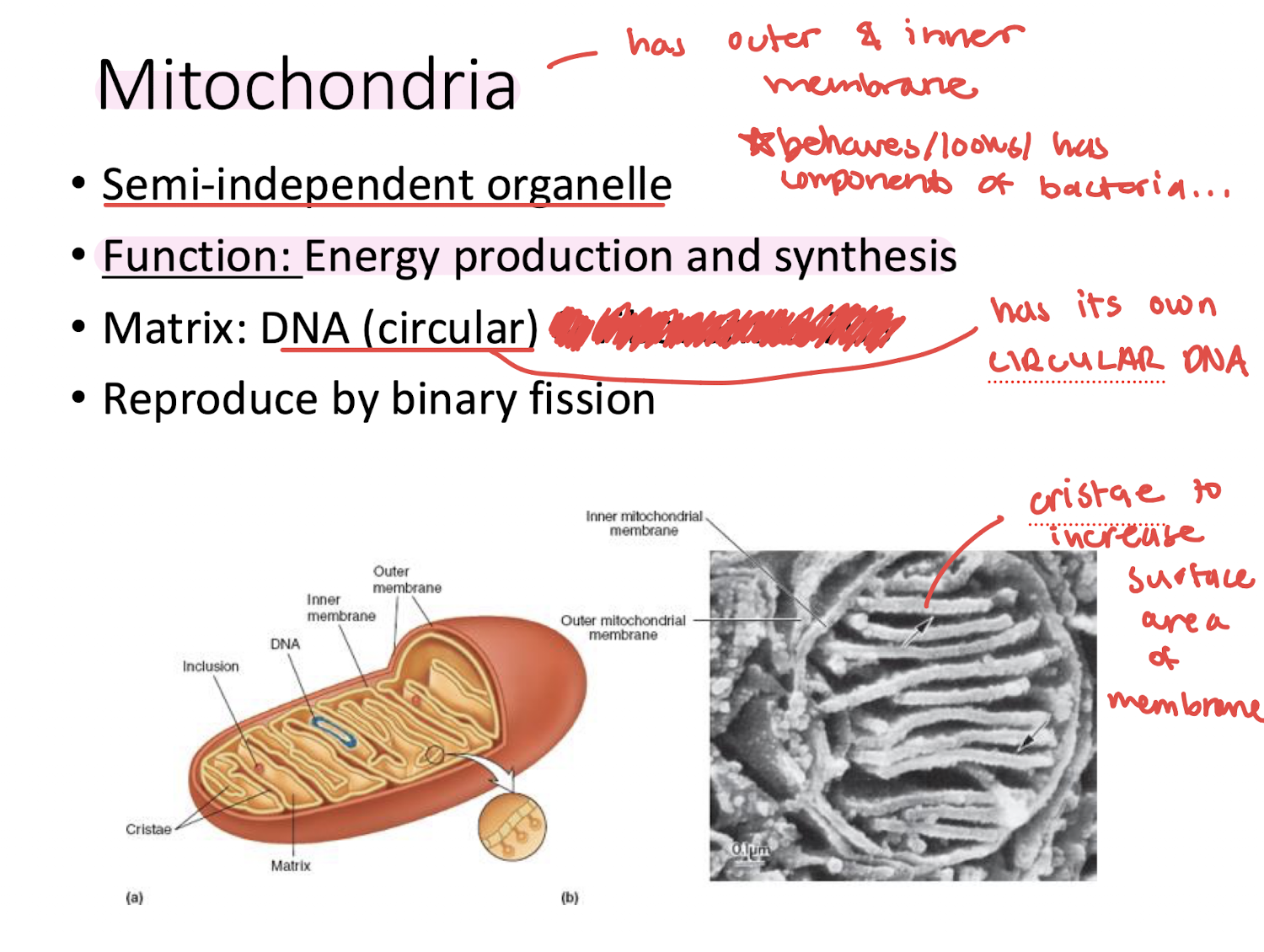
Mitochondria function
energy production & synthesis
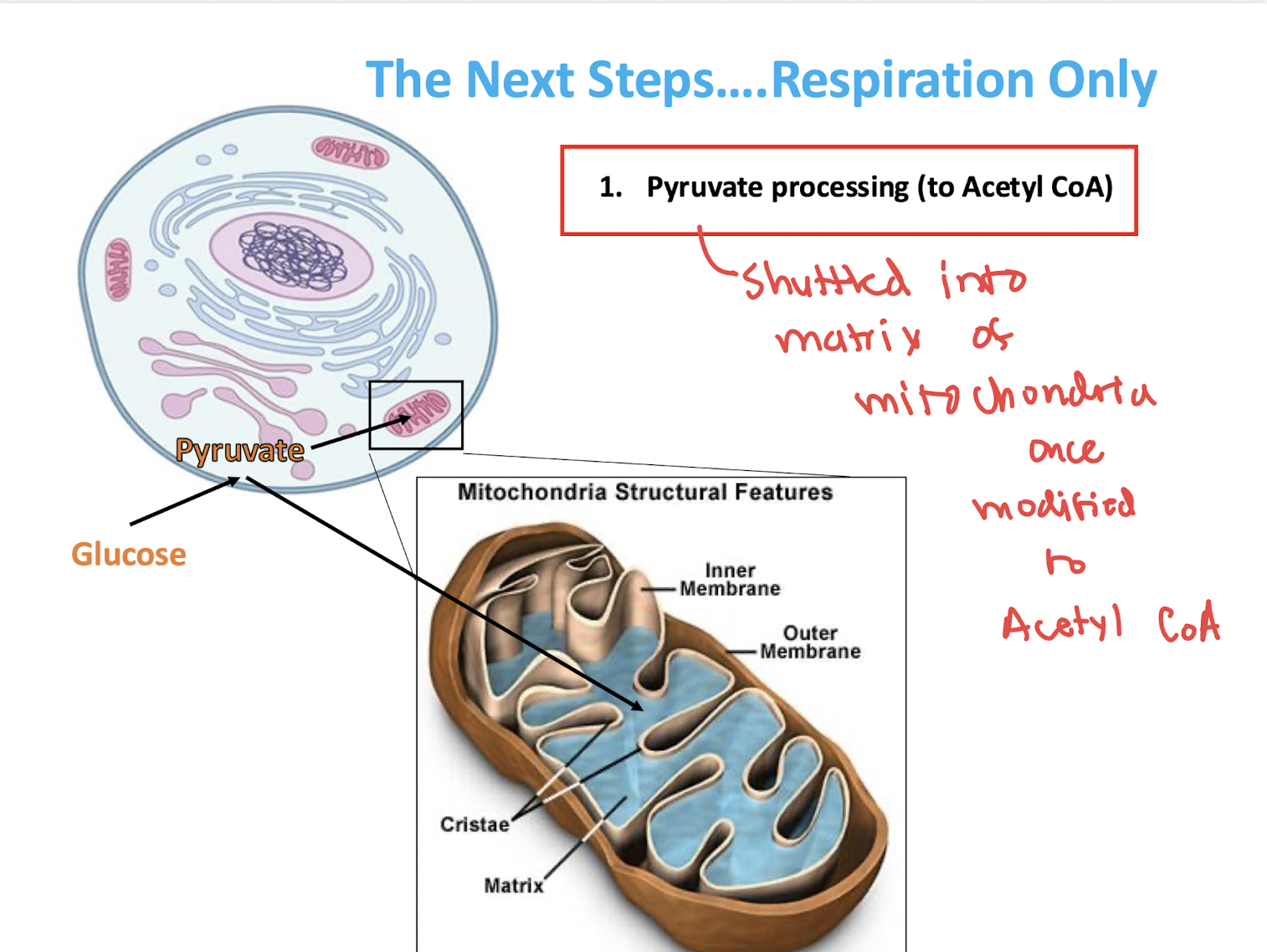
AFTER glycolysis, to “squeeze out” more energy of pyruvate (Respiration ONLY)
pyruvate processing must occur
—> turned to Acetyl CoA
shuttled into matrix of mitochondria (cytoplasm of mitchondria)
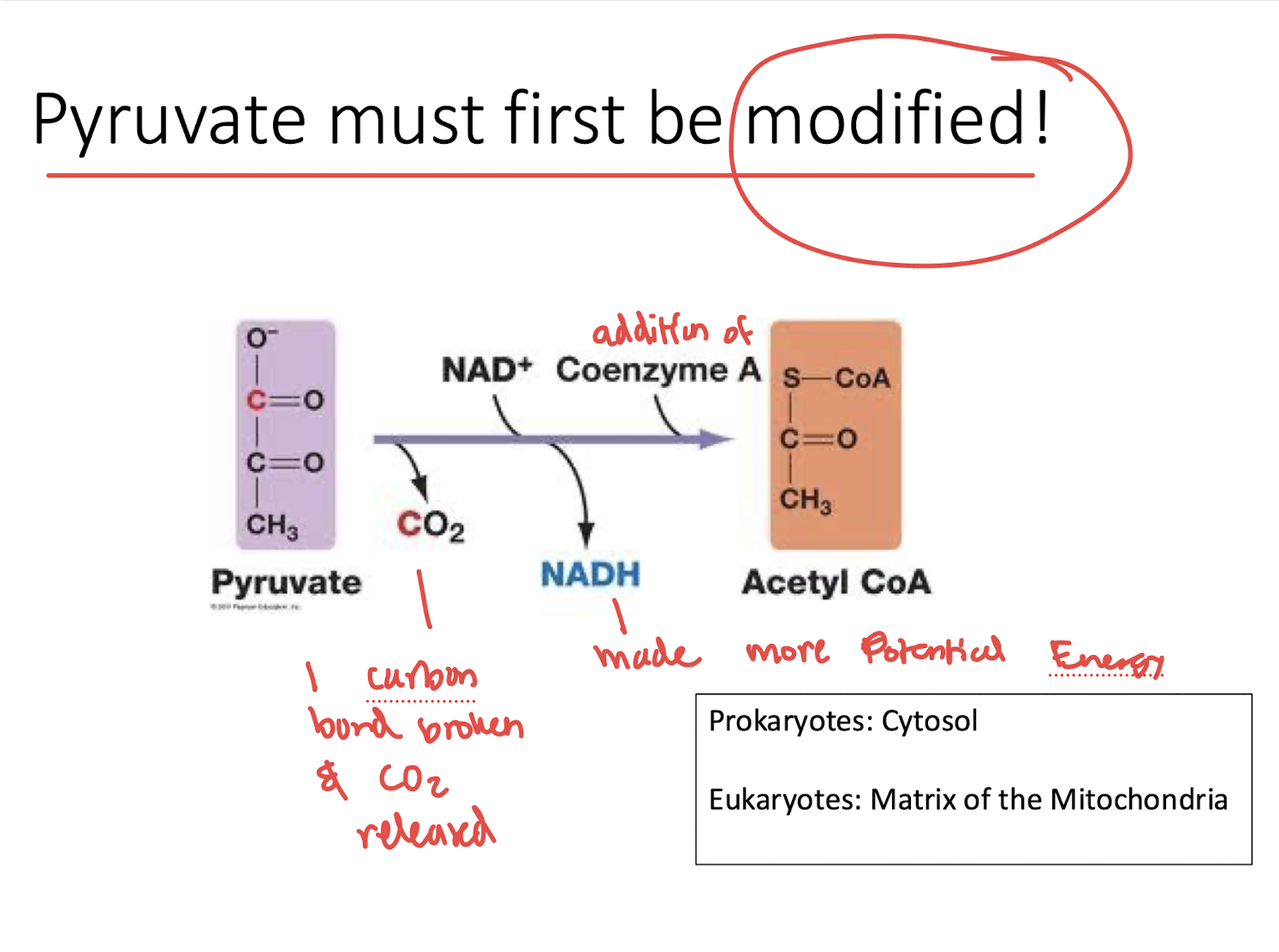
For Pyruvate to continue respiration it must be
shuttled into matrix of mitochondria (cytoplasm of mitchondria)
—> must first be modified!
1 carbon bond broken & CO2 released
NADH produced from NAD+
Addition of coenzyme results in: Acetyl CoA!
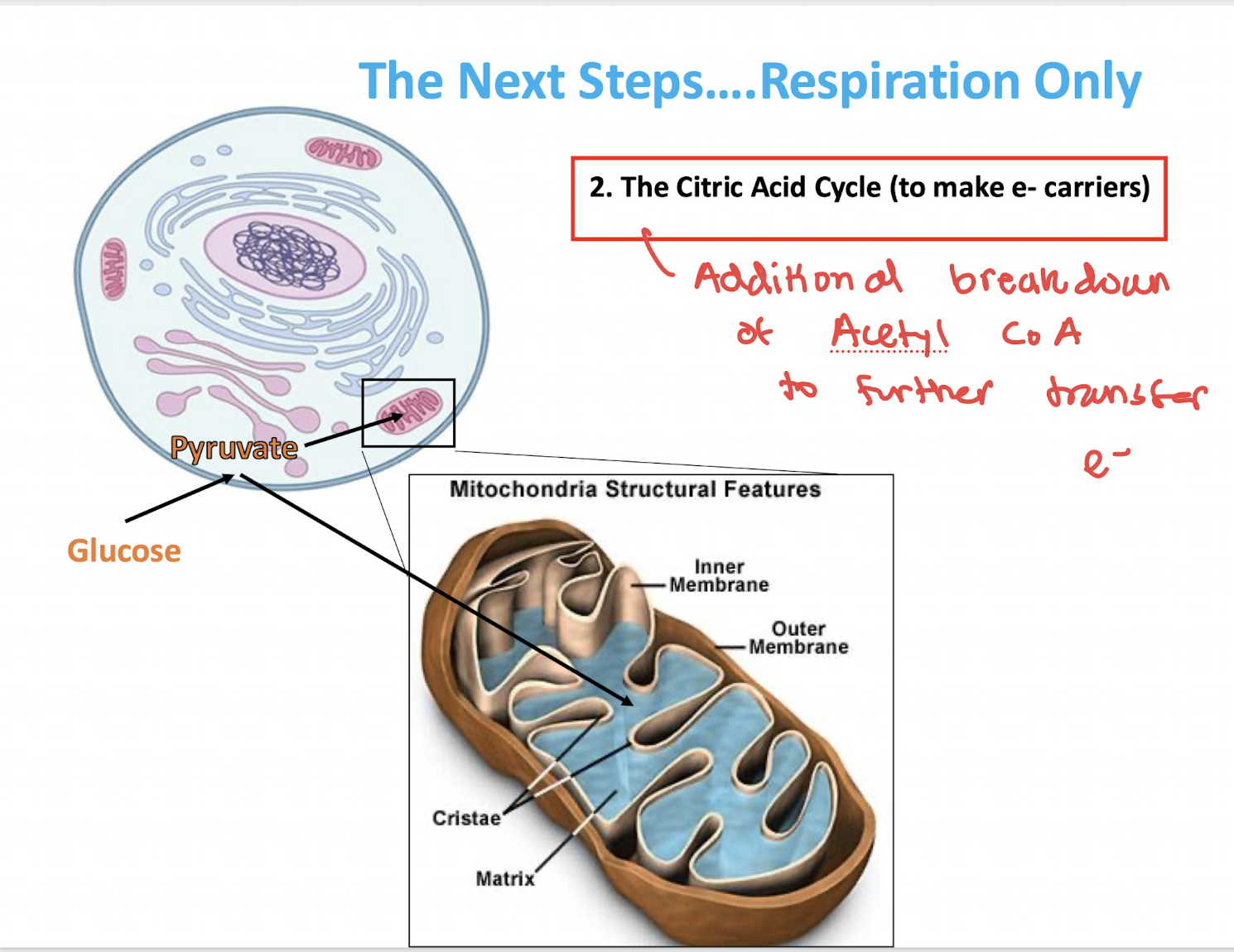
After pyruvate processing…
The citric acid cycle!!
—> additional breakdown of Acetyl CoA
Citric Acid Cycle has
citrate as first stpe, 3 carboxylic acids
The citric acid cycle occurs in..(p)
occurs in the cytosol of prokaryotes
The citric acic cycle occurs in (e)
occurs in the matrix of the mitochondria
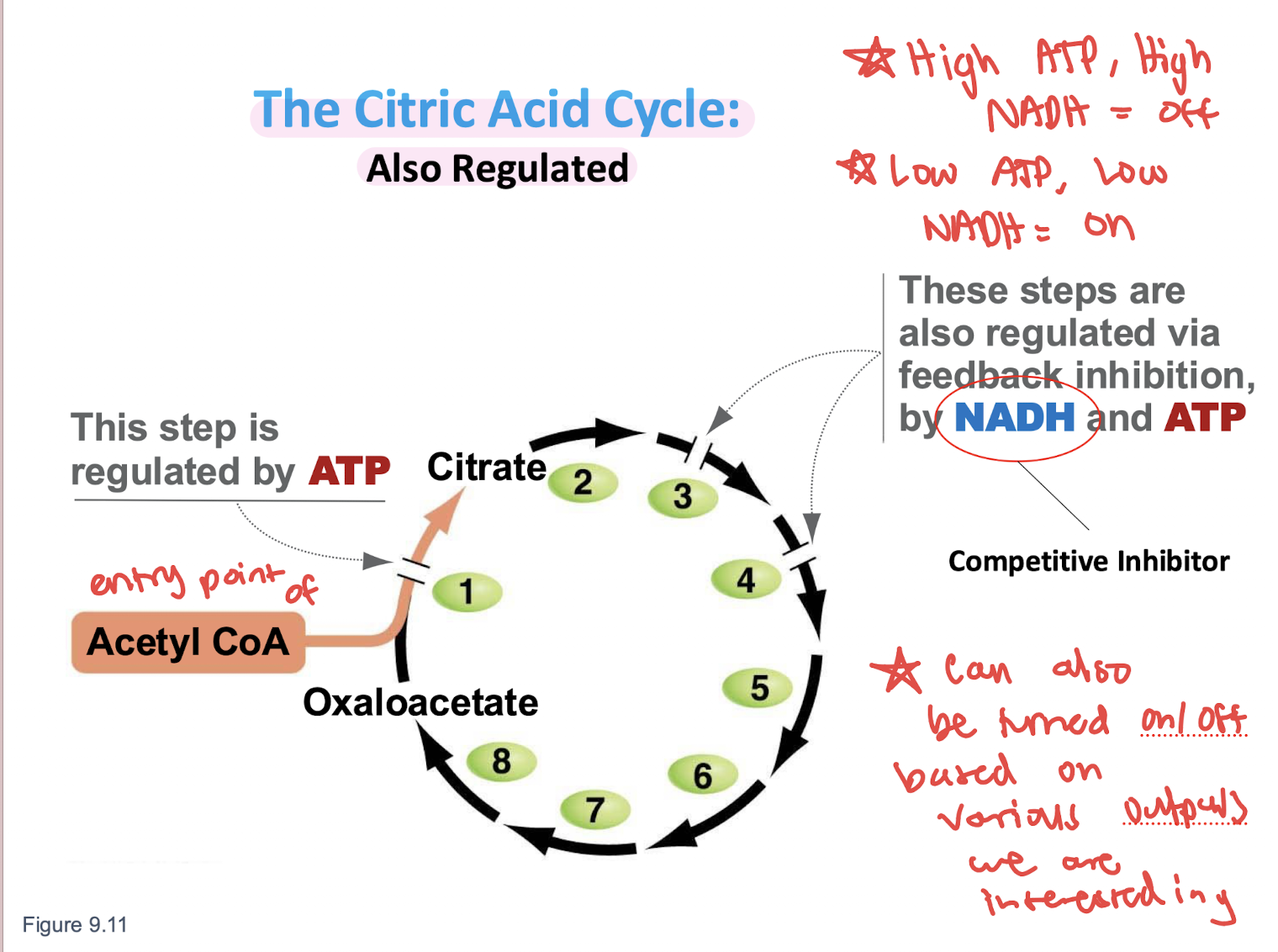
The citric acid cycle is also regulated
Regulated via feedback inhibition by NADH, ATP
High ATP, High NADH = off
Low ATP, Low NADH - on
The Citric Acid Cycle Brief
acetyl CoA loses 2 carbons & produced 2 CO2
Major Goal: TRANSFER electrons (breaking carbon bonds) deriving potential energy
—> loading electrons carriers: NADH, FADH2
—> 2 ATP net
ATP from citric acid cycle & glycolysis is
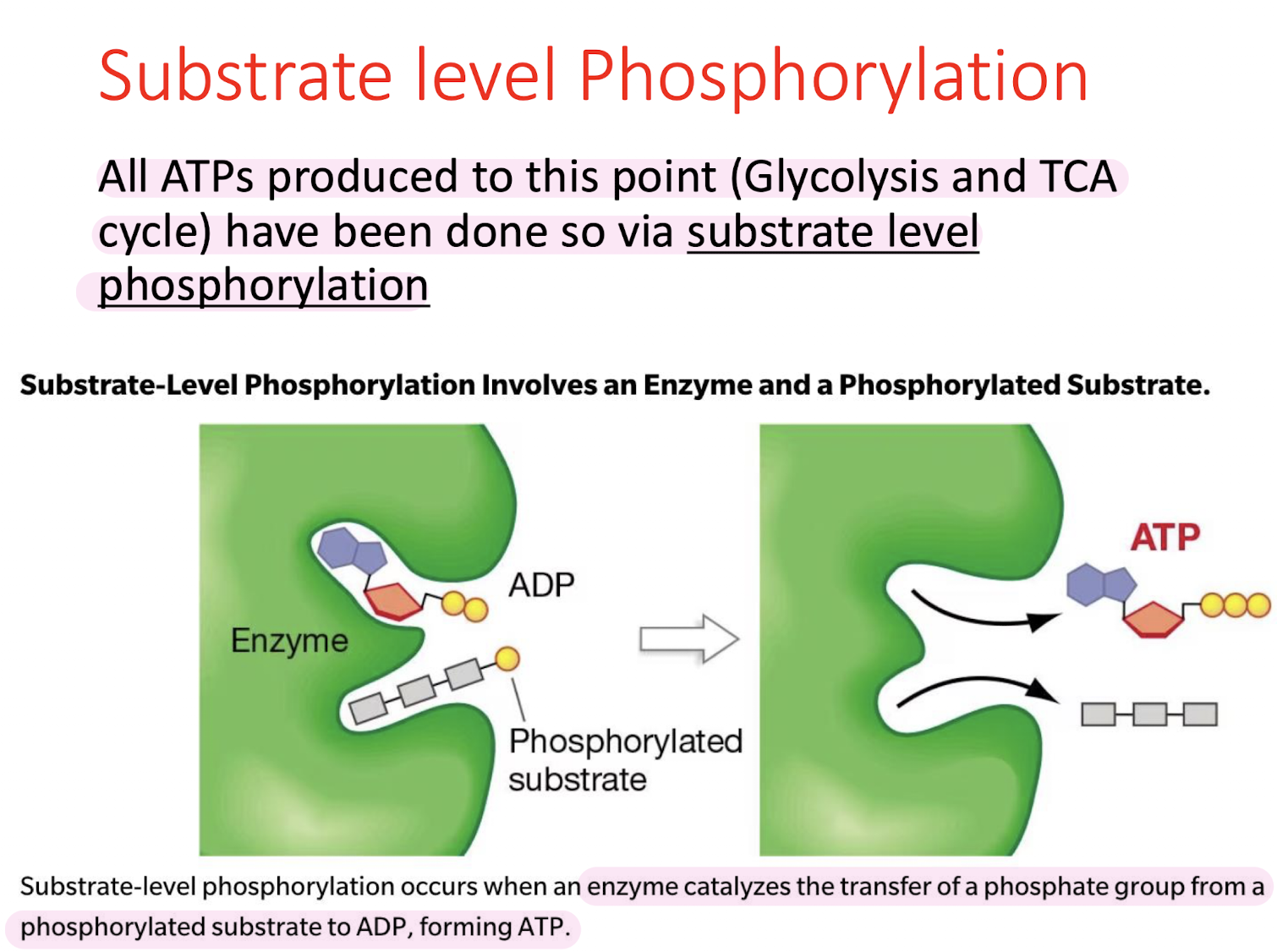
SUBSTRATE LEVEL PHOSPHORYLATION
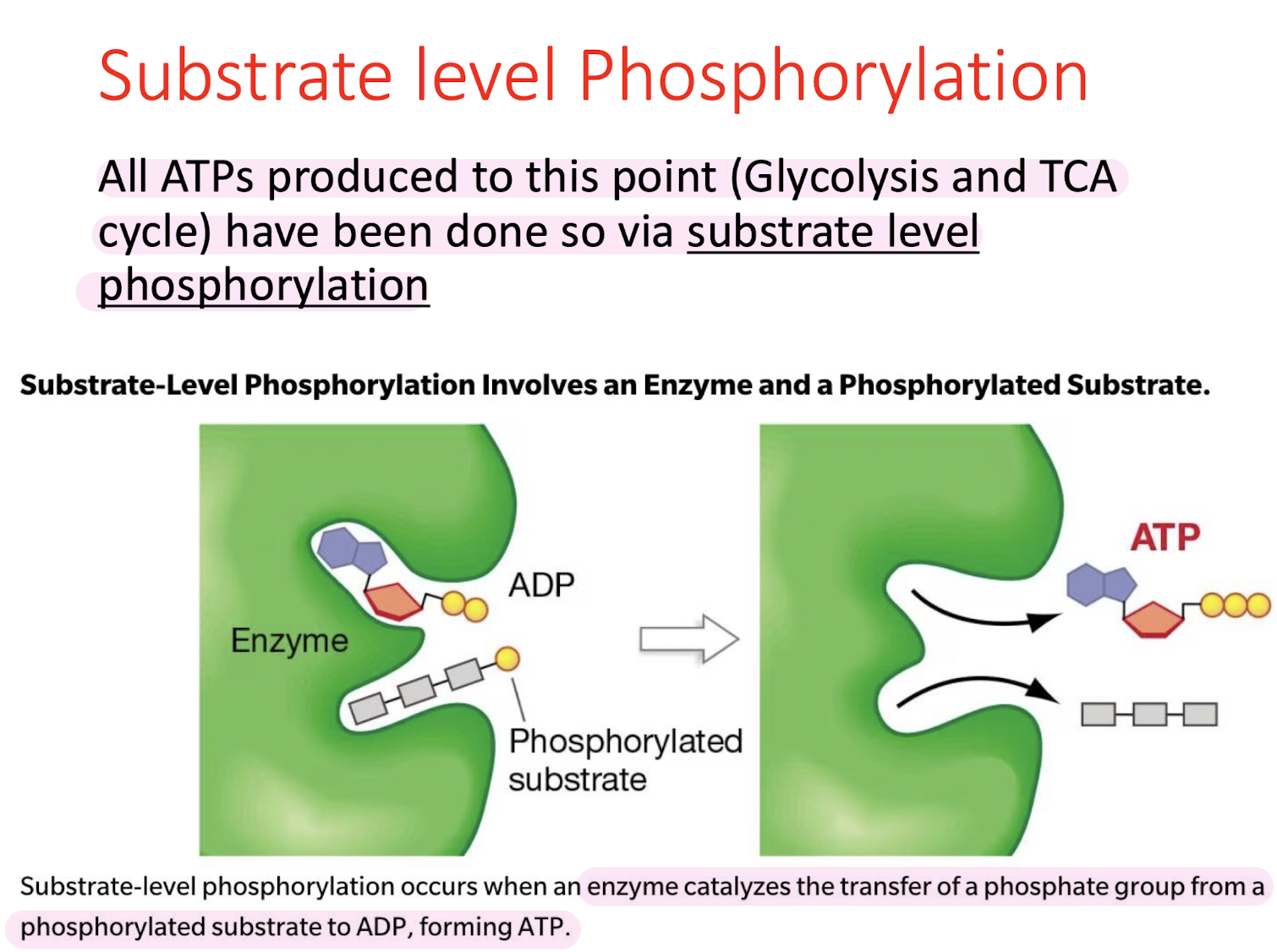
What is substrate level phosphorylation?
enzyme catalyzes the transfer of a phosphate group from a phosphorylated substance to ADP, FORMING ATP
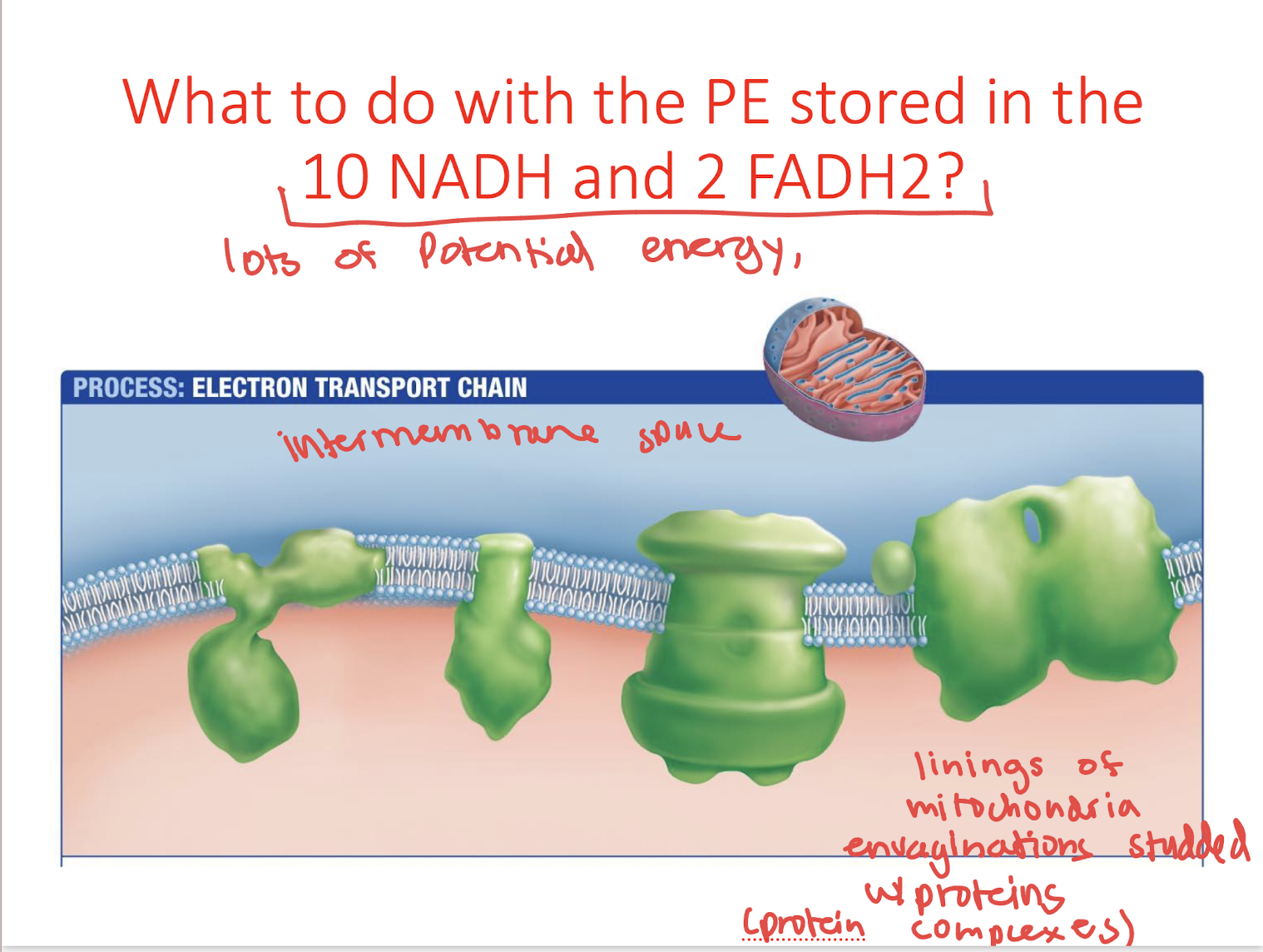
What to do with PE stored in 10NADH & 2 FADH2 from glycolysis, pyruvate processing, and citric acid cycle?
Inner mitochondria cirstate studded with protein complexes
Cytoplasm in inter-membrane space
Electron Transport Chain!!
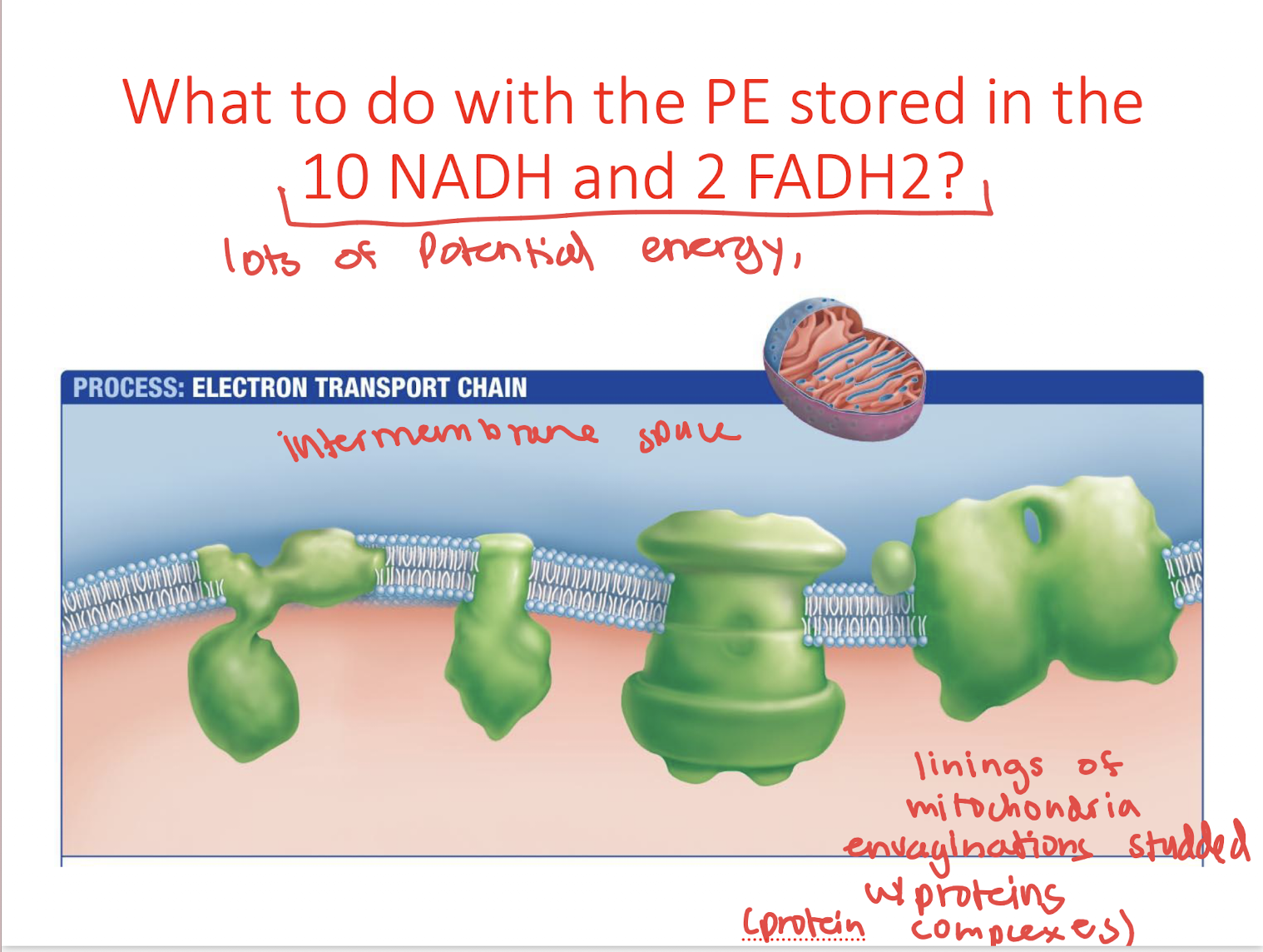
Where is the electron transport chain located in eukaryotes?
Inner mitochondrial membrane
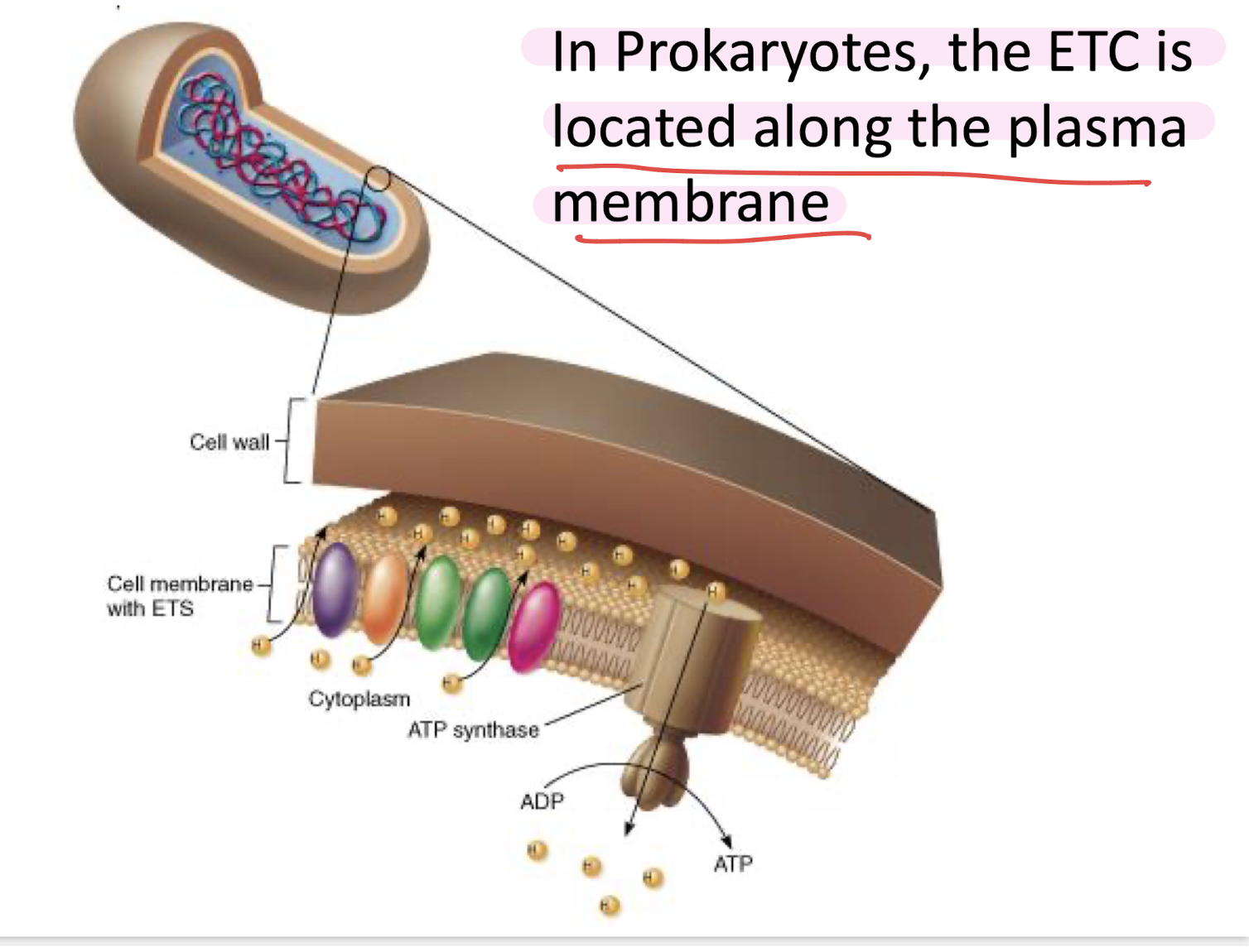
Where is the electron transport chain located in prokaryotes?
along the plasma membrane
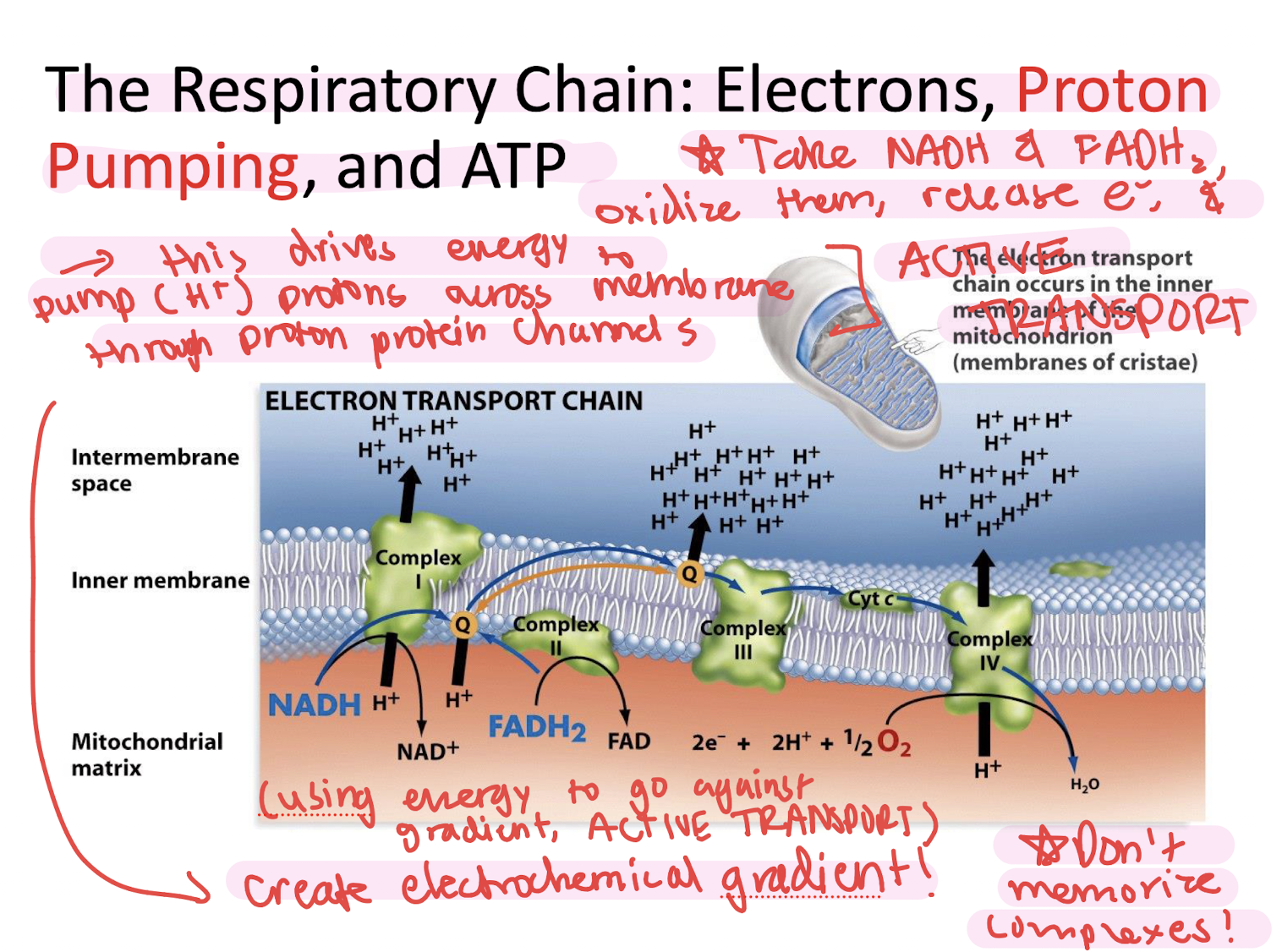
Electron Transport Chain Brief
Function
Uses NADH & FADH₂ electrons (oxidizes them)
Energy used to Creates H⁺ gradient/Pump protons against membrane AGAINST gradient (ACTIVE TRANSPORT)
Drives ATP production
Chemiosmosis
H⁺ Gradient
High H⁺ outside membrane
Low H⁺ inside
👉 Stores potential energy
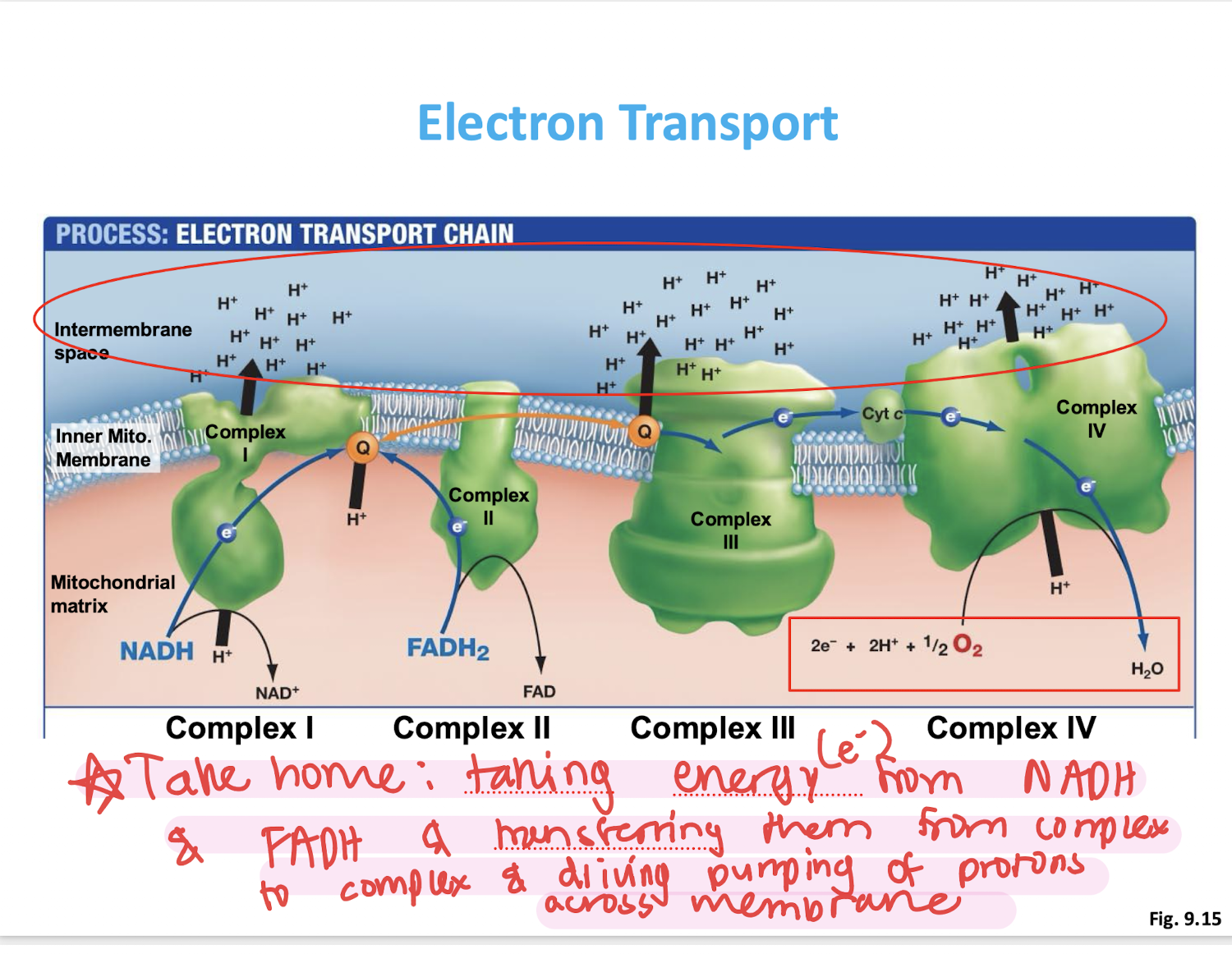
Take home of Electron Transport Chain
taking electrons (energy) from NADH & FADH2 & transferring electrons from complex to complex, activating proton pumping, creating a GRADIENT
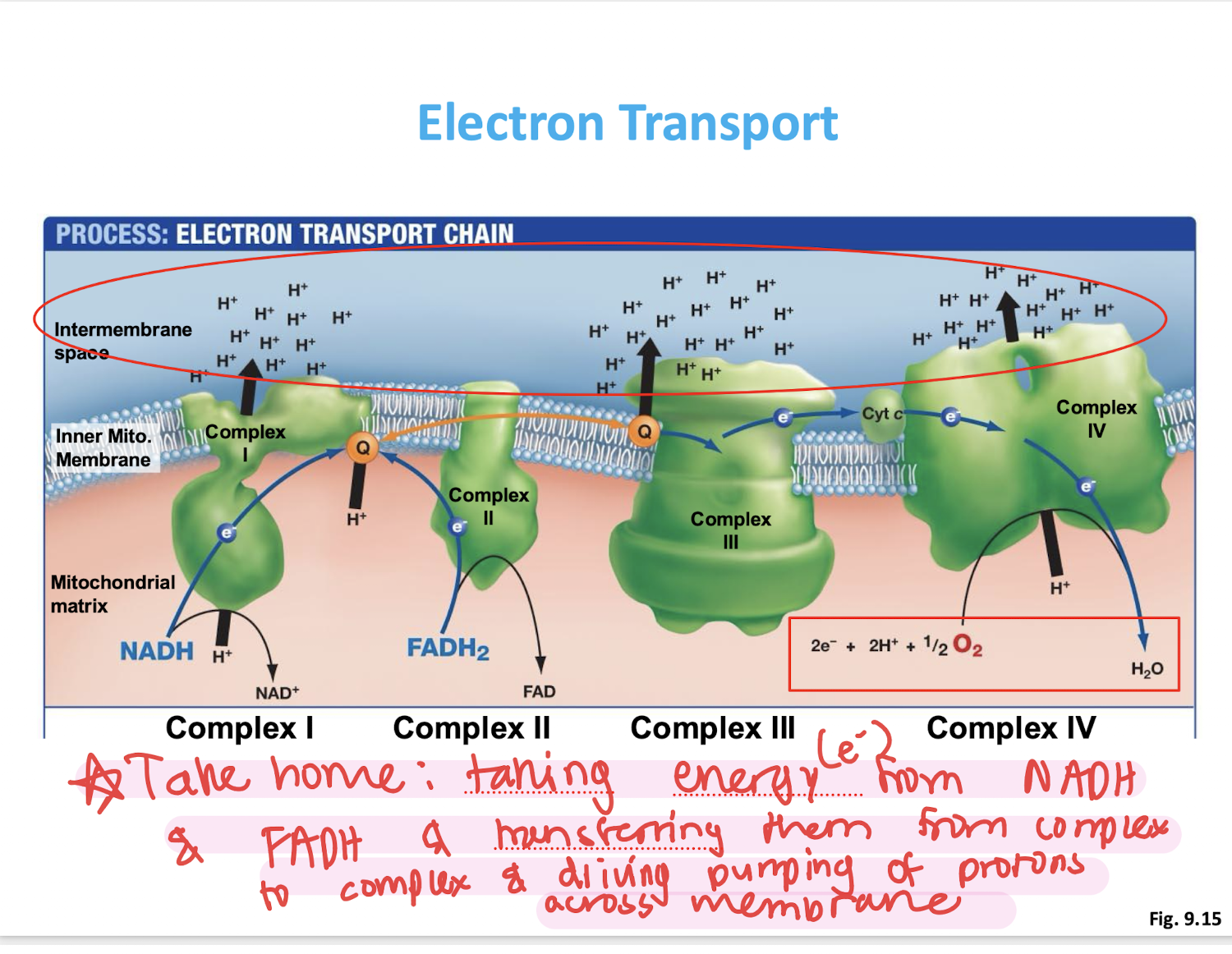
After Electron Transport Chain, Electrons are Transported to (AEROBIC RESPIRATION)
Oxygen! (Final electron acceptor)—> prduce H2O
After Electron Transport Chain, Electrons are Transported to (ANAEROBIC RESPIRATION, PROKARYOTES)
other NON-oxygen final electron acceptor (small molecule)
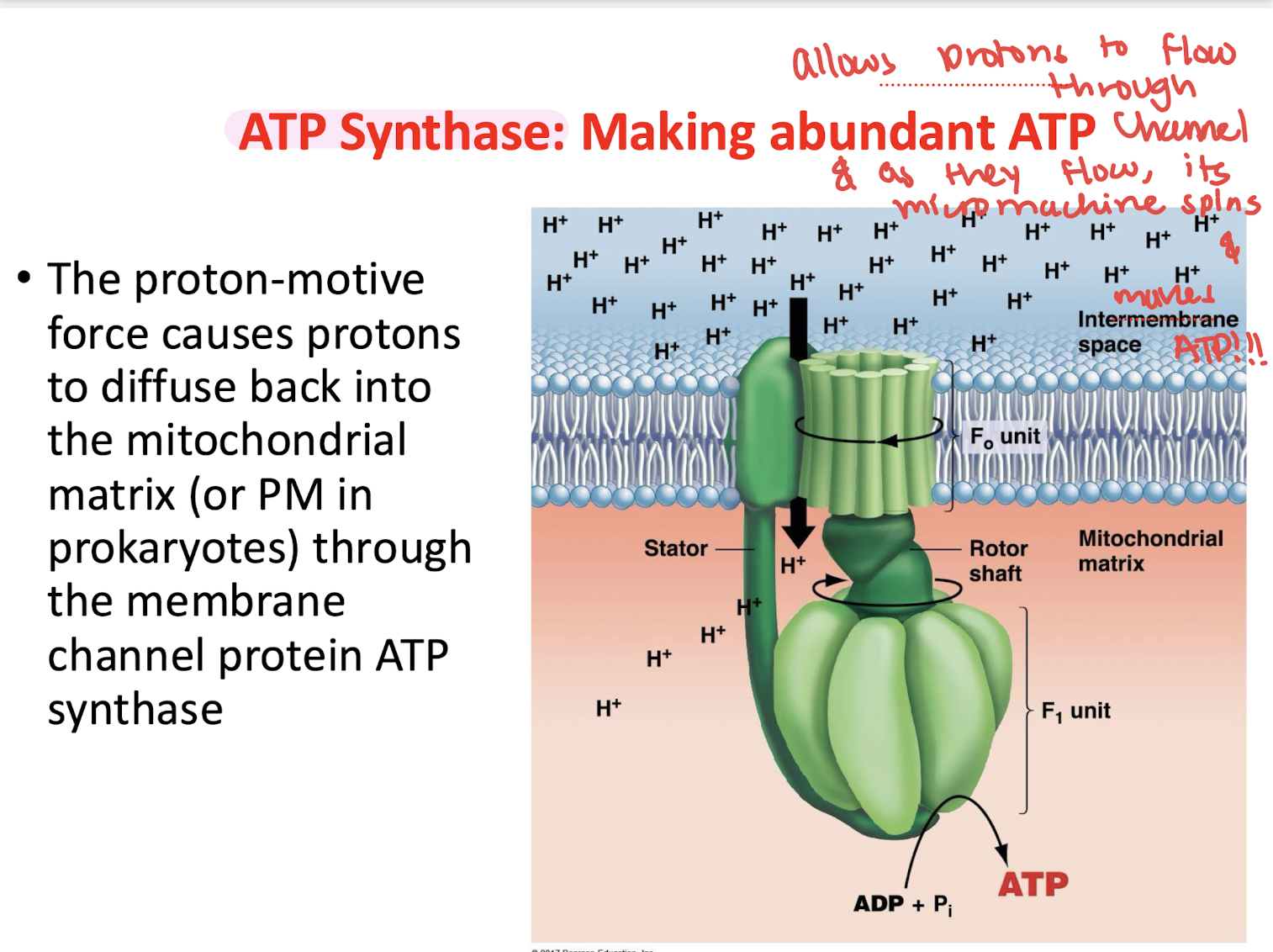
ATP Synthase
protein complex
allows protons to flow through channel & as hey flow, micromachine spins & makes ATP!!
Acts like a turbine
H⁺ flow → spins enzyme → makes ATP
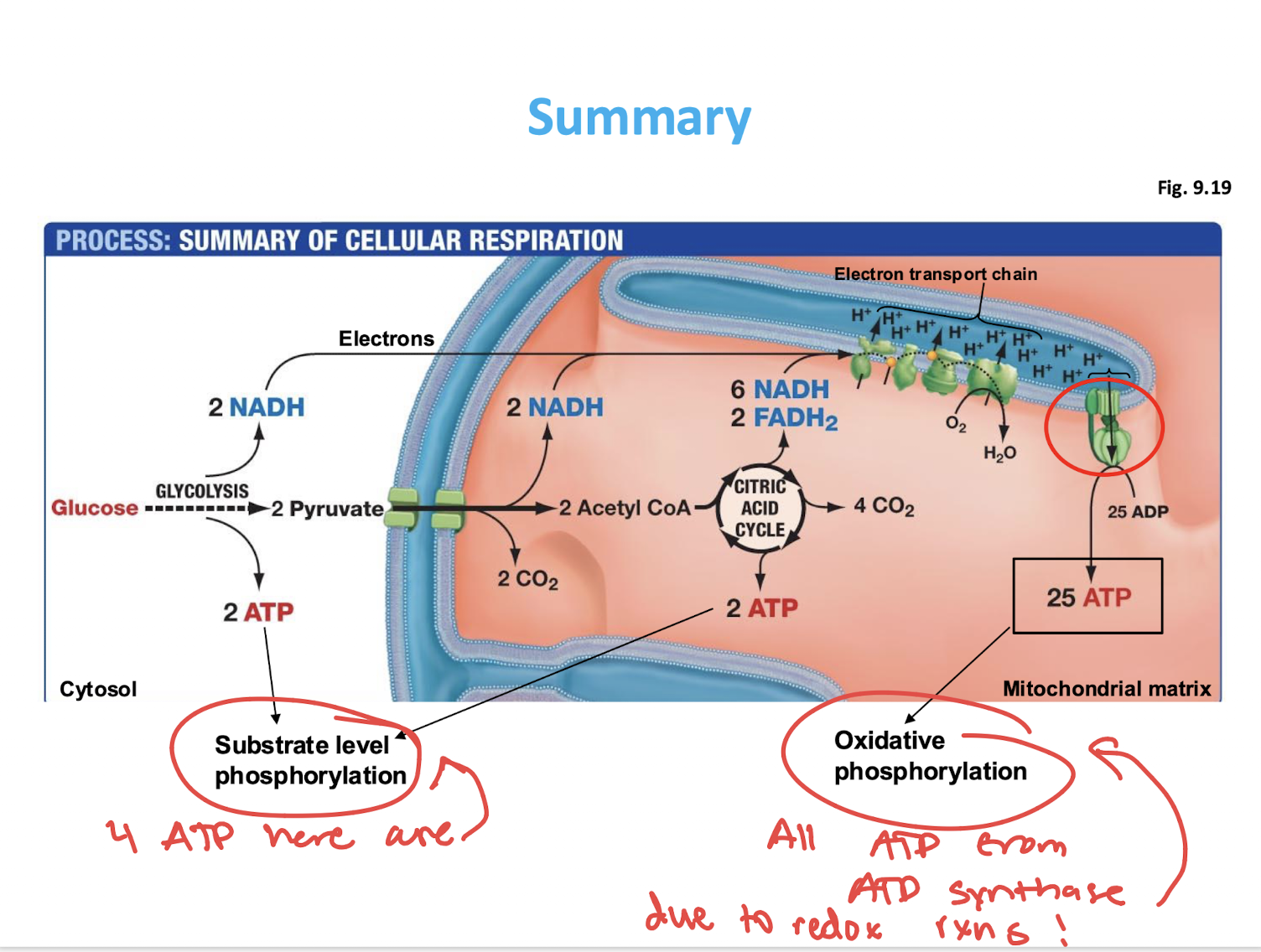
Net: 1 molecule of glucose through Aerobic Respiration
net greater than 25
4 from glycolysis & citric acid cycle
more than 25 from ETC & ATP synthase
How many ATP from substrate level phosphorylation?
4 ATP
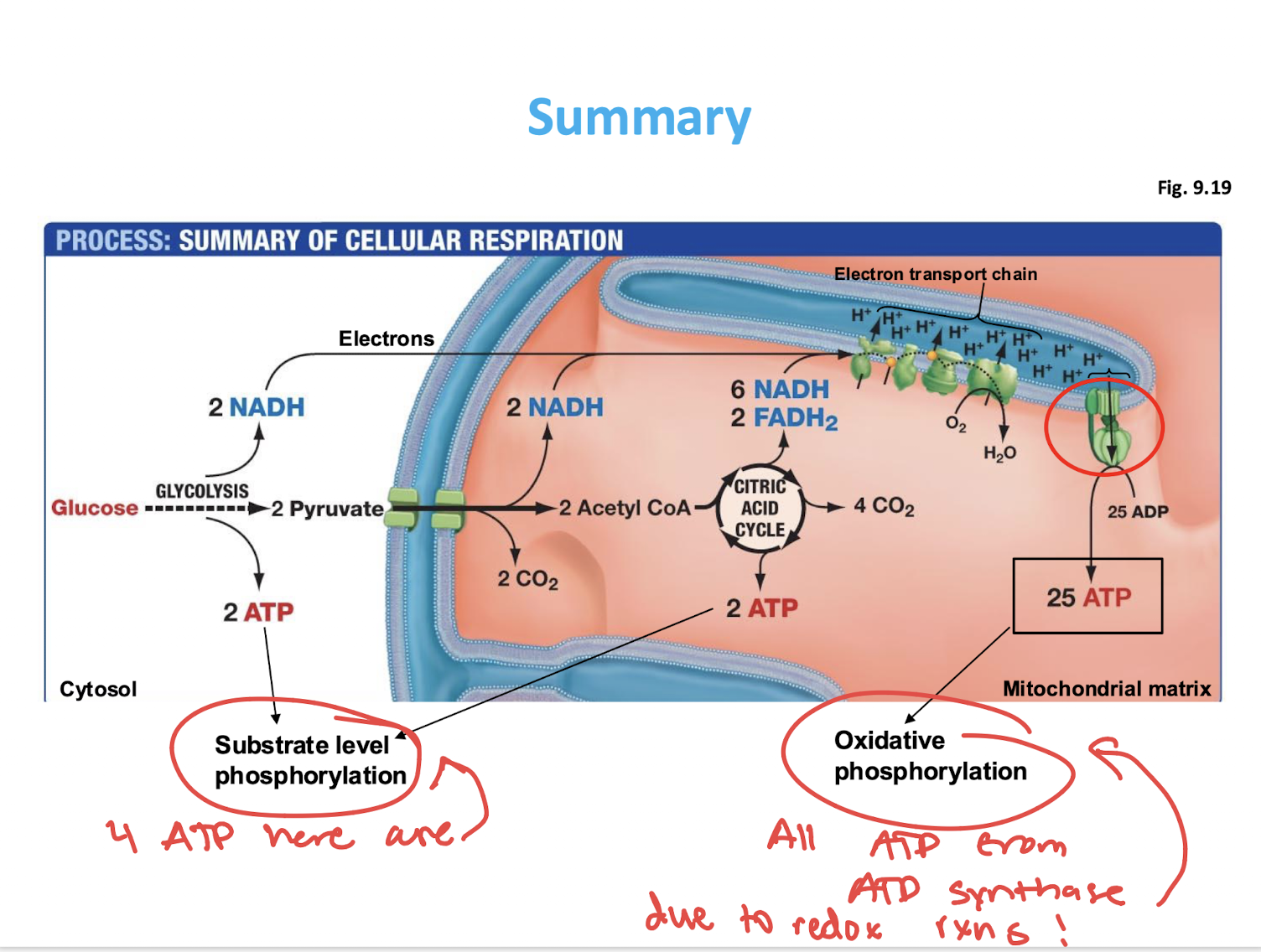
How many ATP from oxidative phosphorylation?
pretty much all ATP from ATP synthase due to redox reactions!!!
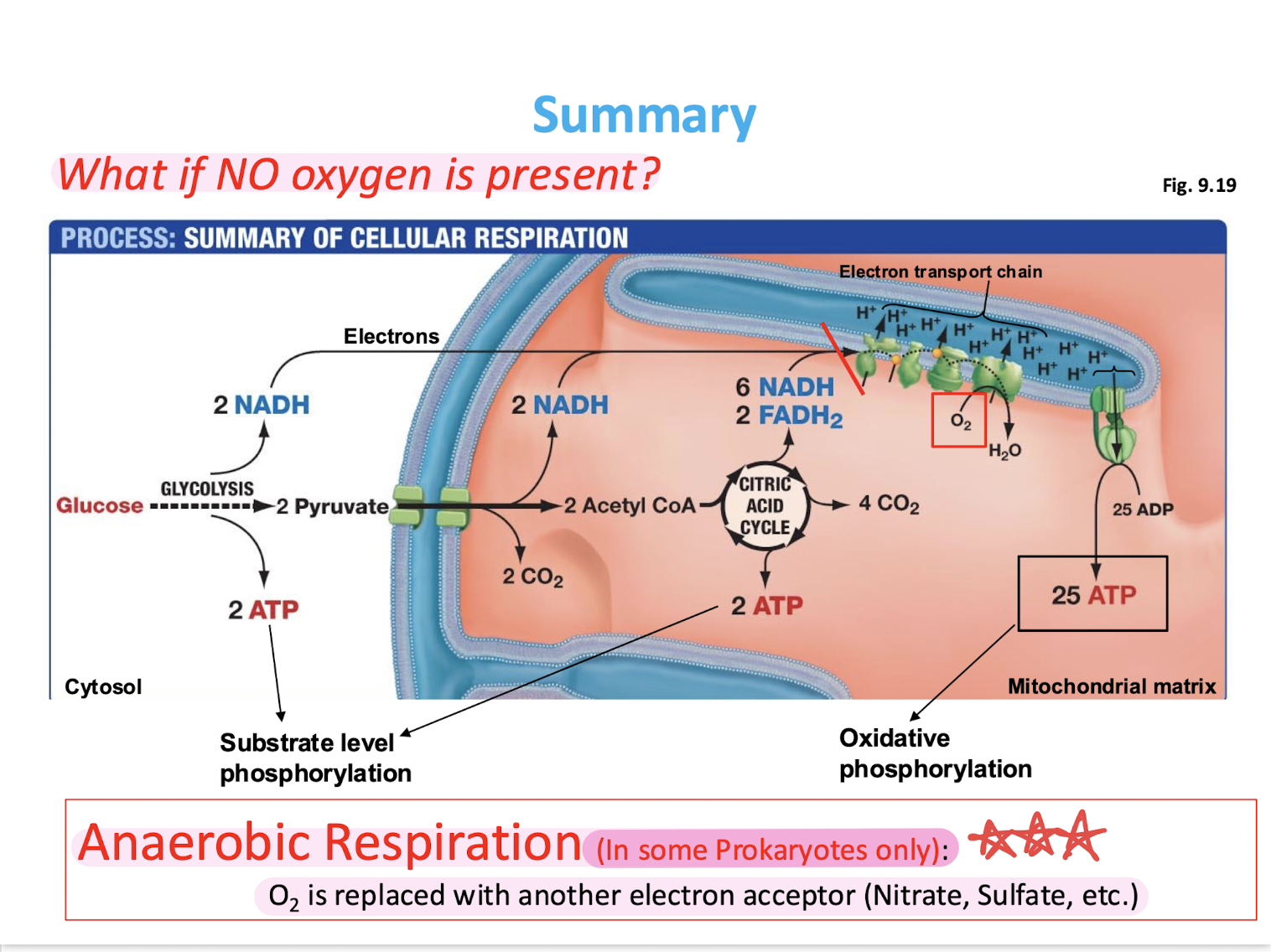
IF NO OXYGEN IS PRESENT
Anaerobic respiration will occur!! (In some prokaryotes only)
O2 is replaced w/another electron acceptor (nitrate, sulfate, etc)
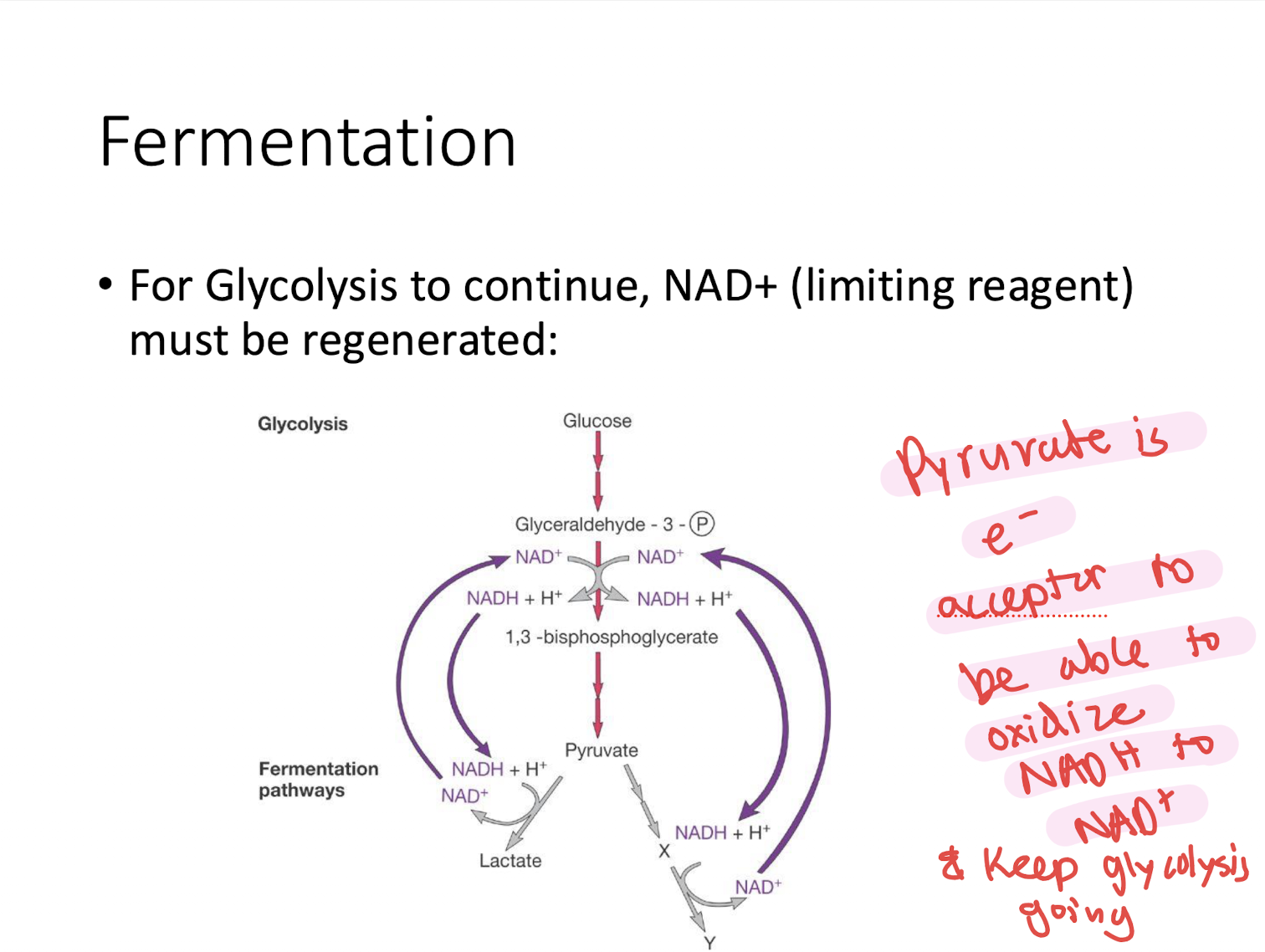
No oxygen, how to regenerate NAD+ to continue glycolysis?
Fermentation!!!
Fermentation
Pyruvate is used as the electron acceptor to be able to oxidize NADH back to NAD+ & keep glycolysis going!!!
Human fermentation?
Lactic fermentation
Fermentation 4 important observations
1) NADH is oxidized to NAD+
2) Electron acceptor is pyruvate ot pyruvate derivative
3) O2 generally not present
4) ETC cannot operate = decreased ATP yield