Topic 6a - Rate of Reaction
 Call Kai
 Learn
Learn Practice Test
 Spaced Repetition
 Match
Match Flashcards
 Knowt Play
1/16

There's no tags or description
Looks like no tags are added yet.
Name | Mastery | Learn | Test | Matching | Spaced | Call with Kai | Chat |
|---|
No analytics yet
Send a link to your students to track their progress
17 Terms
What 3 things must particles do in order to react
Collide
Must have at least the minimum required energy to react (activation energy)
Collide with the correct orientation
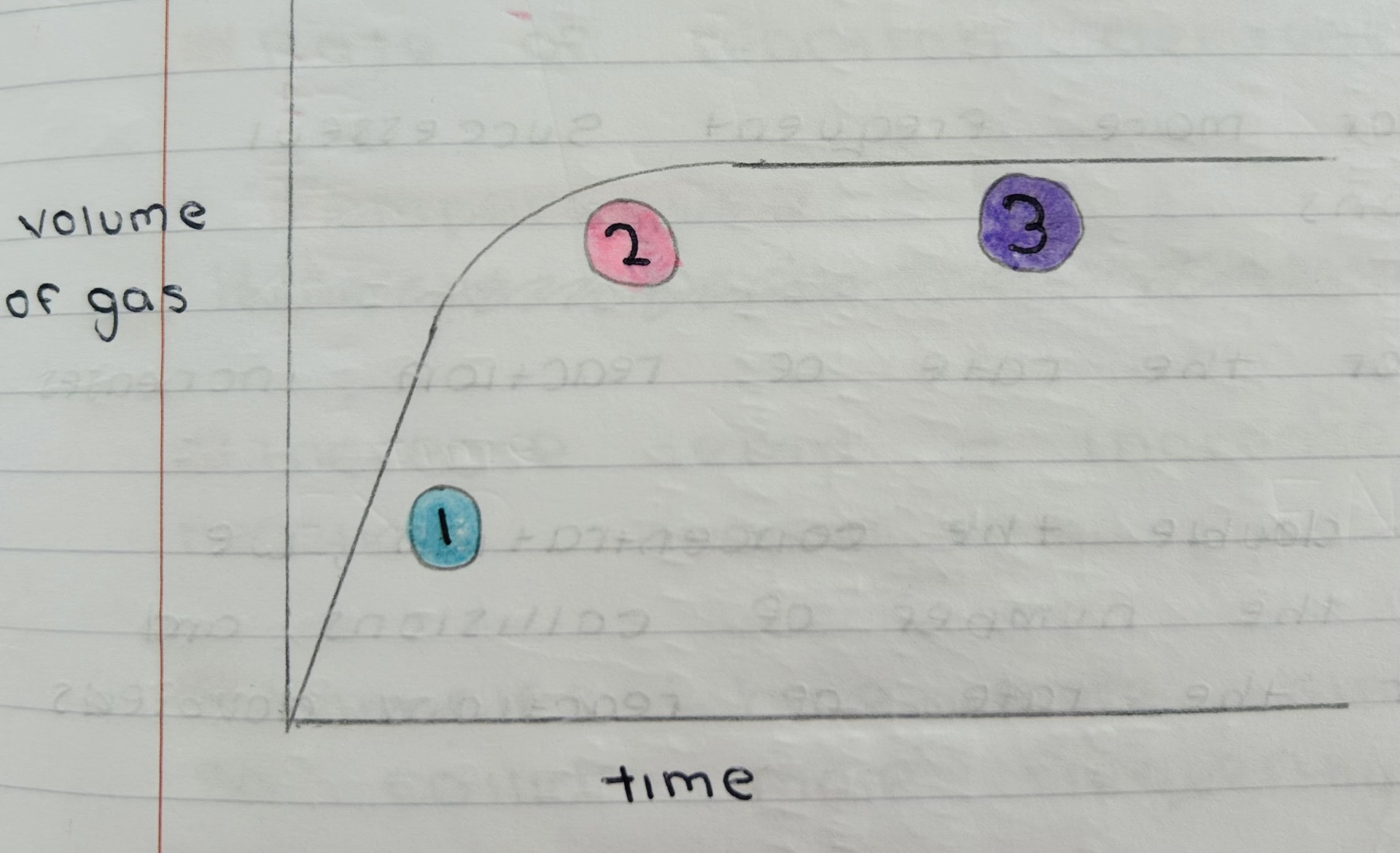
What happens in this reaction progress graph
1) Initial rate, fast, lots of reacting, particles = lots of collisions
2) Rate slows, successful collisions occur less frequently
3) Rate = 0, one or more of the reactants have been used up
4 factors that affect the rate of reaction
Concentration/pressure
Temperature
Surface area
Catalyst
How does concentration affect the rate of reaction
Increased concentration means more particles in the same space therefore more collisions
Therefore more frequent successful collisions
Therefore the rate of reaction increases
What happens to the rate of reaction when the concentration is doubled
If we double the concentration, we double the number of collisions and therefore the rate of reaction doubles
How does temperature affect the rate of reaction
Increase temp = increase rate of reaction
Particles have more kinetic energy so collide more frequently (and with more energy)
More particles have at least the minimum required energy to react
Increased frequency of successful collisions
How does surface area affect the rate of reaction
Increasing SA provides particles with more space to collide
Increases number of collisions
Increases frequency of successful collisions
Rate increases
Using collision theory, what happens to the rate of reaction when the volume the reaction takes place in is increased
Increasing the volume decreases the pressure
This causes particles to collide less frequently (as they are further apart)
Therefore less frequent successful collisions
Rate of reaction decreases
What is a catalyst
A catalyst is a chemical that speeds up a reaction by offering an alternate reaction pathway with a lower activation energy requirement without being changed or used up in the reaction
How does catalysts affect the rate of reaction
Lower the minimum energy required to react
More particles now have at least minimum required energy
Increased frequency of successful collisions
Rate increases
A reaction profile for a catalysed reaction

Mean rate of reaction equation
The quantity of reactant or product can be measured by the mass in grams or by a volume in cm3
The units of rate of reaction may be given as g/s or cm3 /s
The amount of product or reactant can be given in moles, so the units of rate could also be mol/s

Why is mean rate called mean rate
It’s the average
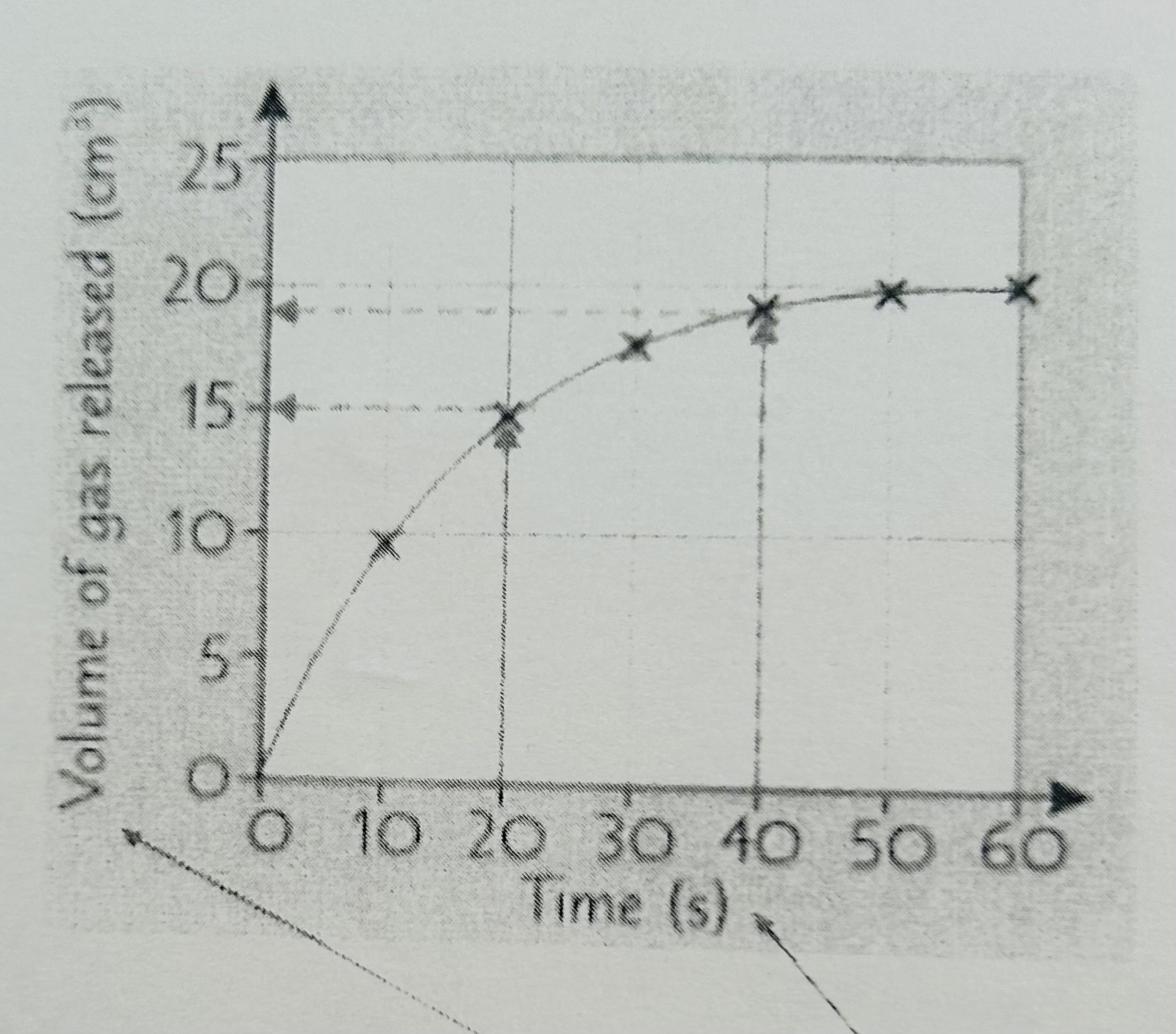
How to find rate of reaction from a graph:
Calculate the mean rate
The mean rate after 20 seconds is:
15/20 = 0.75
The mean rate after 40 seconds is:
19/40 = 0.48
The mean rate between two times eg 20 & 40 seconds is:
Volume at 40 seconds - Volume at 20 seconds/ difference in time
19-15/40-20 = 4/20 = 0.2
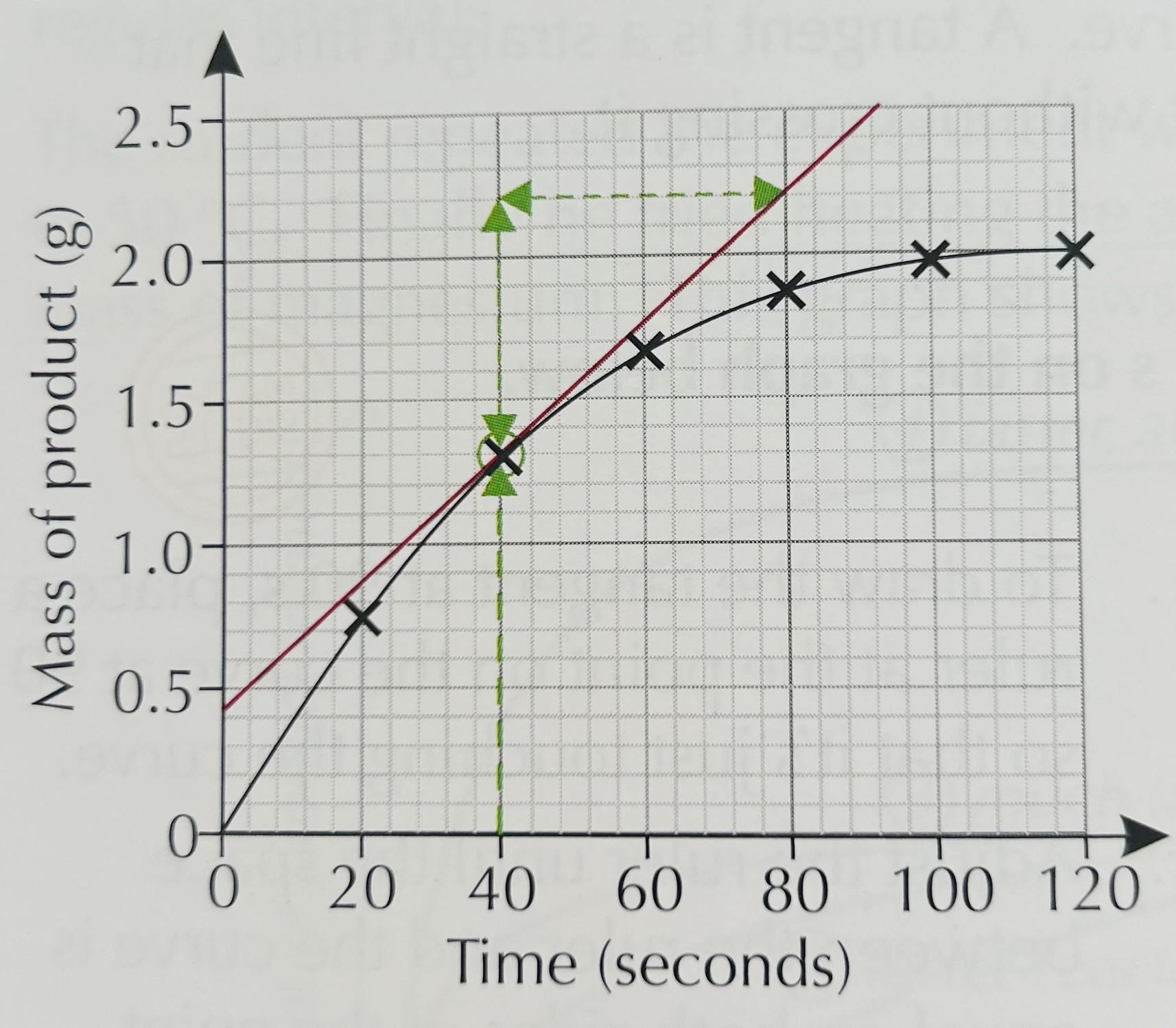
Calculate rate of reaction from a tangent
How to do it:
Draw a straight line that touches the curve at the point you are asked about
The middle of your straight line must touch the curve
Draw a triangle
Gradient = change in y / change in x
For example for this graph:
= (2.2 - 1.3) / (80-40)
= 0.90 / 40 = 0.023
Why the control variable had to be controlled in the experiments
So its accurate and so you know what causes the changes
Example questions for experiments -
Describe what the results tell us how changing the concentration affects the rate of reaction
When the rate of concentration increases the rate of reaction increases too. When the rate is … the concentration is … and when the rate is … the concentration is …