Organic chem: Alkenes
 Call Kai
 Learn
 Practice Test
 Spaced Repetition
 Match
 Flashcards
 Knowt Play
1/28

Earn XP
Description and Tags
29 Terms
Rules for naming alkenes
The position of the c=c must be specified in the name
The alkene is always given priority when applying numbers over alkly groups
The longest carbon chain becomes the one with the alkene
Multiple alkenes in the same molecule must be names using di/tri/tetra/penta
Always include whether it is a E/Z isomer in the name
What does a double bond consist of?
A sigma bond and a π bond
How are π bonds formed?
They form due to the sideways overlap of adjacent p-orbitals
This creates a region of increased electron density above and below the σ-bond

Shape and bond angle of alkenes
Trigonal planar shape
Bond angle of 120°
Why are alkenes more reactive than alkanes?
The π bond is weaker than the σ-bond
Why do alkenes perform addition reactions?
Due to the weaker π bond
What are the 4 types of addition reactions?
Halogenation
Hydrogenation
Hydrogen halide
Hydration
Halogenation- conditions and eg
Conditions: any halogen, room temp, room pressure

Hydrogenation- conditions and eg
Conditions: hydrogen, 150°C, nickel catalyst

Hydrogen halide- conditions and eg
Conditions: any hydrogen halide, room temp, room pressure

Hydration- conditions and eg
Conditions: H₂O(g) (steam), 300°C, phosphoric acid catalyst

What is the name of the mechanism for alkenes?
Electrophilic addition
Define electrophile
An electron pair acceptor
How do the reactions of alkenes start?
They start via heterolytic bond fission
This involves one atom taking both electrons from a covalent bond to form ions
What does the curly arrow show?
Movement of a pair of electrons
Electrophilic addition mechanism for ethene and HBr with explanations
Carbon double bond breaks + a bond is formed between a carbon and the hydrogen
Hydrogen to bromine bond breaks to form a Br- ion
Br- ion formind a bond with the carbocation intermediate

Major and minor product during electrophilic addition
The major product is most likely to form as it forms via a more stable carbocation intermediate
Alkyl groups act as electron donating groups which act to stabilise the carbocation
The major product forms with
the most alkyl groups
more carbon atoms bonded to it
Define steroisomerism
A molecule with the same structural formula but a different arrangement of atoms in space
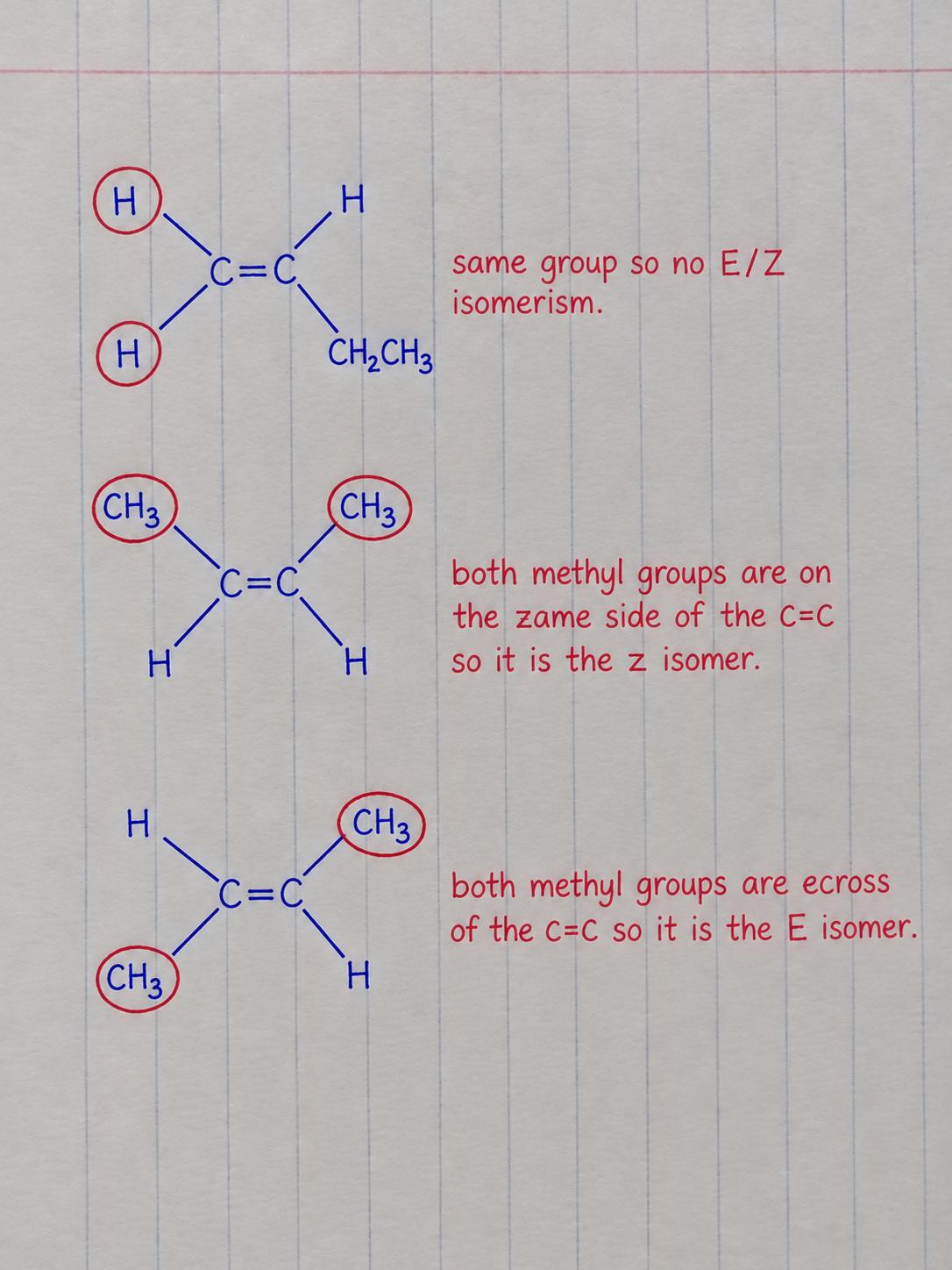
Why does E/Z isomerism happen?
Due to the lack of rotation around the C=C
E/Z isomerism
What is cis/trans isomerism?
A type of E/Z isomerism that only happens when both carbons in the double bond have a hydrogen atom attached
Example of cis/trans isomerism

Cahn-ingold-prelog rules (CIP)
Each atom attached to the carbonds of the double bond is assigned a priority based on atomic number
If both higher priority group are on the zame side it is the z-isomer
If both higher priority groups are ecross it is the E-isomer
When the same atom is directly bonded to the carbond of the double bond you assign priority using the first point of difference
Example of cahn-ingold-prelog rules

Define polymers
Very large simple molecules formed from thousands of monomers
Define monomer
A small molecule that combines with other monomers to form a polymer
How to name polymers?
Place the prefix -poly before the name of its parent monomer
How to draw addition polymers?
