ch18 - respiratory substrates
 Call Kai
 Learn
Learn Practice Test
 Spaced Repetition
 Match
Match Flashcards
 Knowt Play
1/11

There's no tags or description
Looks like no tags are added yet.
Name | Mastery | Learn | Test | Matching | Spaced | Call with Kai |
|---|
No analytics yet
Send a link to your students to track their progress
12 Terms
When an organism respires what substrate is used majority of the time?
Glucose (a carbohydrate)
What are the other two alternative respiratory substrates?
Proteins and Lipids
How can lipids be used as a respiratory substrate?
Lipids such as triglycerides are hydrolysed which digests the ester bonds releasing individual glycerol and fatty acid molecules
Glycerol enters glycolysis as TP to be converted into pyruvate - (because glycerol and pyruvate both contain 3C)
Fatty acids molecules are broken down into 2C units to be converted into acetyl CoA
How can proteins be used as respiratory substrates?
Proteins are hydrolysed into amino acids during digestion
Amine group is removed from from amino acids by deamination in the liver leaving the 3C part to be converted into pyruvate
What is the respiratory quotient (RQ) and what does it tell us
ratio of volume of CO2 produced : to volume of O2 used
> it tells us the substrate being primarily used for respiration
What is the (RQ) formula
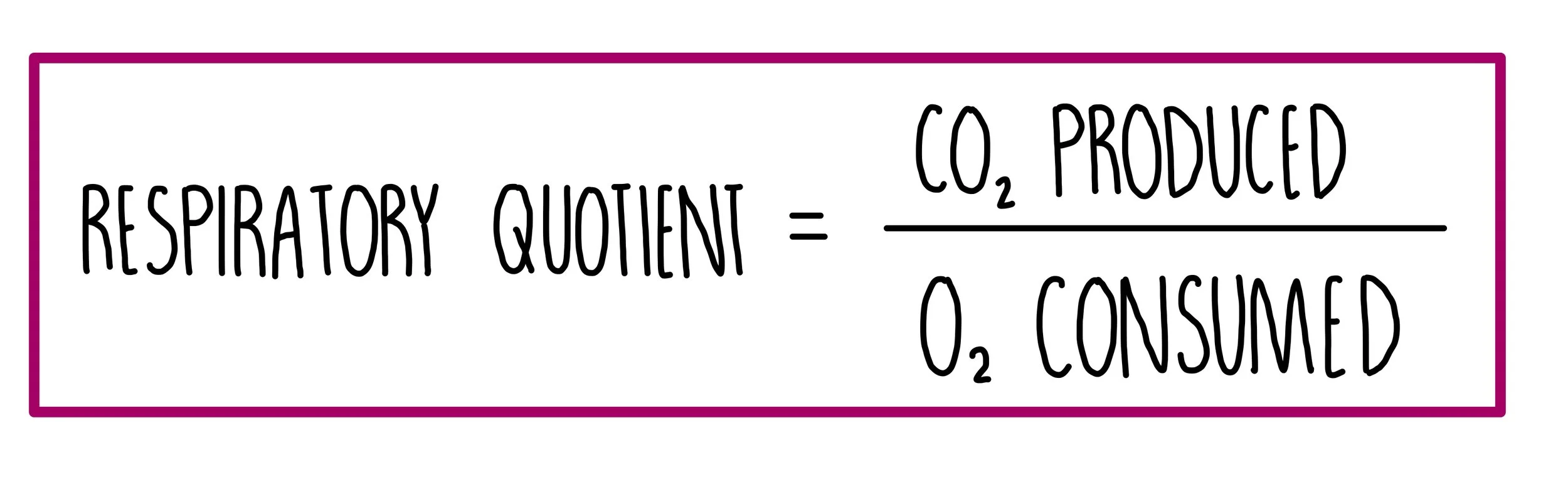
What is the RQ values for the 3 respiratory substrates
carbohydrates = 1.0
proteins = 0.9
lipids = 0.7
what does an RQ bigger than 1 suggest
that anaerobic respiration is taking place
how much quantity of ATP does carbohydrates release and what is their unique role in cellular respiration
energy yield = least amount
role = primary choice for energy as they are easily accessible
how much quantity of ATP does proteins release and what is their unique role in cellular respiration
energy yield = moderate amount
role = only used for respiration when other sources are limited
how much quantity of ATP does lipids release and what is their unique role in cellular respiration
energy yield = highest amount (x2 ATP compared to carbohydrates) due to high amount of CH bonds
-more CH bonds = when lipids are hydrolysed lots of hydrogens released = more coenzymes reduced = more electrons transported to ETC = more energy released and used during chemiosmosis to produce ATP
role = ideal for long term energy storage because:
-broken down/metabolised much more slowly compared to carbohydrates
-insoluble in water
what can be used to measure oxygen consumption by organisms and how does it work
a respirometer
> if oxygen is absorbed the pressure will decrease so coloured fluid in apparatus will move CLOSER towards organism
> distance moved by fluid = volume of oxygen consumed