ENTEROTOXIGENIC E.COLI
 Call Kai
 Learn
Learn Practice Test
 Spaced Repetition
 Match
Match Flashcards
 Knowt Play
1/6

There's no tags or description
Looks like no tags are added yet.
Name | Mastery | Learn | Test | Matching | Spaced | Call with Kai |
|---|
No analytics yet
Send a link to your students to track their progress
7 Terms
key pathogenic mechanism / virulence factor
colonization factor antigen (CFA/I , II, III)
heat labile toxin (LT)
heat stable toxin (ST)
palsmid mediated—transmissible plasmid
ETEC strain can produce either LT or ST or both
clinical manifesttaion and complication
self limited
watery diarrhea
dvlpd 1-3 days later
symptom similar to cholera but milder
causing:
Traveler’s diarrhea
Weanling diarrhea (Infant diarrhea)
mode of transmission
fecal oral
no person to person spread
pathogenesis
STEP 1 : COLONIZATION FACTOR
attachement on host intestinal
STEP 2 : elaborate plasmid encoded enterotoxin
Heat stable toxin
Heat labile toxin
PATHOGENESIS OF HEAT LABILE TOXIN
B subunit of LT toxin bind to GM1 ganglioside of host epithelium
endocytosis into epithelium
A subunit moves across the membrane vacuole
interact with membrane protein , regulate adenylate cyclase
increase cAMP level
decrease absorption of Cl- and Na+ , increase secretion of Na+
manifest water diarrhea
activate secretio of PG and production of inflammatory cytokine
further fluid loss
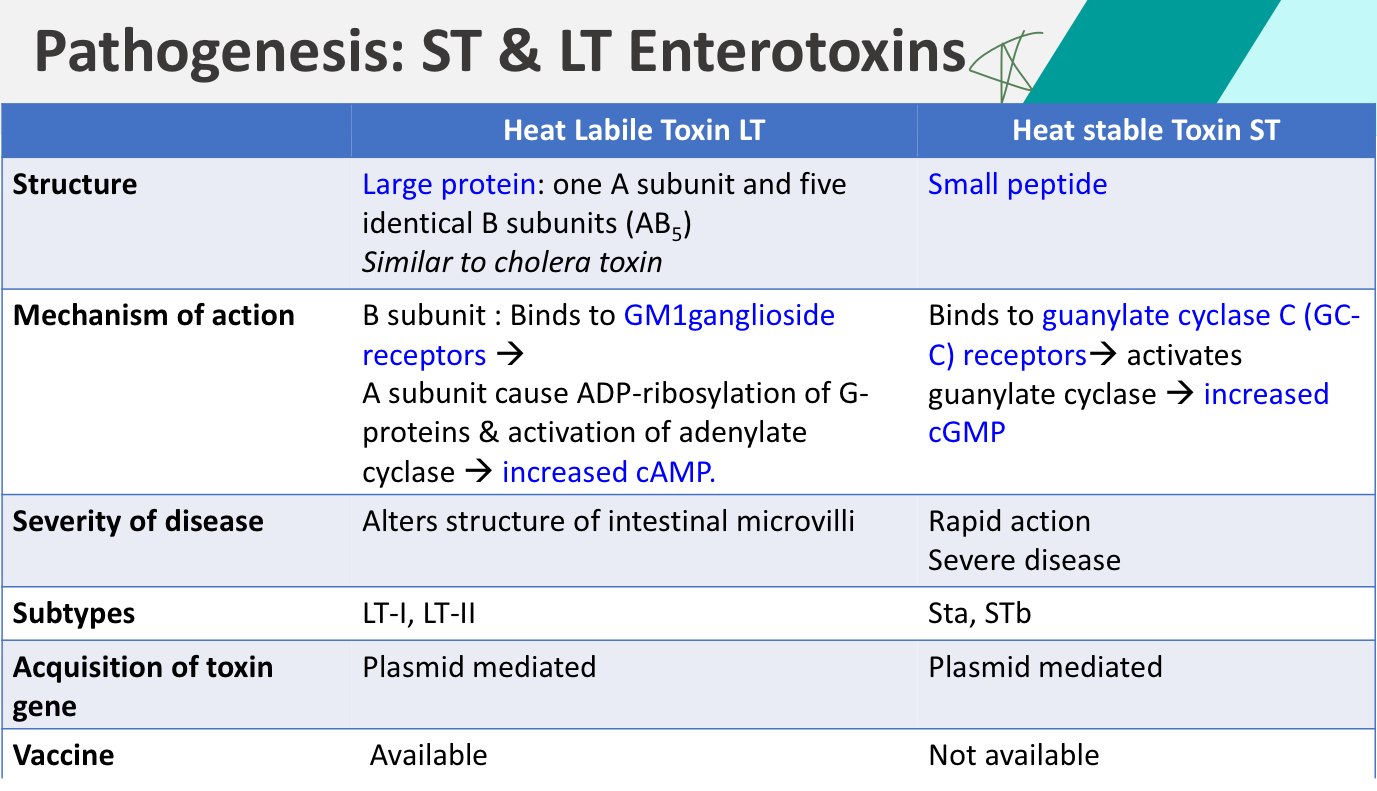
compare LT and ST toxin
diagnosis of ETEC
samples
patients and food sample
molecular method
PCR genotyping → identify gene encode LT and ST toxin
DNA probe → detect virulence gene in stool
immunoassay (ELISA )
detect LT and ST enterotoxin in stool
treatment
supportive measure : fluid balance
no hospitalization/ antibiotic