2.6 Prokaryotic and eukaryotic cells
 Call Kai
 Learn
Learn Practice Test
 Spaced Repetition
 Match
Match Flashcards
 Knowt Play
1/70

There's no tags or description
Looks like no tags are added yet.
Name | Mastery | Learn | Test | Matching | Spaced | Call with Kai |
|---|
No analytics yet
Send a link to your students to track their progress
71 Terms
When did prokaryotic cells first sppear?
3.5 billion years ago - when earth was a very hostile environment
What conditions do scientists believe prokaryotic cells adapted to live in?
extreme conditions of salinity, pH and temperature
What are these prokaryotic cells that have adapted to extreme environment called?
extremophiles
What environments are extremophiles found in today?
hydrothermal vents and salt lakes (similar to environments that made up early earth)
What domain are prokaryotic cells a part of?
archaea
What type of hospitable environments have extremophiles been found in recently?
soil and the human digestive system
What is Salinity?
is the dissolved salt content of a body of water
What does unicellular mean?
an organism that consists of a single cell (single-celled organism)
What organisms are always unicellular?
prokaryotic organisms
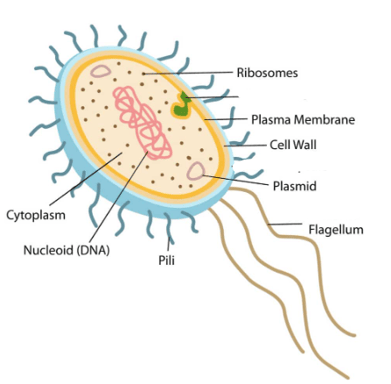
Subcellular structures of a prokaryotic cell (9)?
cell wall, chromosomal DNA, ribosomes, flagella, plasmids, cytoplasm, plasma/cell surface membrane, cytoplasm, pili
Prokaryotic cell diagram?
…
How much DNA do prokaryotic cells usually contain?
one molecule of DNA- a chromosome
What happens to this chromosome to make it more compact?
it is supercoiled
What are the genes on the chromosomes grouped into (in prokaryotic cells)?
operons
What are operons?
a cluster of genes controlled by a single promoter, allowing for coordinated expression
How does being grouped into operons effect how genes act when being switched on or off?
a number of genes are switched on or off at the same time
What is the relative size of ribosomes determined by?
by the rate at which they settle or form a sediment, in a solution
What is the cell wall made out of in prokaryotic cells?
peptidoglycan
What is peptidoglycan also known as?
Murein
What is peptidoglycan?
a complex polymer
What is the complex polymer peptidoglycan formed from?
amino acids and sugars
When did the first eukaryotic cell appear on earth?
1.5 billion years ago
Main difference between eukaryotic and prokaryotic cells?
eukaryotic cells are much more complex
Where is the DNA present in eukaryotic cells?
the nucleus
What is the DNA present as in eukaryotic cells?
supercoiled chromosomes
What does each chromosomes wrap round in eukaryotic cells?
histones
Histones?
proteins that provide structural support for a chromosomes
Why do chromosomes wrap around histones?
for efficient packaging
What is the complex of the chromosomes wrapped around histones called?
chromatin
What does chromatin coil and condense to form?
chromosomes
What kingdoms contain organisms composed of eukaryotic cells (4)?
plant, animal, fungi and protoctista
Differences between prokaryotic flagella and eukaryotic flagella?
flagella of prokaryotes is thinner and doesn't contain the 9+2 arrangement
Where does the energy come from that causes the flagella rotate in eukaryotic cells?
ATP
Where does the energy come from that causes the flagella rotate in prokaryotic cells?
the process of chemiosmosis
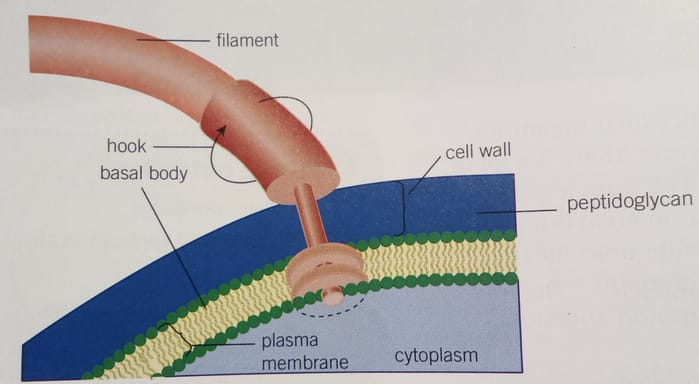
Prokaryotic cell: what is the flagellum attached to in a bacterium?
the membrane of the bacterium
Prokaryotic cell: What attaches the flagellum to the cell membrane?
a Basal body
Prokaryotic cell: what rotates the flagellum?
a molecular motor
Prokaryotic cell: What does the basal body do?
attaches the filament comprising the flagellum to the cell-surface membrane of a bacterium
Prokaryotic cell: What gives the filament a whip movement?
a motor molecule causes the hook/basal body to rotate
Prokaryotic cell: What does the filament (flagellum) having a whip movement do to the cell?
propels the cell
Size of ribosomes in prokaryotic cells?
70S (smaller)
Size of ribosomes in eukaryotic cells?
80S (larger)
What are both of these sizes of ribosomes necessary for?
protein synthesis
What are the larger (80S, eukaryotic) ribosomes involved in the formation of?
more complex proteins
Differences: Prokaryotic nucleus?
not present - DNA free in cytoplasm
Differences: Eukaryotic nucleus?
nucleus present - DNA inside nucleus
Differences: Prokaryotic DNA shape?
circular
Differences: Eukaryotic DNA shape?
distinctly linear (having distinct ends)
Differences: Prokaryotic cell size?
extremely small - less than 2μm in diameter
Differences: Eukaryotic cell size?
larger cells, 10-100 μm in diameter
Differences: is the cytoskeleton present in prokaryotic cells?
yes
Differences: is the cytoskeleton present in eukaryotic cells?
yes - but more complex
Differences: how do prokaryotic cells reproduce?
binary fission
What is binary fission?
the process of asexual reproduction and cell division in prokaryotic cells
Differences: how do eukaryotic cells reproduce?
asexual or sexual
Differences: prokaryotic cell type?
unicellular (single celled organism)
Differences: eukaryotic cell type?
unicellular and multicellular
What type of cells is the cell surface (plasma) membrane present in?
prokaryotic and eukaryotic cells
Differences: what is the cell wall made out of in prokaryotic cells?
peptidoglycan
Differences: what is the cell wall made out of in fungi (eukaryotic) cells?
Chitin
Differences: what is the cell wall made out of in plants (eukaryotic) cells?
Cellulose
Differences: what type of cell is the cell wall not present in (eukaryotic)?
Animal cells
Diagram of a prokaryotic flagellum?
…
Differences: the type of organelles in prokaryotic cells?
non-membrane bound
Differences: the type of organelles in eukaryotic cells?
both membrane-bound and non membrane-bound organelles.
Differences: the number of organelles in prokaryotic cells?
few organelles
Differences: the number of organelles in eukaryotic cells?
many organelles
Differences: how is the DNA organised in prokaryotic cells?
Differences: how is the DNA organised in eukaryotic cells?
Linear chromosomes in the nucleus, organized around histone proteins.
Differences: What is the extra chromosomal DNA in prokaryotic cells?
circular DNA called Plasmids
Differences: Where is extra chromosomal DNA present in eukaryotic cells?
only present in some organelles such as chloroplasts and mitochondria