Marine science overview
 Call Kai
 Learn
Learn Practice Test
 Spaced Repetition
 Match
Match Flashcards
 Knowt Play
1/240

There's no tags or description
Looks like no tags are added yet.
Name | Mastery | Learn | Test | Matching | Spaced | Call with Kai |
|---|
No analytics yet
Send a link to your students to track their progress
241 Terms
Why do water molecules have emergent properties
Oxygen and hydrogen have unique characteristics on their own
When they bond to form water molecules, the compound develops new characteristics called emergent properties
What is a result of water having a high heat capacity
Water can resist temperature changes, moderating climate
What happens to the density of water when water freezes
It decreases, and ice floats in water
How do hydrogen bonds contribute to waters property as a universal solvent
The oxygen atom in water has a partial negative charge while the hydrogen atoms have partial positive charges
This polarity allows molecules to surround and interact with various ionic and polar substances
Why does ice float on water and what is the ecological significance of it in aquatic environments
Ice floats on water because its less dense than liquid water
This occurs because in its solid form water molecules form crystalline structure due to hydrogen bonding
This structure holds the molecules further apart than in liquid water, resulting in lower density
Ecological significance is that it acts as an insulting layer preventing water below from freezing solid this allows marine animals to survive under water during cold months
Role of a solvent in a solution
To dissolve other substances
Why does sodium chloride dissolve easily in water
Partially positive hydrogen of water molecule surrounds the negative chloride ions
Partially negative oxygen end in water molecule surrounds the positive sodium ion
This force breaks the ionic bond between sodium and chloride
How does increase in water temperature impacts the solubility of sodium chloride
As water heats, the molecules move faster and makes it easier for water molecules the ionic bond in sodium chloride
This causes an increase in rate of dissolution of sodium chloride so the warmer the water, the saltier it gets
How does an increase in seawater temperature affect the solubility of salts
It increases the solubility of salts
Why does warm water dissolve more salt than cold water
Warm water molecules move faster making it easier to break ionic bonds
How does turbulence and wave action affect gas levels in upper levels of ocean
It facilitates the dissolving of gases, increasing the concentration of CO2 and O2 in upper 200 meters
Why is CO2 more soluble in water than O2
CO2 forms carbonic acid in water while O2 does not combine with water molecules
How does temperature affect gas solubility in ocean
Cold water dissolves more gas than warm water
How does atmospheric pressure influence gas solubility in seawater
High pressure increases gas solubility while low pressure causes gases to be lost to the atmosphere
Why is there more oxygen in freshwater and estuaries compared to open ocean
Freshwaters and estuaries have lower salinity allowing for more gases like oxygen to dissolve
How does evaporation and precipitation impact salinity
Evaporation causes the salinity to increase because the water is lost from seawater solution to the atmosphere, as the water vapors and salts are left behind, causing an increase in salinity
Precipitation causes salinity decrease because the addition of water (freshwater) dilutes the salinity of ocean surface
Describe one method that would be best to use to neasure water pH level and explain why
Would use a pH probe which is an instrument that electronically measures the concentration of hydrogen ions in a solution
This method is more precise and less subjective compared to other methods
Why does the concentration of oxygen increase after the OML layer
Very low food resources down there so marine organisms respire less
Temps get near freezing and O2 dissolves best with cold temps
The pressure increases and in turn so does the solubility of oxygen
Why is warm water saltier than cold water
As water heats up, molecules move faster
Makes it easier to break the ionic bonds in salt
Allows more salts to dissolve in water
Formula for density
Mass/volume
How does temperature affect density of seawater
As temperature increases, density decreases
Thermocline
Layer between warm less dense water, and cold denser water
How do surface temperatures in Arctic compare to those in tropics
Arctic has surface temps around 10 C and cools at 1C while tropics have higher surface temperatures
How does salinity affect density of water
Increase in salinity, increase in density
Halocline
Layer in ocean where there is a rapid change in salinity with depth
In what conditions would salty water be found on surface of ocean defying usual conditions
In teh tropics with high evaporation rates and higher temperatures occur
Pycnocline
Area of water where density changes quickly with depth
How does water change from liquid to gas in reference to hydrogen bonds and kinetic particle theory
As liquid absorbs heat that causes molecules to vibrate and move further away from each other
The more heat absorbed by water, the higher the vibration between molecules
As a result hydrogen bonds between water molecules break
What is the crust of the earth
Outermost layer of earth made of solid rock
What is the mantle
underneath the crust, hot, semi-solid rock, capable of slow movement
What is the core
make up the center of the Earth; hot, dense, and under great pressure
Which part of core is liquid, which part is solid
Inner core is liquid, outer core is solid
Theory of continental drift
over 300 million years ago all the continents were connected to form “Pangea”
3 pieces of evidence used for continental drift
Similar fossils of plants and animals are found on continents that are separated by oceans.
• Similar geological structures (rock layers in South Africa match those in Brazil)
The shoreline shape of continents with similar geological features seem to fit like a jigsaw puzzle.
Theory of plate tectonics
suggests that lithosphere is broken
into sections called plate tectonics which move on top of mantle
Evidence of plate tectonics
distribution of fossils
geologic matching of rock formations
jigsaw-like fit of continents
paleomagnetic st
What are convection currents
movement of fluids or air based on density difference caused by differing temperatures
3 steps for formation of convection currents
As magma heats up its molecules spread out, becomes less dense, and rises above cooler magma
Near the asthenosphere magma cools and begins to sink
This forms a circular cell of molten rock capable of moving the lithosphere plate above it
Features at transform boundaries
Earthquakes
Tsunamis
Features at convergent boundary
Trenches
Volcanoes
Features at divergent boundary
Earthquakes
Ridges
Hydrothermal vents
How do volcanoes form at convergent boundary (4 steps)
Plate subducts and is exposed to friction
This causes rock to melt
Melted rock is less dense and rises to surface
This forms volcanoes ob non-subducting plate
How do volcanoes form at divergent boundary (3 steps)
Crust pushes away from the ridge
This movement causes small cracks to form on ocean floor
Magma rises to surface through cracks and forms volcanoes
Explain the movement of two plates at convergent boundary
Oceanic plate subducts under the continental plate
Oceanic plate is more dense than continental plate
Compare oceanic and continental plate
Oceanic plate is slimmer but more dense than continental plate
Continental plate is thicker and made of granite
Oceanic plate made of basalt
Steps for earthquakes to form
Energy is released from seabed
All water moves above seabed
Water holds onto energy and moves very quickly through deep water
Water gets to shallower water and slows down but height grows very tall
Steps for hydrothermal vents to form
Cold water seeps through cracks in thin crust surrounding divergent boundaries
Water flowing into a magma chamber dissolves mineral from rocks
Super heated water coming from hydrothermal vents is under pressure, hot and rich in dissolved nutrients and this forms hydrothermal vent plume
Superheated water meets near freezing ocean floor and cools
Minerals precipitate out of solution (solidify and pile on top of each other)
This causes a vent/chimney for the water and can be 60m high
What is an abyssal plain
Flat, sandy region of the ocean floor found at transform boundaries or between boundaries
How do abyssal plains form
As new seafloor is formed the old rock is pushed further and further away
Over time the rocks are covered with sediment and organic material
What are paleomagnetic stripes/magnetic polarity reversal
Measured the magnetism of the ocean using magnetometers
Earths crust is laid out in alternating stripes of normal polarity and reversed polarity
Evidence shows that striped pattern began at mid ocean ridges where crust is weakest and magma pushed through
Compare chemical and physical weathering in marine environments
Chemical weathering changes the rock’s composition chemically
Physical weathering breaks rocks into smaller pieces without chemical change
Characteristics of chemical weathering
Caused by reactions with water and oxygen
Releases dissolved minerals into the ocean
Characteristics of physical weathering
Caused by temperature changes or wave action
Increases sediment size and volume
Describe how sedimentation shapes muddy shores
Muddy shores are found in protected areas with little wave or current action
Fine sediments like silt settle out of suspension due to low water movement
Sedimentation is the main process responsible for the formation of muddy shore
Explain how deltas form at the mouths of rivers
Rivers pick up sediment as they flow downstream
As the river widens at the mouth, water slows down
Sediments settle to the bottom, forming sandbars
Over time, the buildup forms a fan shaped delta with possible tributary channels
Identify and describe two types of erosion and how they transport sediment
Ice erosion: glaciers crush rock and transport sediment within or on top of the ice
Water erosion: rivers and runoff carry sediment to the ocean
Explain how erosion and sedimentation work to form estuaries
Estuaries are sheltered from strong wave action so very little erosion occurs
The water is calm, allowing fine particles like silt and sand to settle (sedimentation)
State two reasons why rock shores are resistant to erosion
Made of granite which is resistant to weathering
Open and exposed, but rocks are large and tightly packed
Explain how water erosion can contribute to sedimentation in marine environments
Water erosion picks up and carries sediments through rivers and runoff
As water slows (when it reaches ocean) sediments begin to settle
Larger particles settle first while finer particles may stay suspended and travel further
Identify the main processes involved in shaping sandy shores and describe how they affect the shoreline
Wind and wave erosion: moves sand along the beach and up and down the shore
Gradual slope forms due to loose sediment settling and constant motion
These processes constantly shift and reshape the shoreline
Compare estuaries and deltas in terms of their formation and environmental conditions
Estuaries form where freshwater meets saltwater in partially enclosed body; deltas form where a river deposits sediment at its mouth
Estuaries have brackish water and are sheltered from waves; deltas are more open and subject to sediment build up
Estuaries are turbid and nutrient-rich due to fine sediments; deltas are shaped by sediment slowing and settling
Describe how sediment size and water speed affect deposition
Faster-moving water can carry larger particles
As water slows larger particles settle first
Fine particles like silt can stay suspended longer and travel farther
Describe the 4 types of erosion
Ice erosion: glaciers drag and crush rocks, carrying sediment embedded in ice
Gravity erosion: rocks fall from cliffs and move toward the ocean
Wind erosion: wind blows sand or dust from one place to another
Water erosion: rivers and runoff carry sediment into the sea
Explain how the morphology of a rocky shore affects sedimentation
Rocky shores are steep and made of resistant granite
High wave energy removes loose particles before they settle
As a result, very little sedimentation occurs on rocky shores
Explain how tides are produced
Tides are the periodic rise and fall of the surface of the ocean resulting from the gravitational interaction of the earth with the moon and sun
Identify and describe two types of tidal patterns
Semi-diurnal: tides that occur twice a day (two high and two low tides)
Diurnal: tide occurs once a day (one high and one low)
What is tidal range? What causes it? How is it calculated?
Tidal range: difference in tide height between consecutive high and low tide
Caused by gravitational pull of sun and moon and difference
High tide - low tide = tidal range
Describe and explain what causes a spring tide to form and how often do they occur?
Describe: spring tides occur when the earth, sun, and moon are aligned (new moon and full moon)
Explain: the alignment amplifies the gravitational effect the moon and sun have on earth
Spring tides occur twice a month
Describe and explain what causes neap tides to occur and how often do they occur?
Describe: occur when the sun and moon are at right angles from each other
Explain: sun and moon are pulling at opposite directions causing a smaller than average tidal range
They occur twice a month
Describe how the alignment of sun, moon, and earth cause tidal range seen with spring tides
tidal range = high tide - low tide
When earth, moon, and sun are in straight line gravitational effects of sun and moon combine and cause stronger tides
greater tidal range = spring tides
State 3 factors, other than gravitational effect on moon and sun, that could influence tidal range
shape of coastline
size of body of water
weather conditions
Explain how the shape of the coastline could influence tidal range
If the tide enters a narrow channel or bay the tidal height is increased because water is being forced into small area
Along an ocean beach the tide height is not increased due to water being more spread out
Explain how weather could influence tidal range
During tropical cyclones the air pressure is much lower and allows the water to swell; high winds also push water onto the shore
High winds and low air pressure can create a tidal surge (rising water higher than the predicted level of the tide)
Define ocean currents
A continuous physical movement of water caused by wind or density
What are surface currents caused by
Surface currents are driven by wind (caused by uneven heating on earth’s surface)
What factors cause deep currents to form
Deep currents are driven by difference in density as temperature and salinity changes
Describe the Coriolis effect
It is a result of earth’s rotation causing wind and objects to be deflected toward left or ight and now travel in straight pattern
This also causes surface currents to be deflected at a 45-degree angle
Describe thermohaline circulation
Starts in N pole when cold water freezes to ice-leaving salt behind
Denser water down wells, mixed with water column until its at the bottom
In Antartica water gets colder and then splits
One current goes to Indian ocean and one current goes to pacific ocean
Water near equator warms/rises
Both warm currents go north in Atlantic towards the N pole
Describe the movement of surface currents in the northern and southern hemisphere
Northern hemisphere currents have clockwise spiral
Southern hemisphere currents have counter clockwise spiral
As wind blows water across the ocean, the rotation of earth causes it to deflect at 45 degree angle (Coriolis effect)
Describe upwelling
Movement of cold nutrient rich water from deep ocean to the surface
Caused by warmer water being pushed away from the coastline causing low-pressure area that brings colder water to the surface
Describe the movement of surface water in the south pacific ocean during normal conditions
Winds-westerlies blow water away from south coast of South America and towards Australia and Asia
What is El Nino and where does it occur
El Nino is a warm current and it develops off the coast of Ecuador in December
Describe the effect La Nina has on upwelling compared to El Nino
El Nino suppresses upwelling
La Nina allows for more cold water from Humboldt current to rise to the surface
Stronger upwelling than normal more than average nutrients surface to the top of the ocean
This leads to a greater ocean productivity
Explain the effect El Nino has on the fish harvest for fisherman in Eastern Pacific
Reduction in upwelling of cold deep nutrient rich water off cost of Peru
Less nutrients in water lowers phytoplankton productivity
This will cause a reduction of food for sardines population and less sardines stock
Weaker east pacific current causes an increase in temp of coastal waters and causes a decline in cold-water species
Explain why there’s a small fish harvest during El Nino years
No upwelling
Less nutrients for producers causing decline in phytoplankton
This causes a decline in fish population
Cold water fish cannot adapt to changes in water temp
As upwelling is suppressed, warm water builds up at the surface of the ocean
Binomial nonmenclature
Universally recognized two-word name for a particular species
Genus
First part of binomial nonmenclature given the capital letter
Species
Second part of binomial nonmenclature given the lowercase letter
Levels of classification
Domain — different kingdoms
Kingdom — different phylum
Phylum — different classes
Class — similar orders
Order — similar families
Family — one of more similar genus
Genus — one of more closely related species
Species — unique to each organism within a genus
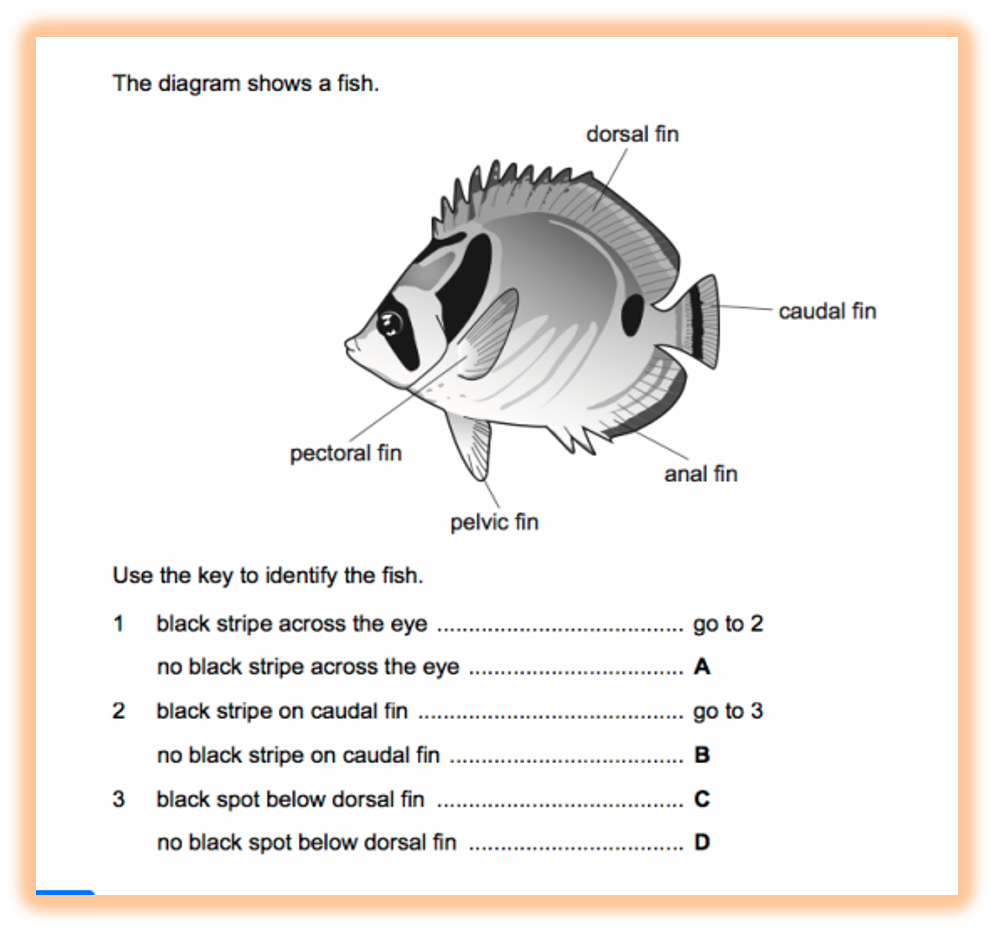
Dichotomous key
System used to identify organisms
Made up of pairs of contrasting descriptions
What are the 8 groups of marine organisms
Phytoplankton
Zooplankton
Echinoderms
Crustaceans
Bony fish
Cartilaginous fish
Macroalgae
Marine grasses
Plankton
Diverse collection of microscopic organisms that have limited mobility and drift in water currents
Why are plankton considered keystone species
They are indicative of the health of an ecosystem
Two groups plankton is divided in to
Phytoplankton (producers) and zooplankton (consumers)
Main types of phytoplankton
Diatoms and dinoflaggellates
Diatoms
Unicellular
Cell walls with silica
Found in surface waters, reproduce rapidly
Represent base of food web
Consumed by krill
Dinoflagellates
Unicellular
No silica cell walls
Found in surface water, reproduce rapidly
Some produce toxins that can poison fish and accumulate in shellfish poisoning humans and other organisms
Zooplankton
Consumers (including larvae, copepods, jellyfish)
Migrate vertically in the water column each day to feed on phytoplankton
Sensitive to environmental changes (pullution, microplastics, acidification, etc)
Larvae
Planktonic stage of fish and invertebrates like sea star (adapted to life floating in the ocean)
Copepods
Most abundant and diverse group of zooplankton
Are crustaceans, herbivores,, feed on diatoms
Bodies are divided (head, thorax, abdomen, two antennae, 2-4 pairs of appendices extend thorax)
Exoskelton made of calcium carbonate and have spikes for protection and better floatation