Reproductive and Urinary Systems
 Call Kai
 Learn
Learn Practice Test
 Spaced Repetition
 Match
Match Flashcards
 Knowt Play
1/148

There's no tags or description
Looks like no tags are added yet.
Name | Mastery | Learn | Test | Matching | Spaced | Call with Kai |
|---|
No analytics yet
Send a link to your students to track their progress
149 Terms
How are the reproductive systems divided?
into make and female systems
What does each reproductive system have?
gonads and accessory reproductive organs
What are gonads?
primary sex organs responsible for producing gametes (eggs and sperm) and secreting sex hormones (testes and ovaries)
What are accessory reproductive organs?
structures used to transport and nourish gametes prior to fertilization
Where are sperm formed?
sperm are formed in the testes. each testis has many tightly coiled seminiferous tubules where sperm are produced
Where do sperm go after production?
after production, sperm are transported into the rete testis and then to the epididymis
What is the epididymis?
the epididymis is a highly coiled tube (6 meters long). the sperm mature during the 20 days it takes to travel through the epididymis before reaching the ductus deferens (vas deferens)
Where are sperm stored?
sperm are stored in the enlarged ampulla of the ductus deferens
What happens when a man is sexually stimulated?
sperm are expelled into the ejaculatory duct and out through the urethra in a process called ejaculation
What are the three major glands associated with the male reproductive system?
seminal vesicles, prostate gland, and bulbourethral glands (Cowper's glands)
What do the accessory glands do?
they produce secretions that form semen, which dilutes the sperm and protects them as they travel
What do the seminal vesicles do?
nutrition, mobility through muscular contraction, clotting of ejaculate
What does the prostate gland do?
thins semen for easier sperm movement and citric acid for energy
What do the bulbourethral glands (Cowper's glands) do?
alkaline mucus to neutralize the urethra and lubricate the penis
What are the two major external structures of the male reproductive system?
the scrotum and penis
What is the scrotum?
it is a flap of skin between the legs that contains the testes. the scrotum maintains an ideal temperature for sperm survival, which is 2-3 degrees Celsius lower than normal body temperature
What are the cremaster muscles?
they control how near the testes are to the body based on external temperature
What is the penis?
the structure that delivers sperm into the female reproductive tract
What is the penis composed of?
shaft, glans penis (tip), and erectile tissue (spongy internal tissue that fills with blood during sexual excitement causing an erection)
What happens during sexual intercourse?
the erect penis is inserted into the female vagina and the semen is ejaculated, propelling the sperm into the female reproductive tract
What is spermatogenesis?
the process of sperm production
What does spermatogenesis begin with?
stem cells called spermatogonia
What happens during spermatogenesis?
diploid spermatogonia divide through meiosis to create four spermatids with only 23 chromosomes each (half the number of necessary chromosomes)
What is spermiogenesis?
it is the final process of sperm production where the spermatids take the final shape of mature sperm
Where do sperm travel as they develop?
they migrate closer to the lumen of the seminiferous tubules, where they will eventually be released
What are the three parts of sperm?
head, midpiece, tail
What does the head of the sperm do?
the head contains the nucleus and has an acrosome on the front portion, which contains enzyme to break into the egg cell during fertilization
What does the midpiece of the sperm do?
the midpiece is surrounded by mitochondria, giving the sperm ample energy to swim
What does the tail of the sperm do?
the tail (flagellum) provides the movement
What are the primary reproductive organs of the female reproductive system?
the ovaries
What do the ovaries do?
the ovaries release egg cells (ova) to be fertilized by sperm. the ovaries contain about 400,000 follicles (clusters of cells surrounding an egg) at a female's birth. only about 400 of these follicles will mature and be released as eggs
What is ovulation?
the release of a mature egg
How does an egg travel to the uterus?
the ovaries release the mature ovum into the finger-like fimbriae that extend from the uterine tubes (Fallopian tubes). the ovum is funneled into the infundibulum before entering the tubes. the ovum is carried through the tubes by cilia towards the uterus
What is the uterus?
the uterus is a hollow, muscular structure that recieves and nourishes an egg as it develops into a baby
What are the three portions of the uterus?
the fundus (superior), the body (hollow middle poriton), and the cervix (inferior)
What are the three layers of the uterus?
endometirum, myometrium, perimetrium
What is the endometrium of the uterus?
it is the mucosal layer. if an egg is fertilizsed by sperm in the uterine tubes, the developing embryo will implant in this layer. if the egg is unfertilized, the endometrium will slough off (menstruation)
What is the myometrium of the uterus?
muscular layer responsible for contractions during childbirth
Whst is the perimetrium of the uterus?
the outer uterine wall
What is the vagina?
it is a thin-walled tube located inferior to the cervix. it recieves the penis during intercourse and is the passageway for menstruation and delivery of a baby during childbirth
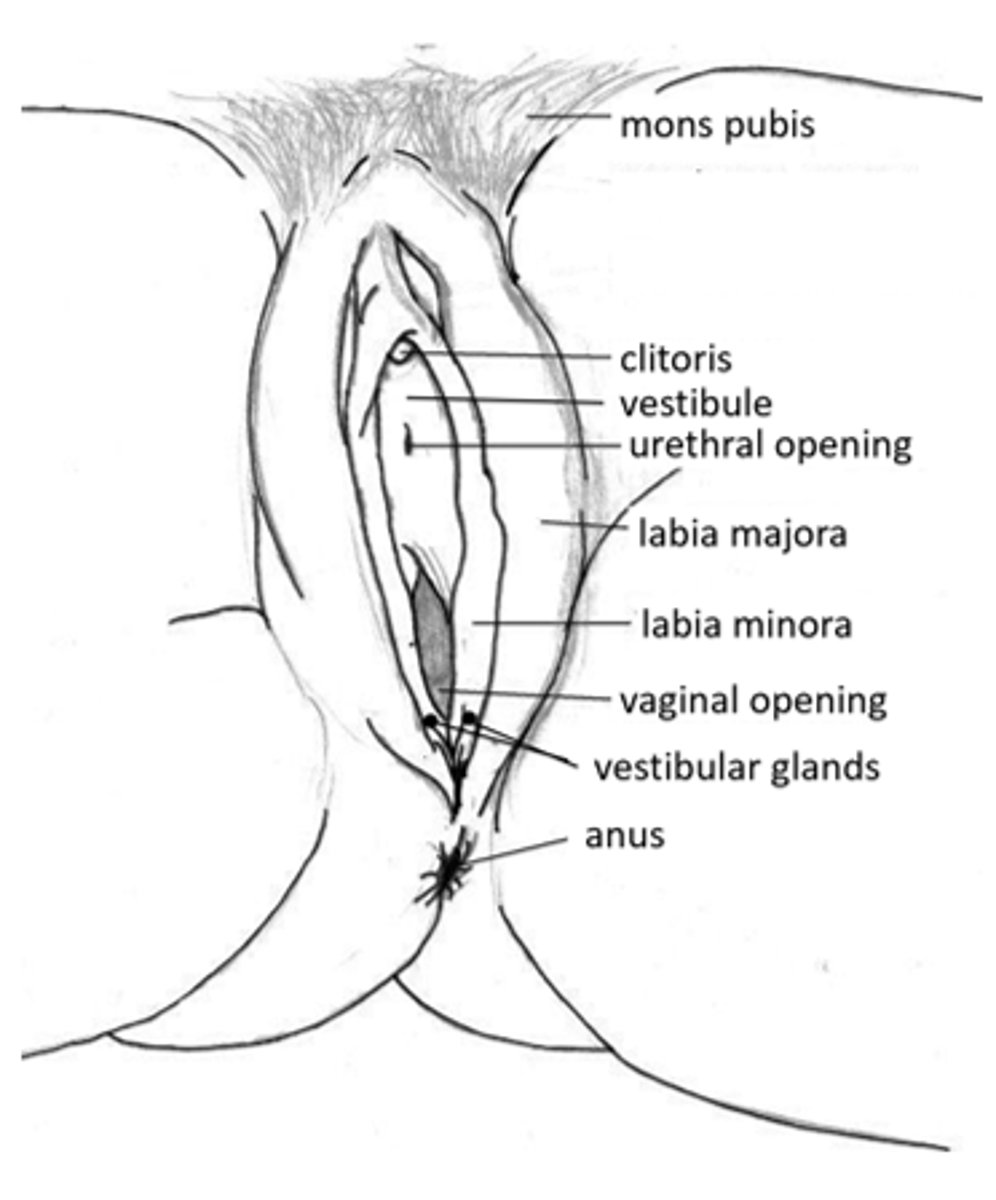
What does the external female genitalia (vulva) include?
mons pubis (fatty area covered with pubic hair) and labia majora / labia minora (skin folds which protect the area known as the vestibule)
What does the vestibule contain?
clitoris (similar to male penis, swells when stimulated), urethral opening (for urine), vaginal opening, and vestibular glands (lubricate the vagina during intercourse)
What does oogenesis begin with?
stem cells, called oogonia
How do oogonia divide?
before birth, the oogonia divide and develop into primary oocytes, which are housed in follicles
What happens to oocytes at puberty?
hormons stimulate a small number of follicles to mature and make the first meiotic division
What is produced from this meiotic divison?
this division is unequal- a large secondary oocyte and a tiny polar body are produced (the polar body, along with its chromosomes, degenerates)
What happens if the secondary oocyte is fertilized?
the second meiotic division will occur. this produces another polar body and reduces the female chromosome number to 23. the male and female nuclei join to form a zygote with 46 chromosomes
What happens after ovulation?
the follicle degenerates into the corpus luteum
What three hormones do the male reproductive system depend on?
testosterone, luteinizing hormone (LH), and follicle-stimulating hormone (FSH)
What is testosterone?
produced in the interstitial cells of the testes; responsible for maturation of reproductive organs and secondary sex characteristics
What is the luteinizing hormone (LH)?
produced in anterior pituitary gland; stimulates release of testosterone
What is the follicle-stimulating hormone (FSH)?
produced in anterior pituitary gland; stimulates sperm production
What are secondary sex characteristics in males?
increased muscle mass and strength, increased bone mass, facial and pubic hair growth deepening of voice, increased sex drive
What four hormones affect the female reproductive system?
LH, FSH, estrogens, progesterone
What do estrogens do?
secreated by the ovaries; causes female secondary sex characteristics
What does progesterone do?
produced by corpus luteum after ovulation; helps to maintain the menstrual cycle
What are female secondary sex characteristics?
breast development, pubic hair growth, increased fat deposits on hips and breasts, widening of hips, and onset of menstrual cycle
What is the difference between male and female mammary glands?
both sexes have mammary glands, but estrogens cause female mammary glandsw to increase in size during puberty
What makes up a breast?
within the center of each breast is a darker areola surrounding a nipple. beneath the skin, 15-25 lobes of alveolar glands are connected by connective tissue and fat
What happens during lactation?
when lactating, the alveolar glands produce milk and pass it via the lactiferous ducts through the nipple
What is the uterine (menstrual) cycle?
it involves recurring changes to the endometrium of the uterus due to hormone fluctuations
How long is the menstrual cycle?
on average, the cycle is 28 days long with ovulation occuring on day 14
What are the three stages of the uterine cycle?
menstrutaion (days 1-5), proliferative phase (days 6-14), and secretory phase (days 15-28)
What is menstruation?
endometrium is shed through the vagina (called a period)
What is the proliferative phase?
the follicles in the ovaries grow and produce estrogens, which cause the endometrial lining to thicken again. one of the mature follicles releases an egg
What happens in ovulation?
LH and FSH levels peak, causing the egg to be released from the ovary into the uterine tube
What is the secretory phase?
the corpus luteum secreates progesterone, which causes uterine lining to further thicken. gloands within the endometrium secrete nutrients to sustain an embryo. if the egg is unfertilized, estrogen and progesterone levels decrease, causing the uterine lining to stop thickening
In order for fertilization to occur, when must intercourse occur?
due to the viability of the oocyte and spermatozoa, intercourse must occur five days before ovulation up to one day afterwards
How many sperm cells are chemically attracted to the oocyte?
hundreds of millions of sperm cells are chemically attracted to the oocyte and travel through the uterine tube until they reach it
How many sperm reach the egg?
only a few hundred sperm reach the oocyte. when they do, they all swarm around it simultaneously
What does the acrosome of the sperm do?
the acrosome on the tip of the sperm cells release enzymes that break down the protective layer around the oocyte
What happens when sperm penetrates an egg?
when one sperm penetrates the barrier, the ovum releases granules that coat the outside of the ovum, preventing other sperm from penetrating
What happens after fertiziliation?
the oocyte nucleus completes the second meiotic division, and the chromosomes of the ovum and sperm unite, makin a full diploid set. this fertilized egg is now called a zygote
What are the two major stages in the development of a baby?
embryonic development (fertilization-week 8) and fetal development (week 9-birth)
What is cleavage?
as the embryo moves down the uterine tube, it already begins to divide
How is the embryo when it reaches the uterus?
the embryo is made of 16 cells by the time it reaches the uterus (now known as a morula)
What is a blastocyst?
the stage of embryonic development after the morula divides further to 100 cells. the blastocyst implants itself into the uterine wall 6-7 days after fertilization
What happens during the first two weeks of a blastocyst?
it arranges itself into two layers- an inner cell mass and an outer trophoblast
How does a blastocyte implant into the uterus?
the trophoblast forms projections (chorionic villi) that embed it into the uterus, eventually becoming the placenta
What is the inner cell mass made of?
embryomic stem cells with differentiate into 3 germ layers: ectoderm, mesoderm, and endoderm
What does ectoderm consist of?
neuron and epithelial cells (skin and nervous system)
What does mesoderm consist of?
red blood cell and cardiomyocytes (muscular, reproductive, and cardiovascular systems)
What does endoderm consist of?
liver cells and pancreas cells (respiratory, digestive, urinary, and endocrine systems)
What is an embryo called after 8 weeks?
a fetus
What are some milestones that happen at 12 weeks in fetal development?
fingers and toes are distinct, placenta is complete, fetal circulation is complete, and organ systems are complete
What are some milestones that happen at 16 weeks in fetal development?
sex is differentiated, rudimentary kidneys secrete urine, heartbeat is present, nasal septum and palate close
What are some milestones that happen at 20 weeks in fetal development?
lanugo covers entire body, fetal movements are felt by the mother, heart sounds are perceptible by auscultation
What are some milestones that happen at 24 weeks in fetal development?
skin appears wrinkled, vernix caseosa appears, eyebrows and fingernails develop
What are some milestones that happen at 28 weeks in fetal development?
skin is red, pupillary membrane disappears from eyes, fetus has an excellent chance of survival, eyes open and close
What are some milestones that happen at 32 weeks in fetal development?
fetus is viable, eyelids open, fingerprints are set, vigorous fetal movement occurs
What are some milestones that happen at 36 weeks in fetal development?
face and body have loose wrinkled appearance because of subcutaneous fat deposit, lanugo disappears, amniotic fluid
What are some milestones that happen at 40 weeks in fetal development?
skin ais smooth, eyes are uniformly slate colored, bones of skull are ossified and nearly together at sutures
What happens at 40 weeks of pregnancy?
oxytocin and prostaglandins cause powerful contractions of the uterus through a positive feedback mechanism
What are the three stages of labor?
dilation stage, expulsion stage, placental stage
What happens in the dilation stage?
amniotic sac ruptures (aka water breaking) and cervix becomes thinner and widens, eventually up to 10 cm
What happens in the expulsion stage?
baby is pushed out through the vagina and cervix
What happens in the placental stage?
within 15 minutes after the baby is delivered, the uterus contracts again to expel the placenta (this prevents unnecessary bleeding)
diagram of internal male reproductive anatomy
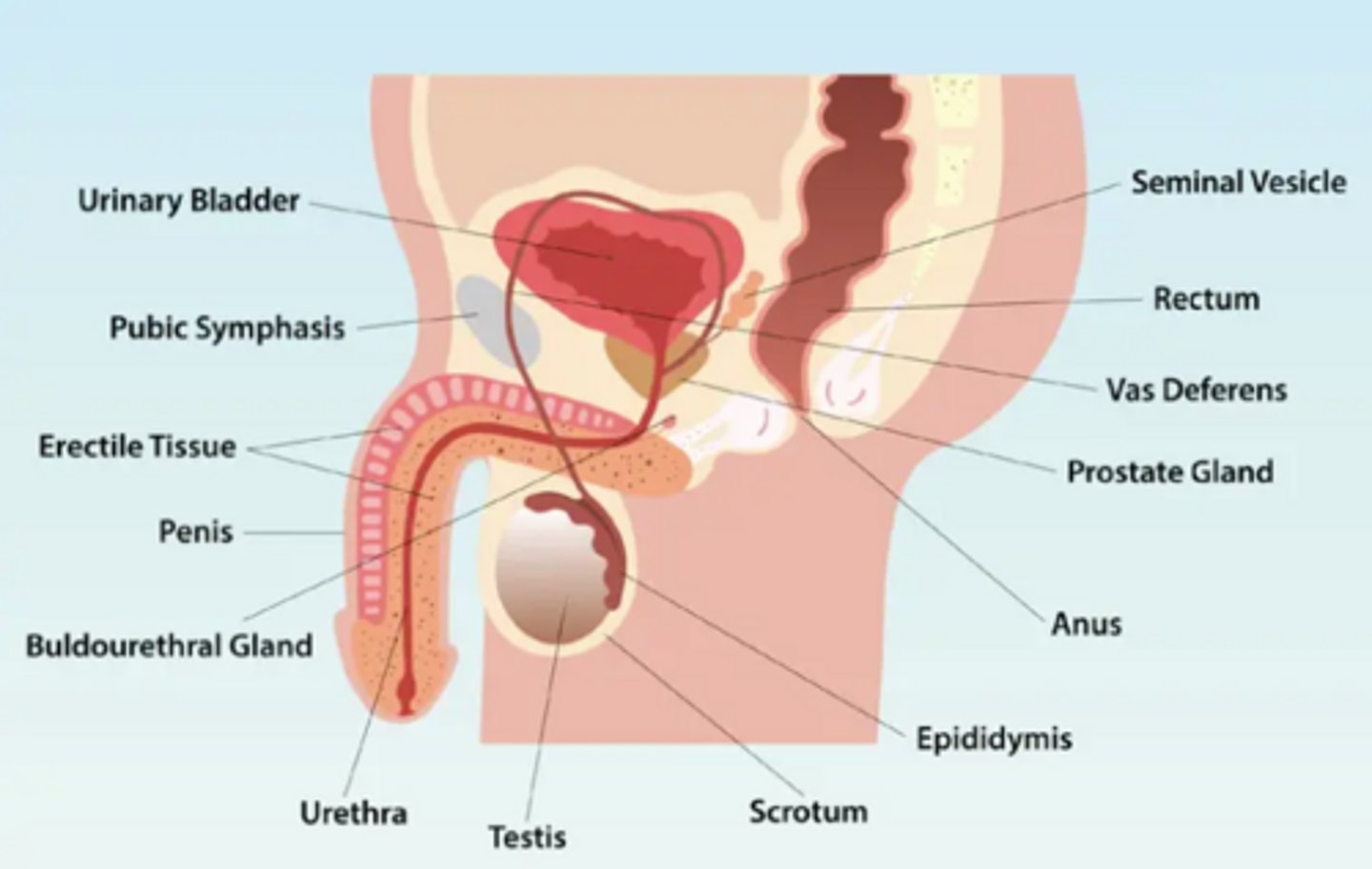
diagram of internal female reproductive anatomy
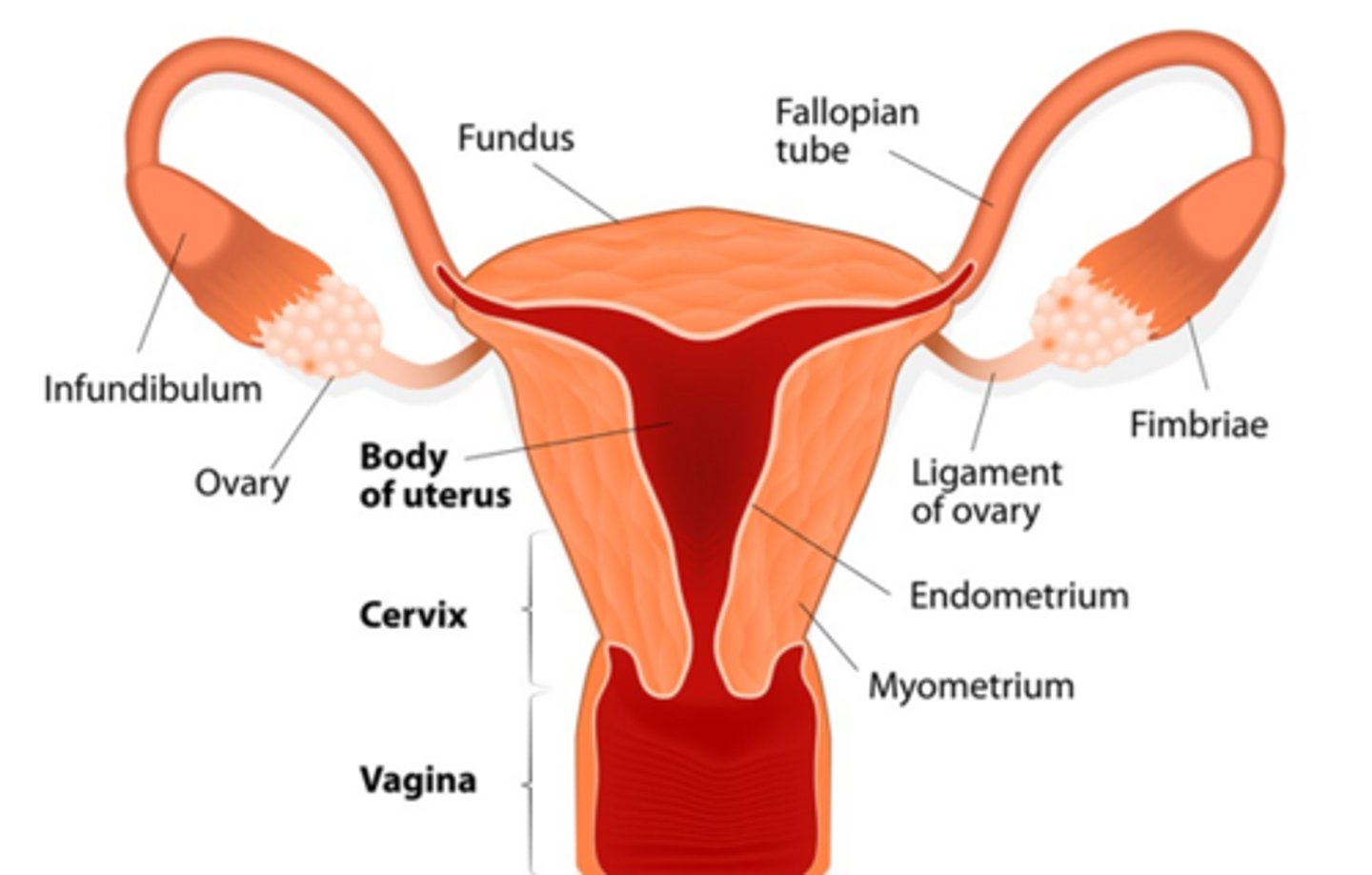
diagram of external female reproductive anatomy