Hell World: Term 2 Week 3: Relegion and Festivals
 Call Kai
 Learn
Learn Practice Test
 Spaced Repetition
 Match
Match Flashcards
 Knowt Play
1/73

There's no tags or description
Looks like no tags are added yet.
Name | Mastery | Learn | Test | Matching | Spaced | Call with Kai |
|---|
No analytics yet
Send a link to your students to track their progress
74 Terms
During the Hellenistic period what is there a big move towards in religion?
There is a move in the Hellenistic period to personal religion. Personal religion is stepping away froom state sanctioned religion towards more personal belief (like a mystery religion e.g. the Eleusinian mysteries). Trend towards things you did by yourself
How did ideas about the soul and afterlife develop?
Ideas of the soul and afterlife develop a bit more- peoples ideas of death. In Homers writings the dead are like fleeting conciousness- they are not very present in any way. In Babylonia there was the idea of the dead not having a good time, it was not something to look forward to at all (no idea of your actions will have consequences after death). Trend that people have freedom to think about what might happen in the afterlife- people start to form new ideas e.g. Plato. Greek religion you were generally free to believe what you liked as long as you took part in rituals, sacrifices correctly
Who was a big figure in religion and healing and what did he have?
Asclepius, healing sanctuary
What was there an increase in the popularity of?
increase in popularity of healing sites (also because health care was improving)
Did most things change in religion from the movement of classical to Hellenistic?
Things did not change that much, what was happening in the classical period stayed the same mostly in the Hellenistic period
What was one of the main things that changed in religion in the Hellenistic world?
One thing that did change was festivals
What changed about money in connection to religion?
Where the money was coming from was different, as well as what people were in charge. In the Hellenistic period there was new money, people could become prestigious through their wealth- and fund things like festivals
What was the reason for change occurring in religion in the Hellenistic world?
Most things changed due to the new areas that were begining to be taken into the Greek world
What did this expansion lead to an introduction of in Hellenistic religion?
Introduction of foreign gods e.g. Isis, Serapis
What was there a creation of with festivals and religion?
Creation of a network of competitive festivals linked to religion, religion is always at the heart of it. The name of all these games were linked to a religious site
How did the Greeks interact with outside religions (give some examples)?
Outsiders were always involved with Greek religion
‘Others’/outsiders were involved with Greek religious practices and Greek sanctuaries for a long time cf. King Amasis of Egypt giving money for the rebuilding of the temple at Delphi in the 6th century BC
Gifts of people like Croesus and Gyges at Delphi (Herodotus 1.46-51; Pausanias 10.5.13)
Where do we often see interaction that foreigners would have with Greek Religion?
In particular sanctuaries – like the Heraion on Samos, or Hera at Perachora – there is lots of evidence for very foreign dedications/ sacrificial victims (potentially brought by foreigners?)
How many ‘other gods’ did Athens have and where would they come from?
C5BC: Athens supported with public expenditure at least 40 deities whom it referred to as “other gods” (other than its central polis deities Athena Polias, Demeter, Persephone and Kore)
Athens had 40 deities, foreign gods were also brought back by travellers, boetian mercenaries they went travelling in egypt and would bring back deities with them.
Would the Greeks consult places that were abroad?
The Greeks would consult places abroad, Alexander visited a temple in Siwa- what the Greeks tend to do is see their gods reflected in other gods- this is seen in Herodtous
Was there a dogma in Greek religion?
In Greek myth there is no dogma, no quaran or bible- no written word, so there is a lot of room for varying beliefs
Identify this statue:
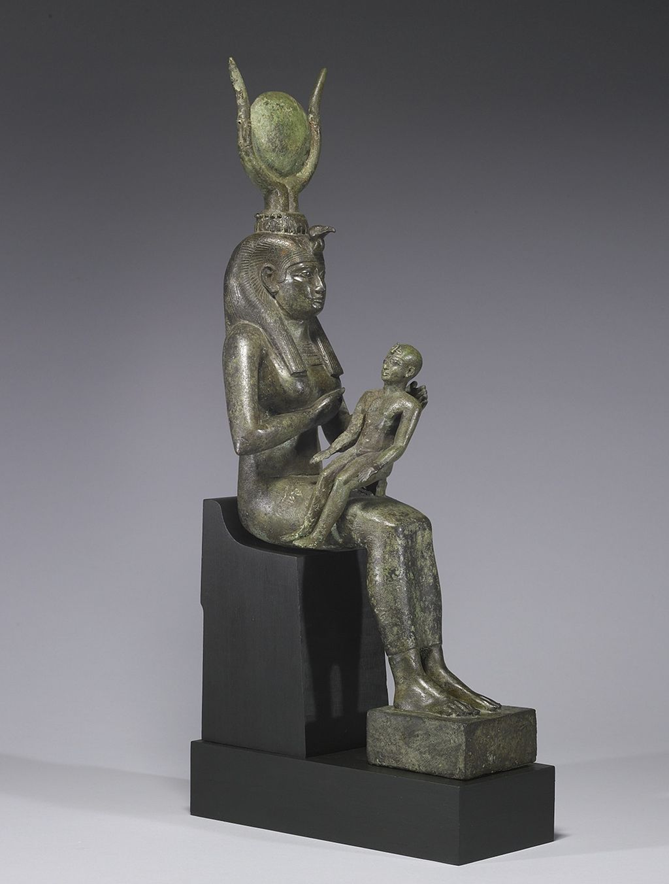
Isis nursing Horus, seventh century BC
Who is Isis and what is she represented as doing in this statue?
Sister of Egyptian god Osiris – represented as mourning for his death (cf. similarity to Demeter and Persephone)
Was Isis known to the Greeks (who) and who was she identified with?
Known to Herodotus (2.61) – identified with Demeter
When and where was a temple set up to Isis that showed her as part of Hellenistic religion?
Ca.331BC Alexander set up temple to Isis in Alexandria (Arrian Anab.3.1.4-5)
Where did the Egyptians worship Isis?
Egyptians worshipping her in Eretria (on the island of Ubea- a long island off of Boetia) at about the same time IG xii supp. 562 (ca.350-320BC). The Eritreans were ahead of everyone else with trading around the near east
How were the Egyptians and Athenians connected?
Egyptians supported by Athenians against Persians during the 4th century, and also an important source of grain (cf. also important trading city of Naucratis from the 6th century BC)
When do we get evidence for Athenians worshiping Isis?
Only in 133/2 BC that we have evidence for Athenians themselves worshipping Isis in Athens (SEG 24.225).
How far does the worship of Isis spread?
By end of Hellenistic period, Isis will be worshipped in nearly every Greek city.- By Roman time, Diodorus claims that cult was known throughout the whole inhabited world (1.25)
What does the cult of Isis have?
Greek-style ‘initiation rites’, this is one of the things that she has that makes her ‘nice’ for people of this time
What was Isis linked to?
Linked to discovery of techniques of civilisation and protection of marriage, social order, individuals in times of danger. She takes on lots of different roles
What is Isis’ cult central to?
Isis’ cult is central to Apuleius’ Golden Ass- The Golden Ass, is the only ancient Roman novel in Latin to survive in its entirety
What did Delos have a lot of?
Foreign sanctuaries- Would have had many foreign visitors, it became like a trading post due to its prestige. Foreigners would come visit and stay due to how prestigious it is
What does this map show:
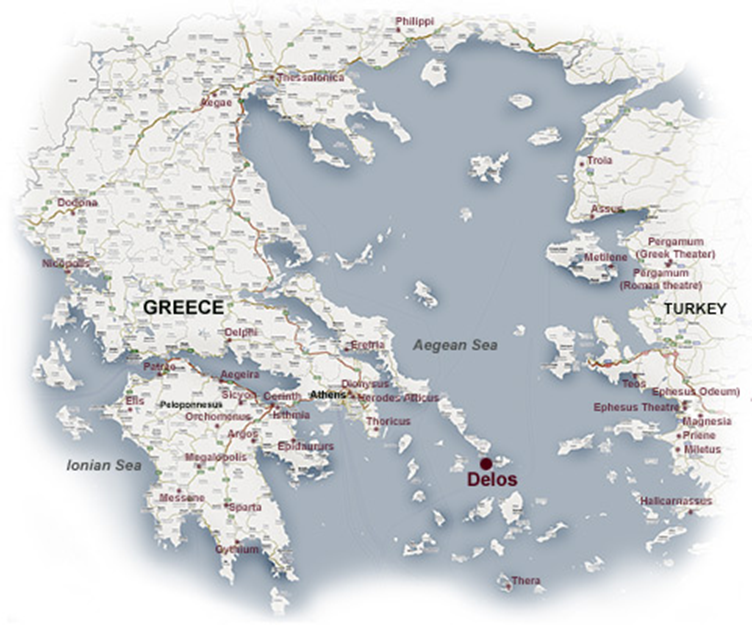
Large cluster of sanctuaries to foreign gods set up by foreigners
Who set up these foreign sanctuaries?
They were set up by permanent residents or people who would frequently visit
Who were the three main gods worshipped at these sanctuaries on Delos?
The three main gods worshipped there: Sarapis (egyptian-hellenistic mixture- almost), Samothrace (in the Greek world, strange island who had their own cults, mystery religions of Samothrace are often linked to success in sea fairing), Syrian goddess called Attagatis had a temple there as well
Where was the cult of Sarapis from and when did it get its first sanctuary on Delos?
Cult of Sarapis from Egypt: in 220 BC given its first sanctuary on Delos.
Who is the god Sarapis?
Sarapis is already a combination of two Egyptian deities: Osiris and the Apis bull (Plutarch and Tacitus (4.83-4) claim that he was invented by Ptolemy I to provide a point of union for Greek and native subjects)
But some argue for the god’s pre-existence. Lots of debate around the origins
Made to be husband of Isis, ruler of the underworld
Was there a rapid spread of the worship of Sarapis?
Rapid spread across Mediterranean world (cf to cult in Caspian sea area 280s-260s BC) because of traveling Egyptians?
Rapid spread of Serapis around the Mediterranean world and beyond, partially because of travelling Greeks and egyptians- essentially a big network
What is the Sarapieia?
Competitive games, it was created for a foreign deity and shows the importance of Sarapis
Why does the Sarapieia stand out?
The Sarapieia at Tanagra stands out amongst the Boeotian games (agōnes) in its relation to foreign cult.
How did the Egyptian gods reach Boetia?
Hellenistic Boeotian mercenaries would have been an obvious vehicle for the introduction of the Egyptian gods into Boeotia, especially Serapis/Sarapis, whose worship in Egypt may have been fostered as a means of integrating Hellenic incomers and the indigenous population.
Did the Greeks get on as an entirety?
The Greeks hated and fought each other all the time (only stopping to band together when they were attacked by others).
Were Panhellenic festivals central to Greece?
Panhellenic festivals were central to the ancient Greek world since archaic times, with places such as Delphi and Olympia defining the essence of an imagined Greek community.
What did Greek cities begin to do with festivals in the Hellenistic period and why?
In the Hellenistic period, several Greek cities began to organise large-scale festivals of their own at their main sanctuaries, thereby anchoring their position in a newly expanded Greek world in traditional cultural practices. It was a way of jostling for prestige
Why were festivals connected to prestige in the Hellenistic World?
In ‘old’ Greece (the Greek mainland and the cities of western Asia Minor) cities jostled for prestige and position under the wider influence first of the Hellenistic monarchs and later of Rome. Introducing your own festival was a way to show off- to invite the wider Greek world to come and see you essentially- its all about prestige
Cities
Further afield, new city foundations in central Asia Minor, Syria, and Egypt were set up on the model of the polis, while pre-existing cities and communities adopted some aspects of Hellenic culture.
When did the amount of festivals begin to increase?
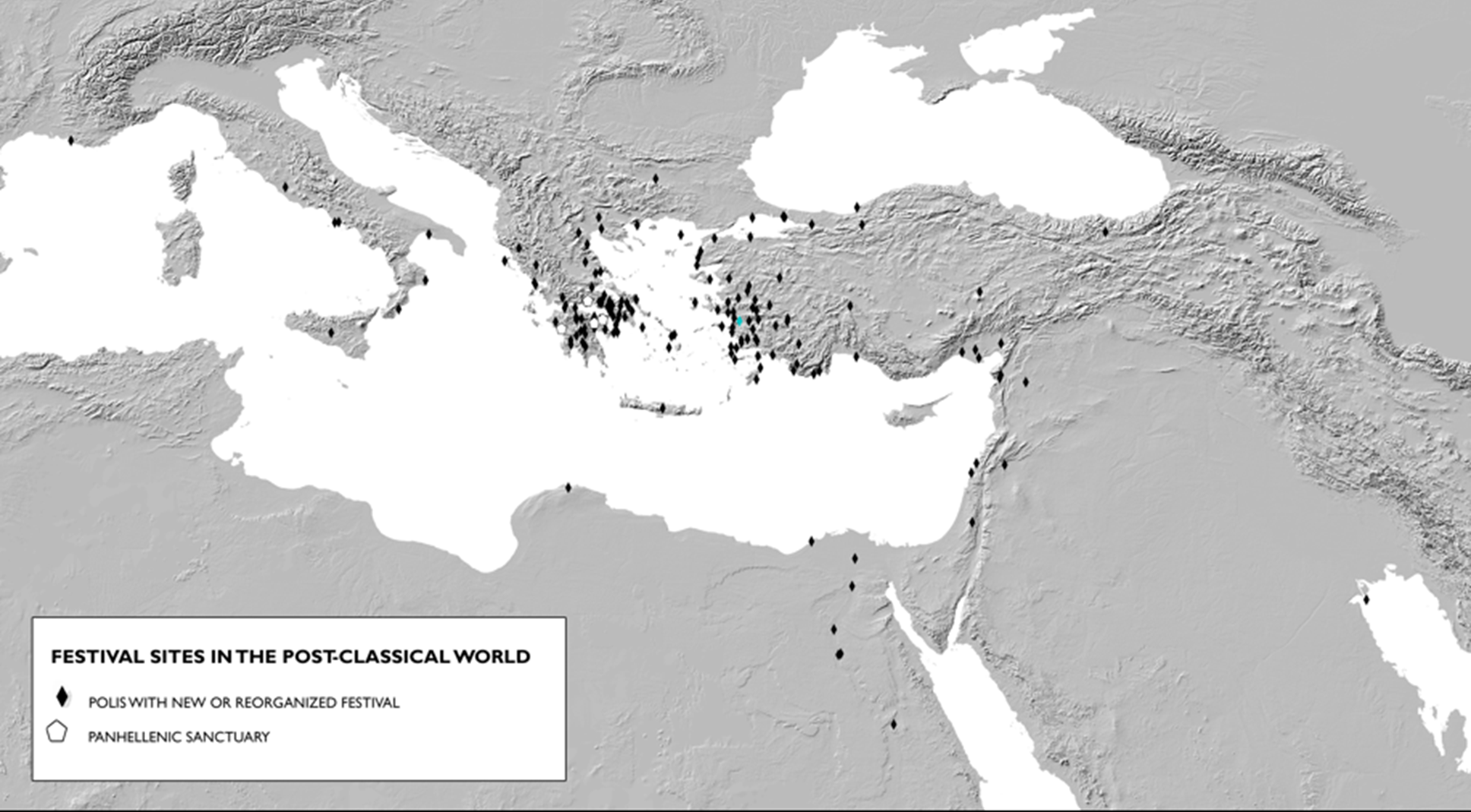
The number of festivals increased significantly from the third century BC onwards, with a wave of new festivals designed to appeal to an audience that now included the newly founded cities throughout the Hellenistic Kingdoms.
Show a map of where festivals were held in the post-classical world?
What was the terrace of foreign gods?
On Delos (connects to cards from earlier)
The terrace was located on the lower slopes of a hill overlooking the city; in its own area, away from civic centre where Apollo’s temples were located
Area consisted of numerous sanctuaries that were established by communities who came from further afield
Sarapieion A, B and C are sanctuaries dedicated to the Egyptian god Sarapis by people from Egypt; Samothrakeion dedicated to the gods of the island of Samothrace
Sanctuary of Atargatis set up to worship the Syrian Goddess
identify this:
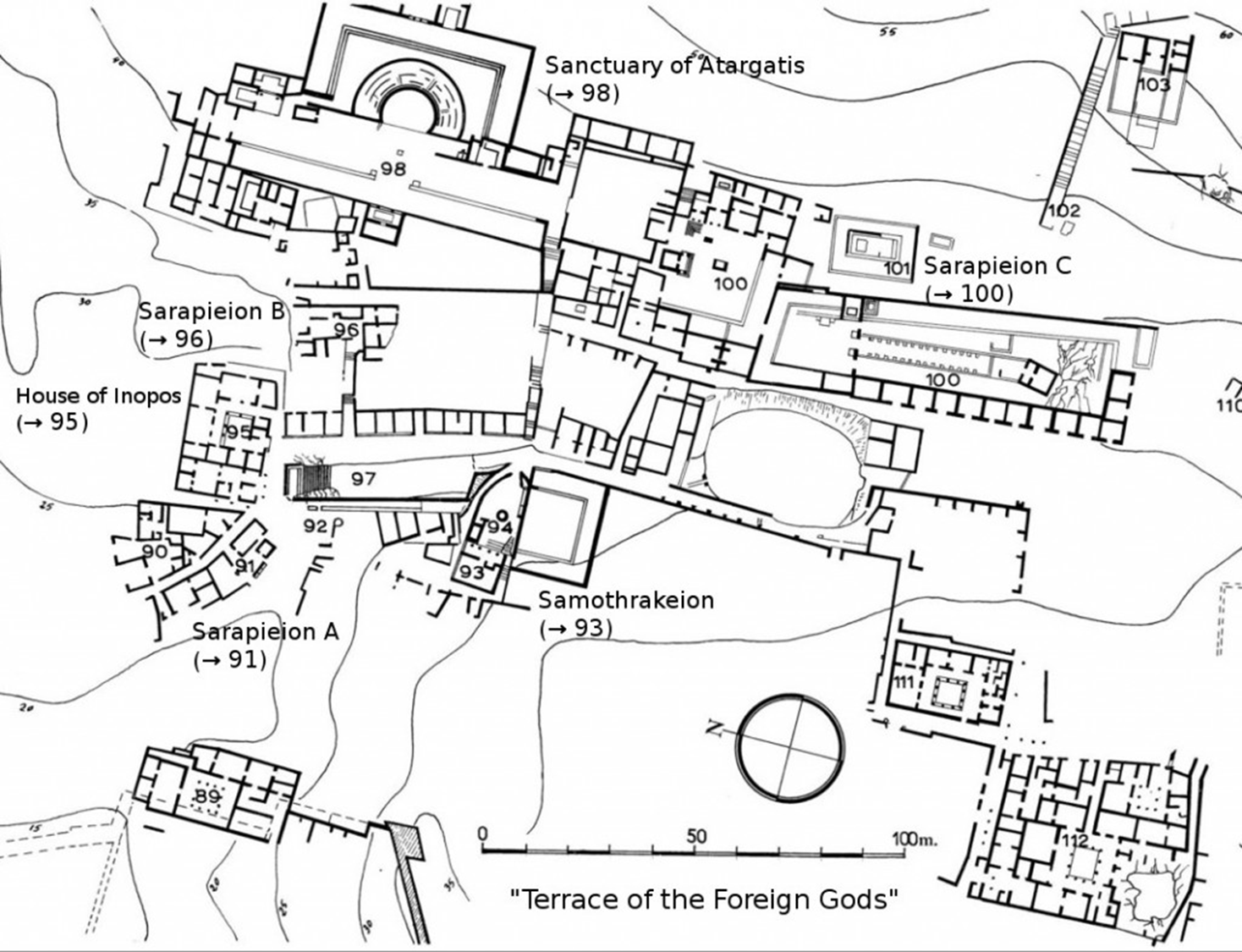
the terrace of foreign gods
What does agnostic mean?
Agonistic- means competition based (agon is competition).
What kind of culture is Greece?
Greece is an agonistic culture.
What is an agnostic festival?
So an agonistic festival would be competitive sport and artistic games. The amount of agonistic festivals from the 5thc BC to the 1stc BC bloom- there are many many more
What did Olympia and their festival act as?
Olympia- the model that all people would follow for their own games.
Explain Greek exclusivity
Greek exclusivity- being part of the in group is very important. The Olympics and other competitions were a good example, you had to be Greek to take part.
Herodotus writes about this in Histories 5.22:
‘Now that these descendants of Perdiccas are Greeks, as they themselves say, I myself chance to know and will prove it in the later part of my history. Furthermore, the Hellenodicae who manage the contest at Olympia determined that it is so, for when Alexander [I] chose to contend and entered the lists for that purpose, the Greeks who were to run against him wanted to bar him from the race, saying that the contest should be for Greeks and not for foreigners. Alexander, however, proving himself to be an Argive, was judged to be a Greek. He accordingly competed in the stadion race and tied for first place.’
What does this text from Herodotus show?
Shows Greek exclusivity
Give an example of Greek exclusivity (story)- who tells the story?
Polybius describes how King Ptolemy IV of Egypt trained the boxer Aristonikos to take on the dominant Theban pankratiast Cleitomachus at the Olympic Games.
Initially the crowd favoured the Egyptian underdog as they hate the Thebans, Aristonikos, until Cleitomachus called upon their sense of Greek pride, reminding them that Aristonikos was fighting for the glory of Ptolemy, but he for the glory of Greece. The idea of identity being part of a select in group
Polybius Histories 27.9.12
Thereupon they say that Cleitomachus stepped aside, and after waiting a short time to recover his breath, turned to the crowd and asked them why they cheered Aristonikos, and supported him all they could? Had they detected him in playing foul in the combat? Or were they not aware that Cleitomachus was at that moment fighting for the honour of Greece, Aristonikos for that of king Ptolemy? Would they prefer an Egyptian to carry off the crown by beating Greeks, or that a Theban and Boeotian should be proclaimed victor in boxing over all comers? Upon this speech of Cleitomachus, they say such a revulsion of feeling came over the spectators that Aristonikos in his turn was conquered more by the display of popular feeling than by Cleitomachus.
What is shown in this extract from Herodotus?
Herodotus Histories 8.144
For there are many great reasons why we should not do this, even if we so desired; first and foremost, the burning and destruction of the adornments and temples of our gods, whom we are constrained to avenge to the utmost rather than make pacts with the perpetrator of these things, and next the kinship of all Greeks in blood and speech, and the shrines of gods and the sacrifices that we have in common, and the likeness of our way of life, to all of which it would not befit the Athenians to be false.
τὸ Ἑλληνικὸν To hellenikon – ‘the Greek thing’
Where did the sports and foundation of the games believed to be developed from?
The idea of good strife- competitiveness essentially, it is discussed in the Iliad- ‘always to be bravest and preeminent above all’
These sports were thought to have been developed from Homeric warfare.
Being a sportsman is seen as being ultra-greek. The foundation of all these games e.g. Olympic, Isthmian are all funeral games (I think), they all link back to this Homeric tradition.
The funeral games for Patroclus in the Iliad- act as origin for these competitions/festivals?
Identify an date this statue:
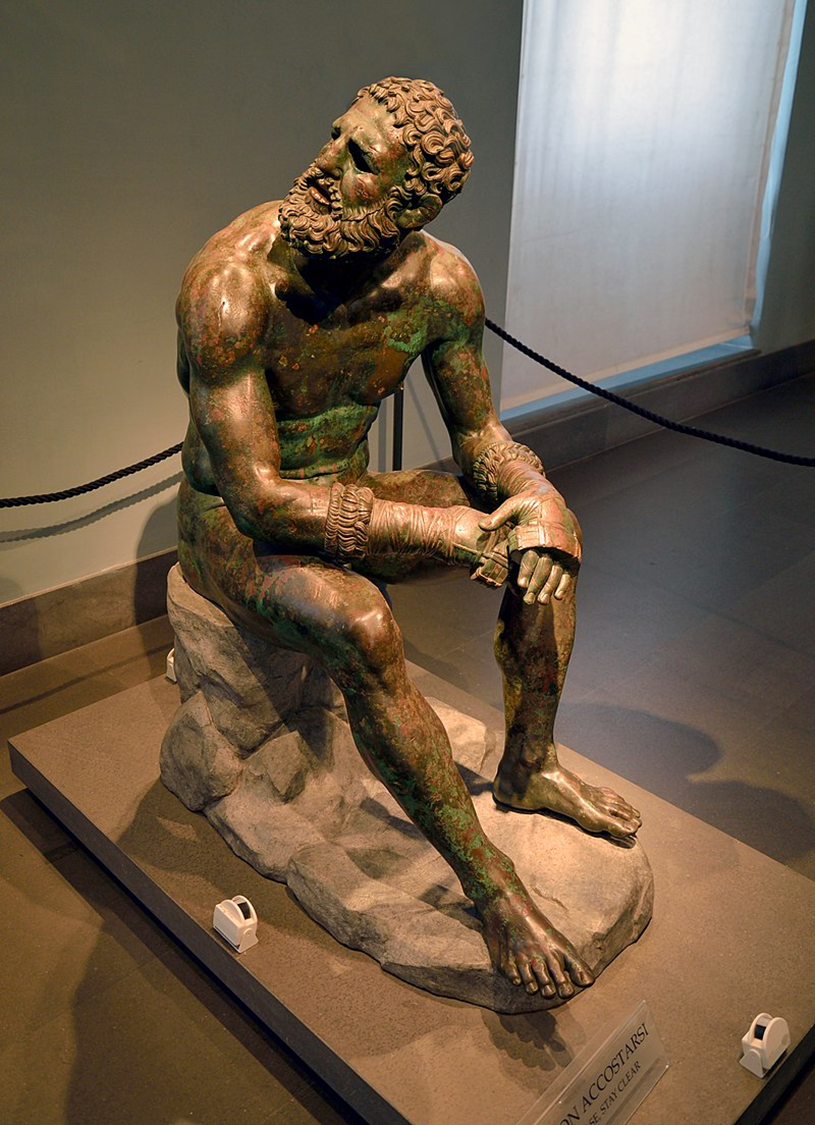
The Boxer at Rest, also known as the Terme Boxer, Seated Boxer, Defeated Boxer, or Boxer of the Quirinal, is a Hellenistic Greek bronze sculpture of a sitting nude boxer at rest, still wearing his himantes, a type of leather hand-wrap. It has been given various dates within the period of about 330 to 50 BC. It was excavated in Rome in 1885
What is there a movement towards in art at this time?
Moving towards a very realistic image in art, boxers are looked on as very heroic figures
What are the crown games?
Start calling them crown games, when you won the Olympic you didn’t win anything- you only got a crown, maybe later on in your home polis you would be rewarded but the only thing the games gave were crowns- they were called stefanic games
What was there an innovation of with festivals during the Hellenistic period?
An innovation of the Hellenistic period was the institution of new festivals or the upgrading of existing ones with a status equal to that of the most important crown games in Greece [isopythian, iso-Olympian- asking for a truce between all people while the games were going on] and the invitation to other Greek states to participate
Give info on the crown games
The Crown Games (also known as the Stephanitic Games, from stephanos, meaning "crown") were the four most prestigious athletic and religious festivals in the ancient Greek world, including the Hellenistic period.
Like their namesakes, they offered crowns as prizes, from which they took their title: stephanitic or crown games, but more important was the fact that victors at such games could expect similar privileges upon their return home, as did the victors of the traditional four games.
Recognition of victors at the games as equal to those at Olympia entailed providing them with cash rewards and other honours.
Along with prestigious athletic contests in honor of Zeus at Olympia, they comprised the Pythian Games for Apollo at Delphi, the Isthmian Games for Poseidon, and the Nemean Games, sacred to Zeus.
Where were dedications commemorating the victories found?
Dedication commemorating victories by the kitharode, Nikokles of Taras, in Panhellenic festivals.
Findspot: Athens (Theatre of Dionysos)
IG II3 4 594 ca. 300-250 BC
List some of these names that were commemorated
Nikokles son of Aristokles
In laurel crown (II) At the Pythia
In laurel crown (III) At the Pythia
In laurel crown (IV) At the Pythia
In olive crown (I) At the Great Panathenaia
In ivy crown (VIII) At the Lenaia in the dithyramb[2]
In laurel crown (V) At the Pythia
In laurel crown (VI) At the Pythia
In laurel crown (VII) At the Pythia
Face B (left)
In crown (IX) At the -ieia
In crown (X) At the Hekatomboia
In pine crown (XI) At the Isthmia the first
In crown (XII) At the Basileia in Macedonia
Face C (right)
In oak(?) crown (XIII) At the Basileia in Alexandria
In crown (XIV) At the Helieia
In crown (XV) At the Basileia (Lebadeia)
In crown (XVI) At the Asklepieia (Epidauros)
The inscription has a physical laurel crown, so where it says in laurel crown it means there is a carving of one
What was the Hekatombia?
The Hekatomboia was an Argive festival that is referred to as the Heraia from the early 2nd century, The Helieia was one of the principal festivals celebrated on the island of Rhodes in honour of Helios.
What was the first new crown games in the Hellenistic style to be put on?
The first new crown games in the Hellenistc style were put on- the Ptolemaia, different from the Greek style because its named after Ptolemy and not the gods or a religious place.
The first such attested festival is the Ptolemaia festival instituted at Alexandria by Ptolemy II in 279BC in honour of his father’s death 4 years earlier.
How did Ptolemy advertise these games?
A series of inscriptions attests to the fact that Ptolemy sent out envoys to Greek cities and leagues urging them to recognize this festival as equal in rank to the Olympic Games.
What did the festival include?
A decree of the League of Islanders gives the fullest account, noting that the festival includes gymnastic, equestrian, and musical contests and agreeing to recognize it as equal to the Olympic Games, to send sacred envoys, to give victors in the games the same honours as they would award victors at Olympia and to bring a gold crown to honour King Ptolemy (Syll 390; Austin 3 2006 no. 256).
What was the Ptolemaia?
He sets this up four years after his fathers death:
In 279BC, on the fourth anniversary of his father’s death, Ptolemy II established a new, quadrennial festival to be held near Alexandria, called the Ptolemaia.
What was the Ptolemaia associated with?
This was swiftly associated with a second, similar set of games, the Theadelpheia, held in honour of Ptolemy II and his new wife (and sister) Arsinoe.
What was the spread of festival connections?
(left) Spread of festival connections in Egypt from the 4th to 1st centuries BC – peaks in 3rd century.
The longer these games went on the more people would travel to take part in these competitions
What is the Magnesia on the Maeander?
Magnesia on the Maeander had been founded as a colony of Thessalian Magnesia. Around 400 BCE the city was relocated to the area of Leukophrys, where a famous temple stood for the city’s archegetis Artemis.
What happened to this city in the third century?
In the third century it joined other Greek cities in a bid for panhellenic recognition, with a reorganisation of the Leukophryeneia.
Explain how they tried to gain recognition of their festival the Leukophryeneia as a stephanitic festival (Stephanitic festivals (from stephanos, meaning "crown") were elite ancient Greek athletic competitions where winners received a symbolic garland—rather than money—signifying immense prestige)
After a manifestation of the goddess Artemis Leukophryene, and after having sought and obtained the advice of Delphic Apollo, the Magnesians aimed to secure asylia for their city and territory, and recognition of their Leukophryeneia as a stephanitic festival by their peers.
This would have established their status as at the forefront of the Greek cities in Asia, but they met with a lukewarm reception.
So they sent at least twenty teams of theoroi to all parts of the Greek world from Sicily to Iran. Finally succeeded ca.208BC- there were clearly many failed attempts before this. Some 100 letters of acceptance were received from Greek cities, leagues of cities, Hellenistic rulers, and an association of dramatic performers, without whom the musical contests could not have gone ahead.
What does this all demonstrate?
This demonstrates the amount of connections and networks that were needed during the Hellenistic period, once you have strong conenctions it makes it much easier to make more connections
Did the city succeed in their endeavour?
An extensive dossier of decrees was inscribed upon the walls of the agora recording the city’s (eventual) success in 208 BC in upgrading the festival of its patron goddess Artemis Leukophryene (white browed) to isopythian status and gaining recognition of her sanctuary as sacred and inviolate (Rigsby 1996: 179–279).
The decrees show that Magnesia had sent out their envoys throughout the Greek world, including to the kings Antiochus III of Syria, Ptolemy IV of Egypt, and Attalos I of Pergamon.
Among those who responded were the major leagues and cities of mainland Greece, the islands, cities of Asia Minor, and communities as far west as Syracuse and as far east as Antioch in Persis, who make much of their ties of kinship with the Magnesians.
What is a theoroi?
An important feature of establishing yourself as a city and establishing a festival was the formal announcement of these festivals to other Greek cities. They did this by sending formal envoys, known as theoroi