Cognitive Science Final (Eliatamby) - Modules 7-12
 Call Kai
 Learn
Learn Practice Test
 Spaced Repetition
 Match
Match Flashcards
 Knowt Play
1/54

There's no tags or description
Looks like no tags are added yet.
Name | Mastery | Learn | Test | Matching | Spaced | Call with Kai |
|---|
No analytics yet
Send a link to your students to track their progress
55 Terms
Etic Properties
Understood in terms of physical properties of the world
Emic Properties
Understood in terms of the way the world is represented in the mind
Does human behavior have etic or emic properties?
Emic properties
Folk psychology
People behave based on their beliefs, desires, and goals
Computational Architecture
The basic operations available to the computer, as well as the way it encodes, stores, and retrieves information
Cognitive Architecture
The architecture of a mind; the kinds of structures and processes that give rise to cognitive behavior (blueprint for intelligent behavior)
What is cognitive architecture used to explain?
Questions about behaviors that are in between the algorithmic and implementational levels
Cognitive Capacity
What the mind can do, and the ways in which it can do it, thanks to its cognitive architecture
Cognitive Penetrability
Cognitive behavior that is knowledge-dependent and involves reasoning, even if we don’t realize it (example: mental color mixing)
What are the different parts to memory?
Memory, Encoding, Storage, Retrieval
Memory
Active system that receives, stores, organizes, alters, and recovers (retrieves) information
Encoding
Converting information into a usable form
Storage
Holding information in memory for later use
Retrieval
Taking memories out of storage
Working Memory (Short Term Memory)
“Workbench of the mind”; lasts longer than sensory memory and has a more limited storage capacity
Channel Capacity
Maximum amount of information that can be processed by the cognitive system at one time
Bit
Unit of information defined by number of possible states
What was the Sternberg Search Experiment?
You are shown a short list of letters or numbers (usually 1 to 6 items), then you are shown a specific item (probe). Then you are asked to find that specific item in the list of items you had been shown.
Working Memory Span
~7 slots
Chunking
Meaningful units made up of more basic pieces of information
Serial Processing
Slots are checked one at a time
Parallel Processing
All slots are checked simultaneously
Self-terminating Search
Stops searching after finding the target; search time depends on set size, target position, positive or negative trial
Exhaustive Search
Keeps searching after finding the target
Negative Trials
The number being searched for is not in the set; self-terminating and exhaustive search have the same result
Positive Trials
The number being searched for is present in the set
What kind of processing does visual search use?
Uses both serial and parallel processing at the same time
What type of search does parallel search use?
Only exhaustive search
What type of search does serial search use?
Both self-terminating and exhaustive search
What is the default working memory search algorithm?
Serial and exhaustive
Modularity
The idea that the mind is made up of independent systems (modules) that are specialized for certain computations
5 Features of a mental module
Fixed neural architecture
Domain specificity
Mandatory operation
Limited central accessibility
Informational encapsulation
Blind spot
A place in our eye that has no photoreceptors (for vertebrates only)
Rods and cones
Specialized light-detecting cells (photoreceptors) in the back of your eye
Photoreceptors
3 types of cones = short, medium, long
Rods
All respond to different wavelengths of light
Contralateral organization
The right hemisphere controls the left side of your body, and the left hemisphere controls the right side (left brain and right brain)
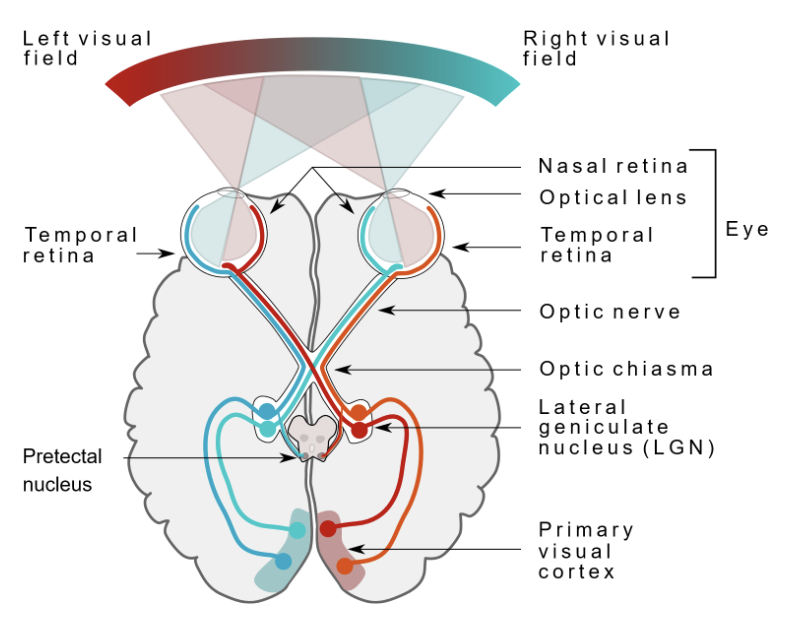
Contralateral organization (in terms of vision)
Left-side vision is provided by the right parts of both eyes; right-side vision is provided by the left parts of both eyes
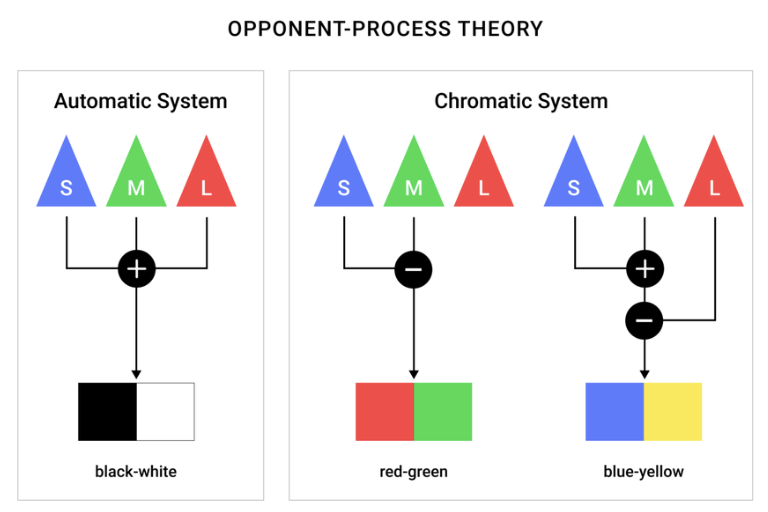
Opponent-Process Theory
Automatic system = black/white
Chromatic system = red/green and blue/yellow
Differentiates colors using neurons, people think this exists due to red/green or blue/yellow colorblindness
Blindsight
The ability for people who are cortically blind to respond to visual stimuli even without conscious-level awareness
Sensation = ?
Detection
Perception = ?
Interpretation
Limited Central Accessibility
We only see the final result of a module's work, not all the steps it used
Bottom-Up Processing
Information flows from senses to perception
Top-Down Processing
Information flows from prior knowledge to perception (mind fills in the gaps)
Color Constancy
Your mind immediately tweaks your perception based on the environment
Encapsulation
Restriction of the flow of information into a system; the output of the system is immune to higher-level beliefs, desires, and goals
Cognitive Impenetrability
The processes involved in perception cannot be changed by information in central memory (beliefs, desires, and knowledge)
Perceptual Grouping
The tendency to see ordered structures in visual patterns (Examples: Law of Proximity, Law of Similarity)
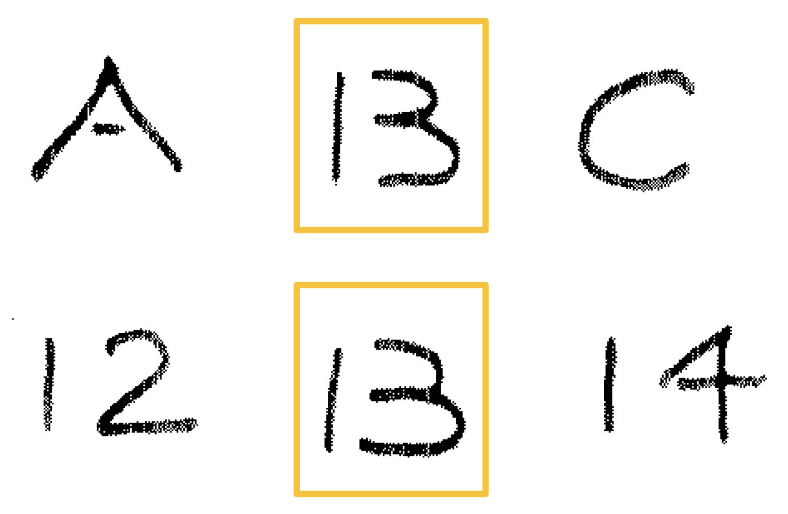
Context-Dependent Perception
Associated with reading; think of the 13 and B looking identical, but based on the context, they are interpreted as different things (shows that perception and recognition are NOT THE SAME)
Modest Modularity
Low-level perceptual systems are modular; central cognition is not
Massive Modularity
The mind is modular through and through, including higher-level cognition
What module is used for faces?
Fusiform Face Area (FFA)
Fusiform Face Area (FFA)
Area of visual processing that specializes in facial recognition (not limited to visual input; selectively responds to the feeling of faces in people born blind)
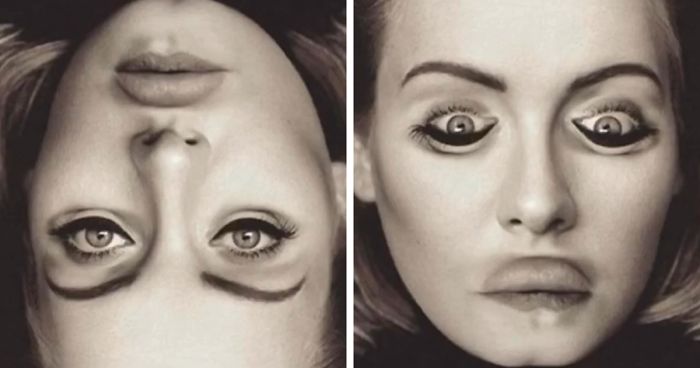
Thatcher Effect (NOTE: associated with encapsulation)
Optical illusion where changes to facial features (upside-down eyes, flipped mouth) are difficult to notice when the face is inverted
Prosopagnosia
The inability to recognize faces