Iso-profits and their slopes.
 Call Kai
 Learn
Learn Practice Test
 Spaced Repetition
 Match
Match Flashcards
 Knowt Play
1/5

Earn XP
Name | Mastery | Learn | Test | Matching | Spaced | Call with Kai |
|---|
No analytics yet
Send a link to your students to track their progress
6 Terms
How can profit be mathematically formed? Assume that the firm’s cost production function is C(Q).

How can an iso-profit curve be seen mathematically?
Also seen as:
PQ - C(Q) = k.
And also seen as:
P = AC + k/Q
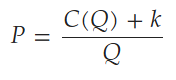
What is the formula then for the zero economic iso-profit curve?
-When k=0, then P = AC. Hence, it can be seen as the AC curve.
-Thus, whether the AC is a straight line (costs are constant for all quantities produced) or a curve (marginal cost increases/decreases) determines the shape of the zero-economic iso-profit curve.
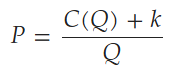
Talk more about the k/Q quality
-The shape of iso-profit curve is also affected by k/Q, though when Q is large, it makes little difference
-Differentiating with respect to Q reveals that it has a negative gradient, so it is downward sloping, and it is accelerating downwards

Why does the iso-profit curve, when Q is large enough, slope the same as the AC?
-The derivative of k/Q is close to 0, meaning the slope of the iso-profit curve only has the derivative of AC to influence. Thus, it then closely reflects the slope of the AC curve.
How can we prove that the marginal cost must pass through the minimum of the iso-profit curves?
-By showing that MC = AC always has the same sign as the slope of the AC curve
-Differentiating by Q reveals this:
dP/dQ = d/dQ(C(Q)/Q) - k/Q2
-Because the differential of C(Q)/Q = [MC-AC]/Q and k/Q = P - AC:
dP/dQ = (MC-AC)/Q - (P-AC)/Q
Which neatly simplifies to this.
-This equation states that, when the slope reaches it minimum, MC must equal P. Boom.
![<p>-By showing that MC = AC always has the same sign as the slope of the AC curve</p><p>-Differentiating by Q reveals this:</p><p>dP/dQ = d/dQ(C(Q)/Q) - k/Q<sup>2</sup></p><p>-Because the differential of C(Q)/Q = [MC-AC]/Q and k/Q = P - AC:</p><p>dP/dQ = (MC-AC)/Q - (P-AC)/Q</p><p>Which neatly simplifies to this. </p><p>-This equation states that, when the slope reaches it minimum, MC must equal P. Boom. </p>](https://assets.knowt.com/user-attachments/3cda7817-1ef5-4716-a9bb-9b5ba15863a8.png)