Nutrition in man
 Call Kai
 Learn
Learn Practice Test
 Spaced Repetition
 Match
Match Flashcards
 Knowt Play
1/78

There's no tags or description
Looks like no tags are added yet.
Name | Mastery | Learn | Test | Matching | Spaced | Call with Kai |
|---|
No analytics yet
Send a link to your students to track their progress
79 Terms
What are nutrients?
Chemical substances that provide energy & materials required by the body.
What are the types of nutrients?
Carbohydrates
Fats
Proteins
Vitamins
Mineral salts
Dietary fibre
Water
What are carbohydrates?
Carbohydrates are organic molecules made up of the elements carbon, hydrogen and oxygen.
What is the principal sources?
Bread, noodles, rice, potato
What can carbohydrates be classified under?
Single sugars (monosaccharide)
Double sugars (disaccharide)
Complex sugars (polysaccharide)
What are the types of single sugars?
Glucose
Galactose
Fructose
GGF (im single :()
What are the types of double sugars?
Maltose
Sucrose
Lactose
MSL
What are the types of complex sugars?
Starch
Cellulose
Glycogen
SCG(S)
What is the body’s source of energy? How do we obtain energy from it?
Body’s main source of energy is complex carbohydrates
Must be broken down into simple glucose units before they can be used, by the brain, muscles and other tissues
Carbohydrates should make up 50-60% of the daily caloric intake
If glucose, galactose and fructose, contains the same amount and types of elements, why do they have different chemical and biological properties?
Arrangement of the various atoms within the molecule give them different chemical & biological properties.
What is a single sugar?
Basic unit of carbohydrate
Small enough to pass through cell membranes
Common single sugars:
glucose (C6H12O6)
fructose (C6H12O6)
So what is the difference between glucose and fructose?
Glucose is found in both plants and animals
Fructose is found commonly in plants but rarely in animals
How are double sugars formed?
Formed when two single sugars (monosaccharides) combine to form a disaccharide sugar
Common double sugars:
–maltose (malt sugar)
– sucrose (cane sugar)
How is maltose formed?
Glucose + glucose → maltose (malt sugar) + water
How is sucrose formed?
Glucose + fructose → sucrose (cane sugar) + water
How is lactose formed?
Glucose + galactose → lactose (milk sugar) + water
How is polysaccharides formed?
Many glucose units combine to form polysaccharides like starch (plant storage of glucose), cellulose (in plant cell walls) & glycogen (animal storage of glucose)
What is the structure, function and occurrence of starch?
Several thousand glucose molecules joined together.
Storage form of carbohydrates in plants.
Found in storage organs of plants, e.g. potato tubers/tapioca.
What is the structure, function and occurrence of cellulose?
Many glucose molecules joined together but bonded differently from starch.
Cellulose cell walls protects plant cells. Serves as dietary fibers to prevent constipation.
Found in cell walls of plants.
What is the structure, function and occurrence of glycogen
Branched molecule of many glucose molecules.
Storage form of carbohydrates in animals.
Stored in liver and muscles of mammals.
Why is glycogen and starch good stores of glucose?
Insoluble in water; impact on water potential and water-solute balance is minimal
Large molecules; hard to diffuse out of cells
Compact; many glucose molecules can be stored in a small place
Easily broken down; they can be hydrolysed back into glucose when the body or plant needs energy.
What is the dietary importance of carbohydrates?
As an immediate source of energy (1g of carbohydrates is broken down to release 16kJ of energy)
To form nucleic acids (e.g. deoxyribose sugar in deoxyribonucleic acid (DNA))
To synthesise lubricants such as mucus
So what are the characteristics of carbohydrates and what are its overall functions?
General formula for carbohydrates is CnH2mOm.
Ratio of H:O = 2:1
Functions:
Provide energy,
form supporting structures (e.g. cell wall)
Form nucleic acid
Can be converted into other organic compounds (amino acids/fats)
To synthesise lubricants such as mucus
What are the types of reducing sugars?
Glucose, fructose and maltose
How can we detect its presence?
Presence of reducing sugars (glucose, fructose and maltose) can be tested using Benedict’s test which gives a green/yellow/orange/red coloration.
(due to oxidation of copper ions)
What are fats?
Fats are organic molecules made up of the elements carbon, hydrogen and oxygen
What are the characteristics of a fat molecule?
Contain much less oxygen in proportion to hydrogen (e.g. Tristearin (beef fat) has the formula C57 H110 O6)
No general formula
A fat molecule can be broken down by lipase into glycerol and 3 fatty acid chains.
What are/is the parts/structure of a fat molecule?
3 fatty acid chains & 1 glycerol
What are the principal sources of fat?
Butter, fatty meat, nuts
Other sources:
Oil
Avocado
Olives
Nuts
Salmon
What dietary importance does fat have?
As a long-term storage of energy; (1g of fats is broken down to release 32kJ of energy)
As an insulating material, especially beneath the skin, thereby preventing excessive heat loss. Important for mammals that live in water, as there is a greater tendency to lose heat, since the hair coverage is no longer an efficient insulator in water.
As a solvent for fat-soluble vitamins like vitamin A, D, E and K
What functions does fat serve?
Store of energy (long-term)
Insulating material
Solvent for fat soluble vitamins/hormones
Form cell membranes
Reduce water loss
Fat should make up what % of our daily diet? Why such low amounts?
30%. Body can synthesise most of its own fats (including cholesterol) from proteins and carbohydrates, especially when intake is excessive.
But why do we still consume fats? And what fats should we avoid?
Because (we only need to consume 1 tablespoon of) polyunsaturated fats like olive or corn oil (as it) contain(s) Linoleic acid, an essential fatty acid, which our body cannot produce.
But saturated fats like butter and other animal fats tend to raise blood cholesterol, which in excessive amounts harms our circulatory system.
But is cholesterol inherently bad?
Cholesterol is needed to synthesise substances like bile acid and steroid hormones, but in excessive amounts can harm circulatory systems.
What are proteins
Proteins are organic molecules made up of the elements carbon, hydrogen, oxygen and nitrogen. Some even contain sulfur.
(R group may sometimes contains sulfur & phosphorus)
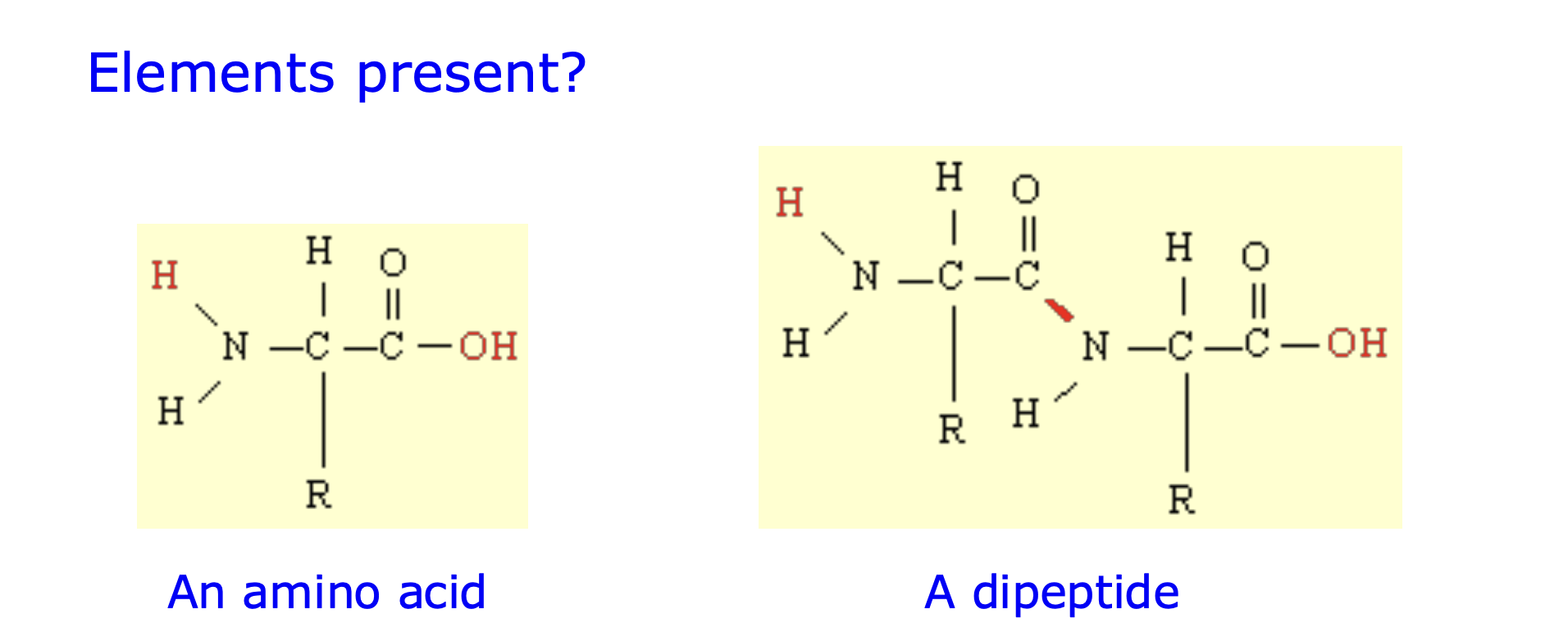
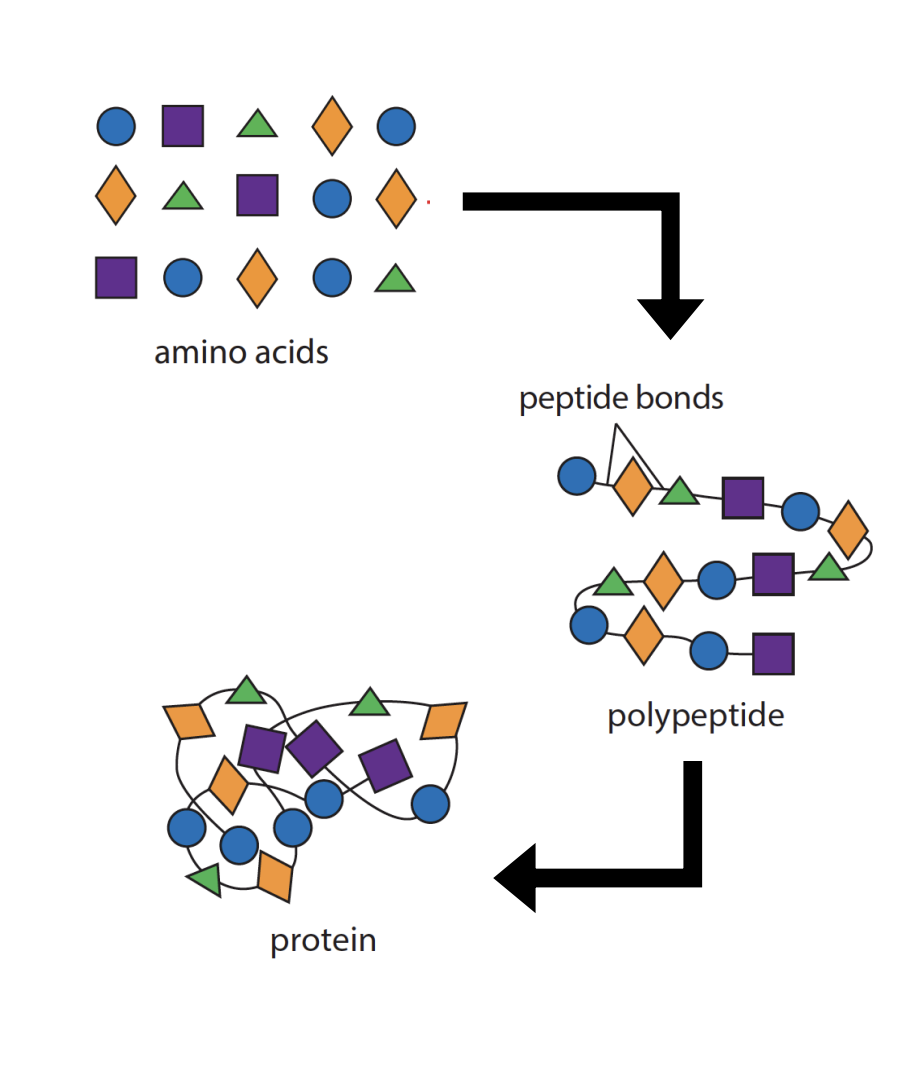
What are proteins made up of?
Amino acids are the building blocks of proteins.
Peptide bonds link up amino acids to form a polypeptide.
One or more polypeptide chains fold to form a 3-D molecule, called protein.
What are the principal sources of protein
PRINCIPAL SOURCES
Lean meat, fish, cheese, milk, beans, peas
Example of sources:
Egg whites Beans Lentils Milk/Cheese Red meat
What is the dietary function of protein?
Essential for growth & repair of worn-out body cells
To synthesise new protoplasm, enzymes & some hormones (e.g. insulin)
To form antibodies (formed by white blood cels)
Characteristics of proteins
Made up of smaller basic units, amino acids
Each amino acid is made up of an amino group, acidic group, a side chain
Amino acids -> Polypeptides -> Proteins
How can we test for proteins?
Presence of proteins can be tested using Biuret test which gives a violet coloration.
What % of our diet should be protein?
12% of the total diet.
Why do we consume protein via meat?
Contains 8 essential amino acids (out of the 20 common ones), which cannot be synthesised in our body and must be obtained from food.
Animal proteins contain high levels of all 8 essential amino acids, but not plant proteins. (not present in a proportion required for proper human nutrition)
What are the types of vitamins u will focus on this year?
Vitamin C and D
What are the principal sources of vitamin C?
Citrus fruits (oranges, lemons, grapefruits)
Other fruits like papayas, guava, fresh green vegetables
What are the symptoms of vitamin C deficiency?
Results in scurvy
Swollen bleeding gums
Loosening of the teeth
Haemorrhages in muscles & skin
Poor healing of wounds
Painful swollen joints
What is the dietary importance of vitamin C?
Needed for the formation of intercellular substances e.g. collagen
Necessary for maintaining healthy epithelial tissues
What are the principal sources of vitamin D?
Fish liver oil, egg yolk, milk, ultraviolet rays in sunlight (ultraviolet rays convert ergosterol in skin to vitamin D)
What is the dietary importance of D?
Promotes absorption of calcium & phosphorus compounds
Enables the body to use these compounds in the formation of bones & teeth
What are the deficiency symptoms of vitamin D?
Poor teeth & bone formation leading to rickets
In children, the ends of long bones become enlarged and due to the softness of the bones, they would become bent under body weight
What are the minerals we will be focusing on this year?
Calcium (Ca) and Iron (Fe)
What are the principal sources of calcium?
Milk, cheese, eggs, cereals, soya beans, dark green vegetables like spinach, ikan bilis
What is the dietary importance of calcium?
Necessary for the clotting of blood
Required for the building of bones & teeth
Needed for the normal functioning of the muscles
What are the deficiency symptoms of poor calcium intake?
Severe deficiency results in rickets
What are the principal sources of iron?
Liver, red meat, egg yolk, bread, dark green vegetables
What is the dietary importance of iron?
To form hemoglobin
To form myoglobin, a protein in muscles which stores oxygen for use in muscle movement
To make certain enzymes involved in cellular respiration
What are the deficiency symptoms of iron?
Nutritional Anaemia
Tiredness & breathlessness; as haemoglobin level is lowered, smaller and fewer red blood cells are formed. The oxygen-carrying efficiency of this person is lower than people who do not suffer from this condition.
What are the two other substances we will focus this year?
Dietary fibre/roughage
Water
What is dietary fibre?
The indigestible portion of plants and consists of mainly cellulose from the cell wall.
What are the principal sources of fibre?
Fresh fruits & vegetables, wholemeal bread
What is dietary fibre’s dietary importance?
Provides bulk to the intestinal contents
Helps peristalsis; the series of wavelike, muscular contractions of the walls of the digestive tract. This enables the food to be mixed and churned properly with the digestive juices and moves the food along the alimentary canal.
What is the deficiency condition of dietary fibre?
Constipation → difficulty passing out faeces which are hard and dry
A diet lacking in dietary fibre would cause the indigestible matter to move slower in the digestive tract, causing too much water to be absorbed, resulting in faeces which are hard and dry.
how can we prevent constipation?
Consuming enough dietary fibre
Drinking sufficiency water.
Exercising regularly would also help by promoting peristalsis
Why is water important?
Extremely important to life as it is an essential component of protoplasm, where numerous biochemical reactions take place. About 70% of the body weight of mammal is water.
What is the principal source of water?
Drinks and soups
What is the dietary importance of water?
Major constituent of digestive juices
Solvent for both salts and many organic compounds in the body
Transports materials, e.g. digested food substances, excretory products, hormones, around the body
What is proteins digested into?
Amino acids
What tests are there?
Iodine test
Benedict’s Test
Fats/lipids test
Biuret’s test
How do we test for carbohydrates? What would we observe, and how can we tell if its absent or present?
Starch test
To 2 cm3 of sample solution, add 1-2 drops of iodine solution.
Observe colour change.
If Iodine solution on the sample remains brown:
Starch is absent.
Iodine solution on the sample turns from brown to blue-black:
Starch is present
What are the reducing sugars, and what is not a reducing sugar?
Reducing sugars include glucose, fructose, galactose, maltose, lactose
Non-reducing sugar: sucrose
How can we test for reducing sugar? What would we observe, and how can we tell if its absent or present?
Benedict’s Test
1. To 2 cm3 of sample solution, add an equal volume of Benedict’s solution.
2. Shake to mix.
3. Heat in a boiling water bath for 2-3 minutes.
4. Record your observation.
Benedict’s solution turned from blue to green
A small amount of reducing sugars are present.
Benedict’s solution turned from blue to yellow/orange
A moderate amount of reducing sugars are present.
Benedict’s solution turned from blue to red/brown/brick-red
A large amount of reducing sugars are present.
Benedict’s solution remained blue on heating.
Reducing sugars are absent.
How to test for fats? What would we observe, and how can we tell if its absent or present?
Fats/lipids test
1. Add one drop of sample to a clean, dry test tube.
2. Add 2 cm3 of ethanol to the test tube. Shake the mixture thoroughly. Observe.
3. Add 2 cm3 of water to the mixture. Observe.
The mixture remains clear with no white emulsion. Lipids/Fats are absent.
White emulsion produced in mixture. Lipids/Fats are present.
How can we test for proteins? What would we observe, and how can we tell if its absent or present?
Proteins test
1. Add 2cm3 of sample solution to a clean test tube.
2. Add 1cm3 of sodium hydroxide solution. Shake the mixture.
3. Add 1% copper (II) sulfate solution drop by drop, shaking after every drop.
4. Record your observation.
Solution remains blue:
Protein absent.
Solution turns from blue to violet:
Protein present.
What are the qualitative and quantitative tests?
Qualitative: (showing only presence of it)
Iodine test
Biuret’s Test
Test for Fats/Lipids
Quantitative: (showing relative amounts)
Benedict’s Test
Why is benedict’s test a quantitative test?
It can show the relative amounts of reducing sugar present, but not the exact quantity of reducing sugar present.
How do we sample solid foods?
Cut it into smaller pieces (breaking up the cells to release nutrients present)
Add sufficient distilled water to try to dissolve the nutrients that we want to test for, but not too much, as excessive dilution would make it difficult for us to detect the presence of nutrients.
But for testing fats in solid samples, add 2cm3 of ethanol instead of distilled water and shake thoroughly. Allow the solid particles to settle before decanting the ethanol into another test tube containing 2cm3 of distilled water.
So what are the steps we should take for all tests?
1.Starch test: Add iodine solution directly to the crushed food.
Benedict’s and biuret tests: Add water to the crushed food to dissolve the nutrients, shake and decant the mixture into a new test-tube before adding the test reagent.
Ethanol emulsion test: Add ethanol to the crushed food to dissolve the nutrients, shake and decant the mixture to a new to a test-tube before adding water.
What are the main functions of carbohydrates proteins and fats?
➢carbohydrates as an immediate source of energy
➢fats for insulation and long-term storage of energy
➢proteins for growth and repair of cells
Why cant we carry out fats/lipids tests using ethanol and water with milk?
It already appears as a ‘milky, white emulsion’.
Why does benedict solution appear blue?
Benedict solution appears blue as it contains copper (II) ions.
The Orange red precipitate contains Cu^+ salts.
As such, reducing sugar is able to reduce the valency of copper from II to I.