Sugar Transport in Plants: Phloem
 Call Kai
 Learn
Learn Practice Test
 Spaced Repetition
 Match
Match Flashcards
 Knowt Play
1/14

There's no tags or description
Looks like no tags are added yet.
Name | Mastery | Learn | Test | Matching | Spaced | Call with Kai |
|---|
No analytics yet
Send a link to your students to track their progress
15 Terms
translocation
movement of sugar through plant phloem
sugars move from sources to sinks
source
any structure in a plant that either produces (like a leaf) or releases (like a storage bulb) sugars for the growing plant
sink
any location where sugar is delivered for use in a growing tissue or storage for later use
growing tissues: apical and lateral meristems; developing leaves, flowers, seeds, and fruits
storage locations: roots, tubers, and bulbs
a storage location can either be a source of a sink depending on the plant’s stage of development and the season:
middle of growing season
sources: mature leaves and stems which are actively photosynthesizing and producing excess sugars
sinks: areas of active growth meristems, new leaves, and reproductive structures like flowers and seeds; sugar storage locations like roots, tubers, or bulbs
end of growing season
plants drop leaves and no longer have photosynthesizing tissue- growing season may end either due to onset of winter or onset or dry season depending on climate
start of next growing season
dt no existing leaves → only source of sugar for growth is sugar stored in roots, tubers, or bulbs from previous growing season- storage sites now serve as sources
actively developing leaves are the sinks
once leaves mature → they become sources of sugar during the growing season
the pressure flow model accounts for several observations:
the fluid in the phloem is under high positive pressure
translocation stops if the phloem tissue is killed
translocation can proceed in both directions simultaneously (but not within the same tube)
translocation is inhibited by compounds that stop ATP production in the sugar source
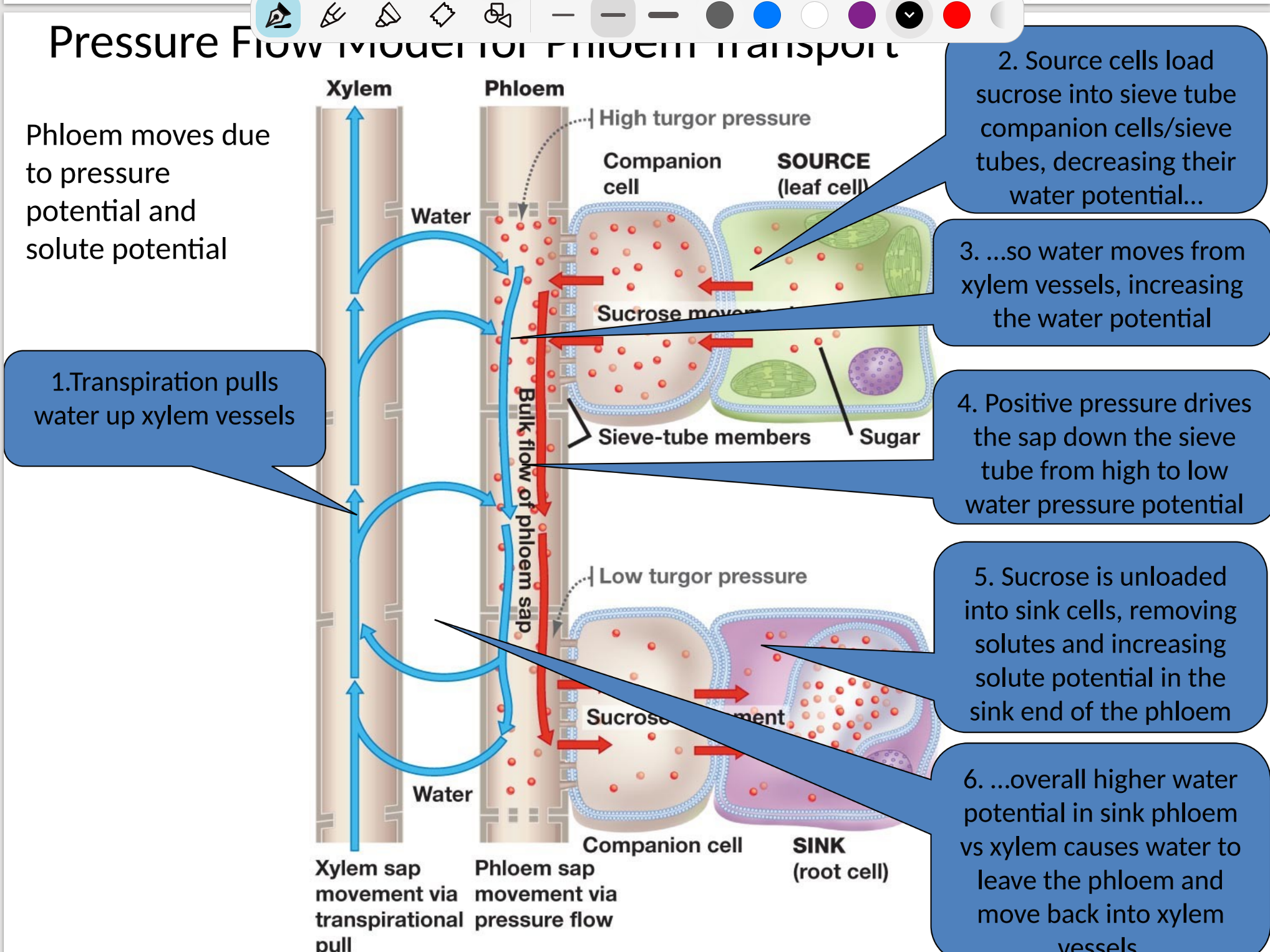
pressure flow model
high conc of sugar at source creates a low Ψs
→ low solute potential draws water into phloem from adjacent xylem
→ movement of water into phloem creates a high Ψp in the phloem
→ high turgor pressure forces movement of phloem sap from source to sink through process called '“bulk flow”
→ the sugars moved via bulk flow are rapidly removed from the phloem at the sink
→ removal of the sugars at the sink increases the Ψs → causes water to leave phloem and return to xylem → decreases Ψp at the sink
diffusion
go from area of high conc to low conc
proton pumps
use energy from ATP to create electrochemical gradients → used to move molecules against conc gradients via co-transporters
co-transporters
move two molecules at same time- one down its conc gradient, which releases energy to transport other molecules against conc gradient
A. symporters: transport two molecules in same direction (both into cell; both out of cell)
B. antiporters: transport two molecules in opposite directions (one into cell and other out of cell)
transport pathways in pressure flow model
photosynthates (sucrose) are produced in parenchyma cells of photosynthesizing leaves
→ sugars are actively transported (ATP) from source cells into the sieve-tube companion cells
companion cells use ATP-powered proton pump to create EG outside cell than proton-sucrose cotransporter to move proton down its CG with sucrose against its CG and into the companion cells
→ active transport of sugar into the companion cells allows the companion cells to accumulate higher conc of sugar than the photosynthesizing leaves
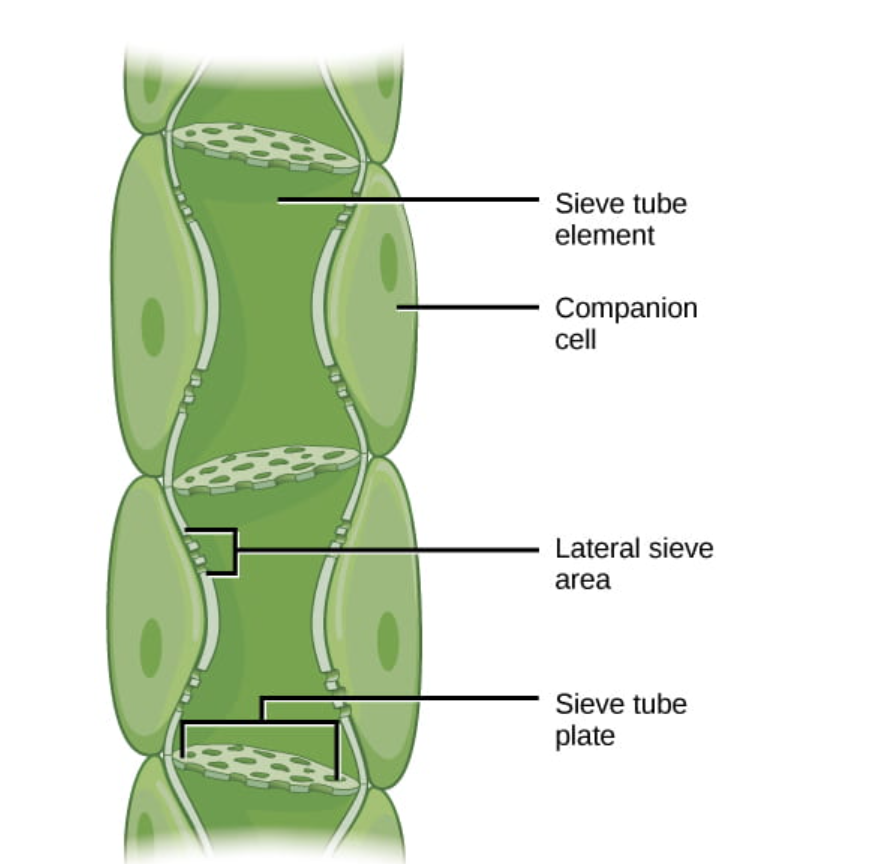
→ in companion cells, the sugar diffuses down its CG into the phloem sieve-tube elements (connected by pores) through the plasmodesmata
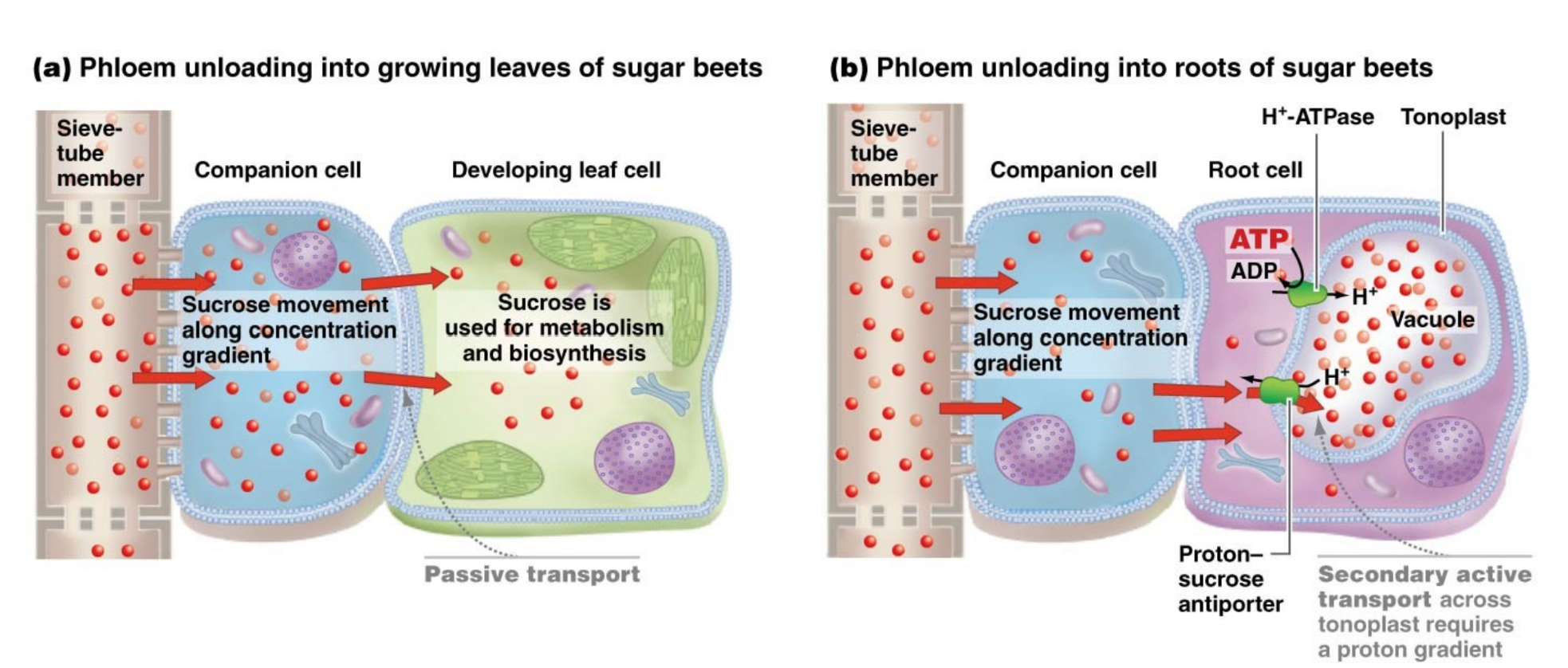
different mechanisms for unloading sucrose into sink cells
if sink is an area of active growth: sucrose conc in the sink cells is usually lower than in phloem sieve-tube elements bc the sink sucrose is rapidly metabolized for growth (passive transport)
if sink is an area of storage where sugar is converted to starch (root, bulb): sugar conc in sink lower than in the phloem sieve-tube elements bc the sink sucrose is rapidly converted to starch for storage (passive transport)
if sink is an area of storage where sugar is stored as sucrose (sugar beet, sugar cane): sink has high conc of sugar than phloem sieve-tube cells → active transport by proton-sucrose cotransporter (relies on ATP-powered proton pump) transports sugar from companion cels into storage vacuoles in the storage cells
once sugar unloaded at sink cells:
the Ψs increases, causing water to diffuse by osmosis from the phloem back into the xylem
movement of water out of the phloem causes Ψp to decrease, reducing the turgor pressure in the phloem at the sink and maintaining the direction of bulk flow from source to sink
driving force for bulk flow (fluid movement) in phloem vs xylem
phloem: active transport of sucrose at source
xylem: transpiration from leaves
site of bulk flow (cells facilitating fluid movement) in phloem vs xylem
phloem: living sieve tube elements
xylem: non-living vessel elements and tracheids (cohesion)
type of pressure potential in sap in phloem vs xylem
phloem: positive (push from source; pressure; Ψp increases)
xylem: negative (pull from top, tension; Ψp decreases)