Final 5th Exam ARTH 102
 Call Kai
 Learn
Learn Practice Test
 Spaced Repetition
 Match
Match Flashcards
 Knowt Play
1/49

There's no tags or description
Looks like no tags are added yet.
Name | Mastery | Learn | Test | Matching | Spaced | Call with Kai |
|---|
No analytics yet
Send a link to your students to track their progress
50 Terms
The American and French Revolutions-relationship between these events and art
Art became a vehicle for civic virtue, propaganda, and emotional rebellion
Neoclassicism- characteristics + themes
It is a blend of ancient classical antiquity (Greek and Roman) and 18th-century Enlightenment philosophy
Characteristics: Straight lines, geometric order, Edges are sharp, figures are clearly defined, the surface of a painting is smooth (you can’t see brush strokes), minimal composition, somber colors
Themes: Civic Virtue and Patriotism, Self-Sacrifice, Logic and Order (Roman forums, temples, battlefields, serious, heroic, moralistic)
Architecture: “Greek Revival” → Columns, Pediments, and Domes
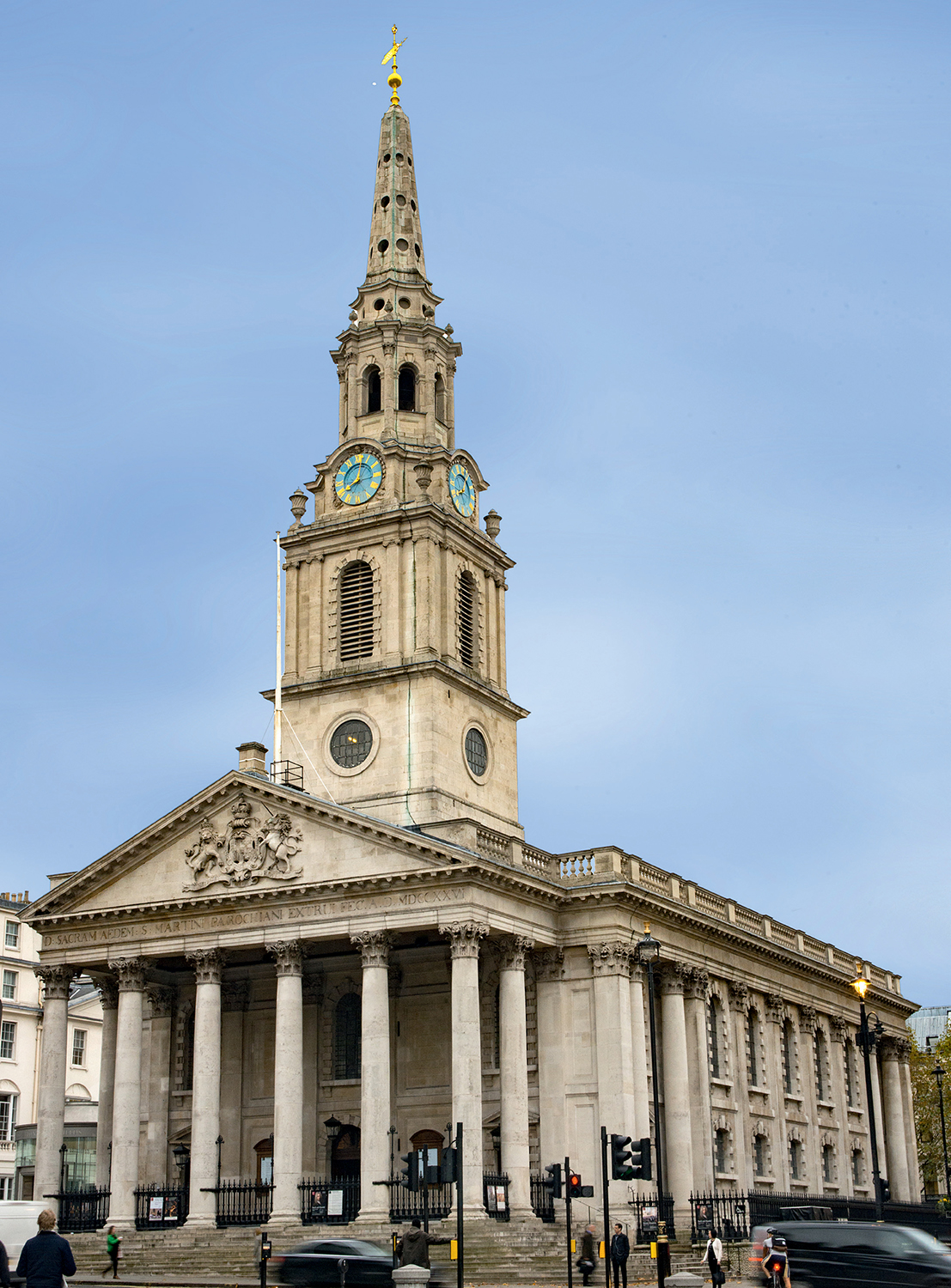
St. Martin-in-the-Fields
Created by James Gibbs
Located in London (England)
Classical style with a steeple design (more Baroque) coming out of a Roman temple
Called Neoclassic style
Rounded windows and pillars in a “rhythm”
Mix of a classical-temple-inspired body with a pediment-capped porch of Corinthian columns and an Italian Baroque bell tower
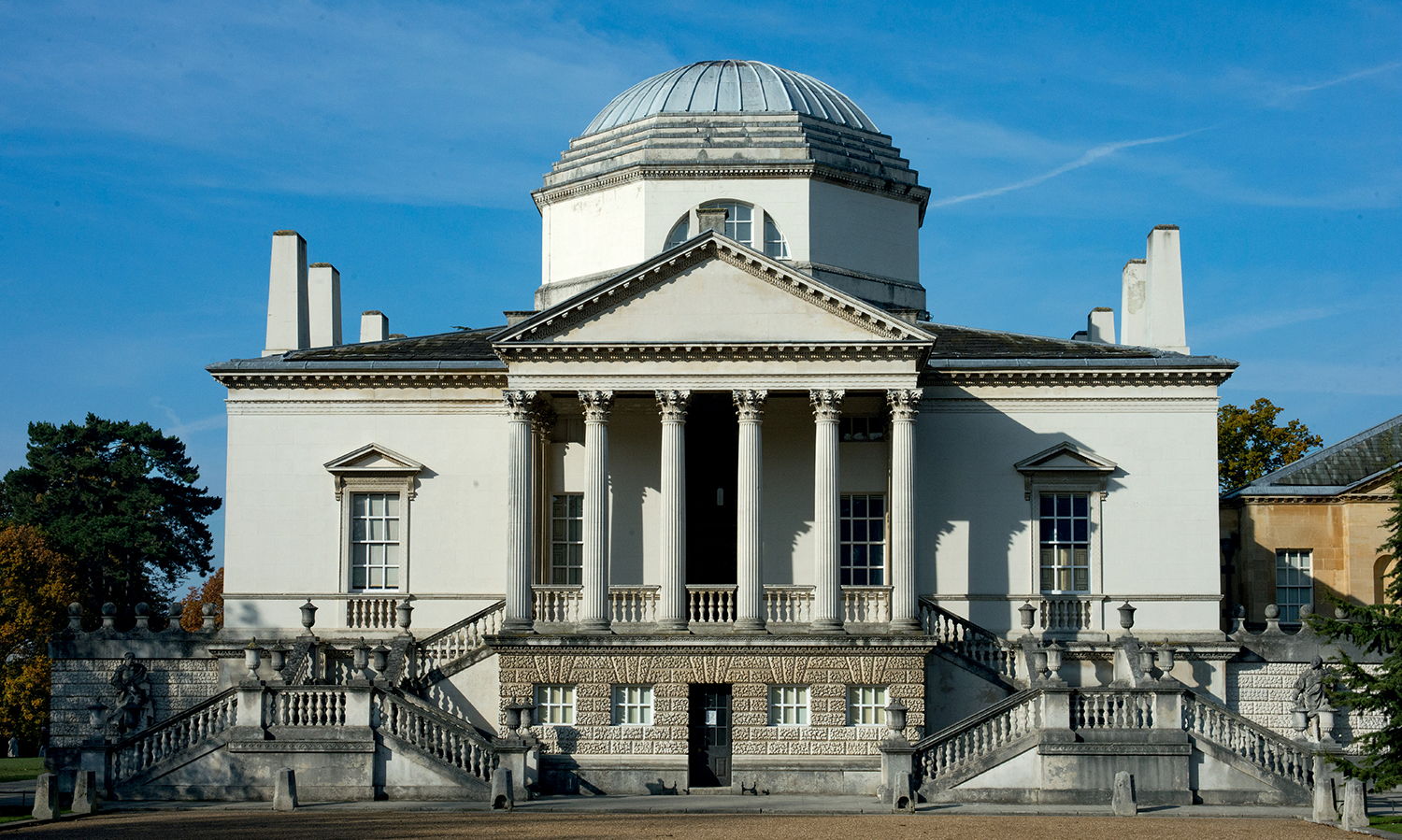
Chiswick House
Created by William Kent and Richard Boyle
England
Variation of the Villa Rotunda
Borrowed from the Renaissance and Roman architecture
Simple symmetry, unadorned planes, right angles, and precise proportions
Chiswick House looks very classical and rational
Which archaeological discoveries at this time influenced the Neoclassical style?
The excavations of Roman cities Pompeii (1748) and Herculaneum (1738)
They yielded well-preserved paintings, sculptures, vases, and other household objects, and provided rich evidence for reconstructing Roman art and life.
European ideas about and interest in ancient Rome expanded tremendously
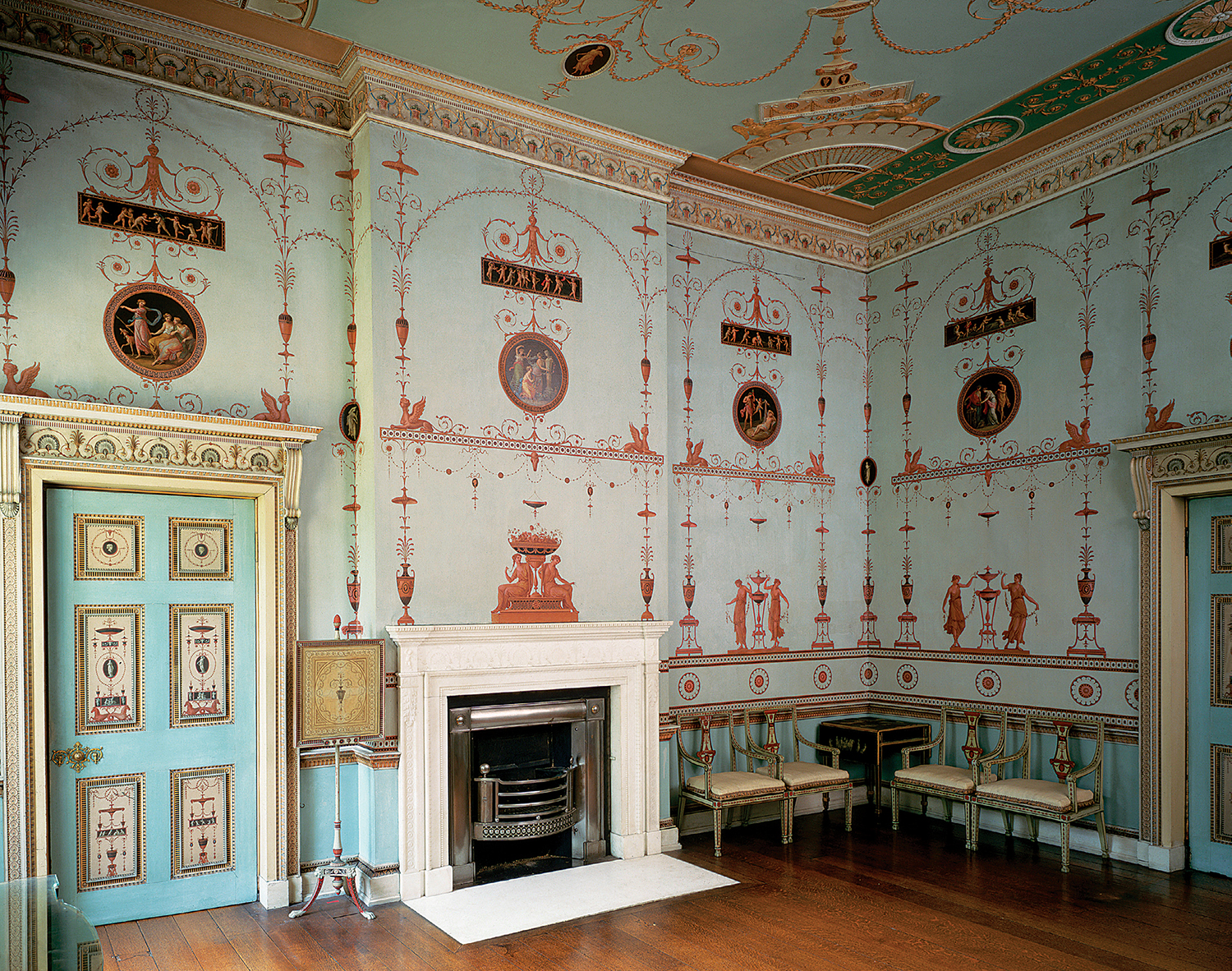
Osterley Park House (Etruscan Room)
Created by Robert Adam
He was inspired by the excavations of Pompeii
They yielded well-preserved paintings, sculptures, vases, and other household objects, and provided rich evidence for reconstructing Roman art and life.
European ideas about and interest in ancient Rome expanded tremendously
Etruscan Room’s wall paintings were inspired by Roman frescoes of the Third and early Fourth Styles of Roman mural painting
Adam took decorative motifs (medallions, urns, vine scrolls, sphinxes, and tripods) from Roman art and arranged them sparsely
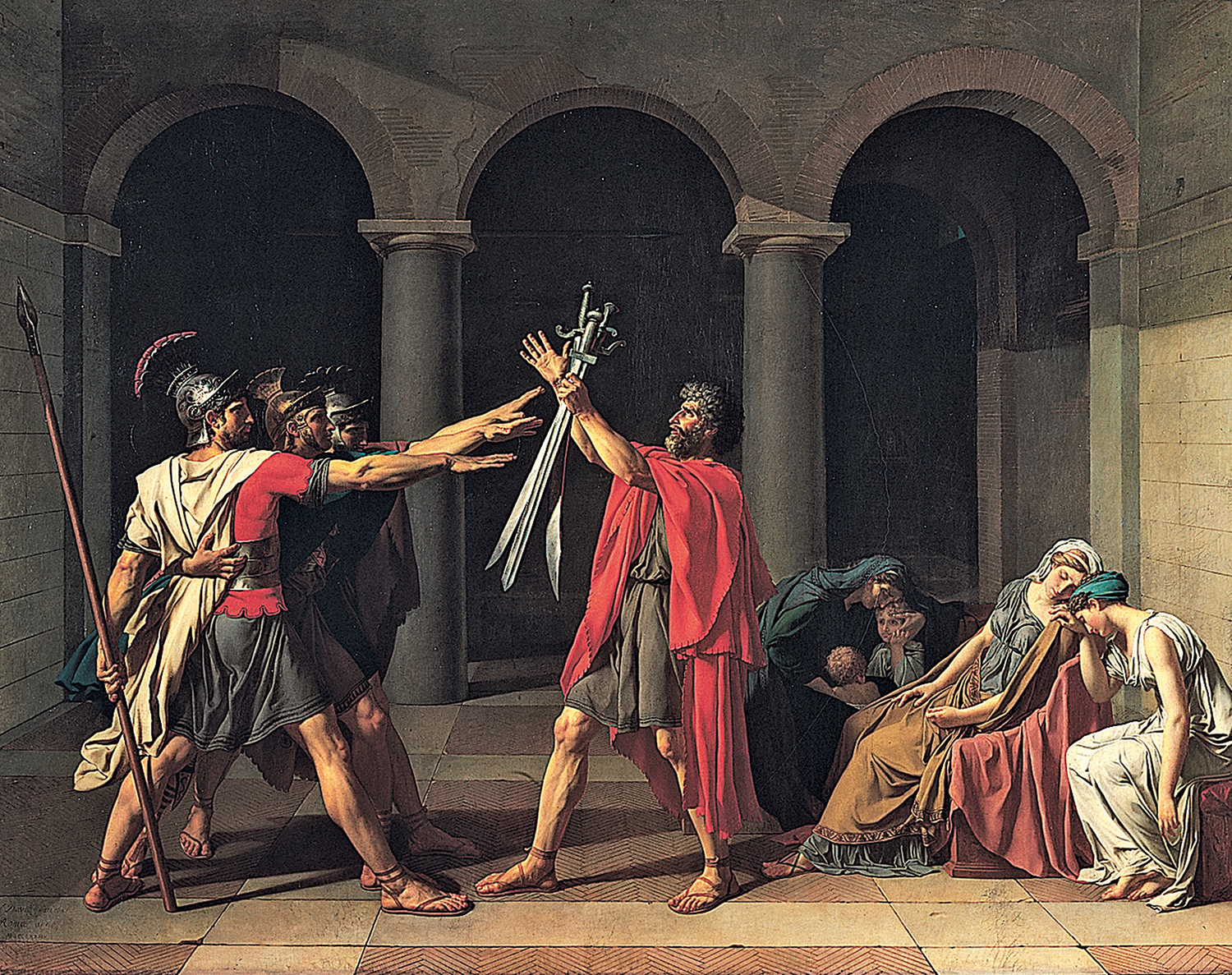
Oath of Horatii
Created by Jaques Louis David
David’s earlier art was inspired by the Baroque/Rococo Era and he then turned to being more archeologically correct (Pre-imperial Roman times)
According to the story, the leaders of the warring cities of Rome and Alba decided to resolve their conflicts in a series of encounters waged by three representatives from each side. The Romans chose as their champions the three Horatius brothers, who had to face the three sons of the Curatius family from Alba
A sister of the Horatii, Camilla, was the bride-to-be of one of the Curatius sons, and the wife of the youngest Horatius was the sister of the Curatii
The painting shows the Horatii as they swear on their swords, held high by their father, to win or die for Rome, oblivious to the anguish and sorrow of the Horatius women.
Oath of the Horatii exemplifies the Neoclassical style
The subject was a narrative of patriotism and sacrifice excerpted from Roman history, but the painter depicted the story according to the principles of classical art
Although David had painted it under royal patronage and did not intend the painting as a revolutionary statement, Oath of the Horatii aroused his audience to patriotic zeal
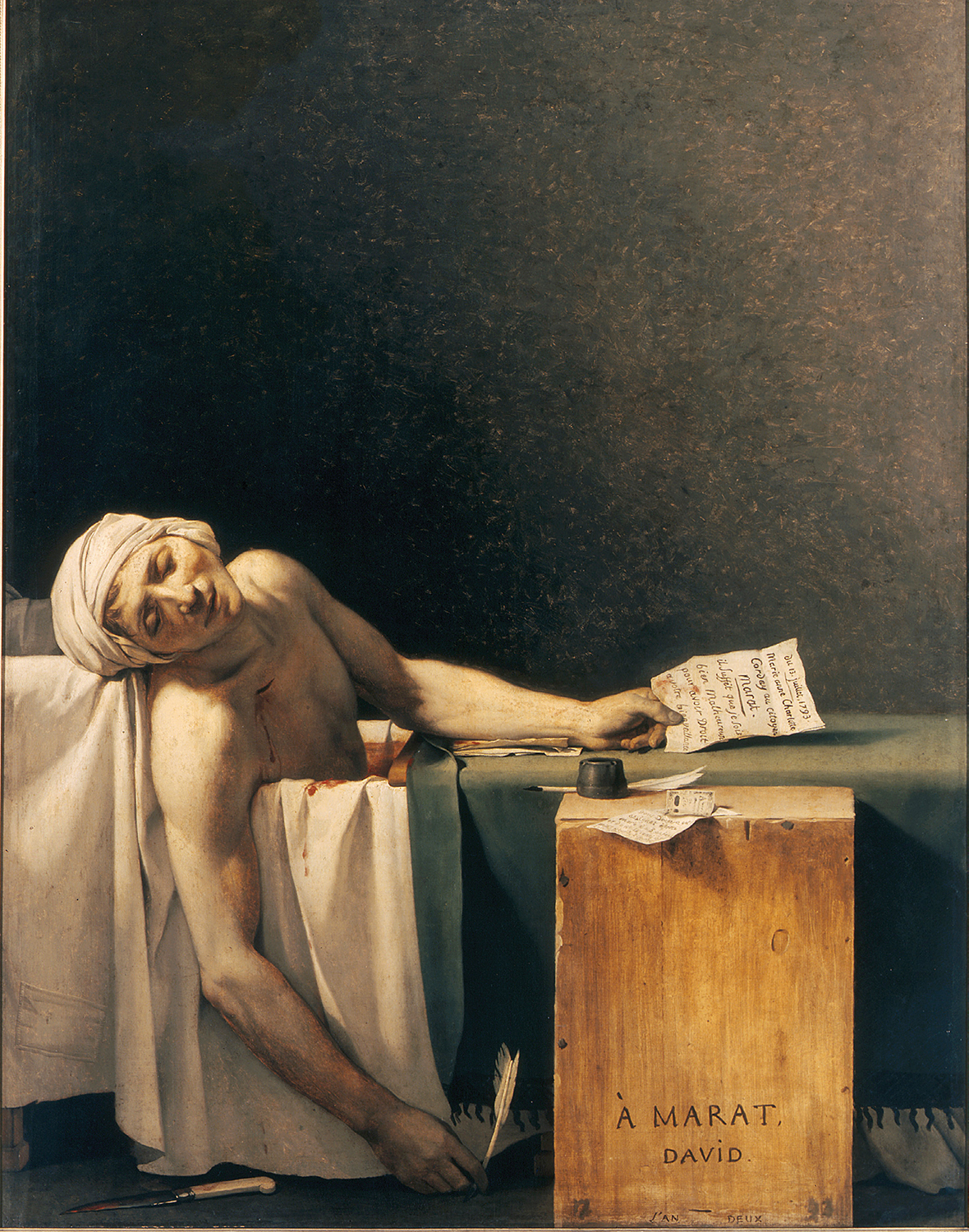
Death of Marat
Created by Jaques Louis David (He became a painter of propaganda)
David believed that art could play an important role in educating the public and that dramatic paintings emphasizing patriotism and civic virtue would prove effective as rallying calls
The painting commemorates the assassination that year of Jean-Paul Marat (1743–1793), an influential writer and minster who was David’s friend
David depicted the martyred revolutionary still holding a quill pen in his right hand after Charlotte Corday (He signed a death warrant of her brother- she wanted revenge), a member of a rival political faction, stabbed him to death while Marat was immersed in a bathtub
Marat suffered from a painful skin disease and required frequent medicinal baths so he did a lot of work there
David was called to the house and he sketched the scene
Martyr painting (“Hero of the revolution”) —> spotlight is quasi religious (Invokes religious atmosphere)
Displayed at his funeral
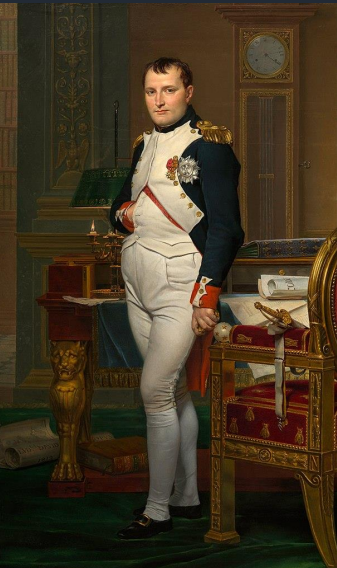
Napoleon
Painted by David (friend of his)
Emperor of the French from 18 May 1804 until his first abdication in 1814
Napoleon commanded the French army in over 80 battles and won 75, displaying unmatched strategic and tactical abilities
After David had gotten out of prison Napoleon approached David after his coronation and offered him the position of First painter of the Empire
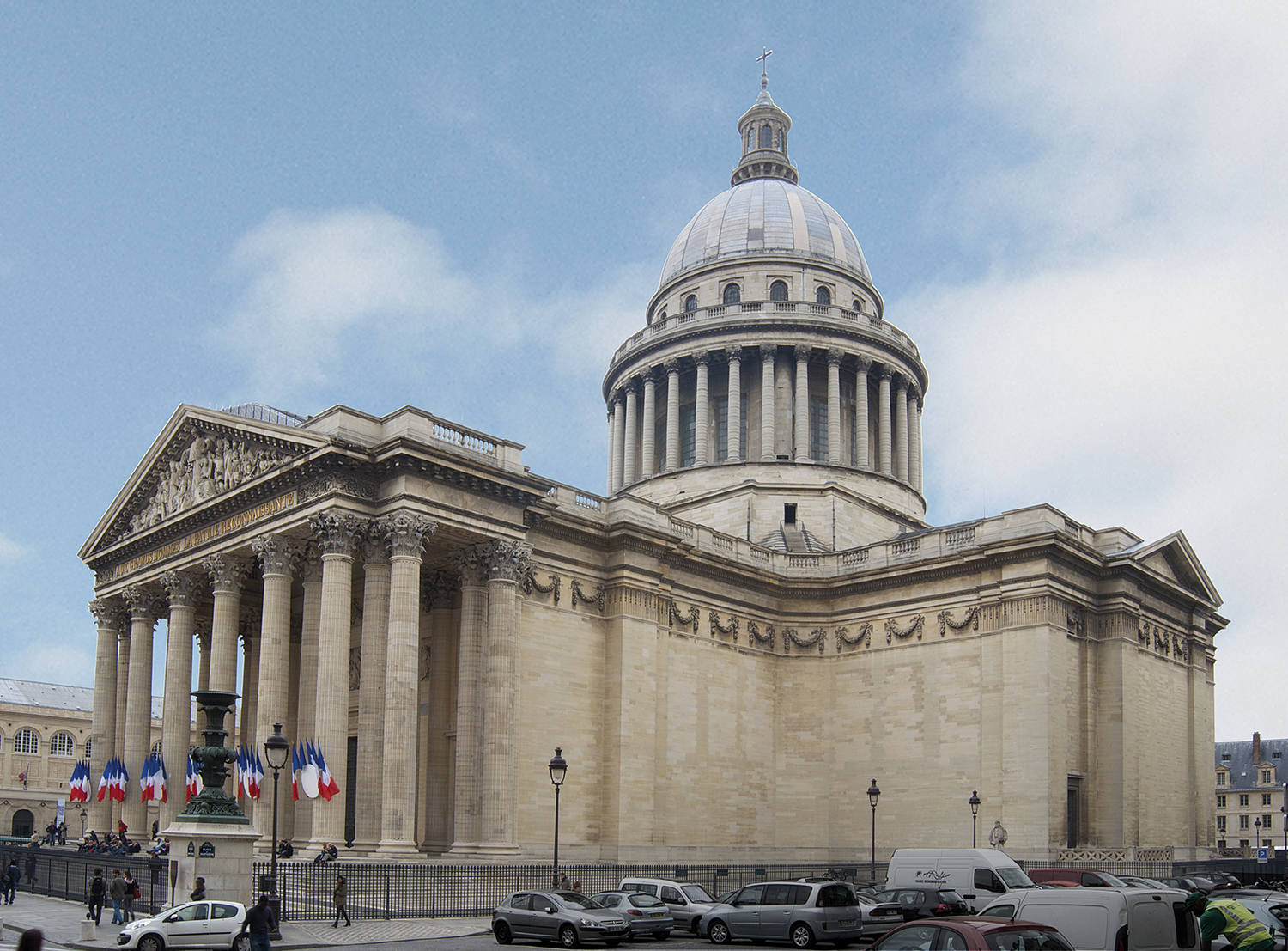
Pantheon
Created by Jaques Germain Souffot
Located in Paris (France)
Originally dedicated to St. Genevieve
The dome copies St. Paul’s Cathedral
Baroque and neoclassical style (very simplistic)
Monument to revolutionary era
Testament to the Enlightenment admiration for Greece and Rome
Combines a portico based on an ancient Roman temple with a colonnaded dome and a Greek-cross plan.
Thomas Jefferson
He was an economist, educational theorist, and gifted amateur architect, as well as statesman
He admired the Palladio and read the Four Books of Architecture
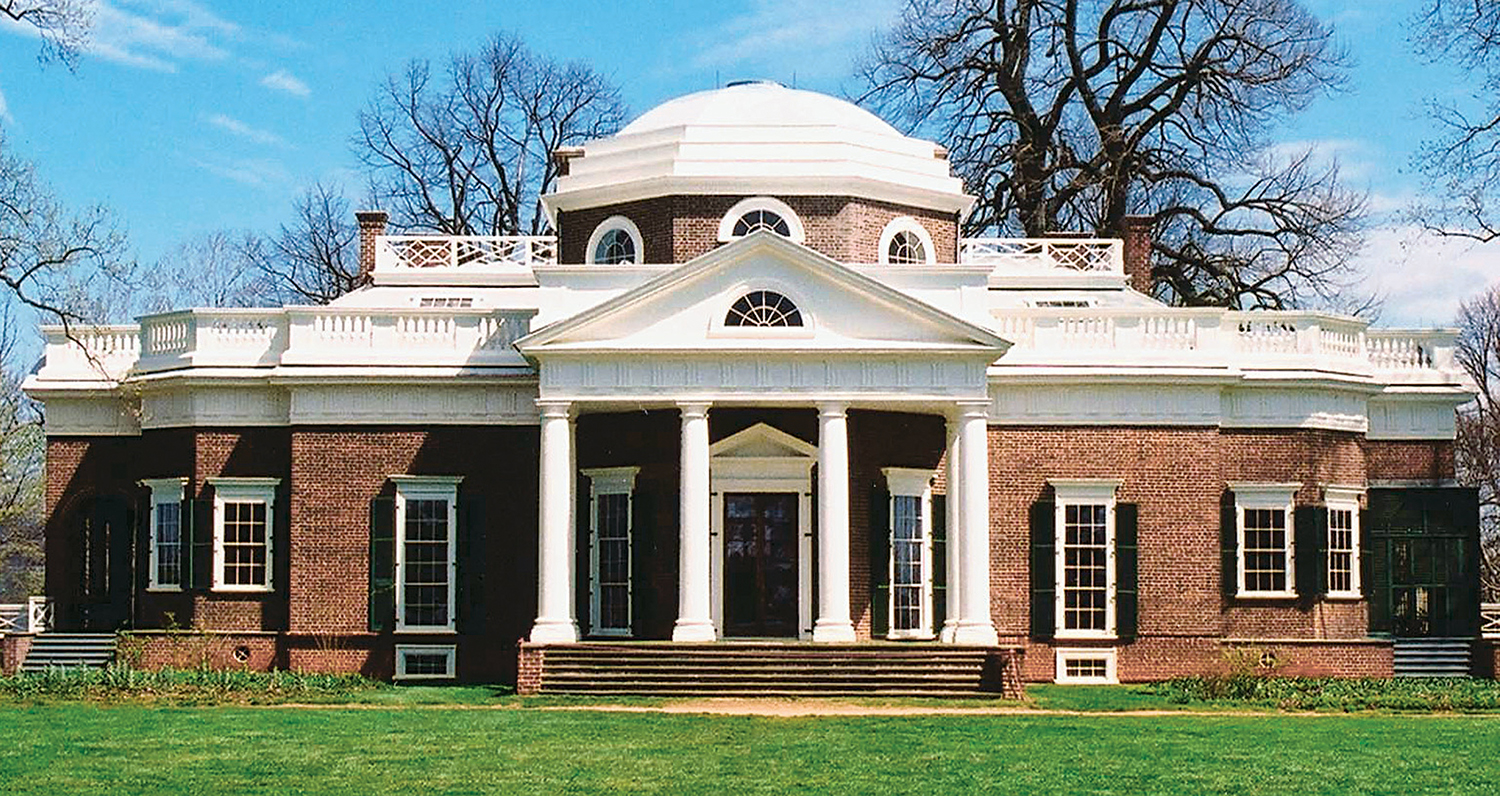
Monticello
Designed and built by Thomas Jefferson
Located in Charlottesville, Virginia
Jefferson had made trips to Italy and France and was influenced by the classical and renaissance architecture
He led the movement to adopt Neoclassicism as the architectural style of the United States
Single-story structure has an octagonal dome set above the central drawing room behind a pediment-capped columnar porch
Recalls the Chiswick House and Villa Rotunda
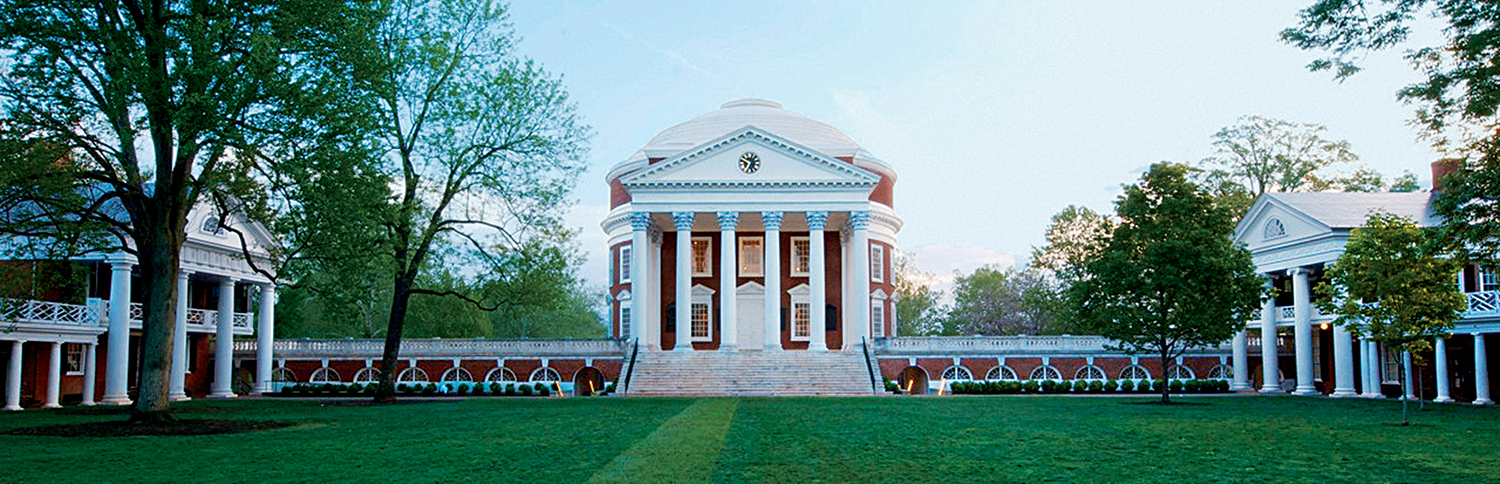
University of Virginia (Rotunda and Lawn)
Created and founded by Thomas Jefferson
Jefferson loved Domes
Jefferson’s Neoclassical Rotunda sits like a temple in a Roman forum on an elevated platform overlooking the colonnaded Lawn of the University of Virginia
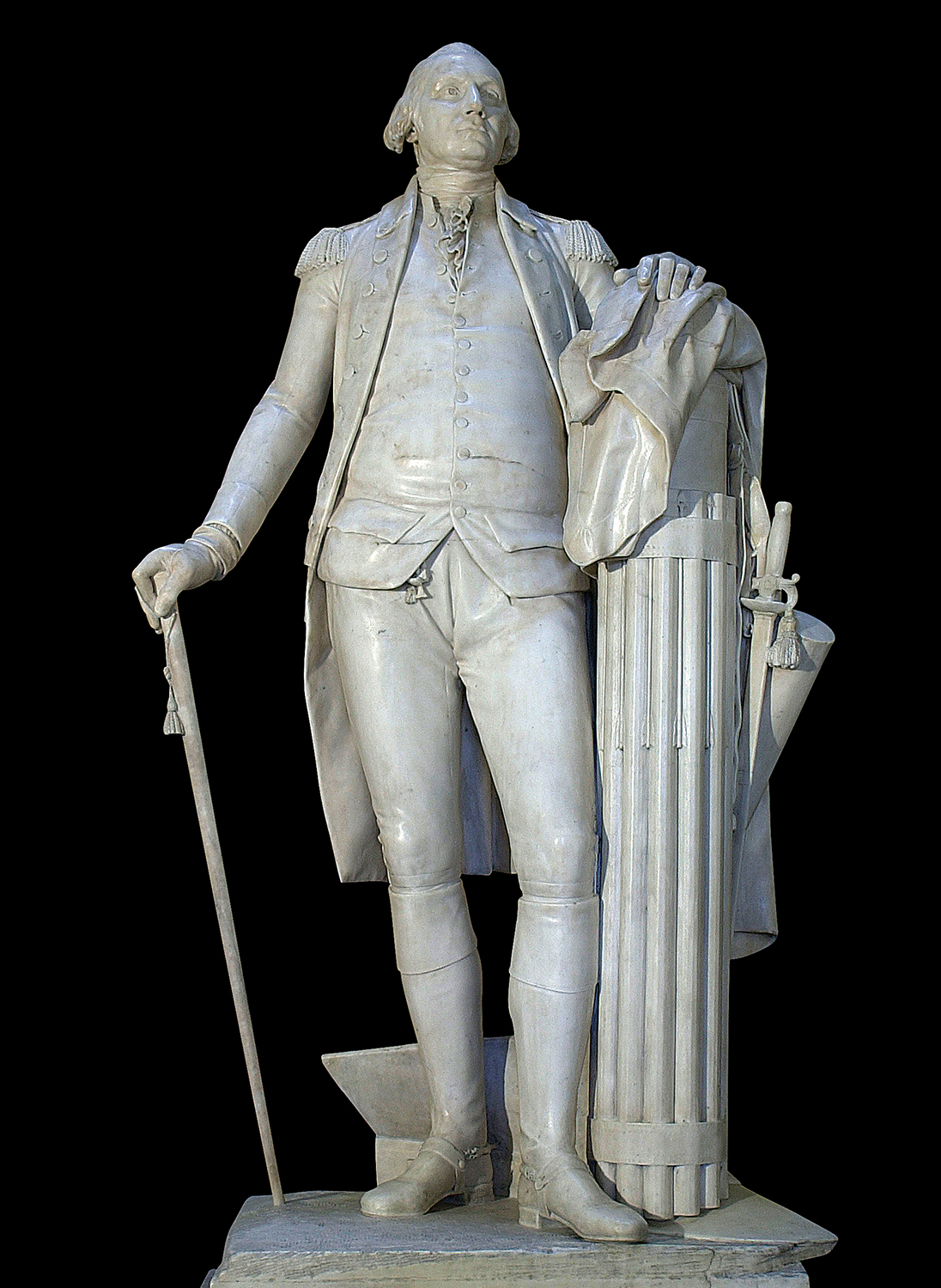
George Washington, 1788-92
Created by Jean Antoine Houdon- he was a well-known French sculptor (Previously sculpted Benjamin Franklin)
The sculpture was designed to honor Washington for his service and emulate his spirit
Houdon portrayed Washington in contemporary garb
He incorporated the Roman fasces (emblem of authority) and Cincinnatus’s plow in the statue, because Washington similarly had returned to his farm after his war service
It was a life-size sculpture and a testament to his character
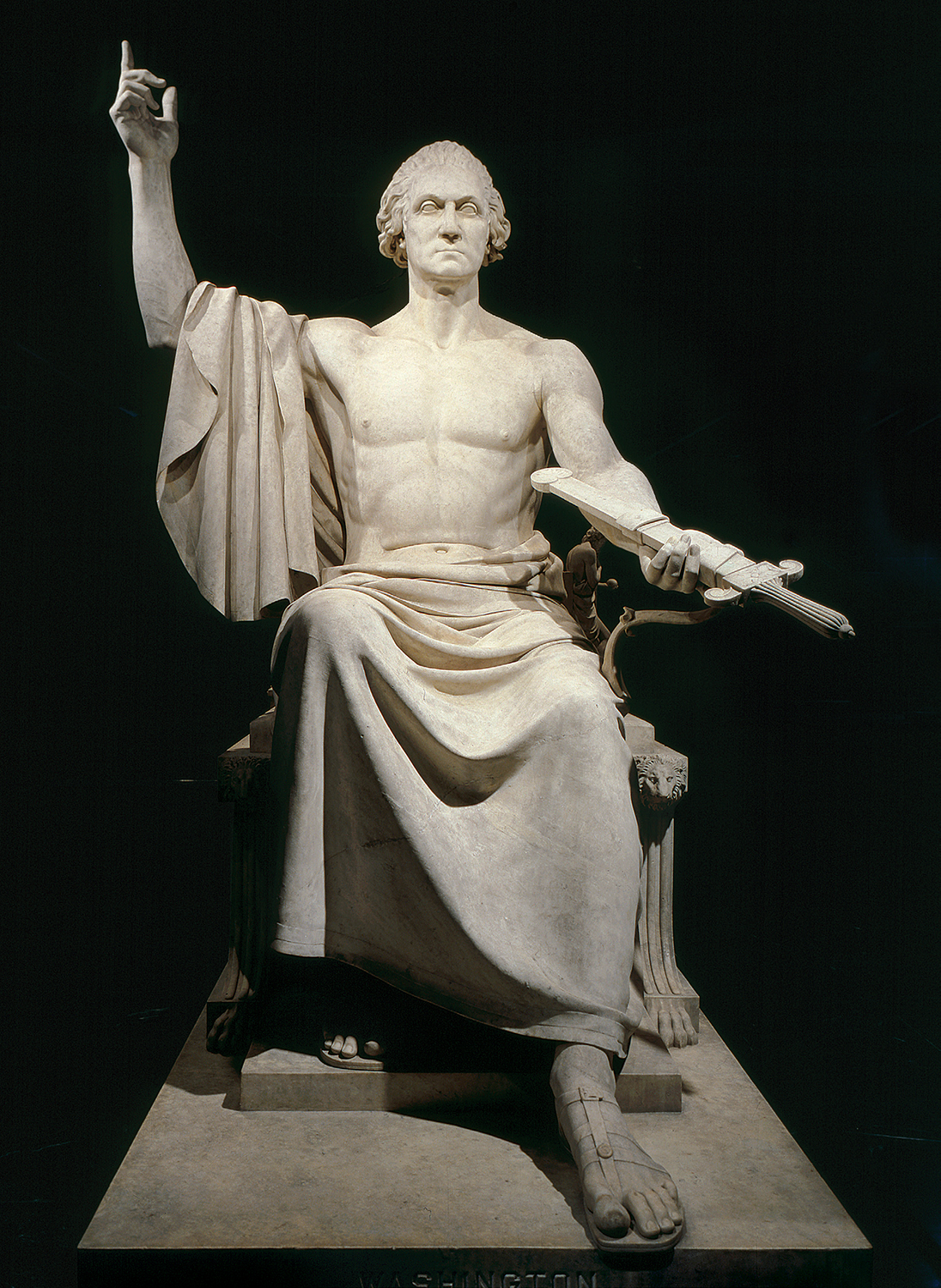
George Washington, 1840
Created by Horatio Greenough
Commissioned to create a statue for the Capitol
Washington gradually took on almost godlike stature as the “father of his country”
Greenough used Houdon’s portrait as his model for the head, but he portrayed Washington as seminude and enthroned,
Washington is being portrayed as a Greek God
He is more than 11 feet tall, seated, and is a supreme example of the Neoclassical style
It did not win favor (mostly because it did not reflect his true character) with either the public or the Congress that commissioned it (one congressman suggested throwing the statue into the Potomac River)
It is now in the Smithsonian
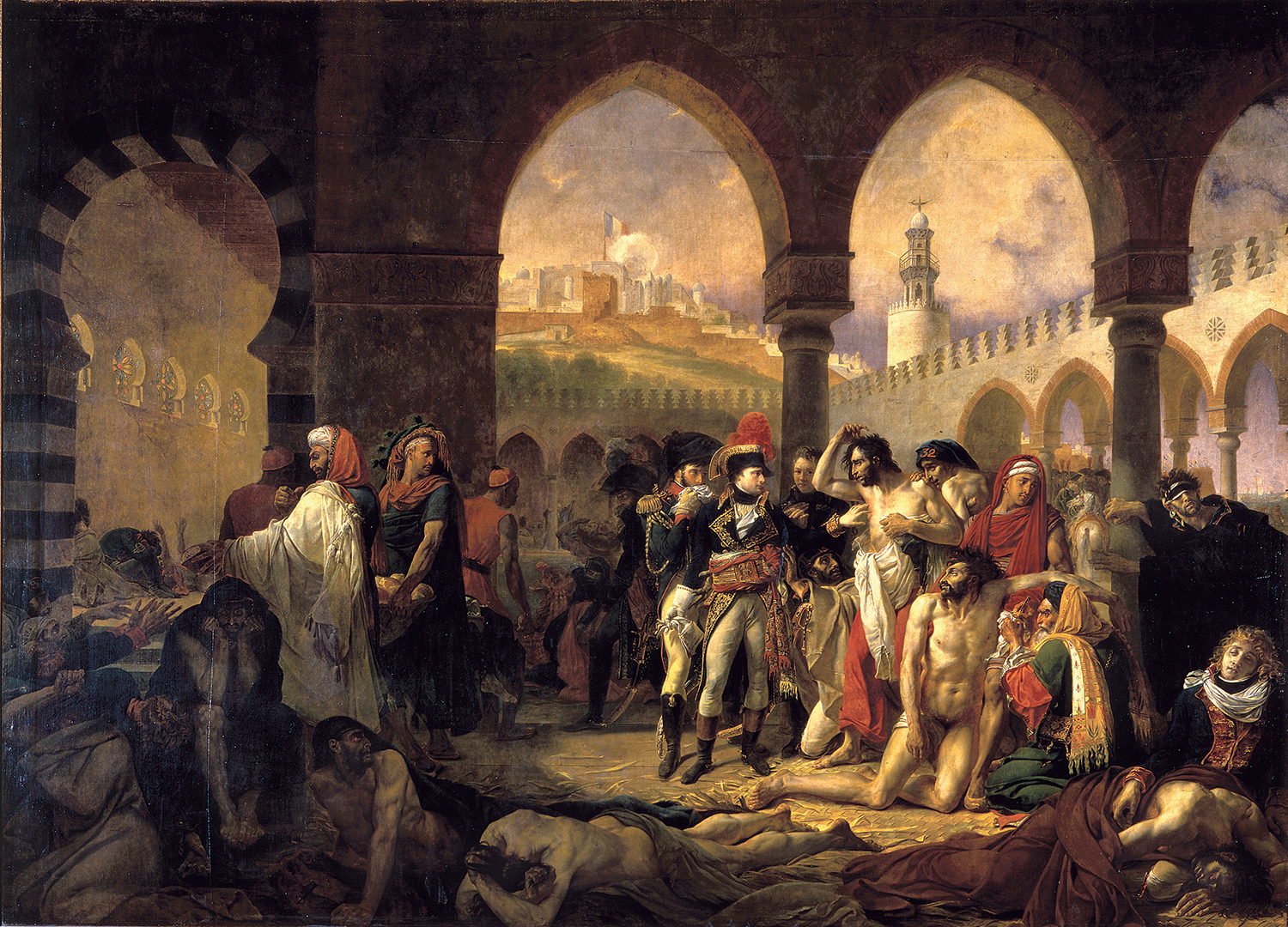
Napoleon at the Plague House at Jaffa
Created by Jean Antoine Gros (Student of David)
Recorded an incident during an outbreak of the bubonic plague in the course of the general’s Syrian campaign of 1799 (When he invaded Egypt and the Middle East)
Gros depicted Napoleon’s staff officers covering their noses against the stench of the place, whereas Napoleon, amid the dead and dying, is fearless and in control. He comforts those still alive, who are clearly awed by his presence and authority.
By depicting the French leader having removed his glove to touch the sores of a French plague victim, Gros implied that Napoleon possessed the miraculous power to heal (definitely not accurate)
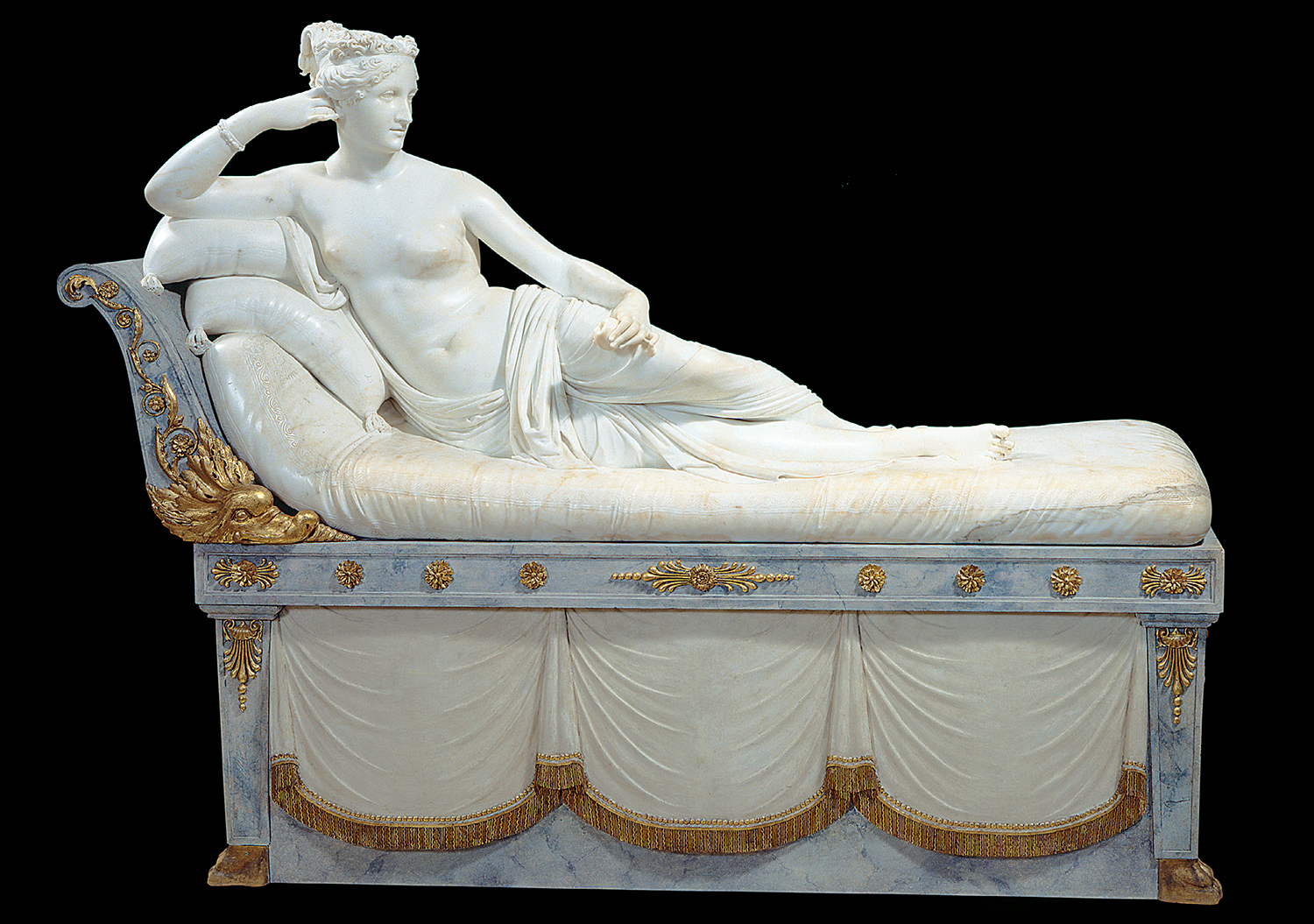
Pauline Borghese as Venus
Created by Antonio Canova
Canova was Napoleon’s favorite sculptor
Napoleon’s sister—at her insistence—is being depicted as the nude Roman goddess of love in a marble statue inspired by classical models
Canova had suggested depicting Pauline clothed as Diana, goddess of the hunt, but she demanded to be portrayed nude as Venus, the goddess of love
Pauline (who had numerous affairs and scandals) appears seminude and reclining on a divan, gracefully holding the golden apple
Romanticism
Focused on imagination, feelings, emotion rather than reason
Inspired by current events, and literature, poetry, music
Revived the Baroque dramatic style.
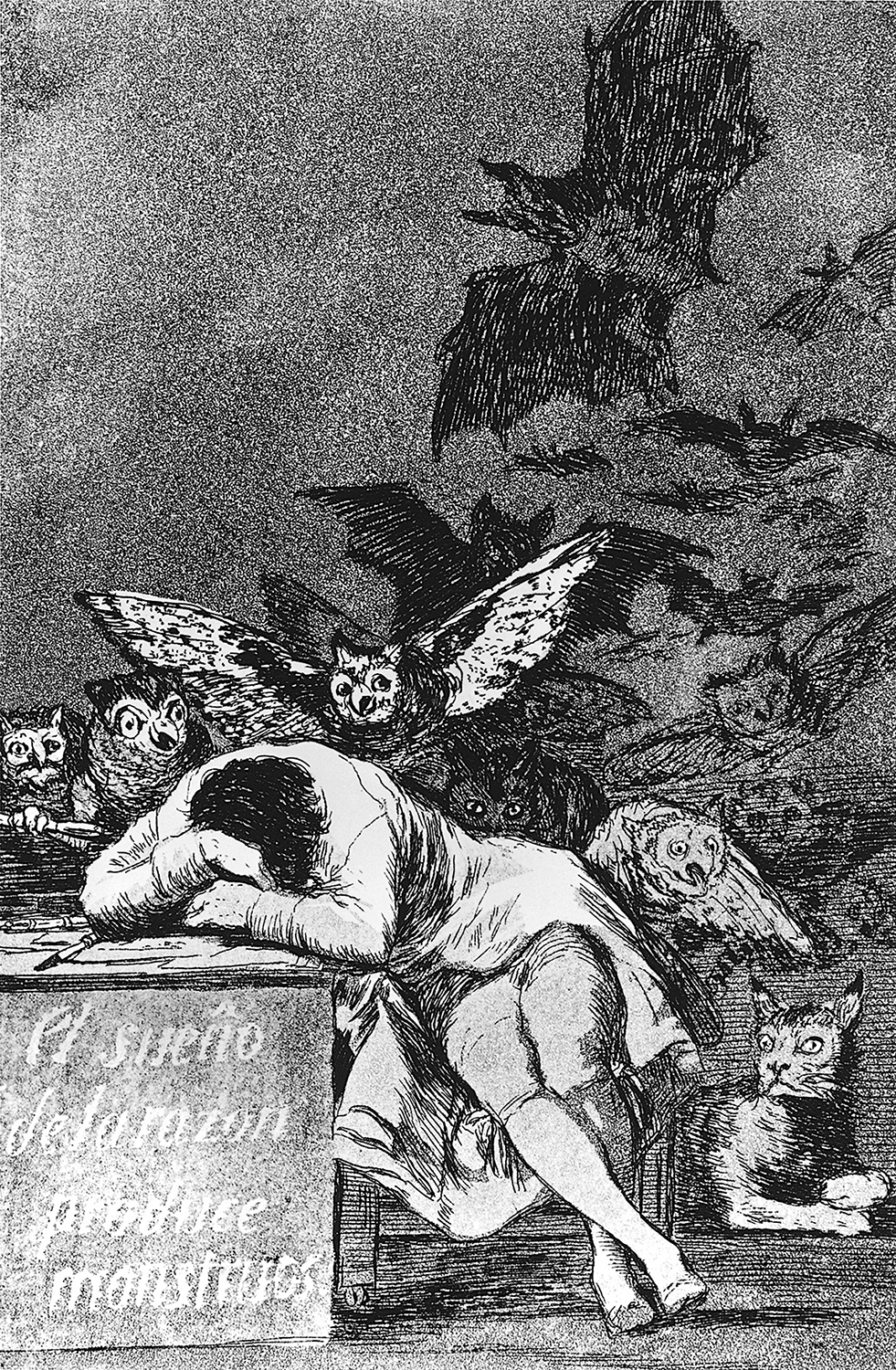
The Sleep of Reason Produces Monsters
Created by Francisco Goya
Goya depicted an artist, probably himself, asleep, slumped onto a desk, while threatening creatures converge on him, at least in his dream
Seemingly poised to attack the artist are owls (symbols of folly) and bats (symbols of ignorance)
The viewer might read this as a portrayal of what emerges when reason is suppressed and, therefore, as advocating Enlightenment ideals
Revealing his embrace of the Romantic spirit—the unleashing of imagination, emotions, and nightmares.
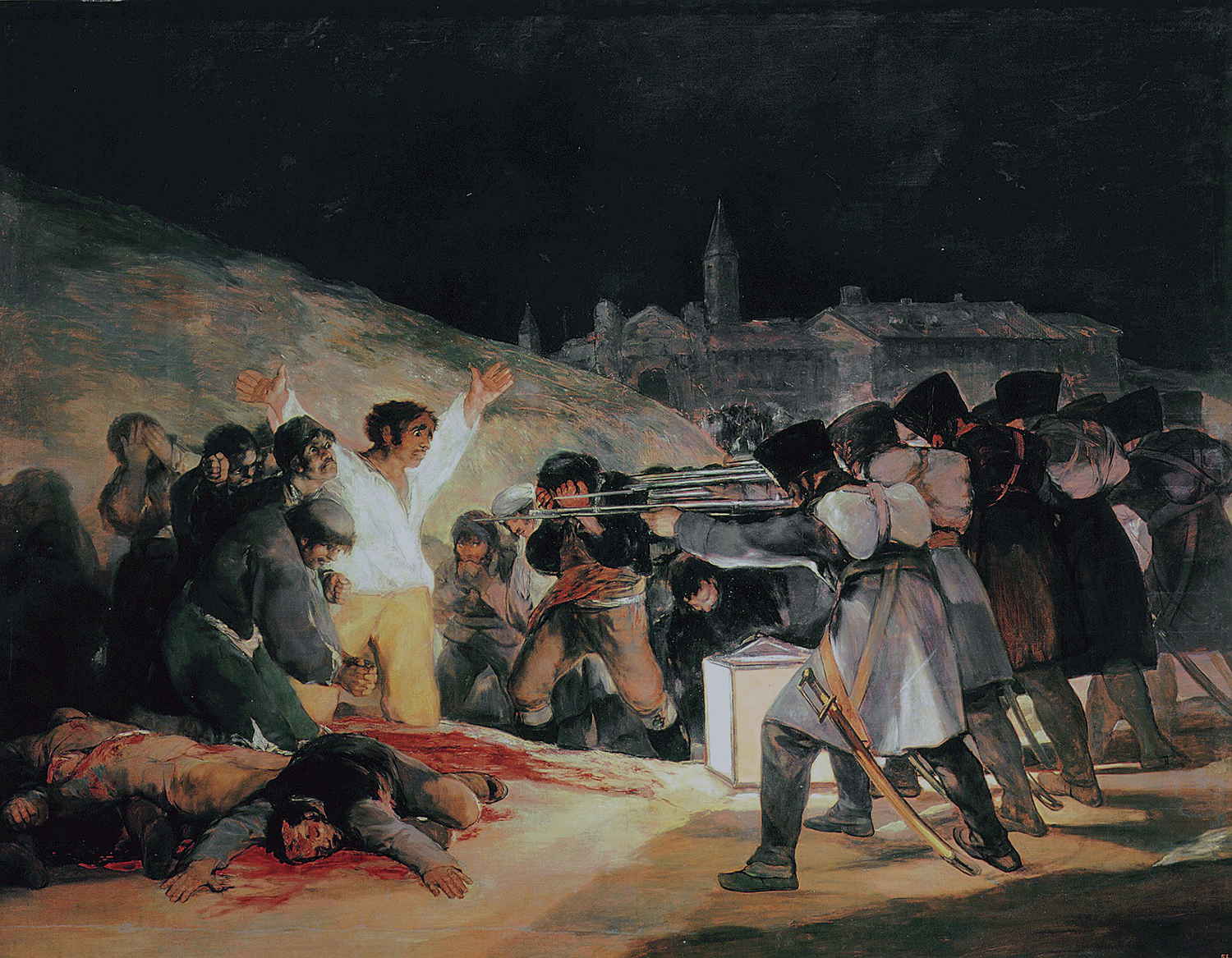
Third of May
Created by Francisco Goya
Spaniards attacked Napoleon’s soldiers in a chaotic and violent clash. In retaliation and as a show of force, the French responded the next day by rounding up and executing Spanish citizens. This tragic event is the subject of Goya’s painting
It was commissioned in 1814 by Ferdinand VII
Goya depicted the anonymous murderous wall of Napoleonic soldiers ruthlessly executing the unarmed and terrified Spanish peasants
He encouraged empathy for the Spaniards by portraying horrified expressions and anguish on their faces, endowing them with a humanity lacking in the faceless French firing squad in the shadows
The peasant about to be shot throws his arms out in a cruciform gesture reminiscent of Christ’s position on the cross
Goya enhanced the emotional drama of the massacre by sharply contrasting the darkness of the night with the focused illumination of the French squad’s lantern and by extending the time frame depicted
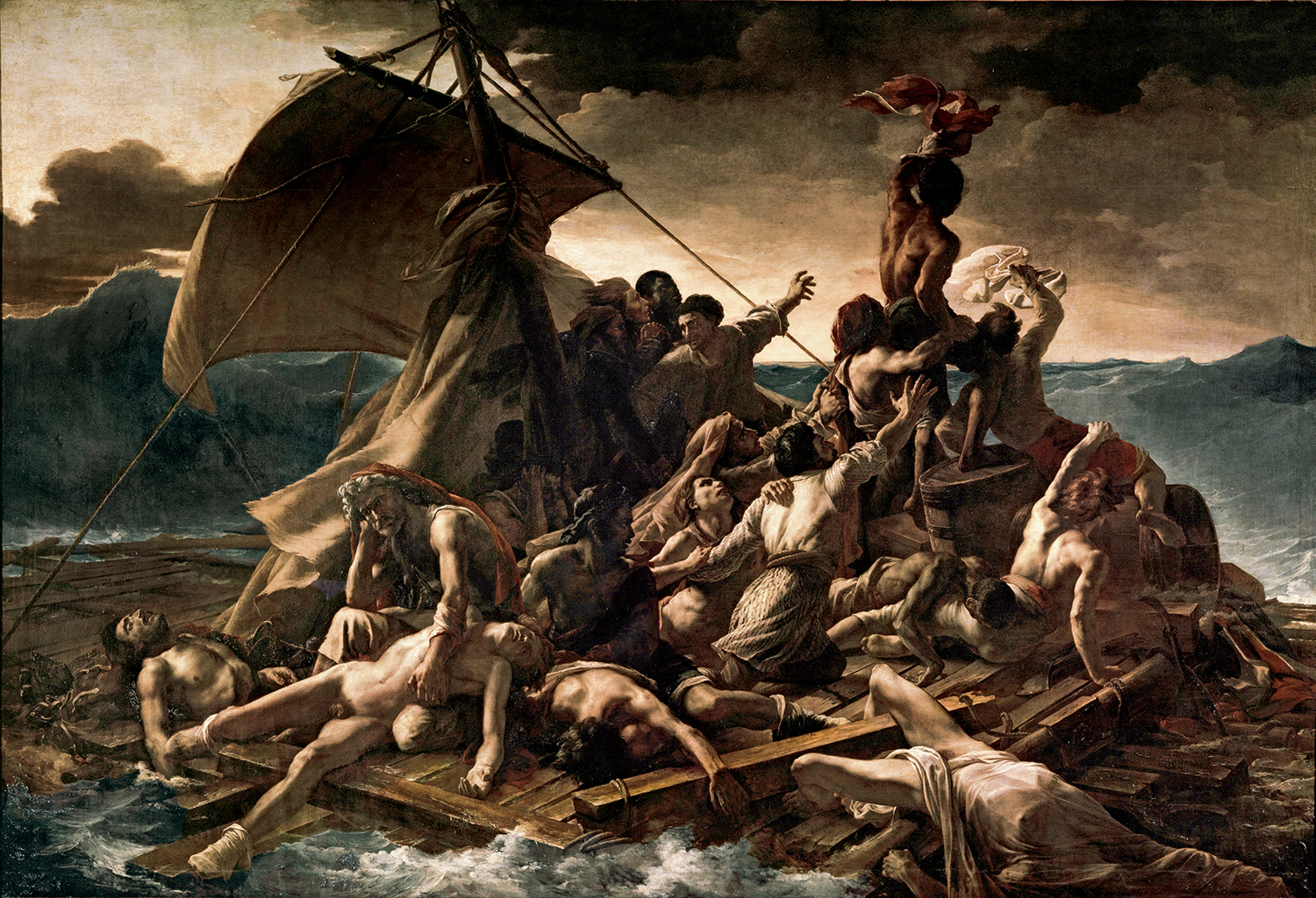
Raft of the Medusa
Created by Théodore Géricault
This panting depicts the shipwreck off the Mauritanian coast of the French frigate Medusa, which ran aground on a reef due to the incompetence of its inexperienced captain (he was not a real captain he was a political appointee)
The captain and his officers safely abandoned the ship on all the lifeboats
In an attempt to survive, the ship’s carpenter built a makeshift raft for himself and the 147 passengers from pieces of the disintegrating frigate
The raft drifted for 13 days, and the starving survivors dwindled to 15, in part because of cannibalism. Finally, the ship Argus spotted the raft and rescued those still alive
Géricault chose to represent the moment when some of those still alive summon what little strength they have left to flag down the Argus far on the horizon
He sought to capture accurately the horror, chaos, and emotion of the tragedy yet invoke the grandeur and impact of Neoclassical history painting
During the eight months he worked on the painting, Géricault visited hospitals and morgues to study the bodies of the dying and dead, interviewed survivors, and had a model of the raft constructed in his studio
Raft of the Medusa is also the artist’s commentary on the practice of slavery (Géricault was a member of an abolitionist group that sought ways to end the slave trade in the colonies)
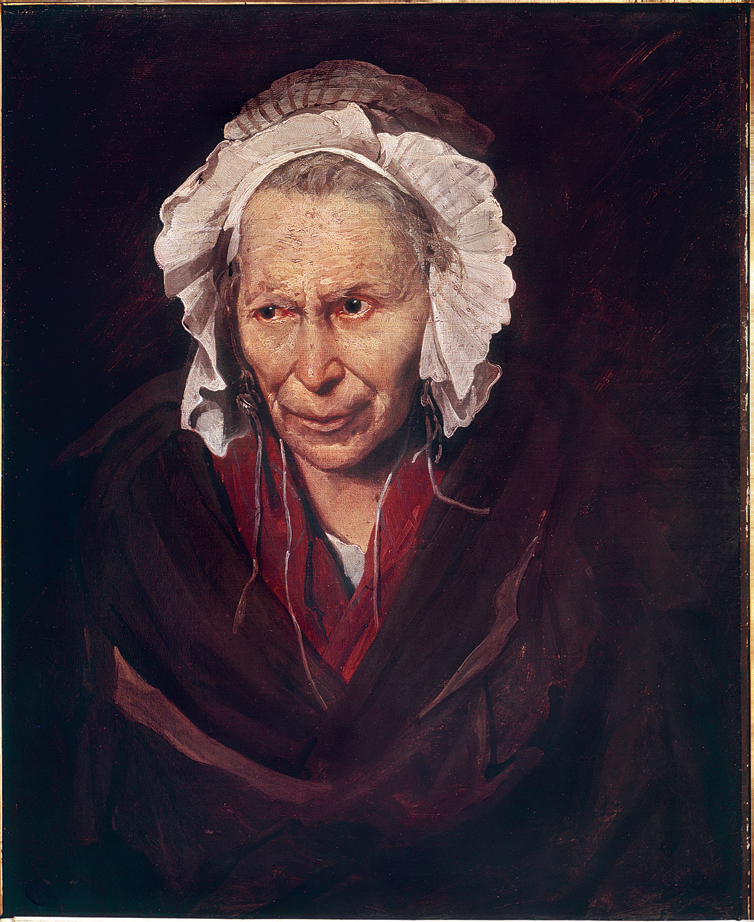
Insane Woman
Created by Théodore Géricault
He examined the influence of mental states on the human face (first kind of look into the human mind)
He was the first artists in history to depict patients in an insane asylum → depicted mental states
The woman portrayed here looks away from the viewer, her mouth tense and her eyes red-rimmed with suffering (she killed children)
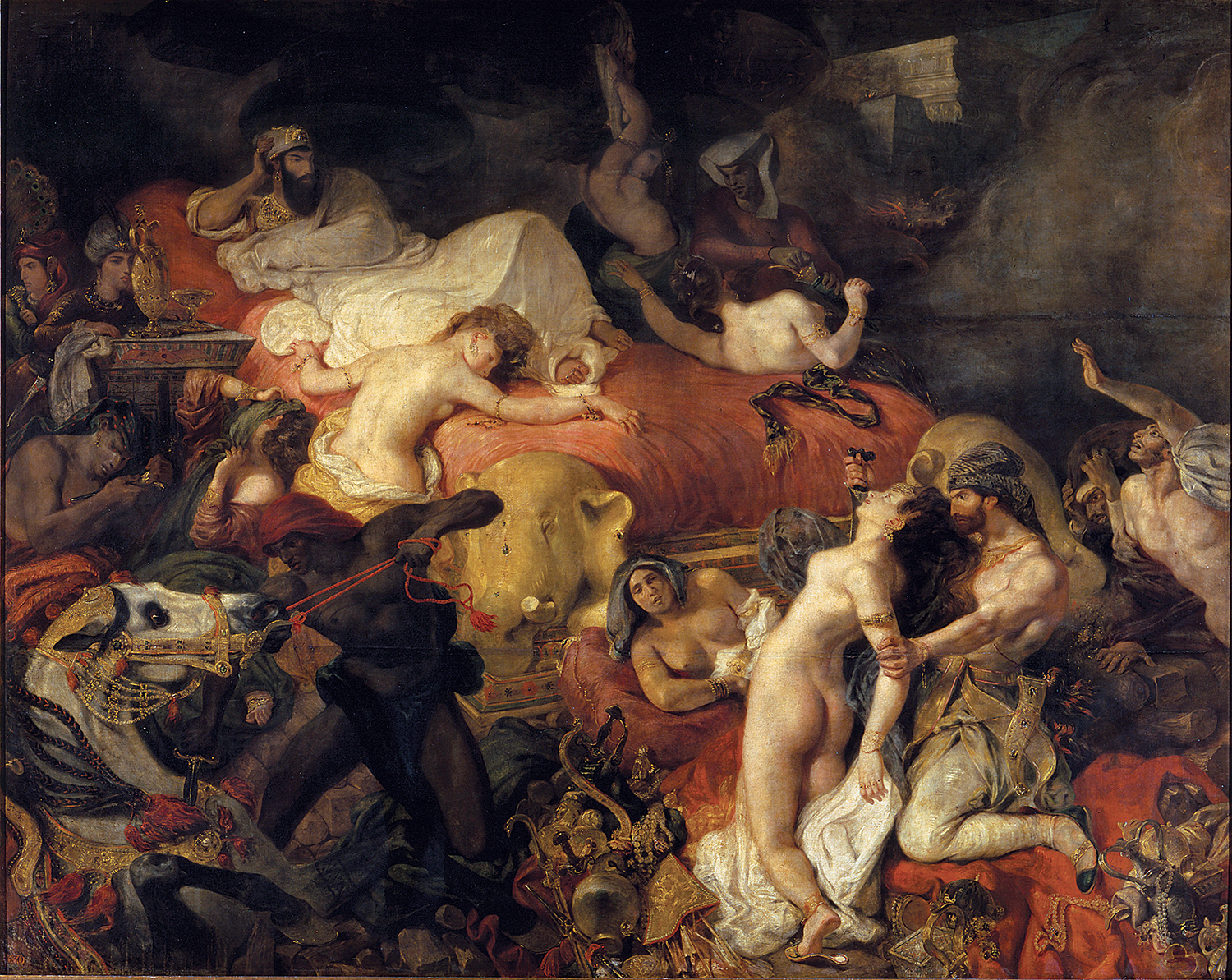
Death of Sardanapalus
Created by Eugène Delacroix
Inspired by Lord Byron’s 1821 poem
The richly colored and emotionally charged canvas is filled with exotic figures
Delacroix depicted the last hour of the Assyrian king Ashurbanipal, whom the Greeks called Sardanapalus. The king has just received news of his army’s defeat and the enemy’s entry into his city
Sardanapalus reclines on his funeral pyre, soon to be set alight. He gloomily watches the carrying out of his order to destroy all of his most precious possessions—his women, slaves, horses, and treasure. The king’s favorite concubine throws herself on the bed, determined to go up in flames with her master
Delacroix filled this awful spectacle of suffering and death with the most daringly difficult and tortuous poses
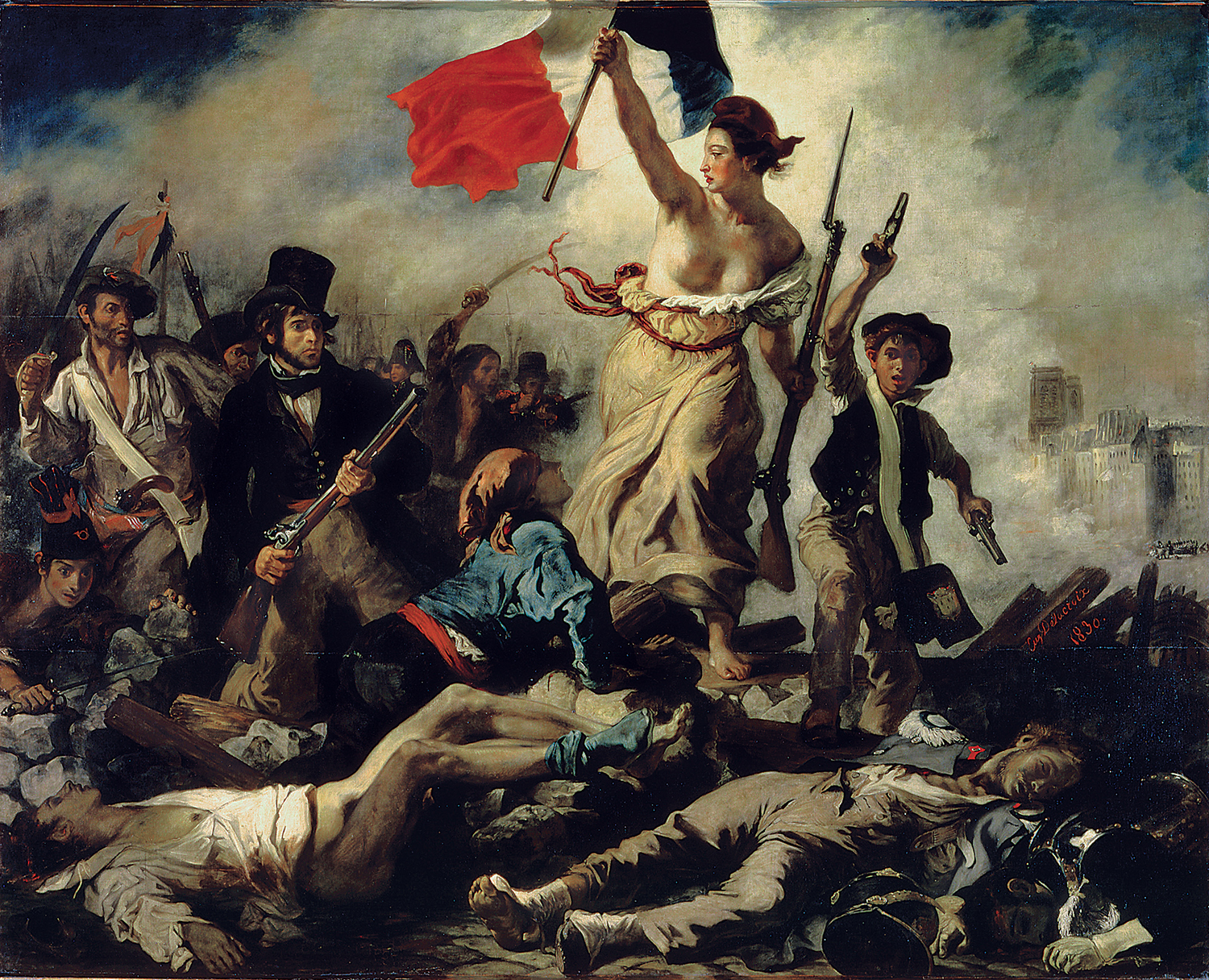
Liberty Leading the People
Created by Eugène Delacroix
Delacroix captured the passion and energy of the 1830 revolution in this painting of Liberty personified leading the Parisian uprising against King Charles X
Liberty (who is bare breasted) is defiantly thrusting forth the republic’s tricolor banner (flag) as she urges the masses to fight on
She wears a scarlet Phrygian cap (the symbol of a freed slave in antiquity)
Around Liberty are bold Parisian types—the street boy brandishing his pistols, the menacing worker with a cutlass, and the university student in top hat armed with a musk
There are dead bodies all around
In the background, the towers of Notre-Dame rise through the smoke and haze. (The painter’s inclusion of this recognizable Parisian landmark specifies the locale and event, balancing allegory with historical fact)
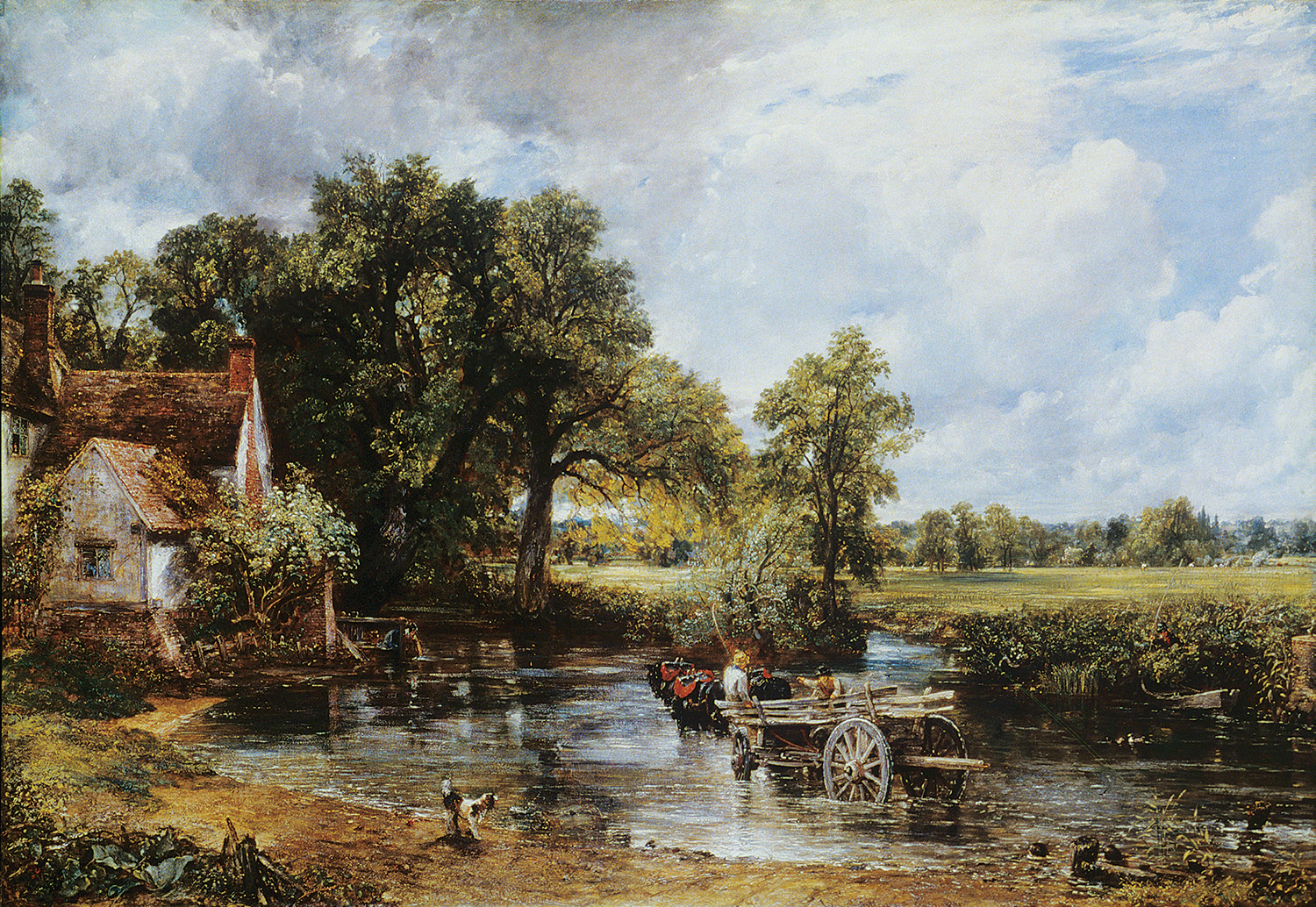
The Haywain
Created by John Constable (England)
It immortalizes the disappearing English countryside during the Industrial Revolution
He devoted his career to painting the English countryside
The artist’s father was a successful miller and flour merchant and a rural landowner of considerable wealth
Many of the scenes Constable painted depict his family’s property near East Bergholt in Suffolk, East Anglia
In his quest for the authentic landscape, Constable studied nature as a meteorologist (he was an accomplished amateur “weatherman”)
He was one of the first to make his sketches outdoors using oil paints instead of watercolors or pencil drawings
He was one of the first artists to make detailed studies of clouds and the atmosphere (weather)
His paintings were considered “nostalgic”
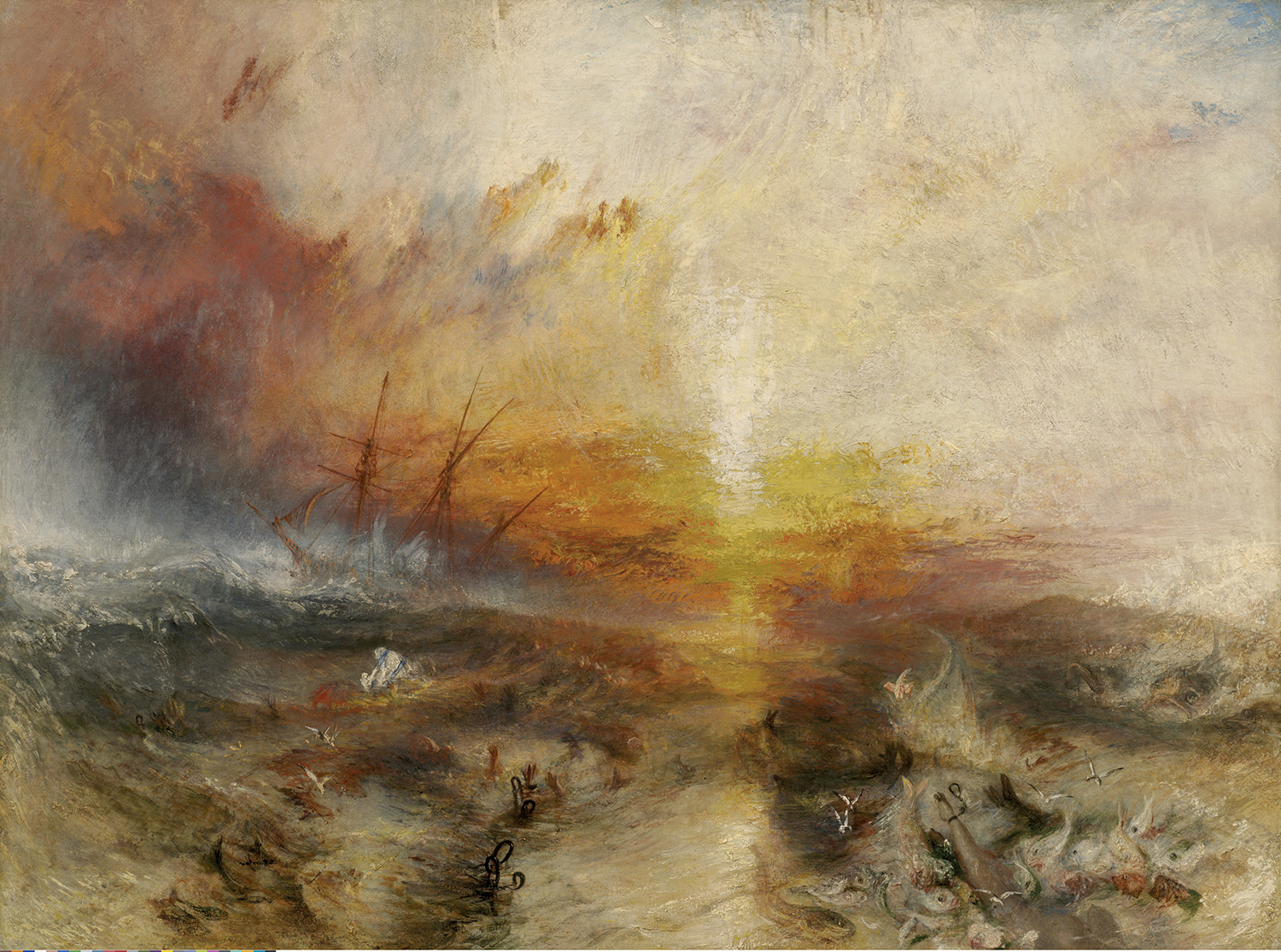
The Slave Ship
Created by J.M.W. Turner
Depicts a 1781 incident reported in the widely read History of the Abolition of the Slave Trade by Thomas Clarkson
The incident involved the slave ship Zong, en route from Africa to Liverpool. The ship’s captain, on realizing that his insurance would reimburse him only for slaves lost at sea but not for those who died en route, ordered more than 50 sick and dying slaves to be thrown overboard
Slavery had been a powerful political issue in England for some time
The essence of Turner’s innovative style is the emotive power of color. He released color from any defining outlines to express both the forces of nature and the painter’s emotional response to them
Almost lost in the boiling colors of Turner’s painting are the event’s particulars, but on close inspection, the viewer can discern the iron shackles and manacles around the wrists and ankles of the drowning slaves, cruelly denying them any chance of saving themselves from the predatory fish circling about them.
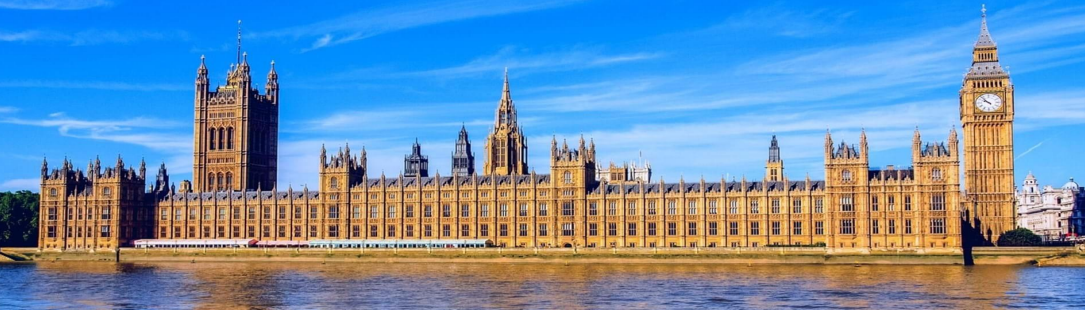
London, Houses of Parliament
Designed by William Barry and Augustus Pugin, 1835
The buildings replaced those that were destroyed by a fire in 1832
The style is Gothic Revival, popular in England
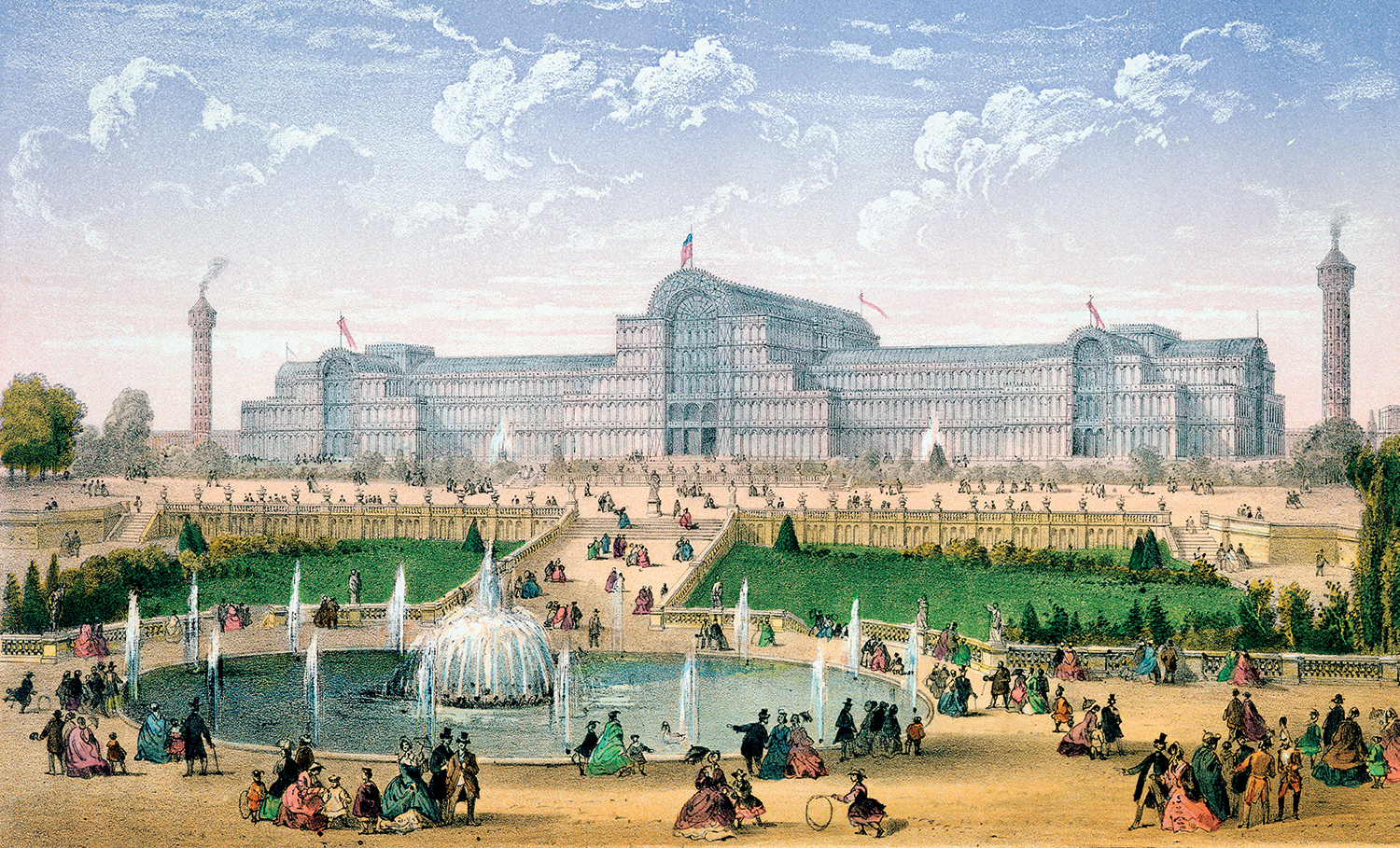
Crystal Palace
Created by Joseph Daxton, 1850-1851
Located in London, England
Daxton designed greenhouses and this was an expansion of his skills
It was a combination of glass and metal construction with cast iron columns
It was prefabricated (use of structural elements manufactured in advance and transported to the construction site ready for assembly.) so construction only took 6 months (rapid)
It burned down in 1936
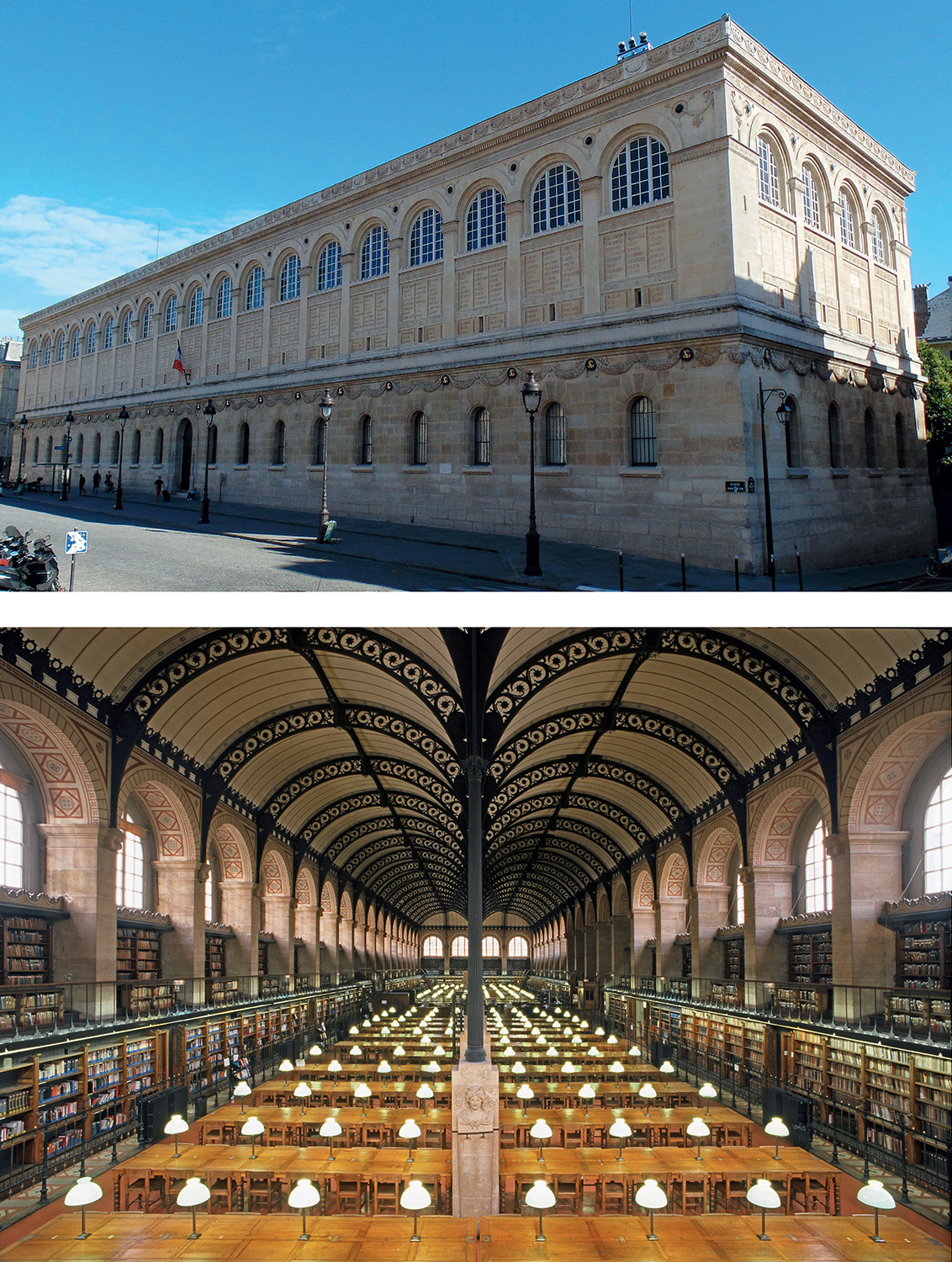
Bibliothèque Sainte-Geneviève
Created by Henri Labrouste
Located in Paris, France
It has a stone exterior → old fashion/classical with a very modern interior that is cast-ironed curved
Mix of Renaissance revival style and modern cast-iron construction
Successful blending of older style with new technology
The exterior of this Parisian library looks like a Renaissance palace, but the interior has an exposed cast-iron skeleton, which still incorporates classical Corinthian capitals and Renaissance scrolls.
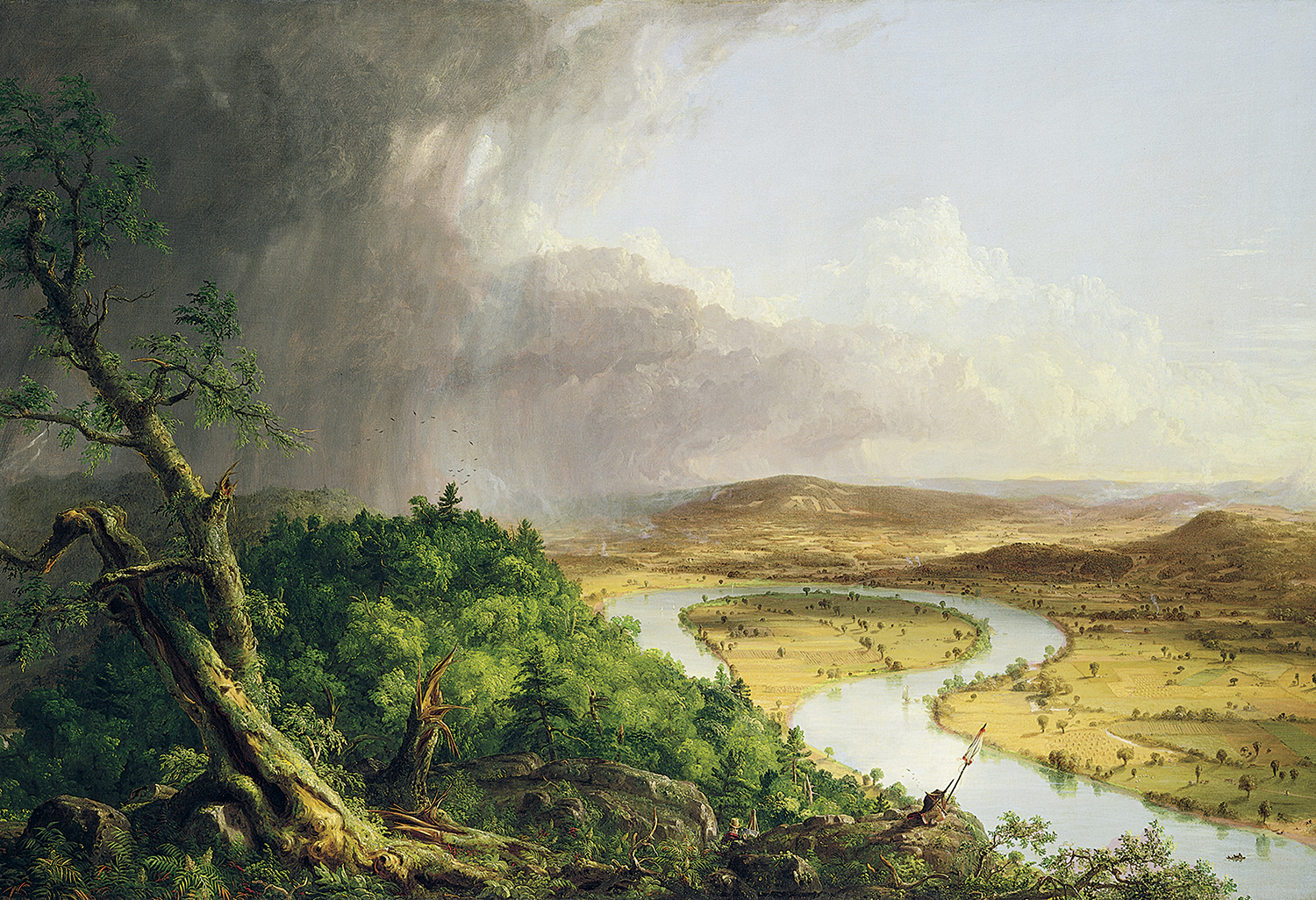
The Oxbow
Created by Thomas Cole
Landscape of the Hudson River Valley
Expressing the awesome power of nature
He contrasted dark wilderness on the left and sunlit civilization on the right
In America, landscape painting was the specialty of a group of artists known as the Hudson River School, so named because its members drew their subjects primarily from the uncultivated regions of New York’s Hudson River Valley
He is the tiny figure working at his easel at the bottom center of the canvas
Gives off the idea of Manifest Destiny: the belief that the U.S. was divinely ordained to expand across North America to the Pacific Ocean
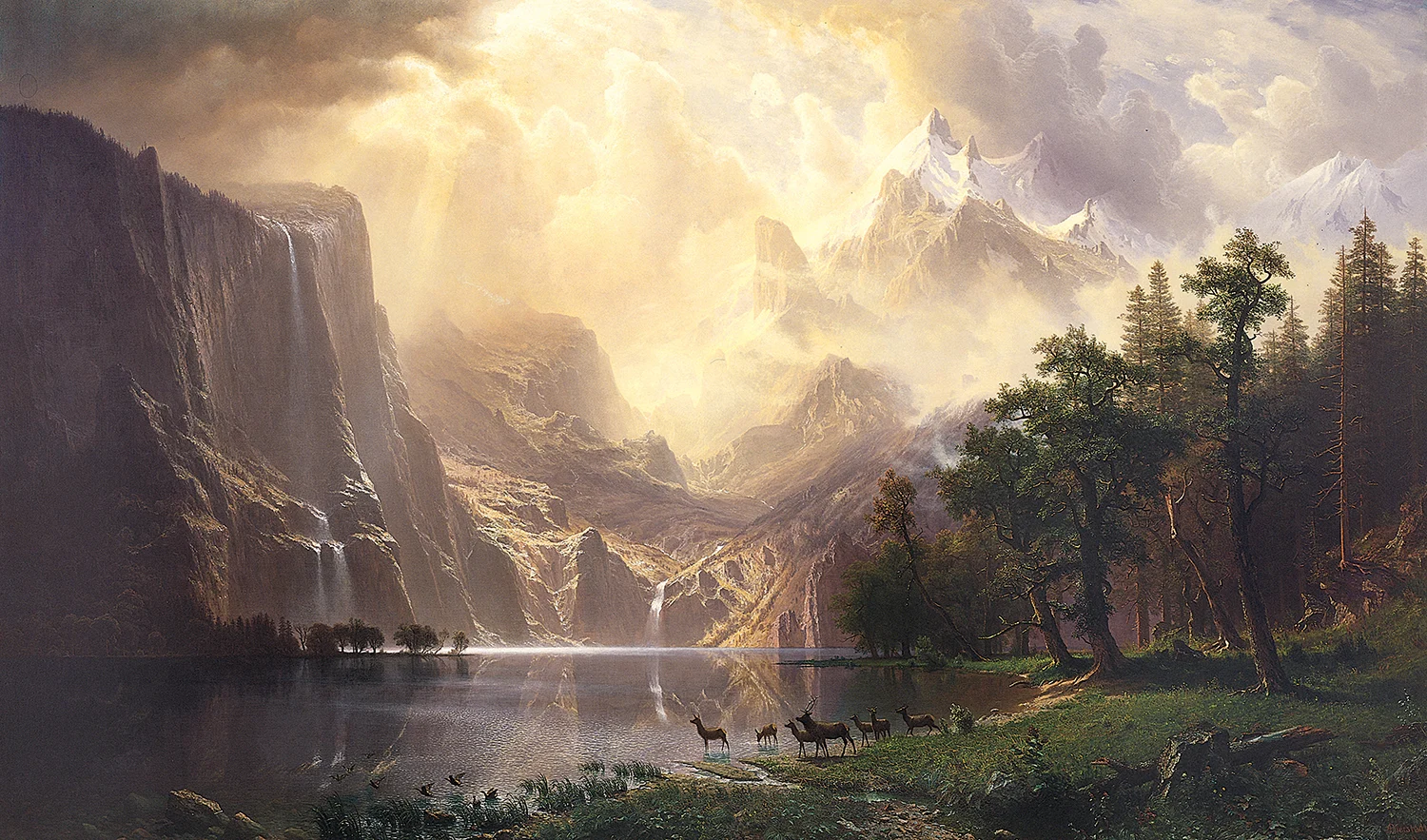
Among the Sierra Nevada Mountains
Created by Albert Bierstadt
Bierstadt’s panoramic landscape presents the breathtaking natural beauty of the American West, reinforcing the 19th-century doctrine of Manifest Destiny
Deer and waterfowl appear at the edge of a placid lake, and steep and rugged mountains soar skyward on the left and in the distance.
A stand of trees, uncultivated and wild, frames the lake on the right.
To underscore the transcendental nature of this scene, Bierstadt depicted the sun’s rays breaking through the clouds overhead, suggesting a heavenly consecration of the land
Romantic style → Raw Power of Nature
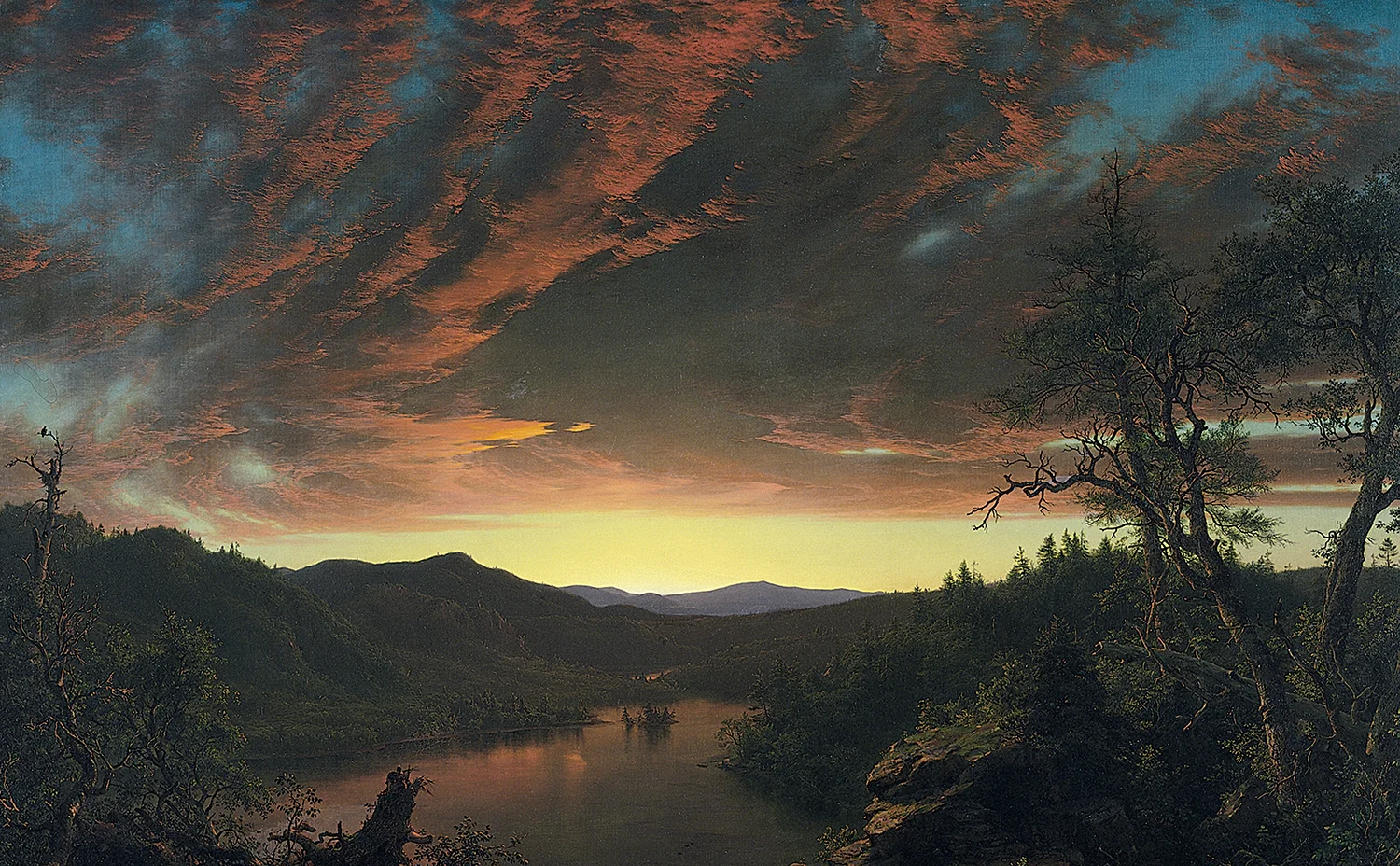
Twilight in the Wilderness
Created by Frederic Edwin Church
Presents a panoramic view of the sun setting over the majestic landscape
Church’s paintings eloquently express the Romantic notion of the sublime
Trees may be a reference to the Civil War
Realism
Championed the honest, unidealized depiction of contemporary life, focusing on ordinary people and working-class struggles
Rejected artificiality and emotionalism, opting for direct observation, earthy tones, and social critique
By depicting these subjects on a scale and with a seriousness previously reserved for historical, mythological, and religious painting, Realist artists sought to establish parity between contemporary subject matter and the traditional themes of “high art.”
Gustave Courbet
The leading figure of the Realist movement in 19th-century art
Courbet used the term “Realism” when exhibiting his own works
The Realists’ sincerity about scrutinizing their environment led them to paint mundane and trivial subjects that artists had traditionally deemed unworthy of depiction—for example, working-class laborers and peasants, and similar “low” themes
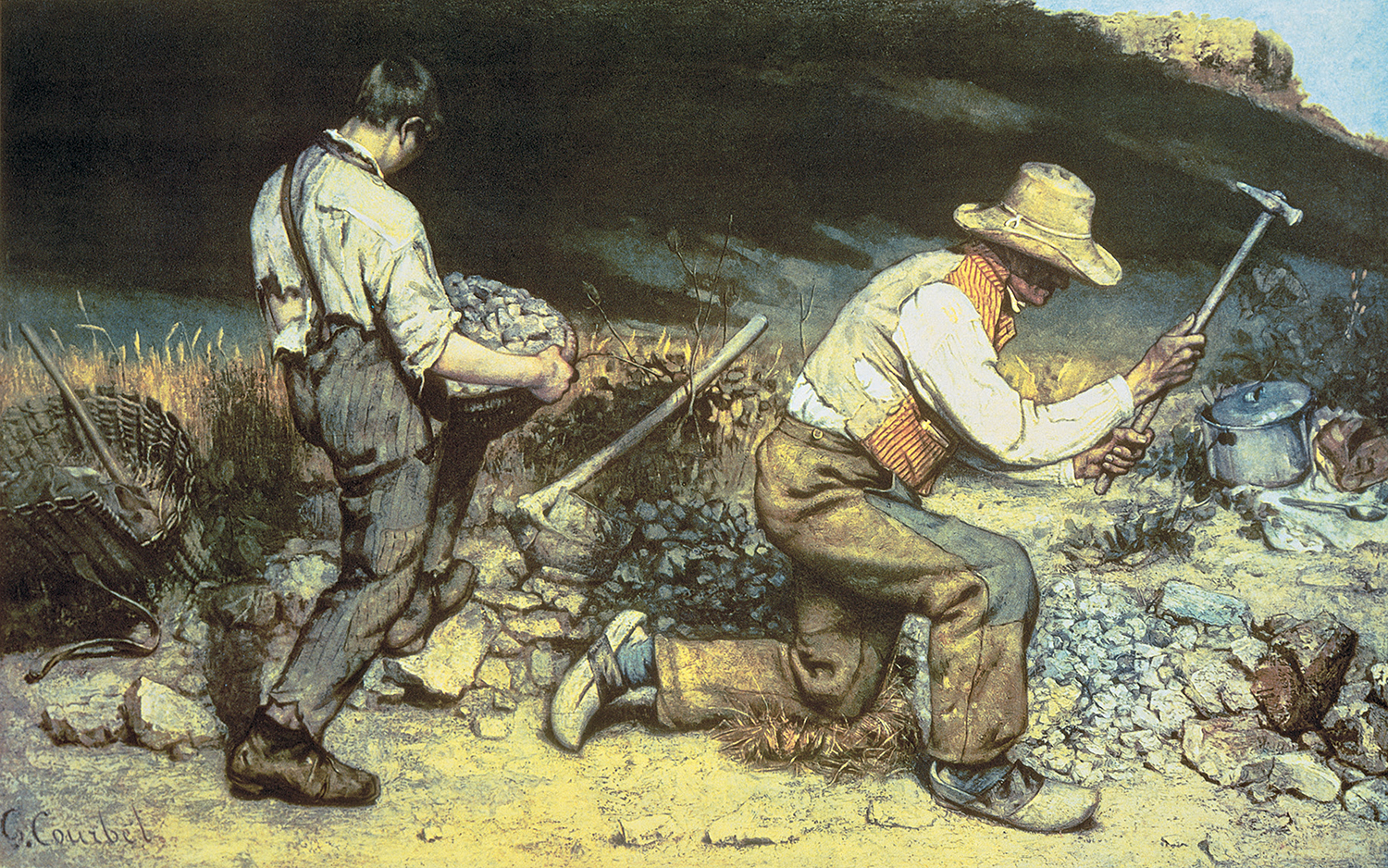
Stone Breakers
Created by Gustave Courbet
He presented a glimpse into the life of rural menial laborers
There are two men—one about 70, the other quite young—in the decidedly nonheroic act of breaking stones to provide paving for provincial roads. Traditionally, this backbreaking, poorly paid work fell to the lowest members of French society, as the stone breakers’ tattered garments and utensils for a modest meal of soup
By juxtaposing youth and age, Courbet suggested that those born to poverty will remain poor their entire lives
The artist neither romanticized nor idealized the men’s work but depicted their thankless toil with directness and accuracy
Courbet’s palette of dirty browns and grays further conveys the dreary and dismal nature of the task
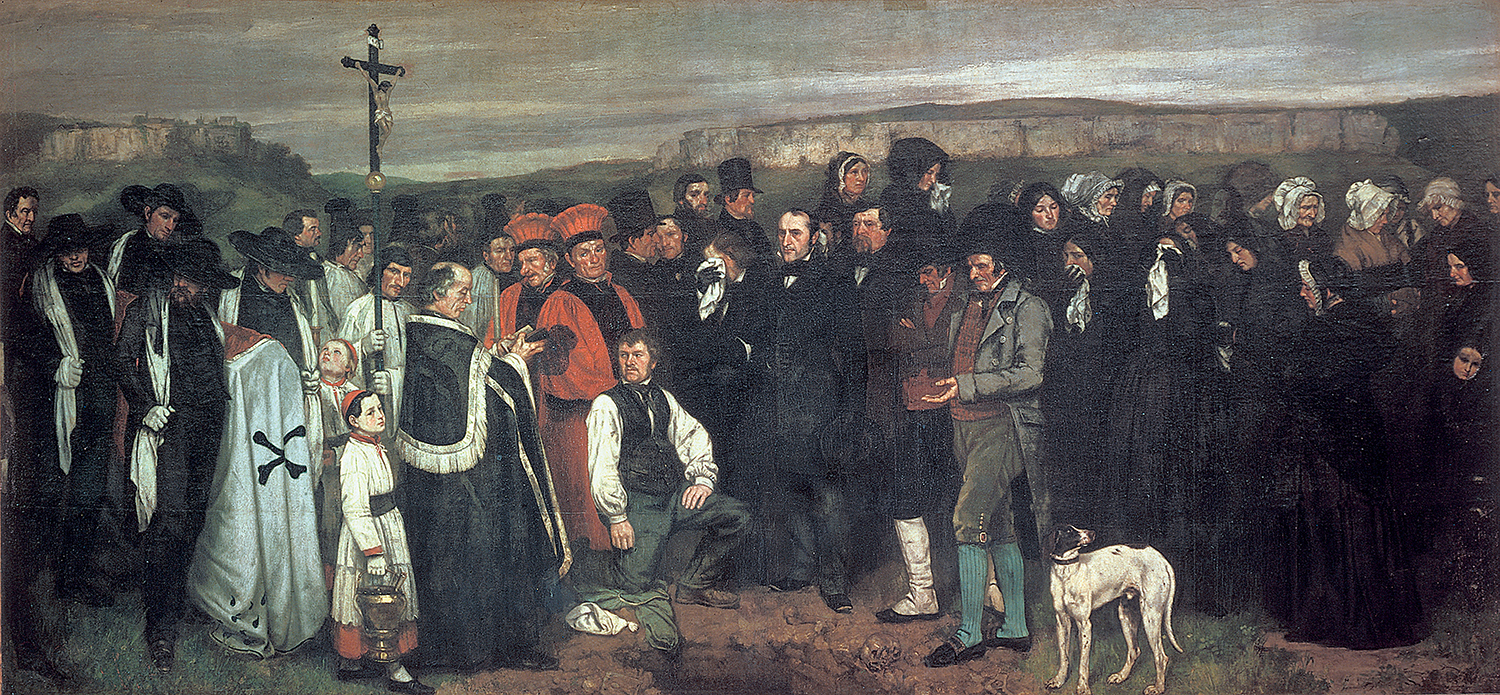
Burial at Ornans
Created by Gustave Courbet
Depicts a funeral set in a bleak provincial landscape outside the artist’s hometown near Besançon in eastern France
Although the painting has the imposing scale of a traditional history painting, the subject’s ordinariness and the starkly antiheroic composition horrified critics.
Burial at Ornans is not a record of the burial of a Christian martyr or a heroic soldier, instead it commemorates a recurring event involving common folk, and it does not ennoble or romanticize death.
Courbet submitted Burial at Ornans to the 1851 Salon in the category of history painting, but declined to identify the deceased
Lithography
The lithographer uses a greasy, oil-based crayon to draw directly on a stone plate and then wipes water onto the stone, which clings only to the areas that the drawing does not cover. Next, the printmaker rolls oil-based ink onto the stone, which adheres to the drawing but is repelled by the water. When the artist presses the stone against paper, only the inked area—the drawing—transfers to the paper.
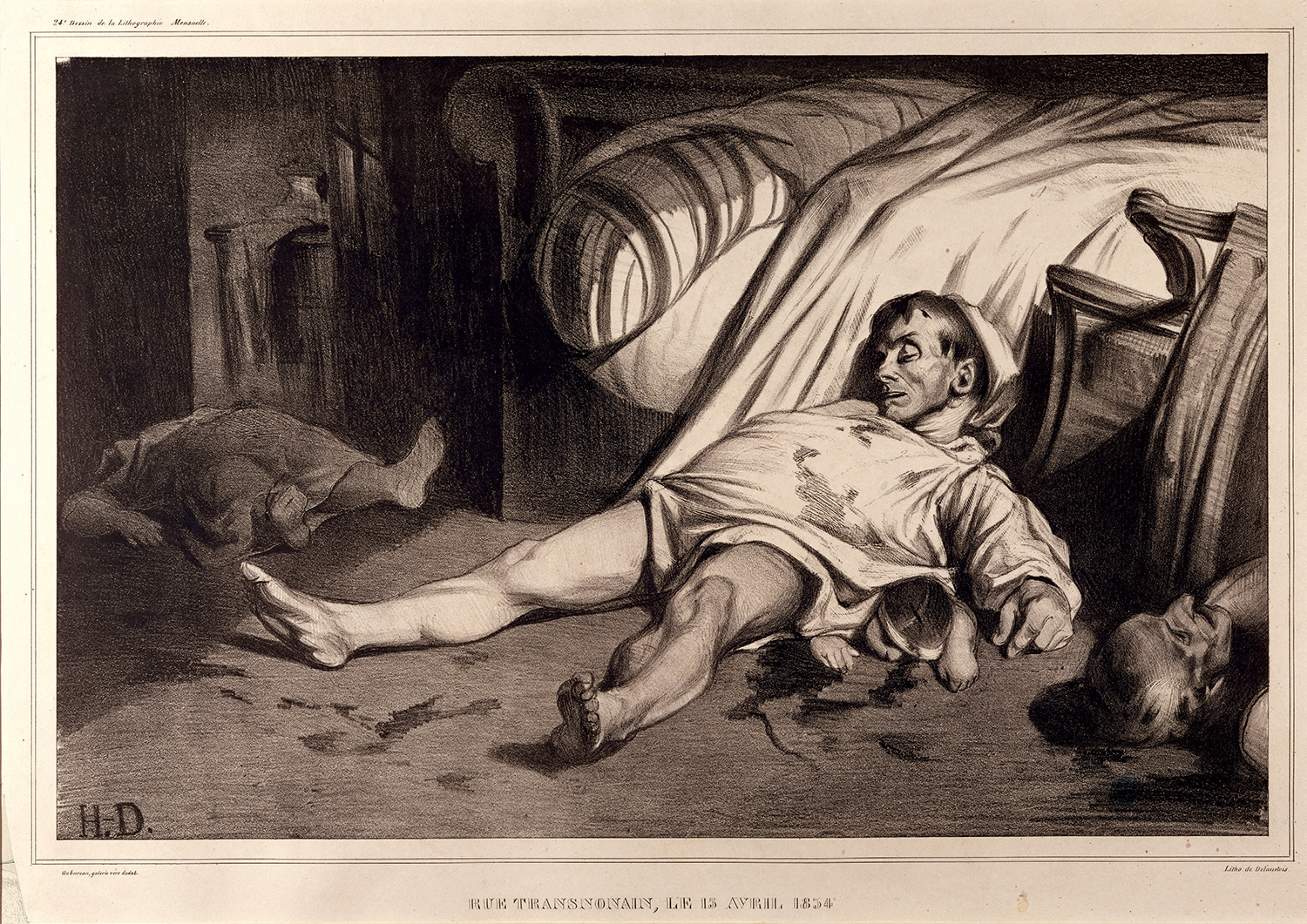
Rue Trasonoia
Created Honoré Daumier
The title refers to the day when, on that street in Paris, an unknown sniper killed a civil guard, part of a government force trying to repress a worker demonstration. Because the fatal shot had come from a workers’ housing block, the remaining guards immediately stormed the building and massacred all of its inhabitants.
The lithograph had the same shocking impact as Goya’s Third of May, 1808, but in Rue Transnonain, Daumier depicted not the dramatic moment of execution but the terrible, quiet aftermath.
The limp bodies of the workers—and of a child crushed beneath his father’s corpse—lie amid violent disorder
Rosa Bonheur
She was the most famous female artist of the 19th century
She won the gold medal at the Salon of 1848 and became the director of France’s state-sponsored drawing school for women the same year
Bonheur became the first woman to be awarded the Grand Cross of the French Legion of Honor
Bonheur received her artistic training from her father, Oscar-Raymond Bonheur (1796–1849), who was a proponent of Saint-Simonianism, an early-19th-century utopian socialist movement that championed the education and enfranchisement of women
She was not admitted to the École des Beaux-Art academy but was successful despite
She focused on animals common in the French countryside, especially horses, but also rabbits, cows, and sheep
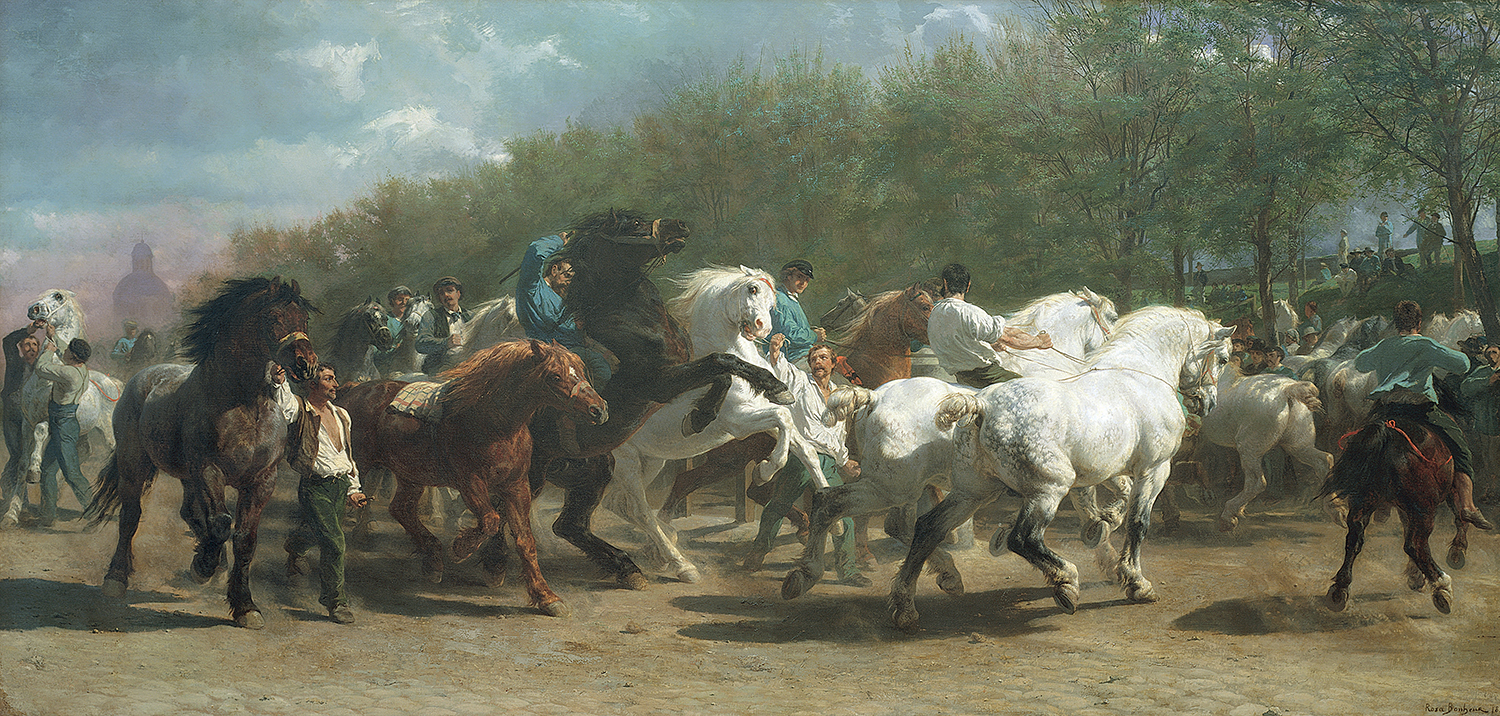
The Horse Fair
Created by Rosa Bonheur
She filled her broad canvas with the sturdy farm Percherons of Normandy and their grooms on parade
The dramatic lighting, loose brushwork, and rolling sky also reveal her admiration of Géricault’s style
Bonheur’s masterful depiction of horses at life size and seen from multiple angles captivated viewers, who eagerly bought engraved reproductions of The Horse Fair, making it one of the most popular artworks of the century.
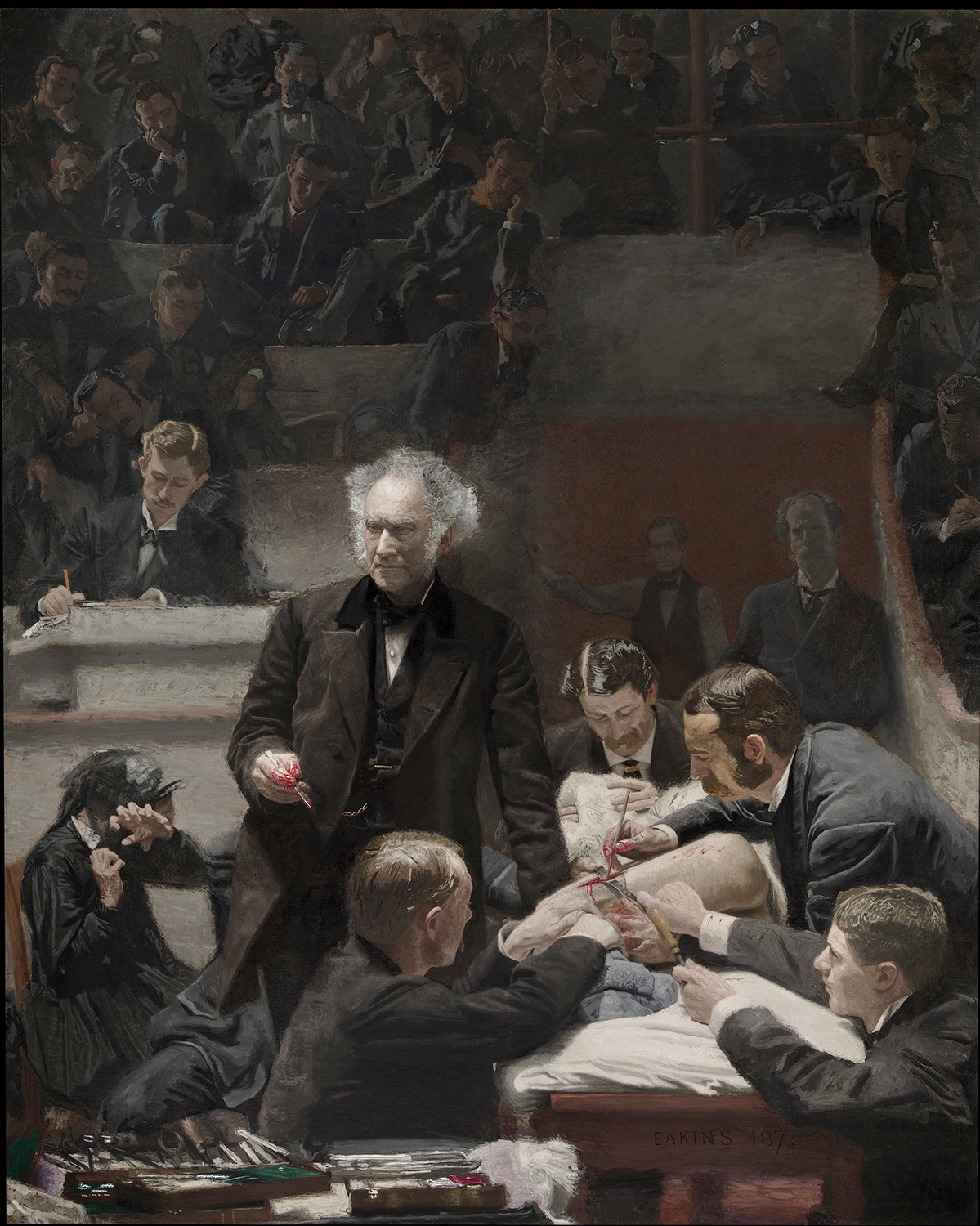
The Gross Clinic
Created by Thomas Eakins (United States)
The painting portrays the renowned surgeon Dr. Samuel Gross in the operating amphitheater of the Jefferson Medical College in Philadelphia (hung there for 130 years)
. Eakins’s decision to depict an operation in progress reflects the public’s increasing faith that scientific and medical advances could enhance—and preserve—lives
Dr. Gross, with bloody fingers and scalpel, lectures about his surgery on a young man’s leg.
Watching the surgeon, acclaimed for his skill in this specific operation, are several colleagues—all of whom historians have identified—and the patient’s mother, who covers her face.
Eakins, who considered becoming a physician and studied at the college, included his self-portrait (in the doorway at the right)
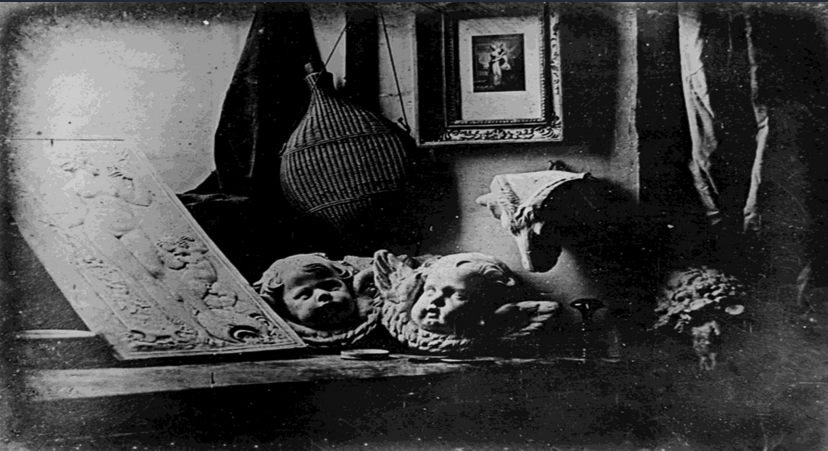
“Still Life in the Studio”
Created by Louis Daguerre
First photographed images (took 2 hours to take the picture)
One of the first plates Daguerre produced after perfecting his new photographic process was this still life, in which he was able to capture amazing detail and finely graduated tones of light and shadow.
A photograph made by an early method on a plate of chemically treated metal; developed by Louis J. M. Daguerre
The inspiration for Daguerre’s composition came from 17th-century Dutch vanitas still lifes
Daguerre arranged his objects to reveal their textures and shapes clearly. Unlike a painter, Daguerre could not alter anything within his arrangement to create a stronger image. However, he could suggest a symbolic meaning through his choice of objects.
Daguerreotype
A photograph made by an early method on a plate of chemically treated metal; developed by Louis J. M. Daguerre
Plates were painted with light-sensitive coating
Technology/art directly challenged painting
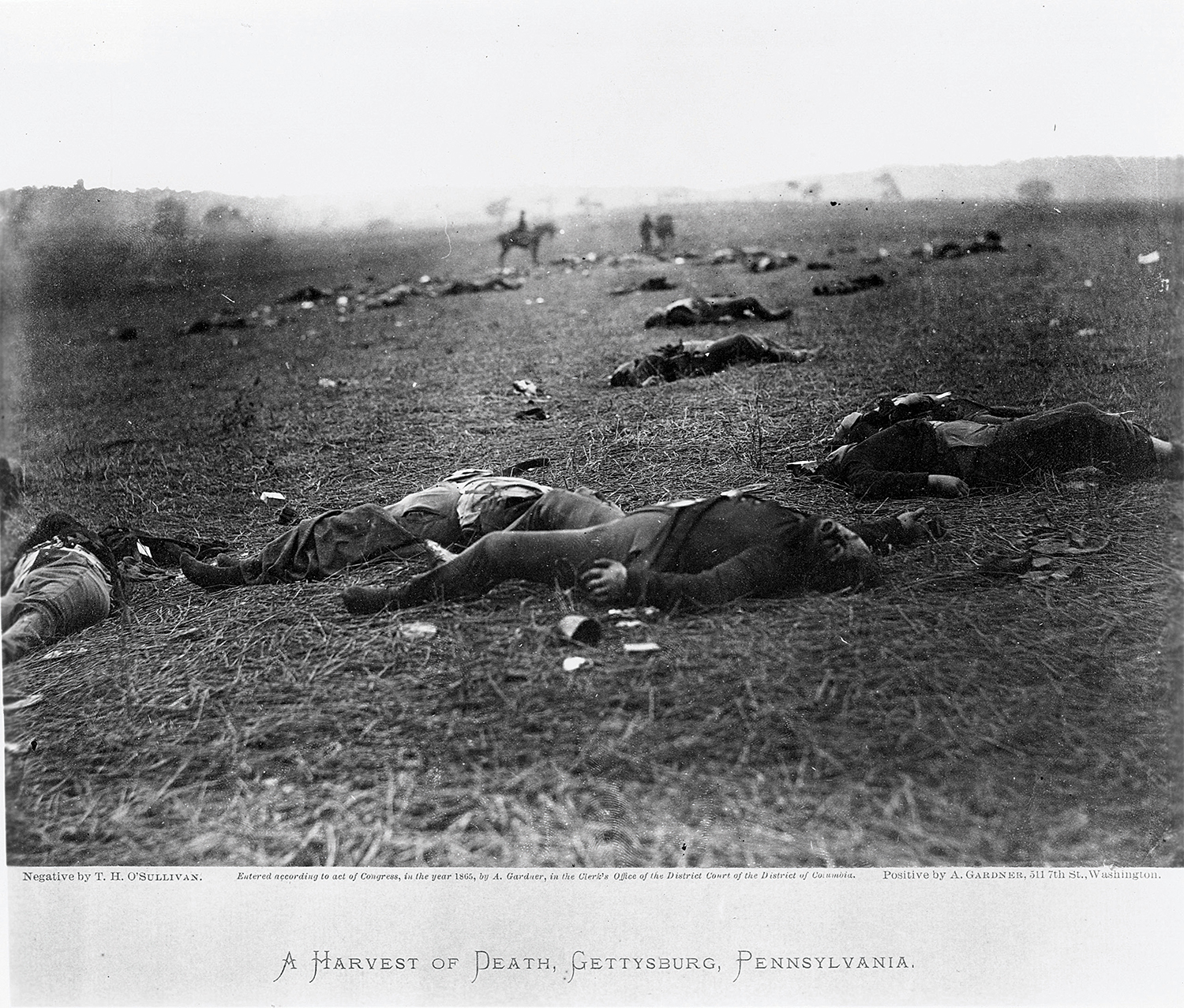
A Harvest of Death, Gettysburg, Pennsylvania
Photographed by Timothy O’sullivan
Although viewers could regard this image as simple reportage, it also functions to impress on people the high price of war. Corpses litter the battlefield as far and wide as the eye can see
Wet-plate technology enabled photographers to record historical events on the spot
Though it was years before photolithography could reproduce photographs such as this one in newspapers, photographers exhibited them publicly. They made an impression that newsprint engravings never could.
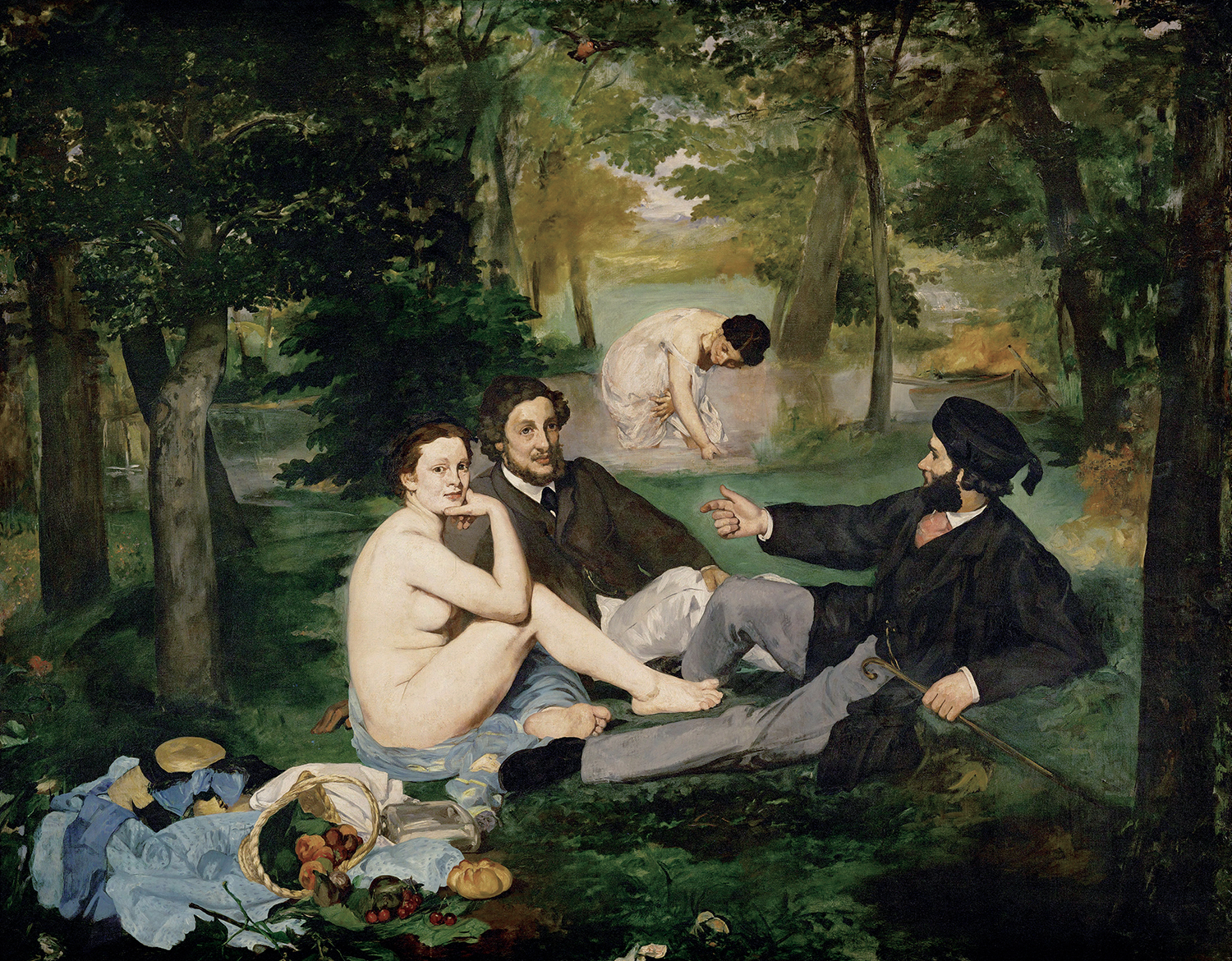
Le Déjeuner sur l’Herbe (Luncheon on the Grass)
Created by Édouard Manet (Paris) - one of the first modern artists
This painting was rejected by the jury for the 1863 Salon for being to vulgar and incomprehensible
Depicts two clothed men and one naked and one clothed woman at a picnic. Consistent with Realist principles, Manet painted a contemporary genre scene and based all four figures on real people, including his brother and Victorine Meurent (his favorite model)
The naked woman—she has undressed in the park and tossed her clothes on the grass—is a distressingly unidealized figure who also seems completely unfazed by her nakedness. She gazes directly at the viewer without shame or flirtatiousness. Her companion looks in the same direction. Neither pays any attention to what the second man is saying to them.
Nor is it clear what relationship, if any, the second woman has to the trio “at lunch.”
No one has any interest in the picnic food. This is no luncheon on the grass, although it may be the aftermath of a meal. Nor is this truly Realism, because the subject is incomprehensible
It was supposed to be a tribute + highlight of technique of painting
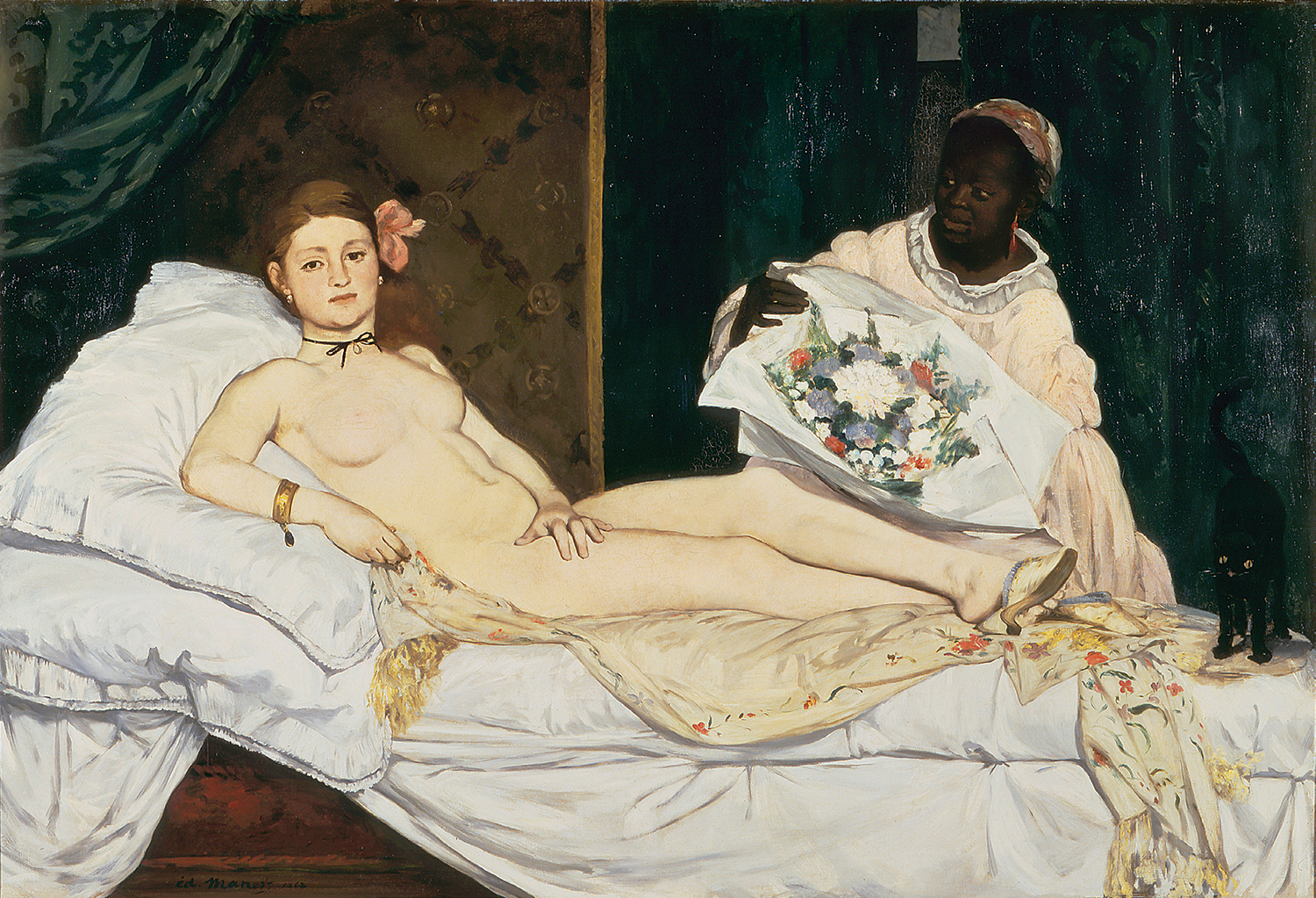
Olympia
Created by Édouard Manet
Recreation of Venus of Urbino
Surprisingly was excepted to the Exhibition
Olympia was a common “professional” name for prostitutes in 19th-century Paris
She reclines on a bed that extends across the full width of the painting (and beyond) and is naked except for a thin black ribbon tied around her neck, a bracelet on her arm, an orchid in her hair, and fashionable slippers on her feet
Like the seated woman in Le Déjeuner, Olympia (Victorine Meurent served again as Manet’s model) meets the viewer’s eye
Olympia is being presented with a bouquet of flowers from the man who has just entered her bedroom
Critics also faulted the painter’s rough brushstrokes and abruptly shifting tonalities.
Impressionism
A late-19th-century art movement that sought to capture a fleeting moment, thereby conveying the elusiveness and impermanence of images and conditions.
Impressionist paintings represent an attempt to capture a fleeting moment—not in the absolutely fixed, precise sense of a Realist painting
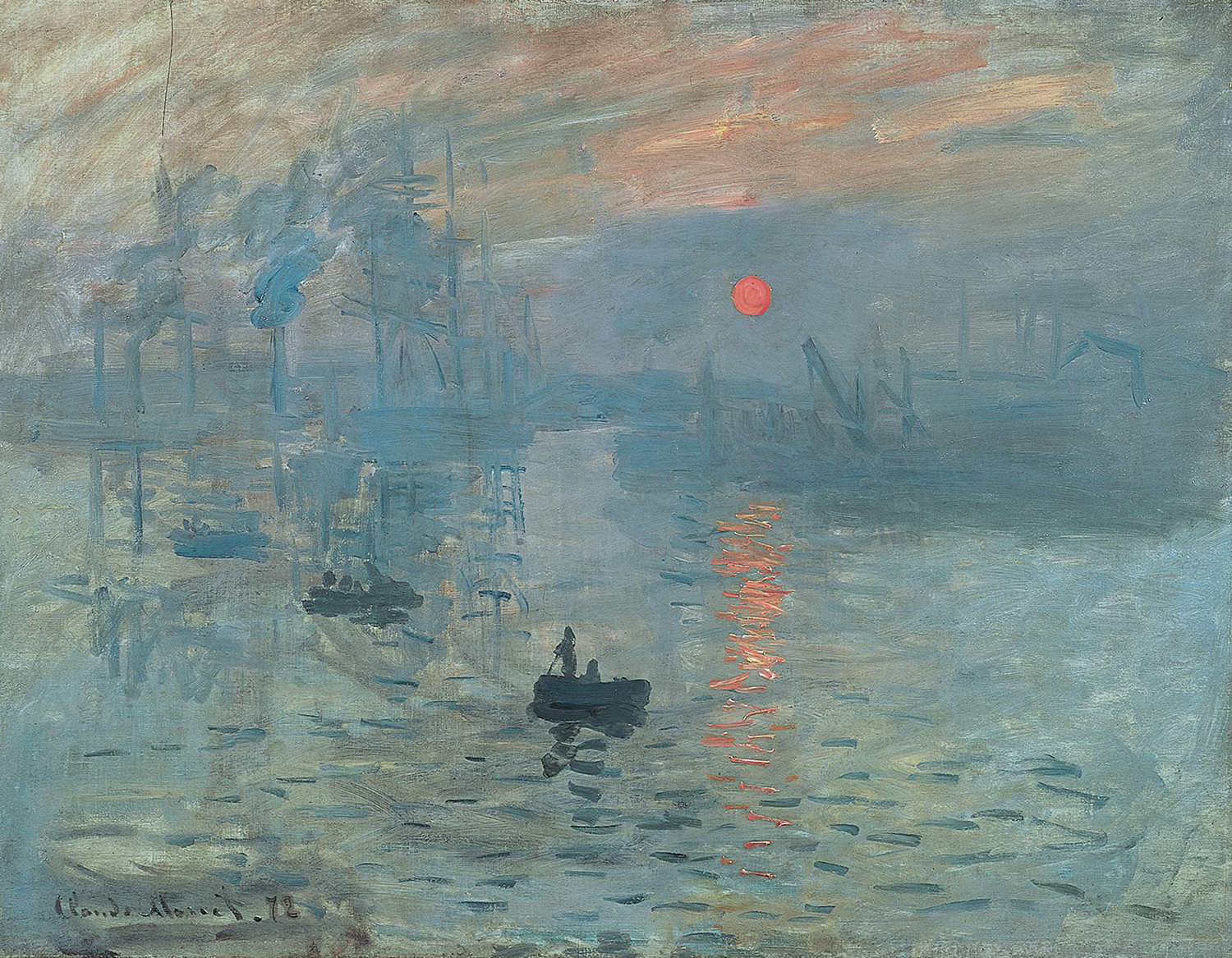
Impression: Sunrise
Created by Claude Monet
This painting is a view of that harbor, represented a sharp break from traditional landscape painting. In recording the boats, water, and sky en plein air—that is, outdoors
Monet made no attempt to disguise the brushstrokes or blend the pigment to create smooth tonal gradations, as traditional painters did
Effected by the pace of modern life
Fascinated by reflected sunlight on water, Monet broke with traditional studio practice and painted his “impression”
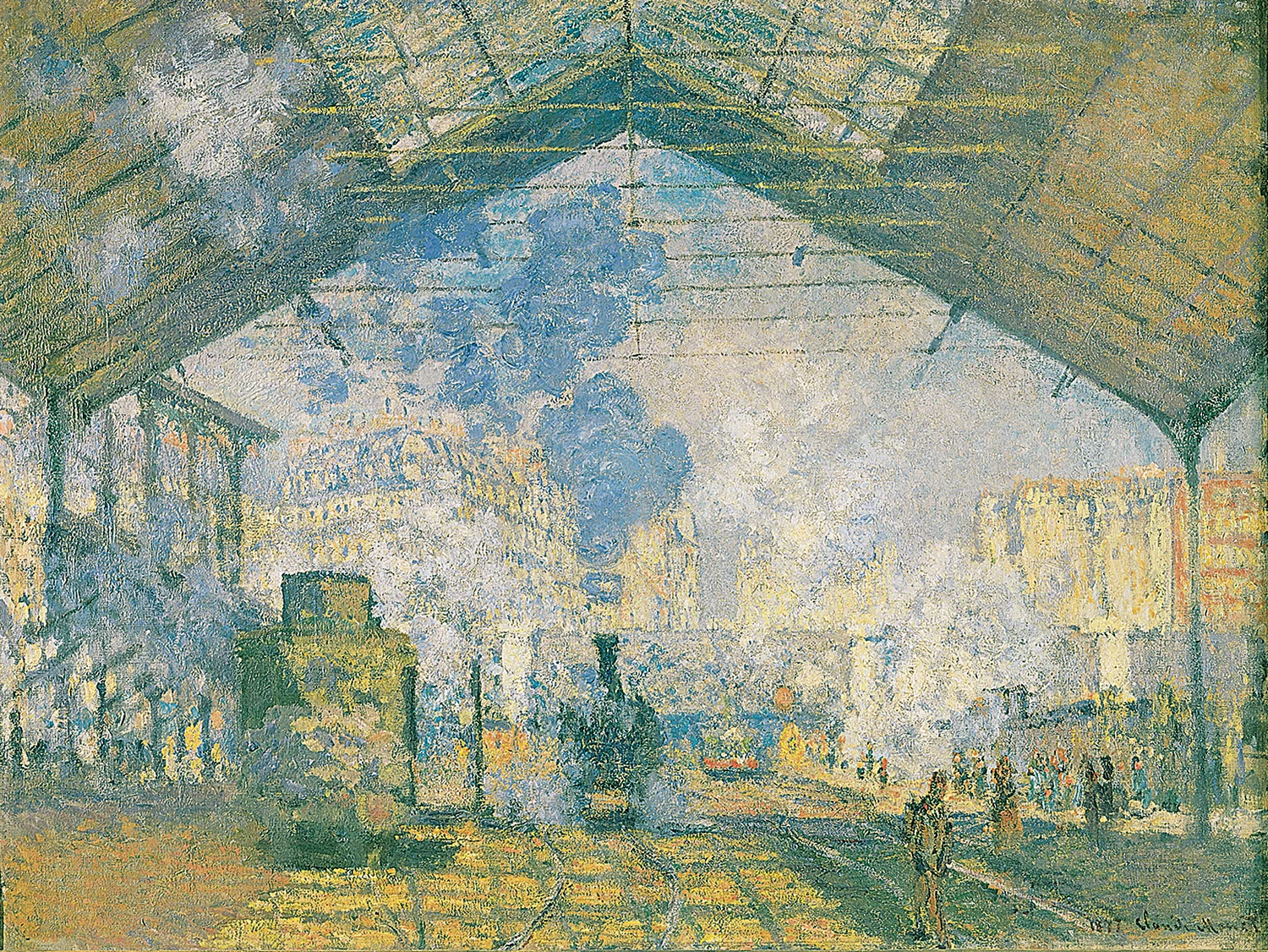
Gare Saint Lazare
Created by Claude Monet
Depicts a characteristic aspect of the contemporary urban scene. The expanding railway network had made travel more convenient, bringing large numbers of people into Paris and enabling city dwellers to reach suburban area
Monet captured the energy and vitality of Paris’s modern transportation hub. The train, emerging from the steam and smoke it emits, rumbles into the station. In the background haze are the tall buildings that were becoming a major component of the Parisian landscape.
Artist liked stuffed/crowded scenes → showed modernity
Monet’s agitated application of paint contributes to the sense of energy in this railway terminal (lighter colors)
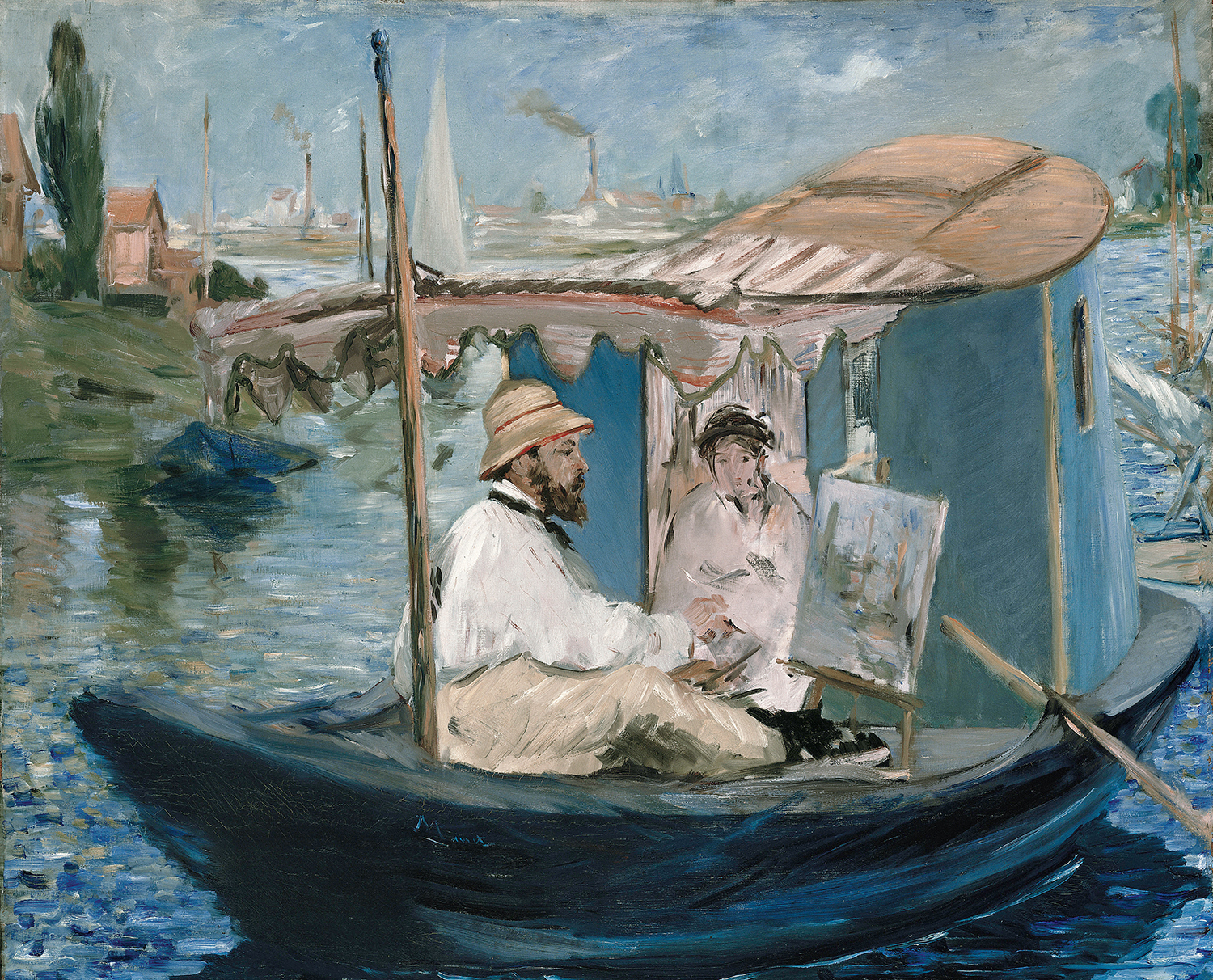
Claude Monet in His Studio Boat
Created by Édouard Manet
In summer 1874, Manet recorded Monet painting—en plein air directly on canvas without any preliminary sketch—in his floating studio on the Seine
In the distance are the factories and smokestacks of Argenteuil
In this painting, Manet adopted not only Monet’s Impressionist subject matter but also the younger artist’s short brushstrokes and fascination with the reflection of sunlight on water