organic stuff that I forget lmao - first 8 topics
 Call Kai
 Learn
Learn Practice Test
 Spaced Repetition
 Match
Match Flashcards
 Knowt Play
1/35

There's no tags or description
Looks like no tags are added yet.
Name | Mastery | Learn | Test | Matching | Spaced | Call with Kai |
|---|
No analytics yet
Send a link to your students to track their progress
36 Terms
what is a homologous series and features of one
family of organic compounds with same functional groups but different carbon chain length
same general formula, similar chemical properties
how does E-Z isomerism come around
C=C bond restricted rotation (planar) and each carbon in double bond has 2 different groups attached
what is petroleum and what is a fraction
mixture of alkanes
compounds with similar boiling points
process for fractional distillation
Crude oil is heated in a furnace
Mixture of liquid and vapour passes up the column which is hot at the bottom and cooler at the top
Vapours pass up the column via series of trays containing bubble caps until they arrive at a tray that is sufficiently cool - condense to a liquid
order of fractions
Refinery gases - fuel on site
Gasoline/petrol - cars
Naphtha
Kerosene/paraffin - jet fuel and lighting
Diesel oil - lorries and taxis
Lubricating oil and waxes - candles and engine oil
Fuel oil - ships, power stations
Tar/bitumen - roads and roofing
what is cracking and why necessary
breaking C-C bonds in alkanes
Shorter chain alkanes are higher in demand and there is less supply - more economically valuable
Longer chain alkanes cracked to form shorter chain alkanes
Alkenes can be used to make polymers - reactive so valuable
conditions for thermal
produces high proportion of alkenes
Free radical fission
Reaction involves heating alkanes to high temperatures 700-1200 K under high pressure, up to 7000 kPa
catalytic cracking
lower temperature - 720 K and slight/moderate pressure using a zeolite catalyst consisting of silicon dioxide and aluminium oxide
Zeolites have honeycomb structure with enormous surface area
Acidic
This form of cracking produces motor fuels mainly - products are mostly branched alkanes, cycloalkanes or aromatic compounds
use of alkanes
fuels
what produced by combustion of alkanes
carbon dioxide, carbon monoxide, water vapour = toxic and greenhouse gas
sulfur dioxide = acid rain
nitrogen oxides = acid rain, respiratory issues
carbon particles = asthma/cancer
how NO formed
Ignition sparks in an engine produce high temps which break the N2 triple bond
N2 + O2 -----> 2NO
only at high temperatures
how to get rid of sulfur impurities
flue gas desulphurisation with CaO or CaCO3
how to get rid of nitrogen oxides and carbon monoxide
Catalytic converter is a honeycomb made of ceramic material coated with platinum and rhodium metals - catalysts
Honeycomb shape provides enormous surface area, polluting gases pass over catalyst and react with each other to form less harmful products
2NO + 2CO -----> N2 + 2CO2
2NO -----> N2 + O2
stuff about greenhouse effect/gases
Carbon dioxide bonds (double bonds) vibrate at IR frequency because they are polar - therefore absorb heat
IR radiation emitted from earth does not escape atmosphere
carbon neutral = no net emissions of carbon dioxide to the atmosphere
carbon-halogen bond and rate of reaction
C-F most polar as F most electronegative
C-I is weaker than/lower bond enthalpy/breaks easier than C-Br or C-Cl/F
why do nucleophilic substitutions occur
Bromine is more electronegative than carbon
C is partially positive
Lone/electron pair donated to the partially positive carbon
what does OH- act as in elimination
OH- ion acts as a base and lone pair donor removing proton from halogenoalkane
what does ozone do
absorbing some of the UV rays from the sun - without this skin cancer would be very common (UV rays damage DNA)
why are CFC’s greenhouse gases and why are C-F fine
CFCs can absorb infrared radiation as the molecule has polar bonds
C-F bonds do not break in UV light
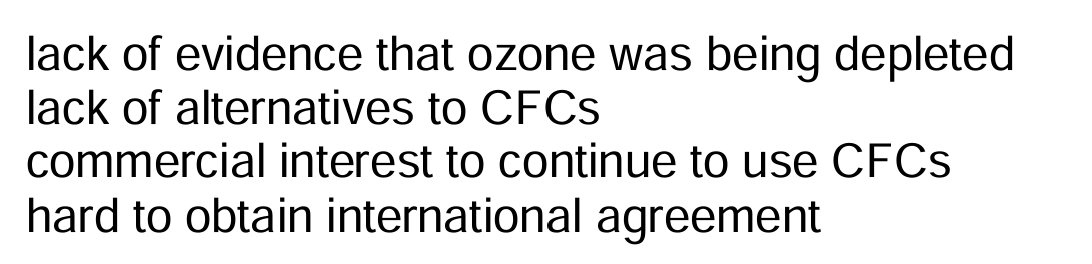
why did CFC’s continue to be used
what does bonding in alkene involve
Double covalent bond = centre of high electron density
how does electrophilic addition occur
C=C is electron dense area
Br2 becomes polarised
Delta positive Br is attracted to C=C
major v minor product spiel
Major product formed via more stable carbocation
State which one is the more stable and that the major came from that
Major product formed from the tertiary carbocation rather than the secondary one
Greater stability of tertiary carbocation due to greater positive inductive effect of three alkyl/two alkyl groups rather than one
why do alkenes not biodegrade/unreactive
strong non-polar C-C and C-H bonds
not open to attack by nucleophiles
what is PVC and its relevance
Properties of polymers can be modified by use of plasticiser additives - small molecules that get between polymer chains and force them apart allowing them to slide across each other
Makes it more flexible
PVC (polychloroethene) is rigid enough for use as drainpipes but with plasticiser can make aprons
what is ethanol made via fermentation separated by
fractional distillation and used as biofuel
what is biofuel
Ethanol is a carbon neutral fuel - releases same amount of carbon dioxide when burnt as was taken in from atmosphere when plants grow and are photosynthesised
No net emissions of carbon dioxide to the atmosphere
Biofuel is a fuel derived or produced from renewable biological sources
Photosynthesis - 6CO2 (g) + 6H2O (l) -----> C6H12O6 (aq) + 6O2 (g)
Fermentation - C6H12O6 ---> 2C2H5OH + 2CO2
Burning - 2C2H5OH + 6O2 ------> 4CO2 + 6H2O
6CO2 goes in and 6 comes out
pros of biofuel
Biofuels are cost-effective
Biofuels are more environmentally friendly than regular fossil fuels
Biofuels are made from renewable sources, rather than finite, and so will not run out
Biofuels can be produced in large batches due to fermentation process
cons of biofuel
Transportation of equipment - releases carbon emissions
Fossil fuels are used to run the fermentation machinery
Nitrous oxide is released from fermenters used to grow the crop
Ethical concerns that there will be too much agricultural land being used for growing crops to make biofuels – this could lead to food scarcity
Ethical issues including reduced biodiversity and habitat loss due to agricultural land being used for crops
Other ecological issues, this includes soil erosion, deforestation, fertiliser run-off and more
alcohol to alkene use
monomers for addition polymerisation can be formed without deriving them from crude oil
mass spec stuff
precise masses are different
electron impact ionisation = breaks molecular ion into smaller fragments
high-resolution mass spec = molecular formula found, cannot identify compound
infrared info
If a molecule has polar bonds, it can absorb infrared radiation = greenhouse gas
Use fingerprint region - look for match to known spectrum
optical isomerism info
non-superimposable mirror images = enantiomers
4 different substituents are attached to one carbon atom - known as the chiral carbon centre
Polarised light is passed through two solutions of the same concentration, each contains a different optical isomer of the same substance
Enantiomers will rotate the plane of light in opposite directions
One solution will rotate the plane of polarisation through one angle - clockwise = +
The other solution will rotate the plane of polarisation the other way
why hydride ion only react with aldehydes/queeftones
Hydride ion is a nucleophile which is attracted to delta positive carbon in polar C=O bond
But in alkenes - there is a C=C electron rich area
Repels the hydride ion so no reaction occurs
why KCN and not HCN
KCN dissociates better than HCN to produce CN- ions
Aqueous conditions
CN- ion is toxic so typically not carried out
why optical isomers form in queeftones/aldehydes
equal chance of attacking the plane from above or below the flat trigonal planar of C=O/planar carbonyl group