science final review flashcards
 Call Kai
 Learn
Learn Practice Test
 Spaced Repetition
 Match
Match Flashcards
 Knowt Play
1/76

There's no tags or description
Looks like no tags are added yet.
Name | Mastery | Learn | Test | Matching | Spaced | Call with Kai |
|---|
No analytics yet
Send a link to your students to track their progress
77 Terms
What tool is used to measure the mass of an object?
digital balance
What tool is used to measure temperature?
thermometer
What is the basic metric unit of length
meter
mass is defined as:
the amount of space an object takes up
What should you do if there is an accident or injury in the lab?
raise your hand and tell the teacher
What are the building blocks of all matter?
atoms
The length of a highway would most likely be measured in what metric units?
kilometers
a. write the chemical symbol for oxygen:
b. write the chemical formula for carbon dioxide:
c. which one (oxygen or carbon dioxide) is an element?
d. How do you know?
a. O
b. CO₂
c.oxygen
d. represented by a single capital letter
a. the density of water is
b. an object with a density of 0.9 g/mL will (sink or float) in water
c. How do you know if an object will float in water?
a. 1 g/mL
b. float
c. If it has a density of less than 1.0 g/mL
round the following numbers to the nearest tenth (0.1)
444.444 33.33 55.55
444.4 33.3 55.6
Which phase of matter is characterized by definite shape and a definite volume?
solid
Which phase of matter is characterized by having neither definite shape nor definite volume?
gas
In which phase of matter would water molecules have the most energy?
gas
What is the electrical charge of a proton?
positive
What is the electrical charge of a neutron?
neutral/no charge
what is the electrical charge of an electron?
negative
What does the atomic number tell you?
the total number of protons
The small positively charged center of an atom is called the
nucleus
In a neutral atom, the number of protons must equal
the number of electrons
list the noble gases:
are the noble gases reactive?
helium, neon, argon, krypton, xenon, and radon
no they have a full number of valence electrons
what part of an atom is involved during chemical bonding?
electrons
On the periodic table table, where are the metals found?
on the left side
In a chemical equation, the arrow represents the word
yield
A form of shorthand using symbols and formulas to represent a chemical reaction is called a
chemical equation
a strong base can have a pH of
8-14
a strong acid could have a pH of
0-6
a neutral substance has a pH of
7
the universal solvent is
water
A substance that changes color in the presence of an acid or a base is called a/an
indicator
what is the mass of a proton?
1 amu
what is the mass of a neutron?
1 amu
what is the mass of an electron?
0.0006 amu
where are the protons found in the atom
in the nucleus
where are the neutrons found in an atom?
in the nucleus
where are the electrons found in the atom?
outside the nucleus along orbitals in the electron cloud
What do we call the very small center core of the atom?
nucleus
where are the most reactive metals found?
group 1 and group 2
list 3 properties of metals:
conductors, malleable and luster (metallic)
three ways in which the solution rate can be increased are
crush it, heat it, and stir it
what is an amorphous solid?
A solid object with no definite shape
examples of chemical reactions include
digestion and combustion
a change from a solid to a liquid is called
melting
a change from a liquid to a solid is called
freezing
air, saltwater, and raisin bran are all examples of
homogeneous mixture
list 3 properties of acids
sour in taste, turns litmus paper red, contains Hydrogen (h+) ions
list three properties of bases
bitter in taste, turns litmus paper blue, contains hydroxide ions (OH)
what is the freezing point of water?
what is the boiling point of water?
0℃
100℃
what do the following prefixes mean?
kilo
centi
milli
kilo-1000
centi-1/100
milli-1/1000
matter is anything that has ______ and ____ __ _____.
a mass, takes up space
an educated guess is called
a hypothesis
in a controlled experiment, the factor being tested or changed is the
independent variable
the universal solvent is
water
of the following, which has the most amount of mass?
neutron and proton
on the periodic table, where are the most reactive metals found?
group 1 and 2
on the periodic table, where are the most reactive nonmetals?
group 17
on the periodic table, where are the least reactive elements?
group 18
signs of a chemical change include
color change, bubbling or fizzing, and a change in temperature
what is the density of a 40 gram object with a volume of 10 mL?
4.0 g/mL
if an atom has an atomic number of 3 and a mass of 7, how many neutrons does this atom have?
how many protons?
4 neutrons and 3 protons
why does a heated gas rise?
hot air/gas is less dense than cold air/gas
what instruments would be needed to find the density of an object?
to measure mass to measure volume
-electronic balance -graduated cylinder
-ruler
why does oil float on top of water?
they have different densities (oil’s density is under 1.0)
an atom with an atomic number of 12 would have how many electrons in the first energy level?
how many electrons would this atom have in the second energy level?
2, 8
name two types of electric charge
positive or negative
what is an electric current?
A loop in which electrons are able to move producing energy
what are the three main components of a simple electric circuit?
power source, load, and conductive pathway (wire)
what’s the difference between a conductor and an insulator? give an example of each
Conductors allow the flow of electricity through it where insulators do not. An example of a conductor is copper and aluminum. An example of an insulator is rubber, plastic, and glass.
what type of wave is a sound wave?
longitudinal
what does the frequency of a sound wave determine?
the number of cycles per second of wave in a given period of type.
what does the amplitude of a sound wave determine?
the amount of energy the wave possesses
what happens to sound waves when they hit a hard surface?
they bounce off
how are sound waves produced by musical instruments?
through vibrations in the molecules
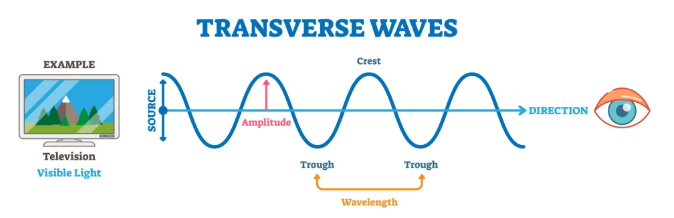
what type of wave is a light wave?
transverse wave
what happens when light hits a mirror?
the image is inverted or backwards and is reflected back at you
what is refraction?
the bending of light through an object
what is reflection?
the bouncing back of light waves
what is the lowest point and what is the highest point on a transverse wave called?
lowest point-trough
highest point-crest