HESI A2 BIOLOGY 2026 *CURRENT*
 Call Kai
 Learn
Learn Practice Test
 Spaced Repetition
 Match
Match Flashcards
 Knowt Play
1/112

There's no tags or description
Looks like no tags are added yet.
Name | Mastery | Learn | Test | Matching | Spaced | Call with Kai |
|---|
No analytics yet
Send a link to your students to track their progress
113 Terms
What is an atom?
The smallest basic unit of matter
What is a molecule?
Two or more atoms held together by covalent bonds
What is a compound?
Substance formed by the chemical combination of two or more elements in definite proportions
What is an element?
A pure substance that consists entirely of one type of atom
What is an ion?
An atom or molecule with a net electric charge due to the loss or gain of one or more electrons
What is a cation?
An ion with a positive charge. Formed by losing electrons
What are protons?
Positively charged particles
What are electrons?
Negatively charged particles
What are neutrons?
Neutral charged particles
What is an anion?
A negatively charged ion
What are electron shells?
The outside part of an atom around the atomic nucleus
What is the valence shell?
The outermost shell of an atom
What are isotopes?
Atoms of the same element with different numbers of neutrons
What is the nucleus?
A membrane-bound organelle that houses the genetic material in eukaryotic cells, functioning as the control center for cellular activity
Atomic mass
Number of protons and neutrons
What is the nuclear envelope?
A double membrane that controls material entry or exit
What are Nuclear Pore Complexes?
Holes in the nuclear envelope; connecting nucleus to cytoplasm
Function: Facilitate nucleocytoplasmic transport, maintaining cellular function by regulating molecular traffic.
What is the nuclear lamina?
A network of protein filaments (mainly lamin proteins) lining the inner membrane of the nuclear envelope
Function: Provides mechanical support, maintains nuclear shape, and organizes chromatin by anchoring it to the nuclear periphery
What is the Nucleoplasm?
The nucleoplasm is a viscous fluid that fills the nucleus, containing a mixture of ions, nucleotides, enzymes, and nucleic acids. It is not a blob of fluid, but has its own levels of organization
Function: Provides a medium for enzymatic reactions related to DNA replication and transcription
What is the Nucleolus?
A dense, spherical structure within the nucleus that is the site of ribosomal RNA (rRNA) transcription and ribosome subunit assembly
Function: Ribosome biogenesis, producing ribosomal components for protein synthesis
What is chromatin?
A mixture of DNA and proteins that form the chromosomes found in the cells of humans and other higher organisms.
Function: It organizes DNA to fit within the nucleus and regulates gene expression through its state of condensation
What is a chromotid?
Is one of the two identical halves of a chromosome that has been replicated in preparation for cell division.
What are ribosomes?
Small, complex molecular machine found in all living cells, both prokaryotic and eukaryotic. They are composed of ribosomal RNA (rRNA) and proteins, forming two subunits: a smaller subunit that reads messenger RNA (mRNA) and a larger subunit that forms peptide bonds between amino acids.
Can be found either floating freely in the cytoplasm or attached to the endoplasmic reticulum (in eukaryotic cells), where they are referred to as rough endoplasmic reticulum (RER).
(Workhorse of the cell)
Performs two functions: decoding the message from RNA and forming peptide bonds to synthesize proteins
What is the endoplasmic reticulum?
A tubular network that acts as a transport system.
Fused to the nuclear membrane and extends into the cytoplasm (The cells' factory + transport system)
Functions: Responsible for making, processing, and transporting important molecules inside the cell
What is the smooth endoplasmic reticulum?
It synthesizes lipids. DOES NOT contain ribosomes (NO ribosomes = No protein production)
Lipids, detox, calcium
Functions: Lipid production, detoxification, calcium storage, carb metabolism
What is the rough endoplasmic reticulum?
An organelle that synthesizes/produces, and packages proteins. Covered in ribosomes.
Makes, folds, and sends proteins to the Golgi
Functions: Protein synthesis, protein folding and modification, protein transport, and membrane production
What is the Golgi apparatus/body?
Flattened stacks/disks that process, package, and deliver proteins and lipids from the ER (The cells' post office + packaging center)
Function: Modifies proteins and lipids, sorts and packages, ships materials, and forms lysosomes
What are lysosomes?
Enzymes that break down food and aid digestion, destroying bacteria and viruses (Cells' cleanup and recycling center)
Functions: Break down waste, destroy pathogens, recycle cell parts (autophagy), and digest large particles
What are vacuoles?
Membrane-enclosed saclike structures that store materials such as water, salts, proteins, and carbohydrates (Especially important in plant cells!)
Functions: Storage, maintain turgor pressure (plants), waste management, digestion, water balance
What are mitochondria?
Produces energy for the cell (The powerhouse of the cell)
Functions: ATP production (energy), cellular respiration, regulates cell death (apoptosis), heat production, metabolism support
What are chloroplasts?
Membrane-bound organelles where photosynthesis takes place in plants
Functions: Photosynthesis, light absorption, glucose production, oxygen production
What is the cellular membrane?
The protective outer layer that controls what enters and leaves the cell (The gatekeeper)
Functions: Selective permeability (main job), protection and structure, cell communication, transport of substances, and cell recognition
What are prokaryotic cells?
Small, simple cells without a nucleus (NOT membrane-bound)
What are eukaryotic cells?
Complex cells with a nucleus (ARE membrane-bound)
What are organelles?
Specialized structures within a living cell that perform distinct functions
What are the similarities & differences between plant and animal cells?
Both are eukaryotic cells, meaning they have a defined nucleus and complex structures encased within membranes (organelles). Both cell types share common cellular machinery such as a nucleus, mitochondria, endoplasmic reticulum, ribosomes, and the Golgi apparatus.
However, they also exhibit distinct structural differences that define their functions and responses to their environment. Some of these differences include the presence of cell walls and chloroplasts in plant cells, and centrioles and lysosomes in animal cells.
What is photosynthesis?
The process by which a cell captures energy in sunlight and uses it to make food
What role does water play in photosynthesis?
Supply electrons in the light reactions
The role of water in photosynthesis is to be split by light energy and supply the electrons used to produce ATP in the light reactions step. Water plays a critical role in the light-dependent reactions of photosynthesis, which occur in the thylakoid membranes of the chloroplast. Splitting of water (Photolysis), water molecules are split into oxygen, protons (H⁺), and electrons in a process called photolysis. The role of the electrons is the electrons from water replenish the electrons lost by chlorophyll molecules in Photosystem II when they are excited by light energy. These electrons move through the electron transport chain, leading to the production of ATP and NADPH, which are used in the Calvin cycle. With oxygen production, oxygen is released as a byproduct of water splitting and is expelled into the atmosphere.
What is diffusion?
The movement of particles from an area of high concentration to an area of low concentration
What is osmosis?
Diffusion of water through a selectively permeable membrane
What is active transport?
Movement of molecules into or out of a cell against a concentration gradient
What is passive transport?
The movement of materials across the cell membrane without using cellular energy
What is cellular respiration?
The process by which cells convert sugars, primarily glucose, into energy.
This process involves combining oxygen with food molecules to produce adenosine triphosphate (ATP), which serves as a usable form of energy for cellular activities. During cellular respiration, carbon dioxide and water are produced as waste products.
What does the cell membrane consist of?
A bilayer of phospholipid molecules
Phospholipids are molecules composed of two parts: a hydrophilic (attracts water) phosphate head and a hydrophobic (repels water) lipid tail. The _______ consists of a bilayer of phospholipids where the phospholipids line up tail-to-tail. This bilayer creates a hydrophobic region between two layers of lipids, making it selectively permeable. Selectively permeable means that the cell membrane allows specific molecules or ions to pass through it while keeping others out
What does permeable mean?
Fluid or particles can pass through
Which organelle is responsible for cellular respiration?
Cellular respiration takes place inside the ___________, which is the powerhouse of the cell. In the ____________, ATP (energy) is produced in three stages, which collectively are referred to as cellular respiration:
⦁ Glycolysis
⦁ Citric acid cycle
⦁ Oxidative phosphorylation
What are the processes of cellular respiration?
1. Glycolysis
2. Krebs Cycle
3. Electron Transport Chain
What is a metabolic pathway?
A series of chemical reactions that occur within a cell to convert a starting molecule into a product
These pathways involve specific enzymes that modify metabolites, which are the reactants, products, and intermediates of these processes. Each step in a ____________ brings about a small but specific chemical change, facilitating the metabolism of biomolecules
What is glucogenesis?
Refers to the synthesis of new glucose from noncarbohydrate precursors, providing glucose when dietary intake is insufficient or absent.
It is also essential in the regulation of acid-base balance, amino acid metabolism, and the synthesis of carbohydrate-derived structural components
What is glycolysis?
Breakdown of glucose into pyruvate.
When does a cell undergo fermentation?
During low amounts of oxygen
________ is a widespread pathway, but it is not the only way to get energy from fuels anaerobically (in the absence of oxygen). Some living systems use an inorganic molecule other than O2, such as sulfate, as a final electron acceptor for an electron transport chain. This process, called anaerobic cellular respiration, is performed by some bacteria and archaea. These fermentation pathways consist of glycolysis with some extra reactions tacked on at the end. In yeast, the extra reactions make alcohol, while in your muscles, they make lactic acid.
What is the Krebs cycle?
The second stage of cellular respiration, in which pyruvic acid is broken down into carbon dioxide in a series of energy-extracting reactions
What are the products of the Krebs cycle?
2 ATP, 6 NADH, 2 FADH2, 4 CO2
(ATP, carbon dioxide, NADH)
What is the electron transport chain?
A sequence of electron carrier molecules that shuttle electrons, down a series of reactions that release energy; used to make ATP
What is anaerobic cellular respiration?
Burning fuels to generate ATP in the ABSENCE of oxygen
What is ATP?
Is the primary energy-carrying molecule in cells, acting as the "energy currency" that powers nearly all cellular activities
What is NADH?
Is the reduced form of nicotinamide adenine dinucleotide (NAD+), acting as a key electron carrier in cellular energy production
What is the energy cycle?
The use of organic molecules for energy, which is replenished by photosynthesis in plants
What is the energy pyramid?
A diagram that shows the amount of energy that moves from one feeding level to another in a food web
What is cellular reproduction?
The process by which cells divide to form new cells
What is heredity?
The passing on of physical or mental characteristics genetically from one generation to another
What is a genotype?
The genetic makeup of an organism
What is a phenotype?
The physical characteristics of an organism
What are alleles?
Different versions of the same gene
What are dominant alleles?
It is a trait that always shows up in the organism when the allele is present
What are recessive alleles?
A form of the gene that only controls the characteristic if it is present on both chromosomes
What is heterozygous?
Organisms have two different alleles for a particular trait
What is homozygous?
Organisms that have two identical alleles for a particular trait
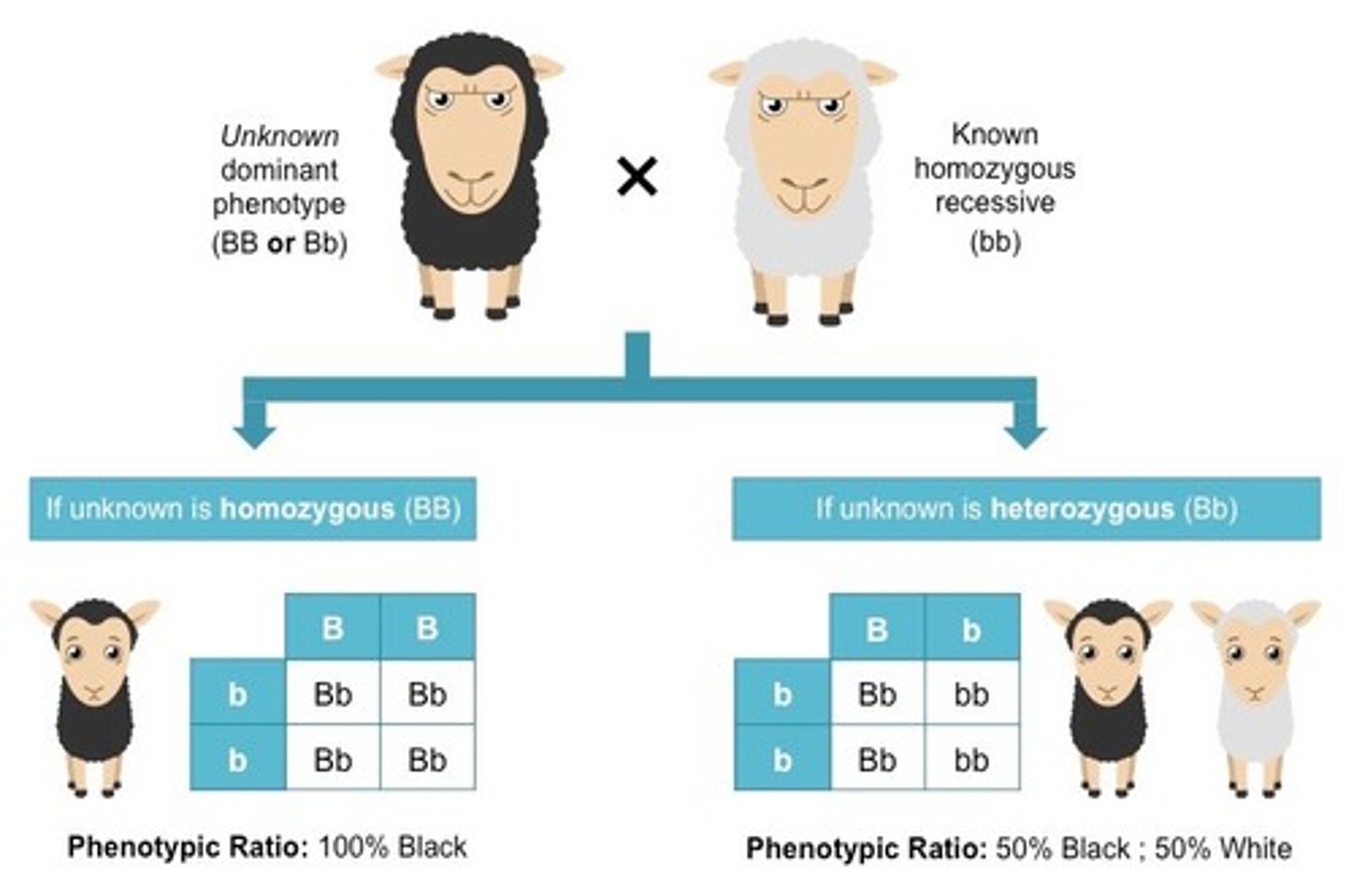
What are Punnett squares?
Punnett squares are charts that are used to show the possible gene combinations in a cross between 2 organisms
What is incomplete dominance?
When one allele is not completely dominant over another
What are chromosomes?
They are threadlike structures made of protein and a single molecule of DNA that serve to carry the genomic information from cell to cell. In plants and animals (including humans), they reside in the nucleus of cells
Humans have 22 pairs of numbered _____________ (autosomes) and one pair of sex _____________ (XX or XY), for a total of 46. Each pair contains two ___________, one coming from each parent, which means that children inherit half of their ___________ from their mother and half from their father
What are chromosomal mutations?
Deletion, duplication, inversion, translocation
What is codominance?
A genetic scenario where both alleles in a heterozygote are fully expressed
What is a genome?
The entire set of genetic material in an organism
What is DNA?
Deoxyribonucleic acid, a self-replicating material present in nearly all living organisms as the main constituent of chromosomes. It is the carrier of genetic information
What is RNA?
A nucleic acid present in all living cells. Its principal role is to act as a messenger carrying instructions from DNA for controlling the synthesis of proteins
What is mitosis?
Cell division that generates new cells for growth and repair. The division of one cell into two genetically identical daughter cells
How many chromosomes are in daughter cells produced by meiosis?
23
The number of chromosomes in a cell is halved during meiosis I and maintained during meiosis II. So, when a cell containing 46 chromosomes undergoes gametogenesis, the resulting daughter cells each contain 23 chromosomes after meiosis I and 23 chromosomes after meiosis II. The process results in four daughter cells that are haploid, which means they contain half the number of chromosomes of the diploid parent cell. Meiosis has both similarities to and differences from mitosis, which is a cell division process in which a parent cell produces two identical daughter cells
What is meiosis?
A type of cell division that results in four daughter cells, each with half the number of chromosomes of the parent cell, as in the production of gametes and plant spores
Which of the following is the function of meiotic cell division?
Formation of sex cells or gametes
Meiosis is responsible for the formation of sex cells or gametes, which are responsible for sexual reproduction. It activates the genetic information for the development of sex cells.
What is interphase?
Interphase is the longest stage in the eukaryotic cell cycle, during which the cell prepares for division
It consists of three main phases:
- G1 phase (first gap), where the cell grows and synthesizes proteins
- S phase (synthesis), where the cell replicates its DNA
- G2 phase (second gap), where the cell continues to grow and prepares for mitosis. During interphase, the cell is metabolically active, acquiring nutrients and performing essential functions to ensure successful division
What is prophase?
The first stage of cell division in mitosis and meiosis, where chromosomes condense, the mitotic spindle forms, and the nuclear envelope begins to break down
What is prometaphase?
Nuclear envelope breaks down. Microtubules contact chromosomes at kinetochores
What is metaphase?
The stage of cell division where chromosomes align at the cell’s equator, ensuring accurate separation into daughter cells
What is anaphase?
The stage of cell division in which sister chromatids or homologous chromosomes are pulled to opposite poles of the cell, ensuring each daughter cell receives a complete set of chromosomes
What is telophase?
The final stage of cell division in both mitosis and meiosis. During this phase, the spindle apparatus disappears, and the nuclear envelopes reform around each set of daughter chromosomes, resulting in the formation of two distinct nuclei within the dividing cell. This stage is usually followed by cytokinesis, where the cytoplasm divides to form two daughter cells
Stages of mitosis in order
Interphase, prophase, metaphase, anaphase, telophase, cytokinesis
Stages of meiosis in order
Prophase I, Metaphase I, Anaphase I, Telophase I, Prophase II, Metaphase II, Anaphase II, Telophase II
Taxonomic Hierarchy in order
(Most inclusive) Domain → Kingdom → Phylum → Class → Order → Family → Genus → Species (Least inclusive)
What is the domain?
This is the highest taxonomic rank and categorizes life into three main groups: Bacteria, Archaea, and Eukaryota.
What is the kingdom?
Below the domain, __________ group organisms that share significant traits. For example, the Animalia _______ includes all animals, while the Plantae ________includes all plants
What is the Phylum?
Each kingdom is divided into ____________. For instance, the Chordata _________ includes all animals with a notochord, such as mammals, birds, and reptiles
What is the class?
Within each phylum, organisms are further classified into _________. For example, the ______ Mammalia includes all mammals, characterized by features like fur and mammary glands
What is order?
Classes are divided into _________. For instance, the _________ Primates includes humans, apes, and monkeys
What is the family?
Orders are further divided into _________. For example, the ________ Hominidae includes great apes and humans
What is the genus?
Each family contains one or more _________. The _______ Homo includes modern humans and their close relatives
What is the species?
This is the most specific rank, identifying individual organisms that can interbreed. For example, Homo sapiens refers specifically to modern humans
What are carbohydrates?
Sugars and starches
What are lipids?
Are organic compounds like fats, oils, and waxes.
They are made primarily of carbon, hydrogen, and oxygen, but they do not contain nitrogen in significant amounts. They serve as energy storage molecules, structural components of cell membranes (like phospholipids), and signaling molecules (like steroids)
What is glucose?
It is a simple sugar (monosaccharide) and an important carbohydrate.
Its chemical formula is C₆H₁₂O₆. It serves as a primary energy source for cells but, like other carbohydrates, does not contain nitrogen.