Kaarten: Developmental biology | Quizlet
 Call Kai
 Learn
Learn Practice Test
 Spaced Repetition
 Match
Match Flashcards
 Knowt Play
1/50

There's no tags or description
Looks like no tags are added yet.
Name | Mastery | Learn | Test | Matching | Spaced | Call with Kai |
|---|
No analytics yet
Send a link to your students to track their progress
51 Terms
hCG (human Chorionic Gonadotropine)
Hormoon bij dat vrijkomt bij zwangerschap mens
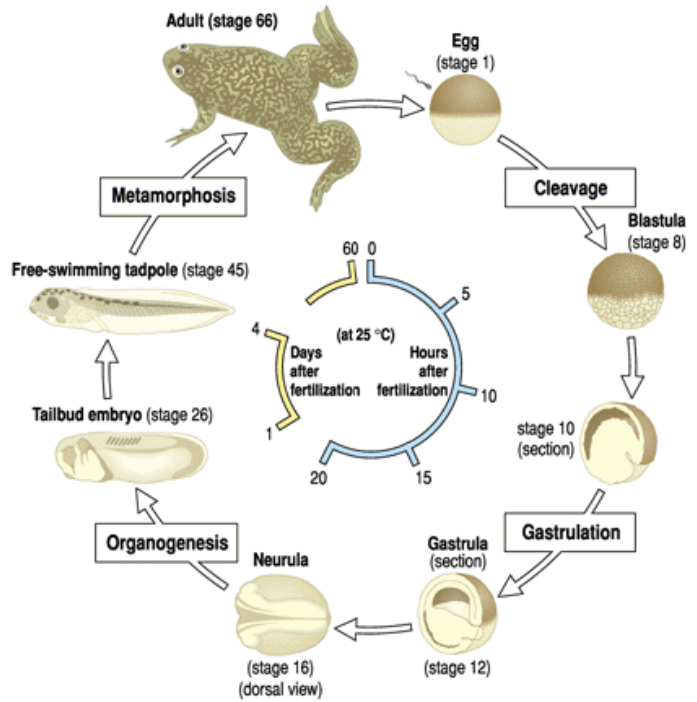
Xenopus laevis (levenscycli)
Kikker als model voor ontwikkeling
1 dag → embryo
4 dagen → kikkervis
Spermatozoids
motile male reproductive cells (gametes) in animals
Somites
blocks of paraxial mesoderm that form sequentially along the anterior-posterior axis of the developing embryo
Oocyte
An unfertilized egg cell
Neurilation
The process where the neural plate folds and closes to form the neural tube (the precursor to the brain and spinal cord)
Cemen gland
a sticky adhesive organ on the head of frog (Xenopus) tadpoles that lets them attach to surfaces after hatching
Animal pole
The darker, pigmented half of the egg where the nucleus sits and cell division is fastest.
Vegetal pole
Yolk-rich end of the egg, opposite the animal pole
Pronucleus
The haploid nucleus of a sperm or egg before they fuse at fertilization
Yolk platelets
Protein/lipid storage granules in the egg that provide nutrients for the developing embryo
Vitelline membrane
Thin layer surrounding the egg, just outside the plasma membrane
Morula
Solid ball of cells after several cleavage divisions
Blastocoel
Fluid-filled cavity inside the blastula
Marginal zone
ring of cells between animal and vegetal poles, key region for mesoderm induction
Blastopore
opening that forms during gastrulation, marking where cells move inward
Bottle cells
Cells at the blastopore lip that constrict apically, initiating the inward movement of gastrulation
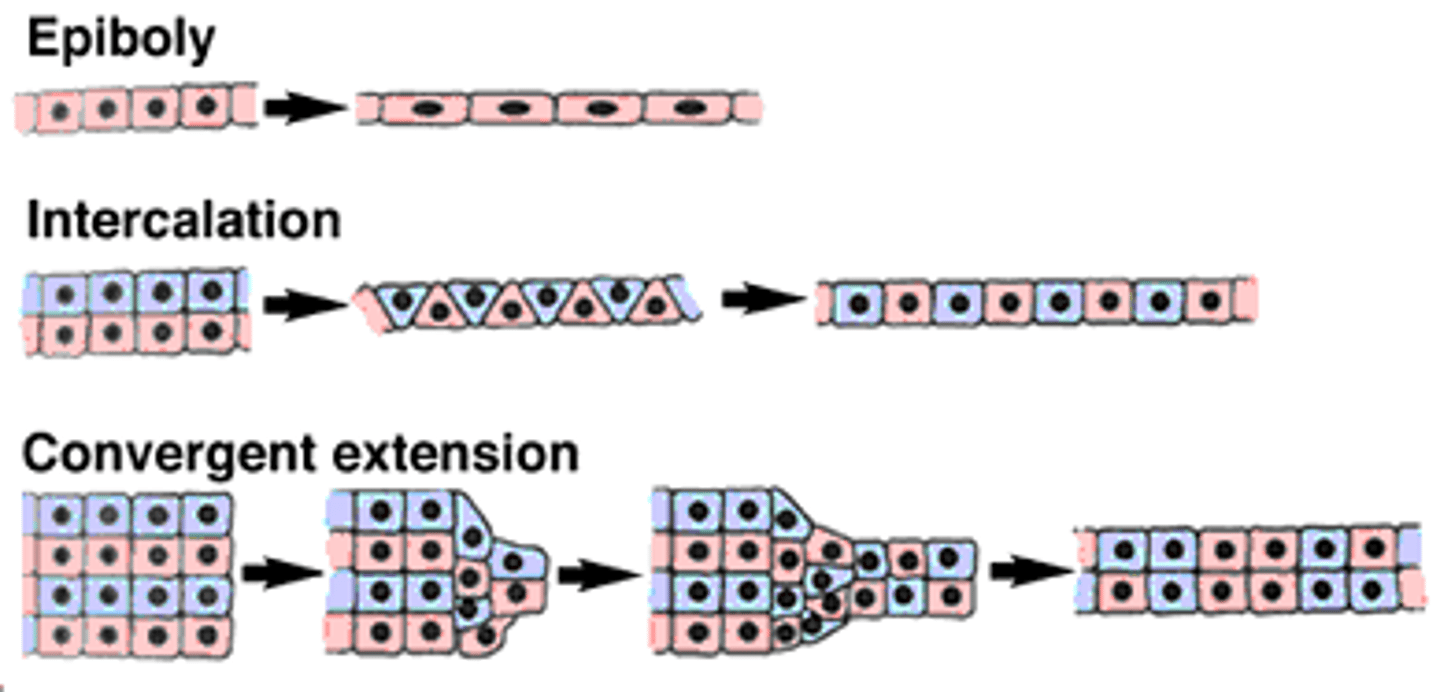
Epiboly proces
The spreading and thinning of the animal cap cells to cover the entire embryo
Epiboly
Intercalation
Convergence-extension
Neural plate
Flat sheet of ectoderm that folds to form the neural tube
Notochord
Rod-shaped structure that defines the body axis and induces the neural plate above it
= dorsal mesoderm structure
= hydraulic rod
Brain frog
Forebrain: future eyes
Midbrain:
Hindbrain: ear visicle
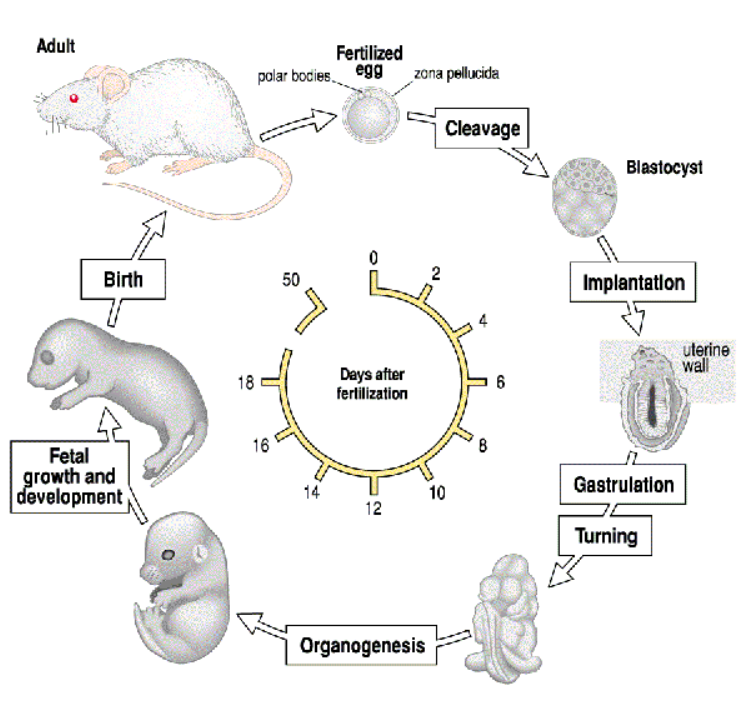
Mouse life cycle
4-5 → blastocyst
5,5 → uterus
6 → gastrulation
20 → birth
Mammal egg
100 microns diameter (5-10)
zona pullucida = gel protection around egg
polar body
2 pronucleï → merge → devide → two cell
Polar body
A small cell produced during meiosis of the oocyte — it gets most of the cytoplasm discarded, allowing the egg to keep nearly all its yolk and cytoplasm.
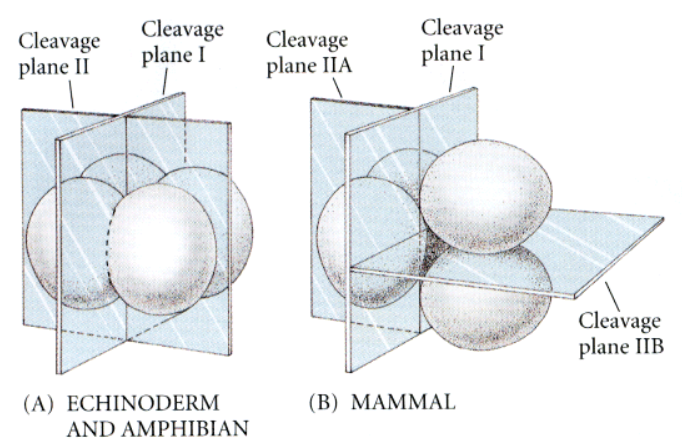
Cleavage frog vs mousse
1) different planes (meridionally, equatorraly)
2) shortened cell cylce vs normal cell cycle (24h, 12h)
3) synchrone vs not synchrone (7- and 13-cell embyo stages)
dpc
= Days post coitum
Brachyury gene
Master transcription factor gene that marks and specifies mesoderm
transgenic
An organism with foreign DNA artificially inserted into its genome
oviduct
Tube that carries eggs from the ovary to the uterus
trophectoderm cells
Outer cells of the mammalian blastocyst that form the placenta
epiblast
Inner layer of the mammalian blastocyst that gives rise to the embryo proper
primitive endoderm
Layer lining the blastocyst cavity that gives rise to the yolk sac
Syncytium
Mass of cytoplasm with multiple nuclei, not divided into separate cells
Allantois
Membrane that handles waste and gas exchange in the embryo; contributes to the umbilical cord
Amnion
Fluid-filled membrane sac surrounding and protecting the embryo
Node
Mammalian equivalent of the blastopore lip; organizer region that directs gastrulation
Sclerotome
Ventral part of the somite that forms vertebrae and ribs
Coelom
Fluid-filled body cavity lined by mesoderm
Spemann organizer
responsible for what is called the primary embryonyc induction
posterior marginal zone
Region in the chick embryo equivalent to the Spemann organizer; initiates primitive streak formation.
Xeno-transplantation experiments
Transplanting tissue between different species to test its signaling/organizing properties
chimera
Organism containing cells from two or more genetically distinct individuals
axial mesoderm or chordamesoderm
forms the notochord
paraxial mesoderm
forms the somites
Intermediate mesoderm
forms the urogenital system
Lateral mesoderm
forms the body wall, the circulatory system and the extraembryonic mesoderm
Head mesenchyme
participate to the formation of the face
dermamyotome
Dorsal part of the somite giving rise to dermis and skeletal muscle
sclerotome
Ventral somite compartment that forms vertebrae and ribs
Sonic hedgehog
encodes for a secreted protein expressed by the notochord that gives the signal to form the sclerotome region