Organic reaction mechanisms
 Call Kai
 Learn
Learn Practice Test
 Spaced Repetition
 Match
Match Flashcards
 Knowt Play
1/65

There's no tags or description
Looks like no tags are added yet.
Name | Mastery | Learn | Test | Matching | Spaced | Call with Kai |
|---|
No analytics yet
Send a link to your students to track their progress
66 Terms
Where are neighboring groups located?
α or β molecule to the reaction center
What intermediate do reactions involving neighbouring group participation typically produce?
a cyclic intermediate (typically 3 or 5 membered)
a) What feature do they possess, thus b) what are the important neighbouring groups?
a) groups have a lone pair on heteroatom
b) sulfides, esters, carboxylates, ethers, amines
What is the a) most and b) least effective neighboring group?
a) sulfides
b) ether
TRUE OR FALSE: π bonds can act as neighbouring groups
TRUE
This includes phenyl rings!
Payne rearrangement
Acid catalysed: epoxide picks up H+
Base catalysed: OH loses H+

What type of nucleophile favours an a) SN1 and b) SN2 reaction?
a) weak
b) strong
What makes a a) weak, b) moderate and c) strong nucleophile?
a) neutral, partial negative charge from lone pair of electrons eg. H2Ö: . single weak bond to carbon
b) stabilized charge eg. Br-
c) unstabilized charge eg. RO-
*same groups as leaving group but opposite strength
What is the stereochemistry of products of a a) SN1 and b) SN2 reaction?
a) racemic mixture
b) inversion (eg. R → S)
1,2 alkyl shift
allows the formation of an unstable primary carbocation to be avoided


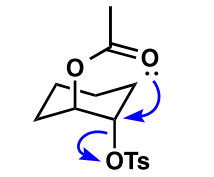
Which of the pictured reactions will proceed quicker and why?
The trans reagent because OAc can give neighboring group participation
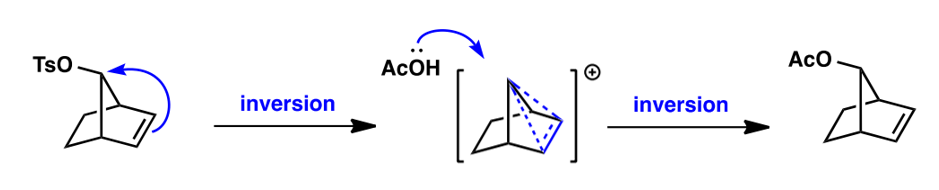
substitution reactions at saturated carbon atoms that proceed with (retention/inversion) of stereochemistry usually involve neighbouring group participation
substitution reactions at saturated carbon atoms that proceed with (retention/inversion) of stereochemistry usually involve neighbouring group participation
TRUE OR FALSE: 1,2 shifts happen in favour of obtaining more stable carbocations
TRUE
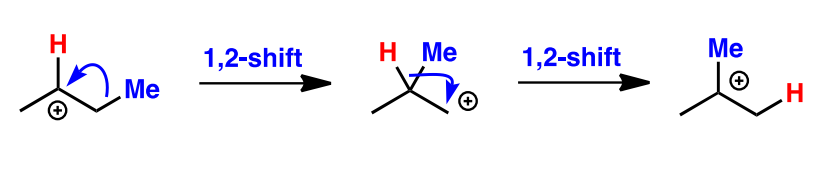
Wagner-Meerwein rearrangement
An E1 1,2 alkyl shift to form a more stable carbocation, followed by deprotonation

pinacol rearrangement
for 1,2 unsymmetrical diols; the product formed is determined by carbocation stability
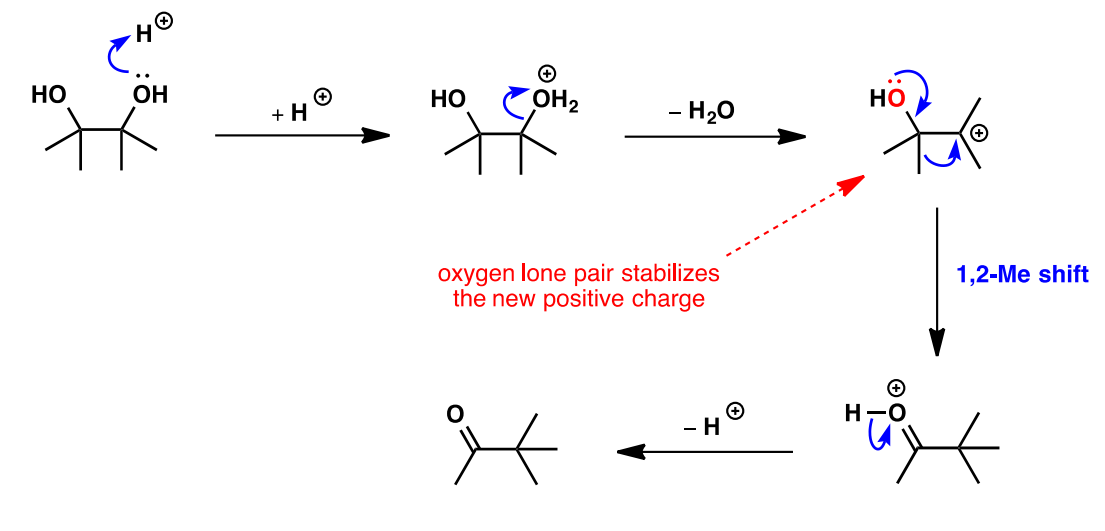
TRUE OR FALSE: a pinacol rearrangement is specific to 1,2 diols
FALSE: Epoxides can undergo a similar reaction with acids
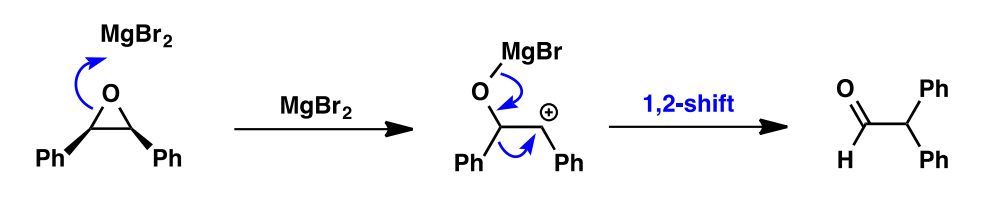
Semipinacol rearrangement
occurs when alcohol has been converted into a better leaving group; avoids forming a primary carbocation
diazonium salts can have N≡N act as the leaving group for a semipinacol rearrangement

Generally, the regioselectivity of the semipinacol rearrangement is (same as/opposite) that of the pinacol rearrangement
Generally, the regioselectivity of the semipinacol rearrangement is (same as/opposite) that of the pinacol rearrangement
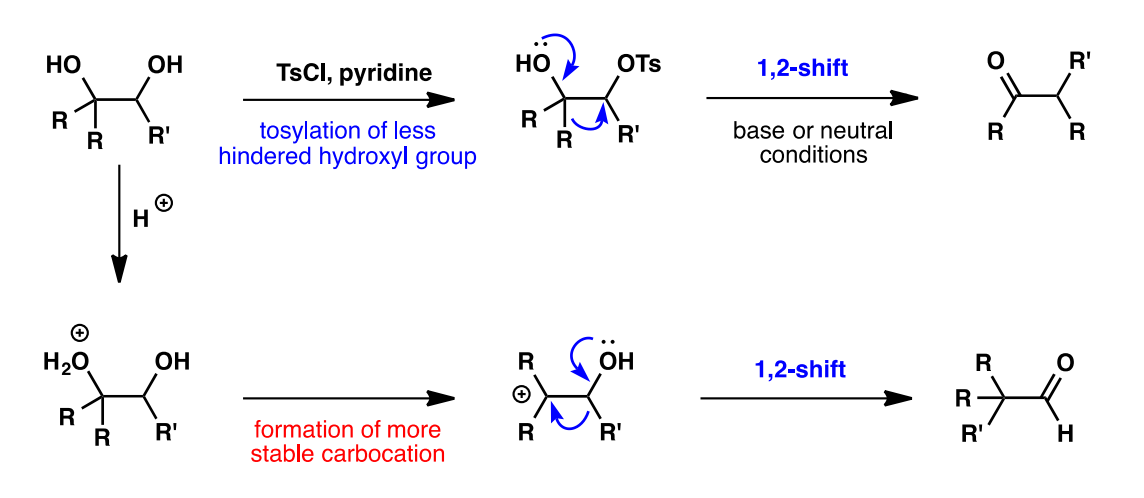
Forming diazonium salt
R-NH2 —NaNO2, HCl→ R-+N2 + Cl-
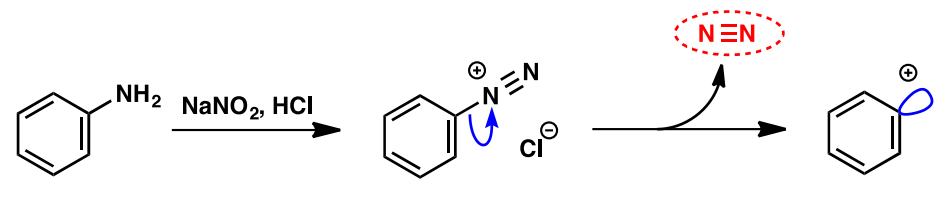
dienone-phenol rearrangement

benzilic acid rearrangement
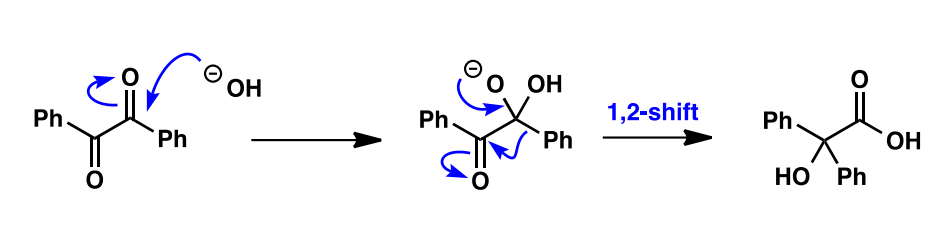
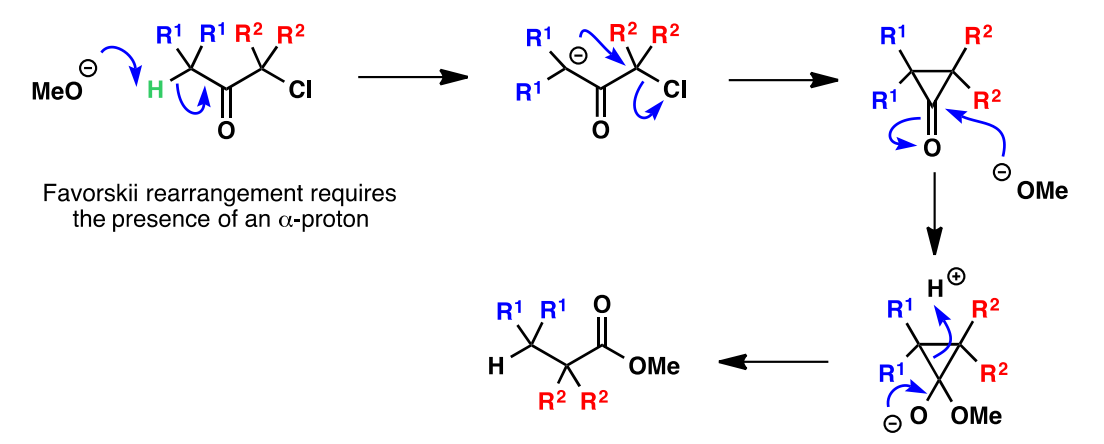
Favorskii rearrangement
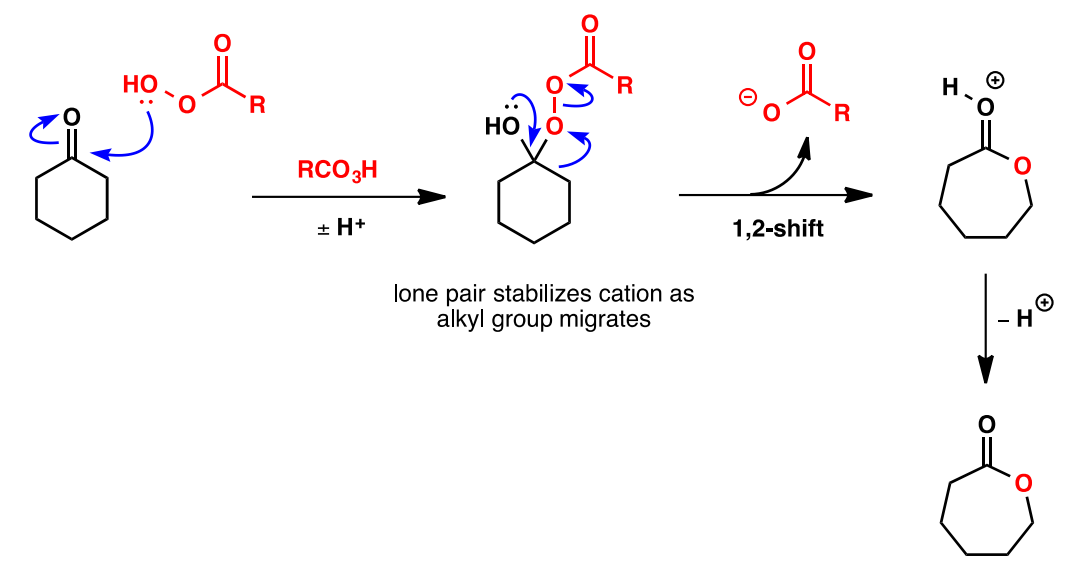
Baeyer-Villiger rearrangement
Treatment of a ketone with a peroxyacid such as m-CPBA
groups with highest to lowest migratory aptitude of O from peroxyacid in Baeyer-Villiger rearrangement
tert-alkyl > sec-alkyl > Ph > primary alkyl > Me
Epoxidation
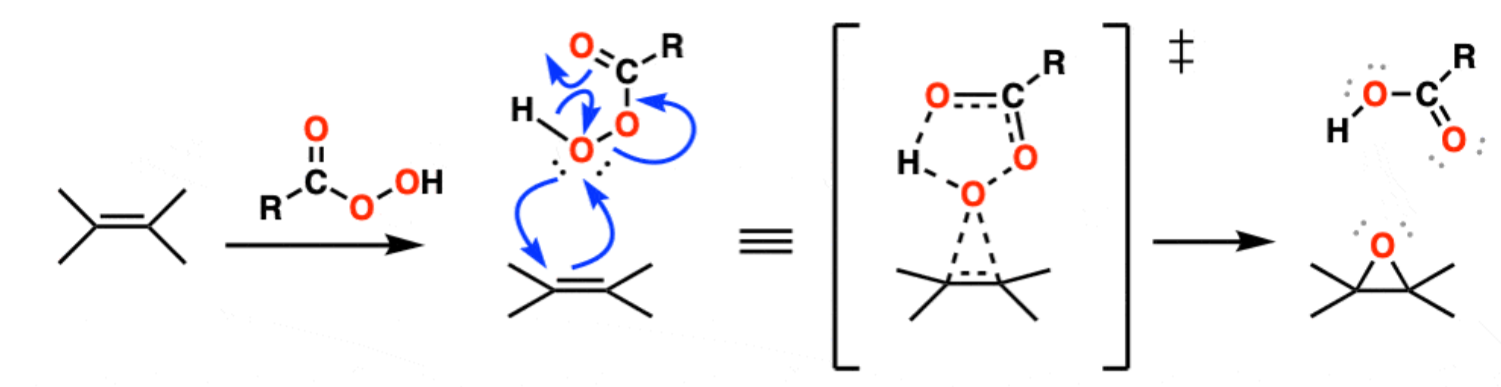
Which is the preferred reaction with m-CPBA: epoxidation or Baeyer-Villiger rearrangement?
Baeyer-Villiger rearrangement
Beckmann rearrangement
Hint: forms amide
the migrating must be trans to the OH group

persistent radicals
stable radicals that survive almost indefinitely, stabilized by electronic and steric effects
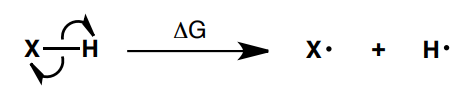
The greater the value of ΔG, the stronger the bond and the (more/less) stable the radicals.
The greater the value of ΔG, the stronger the bond and the (more/less) stable the radicals.
Which of the following a) stabilize and b) destabilize radicals: electron-withdrawing groups, electron-withdrawing groups, conjugation
a) All of the above!
b) N/A
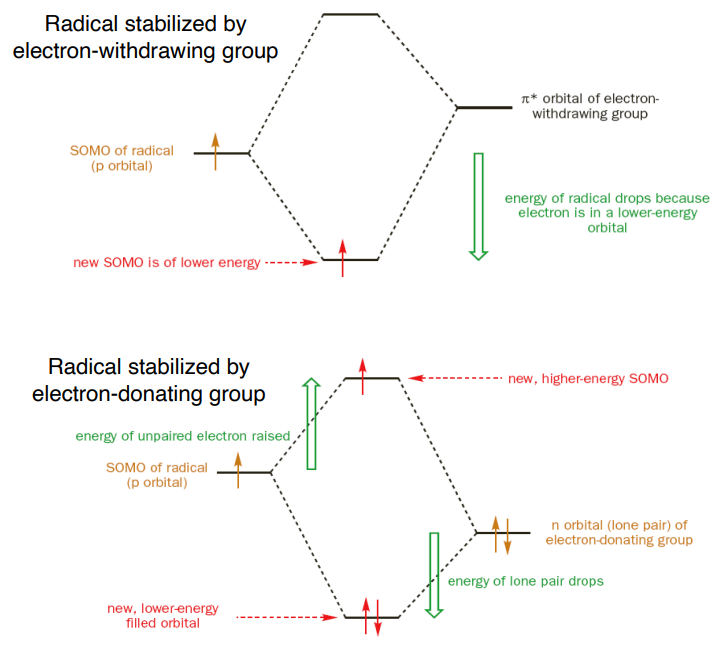
How do a) electron withdrawing and b) donating groups affect radical orbitals? Hint: energy levels
a) lower energy of single occupied molecular orbital
b) lower energy of electron pair
AIBN radical formation

Benzoyl peroxide radical formation

Radical pinacol reaction

acyloin reaction: ester + radical
esters forming a reactive diketone that makes the reaction propagate
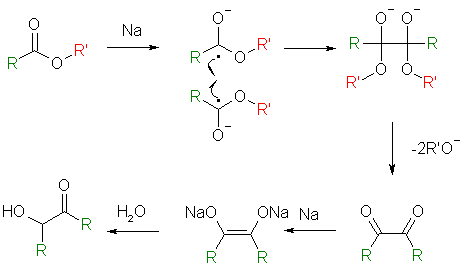
How can an acyloin reaction be made to not proceed to completion?
Me3SiCl to trap the highly reactive enediolate (RO-C=CO-R)
What determines selectivity of radical reactions? (2)
strength of the bonds being broken (and formed) —greatest for primary
stability of the radicals being formed— 3o is most stable
How can weak CX bonds be broken by radicals?
Bu3SnH →Bu3Sn* to remove the halide
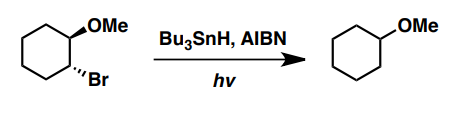
Bu3SnH can be used for what purposes?
removing an alkyl halide (and replacing with H)
C-C bond formation for alkenes (together with R-X)
radical cyclization classification
X-Y-Z
X= size of formed ring
Y= is attacked bond part of newly formed ring?; endo (yes), exo (no)
Z= attacked bond; dig (triple), trig (double), tet (single)
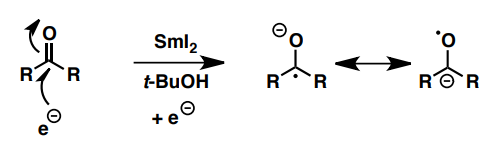
SmI2 reagent in reactions
used to generate ketyl radical anions from aldehydes and ketones, which can undergo addition to C=C bonds:
a) what are thioxoesters used for and b) how are they generated for c) what reaction?
a) transform secondary or tertiary OH into a good group for attack of a radical and subsequent elimination
b) see image
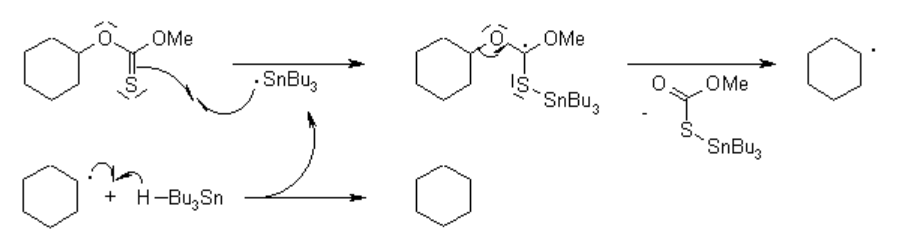
c) Barton-McCombie reaction
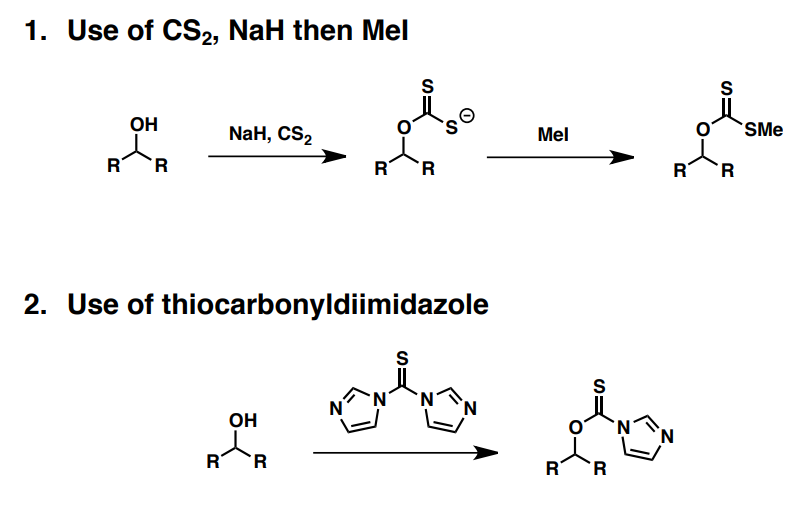
Barton-McCombie reaction
Exposure of the thioxoesters to Bu3SnH with AIBN as the initiator gives the reduced product
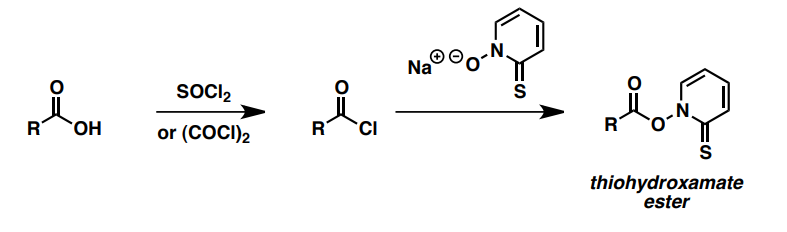
What reagents need to be generated in sequence for Barton decarboxylation reaction?
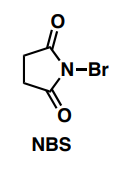
molecular bromine (Br2) can be provided by the reagent…
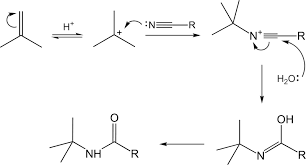
Ritter reaction
Crossover experiments purpose
determine if a reactant breaks apart to intermediates which are released before recombining to product by introducing multiple labelled sites in one molecule
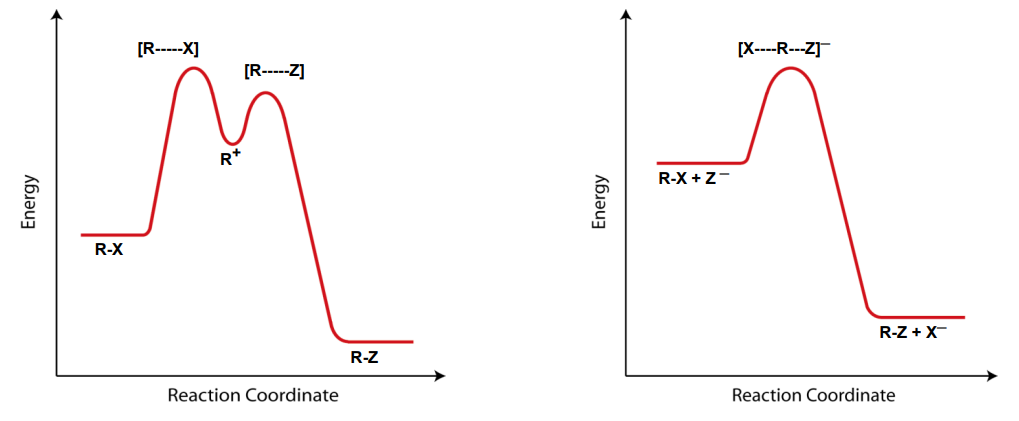
Rate equation for a) SN1 and b) SN2 reaction
a) rate = k[RX]
b) rate = k[RX][Z–]
Energy profile for SN1 and SN2
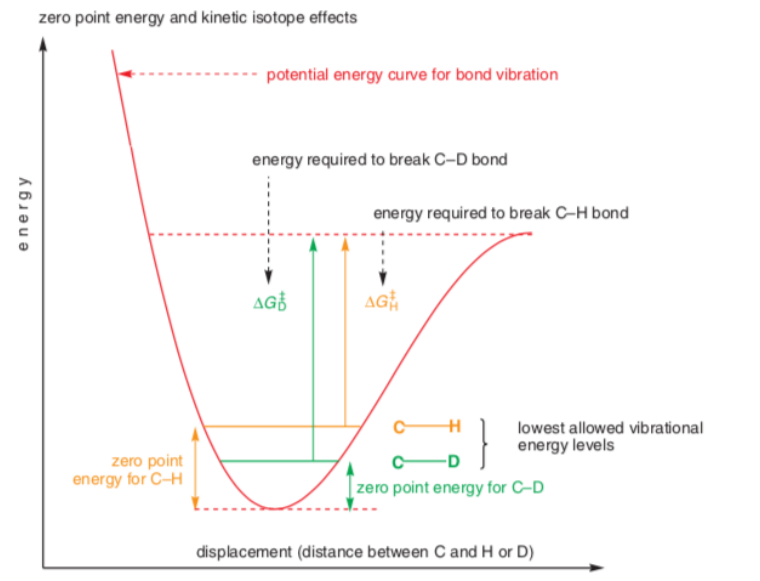
a) What is the kinetic isotope effect and b) what is a limitation in using it to determine reaction mechanism?
a) the zero point energy is lower for heavier isotopes therefore there is a greater ΔG for bond breaking, making the reaction slower
b) bond to the isotopically substituted atom must be broken in the rate determining step
TRUE OR FALSE: The kinetic isotope effect is affected by size of the atom
TRUE: becomes very small for larger atoms
A positive ΔS‡ means there is (__) in entropy as the starting material goes to the transition state
A positive ΔS‡ means there is an increase in entropy as the starting material goes to the transition state
Which commonly substituted isotope used for labelling is not observed in NMR?
18O
How does incorporating an electron withdrawing group affect the rate of reaction for a) SN1 and b) SN2 mechanisms and c) why?
a) decrease
b) no effect
c) The electron-withdrawing group destabilizes the carbocation intermediate
What does a) a positive and b) negative σ Hammett value indicate (x intercept)?
a) electron withdrawing group
b) electron donating group
What determines if σpara or σmeta is greater?
σpara is greater for conjugating substituents
σmeta is greater for inductive withdrawal
What are the components of the Hammett relationship (graph)?
ρ = m = log(kX /kH) / σ = sensitivity of reaction to electronic effects compared to benzene (1.0)
What are the possible ρ value ranges for a Hammett relationship and what do they indicate?
positive value= more electrons in transition state than reagent
negative value= more electrons in reagent than transition state
Between +5 and -5, what do the Hammett values mean?
← -5, -4, -3, -2, -1, 0, 1, 2, 3, 4, 5 →
positive charge on ring
positive charge near ring, conjugation lost
benzene ring not involved in change of electrons
negative charge near ring, conjugation lost
negative charge on ring
TRUE OR FALSE: Catalysts can act both by lowering ΔG‡ and/or ΔGo, or providing a new mechnistic pathway
FALSE: Catalysts cannot change the thermodynamics/ΔGo/energy change from reactant to product. The other methods work, though
What are the two types of acid-base catalysis and what differentiate them?
Specific: proton exchange occurs before rate-determining step
General acid catalysis: proton exchange occurs during rate-determining step
Between the two types of acid-base catalysis, which is milder?
general
What feature(s) determine efficacy of a) specific and b) general acid or base catalyst?
a) ONLY pH
b) pH and concentration
TRUE OR FALSE: acid and base catalysis cannot drive the same reaction as they cancel each other out.
FALSE
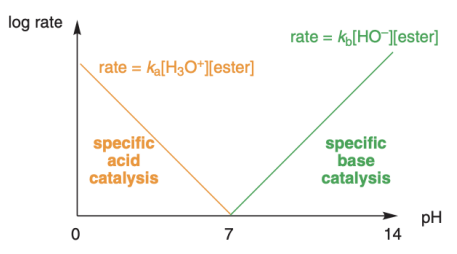
What pH is a) specific acid, b) specific base, c) general acid, d) general base effective at?
a) near or below the pKa of the substrate’s conjugate acid
b) near or above the pKa of the substrate
c) near the pKa of the conjugate acid
d) near the pKa of the substrate
Why is there sometimes general and sometimes specific acid/base catalysis?
concentration of [H+] and [OH–] in regards to pH
Rate of proton transfer
Stability of reaction intermediates