Aromatic compounds
 Call Kai
 Learn
Learn Practice Test
 Spaced Repetition
 Match
Match Flashcards
 Knowt Play
1/33

There's no tags or description
Looks like no tags are added yet.
Name | Mastery | Learn | Test | Matching | Spaced | Call with Kai |
|---|
No analytics yet
Send a link to your students to track their progress
34 Terms
molecular formula of benzene?
C6H6
when was benzene first discovered?
in 1825 by Michael Faraday, who isolated and identified it in an oily residue from the gas that was used for street lighting
features of Benzene:
colourless, sweet smelling, highly flammable liquid
Found naturally in crude oil, is a component of petrol, and also found in cigarette smoke
Classified as a carcinogen
what does a benzene molecule consist of?
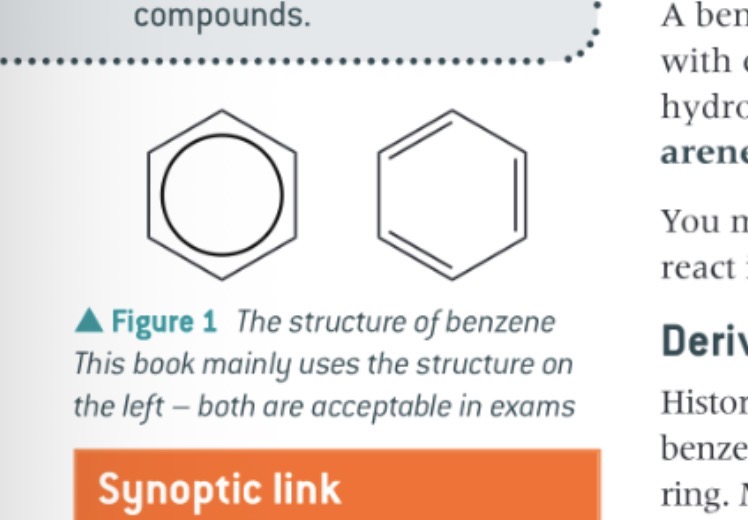
a hexagonal ring of 6 carbon atoms, with each carbon atom joined to 2 other carbon atoms and to one hydrogen atom
What is benzene classed as?
an aromatic hydrocarbon/ an arene
2 different structures of benzene:
Does benzene react in the same way as alleles?
no
what was aromatic the term for historically?
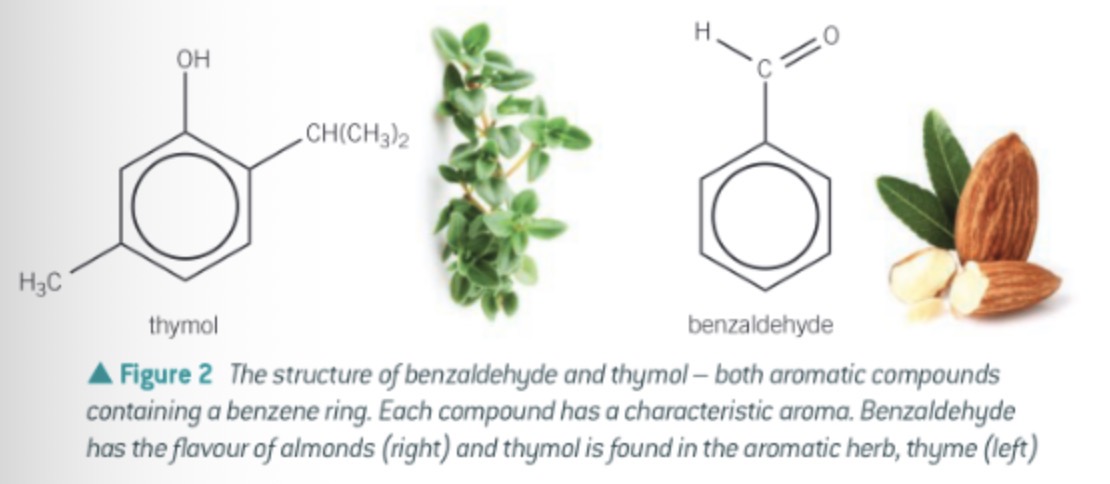
used to classify the derivatives of benzene, as many pleasant smelling compounds contained a benzene ring. Many odourless compounds have been found to contain a benzene ring, yet the term aromatic is still used to classify these compounds
structures of benzaldehyde and thymol:
What happened for many years?
scientists attempted to establish a structure for benzene taking into account its molecular formula and the experimental evidence available at the time
what did its molecular formula suggest?
a structure with many double bonds/ triple bonds - odd as that would make it very reactive but it is in fact no very reactive
What happened in 1865?
the German chemist Friedrich August Kekule suggested that the structure of benzene was based on a carbon ring of 6 joined by alternate single and double bonds. He claimed that he had thought of the ring shape of benzene while day dreaming about a snake seizing its own tail
why did not all chemists accept Kekules model of Benzene?
Because the structure isn’t able to explain all of its chemical and physical properties
what 3 pieces of evidence appear to disprove Kekules model?
lack of reactivity of benzene
The lengths of the C-C bonds in benzene
Hydrogenation enthalpies
The lack of reactivity of benzene:
if benzene had C=Cbonds, it should decolourise bromine in an electrophilic addition reaction
what was the issue with this?
benzene doesnt undergo electrophilic addition reactions
Benzene doesnt decolourise bromine under normal conditions
This led to suggesting that benzene cant have any C=C bonds in its structure
The lengths of the C-C bonds in benzene:
using a technique called X ray diffraction, its possible to measure bond lengths in a molecule. When benzene was examined in 1929 by the crystallographer Lonsdale, it was found that all the bonds in benzene were 0.139nm. This was between the length of a single bond (0.153) and a double bond (0.134)
Hydrogenation enthalpies:
the Kekules structure, with alternate single and double bonds, could be given the name cyclohexa-1,3,5-triene to indicate the double bonds
what would be the case with this?
if benzene did have the Kekules structure, then it would be expected to have an enthalpy change of hydrogenation that is 3x that of cyclohexene. When cyclohexene is hydrogenated one double bonds reacts with hydrogen. The enthalpy change of hydrogenation is -120kymol-1
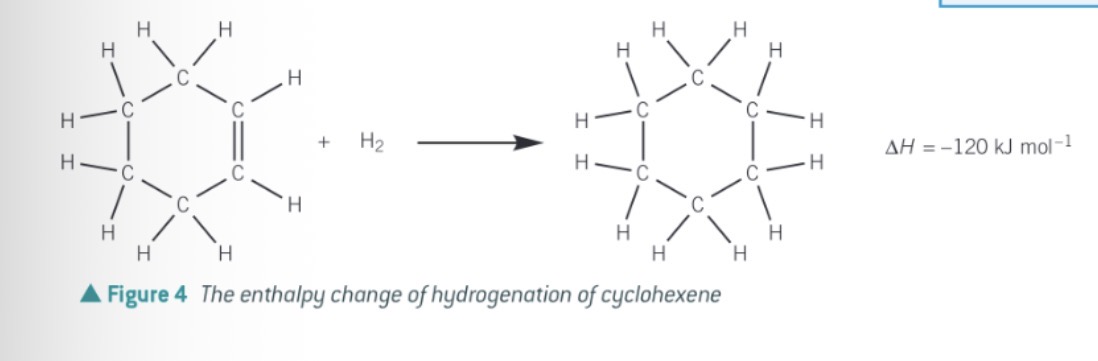
Therefore what would be predicated of the Kekules structure?
it would contain 3