Chapter 9: Reporting Processes and XBRL
 Call Kai
 Learn
Learn Practice Test
 Spaced Repetition
 Match
Match Flashcards
 Knowt Play
1/91

There's no tags or description
Looks like no tags are added yet.
Name | Mastery | Learn | Test | Matching | Spaced | Call with Kai |
|---|
No analytics yet
Send a link to your students to track their progress
92 Terms
Learning Objectives
LO 9-1 Explain how data warehouses are created and used.
LO 9-2 Describe the basic components of business intelligence and how they are utilized in a firm.
LO 9-3 Describe how digital dashboards allow for continuous tracking of key metrics.
LO 9-4 Explain how XBRL works and how it makes business reporting more efficient.
LO 9-1 Explain how data warehouses are created and used.
Data warehouse
A collection of information gathered from an assortment of external and operational (i.e, internal) databases to facilitate reporting for decision making and business analysis
Data warehouses serve as
as the main repository of the firm's historical data (or, in other words, its corporate memory) and will often serve as an archive of past firm performance.
Operational and external databases that are used as inputs into the data warehouse/Model of Data Warehouse Design
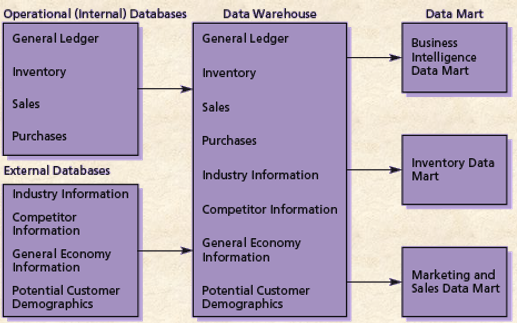
Operational databases may all come from
within the company's enterprise system or various systems throughout the firm.
External databases may come from
a variety of places, including purchased data from the Gartner Group, the Federal Reserve, industry organizations, and so forth.
Data Mart
takes a subset of the information from the data warehouse to serve a specific purpose, such as a marketing data mart, an inventory data mart, or a business intelligence data mart.
a data warehouse is made up of
many data marts
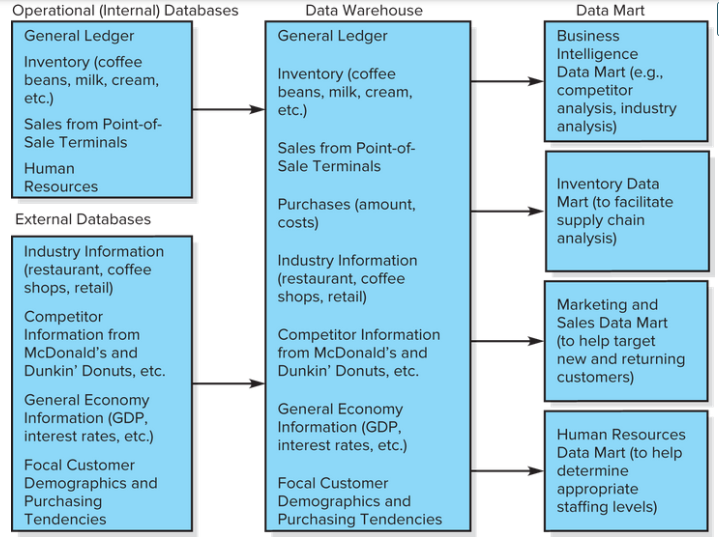
Example of a potential data warehouse design for Starbucks.
Data marts useful to Starbucks:business intelligence, inventory, marketing, and sales and human
resources.
Advantages and benefits of using a data warehouse
Data warehouses use a common data model for all data in the warehouse, making it easy to quickly compare information
Any data inconsistencies from the input databases are removed so that the data warehouse has
homogeneous data that can be readily accessed and analyzed.
The data warehouse is kept separate from the operational database:the information in the warehouse can be stored safely for extended periods of time, and data warehouses can run data queries without affecting the performance
Data warehouses work together with operational systems to provide necessary insight for ex) CRM and SCM
Decision Support System (DSS)
A computer-based information system that facilitates business decision-making activities; type of systems used to support managerial decision making
Data warehouses are often designed to facilitate
decision making
A key disadvantage of a data warehouse is
that it can quickly become obsolete with outdated data unless there is a mechanism to continuously update the internal and external databases as time passes.
Why would Apple's marketing department only use a subset of the data (using a data mart) instead of the entire data warehouse?
Specific functions in a firm, such as marketing, often do not need the whole data warehouse but would prefer a data mart that most closely addresses their needs. Apple may be interested in the demographics of the customer segment that purchases iPods and iPhones to best identify those most likely to buy an iPad or other Apple innovation.
Imagine what might be included in a data warehouse for Best Buy. How might it be useful?
To answer this question, we'll use Figure 9.2 as a guide. Among other things, Best Buy would be interested in general ledger, inventory, sales, and cost information from its internal databases. The company would also be interested in data from the retail industry, specifically from the retail segment that includes consumer electronics, personal computers and entertainment software, and appliances. General economic information and focal customer demographics would all be useful.
L.O. 9-2 Describe the basic components of business intelligence and how they are utilized in a firm.
Business Intelligence
A computer-based technique for accumulating and analyzing data from databases and data warehouses to support managerial decision making
Business Intelligence aka competitive intelligence. However, while competitive intelligence often deals with the examination of external information regarding competitor strategic and tactical actions, the process of business intelligence can be viewed more generically as including these three steps:
•Gather information (either internal information, external information or both) from a variety of sources.
•Analyze the data to discern patterns and trends from that information to gain understanding and meaning.
•Make decisions, hopefully better-informed ones, based on the information gained.
One way that firms may gather business intelligence is by use of
a web crawler, which browses the Internet in a systematic way, collecting information.
There are many different settings in which business intelligence is used: potential settings where it might be used.
Imagine GEICO or other insurance carriers using business intelligence to forecast claim amounts, medical coverage costs, and important elements that affect medical coverage. Such knowledge can be used to allow the firm to optimize its own insurance coverage and thehandling of its medical claims. As the underlying health care requirements change due to recent legislation, such business intelligence will be critical for GEICO's continued success.
Imagine ESPN trying to figure out the demographics of its audience (e.g., age, gender, net worth, interests outside of sports) watching its various sports offerings (e.g., football, basketball, soccer, auto racing, equestrian events). This will facilitate identifying the potential customers buying commercial spots as well as pricing its commercial breaks and finding other sponsorship opportunities.
Imagine GoPro using business intelligence to track pricing information for its various, assorted cameras and video products of its offline and online competitors so that the management can price products appropriately to stay competitive in the market.
How would Tesla, Dunkin’ Donuts, Morgan Stanley use business intelligence?
– They may use business intelligence to assess current economic and stock market conditions, assess how other Internet retail firms are performing in the stock market and assess how initial public offerings have recently performed.
Data mining
one technique used to analyze data for business intelligence purposes. Data mining is a process using sophisticated statistical techniques to extract and analyze data from large databases to discern patterns and trends that were not previously known.
Data mining is often used to find
patterns in stock prices to assist technical financial stock market analysts, or in commodities or currency trading.
Another example of data mining in a retail setting might be analyzing the point-of-sale terminal to find the following trends:
Items frequently bought in combination
Items frequently included in a large $200-plus grocery bill.
Items frequently purchased by people making relatively small purchases,
main caveat about data mining is
making sure the results are reasonable (or even plausible).
While data mining may find a statistical correlation between two data items, it may or may not
Have a plausible relationship in the real world. (may not have a causation)
There is a classic example that ice cream sales are correlated with drownings, suggesting that as ice cream sales increase, the number of drownings also increases. That does not mean that ice cream sales cause drownings or that drownings cause more ice cream sales, but rather that warm weather caused both.
professional judgment must be used when using
data mining techniques.
We must also be careful to communicate clearly. if we are describing a correlation, we should use words like
"is associated with," "is linked to," or "is related to" to describe the relationship.
If causation is implied, we could use words like
"causes", "impacts," "affects, "enhances," or "improves."
How would Starbucks use business intelligence to monitor Dunkin' Donuts or other competitors (like McDonald's)?What sources would it monitor?
Starbucks could use business intelligence to monitor websites, news articles, court filings, and the like for Dunkin' Donuts' prices, the locations for potential stores, and proposed new products.
How would the concepts behind business intelligence and data mining be used by the Miami Heat of the National Basketball Association to best compete on the court with the Oklahoma City Thunder?
Business (perhaps better termed as "competitive") intelligence and data mining could be used in the NBA to see which defenses work best, who to foul at the end of the game, who would usually take the end-of-the-game shot, who and when to play tight defense at the three-point line, and so on. This would be particularly helpful in a playoff series of five to seven games, where the team plays its competitor in successive games.
L.O. 9-3
Describe how digital dashboards allow for continuous tracking of key metrics.
Digital Dashboard
A display to track the firm’s process or performance indicators or metrics to monitor critical performance.
Examples of the metrics that might be continuously tracked include
month-to-date orders, days that receivables are outstanding, budget variances, and days without an accident on the assembly line.
Specialized dashboards may track
overall corporate processes and performance or be specialized by function or department. These dashboards may track building projects, customer relationships, sales and marketing, security, operations, and the like.
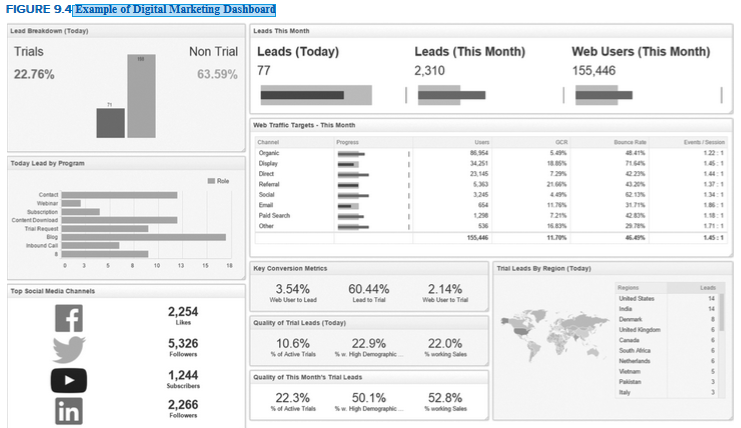
While digital marketing activities may span multiple marketing channels,
this dashboard is designed to be representative of what a digital marketing manager might use to monitor performance on a continuous basis.
The metrics displayed are selected to inform
a wide audience,
Example of Digital Marketing Dashboard
What business processes could be on a digital dashboard for your business school? As retention of students becomes increasingly important for universities and business schools, what metrics could be displayed to monitor and support retention?
A business school might use a digital dashboard to track its performance. Many items might be tracked, but if the business school is particularly interested in retention, it might be interested in
a. Number of students enrolled each semester and number of students returning from previous semesters.
b. Grades of students dropping out (are they dropping out due to poor performance?).
c. Student loans of students dropping out (are they experiencing financial trouble, etc .? ).
d. Job placement rates in each major (are students getting jobs when they graduate?).
Why is a dashboard more useful than a standard report shared periodically?
A dashboard is used to monitor, and display, in a user-friendly way, the critical business processes that most affect firm performance. Standard reports may always be used but may not be as accessible as a digital dashboard.
XBRL stands for
eXtensible Business Reporting Language
XBRL is based on
the XML language, a standard for Internet communication between businesses
XBRL is specifically designed
to electronically communicate business information and to facilitate business reporting of financial and nonfinancial data.
Advantage of XBRL
greatly enhances the speed and accuracy of business reporting.
XBRL gives each financial statement item (both text and numbers)
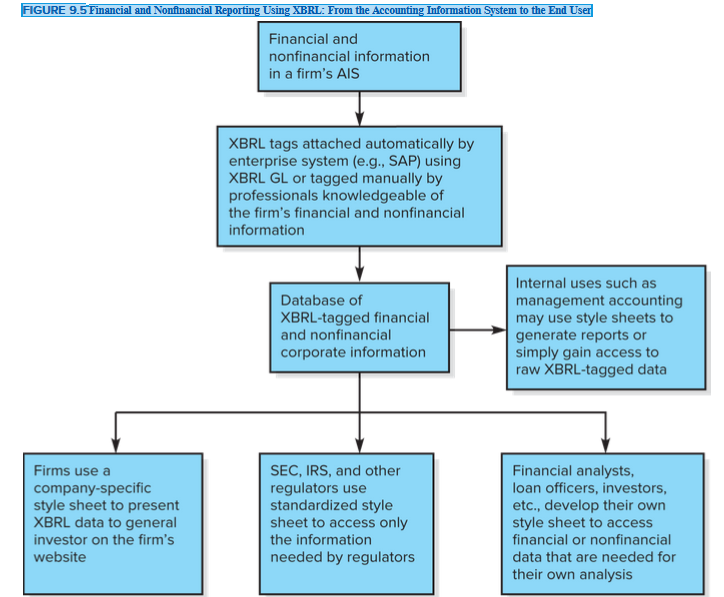
its own unique tag that is computer readable and searchable. Total assets, for example, has its own unique tag telling the database exactly what it is.
In February 2009, the U.S. Securities and Exchange Commission (SEC) passed a new rule titled "Interactive Data to Improve Financial Reporting," which required
all large domestic and foreign accelerated filers to begin formatting their financial statements using
XBRL.
Financial and Nonfinancial Reporting Using XBRL: From the Accounting Information System to the End User
History of XBRL: April 1998
Charles Hoffman, a CPA from the accounting firm Knight Vale and Gregory in Tacoma, Washington, contemplated how XML could be used as a means to electronically deliver financial information.
History of XBRL: January 1999
A prototype of XBRL is presented to the AICPA; the AICPA agrees that XBRL is important to the accounting profession.
History of XBRL: July 2000
XBRL releases the first XBRL specification for financial statements for commercial and industrial companies in the United States.The committee announces the formation of an international organization to position for rapid global expansion and adoption.
History of XBRL: June 2001
XBRL announces an effort to create XBRL for transactions internal to the company. This is often called XBRL GL, which is essentially XBRL on the general ledger.
History of XBRL: October 2001
XBRL recognizes that different countries have different reporting needs and divides up the job of developing specifications different XBRL jurisdictions, such as XBRL-Australia, XBRL-Canada, XBRL-Germany, XBRL IASB, XBRL-Japan, XBRL-Netherlands, XBRL-UK
History of XBRL: February 2002
The Australian Prudential Regulatory Agency (APRA), one of the world's largest regulatory agencies, announces that XBRL is being used to overhaul data collection from 11,000 superfunds, insurers, and banks required to report to it on a regular basis.
History of XBRL: December 2003
XBRL 2.1 specification is released
History of XBRL: May 2004
XBRL- UK releases taxonomy for UK GAAP
History of XBRL: July 2005
XBRL International releases a new version of its GL taxonomy, which allows the efficient handling of financial and business nformation contained within an organization
History of XBRL 2008-2009
The SEC mandates that operating firms provide their financial statements to the SEC and on their corporate website in interactive data format using XBRL.
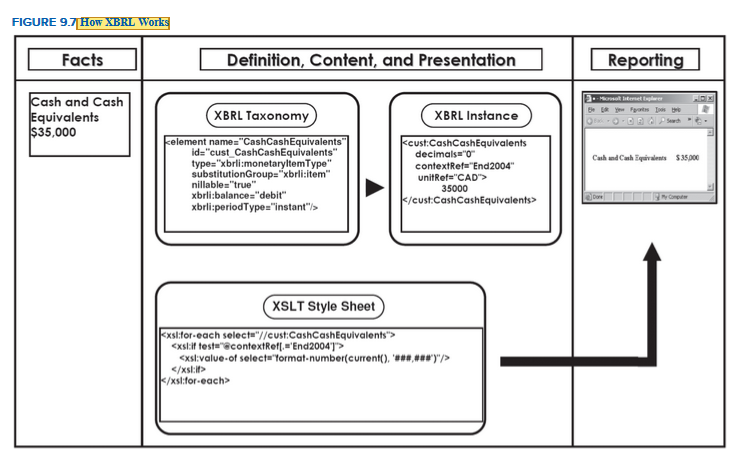
How XBRL works
XBRL specification
Provides the underlying technical details of what XBRL is and how it works.
XBRL taxonomy
Defines and describes each key data element (e.g., total assets, accounts payable, net income, etc.).
each country may have its own
own taxonomy for financial reporting.
U.S. banks are required to submit their ____ using XBRL
quarterly report "Report of Condition and Income" or their Call Report to the Federal Deposit Insurance Corporation (FDIC
The Federal Financial Institutions Examination Council
(FFIEC) is responsible for creating
creating XBRL Call Report taxonomy to facilitate filing call reports.
A Description of XBRL Elements (Tag Names)
PrepaidRent- Amount of asset related to consideration paid in advance for rent that provides economic benefits within a future period of one year or the normal operating cycle, if longer.
NetIncomeLoss- The portion of profit or loss for the period, net of income
Deferred Revenue-Amount of deferred income and obligation to transfer product and service to customer for which consideration has been received or is receivable
Cash- Amount of currency on hand as well as demand deposits with banks or financial institutions
XBRL instance documents
contain the actual dollar amounts or the details of each of the elements within the firm’s XBRL database
a collection of data in a computer readable format. It is not until the style sheet is applied that the financial statement information is finally readable by people.
XBRL style sheet
Adds presentation elements to XBRL instance documents to make them readable by people.
Note: The data may be presented in a number of formats, including HTML, PDF, Microsoft Word, and Microsoft Excel
The style sheet is made in
conformance with a standardized language called
Extensible Stylesheet Language (XSL).
(XSL). The official XSL specification for the XSL language
is XSLT.
assurance
Independent, professional opinions that reduce the risk of having incorrect information.
Before the SEC mandated XBRL submissions, assurance on any voluntary XBRL filings generally followed guidance from
the Public Company Accounting Oversight Board (PCAOB),
XBRL assurance will include assurance that
1. The most current, standardized XBRL taxonomy is used.
2. The underlying financial and nonfinancial data that are used in XBRL tagging are reliable.
3. The XBRL tagging is accurate and complete.
4. The reports generated using XBRL are complete and received on a timely basis.
XBRL allows ____ so not only is it possible to know the level of sales, but it is possible to know sales revenue in much more detail.
highly disaggregated data,
XBRL Global Ledger Taxonomy (XBRL GL)
Serves as a ledger using the XBRL standard for internal purposes. Serves as a means to facilitate efficient communication within a firm.
XBRL GL allows the representation of
anything that is found in a chart of accounts, journal entries, or historical transactions-financial and nonfinancial.
XBRL is generally supported by
enterprise systems (ERPs) such as SAP, Oracle, and Microsoft.
Advantages of XBRL GL
XBRL GL is reporting independent- It collects general ledger and after-the-fact receivables, payables, inventory, and other nonfinancial facts and then permits the representation of that information using traditional summaries and through flexible links to XBRL for reporting.
XBRL Global Ledger is system independent.
XBRL Global Ledger permits consolidation - XBRL GL can help transfer the general ledger from one system to another, be used to combine the operations of multiple organizations, or bring data into tools that will do the consolidation.
XBRL Global Ledger provides flexibility- It offers an extensible, flexible, multinational solution that can exchange the data required by internal finance, accountants, and creditors
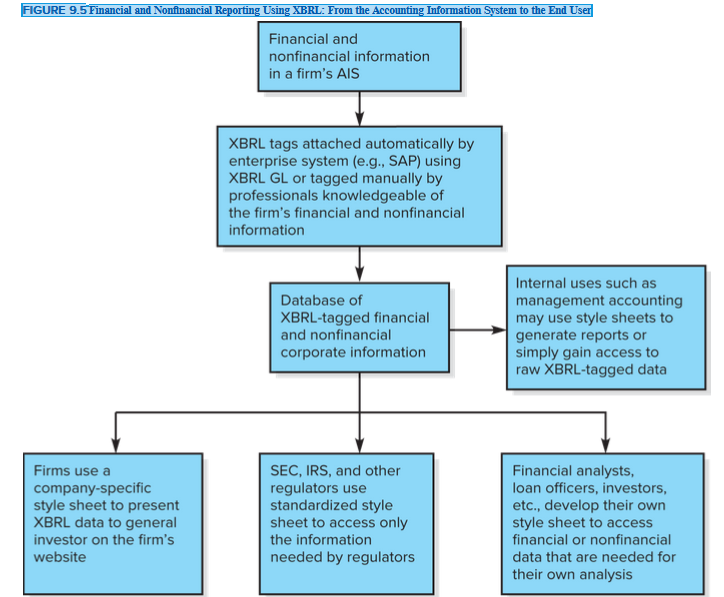
Using Figure 9.5 as a guide, how will XBRL GL facilitate the process of tagging the data that are generated by the firm's AIS?
Using Figure 9.5 as a guide, how will XBRL GL facilitate the process of tagging the data that are generated by the firm's AIS?
XBRL GL will automatically tag the various financial and nonfinancial elements in the enterprise system software. This makes this step of tagging trivial for the firm to perform.
What is the XBRL tag for deferred revenue?
The appropriate XBRL tag for deferred revenue is DeferredRevenue (no spaces)
1. A subset of a data warehouse is called a:
a. small data warehouse.
b. data mart.
c. data martian.
d. business intelligence.
Data mart
A data warehouse may include:
A. competitor information
B. an iPad
C. an XBRL style sheet
D. a digital dashboard
A: competitor information
American Airlines may use business intelligence to:
A. track the cost of snacks on its airplanes.
B. monitor the cost of its pilots and flight attendants.
C. track the cost of its airplane fuel.
D. monitor prices on competitive routes.
E. All of the choices are correct.
E: all of the choices are correct
The computer-based technique to accumulate and analyze data is called:
A. data warehouse
B. business intelligence
C. digital dashboard
D. XBRL
B. business intelligence
The steps in business intelligence include:
A. create data warehouse, query data warehouse, make decision.
B. gather information, analyze data for patterns, make decision.
C. analyze data for patterns, gather information, make decision.
D. query data warehouse, create data warehouse, make decision.
B. gather information, analyze data for patterns, make decision.
A digital dashboard tracks, in a user-friendly way:
A. critical business markets.
B. critical business failures.
C. automobile speed.
D. critical business processes
D. critical business processes
XBRL facilitates business reporting of:
A. only financial information.
B. the XML language.
C. financial and nonfinancial information.
D. business processes.
C. financial and nonfinancial information.
The first person to propose using XML as a means to electronically deliver financial information was
A. Herb Hackett
B. Albert Gore
C. Charles Hoffman
D. Robert Byrd
C. Charles Hoffman
XBRL GL, or XBRL Global Ledger Taxonomy, is different from XBRL U.S. GAAP because it facilitates:
A. efficient communication with the supply chain.
B. efficient communication within a firm.
C. efficient communication with customers.
D. efficient communication between the firm and external parties.
B. efficient communication within a firm.
The stated advantages of XBRL GL do not include:
A. reporting independence.
B. flexibility.
C. scalability.
D. system independence.
C. scalability.
What is the mechanism called that firms may use to track their marketing efforts?
A. XBRL
B. Digital dashboard
C. Data analytics
D. Business intelligence
B. Digital dashboard
XBRL assurance might include all but which of the following:
A. The XBRL tagging is useful to investors.
B. The XBRL tagging is accurate and complete.
C. The most current, standardized XBRL taxonomy is used.
D. The reports generated using XBRL are complete and received on a timely basis.
A. The XBRL tagging is useful to investors.
The XBRL style sheet is made in conformance with which standardized language?
A. XBRL GL
B. XL
C. XML
D. XSL
D. XSL
Which body mandated that operating firms in its jurisdiction submit their financial reports using XBRL?
A. SEC
B. GASB
C. FASB
D. NYSE
A. SEC
Which technique or tool is used to analyze data for business intelligence purposes?
A. Decision support systems
B. Data mining
C. Big Data
D. Data marts
B. Data mining