AP Psych UNIT 1
 Call Kai
 Learn
Learn Practice Test
 Spaced Repetition
 Match
Match Flashcards
 Knowt Play
1/281

There's no tags or description
Looks like no tags are added yet.
Name | Mastery | Learn | Test | Matching | Spaced | Call with Kai |
|---|
No analytics yet
Send a link to your students to track their progress
282 Terms
Nature vs Nurture
One of the biggest questions/debates in psychology, which asks whether we’re shaped by our genes or experiences. AKA, how does genetic inheritance interact with our experiences to influence development.
Nature
genetics, heredity; predisposed characteristics (genes) passed down from our parents to create our genetic makeup.
Nurture
environment; everything from our family and friends to our education and experiences.
Dual-inheritance Theory
The theory that human behavior is the result of two different processes that develop independently, but interact with each other: biological and cultural evolution.
Biological, Evolutionary, Cognitive, Humanistic, Psychodynamic, Behavioral, Sociocultural.
Order the psychological perspectives on a scale of Nature to Nurture.
Evolutionary Psychology
Psychology which refers to the alikeness in all humans; our shared biological and evolutionary history.
Natural Selection
A process where traits that enhance survival get passed on.
Mutations
Random errors/changes in DNA that can lead to new traits. Nature’s method of testing alternate possibilities.
Behavioral Genetics
Psychology which refers to the differences in humans; our differing genes and environments.
Genes
The basic units of heredity; a segment of DNA that carries genetic information (ex. eye color, brain disorder, etc.).
Genome
A common set of genes (ex. humans’ _____—we have 99.0% similarity because we're the same family).
Epigenetics
The study of environmental factors that affect how our genes are expressed.
Epigenetic Expression (Marks)
Self-regulating genes that react to the environment; like on-off switches. DNA is the pen, this is the pencil.
Gene-Environment Interaction
This term can be described by this example: having calloused hands versus no callouses is an effect of one’s environment… but that effect is possible because of the biological mechanism, adaptation.
Interaction
the interplay that occurs when the effect of one factor depends on another.
Eugenics
The controversial idea of improving human populations by selective breeding and controlling reproduction; fueled movements in the early 20th century which aimed to control who could reproduce based on flawed (prejudiced) ideas of “desirable” traits. Note: breach of ethics!
Racial & Class Bias, Forced Sterilizations, and Violation of Human Rights.
What were three of the key issues during the eugenics movement?
Nervous System
the ultimate communication & control system of your body.
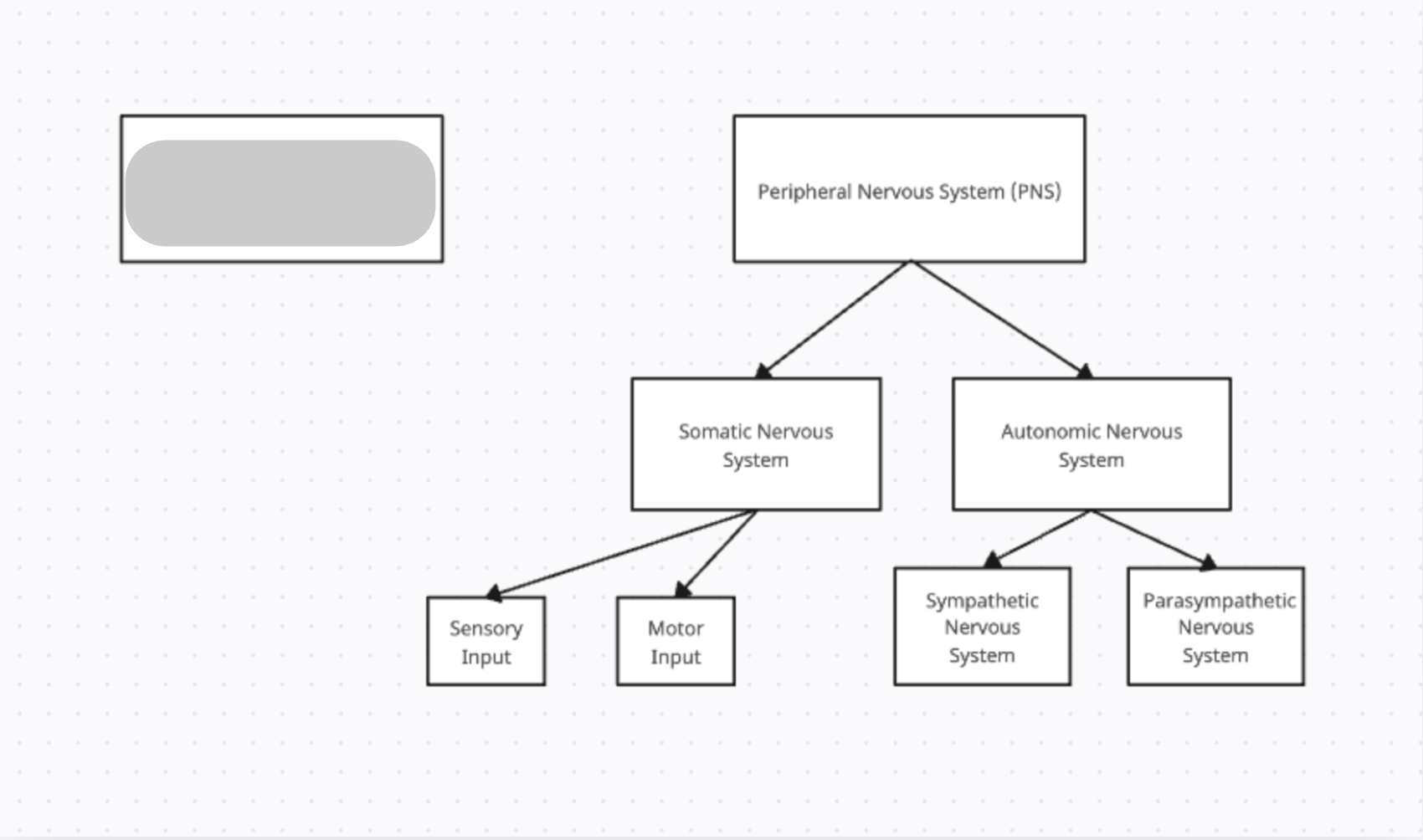
Central Nervous System (CNS)
Includes the brain & spinal cord. Acts as the command center; processing information & sending instructions through the body.
Peripheral Nervous System (PNS)
Includes all the nerves outside the brain and spinal cord. Communicates with chemical & electrical messages and connects the CNS to the rest of the body—it is like the highways and back roads that connect cities.
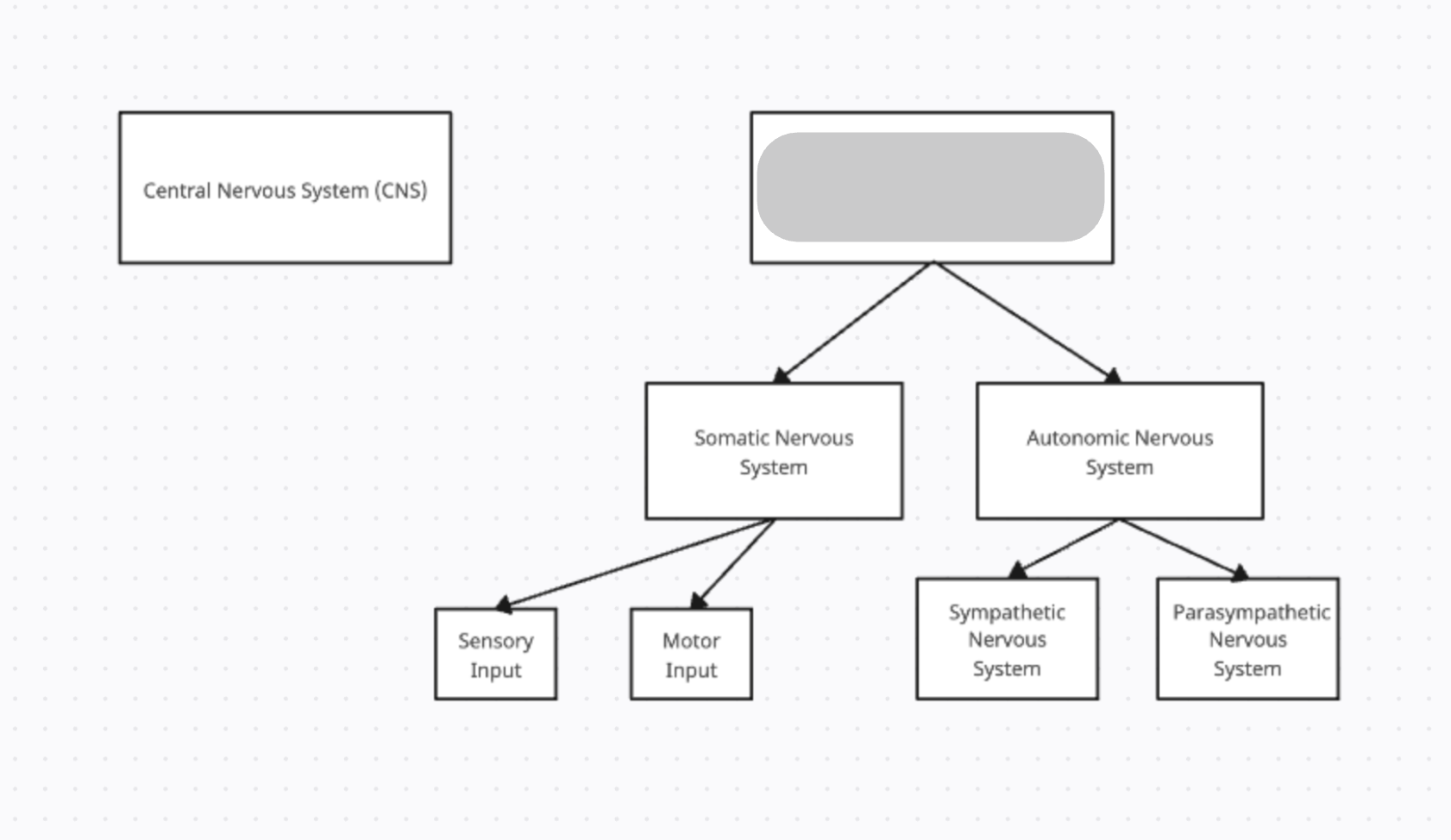
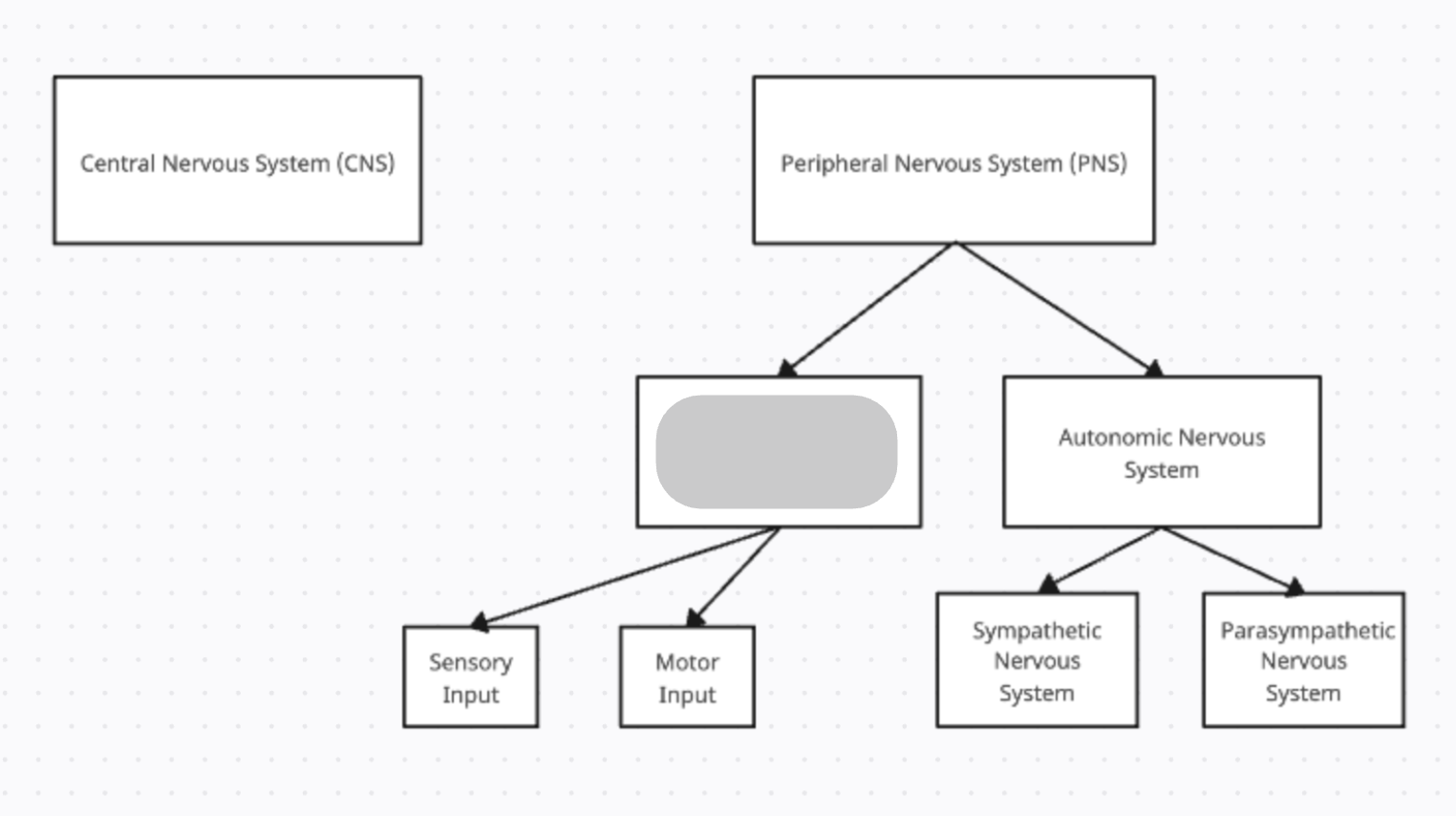
Somatic Nervous System and Autonomic Nervous System
The two subdivisions of the PNS are…
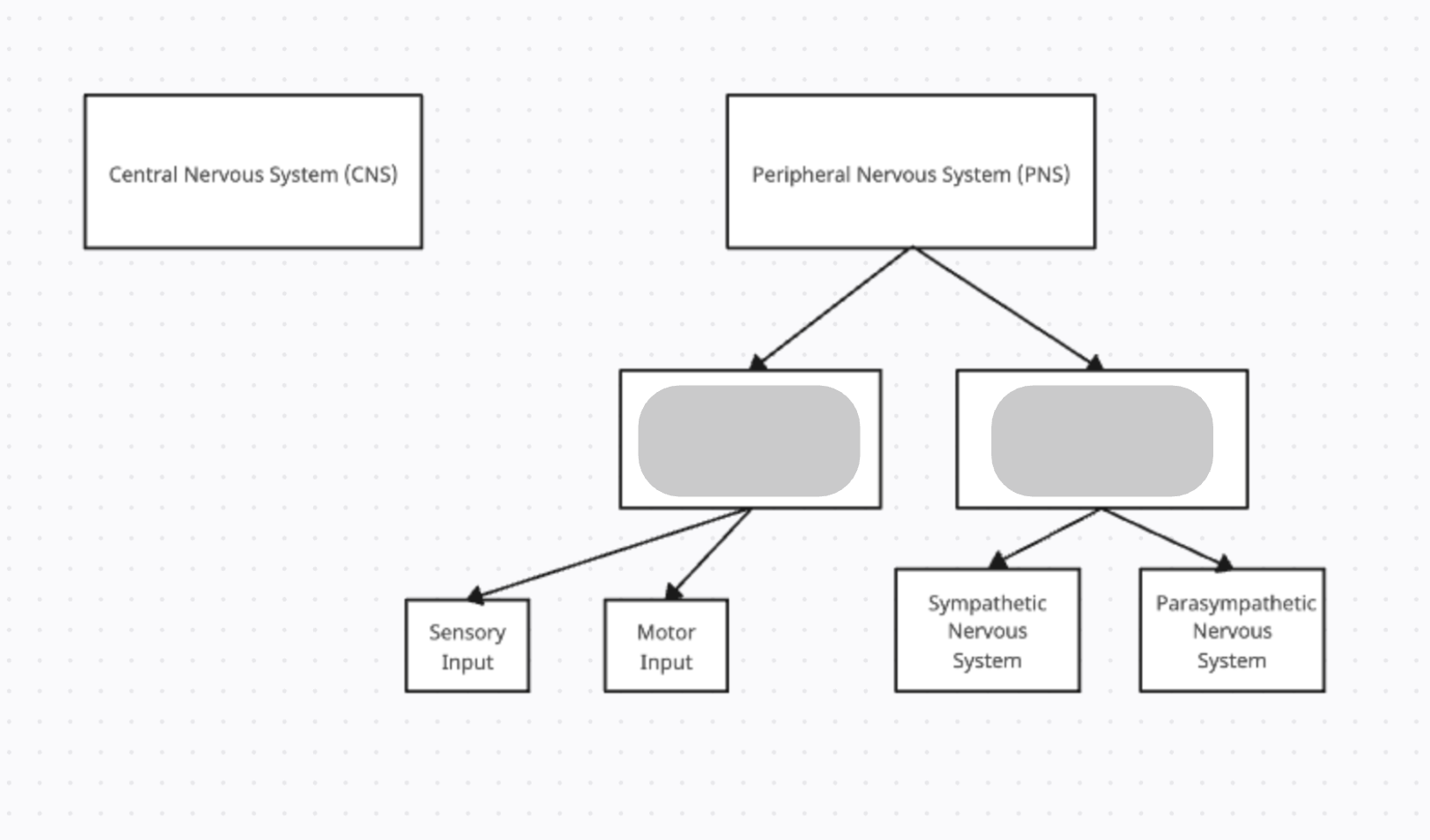
Somatic Nervous System
It controls voluntary movement of skeletal muscles. It uses motor neurons (efferent) and sensory neurons (afferent).
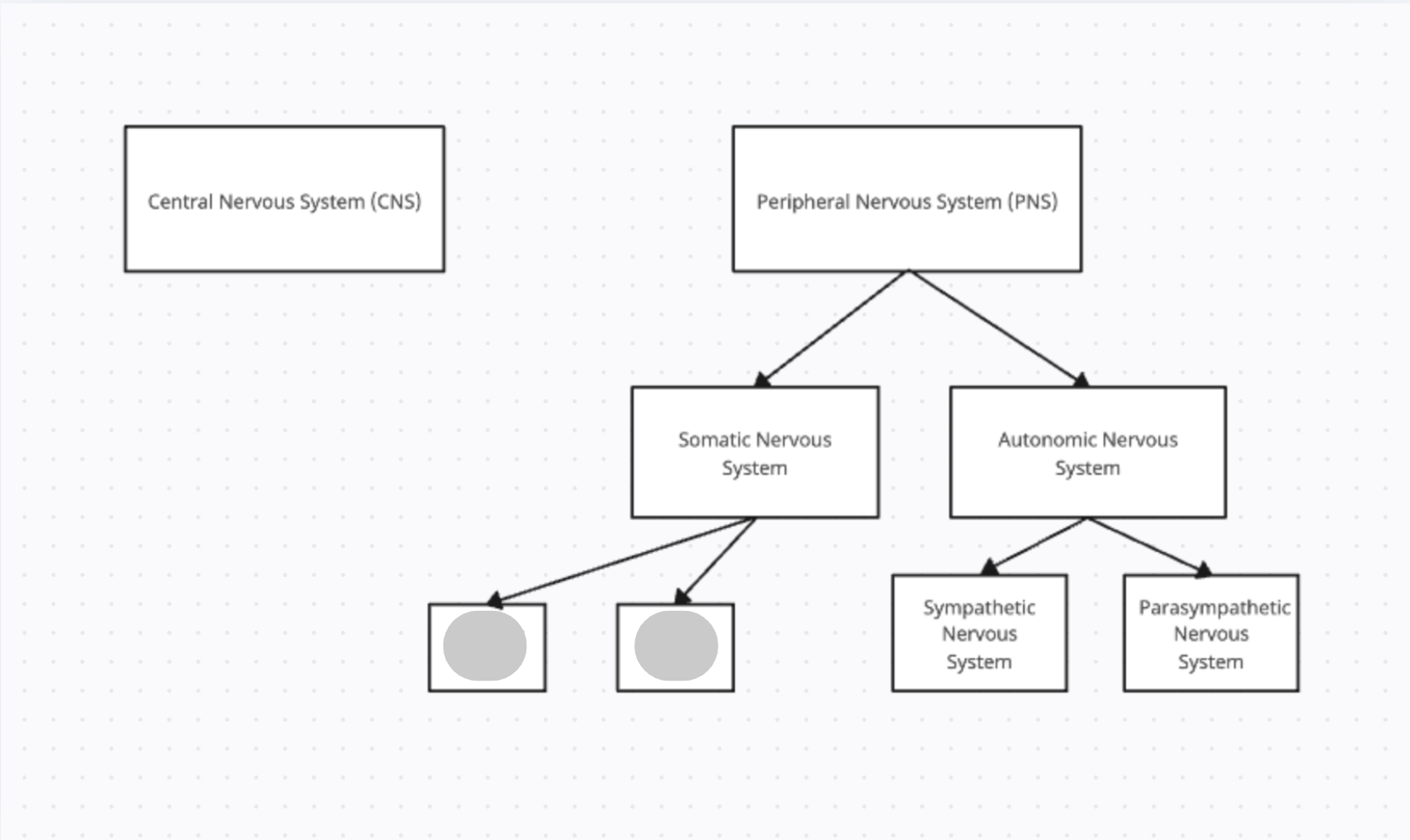
Sensory Input and Motor Input.
The two main neuron inputs the Somatic N.S. uses are…
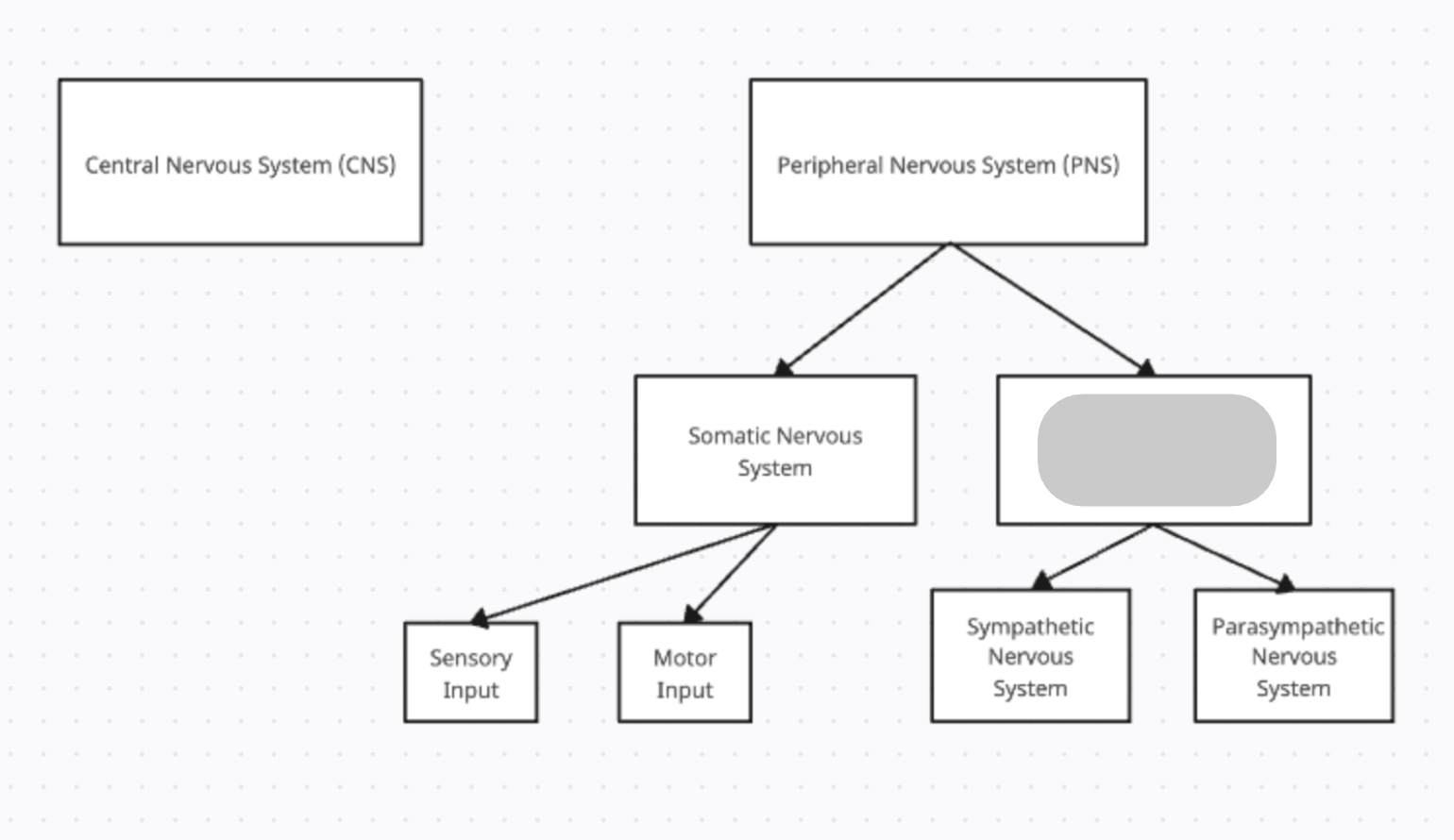
Autonomic Nervous System
Controls involuntary actions like heartbeat, digestion, and breathing—basically all the stuff you don’t think about but can’t live without.
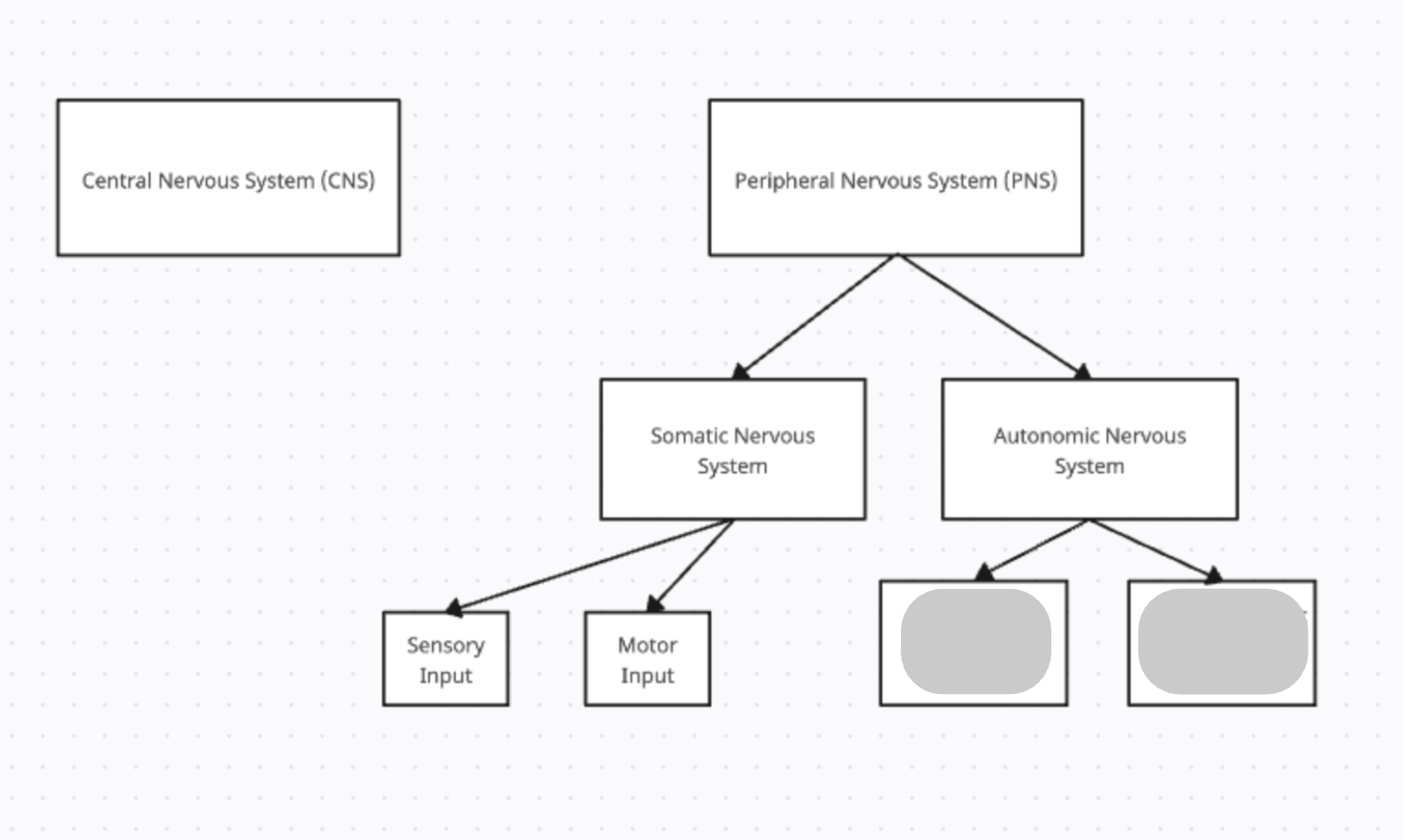
Sympathetic Nervous System and Parasympathetic Nervous System
The two subdivisions of the Autonomic Nervous System are…
Sympathetic Nervous System
Controls “fight or flight” response. It readies the body for action in stressful situations; an alarm system.
Parasympathetic Nervous System
Controls “rest and digest” response. It automatically slows the body down after a stressful event.
Sensory Neurons, Motor Neurons, and Interneurons.
The three types of neurons include…
Sensory Neurons
Found mainly in the Somatic N.S.; classified as afferent; carries messages from body’s tissue’s & sensory receptors inward to brain & spinal cord (CNS) for processing.
Motor Neurons
Reside in CNS with axons extending to Somatic N.S.; classified as efferent; carry instructions from CNS outward to body’s muscles & glands.
Interneurons
Found mainly in CNS; processes information between sensory and motor neurons; most complex of the three types of neurons (billions vs millions).
Afferent
Meaning moving messages inward to CNS for processing; i.e. sensory neurons.
Efferent
Meaning carrying instructions outward to body (to muscles, glands, etc.); i.e. motor neurons. THINK “E -MMIGRATION
Dilated pupils, accelerated heart rate, inhibited digestion, relaxed bladder, stimulated ejaculation in males.
Sympathetic effects on the body include…
Contracted pupils, slowed heart rate, stimulated digestion, contracted bladder, allow blood flow to genitals.
Parasympathetic effects on the body include…
Fire; wire.
An important concept; fill in the blanks: neurons that ____ together, ____ together.
Reflex Arc
An automatic, rapid response to a stimulus—it bypasses the brain by interneural communication to the spinal cord for a quicker reaction.
Neuron
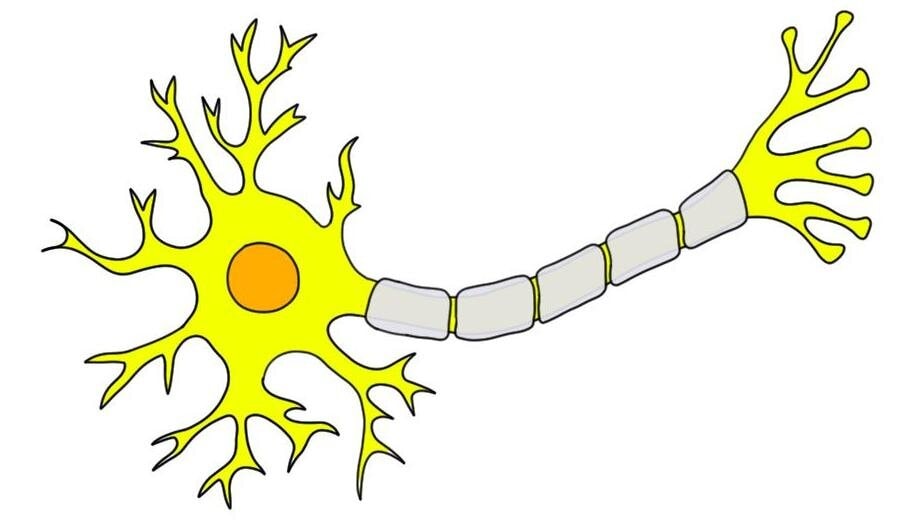
Specialized cells that transmit electrical signals. They carry out most of the brain’s communication by sending messages to the brain and back.
Glial Cells
The brain’s “support staff”; They protect, nourish, and clean up after neurons. They maintain the environment for neurons to function properly. (Note: Schwann cells are a type of glial cell).
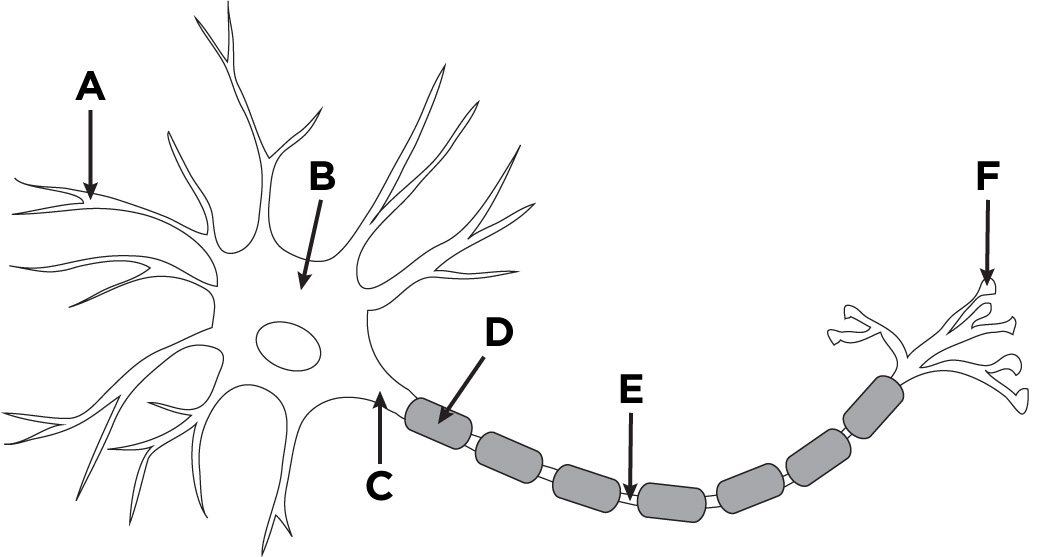
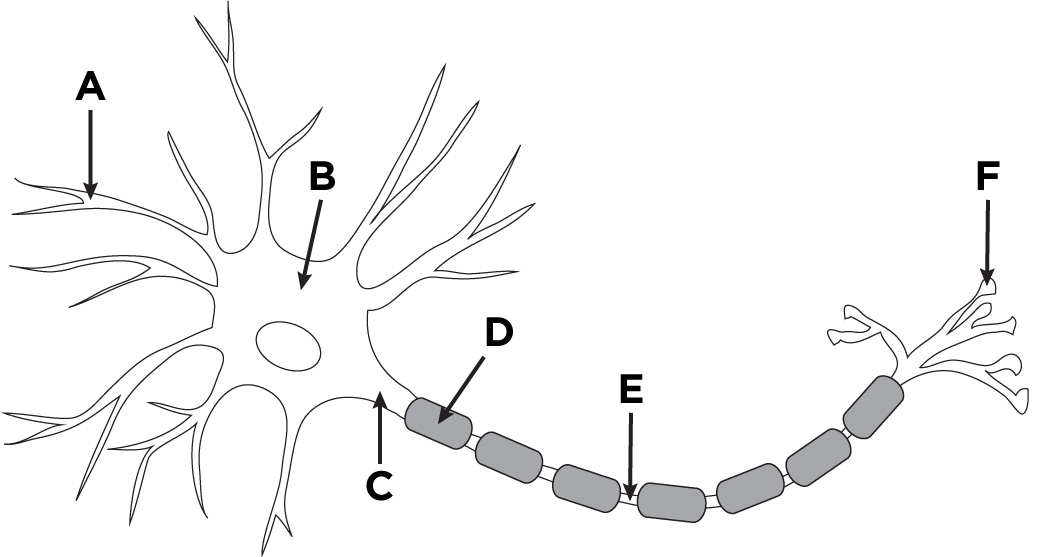
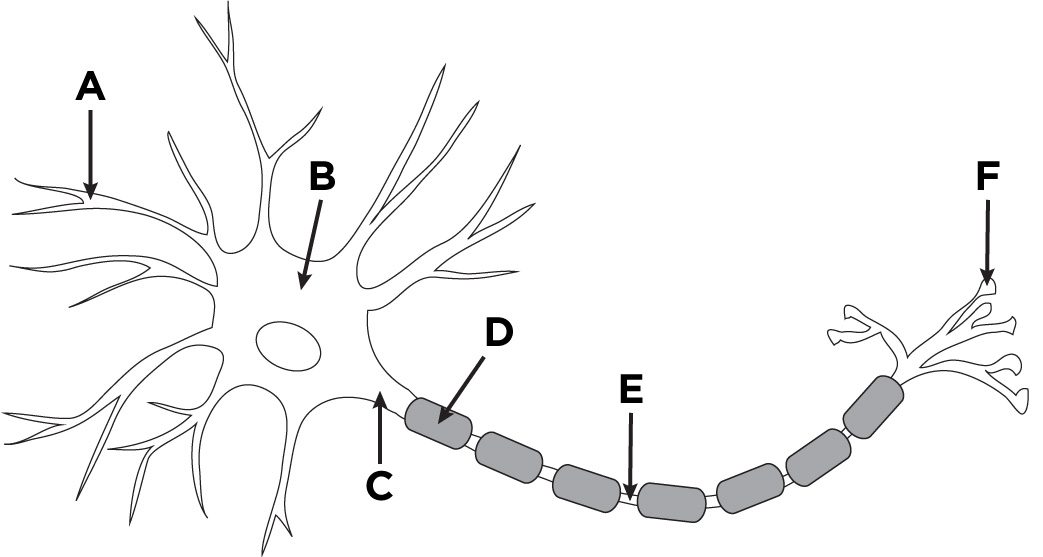
Cell body (soma), dendrites, axon, myelin sheath, terminal branches & buttons, and synapse
The parts of a neuron we must know include…
Cell Body (Soma)
The neuron’s life center & control center; houses the nucleus; produces energy. letter B.
Dendrites
The “listener”; receives incoming signals from other neurons. Letter A.
Axon
The “talker”; sends signals to other neurons/muscles. Letters C/E.
Myelin Sheath
Fatty layer around axon; speeds up electrical signal transmission. Letter D.
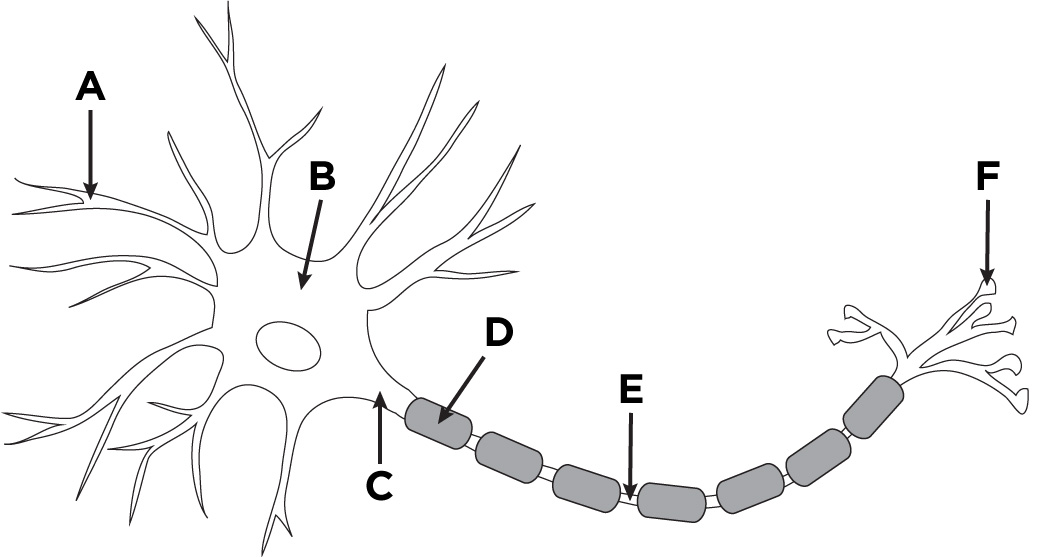
Terminal Branches & Buttons
At the end of neurons; forms the junction with other neurons. Letter F.
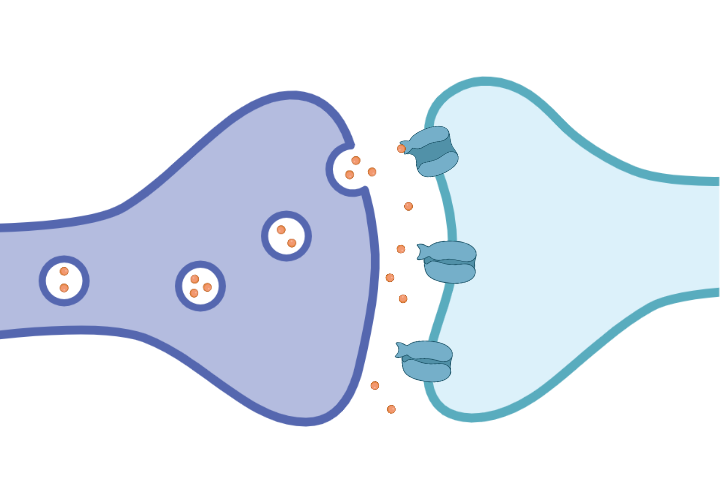
Synapse (Synaptic Cleft)
The junction between communicating neurons (terminal buttons to dendrite); the tiny gap between the neurons where they “connect.” Here, messages change from electrical to chemical by way of neurotransmitters.
Threshold
The level of stimulation required to trigger a neural impulse; excitatory signals must exceed inhibitory signals by a _______.
All-or-none Response
A neuron’s reaction of either firing (with a full strength response) or not firing; there’s no “intensity,” it either fires or doesn’t.
Resting Potential
The state where the fluid outside an axon’s membrane has mostly positively (+) charged ions, and the fluid inside has a mostly negative (-) charge.
Neural Impulse / Action Potential
The brief electric charge that travels down the axon.
Depolarization
When a neuron is stimulated, the electrical potential across the neuron's membrane becomes less negative.
Refractory Period
A brief resting pause that occurs after a neuron has fired; subsequent action potentials cannot occur until the axon returns to its resting state.
Neurotransmitters
Chemical messengers that transmit signals across the synapse. When released by the sending neuron, they travel across the synaptic gap and bind to the receptor site on the receiving neuron. Whether the neuron will fire or not depends on if the amount of _________ exceeds the threshold.
Reuptake
The reabsorption of excess neurotransmitters by the sending neuron.
Excitatory Neurotransmitters
Neurotransmitters that encourage neurons to fire.
Inhibitory Neurotransmitters
Neurotransmitters that prevent neurons from firing.
Dopamine
Excitatory neurotransmitter; deals w/ motor movement, learning, attention/alertness, and emotion. Plays a major role in reward-motivated behavior (motivation to want more. A lack can lead to tremors, decreased mobility, and Parkinson’s disease; an excess can lead to schizophrenia.
Norepinephrine
Excitatory neurotransmitter; deals with arousal, alertness, and energy. An undersupply can depress one’s mood.
Glutamate
Excitatory neurotransmitter; deals with learning and memory. Oversupply can overstimulate the brain, producing migraines and seizures. Notes from last test: think about how the hippocampus uses this neurotransmitter for repetetive learning, and how it strenthens neural connections (memory).
Acetylcholine (ACh)
Excitatory neurotransmitter; deals with motor movement/muscle action, learning, and memory. Alzheimer’s causes ACh-producing neurons to deteriorate, and an excess causes muscles to fire without stopping (ex. black widow venom). Notes from last test: think about how alcohol inhibits this neurotransmitter, which causes lack of control of msucles and bad memory.
Substance P
Excitatory neurotransmitter; involved in transmitting pain/stress signals to the brain and immune response. Increases blood flow to injured areas = inflammation. Can influence emotional pain (ex. anxiety). Oversupply can lead to chronic pain (ex. arthritis).
GABA (Gama-amino butyric acid)
Inhibitory neurotransmitter; calms the nervous system. Undersupply is linked to seizures, tremors, and insomnia.
Serotonin
Inhibitory neurotransmitter; regulates mood, sleep, hunger, and arousal. Undersupply is linked to depression, and recent theories connect an excess to high anxiety levels.
Endorphins
Inhibitory neurotransmitter; the body’s natural painkillers. Deals with the perception of pain or pleasure. Oversupply of opioid drugs can suppress the body’s natural supply of this.
Multiple Sclerosis (MS)
The myelin sheath is damaged, slowing down or blocking signals.
Myasthenia Gravis
An autoimmune disorder where acetylcholine receptors are attacked (causing an inability to receive neurotransmitters), leading to muscle weakness.
Endocrine System
A slower communication system that uses hormones instead of neurotransmitters.
Hormones
Chemical messengers that travel through the bloodstream and affect behavior and mood. (Note: they’re like postcards, while neurotransmitters are like texts… they take longer to arrive but can also last longer).
Adrenaline
Released by adrenal glands; increases heart rate, blood pressure, and blood sugar, providing a surge of energy to power fight-or-flight.
Oxytocin
Released by the pituitary gland; influences bonding & social behaviors (incl. sexual).
Leptin
Regulates hunger & fat storage.
Melatonin
Regulates sleep-wake cycles (circadian rhythm).
Ghrelin
Stimulates hunger.
Cortisol
Released by the pituitary gland under hypothalamus instruction; triggered by stressful events. A stress hormone that increases blood sugar.
Psychoactive Drugs
Substances that affect brain activity and lead to changes in perception, mood, or consciousness. They change how neurotransmitters operate by either enhancing or inhibiting their function.
Agonists
Drugs that make neurons fire; they mimic neurotransmitters or enhance their action. (Ex. Opioids like heroin mimic endorphins by reducing pain).
Antagonists
Drugs that stop neural firing; they block neurotransmitter activity. (Ex. Some antipsychotics block dopamine receptors to reduce hallucinations).
Reuptake Inhibitors
Drugs that block reuptake of excess neurotransmitters; they prevent the reabsorption of excess neurotransmitters, increasing their activity. (Ex. Cocaine blocks dopamine reuptake, causing an intense high).
Stimulants
Drug classification; drugs that speed up body functions and enhance energy. Includes nicotine, caffeine, cocaine, methamphetamines (and the parent drug amphetamine), and ecstasy. They boost dopamine, norepinephrine, and serotonin levels, creating heightened alertness and energy.
Amphetamines
A central nervous system stimulant that speeds up the communication between the brain and the body. Often used to treat ADHD and narcolepsy. Boosts dopamine, norepinephrine, and serotonin to increase focus, attention, impulse-control, and wakefulness.
Depressants
Drug classification; drugs that slow down body function and neural activity. Includes alcohol, barbiturates, and opioids (incl. heroin & fentanyl). They enhance GABA, reducing anxiety, but impairing motor skills. (In opioids case, they mimic endorphins and reduce pain).
Hallucinogens
Drug classification; drugs that alter perception & can cause visual or auditory hallucinations. Includes LSD, marijuana, and psychedelics. They affect serotonin or endocannabinoid systems, leading to distorted reality or mood shifts.
Tolerance
The need to take more of a drug to achieve the same effect. Your brain adapts to the drug’s effects over time, reducing its impact.
Addiction
A compulsive craving for a substance despite harmful consequences. Linked to changes in the brain’s reward system, particularly with dopamine.
Withdrawal
Physical and psychological symptoms when stopping the drug. Symptoms include anxiety, nausea, tremors, or intense cravings, depending on the drug.
Near-Death Experience
An altered state of consciousness reported after a close brush with death (such as cardiac arrest); often similar to drug-induced hallucinations.
Substance Use Disorder
When drug use becomes uncontrollable and interferes with daily life. It impacts behavior, relationships, and mental health. Physiological examples include liver damage from alcohol or lung damage from smoking. Psychological examples include the development of depression, anxiety, or paranoia due to long-term drug use.
Neuroplasticity
The brain’s ability to rewire itself; allows for it to adapt after injury or damage. When one part is damaged, other areas can sometimes take over its function. It is highest in childhood (but still continues through life). Challenging yourself and keeping the brain active through exercise, rehearsal, socializing, learning, and hobbies can enhance it. Long-lasting high levels of stress, aging, and a closed mindset can suppress it.
Neurogenesis
The process of creating new neurons (nerve cells) in the brain, primarily occurring during embryonic development & continuing through life in specific brain regions like the hippocampus.
EEG (Electroencephalograph)
An amplified recording of the waves of electrical activity on the brain’s surface; measured using electrodes placed on the scalp. Allows researchers to isolate brain waves to examine those evoked by the stimulus. Often used in depression & anxiety studies.
MEG (Magnetoencephalography)
A brain-imaging technique that measures magnetic fields created by the brain’s neural electrical activity. Allows researchers to understand how certain tasks influence brain activity by measuring speed & strength of magnetic field. Often used in PTSD studies, mental trauma.
PET (Positron Emission Tomography)
Reveals most active brain areas while the brain is performing certain tasks by displaying where a radioactive form of glucose goes; measures in level of consumption of the fuel. Often used to study anxiety and other temperaments.
MRI (Magnetic Resonance Imaging)
Uses magnetic fields and radio waves to produce computer-generated images of soft tissue. Reveals brain anatomy (size, shape, etc.). Often seen in studies correlating behavior with certain brain anatomy.
fMIR (Functional MRI)
Reveals blood flow & therefore brain activity, by comparing successive MRI scans. Can reveal functioning as well as structure. Often used to study effects of past trauma on current behaviors.
CT (Computed Tomography)
A series of x-ray photos taken from different angles & combined by computers into composite images of a slice of the brain’s structure. Used to reveal brain damage.
Lesioning Studies
Naturally or experimentally damaging tissue of the brain used to study portions of the brain; cutting in the brain & looking for change. (Note: there are ethical challenges to this).
Complex (outer), Basic (inner)
The brain’s outer layers handle ______ thinking, and as we move inward, we find regions responsible for more ______ functions.
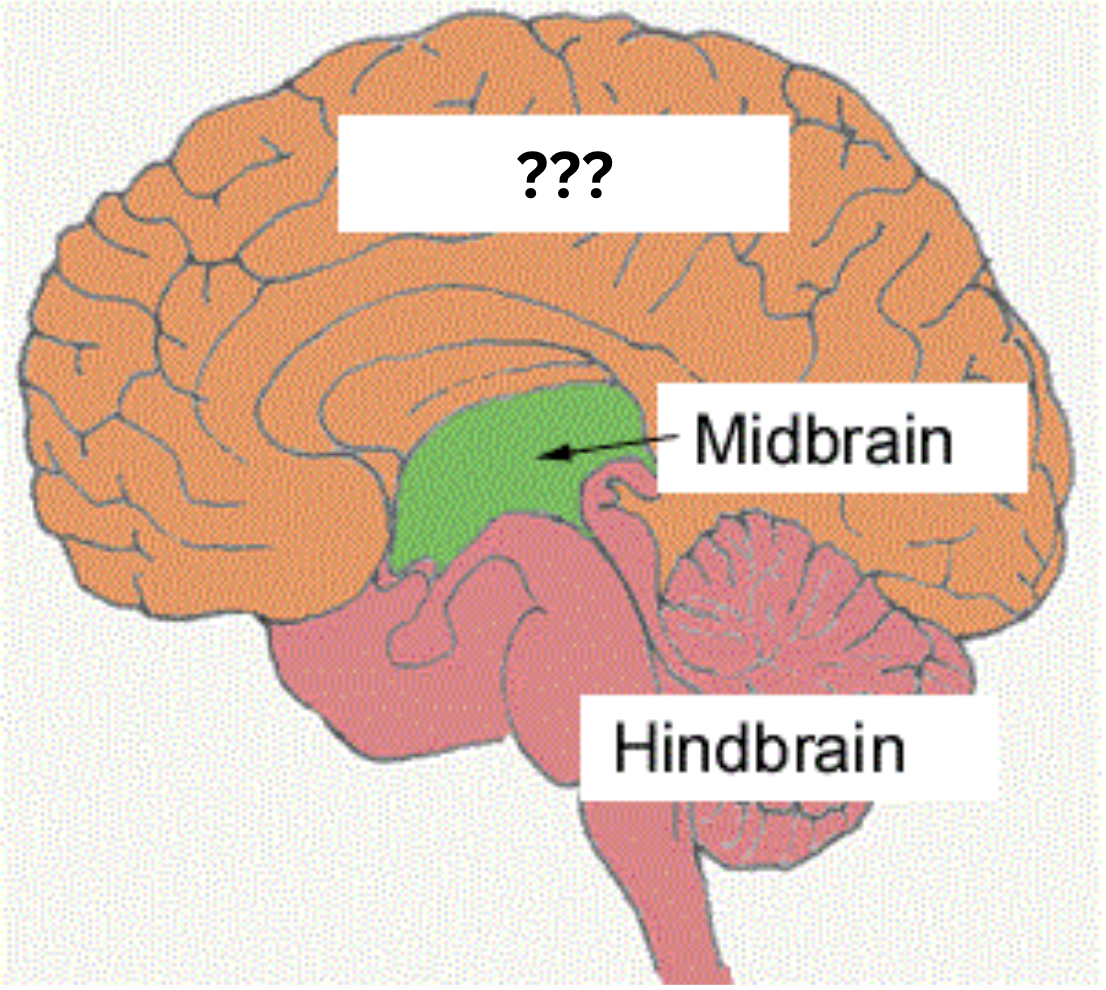
Hindbrain
The back chunk of the brain; includes medulla, pons, and cerebellum; directs essential and survival functions incl. breathing, sleeping/wakefulness, coordination, and balance.
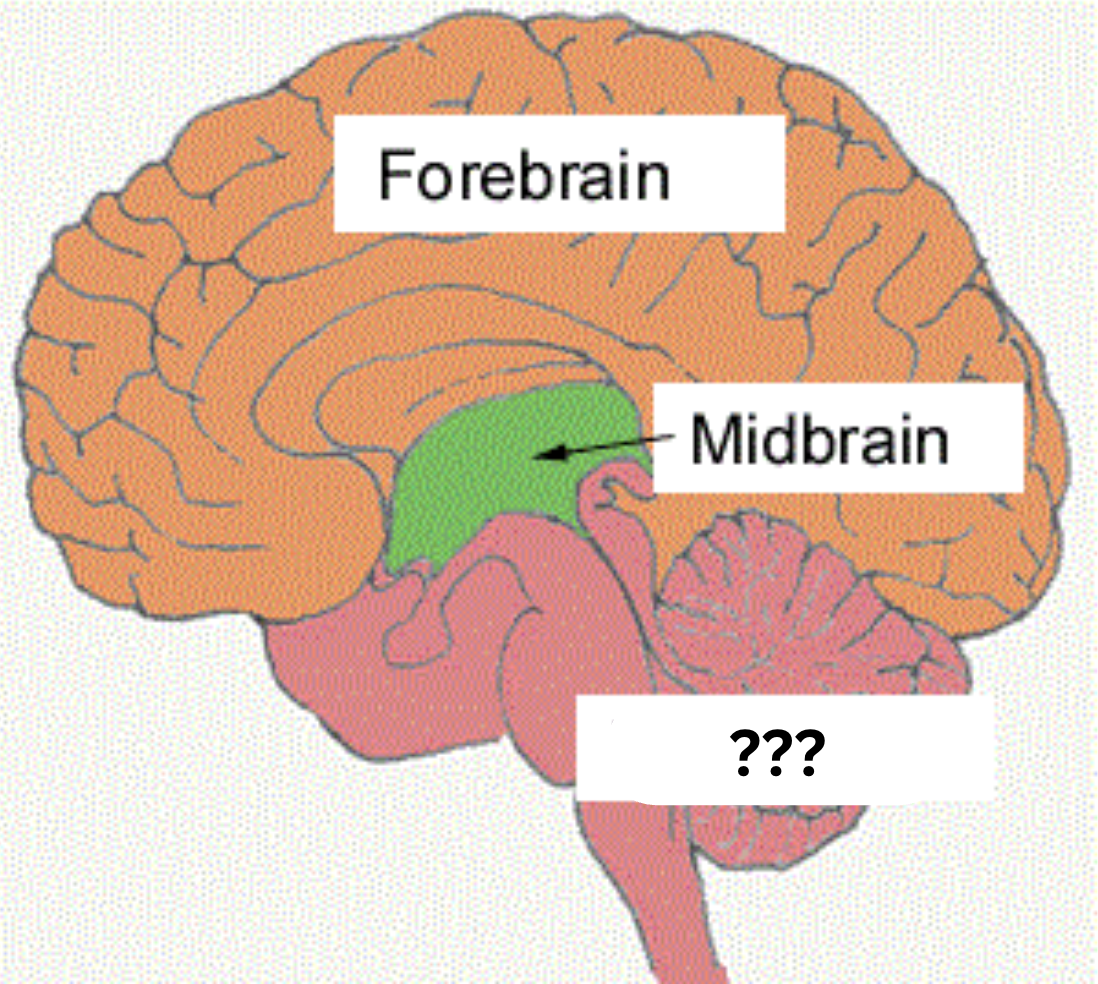
Midbrain
The top chunk of the brain; connects hindbrain with the forebrain; controls some motor movement and transmits auditory & visual information.
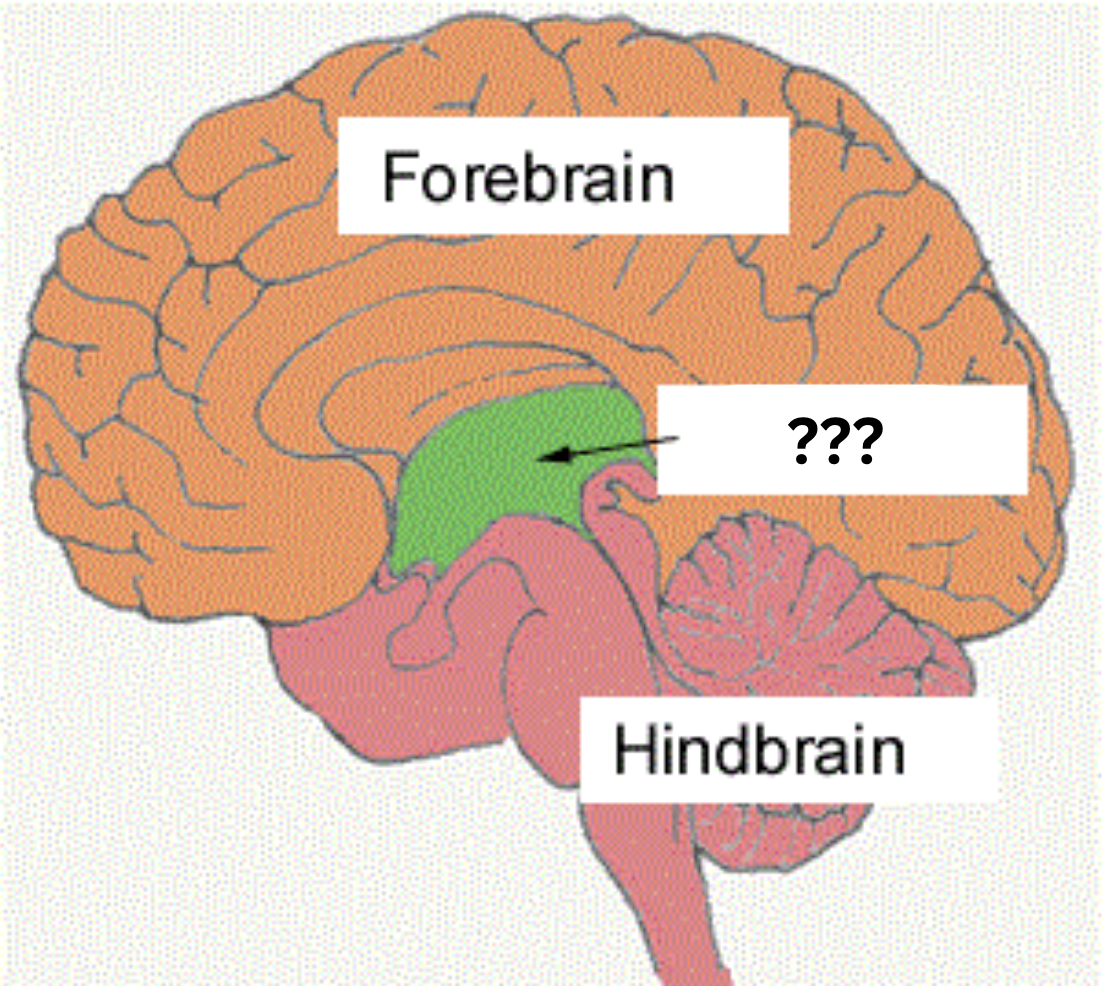
Forebrain
The front chunk of the brain; includes cerebral cortex, thalamus, and hypothalamus; manages complex cognitive activities, sensory and associative functions, and voluntary movement.