BIOL 107 Part G - DNA and RNA (Terms)
 Call Kai
 Learn
Learn Practice Test
 Spaced Repetition
 Match
Match Flashcards
 Knowt Play
1/44

There's no tags or description
Looks like no tags are added yet.
Name | Mastery | Learn | Test | Matching | Spaced | Call with Kai |
|---|
No analytics yet
Send a link to your students to track their progress
45 Terms
Plasmids
Circular DNA found in prokaryotes found everywhere in the cytosol, with ~1000 copies per cell
Nucleosome
The units of nuclear chromosomes, made of nuclear DNA wrapped around Histone proteins within the nucleus to form a complex, linking to create 30 nm fibres
Template Strand
A single strand from a separated DNA helix that is the model used to create a new DNA strand, forming half of a new daughter DNA molecule
RNA Polymerase
An enzyme that is responsible for RNA synthesis with the ability to elongate and initiate, thus able to create a complementary RNA strand from a template DNA strand
DNA Polymerases
A group of enzymes with universal mechanisms that each play a specific role in DNA replication
DNA Polymerase I
The DNA polymerase responsible for the repair of DNA and the removal of primers from the new strand in DNA replication, with the ability to elongate, proofread, repair, and remove primers
DNA Polymerase III
The DNA polymerase responsible for the main elongation of the new strand in DNA replication, with the ability to elongate and proofread
RNA Primers
Small, 10 nt RNA strands that act as a guidepoint to initiate DNA replication and facilitate lagging strand creation
Primase
An RNA polymerase enzyme that creates RNA primers during DNA replication
Origin of Replication (ori)
The point from which DNA replication begins, where replication will fork out in both directions
Leading Strand
The new strand of DNA created continuously from the template strand oriented 3’ to 5’ at the ori
Lagging Strand
The new strand of DNA created section by section in Okazaki fragments from the template strand oriented 5’ to 3’ at the ori
Okazaki Fragments
~1000 nt long DNA fragments that are created as sections of the lagging strand
DNA Ligase
An enzyme that joins already present DNA nucleotides in the lagging strand
Topoisomerase
A protein that untangles DNA in front of the replication fork in preparation for DNA replication
Helicase
A protein that separates the strands of DNA after initiation at the replication fork in preparation for DNA replication by forming a ring around the lagging strand
Single Stranded Binding (SSB) Proteins
Proteins that keep the strands of DNA separated during DNA replication
Initiators
Small proteins that pull strands apart to start replication by connecting to each other and binding to DNA
Telomeres
The ends of linear chromosomes with specific DNA that must be replicated by Telomerase
Telomerase
A DNA polymerase enzyme that replicates telomere DNA at the ends of linear chromosomes
Central Dogma of Biology
A theory stating that genetic information flows only in one direction: from DNA, to RNA, to protein
Ribonucleic Acid (RNA)
A nucleic acid made from NTPs that is the intermediate between DNA in the nucleus and proteins in the cytosol, bringing genetic information into ribosomes for protein synthesis
Gene
A region on a DNA molecule that contains the information responsible for the production of an RNA molecule
Codon
A 3 nucleotide unit of an RNA strand that encodes for one specific amino acid
Methionine (Met)
The amino acid that encodes the start of protein synthesis, with code AUG
Ter (X)
The amino acid that encodes the stop of protein synthesis, with multiple stop codes
Messenger RNA (mRNA)
A long, mature type of temporary RNA created in the process of translation that contains the genetic information read by a ribosome to create a protein
Ribosomal RNA (rRNA)
A type of RNA created in the process of translation that makes up ribosomes along with proteins
Transfer RNA (tRNA)
A type of RNA that carries a single amino acid corresponding to a codon in protein synthesis
Transcription
The synthesis of RNA from a DNA molecule, transferring the permanent genetic information onto a temporary messenger
Promoter DNA
A section of DNA with a recognizable gene sequence at the start of a gene that an RNA polymerase attaches to in order to initiate transcription
General Transcription Factor (TF) Proteins
Proteins that act as a marker to help RNA polymerase find the promoter region during transcription initiation
Terminator DNA
A section of DNA with a recognizable gene sequence at the end of a gene that signals RNA polymerase to release the DNA and fall off to terminate transcription
Intrinsic Termination
The process of terminating transcription used by both prokaryotes and eukaryotes that is done by the created RNA itself
Factor-Dependent Termination
The process of terminating transcription used by both prokaryotes and eukaryotes in which the RNA sequence recruits a protein to aid in the termination process
RNA Processing
The stage between RNA synthesis and maturing of the RNA molecule that gives pre-RNA necessary modifications to specialize into tRNA, rRNA, or mRNA
Cleavage Factor
A protein recruited by the RNA sequence AAUAAA that performs factor-dependent termination and recruits poly(A) polymerase during mRNA processing
Capping Factor
A protein that attaches the 5’ cap to a pre-RNA molecule during mRNA processing
Poly (A) Polymerase
An RNA polymerase that attaches a poly(A) tail to a pre-RNA molecule during mRNA processing
5’ Cap
A backwards G nucleotide attached to the 5’ end of an mRNA molecule during mRNA processing
Poly(A) Tail
A tail sequence consisting of a chain of 150-200 A nucleotides in a row attached to the 3’ end of an mRNA molecule during mRNA processing
Intron
An intervening region of an RNA strand (or the DNA region that encoded it) found only in eukaryotic mRNA that does not express genetic information needed in protein synthesis and thus is removed from mature mRNA
Exon
An expressed region of an RNA strand (or the DNA region that encoded it) that contains genetic information needed in protein synthesis and thus remains in mature mRNA
Splicing Factors
Proteins that mark the location of introns while mRNA synthesis is occurring through locating and situating at exon/intron boundaries and intron/exon boundaries
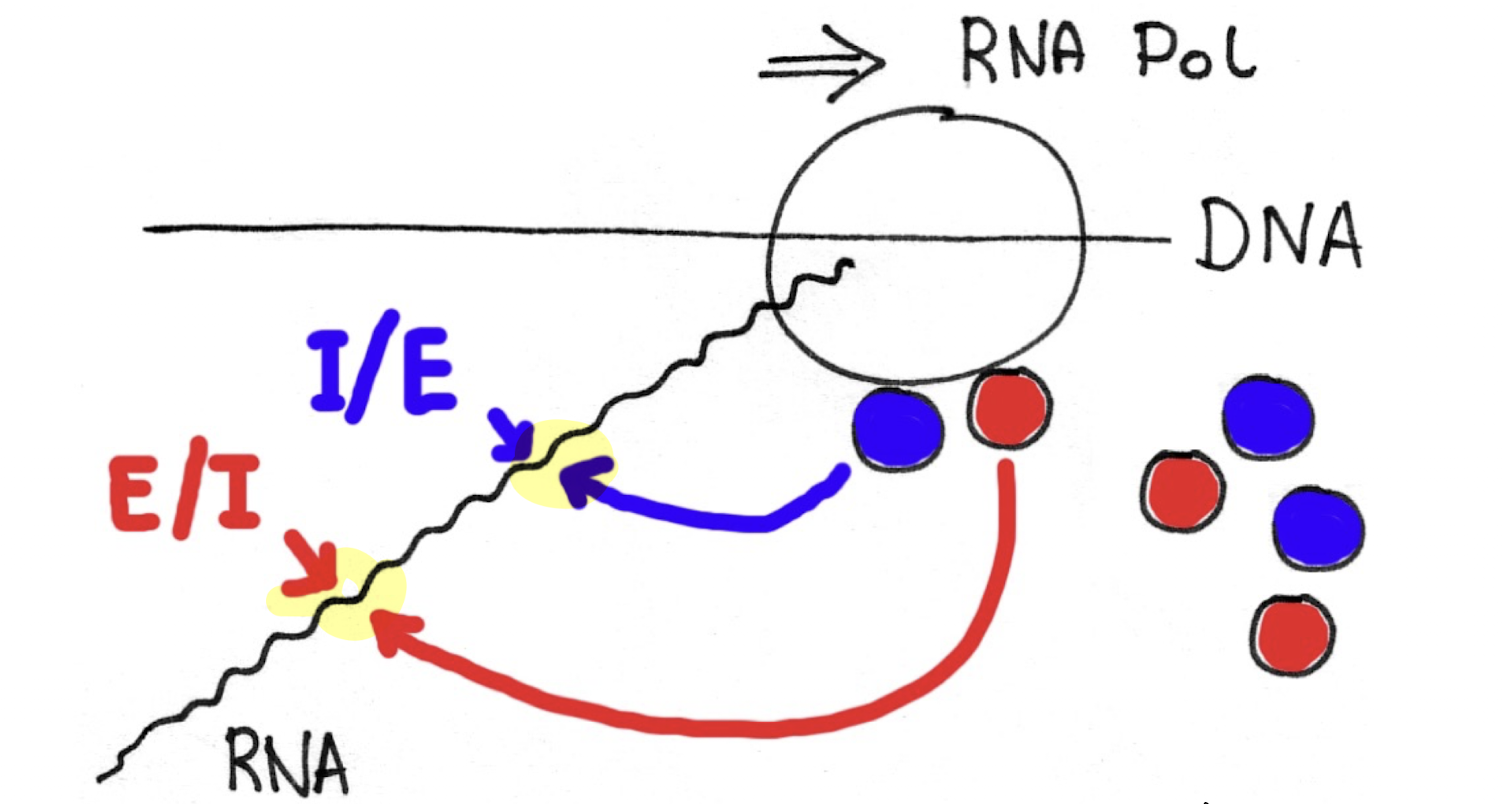
Spliceosomes
Molecular machines made of RNA and proteins that remove introns and ligate exons during mRNA processing