5- nervous transmission
 Call Kai
 Learn
Learn Practice Test
 Spaced Repetition
 Match
Match Flashcards
 Knowt Play
1/34

There's no tags or description
Looks like no tags are added yet.
Name | Mastery | Learn | Test | Matching | Spaced | Call with Kai |
|---|
No analytics yet
Send a link to your students to track their progress
35 Terms
What are the two control systems humans have?
Nervous system and endocrine system
What are the simple steps of response the nervous system goes through?
Stimulus → receptor → coordinator → effector → response
What are all neurone’s made up of?
cell body
several dendrites (or one dendron)- carry nerve impulses towards the cell body
axon- carries the nerve impulse away from the cell body
What do dendrites provide (structurally)?
A large surface area for connecting with other neurones.
What are the cells which are wrapped around the axon many times to form a thick lipid layer called?
Schwann cells
What are the gaps in the myelin sheath called?
Nodes of Ranvier
What are the three types of neurone?
Sensory neurones- have a long dendron and transmit nerve impulses from sensory receptors all over the body to the central nervous system.
Motor neurones (effector neurones)- have a long axon and transmit nerve impulses from the central nervous system to effectors {muscles and glands} all over the body.
Relay neurones (inter neurones/ relay/ bipolar neurones)- smaller, with many interconnections, they make up 99.9% of all neurones in the central nervous system.
What is a nerve impulse?
A brief reversal of membrane potential caused by events in the cell membrane.
What is the Na+/K+ ATPase pump and what is the ratio of Na+/K+ transport?
A protein pump that uses ATP to move Na +and K+ across the membrane, the ratio 3 Na +out of the cell and 2 K+ into the cell.
Why is the Na+/K+ ATPase pump important?
It maintains a stable imbalance across the membrane which causes a potential difference across all animal cell membranes called the membrane potential.
Why do potassium ions diffuse out faster than sodium ions diffuse in?
There are more potassium channels than sodium channels.
Is the resting membrane potential always negative or positive inside the cell?
Negative
What is an action potential?
A brief reversal of membrane potential during a nerve impulse.
What type of channels are involved in producing action potentials?
Voltage-gated sodium and potassium channels
What does ‘voltage-gated’ mean?
Channels open or close depending on membrane potential.
What is the normal membrane potential charge of nerve cells?
-70mV (inside the axon)
What are the two main phases of an action potential?
Depolarisation
Repolarisation
What happens during depolarisation?
The sodium channels open fully causing sodium ions to diffuse in down their gradient, making the inside of the cell more positive. This reverses the normal voltage polarity.
What happens during repolarisation?
The potassium channels open fully causing potassium ions to diffuse out down their concentration gradient, making the inside more negative again. This restores the original polarity.
At what voltage do sodium and potassium channels open?
Sodium→ -30mV
Potassium→ 0V
What are the steps of an action potential being produced?
POLARISED (resting potential)
Sodium ion concentration higher outside the axon; potassium ion concentration higher inside
Overall more positive ions outside than inside → outside is positively charged relative to inside
Stimulus received → DEPOLARISATION begins
Temporary reversal of charge across the membrane
Inside of axon becomes positive (about +40 mV compared to outside)
Opening of voltage-gated sodium channels
Sodium ions diffuse into the axon down their concentration gradient
Reduces negativity inside the axon
THRESHOLD VALUE reached (~ –60 mV)
Triggers opening of more sodium channels
Occurs via POSITIVE FEEDBACK
Rapid depolarisation → ACTION POTENTIAL
Large influx of sodium ions
Inside becomes more positive than outside (+40 mV)
Voltage-gated sodium channels close; potassium channels open
Potassium ions diffuse out of the axon down their concentration gradient
REPOLARISED
Inside becomes negatively charged again relative to outside
HYPERPOLARISATION
Potassium efflux lowers membrane potential below –70 mV
Return to resting state
Voltage-gated potassium channels close
Sodium/potassium ATPase pump restores ion balance
Membrane returns to resting potential → REPOLARISED
Time scale
Entire process takes about 2 milliseconds
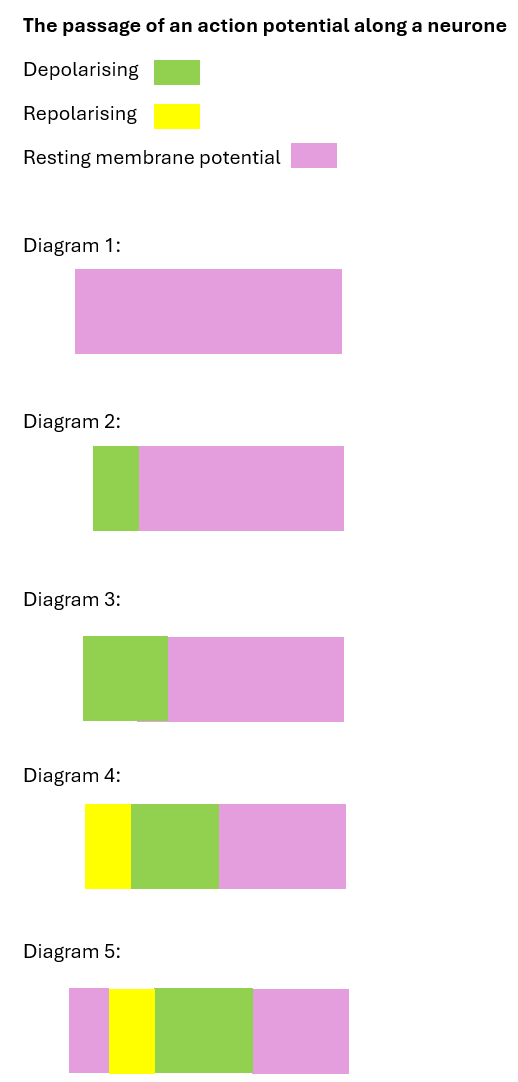
How does an action potential travel along a neurone?
Stage/ diagram 1:
At resting potential, the axon membrane is polarised.
High concentration of sodium ions on outside.
High concentration of potassium ions on inside.
But, more positive on outside than inside overall.
Stage/ diagram 2:
A stimulus causes sudden influx of sodium ions.
Charge on axon membrane reverses.
Membrane depolarises, leading to an action potential.
Stage/ diagram 3:
Voltage-gated sodium ion channels are now triggered to open a little further along the axon.
Sodium ions enter and depolarisation occurs here.
Behind this, the voltage-gated sodium ions channels close and the potassium one open- potassium ions leave the axon.
Stage/ diagram 4:
The outward movement of potassium ions causes the initial region to repolarise.
The next region has become depolarised and this action potential is propagated (get passed along) in the same way further along the neurone.
Stage/ diagram 5:
Repolarisation means the neurone returns to its resting potential, ready for a new stimulus.
How do impulses pass along myelinated and unmyelinated axons?
Once an action potential has been created, it continues along the length of an axon.
It is important to realise that NOTHING PHYSICALLY MOVES; it is simply that the reversal of electrical charge at depolarisation it reproduced at successive points along the axon membrane.
As one region depolarises and produces an action potential, it acts as a stimulus for the depolarisation of the next region of the axon.
The previous region of the membrane returns to its resting potential- is repolarised
Why can ions can only be exchanged in the Nodes of Ranvier?
The myelin sheath is an electrical insulator which prevents action potentials from forming so the ions must be exchanged in these gaps.
What effect does the fact that ions can only be exchanged in the Nodes of Ranvier have on the way an action potential is transmitted compared to an unmyelinated axon?
The action potentials ‘jump’ from node to node in a process called saltatory conduction.
How does the use of saltatory conduction affect the speed with which an action potential is transmitted?
It increases it.
What does the ‘all or nothing’ principle mean?
When the nerve impulse happens, it can either:
If depolarisation reaches the threshold it generates an active potential (all).
If depolarisation is not strong enough to meet the threshold it won’t generate an action potential (nothing).
How does an organism distinguish between different sizes of stimuli?
The body detects a higher frequency of action potential when the stimulus is larger/ stronger. E.g.
Very weak stimulus - don’t get any action potential, as threshold is not exceeded, no depolarisation and no action potential.
Weak stimulus- threshold exceeded, depolarisation, action potential produced
Strong stimulus- threshold exceeded, depolarisation, action potentials same size but more frequent.
Very strong stimulus- threshold exceeded, depolarisation, action potentials the same size but even more frequent.
2 → 4 (increase in frequency of action potential)
Describe transmission across a synapse.
The electrical impulse arrives at the end of the pre-synaptic neurone.
It’s arrival stimulates the opening of calcium ion channels in the pre-synaptic membrane.
These channels open, allowing the calcium ions to diffuse into the pre-synaptic neurone.
The change in concentration causes the vesicles of the neurotransmitters to fuse with the pre-synaptic membrane.
The neurotransmitter is released into the synapse by the process of exocytosis.
The neurotransmitter diffuses across the synaptic cleft, down its concentration gradient
And binds to complementary receptors on the post synaptic membrane.
This stimulates the opening of sodium ion channels, allowing sodium ions to diffuse into the post synaptic neurone.
The gain of sodium ions makes the inside of the axon progressively more positive compared to the outside
The neurone membrane depolarises.
A new action potential is propagated along the post synaptic neurone.
What are the different types of synapse?
Excitatory ion-channel synapses
Inhibitory ion-channel synapses
Non-channel synapses
Neuromuscular junctions
Electrical synapses
How do (1.) excitatory ion-channel synapses work (describe them)?
These synapses have neuroreceptors that are sodium (Na+) channels. When the channels open, positive Na+ ions diffuse in, causing a local depolarisation called an excitatory postsynaptic potential (EPSP) and making an action potential more likely.
Typical neurotransmitters in these synapses are acetylcholine, glutamate or aspartate.
How do (2.) inhibitory ion-channel synapses work (describe them)?
These synapses have neuroreceptors that are chloride (Cl-) channels. When the channels open, negative CI- ions diffuse in causing a local hyperpolarisation called an inhibitory postsynaptic potential (IPSP) and making an action potential less likely. So with these synapses an impulse in one neurone can inhibit an impulse in the next.
Typical neurotransmitters in these synapses are glycine or GABA.
How do (3.) non-channel synapses work (describe them)?
These synapses have neuroreceptors that are not channels at all, but instead are membrane-bound enzymes. When activated by the neurotransmitter, they catalyse the production of a ‘messenger chemical’ inside the cell, which in turn can affect may aspects of the cell’s metabolism. In particular they can alter the number and sensitivity of the ion channel receptors in the same cell.
These synapses are involved in slow and long-lasting responses like learning and memory.
Typical neurotransmitters are adrenaline, noradrenaline, dopamine, serotonin, endorphin, angiotensin and acetylcholine.
How do (4.) neuromuscular junctions work (describe them)?
These are the synapses formed between effector neurones and muscle cells. They always use the neurotransmitter acetylcholine, and are always excitatory. Effector neurones also form specialised synapses with secretory cells.
How do (5.) electrical synapses work (describe them)?
In these synapses the membranes of the two cells actually touch, and they share proteins. This allows the action potential to pass directly from one membrane to the next without using a neurotransmitter. They are very fast, but are quite rare, found only in the heart and the eye.