Unit 2: Airplane Instruments, Engines, and Systems
 Call Kai
 Learn
Learn Practice Test
 Spaced Repetition
 Match
Match Flashcards
 Knowt Play
1/99

There's no tags or description
Looks like no tags are added yet.
Name | Mastery | Learn | Test | Matching | Spaced | Call with Kai |
|---|
No analytics yet
Send a link to your students to track their progress
100 Terms
In the Northern Hemisphere, a magnetic compass will normally indicate a turn toward the north if
C. an aircraft is accelerated while on an east or west heading.
Deviation in a magnetic compass is caused by the
C. magnetic fields within the aircraft distorting the lines of magnetic force.
During flight, when are the indications of a magnetic compass accurate?
A. Only in straight-and-level unaccelerated flight.
Deviation error of the magnetic compass is caused by
B. certain metals and electrical systems within the aircraft.
In the Northern Hemisphere, if an aircraft is accelerated or decelerated, the magnetic compass will normally indicate
B. correctly when on a north or south heading.
In the Northern Hemisphere, a magnetic compass will normally indicate initially a turn toward the west if
B. a right turn is entered from a north heading.
In the Northern Hemisphere, the magnetic compass will normally indicate a turn toward the south when
C. the aircraft is decelerated while on a west heading.
What should be the indication on the magnetic compass as the pilot rolls into a standard rate turn to the right from a south heading in the Northern Hemisphere?
B. The compass will indicate a turn to the right, but at a faster rate than is actually occurring.
In the Northern Hemisphere, a magnetic compass will normally indicate initially a turn toward the east if
C. a left turn is entered from a north heading.
The pitot-static system provides impact pressure for which instrument?
C. Airspeed indicator.
Which instrument will become inoperative if the pitot tube becomes clogged?
C. Airspeed indicator.
If the pitot tube and outside static vents become clogged, which instruments would be affected?
B. The altimeter, airspeed indicator, and vertical speed indicator.
Which instrument(s) will become inoperative if the static vents become clogged?
C. Airspeed indicator, altimeter, and vertical speed indicator.
What is an important airspeed limitation that is not color coded on airspeed indicators?
C. Maneuvering speed.
What does the red line on an airspeed indicator represent?
C. Never-exceed speed.
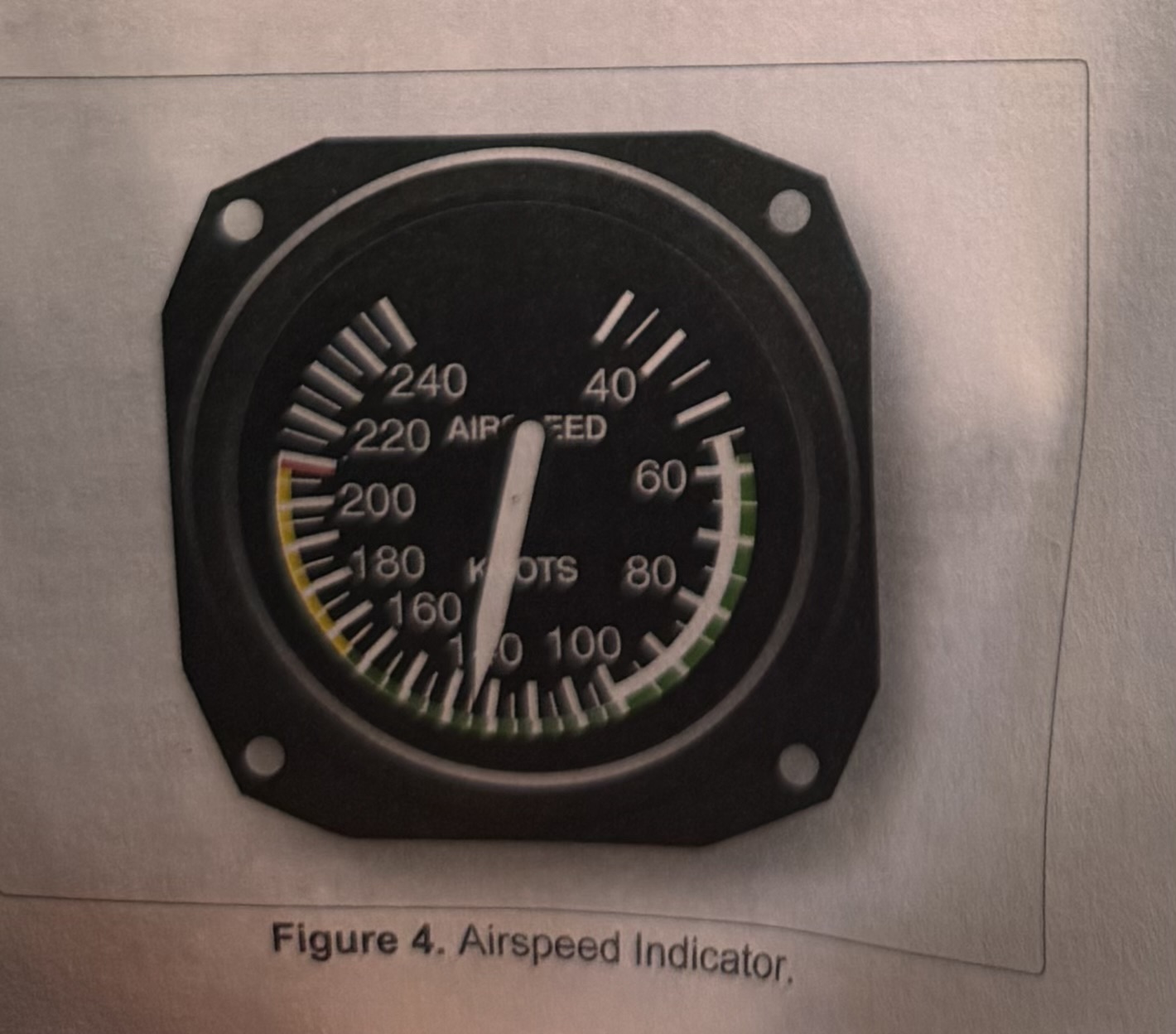
(Refer to Figure 4 below.) What is the caution range of the airplane?
C. 165 to 208 kts.
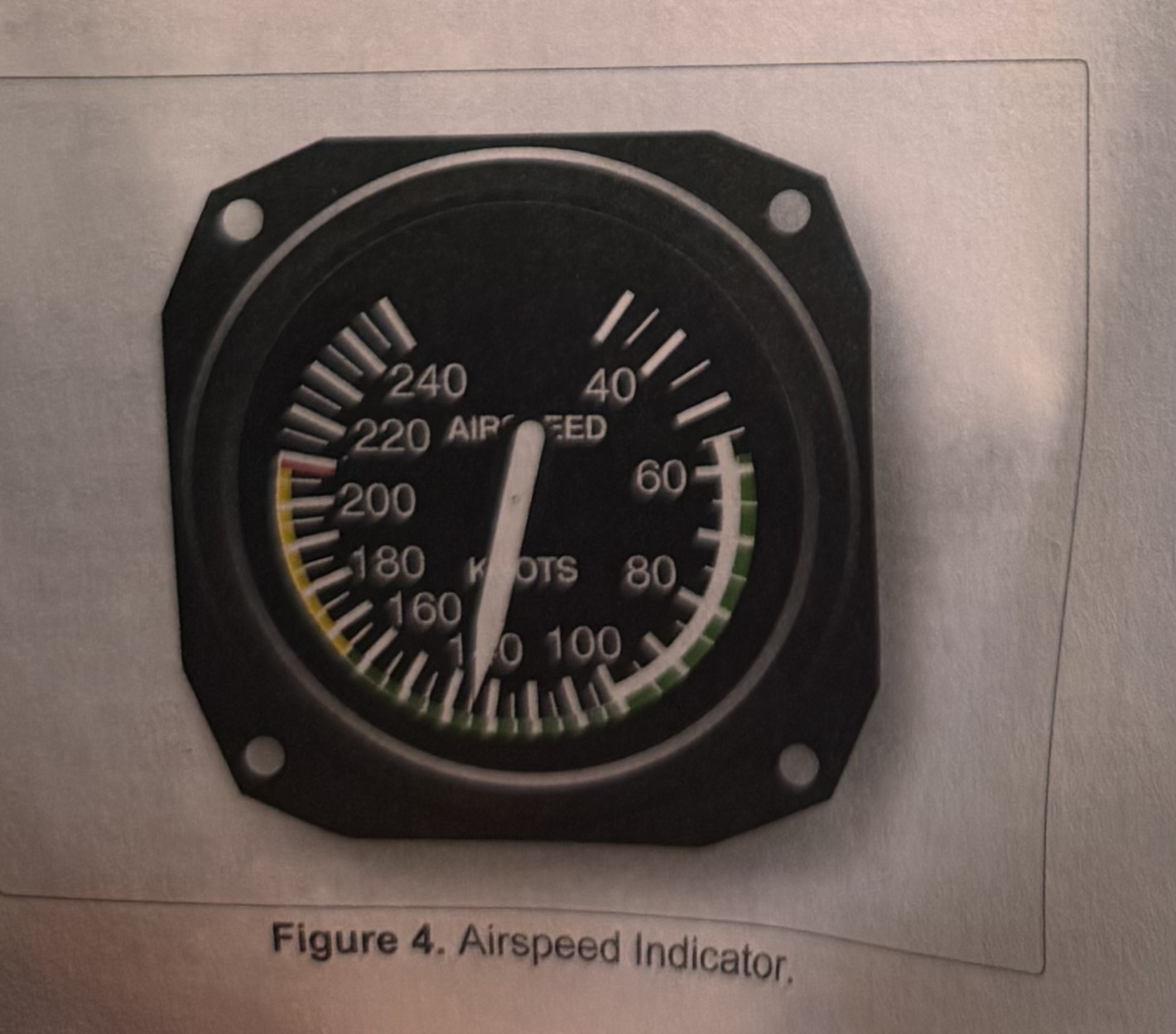
(Refer to Figure 4 below.) The maximum speed at which the airplane can be operated in smooth air
C. 208 kts.
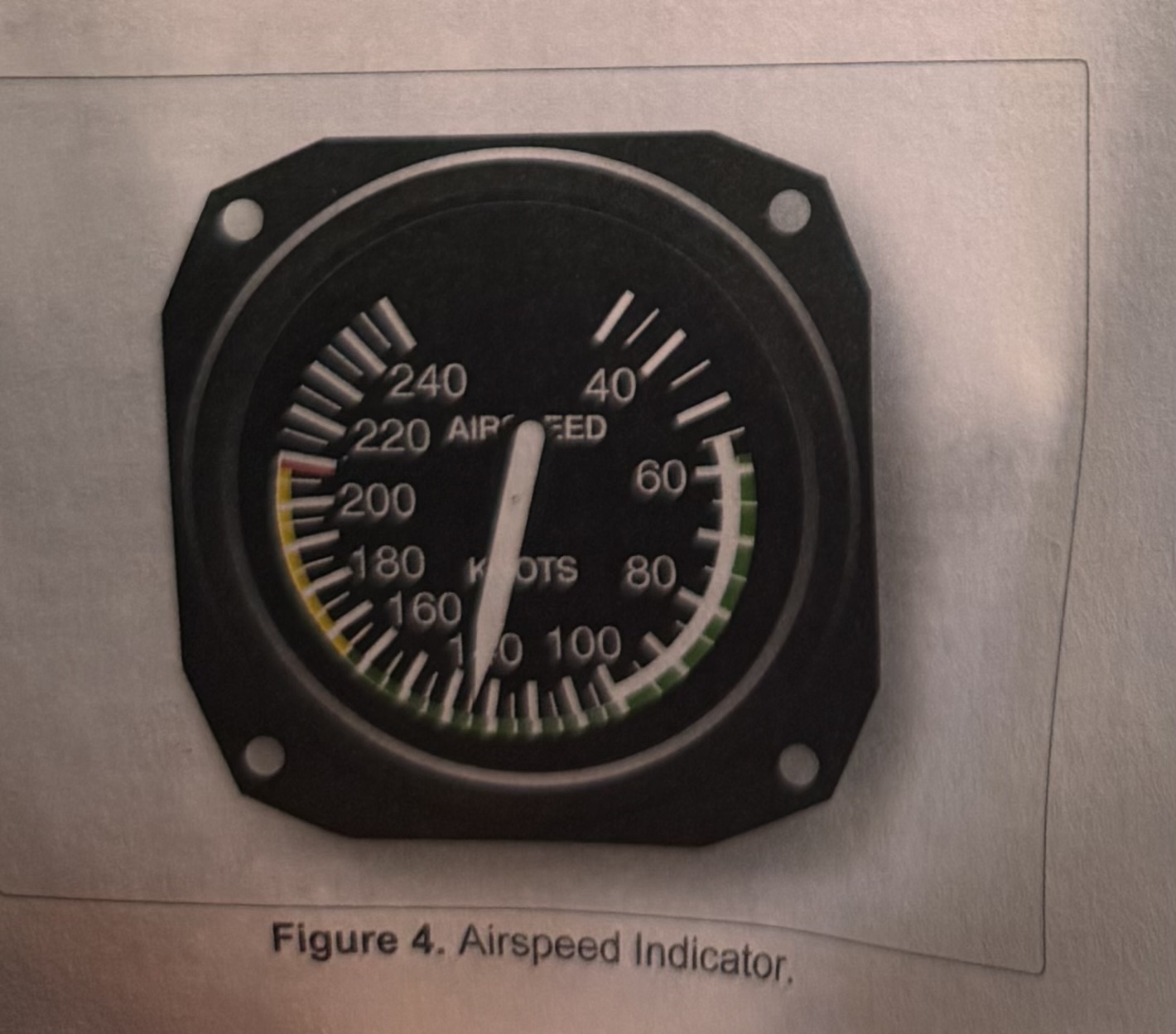
(Refer to Figure 4 below.) What is the full flap operating range for the airplane?
A. 55 to 100 kts.
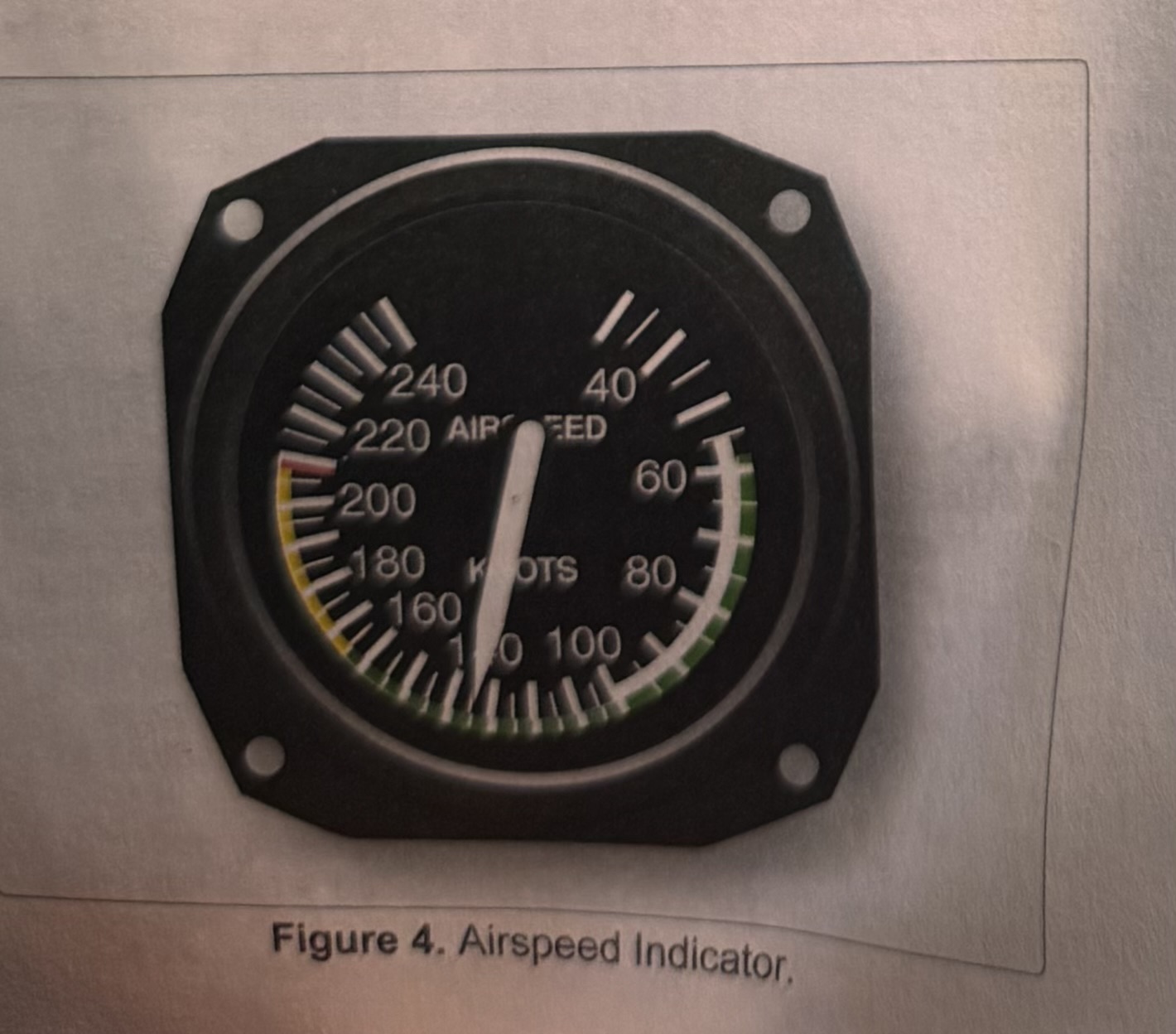
(Refer to Figure 4 on page 54.) What is the maximum flaps-extended speed?
B. 100 kts.
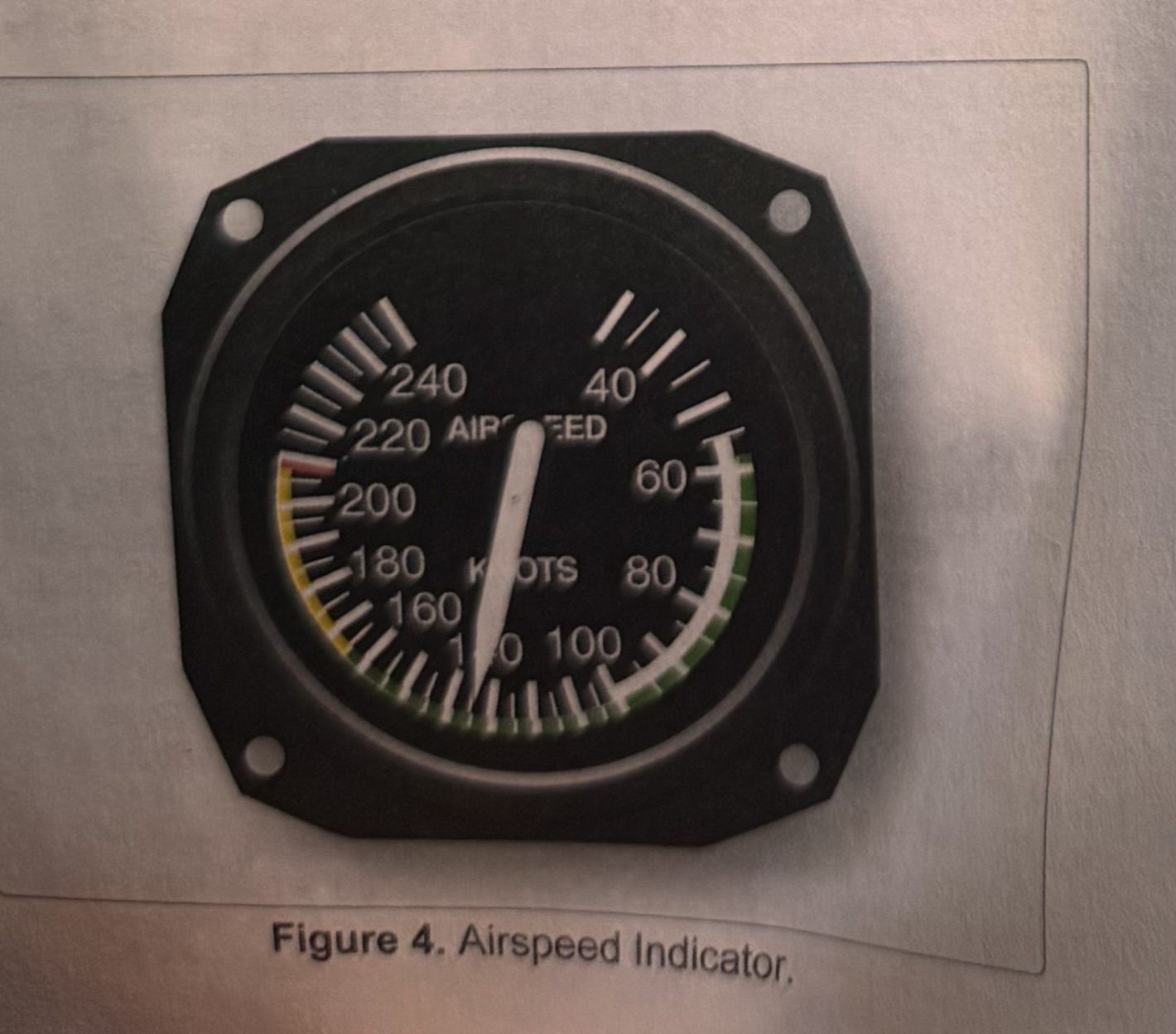
(Refer to Figure 4 on page 54.) Which marking identifies the never-exceed speed?
C. The red radial line.
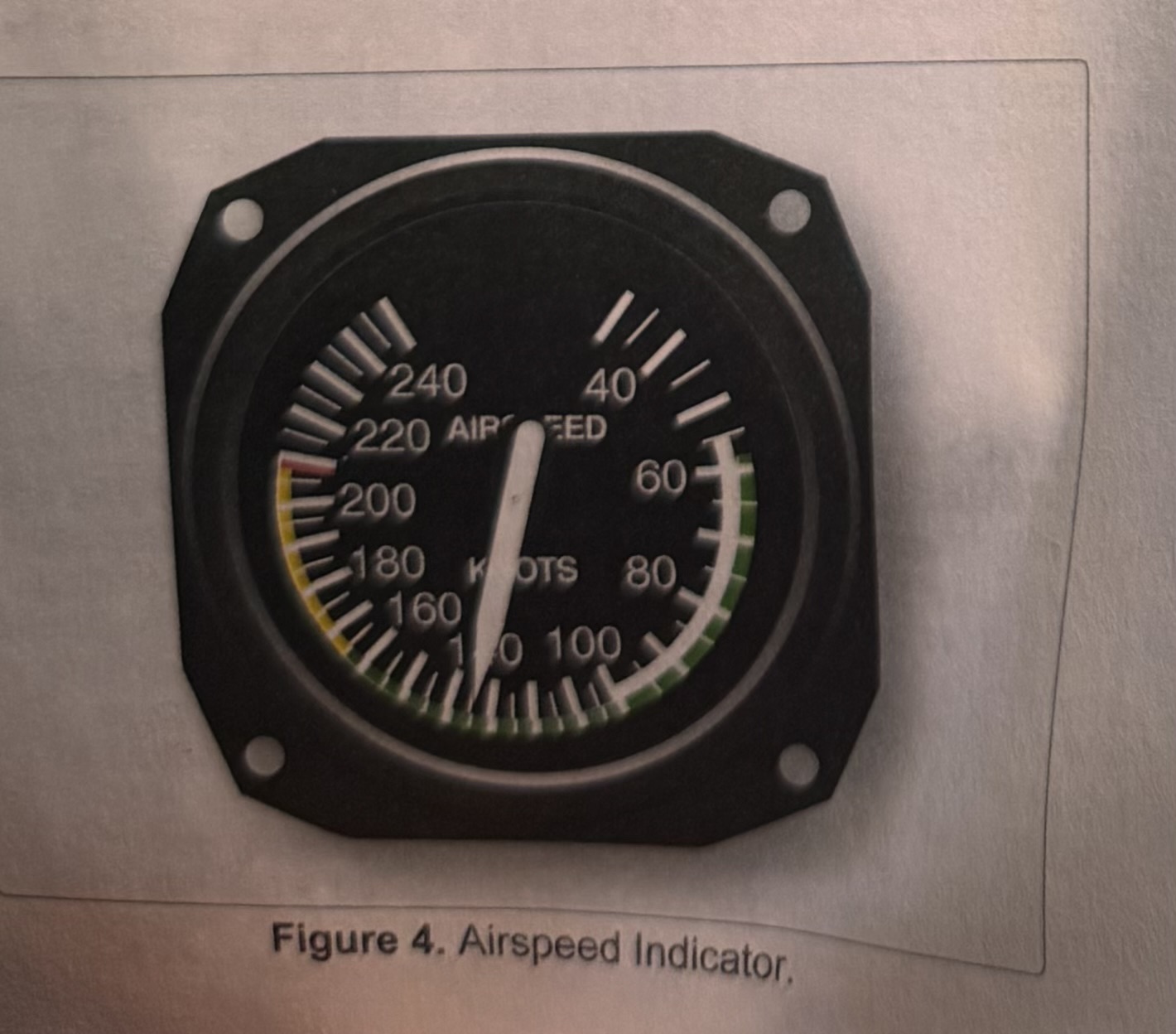
(Refer to Figure 4 on page 54.) Which color identifies the power-off stalling speed in a specified configuration?
C. Lower limit of the green arc.
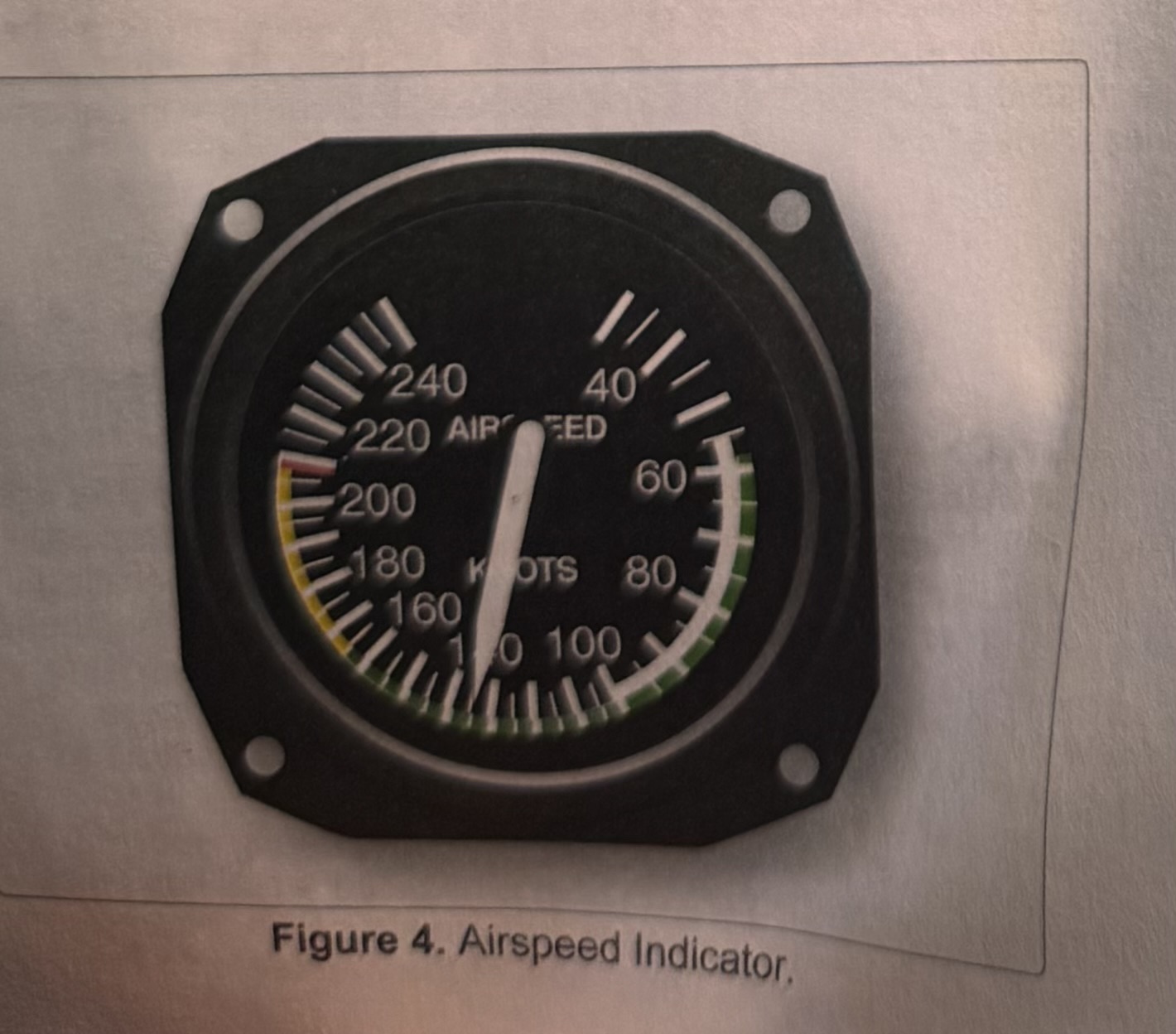
(Refer to Figure 4 on page 54.) Which color identifies the normal flap operating range?
C. The white arc.
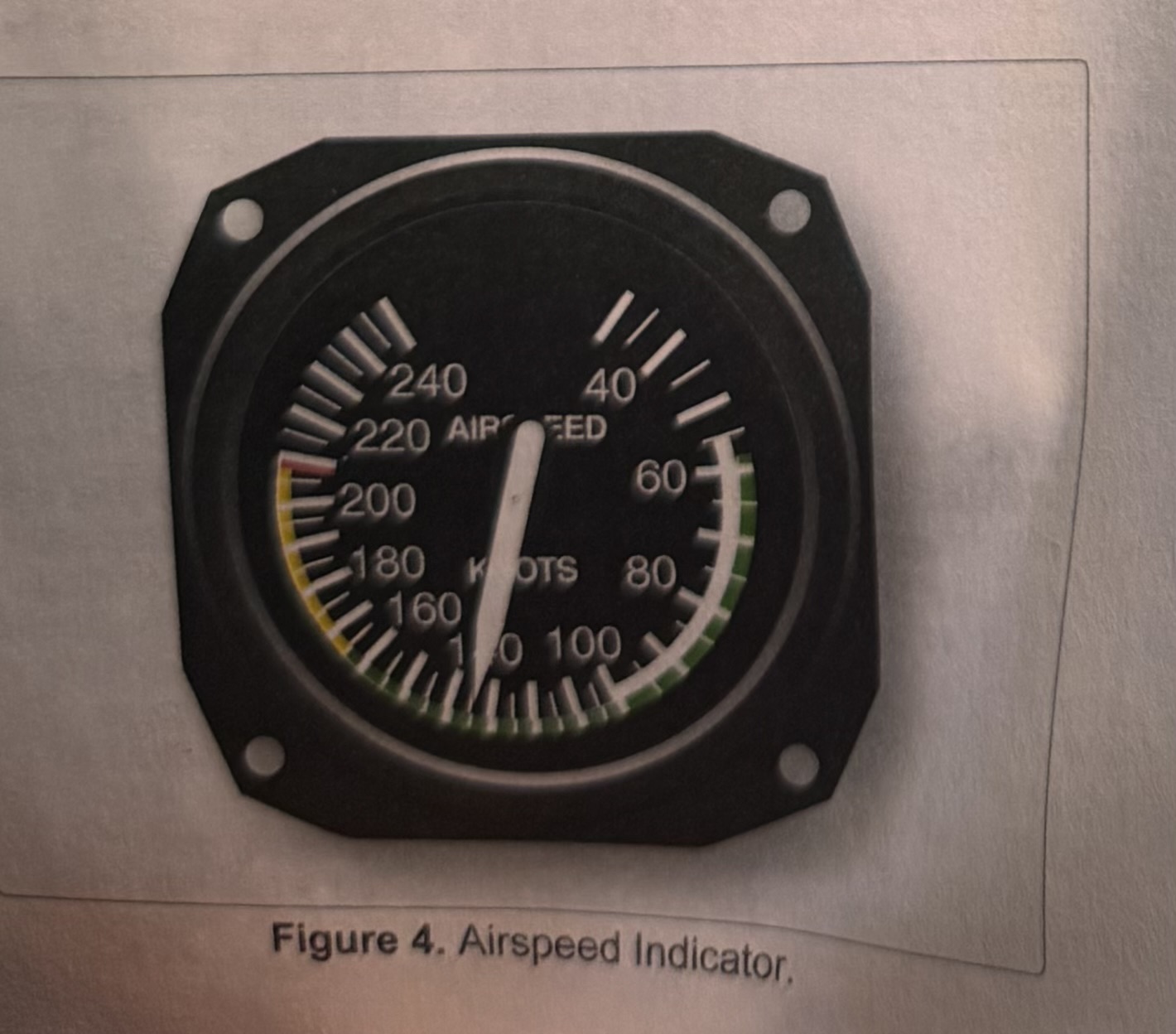
(Refer to Figure 4 on page 54.) Which color identifies the power-off stalling speed with wing flaps and landing gear in the landing configuration?
C. Lower limit of the white arc.
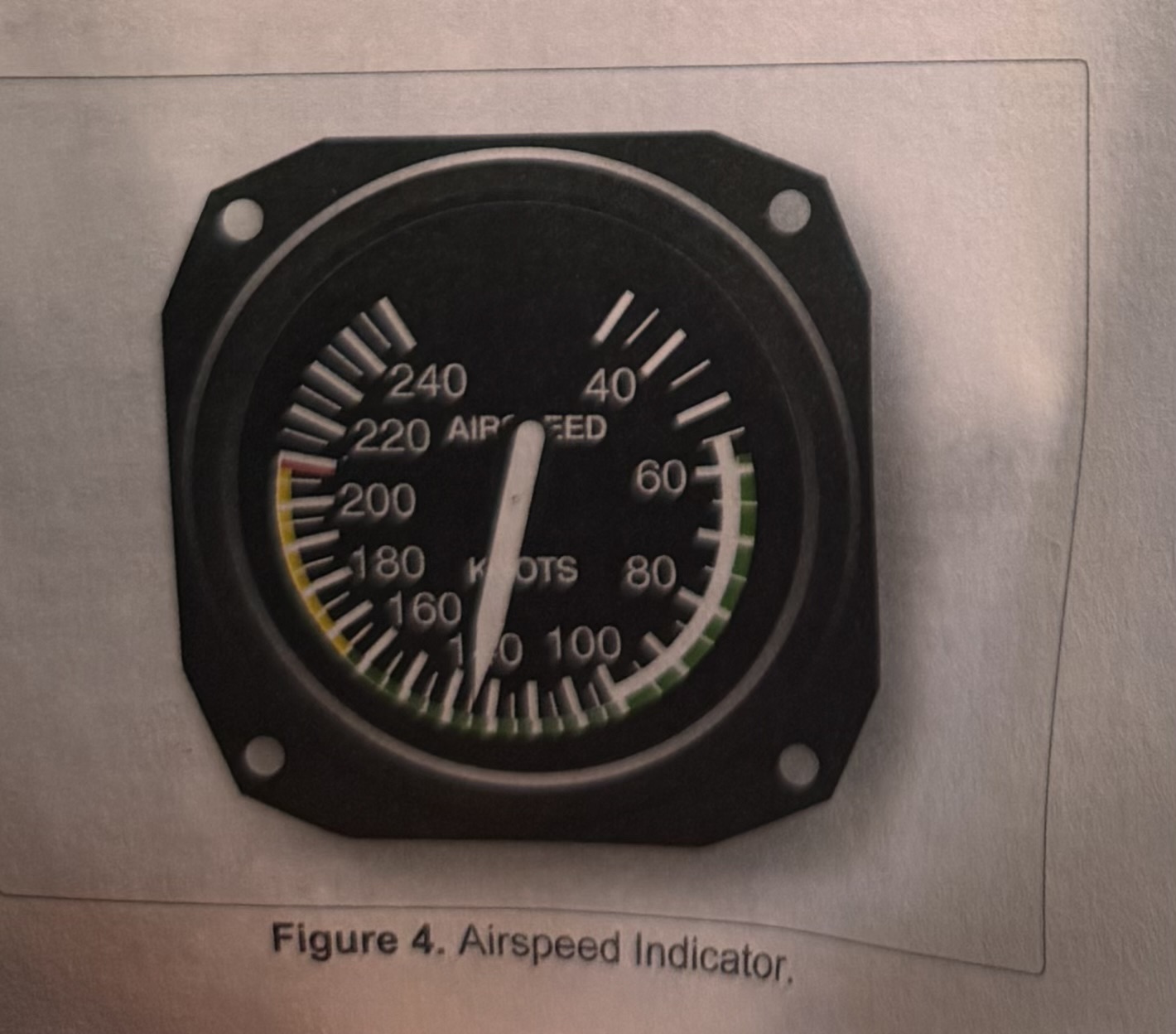
(Refer to Figure 4 on page 54.) What is the maximum structural cruising speed?
B. 165 kts.
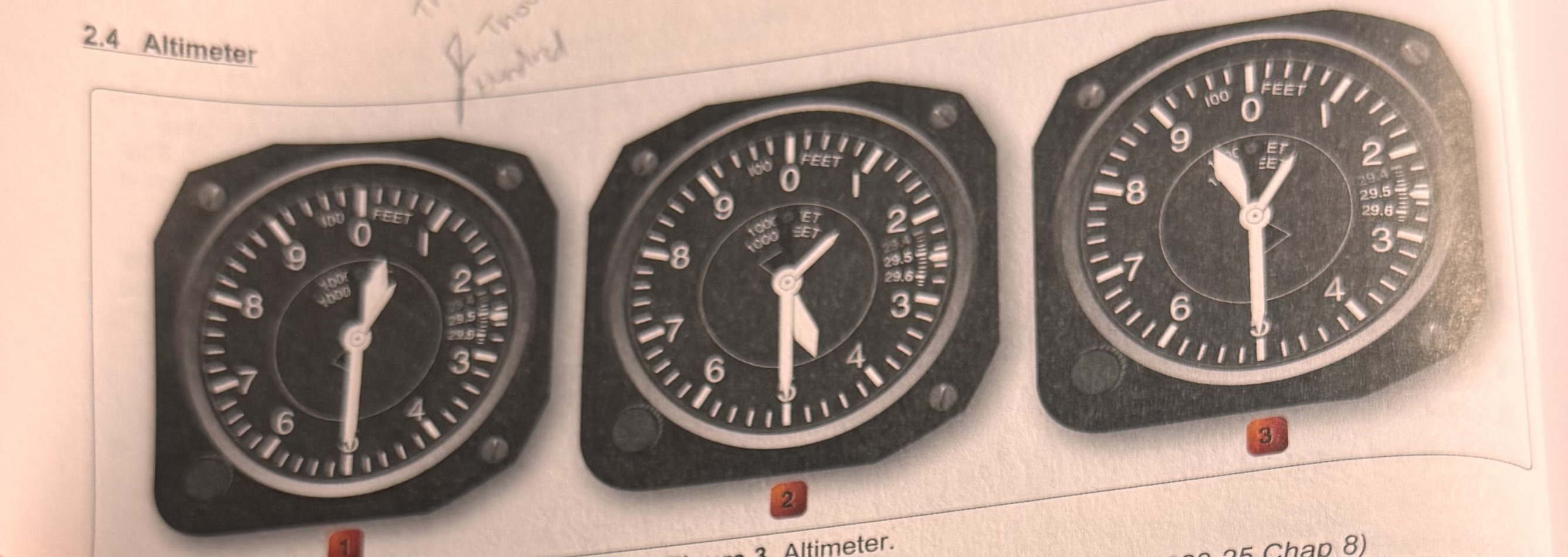
(Refer to Figure 3 above.) Altimeter 1 indicates
C. 10,500 feet.
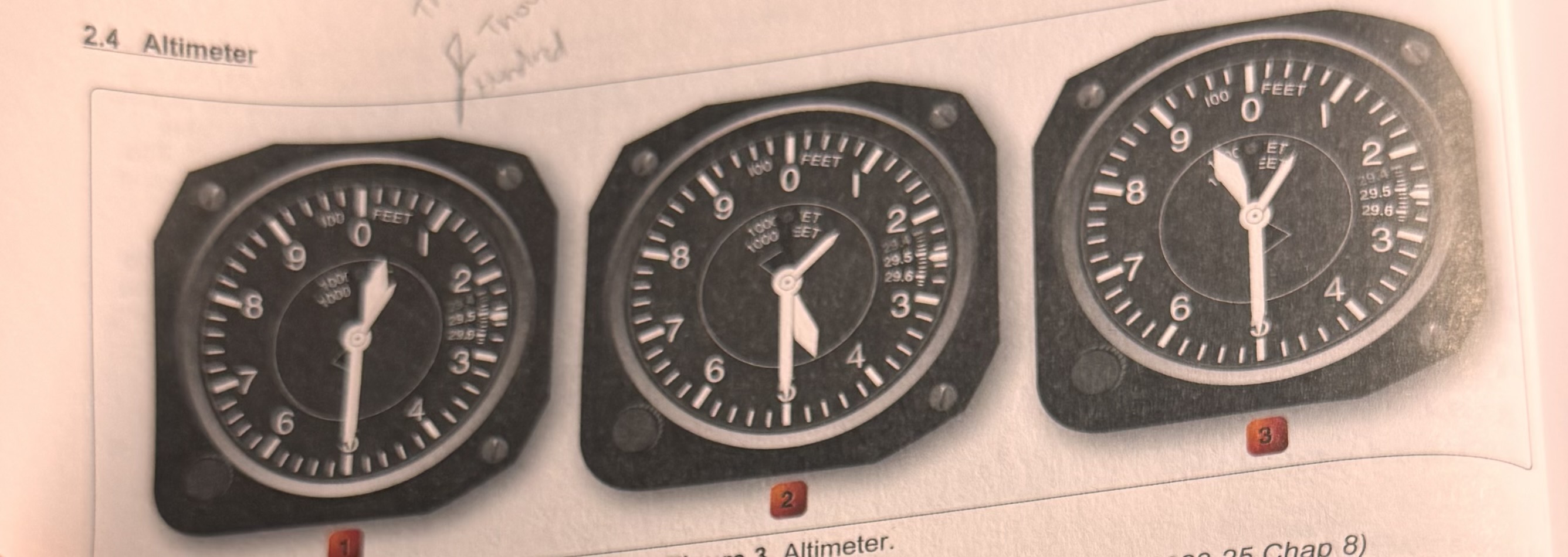
(Refer to Figure 3 above.) Altimeter 3 indicates
A. 9,500 feet.
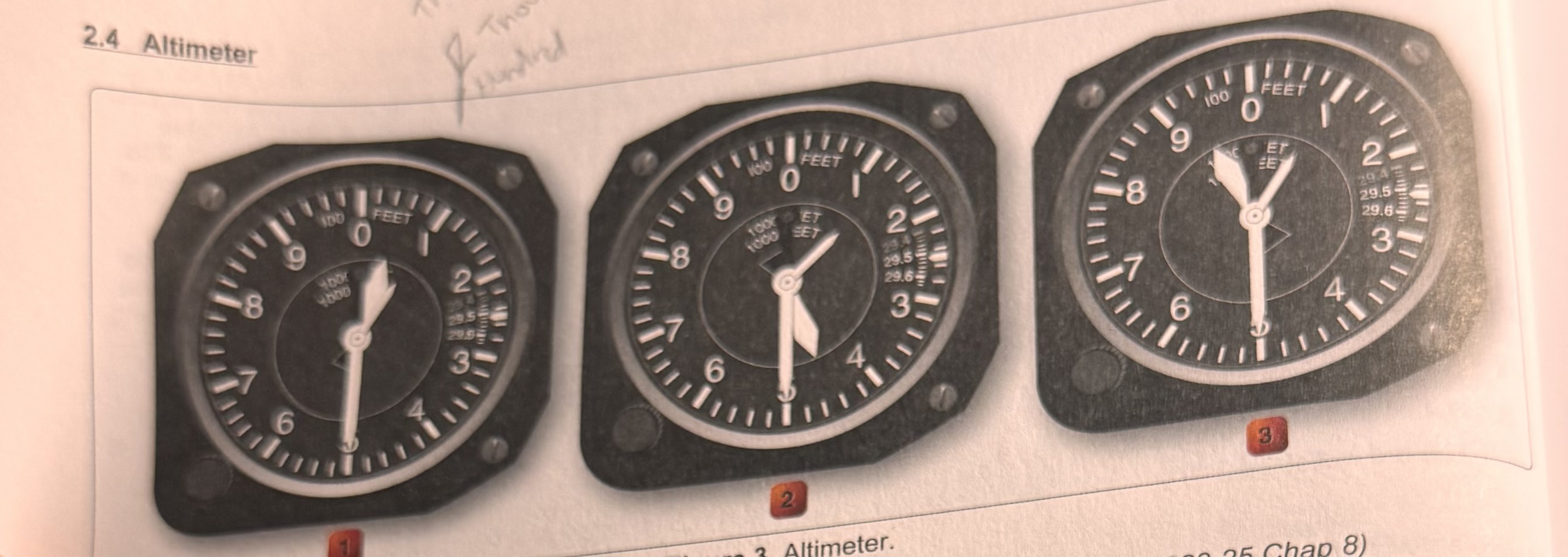
(Refer to Figure 3 above.) Which altimeter(s) indicate(s) more than 10,000 feet?
B. 1 and 2 only.
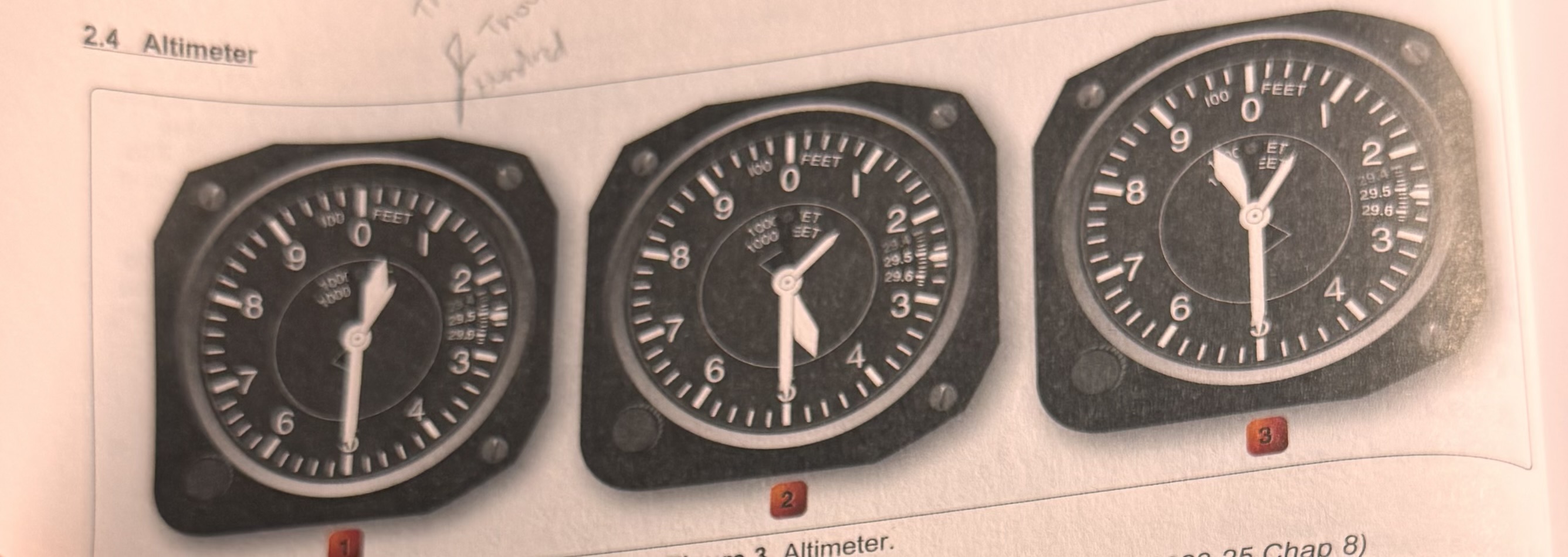
(Refer to Figure 3 above.) Altimeter 2 indicates
C. 14,500 feet.
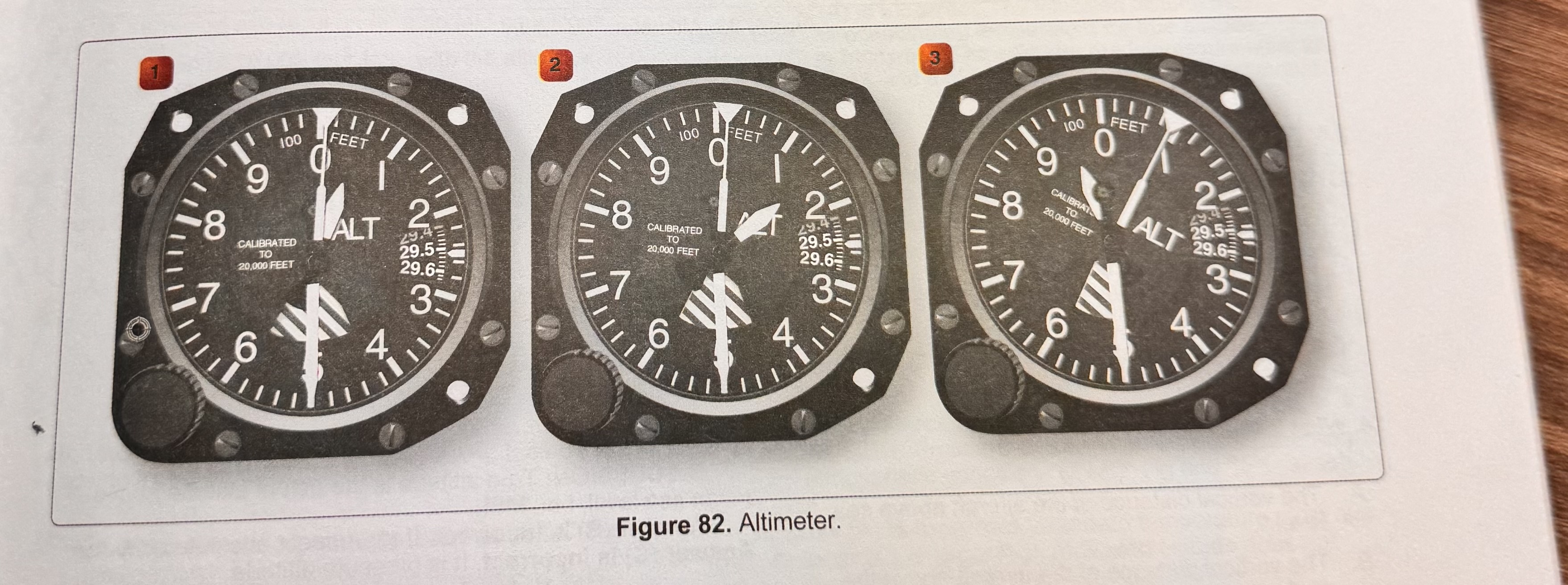
(Refer to Figure 82 below.) Altimeter 3 indicates
A. 9,500 feet.
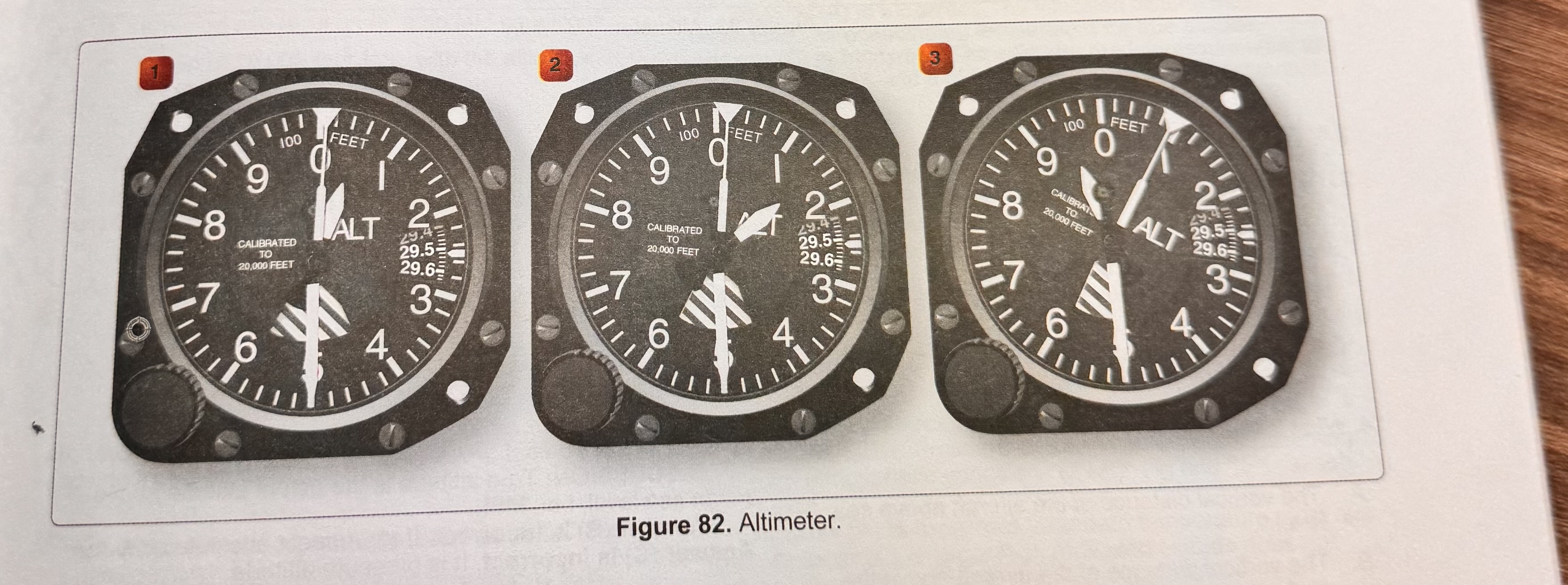
(Refer to Figure 82 below.) Altimeter 1 indicates
C. 500 feet.
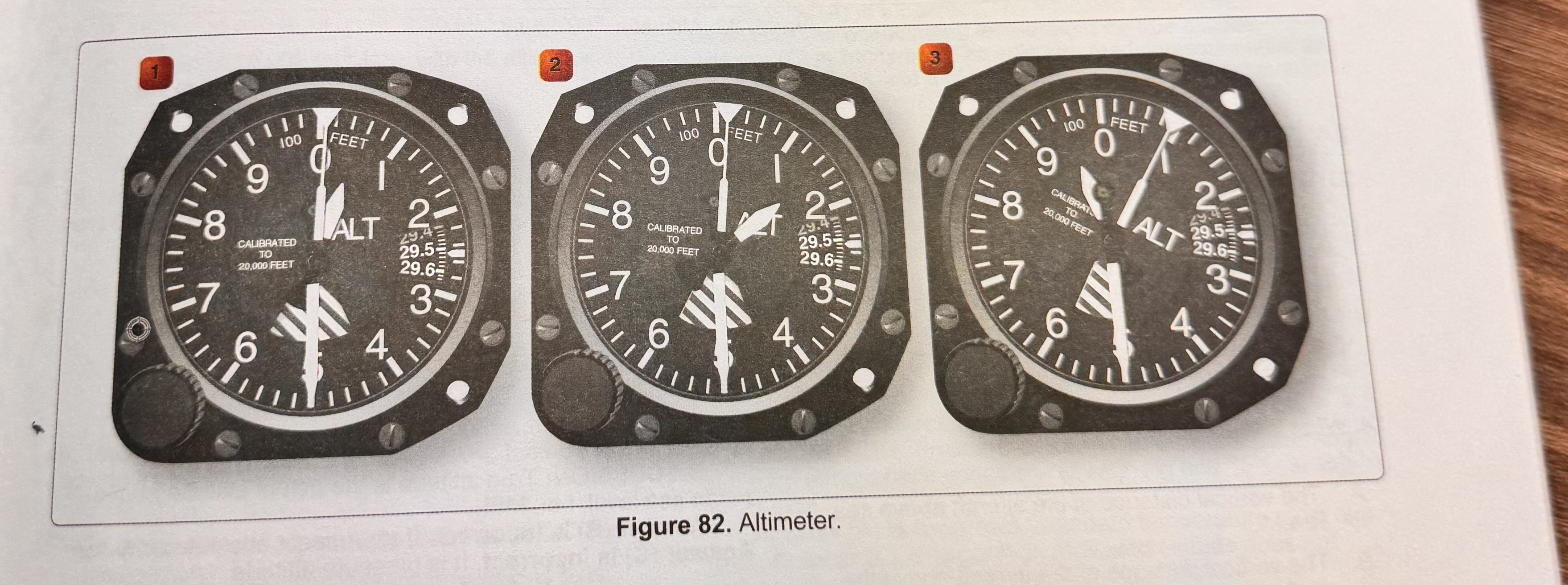
(Refer to Figure 82 above.) Which altimeter(s) indicate(s) more than 9,000 feet?
C. 3 only.
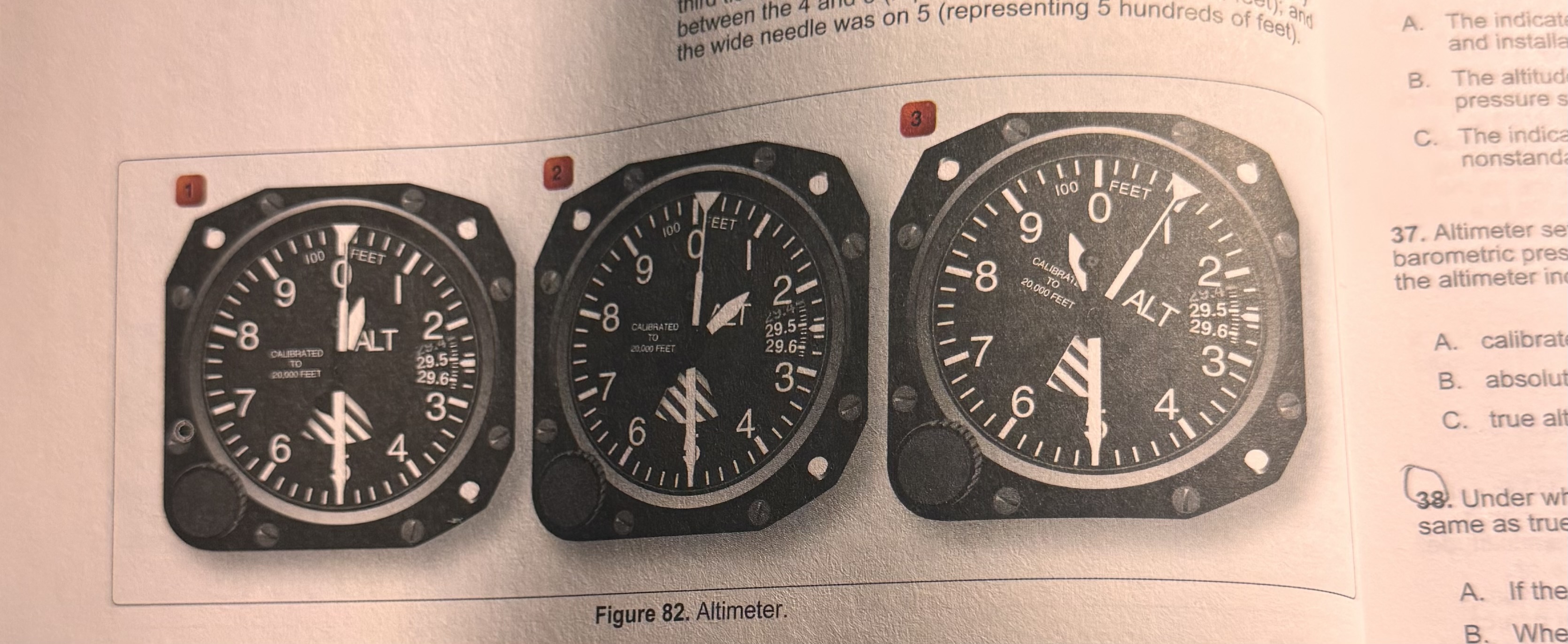
(Refer to Figure 82 below.) Altimeter 2 indicates
B. 1,500 feet.
What is absolute altitude?
B. The vertical distance of the aircraft above the surface. (AGL)
What is true altitude?
A. The vertical distance of the aircraft above sea level. (MSL)
What is density altitude?
B. The pressure altitude corrected for nonstandard temperature.
What is pressure altitude?
B. The altitude indicated when the barometric pressure scale is set to 29.92.
Altimeter setting is the value to which the barometric pressure scale of the altimeter is set so the altimeter indicates
C. true altitude at field elevation.
Under what condition is indicated altitude the same as true altitude?
B. When at sea level under standard conditions.
Under what condition is pressure altitude and density altitude the same value?
C. At standard temperature.
Under which condition will pressure altitude be equal to true altitude?
B. When standard atmospheric conditions exist.
If it is necessary to set the altimeter from 29.15 to 29.85, what change occurs?
C. 700-foot increase in indicated altitude.
If a pilot changes the altimeter setting from 30.11 to 29.96, what is the approximate change in indication?
C. Altimeter will indicate 150 feet lower.
If a flight is made from an area of low pressure into an area of high pressure without the altimeter setting being adjusted, the altimeter will indicate
C. lower than the actual altitude above sea level.
If a flight is made from an area of high pressure into an area of lower pressure without the altimeter setting being adjusted, the altimeter will indicate
B. higher than the actual altitude above sea level.
Which condition would cause the altimeter to indicate a lower altitude than true altitude?
C. Air temperature warmer than standard.
Under what condition will true altitude be lower than indicated altitude?
A. In colder than standard air temperature.
A. Pressure levels are raised on warm days and the indicated altitude is lower than true altitude.
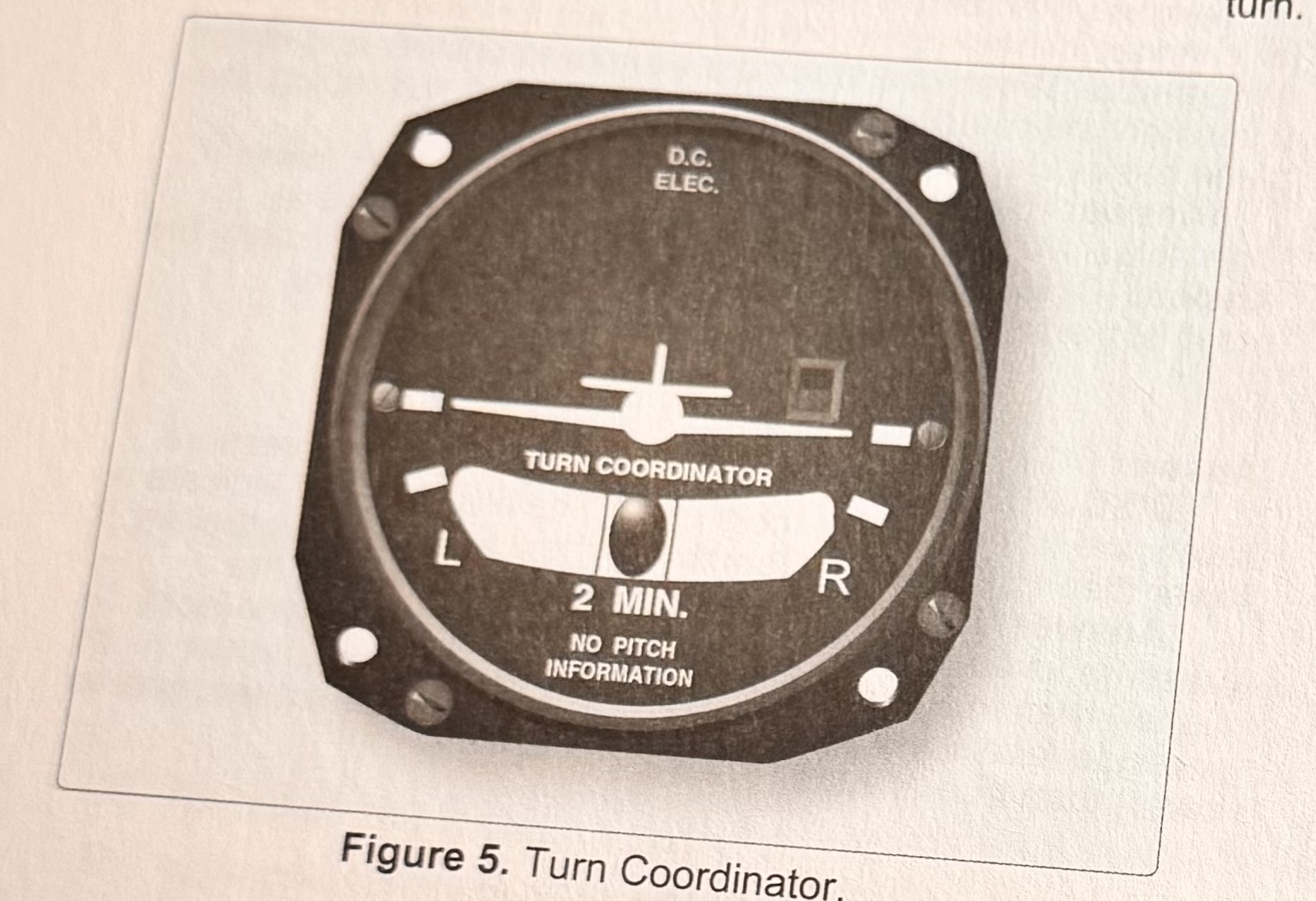
(Refer to Figure 5 below.) A turn coordinator provides an indication of the
A. movement of the aircraft about the yaw and roll axes.
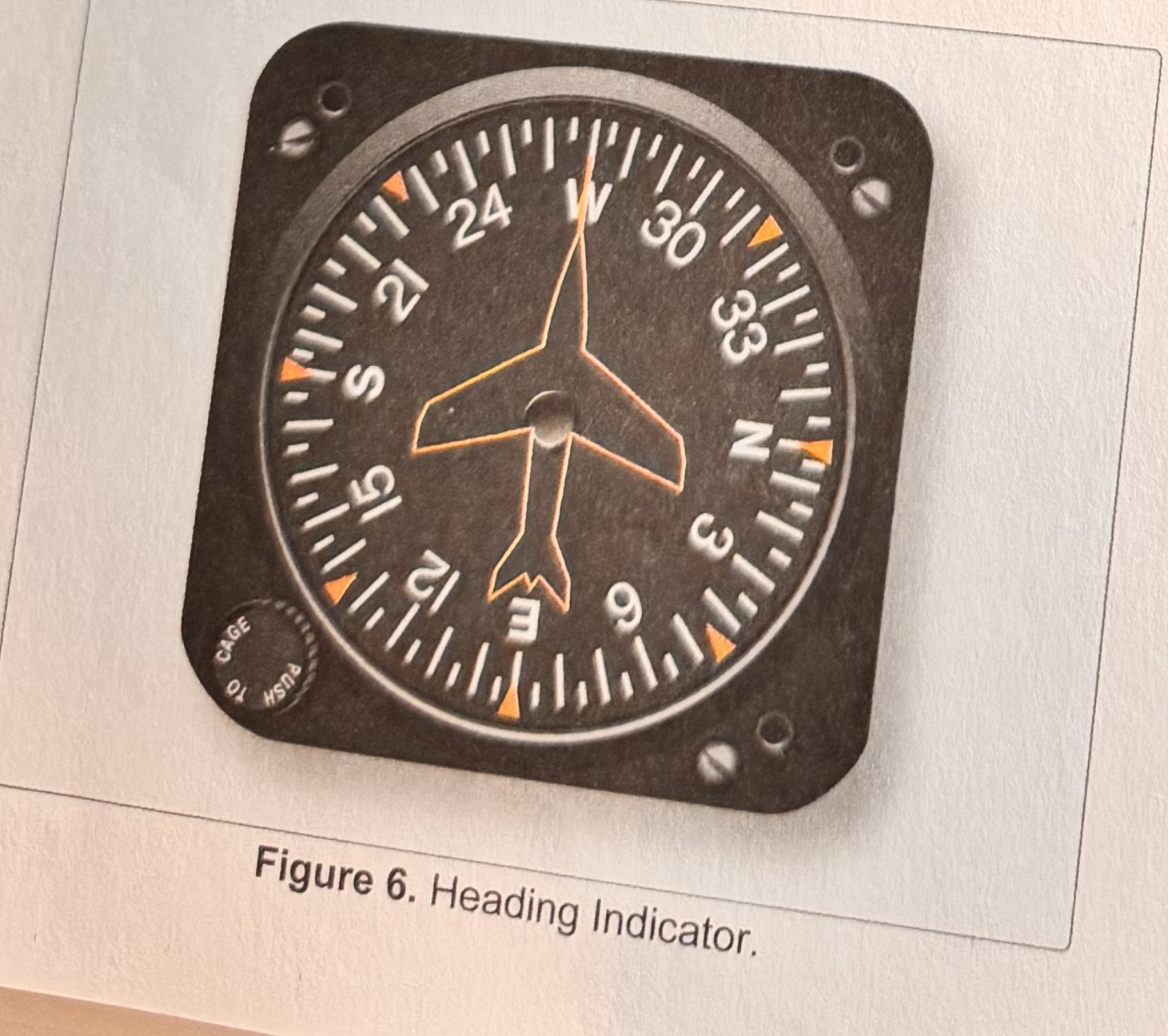
(Refer to Figure 6 below.) To receive accurate indications during flight from a heading indicator, the instrument must be
C. periodically realigned with the magnetic compass as the gyro precesses.
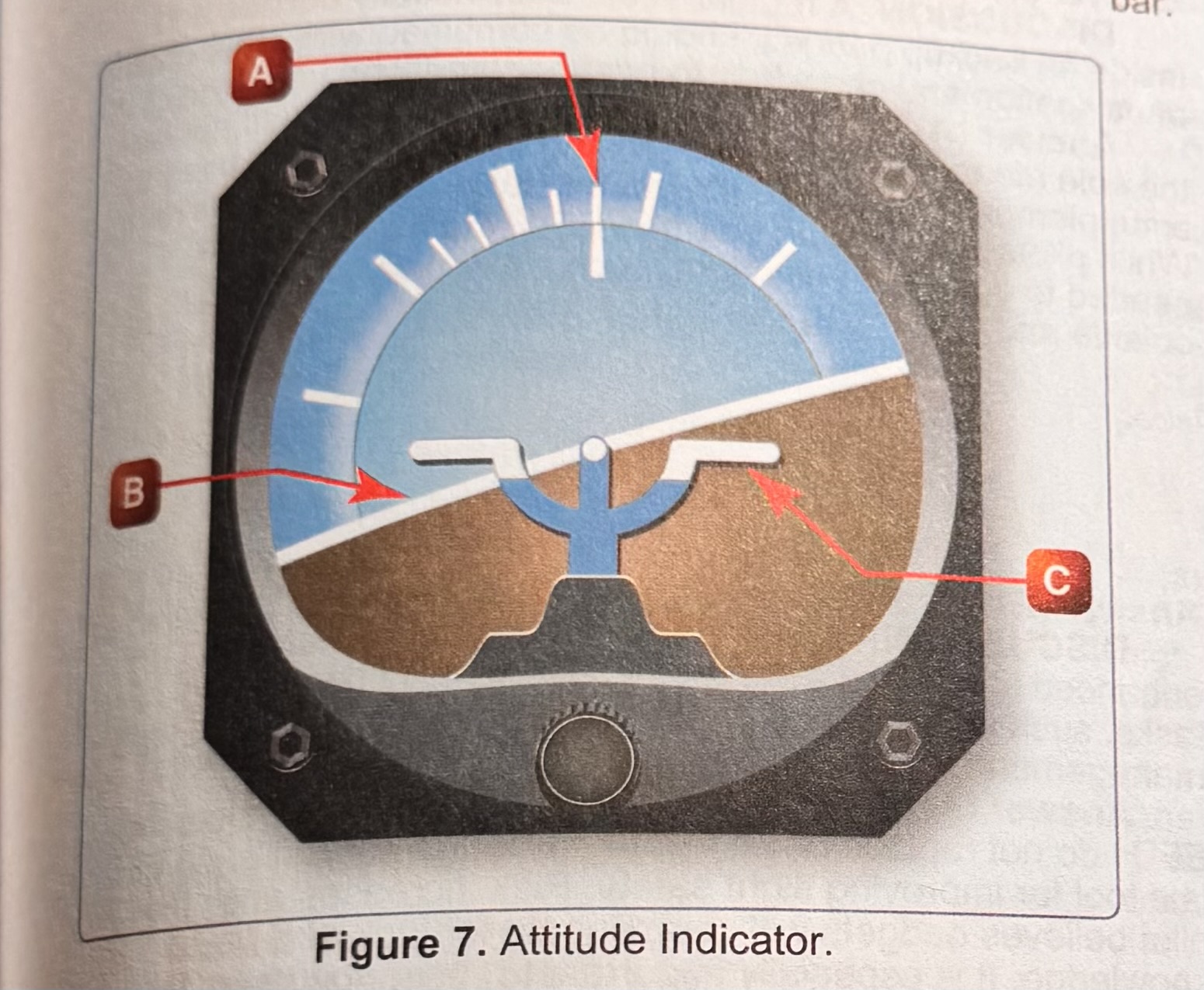
(Refer to Figure 7 below.) The proper adjustment to make on the attitude indicator during level flight is to align the
C. miniature airplane to the horizon bar.
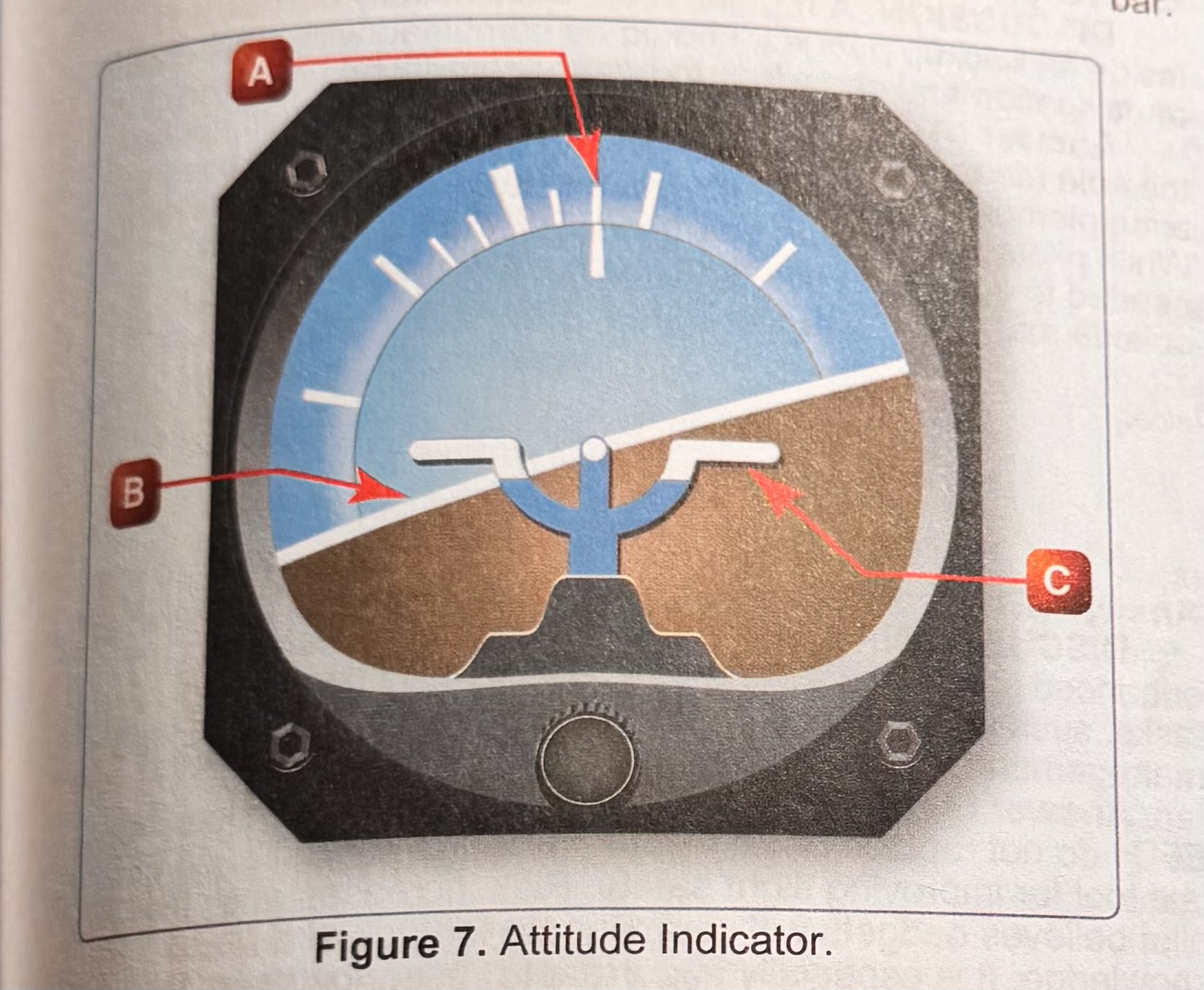
(Refer to Figure 7 above.) How should a pilot determine the direction of bank from an attitude indicator such as the one illustrated?
C. By the relationship of the miniature airplane (C) to the deflected horizon bar (B).
B. Situational awareness is increased.
C. Regularly scan both inside and outside, use all appropriate checklists, and cross-check with other forms of information.
An aircraft which is equipped with an Electronic Flight Display (EFD) can
B. offer new capabilities and simplify the basic flying task.
A pilot is flying an aircraft equipped with an electronic flight display and the air data computer fails. What instrument is affected?
B. Airspeed indicator.
An abnormally high engine oil temperature indication may be caused by
A. the oil level being too low.
B. cause loss of power, excessive oil consumption, and possible permanent internal engine damage.
C. cause loss of power, excessive oil consumption, and possible permanent internal engine damage.
For internal cooling, air cooled engines are especially dependent on
C. the circulation of lubricating oil.
If the engine oil temperature and cylinder head temperature gauges have exceeded their normal operating range, the pilot may have been operating with
C. too much power and with the mixture set too lean.
What action can a pilot take to aid in cooling an engine that is overheating during a climb?
A. Reduce rate of climb and increase airspeed.
What is one procedure to aid in cooling an engine that is overheating?
A. Enrich the fuel mixture.
A. The throttle controls power output as registered on the manifold pressure gauge and the propeller control regulates engine RPM.
B. avoid high manifold pressure settings with low RPM.
B. Permits the pilot to select the blade angle for the most efficient performance.
A. improved engine performance.
If the ignition switch ground wire becomes disconnected, the magneto
B. may continue to fire.
The reason a 4-cylinder reciprocating engine continues to run after the ignition switch is positioned to OFF may be a
C. broken magneto ground wire.
With regard to carburetor ice, float-type carburetor systems in comparison to fuel injection systems are generally considered to be
A. more susceptible to icing.
Which condition is most favorable to the development of carburetor icing?
C. Temperature between 20°F and 70°F and high humidity.
The possibility of carburetor icing exists even when the ambient air temperature is as
A. high as 70°F and the relative humidity is high.
If an aircraft is equipped with a fixed-pitch propeller and a float-type carburetor, the first indication of carburetor ice would most likely be
C. decrease of RPM.
If an aircraft is equipped with a fixed-pitch propeller and a float-type carburetor, the first indication of carburetor ice would most likely be
C. loss of RPM.
The operating principle of float-type carburetors is based on the
B. difference in air pressure at the venturi throat and the air inlet.
The presence of carburetor ice in an aircraft equipped with a fixed-pitch propeller can be verified by applying carburetor heat and noting
C. a decrease in RPM and then a gradual increase in RPM.
76. Generally speaking, the use of carburetor heat tends to
A. decrease engine performance.
77. Carburetor icing can occur during any phase of flight but is particularly dangerous during which phase of flight?
C. Using reduced power such as during descent.
78. Applying carburetor heat will
B. enrich the fuel/air mixture.
79. What change occurs in the fuel/air mixture when carburetor heat is applied?
B. The fuel/air mixture becomes richer.
80. During the run-up at a high-elevation airport, a pilot notes a slight engine roughness that is not affected by the magneto check but grows worse during the carburetor heat check. Under these circumstances, what would be the most logical initial action?
A. Check the results obtained with a leaner setting of the mixture.
81. The basic purpose of adjusting the fuel/air mixture at altitude is to
B. decrease the fuel flow in order to compensate for decreased air density.
82. While cruising at 9,500 feet MSL, the fuel/air mixture is properly adjusted. What will occur if a descent to 4,500 feet MSL is made without readjusting the mixture?
A. The fuel/air mixture may become excessively lean.
83. Fuel/air ratio is the ratio between the
B. weight of fuel and weight of air entering the cylinder.
84. Detonation occurs in a reciprocating aircraft engine when
C. the unburned charge in the cylinders explodes instead of burning normally.
85. Detonation may occur at high-power settings when
A. the fuel mixture ignites instantaneously instead of burning progressively and evenly.
86. If a pilot suspects that the engine (with a fixed-pitch propeller) is detonating during climb-out after takeoff, the initial corrective action to take would be to
B. lower the nose slightly to increase airspeed.
87. If the grade of fuel used in an aircraft engine is lower than specified for the engine, it will most likely cause
C. detonation.
88. The uncontrolled firing of the fuel/air charge in advance of normal spark ignition is known as
B. pre-ignition.
89. What type fuel can be substituted for an aircraft if the recommended octane is not available?
A. The next higher octane aviation gas.
90. Filling the fuel tanks after the last flight of the day is considered a good operating practice because this will
C. prevent moisture condensation by eliminating airspace in the tanks.
91. To properly purge water from the fuel system of an aircraft equipped with fuel tank sumps and a fuel strainer quick drain, it is necessary to drain fuel from the
C. fuel strainer drain and the fuel tank sumps.
92. On aircraft equipped with fuel pumps, when is the auxiliary electric driven pump used?
B. In the event the engine-driven fuel pump fails.
93. Which would most likely cause the cylinder head temperature and engine oil temperature gauges to exceed their normal operating ranges?
A. Using fuel that has a lower-than-specified fuel rating.
94. What should be the first action after starting an aircraft engine?
A. Adjust for proper RPM and check for desired indications on the engine gauges.
95. During preflight in cold weather, crankcase breather lines should receive special attention because they are susceptible to being clogged by
C. ice from crankcase vapors that have condensed and subsequently frozen.
96. An electrical system failure (battery and alternator) occurs during flight. In this situation, the pilot would
A. experience avionics equipment failure.
97. A positive indication on an ammeter
B. shows the rate of charge on the battery.
98. To keep a battery charged, the alternator voltage output should be
C. higher than the battery voltage.
99. Which of the following is a true statement concerning electrical systems?
C. Lights and radios use the electrical system for power.