Early-life history processes in marine species
 Call Kai
 Learn
Learn Practice Test
 Spaced Repetition
 Match
Match Flashcards
 Knowt Play
1/42

There's no tags or description
Looks like no tags are added yet.
Name | Mastery | Learn | Test | Matching | Spaced | Call with Kai |
|---|
No analytics yet
Send a link to your students to track their progress
43 Terms
Larvae definition
The free-living stage between hatching and metamorphosis (typically with independent movement)
Larval pool
The total number of larvae produced (many die in this stage)
Primary larvae
Have cilia
Secondary larvae
Lack ciliated epithelium. Instead have setae
How are larvae similar
microscopic (<1-2mm), short-lived, typically in water column, most swim using cilia, poor swimmers but are transported long distances, most feed on phytoplankton and bacteria
Terminal addition hypothesis
the first animals were small pelagic forms similar to modern larvae, with adult bilaterian body plans evolved subsequently
Intercalation hypothesis
Adult bilaterian body plans evolved first and that larval body plans arose by interpolation of features into direct-developing ontogenies
Is the terminal addition hypothesis or the intercalation hypothesis more likely to have occurred
intercalation
Advantages of having a larval stage
Larvae eat different foods to adults which lessens competition, larvae can colonize new areas (reduces inbreeding), breaks pathogen and parasite cycles, avoid benthic predators during development
Evolution of reproductive larval niches
The ability of the larvae to feed on the plankton may have lessened the requirement of adults to provide reserves for the larvae or to produce large offspring. Leads to many smaller eggs rather than few larger ones
Disadvantages of larval form
Moving away from favorable parent habitat, vulnerability to planktonic predators, greater vulnerability to UV and chemical stress, chance of not finding place to metamorphosize
Planktotrophy
Complex larval morphology, small eggs, high fecundity (many offspring), long development, high mortality, high dispersal
Lecithotrophy
Simplified larval forms, large eggs, low fecundity (few offspring), short development, low mortality, low dispersal
Thorson’s rule
species producing planktonic larvae are rarer at higher latitude (cold regions less habitable)
Larval mortality rate is…
hard to estimate but extremely high
What percentage of larvae from the larval pool die per day
16%
Equation for recruitment
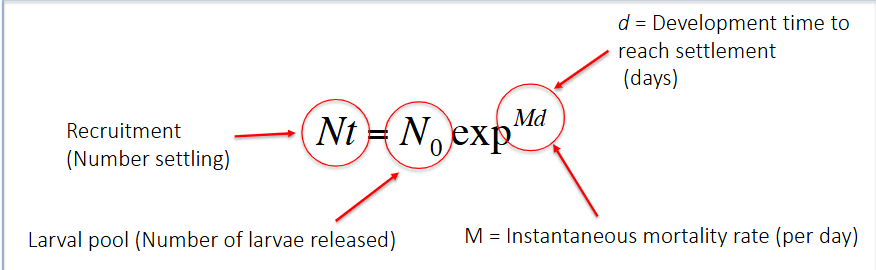
Causes of larval mortality
Predation, starvation/exhaustion, environmental, stranding/sinking
What percent of larvae are chemically defended
40-60%
What do most planktonic larvae feed on
Phytoplankton and bacteria
What percentage of planktonic larvae do not feed
<5%
Lecithotrophic larvae
Gain all of their nutrition from reserves in the egg and thus do not feed
Hydrosol feeding
Particulate food filtered or sieved by specialized feeding structures lost at settlement
How much do larvae eat per day
2-5 mL and 1,500-3,000 cells
Ideally, how many cells do larvae need to eat per day to survive
1,000 to 4,000 cells
How does temperature impact larval development
Low temps slow development rates, and higher temps quicken development rates
Kinds of Larval Transport
Mode of transportation (tides, currents, etc.)
Larval Dispersal
Distance larvae move
Connectivity
Dispersal can move larvae from one population to another, where they can settle and recruit
Benefits of larval dispersal
Easy to recolonize an area after local extinction, reduced likelihood of inbreeding, large geographic range, lower risk of extinction
Disadvantages of larval dispersal
Dispersal away from favorable parental habitat
How long do teleplanic larvae remain in the larval stage
Remain in larval state for many months (become large in size)
How long do actaplanic Larvae stay in larval stage
Remain in larval state from 1 week to 2 months (most temperate larvae) (coastal)
How long do anchiplanic stay in the larval stage
Stay in larval state for seconds to minutes
What is relationship between pelagic larval duration and dispersal distance?
The longer it takes for a larvae to mature and settle the farther it can travel
How far can anchiplanic larvae travel
Only a number of meters
How far can an actaplanic larvae travel
10Km or less
How far can Teleplanic larvae travel
10s-100sKm
What influences the larval experience
(nutrition, larval duration, metabolism) influences the energy and resources available for post-settlement juveniles (within generational)
What factors influence the adult stage of these species
(nutrition, environment) influences the energy and resources available for developmental stages (inter-generational)
What is the most vulnerable life history stage to environmental change
Larval stage
Reasons why larvae are highly vulnerable to env. change
Morphology: small, high surface areas
- Lack protective coverings
- Ectothermal
- Undergoing fast rates of development (i.e. embyos/larvae)
- Physiologically stressed
- Experience high mortality
- Development rates very sensitive to environmental conditions (temp, food)
What env. factors affect larval development the most
Temp & PH