A&P Chapter 11 Notes
 Call Kai
 Learn
Learn Practice Test
 Spaced Repetition
 Match
Match Flashcards
 Knowt Play
1/23

There's no tags or description
Looks like no tags are added yet.
Name | Mastery | Learn | Test | Matching | Spaced | Call with Kai |
|---|
No analytics yet
Send a link to your students to track their progress
24 Terms
What Are The Types Of Nervous Systems?
central nervous system (CNS) = brain and spinal cord
peripheral nervous system (PNS) = everything outside of brain and spinal cord!
somatic nervous system (SNS) = voluntary movement
autonomic nervous system (ANS) = involuntary movement
What Are The Job Types Of The Peripheral Nervous System?
somatic = voluntary movement, things you can control
moving your arm
autonomic = involuntary movement, things your body does by itself
heart beat
for autonomic, think like auto pilot
What Are The Directions Of The Central Nervous System?
sensory = afferent, messages going to the brain
when you touch something, and it’s hot
motor = efferent, messages going from the brain
message telling you to move your hand away
for afferent, think “a” does not mean away, it means to
What Are The Moods Autonomic Nervous System?
sympathetic = fight or flight
parasympathetic = rest and digest
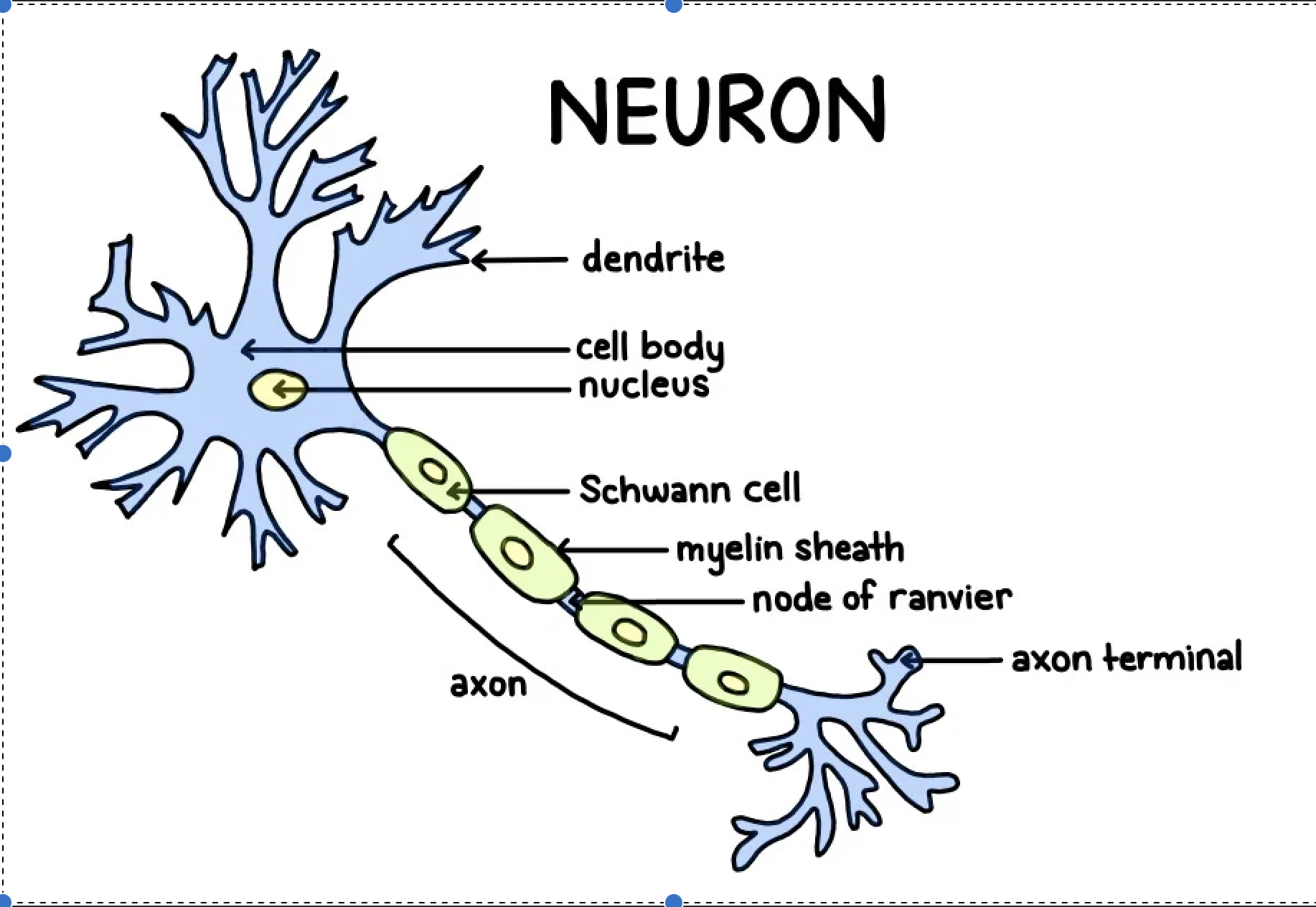
What Does A Multipolar Neuron Consist Of?
dendrites = branch like receptors that receive messages
cell body with nucleus = the main part containing the nucleus
axon = long trunk that sends messages
axon hillock = where the cell body meets the axon, is also the decision spot (to send message or not?)
schwann cell (myelin sheath) = creates insulation around axon (like rubber on a wire)
node of ranvier = gaps in the myelin sheath that help speed things up
axon terminal = knob like endings that send messages
synaptic vesicles = tiny bubbles in the axon terminal that store and release chemicals
neurotransmitters = the chemicals that carry messages
think of a neuron like a tree with a long trunk
Cluster Terminology
peripheral nervous system
ganglion, nerve
central nervous system
nuclei, tract
Ganglion
Cluster of cell bodies in the peripheral nervous system
Nuclei
Cluster of cell bodies in the central nervous system
Nerve
Bundles of axons in the peripheral nervous system
Tract
Bundle of axons in the central nervous system
What Are The Types Of Neurons?
unipolar
bipolar
multipolar
Unipolar Neuron
sensory = feel things
Bipolar Neuron
special senses = eyes, ears, nose
Multipolar Neuron
motor = thinking cells
the most common type of neuron
What Are The Neuroglia Cells In The Central Nervous System?
astrocytes = protect the brain (blood brain barrier)
oligodendrocyte = make up myelin sheath
microglia = clean up
ependymal = produce cerebral spinal fluid/brain fluid
Neuroglia cells are like helpers and cleaners
What Are The Neuroglia Cells In The Peripheral Nervous System?
schwann cells = make up myelin sheath
satellite = support neurons
Neuroglia cells are like helpers and cleaners
What Are The Types Of Ion Channels?
leakage = always a little open
gated = open/close when needed
What Are The Types Of Gated Ion Channels?
voltage = opens with electricity change, change in membrane potential
Na+ and K+ (salt and potassium)
ligand = opens with chemicals (neurotransmitters)
mechanical = opens with touch/pressure
What Does Graded Membrane Potential Consist Of?
occurs at the dendrite
varies in strength
travels short distances to the axon hillock
What Does Action Potential Consist Of?
occurs at the axon hillock
one strength
travels long distances
all or none principle (it either happens or it doesn’t)
What Are The Speeds Of Action Potential?
no myelin = unmyelinated
slow (continuous conduction)
with myelin = myelinated
fast, jumping node to node (saltatory conduction)
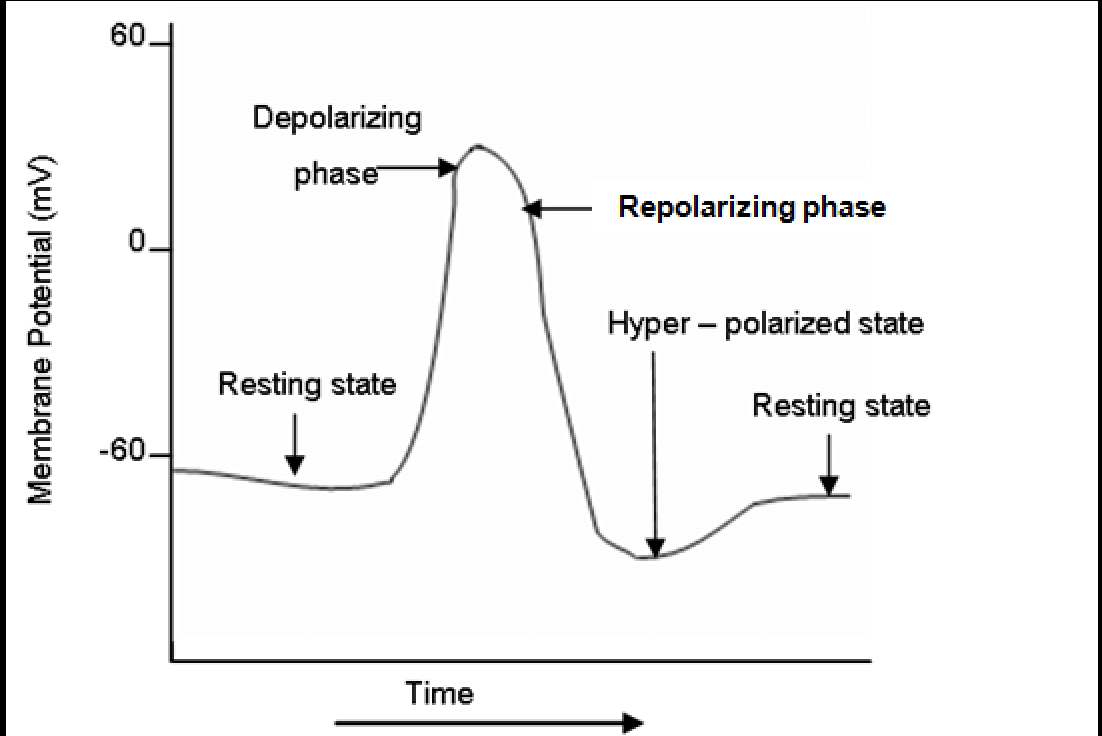
What Is The Action Potential Process?
Resting membrane potential = K+ in (potassium), Na+ out (sodium)
Depolarization = Na+ in (sodium)
Repolarization = K+ out (potassium)
Hyperpolarization = too much K+ out (potassium)
What Is The Neurophysiology Of A Synapse?
presynaptic membrane = sender
releases neurotransmitters (calcium triggers release)
post synaptic membrane = receiver
has receptors
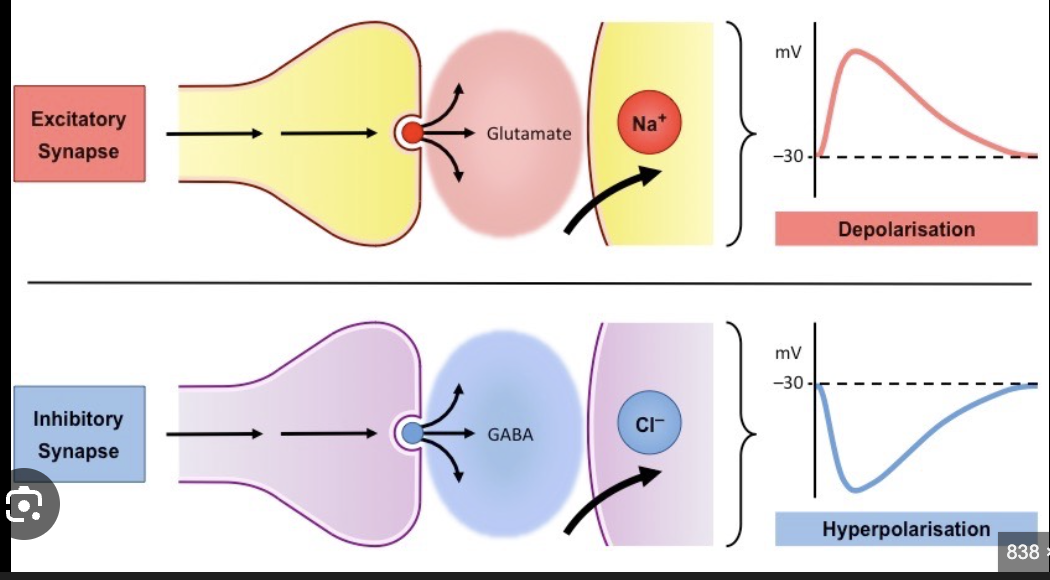
What Is The Outcome Of A Synapse?
inhibitory post synaptic potential (ISPS)
calms = hyper-polarization (too much K+ out)
excitatory postsynaptic potential (EPSP)
excites = depolarization (Na+ in)