Intro to Database Week 4 & 5 (midterm)
 Call Kai
 Learn
Learn Practice Test
 Spaced Repetition
 Match
Match Flashcards
 Knowt Play
1/20

There's no tags or description
Looks like no tags are added yet.
Name | Mastery | Learn | Test | Matching | Spaced | Call with Kai |
|---|
No analytics yet
Send a link to your students to track their progress
21 Terms
Entity Relationship Model (ER)
A conceptual data model for database design
Entity & Entity set
Entity: Objects represented in database
Entity set: Collection of actual entities in database
Attribute & Key Attribute
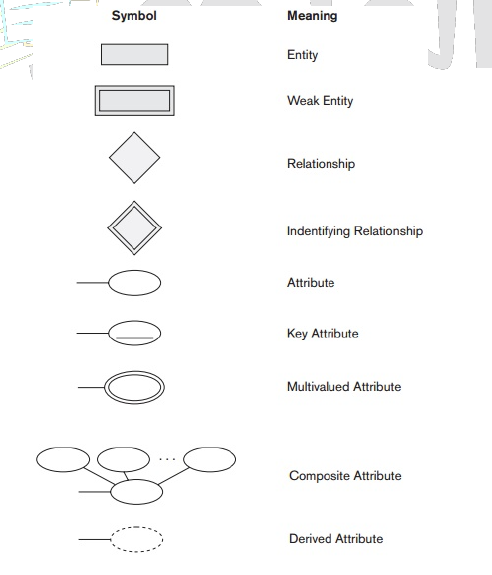
Attribute: Properties of an entity
Key Attribute: unique attribute of an entity (can be composite)
What are the 3 types of attributes
Simple Attribute: entity has 1 value
Composite attribute: attribute has many values (address)
Multi-valued attribute: attribute can have many values
Data value
Value of a specific property
Relationship, relationship type & relationship set
Relationship: relate two or more entities
Relationship type: Description of relationship (participants & constraints)
Relationship set: set of relationship instances in database OR state of relationship type
Degree of Relationships
Unary (Recursive)
Binary
Ternary
N-ary relationship
Weak entity
Entity that does not have a key attribute of its own that must be identified by another entry (identifying relationships)
key can be partial key or primary key of identifying (strong) entity
Summary of all the notations
What are the constraints on relationship types (binary)
Cardinality
Participation Constraint (Existence Dependency)
Cardinality Ratio
Specifying maximum participation
One-to-one (1:1)
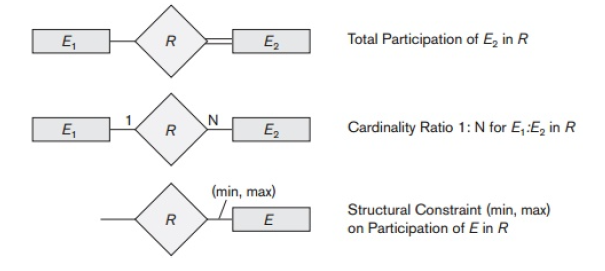
One-to-many (1:N)
Many-to-many (M:N)
Participation Constraint
Specifying minimum participation
Zero (optional participation, NOT existence dependent
One or more (Total participation, existence deponent)
Notation for Relationship Constraints
Relationship attributes appear in
M..N relationships but put at the n-side for 1-N
Each entity must participate at least ____ and at most ____
min, max
an entity does not have to participate if
they have no constraint (0,N) but it can participate at N times
What are the UML similarities to ER
Class = entity
Relationships = relationship
Multiplicities = cardinality
What are the Relationships in Class Diagram
Association: Two independent objects
Aggregation: two related objects, one is part of the other
Link attributes: similar to relationship attributes
Subclasses/Subtypes (Is-A relationship)
Can only be represented by EER (Extended Entity Relation Model)
subclass inherits all attributes & relationships of superclass
Specialization
Defines a set of subclasses of a superclass
Generalization
subclasses are generalized into one superclass