ap biology final
 Call Kai
 Learn
Learn Practice Test
 Spaced Repetition
 Match
Match Flashcards
 Knowt Play
1/86

There's no tags or description
Looks like no tags are added yet.
Name | Mastery | Learn | Test | Matching | Spaced | Call with Kai |
|---|
No analytics yet
Send a link to your students to track their progress
87 Terms
Rosalind Franklin
Used X-ray diffraction to discover the double-helical structure of DNA.
pedigree patterns of inheritance
a family tree indicating the presence or absence of the trait in question for each member of each generation
Mitochrondrial DNA
inherited from mother
Nondisjunction
Error in meiosis in which homologous chromosomes fail to separate.
Mendel's Law of Segregation
Alleles segregate from one another during the formation of gametes. (anaphase I)
Mendel's Law of Independent Assortment
genes found on different chromosomes are sorted into sex cells independently of one another. (metaphase I)
sex-linked traits
A trait associated with a gene that is carried only by the male or female parent.
Plasmids
small circular DNA molecules that replicate separately from the bacterial chromosome
Topiosomerase
relieves overwinding strain ahead of replication forks by breaking, swiveling, and rejoining DNA strands
DNA helicase
An enzyme that unwinds the DNA double helix during DNA replication
single stranded binding proteins
Proteins that act as scaffolding, holding two DNA strands apart during replication
DNA primase
synthesizes a short RNA primer to provide a 3'-OH group for the attachment of DNA nucleotides
DNA polymerase
Enzyme involved in DNA replication that joins individual nucleotides to produce a DNA molecule
DNA ligase
A linking enzyme essential for DNA replication; catalyzes the covalent bonding of the 3' end of a new DNA fragment to the 5' end of a growing chain.
Transcription
Transcription happens in three main stages:
Initiation: Transcription factors (proteins) help RNA polymerase bind to a specific DNA sequence called the promoter (often rich in T and A bases, known as the TATA box), which acts as the "start here" signal.
Elongation: RNA polymerase unwinds the DNA and reads the template strand in the (3' 5') direction. It builds the new mRNA strand in the (5' 3') direction by adding complementary RNA nucleotides (A pairs with U, C pairs with G).
Termination: The RNA polymerase reaches a specific sequence called the terminator, which causes the enzyme to detach and release the newly formed pre-mRNA transcript.
Translation
Initiation: The small ribosomal subunit binds to the mRNA and the initiator tRNA (carrying the amino acid Methionine, which corresponds to the "start" codon, AUG). The large ribosomal subunit then joins to complete the translation complex. [1
Elongation: The ribosome moves along the mRNA in the 5' to 3' direction. Transfer RNAs (tRNAs) sequentially enter the ribosome, match their anticodons to the mRNA codons, and transfer their amino acids to the growing polypeptide chain.
Termination: The process halts when the ribosome reaches a "stop" codon (e.g., UAA, UAG, UGA). A protein called a release factor binds to the stop codon, detaching the polypeptide chain from the ribosome
Epigenetics
the study of environmental influences on gene expression that occur without a DNA change
Parasitism
A relationship between two organisms of different species where one benefits and the other is harmed
Mutualism
A relationship between two species in which both species benefit
Commensalism
A relationship between two organisms in which one organism benefits and the other is unaffected
Symbiosis
A close relationship between two species that benefits at least one of the species.
Electrophoresis
Charge: DNA has a negatively charged sugar-phosphate backbone. When an electrical current is applied, the DNA migrates away from the negative electrode (cathode) and toward the positive electrode (anode).
Size: The gel acts as a molecular sieve. Shorter DNA fragments easily navigate the pores and travel further down the gel, while longer fragments are slowed down and remain closer to the starting wells
bacterial transformation
ability of bacteria to alter their genetic makeup by uptaking foreign DNA from another bacterial cell and incorporating it into their own
PCR
(polymerase chain reaction) multiple copies of a specific segment of DNA (amplify)
DNA sequencing
Determining the exact order of the base pairs in a segment of DNA.
Natural Selection
A process in which individuals that have certain inherited traits tend to survive and reproduce at higher rates than other individuals because of those traits.
convergent vs divergent evolution
Convergent evolution- process by which unrelated organisms independently evolve similarities when adapting from similar environments
Divergent evolution- the process in which an interbreeding population or species diverges into two or more descendant species, resulting in once similar or related species to become more and more dissimilar
Bottleneck vs Founder Effect
Bottleneck effect; the change in the gene pool of a species by the breeding of a small portion of the alleles of the genes of the parental population. i.e the many of the cheetah's died out, and only a small portion of the population carrying a small portion of the alleles originally present in the population, survived to breed.
Founder effect; a few individuals carrying a small portion of the populations gene pool become isolated from the population and interbreed.
comparison; in the founder effect a small number of individuals from the population relocate to a separate area. Which can be a bottleneck.
Hardy-Weinberg equilibrium
The Hardy-Weinberg equilibrium is a mathematical model used in AP Biology as a null hypothesis to determine if a population is evolving. It states that allele and genotype frequencies will remain constant across generations if five conditions are met: no natural selection, no mutations, no gene flow, large population size, and random mating
Cladogram
A diagram that is based on patterns of shared, derived traits and that shows the evolutionary relationships between groups of organisms
punctuated equilibrium
Pattern of evolution in which long stable periods are interrupted by brief periods of more rapid change
Gradualism
A proposed explanation in evolutionary biology stating that new species arise from the result of slight modifications (mutations and resulting phenotypic changes) over many generations.
altruistic behavior
action in which an organism helps another at its own expense
Ectotherm
An animal whose body does not produce much internal heat
Endotherm
An organism that is internally warmed by a heat-generating metabolic process
keystone species
A species that influences the survival of many other species in an ecosystem
sexual variation in meiosis
genetic variation in meiosis is driven by three core mechanisms that ensure offspring are genetically unique: crossing over, independent assortment, and random fertilization. These processes shuffle alleles, generating the raw material for natural selection
hydrogen bonding
the intermolecular force in which a hydrogen atom that is bonded to a highly electronegative atom is attracted to an unshared pair of electrons of an electronegative atom in a nearby molecule
Hydrolysis
A chemical process that splits a molecule by adding water.
dehydration reaction
A chemical reaction in which molecules combine by removing water
primary protein structure
sequence of amino acids
secondary protein structure
coiling or folding of a polypeptide due to H-bonding between amino acids (alpha helix and beta plated sheets)
tertiary protein structure
three-dimensional folding pattern of a protein due to side chain interactions
quaternary protein structure
2+ protein chains forming functional protein
structure of amino acids
- An R group
- the amine group
- the carboxyl group
- a hydrogen atom
DNA replication 5'-> 3'
DNA polymerase can only build new DNA strands in the 5' to 3' direction. Because DNA strands are antiparallel (run in opposite directions), this directional constraint creates two different pathways: the continuously built leading strand and the fragment-based lagging strand
Carbohydrates
Carbon, Hydrogen, Oxygen (CHO)
Lipids
(CHOP)
Proteins
(CHONS)
Nucleic Acids
CHONP
Phospholipid Bilayer
Plasma membrane layers composed of phospholipid molecules arranged with polar heads (hydrophilic) facing the outside and nonpolar tails facing the inside. (hydrophobic)
Golgi apparatus
A system of membranes that modifies and packages proteins for export by the cell
Lysosome
cell organelle filled with enzymes needed to break down certain materials in the cell
Mitochondria
Powerhouse of the cell, organelle that is the site of ATP (energy) production
Chloroplast
organelle found in cells of plants and some other organisms that captures the energy from sunlight and converts it into chemical energy
Vacuole
Cell organelle that stores materials such as water, salts, proteins, and carbohydrates
Membrane Selective Permeability
Membrane selective permeability is the plasma membrane's ability to regulate which substances enter and exit a cell, maintaining internal homeostasis. This property arises directly from the fluid mosaic structure of the phospholipid bilayer
active transport
Energy-requiring process that moves material across a cell membrane against a concentration difference
passive transport
Requires NO energy, Movement of molecules from high to low concentration, Moves with the concentration gradient
Exocytosis
Process by which a cell releases large amounts of material
Endocytosis
process by which a cell takes material into the cell by infolding of the cell membrane
water potiential
Water potential is the potential energy of water per unit volume compared to pure water. It measures the tendency of water to move from one area to another through osmosis. Water always flows from an area of high water potential to low water potential
SA:V ratio
The "best" surface area-to-volume (SA:V) ratio is the highest ratio possible. A higher ratio means a cell or organism has more membrane surface area per unit of volume, allowing for highly efficient diffusion of nutrients, waste, and thermal energy
cellular respiration lab setup
The AP Biology Cellular Respiration Lab (often Investigation 6) measures respiration rates by tracking O@ consumption in germinating and non-germinating seeds at various temperatures. Potassium Hydroxide (KOH) is used to absorb CO2 allowing direct measurement of gas volume changes in respirometers
enzyme-substrate complex
A temporary complex formed when an enzyme binds to its substrate molecule(s).
Enzyme reaction rates are affected by
1. Shape- "Lock and Key Model" if it is the wrong shape it will not work.
2. Temperature- each enzyme works best at a specific temperature
3. Ph-- each enzyme works best at a specific ph
What are the steps of cellular respiration?
1. Glycolysis, 2. Pyruvate Oxidation, 3. The Krebs Cycle, 4. Oxidative Phosphorylation
Where does glycolysis occur?
Cytosol/cytoplasm
What happens during glycolysis?
A 6-carbon glucose molecule is split into two 3-carbon pyruvate molecules.
What is the net gain of ATP from glycolysis?
2 ATP
What is produced during glycolysis besides ATP?
2 NADH
Does glycolysis require oxygen?
No, it occurs under both aerobic and anaerobic conditions.
Where does pyruvate oxidation occur?
Mitochondrial matrix
What happens during pyruvate oxidation?
Pyruvate is converted into Acetyl-CoA, releasing CO2 and generating NADH.
Where does the Krebs Cycle occur?
Mitochondrial matrix
What is produced in one turn of the Krebs Cycle?
1 ATP, 3 NADH, and 1 FADH2
What happens during the Krebs Cycle?
Acetyl-CoA combines with a 4-carbon molecule to form citrate and is fully oxidized, releasing CO2.
Where does oxidative phosphorylation occur?
Cristae
What are the two parts of oxidative phosphorylation?
Electron Transport Chain (ETC) and Chemiosmosis
What happens in the Electron Transport Chain?
NADH and FADH2 drop off electrons, creating a proton gradient.
What is the role of oxygen in oxidative phosphorylation?
Oxygen serves as the terminal electron acceptor, forming water.
What powers ATP production during chemiosmosis?
Protons rushing back down their concentration gradient through ATP synthase.
oxidation v reduction
OIL(loss of electrons) RIG (gain of electrons)
- combustion, photosynthesis, metabolism
signal transduction pathway
A series of steps linking a mechanical, chemical, or electrical stimulus to a specific cellular response.
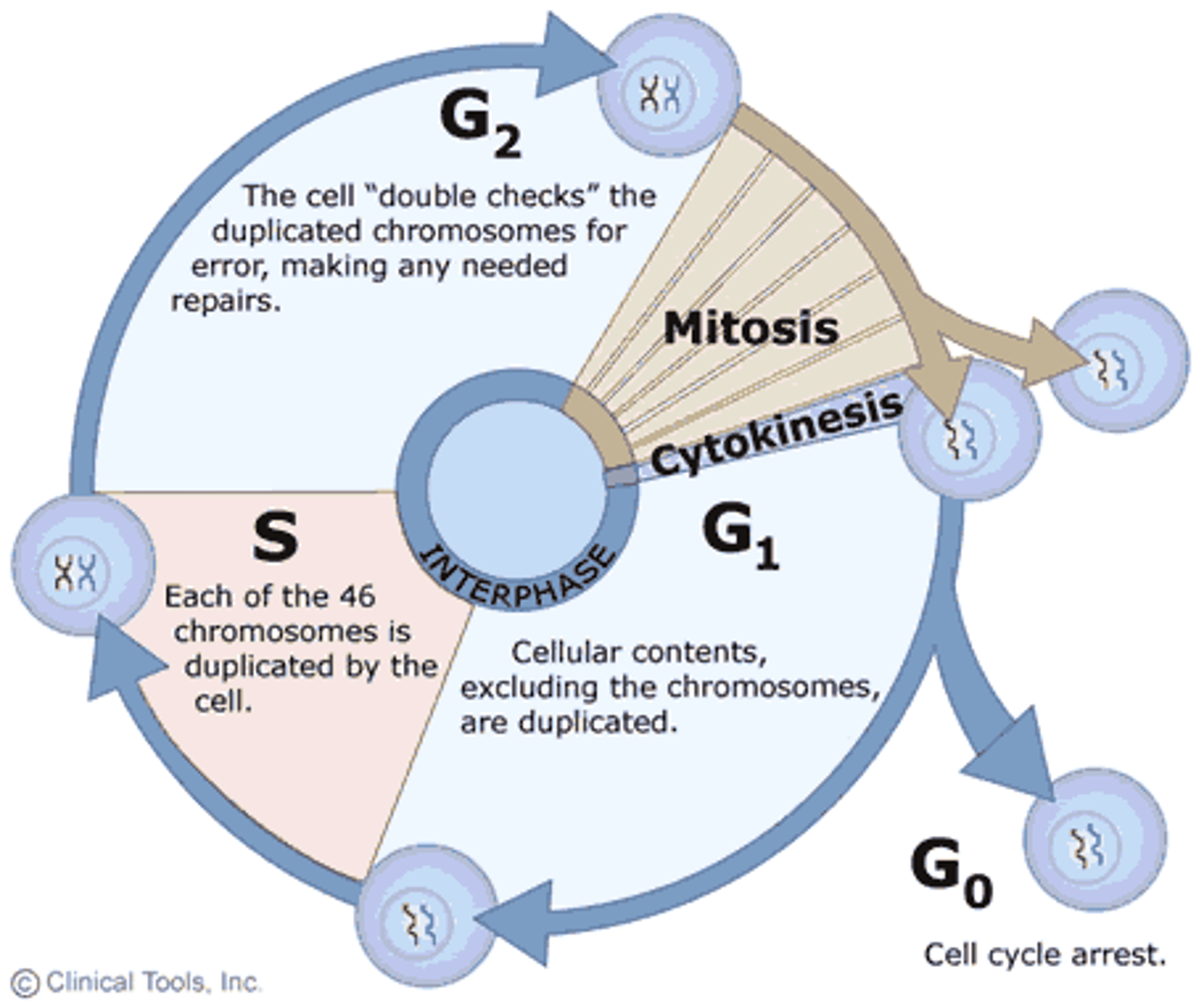
cell cycle stage
1. Interphase
The cell spends about 90% of its life here, preparing to divide. : The cell grows, produces proteins, and carries out its normal metabolic functions.
S Phase (Synthesis): The cell replicates its DNA so each chromosome consists of two identical sister chromatids.
G2 Phase (Gap 2): The cell continues to grow, makes necessary proteins, and duplicates organelles to prepare for the final split.
2. Mitotic (M) Phase
Mitosis and Meiosis Differences
Mitosis: "identical"- one diploid cell(2n) becomes two diploid cells(2n)
Meiosis: "reductional"- one diploid cell(2n) becomes four haploid cells(n)
Cyclins and CDKs
Cyclins and Cyclin-dependent kinases (CDKs) are internal control proteins that regulate the cell cycle. CDKs are enzymes that are always present in the cell but are inactive by default, whereas cyclin levels fluctuate predictably. When cyclins bind to CDKs, they activate a phosphorylation cascade that drives the cell forward into the next phase