Language & Development - Block 1
 Call Kai
 Learn
Learn Practice Test
 Spaced Repetition
 Match
Match Flashcards
 Knowt Play
1/69

There's no tags or description
Looks like no tags are added yet.
Name | Mastery | Learn | Test | Matching | Spaced | Call with Kai |
|---|
No analytics yet
Send a link to your students to track their progress
70 Terms
Uniquely human
Language in all its complexity is _________ _____
Intro facts about language
All human groups on earth have language
All languages are equally expressive
All languages are easily learned by children
A critical evolutionary step in human evolution
Even though it comes easily to most of us: People may lose this ability, not have fully developed it, or may not be able to learn it
Natural language
Communication system of arbitrary signs
Sign components
Spoken/written form, world reference, concept
Arbitrary
No transparent or intrinsic relation between the sign and its reference, not iconic
Motor way signs
These are NOT arbitrary
Communication system
Set of shared rules that establish a systematic mapping between words and the world
Rules are implicit and established by common use
9 Characteristics of a natural language (Hockett)
Semanticity, Arbitrariness, Discreteness, Displacement, Productivity, Traditional Transmission, Duality of Patterning, Prevarication, Reflexiveness
Semanticity
language conveys meaning or referring to something
Displacement
We can talk about things that aren't present or factual
Cultural Transmission
Languages are learned in a community of native speakers
Discreteness
Linguistic units (sounds, words) are perceived as distinct from one another rather than as a continuum
The sounds "R-OO-M" in room, distinct from those in LOOM
Productivity
New words can be created, new meanings can be generated, recursive rule*
Recursive rule
A rule for a sequence in which one or more previous terms are used to generate the next term. It can be re-applied to its output
Duality of patterning
A handful of meaningless sounds can be combined to produce thousands of meaningful words
Combination of units at several levels
Example: word + "-ness" = sadness, lightness, craziness
Word parts can combine into other words and combine into sentences (syntax)
Learnable structured patterns
Combinations follow language-specific patterns (rules) giving rise to:
No
Is Morse code a natural language distinct from spoken languages like English?
No (2)
Is music a natural language?
Comprehension
Mapping word sounds to stored meanings involves:
Recognizing sounds and words (cat, not pat or pal)
Accessing/retrieving the meaning of the word (cat = domestic animal)
Combining words into a message (establishing relationship between words, lion killed the cat vs lion was killed by the cat)
Damage to Broca's area
Mr. Landry doesn't know which animal died when stating “The leopard was killed by the lion.” He only understands nouns and verbs, not other words or endings.
Production
Fluent speech takes longer to appear in learning —> speaking is harder than comprehending
Speaking involves
Retrieving words from memory
Putting words together
Fine grained motor planning
Koko the gorilla
Example of displacement; Koko is a gorilla that has been taught sign language
Arbitrary
Primate alarm calls for snakes, eagles, and leopards in vervet monkeys are learned or inherited. Do not represent the sounds these predators make. Referential calls, not just a behavioural reflex
Chimpanzee Vicky
Animals do not have complex systems in the world but can they learn a human language?
This animal was raised in a family alongside a child and with intensive speech therapy, she learned to say 4 words.
Human vocal anatomy
Longer oral cavity and much lower larynx, compared to orangutan and chimpanzee
Whashoe (chimp) and Koko (gorilla)
These animals went through intensive practice and training with modified ASL. But not very clear that signs were spontaneous because the researchers are showing her the sign beforehand.
Lana (bonobo)
Another animal taught with visual signs. She pushes keys to get things
Kanzi the Chimp/bonobo
Spontaneously learned looking at his mother
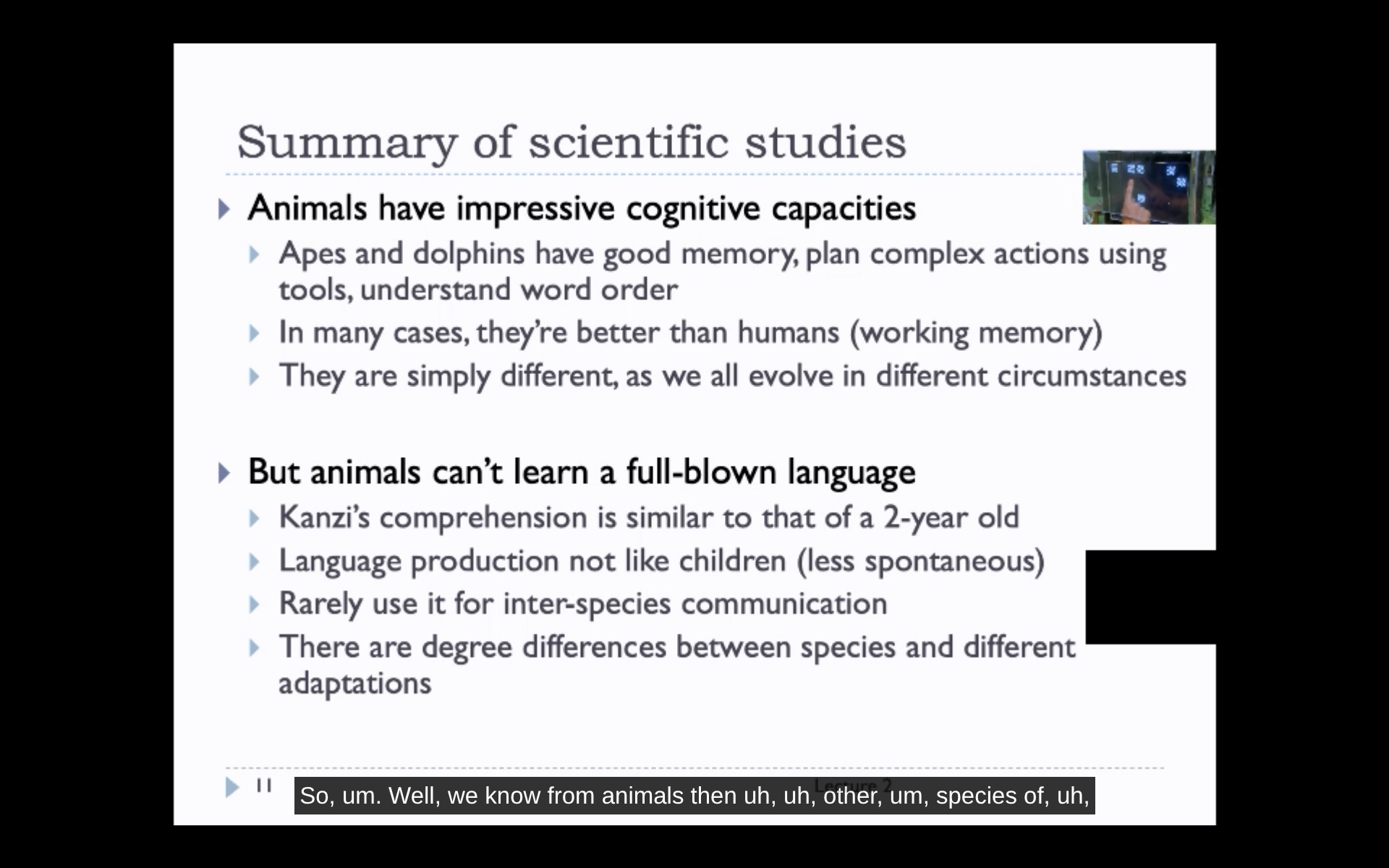
Best example of apes' cognitive abilities in optimal conditions (make tools and plan complex actions; knows hundreds of words; understands sentences, word order, and complex phrases like a 2 year old, suggest something a lot closer to human languages)
Productivity in expressing thought
What feature of human languages is absent in Kanzi?
Reference, productivity in expressing thought, analyzing sentences, or use of arbitrary signs
Non-primates
They can tell us how much communication systems evolved independently of human lineage.
Dolphins
In the wild: sociable, learning from parent to child, signature clicks, creative behavior, cross-species cooperation
In captivity: capable of high cognitive abilities, can categorize objects, absence, and presence of objects, complex concepts like under and thru, artificial language with word order variation
Summary of animal studies
28%
Mammals are born with 90% of brain mass, whereas humans are both with:
This allows for opportunity to learn and wire connections
Social-communicative urge
Young babies naturally cooperate with others, whereas chimps do not 1st other factor operating thru evolution
Joint attention and understanding of others communicative intentions
We have an innate cognitive capacity for these: although dogs can do this, they lack other necessary characteristics they can't do elbow cross pointing though (3 year olds can)
They are domesticated
Why can dogs understand pointing?
Do animals have communication systems similar to human languages?
If you look at actual properties of human languages, other species appear limited in
- The extent they communicate in nature
- The extent to which they can learn human languages
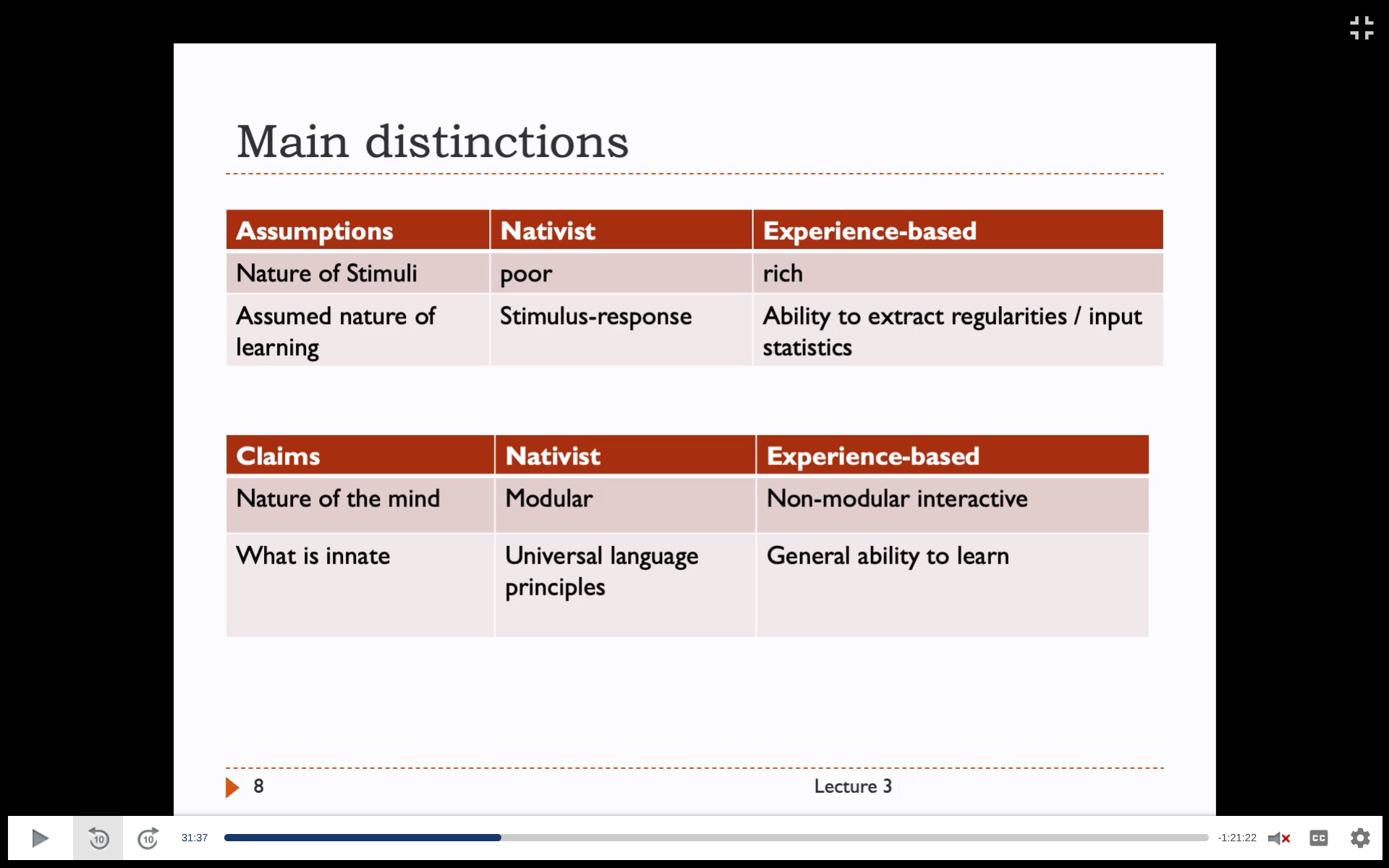
Innate modular view
Language is an instinct
Innate knowledge of universal language principles
Innate language organ guiding acquisition: a separate brain system, independent of other cognitive abilities
Based on poverty of stimulus argument
poverty of the stimulus argument (Chomsky)
the argument that the linguistic environment to which a child is exposed is not good enough to enable language acquisition on its own
Take a recursive rule:
Children cannot learn this rule from input: They do not encounter sufficient evidence to learn these rules. They must analyze the sentence structure, and this is not taught
They could not learn this rule by stimulus-response conditioning
Conclusion: universal structural principles are innate
Experience-based interactive view
Linguistic and non-linguistic input is rich and structured (Child must map one to the other and social interaction gives you feedback)
Children cannot learn extract rules/patterns over time (Sentence structure can result from learning: sensitivity to regularities in the input)
There is a general innate capacity to learn from experience, but not language specific principles (This innate capacity may include instinct to communicate and innate computation power — domain general, not language specific)
Innate vs experience
photo
Nativists
If language is modular, we should find dissociations between language and other cognitive abilities (e.g., visuo-spatial, IQ)
Williams Syndrome
a disorder characterized by impairments of spatial cognition and IQ but superior linguistic abilities Nativist claim: evidence of intact language vs impaired cognition (developmental delay)
Specific language impairments
Impairments in distinguishing sounds, sentence understanding, producing well-formed sentences
Nativist claim: typical cognition vs impaired language at several levels
Criticisms of nativist claims - Williams syndrome
- Language rules are not intact but impaired, delayed language development
- Genes can have cascading effects in many cognitive effects
Criticisms of nativist claims - Specific language impairments
They are not language specific: working memory and sound processing deficits may be the problem (Because small words like by, a, was, and endings like -ed are not phonologically stressed, children have difficulties extracting structural patterns in the input)
Can humans invent a language?
Nativists: if there are innate language principles, children should invent a language with little input
Feral children and cases too varied to make conclusion
What happens to children deprived of linguistic input?
Nicaraguan Sign Language (NSL)
Evidence for sensitive period!!! Sign language developed by deaf children in Nicaragua Two generations of signers were observed: First group of older students arrive with their home signs (less consistently used, oriented to global meaning without sub units) Younger signers learnt this rudimentary system, but: conventionalized and regularized the rules along with adding subtler distinctions to express more info more efficiently
Over generalization error
Mouses instead of mice
Sensitive period: nature vs nurture
Nativist:
Young signers create a regular system with little input due to innate principles
Maturation of language system is innately determined
Non-nativist:
Sensitive period is due to initial brain plasticity
Sensitive period is not language specific but found in other domains
The brain extracts generalizations from patchy input for all types of input
Learner needs the right kind of input
What appears to be innate?
- Instinct or social pressure to communicate.
- Developmental constraints: neural plasticity and brain growth along with experience.
- The ability to extract patterns and generalise from experience.
Sentential markers
English: train arrive-d (tense) Turkish: train arrive-di (evidence type)
Vocabulary differences
color terms (light and dark vs many other terms)
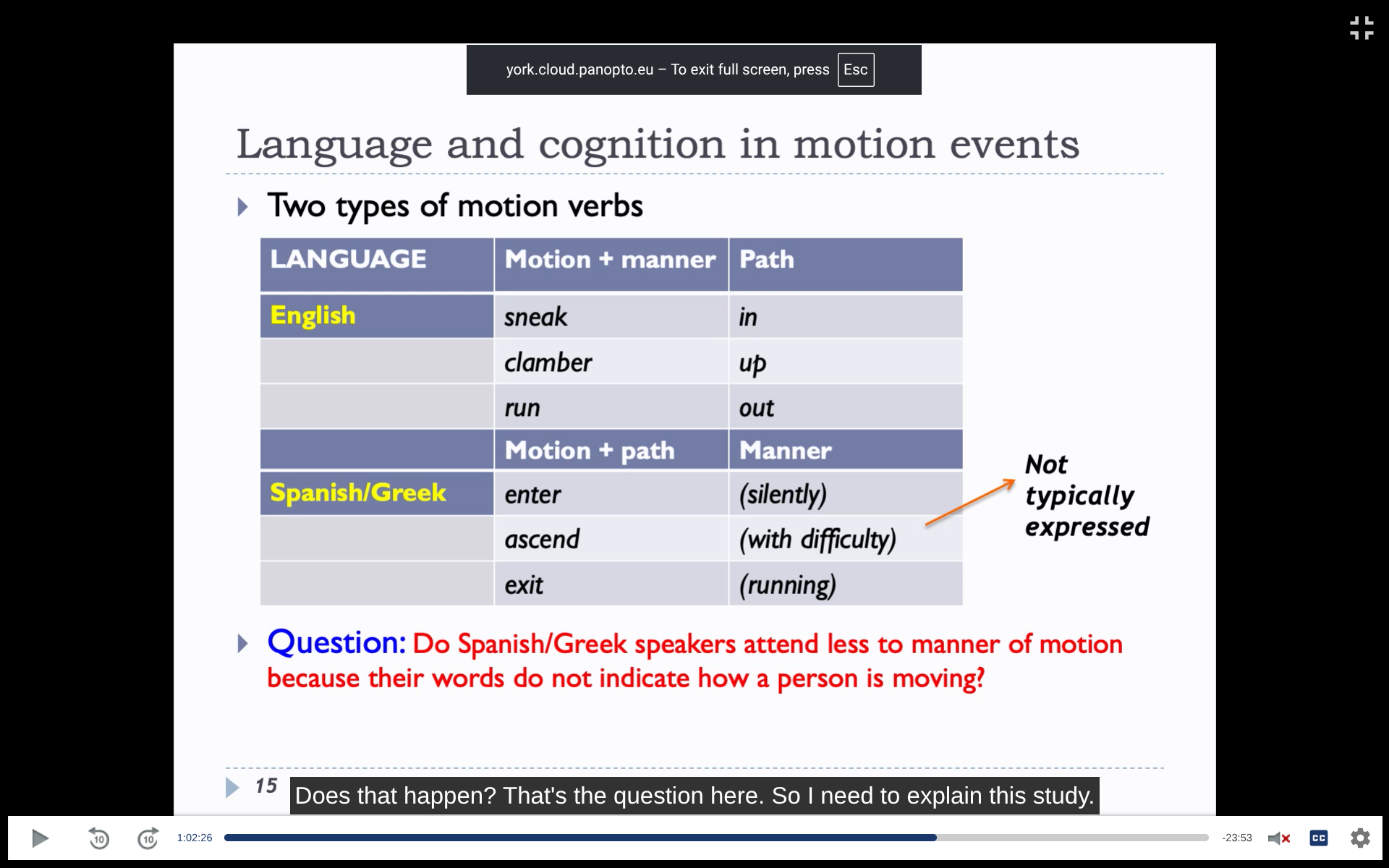
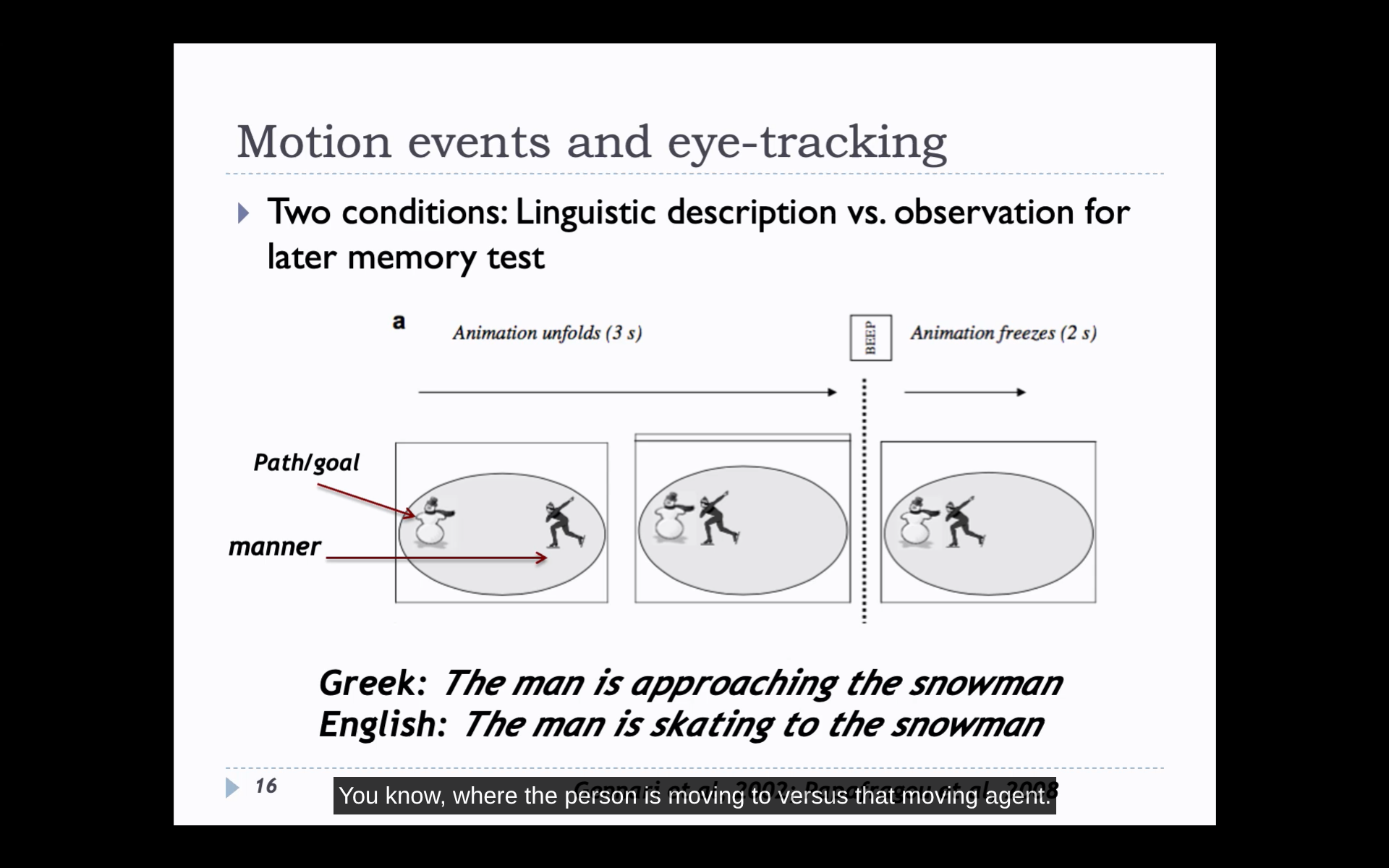
motion verbs (manner verbs vs path verbs)
Manner verbs tell how the action happens (the gait, style, or physical characteristic of the movement).
Examples: run, swim, stumble.
Path verbs tell where the object goes (the trajectory or direction of the movement).
Examples: enter, descend, cross.
Can language-specific characteristics shape our mental representations?
Universal (innate, modular view)
- No. All humans have similar representations
- Languages differ in the way they map the same thoughts into words
Linguistic relativity (learning, interactive view)
- Maybe. Language may influence our mental representations at least in some circumstances
Summary for this unit
Munsell color system
a color naming system based on hue, saturation, and value
Berinmo Language
Language with five basic color words.
English speakers were better for blue/green, but these speakers were better for nol/wor
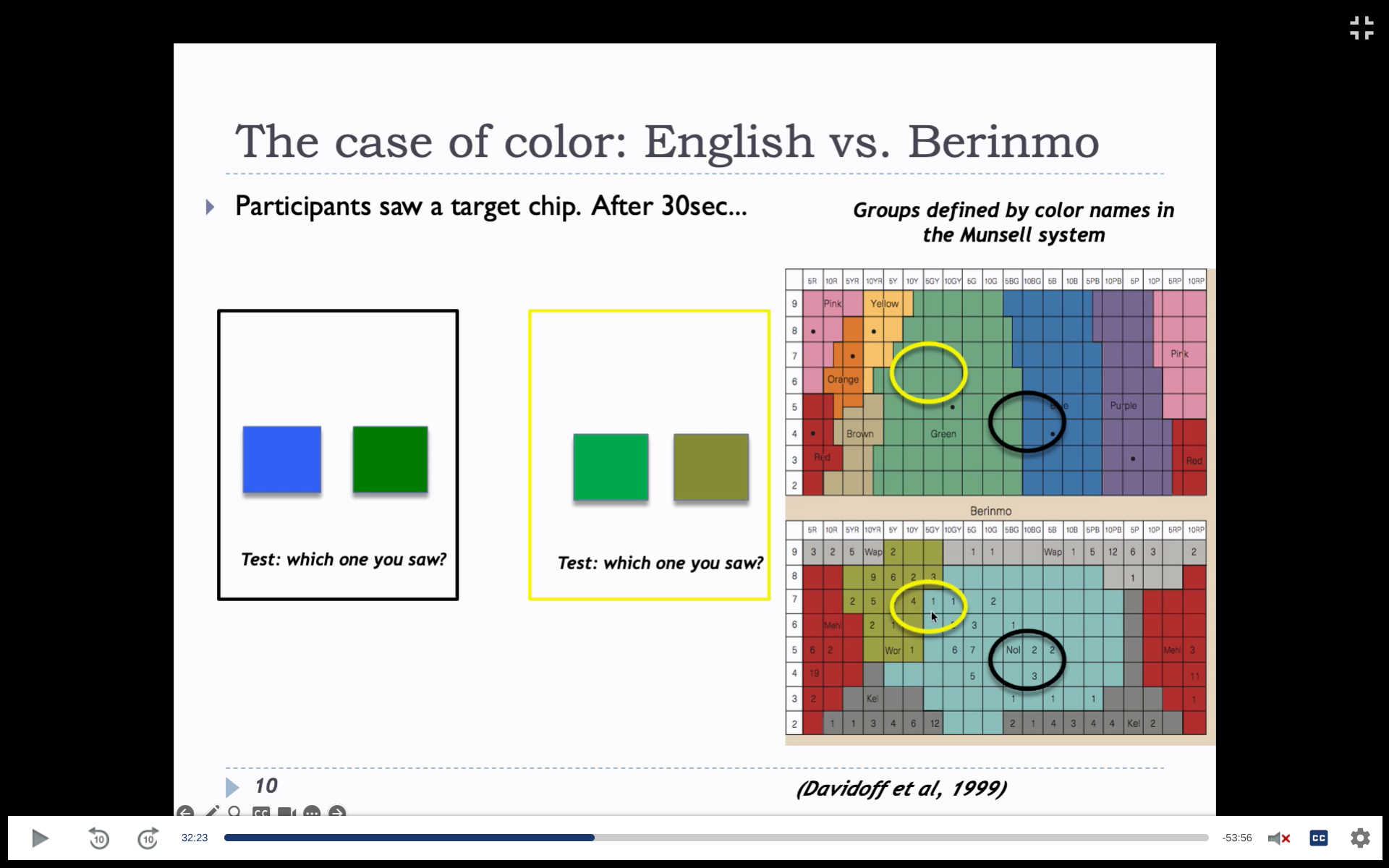
Color names help us discriminate colors in memory
What does this study show?
note: but can we infer from this that color names typically alter our ability to discriminate colors and whether this effect generalizes to other situations
Winawer et al. (2007)
Evidence for Linguistic Relativity: Colour Perception
In general, speakers are faster between colour categories than within
Ie. if ppts are presented with 3 patches, they are faster to distinguish between two green and one red, than two dark green and one light green
Russian speakers: have two different categories for blue: light blue (goluboy) and dark blue (seigney)
English speakers: have one category for blue
So Russian speakers should be faster than English speakers when one square is from the light blue category and two are from the dark blue category
For Russian speakers, they cross a colour category, for English speakers, they don't
Task: carried out under different levels of itnerface
1) Task without any interference
2) Rehearsing Digits: intended to inhabit language - keeping the phonological loop full so ppts not able to engage language as much
3) Maintaining a visual pattern: takes up processing but not specifically language (control)
Results For the no interference condition:
Russian speakers significantly faster when the colours were across categories than within colour categories
English speakers: showed no significant difference between the two, were just as slow whether it was light blue/dark blue or two shades closer together
For the spatial interference condition
Same pattern
For the Verbal Interference Condition
The effect disappears, Russian speakers equally slow in both conditions
Conclusions
Language CAN affect perception, the way people see the world seems to be different in different languages
Gilbert et al. (2006)
Manipulating which brain hemisphere receives visual info first
Left hemisphere is where words are stored
Task: identify odd one out fast
Results: language effect (English vs Russian) only when LH is first
Conclusions from Gilbert et al. (2006)
Color words do not permanently alter perception
We see an influence of language on some perception tasks
When color words are quickly activated in the left hemisphere
When people can rely on words to perform a memory or discrimination task
Consistent with linguistic relativity or the Whorfian hypothesis!
Two types of motion verbs
photo
Gennari et al. (2002)
Study showing similar memory across languages.
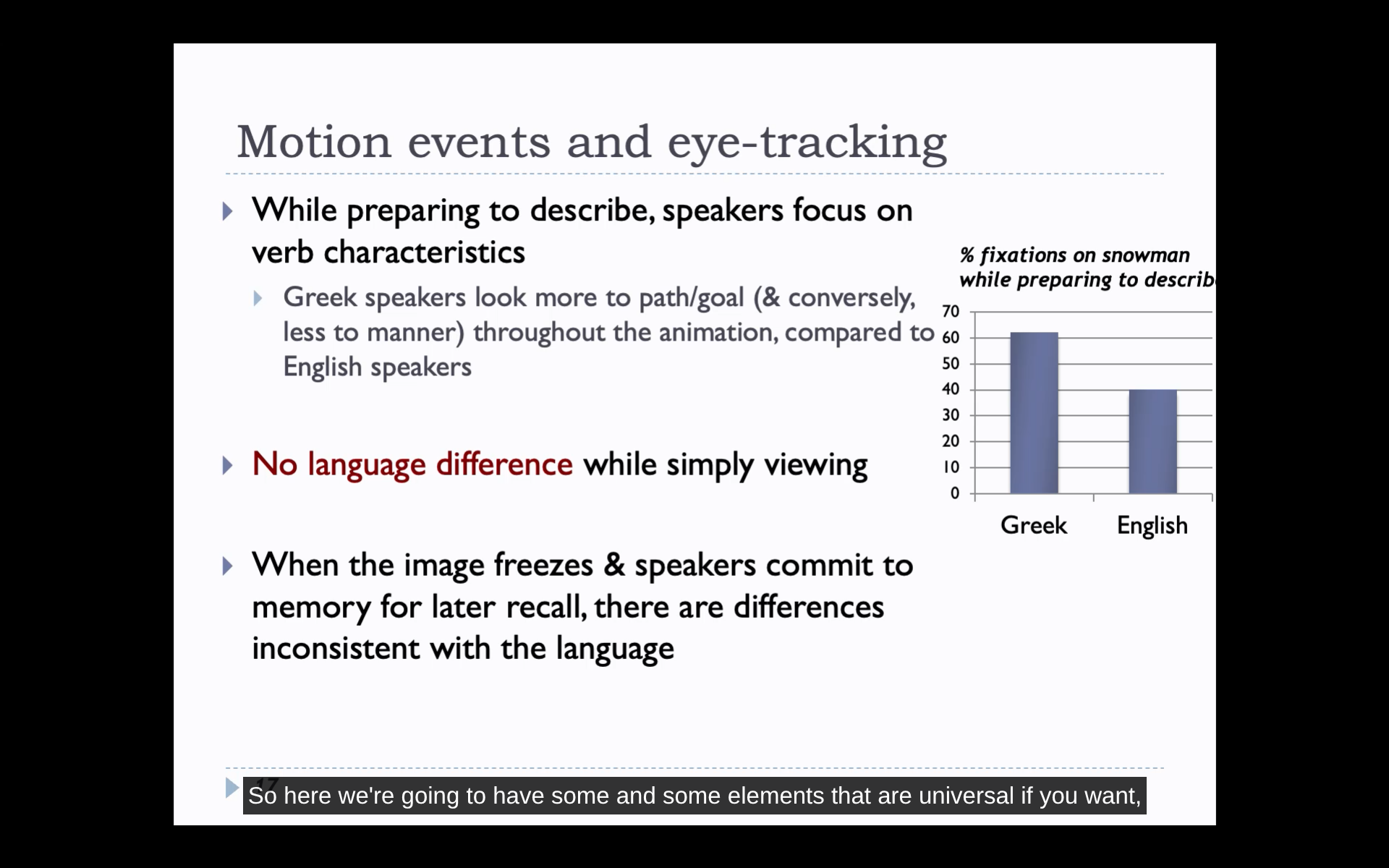
Papafragou et al (2008) and Gennari results
What do these motion studies tell us?
Attention allocation depends on the task: observation vs description
Describing elicits language-specific pattern of looks
Simple observation does NOT seem to involve linguistic meaning, unlike color names
But language might be used to memorize events
Conclusions
Language may influence some cognitive representations depending on task and stimulus types (colors vs events) (e.g., language may help memory or perceptual discriminations)
Evidence consistent with language relativity view
Habitual or learned words-to-world associations can be useful if this makes task performance more efficient
Against universal view
Review
All tutorial notes and studies