15.5 - Damped Simple Harmonic Motion
 Call Kai
 Learn
Learn Practice Test
 Spaced Repetition
 Match
Match Flashcards
 Knowt Play
1/3

There's no tags or description
Looks like no tags are added yet.
Name | Mastery | Learn | Test | Matching | Spaced | Call with Kai |
|---|
No analytics yet
Send a link to your students to track their progress
4 Terms
Damped Harmonic Motion
Damped harmonic motion is a type of oscilaltory motion in which a dampening factor is introduced; this dampening factor results in the motion eventually ceasing after a set amount of time. The dampening factor can be due to drag, friction, air resistance, etc, but regardless of its source, the end result is always the same: motion must cease eventually.
This is why pendulums eventually come to a stop and do not swing forever; furthermore, this is why pendulums also reduce in the maximum magnitude of their angular displacement on each swing: drag reduces the maximum angular displacement per swing by some factor.
Motion for Damped Harmonic Motion
The way that we determine the equation of motion for a damped harmonic oscillator is by the following:
Realize that there is a drag force present that acts opposite of the direction of motion that is also proportional to the velocity of the object; imagine a mass-spring system in which the mass is attached to a vane in a jar of water. The vane moves downwards (as does the mass-spring system), but the drag from the water resists the downwards motion and pushes upwards. Regardless of the motion of the mass-spring system itself, the drag force will always be directed in the direction opposite of the motion. So we have Fd = -bv; where b is the dampening factor and v is the velocity of the mass-spring system and vane (since they are all a part of the same system after all).
We also have the spring force that acts as a restoring force and thus opposes the direction of motion: Fs = -kx.
Finally we sum the forces in the y direction to obtain Fy,net = -bv -kx. We then set this sum equal to ma (Newton’s 2nd Law) to obtain: -bv -kx = ma.
We omit gravity for simplicity’s sake.
We then realize that each of the terms can be written with respect to position so as to obtain a 2nd-order, linear, differential equation:
v(t) = dx(t)/dt
a = dx²(t)/d²(t)
Once we solve the 2nd-order differential equation, we obtain the solution as necessary.
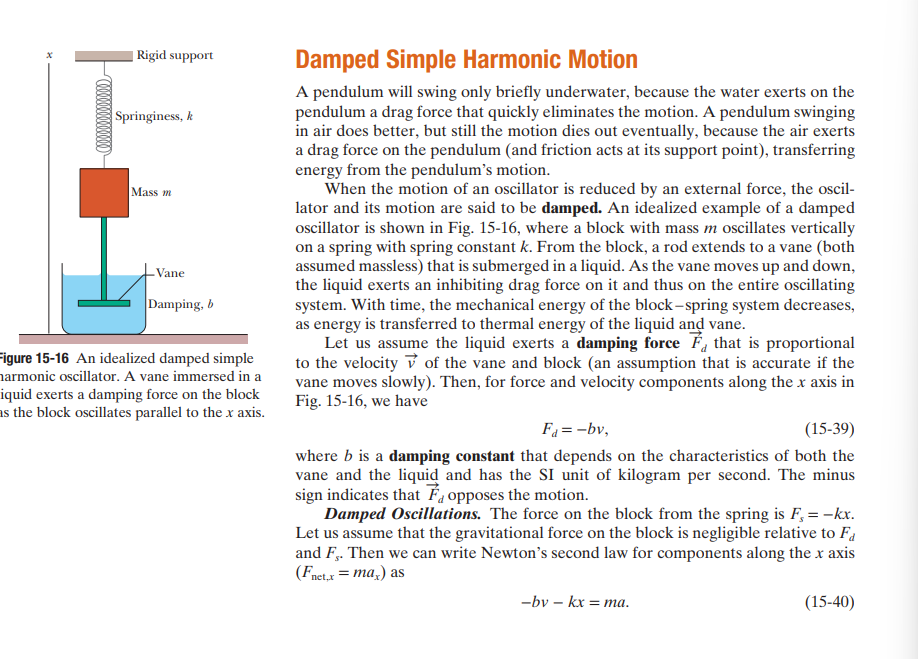
Differential Equation for Damped Harmonic Motion
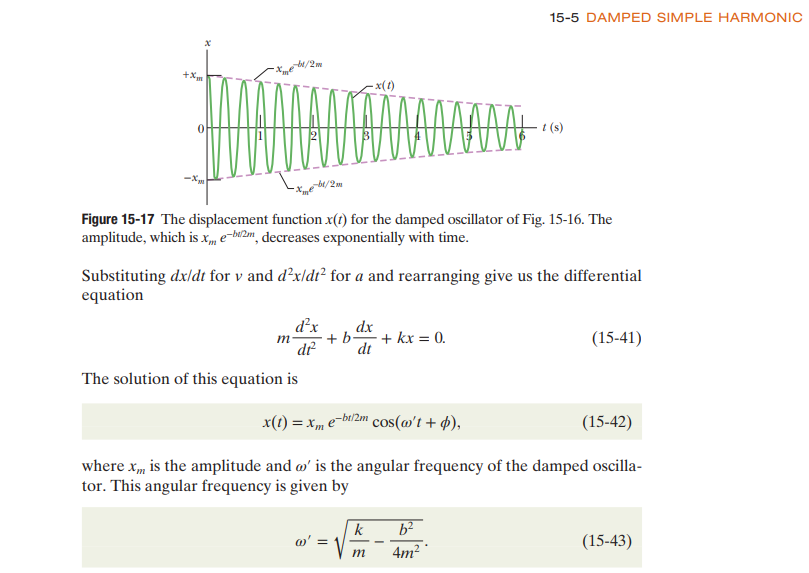
Mechanical Energy of a Damped Harmonic Oscillator