production analysis
 Call Kai
 Learn
Learn Practice Test
 Spaced Repetition
 Match
Match Flashcards
 Knowt Play
1/31

There's no tags or description
Looks like no tags are added yet.
Name | Mastery | Learn | Test | Matching | Spaced | Call with Kai |
|---|
No analytics yet
Send a link to your students to track their progress
32 Terms
input in the long run
all factors of production can be flexible
inputs in the short run
only one input may be flexible
production function
Q = F(L,K)
cobb douglas production function
Q = F(L,K) = L^α K^β
inputs have a degree of substitutability
linear production functions
Q=F(L,K)=αL+βK
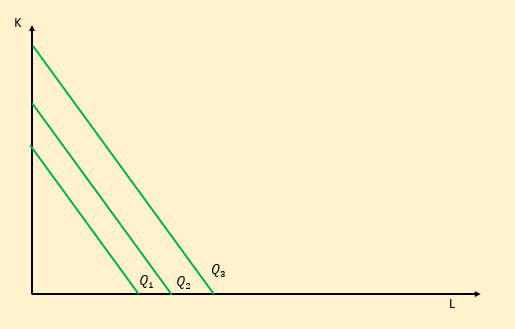
inputs are perfect substitutes
leontief production function
Q(L,K)=min{αL,βK}
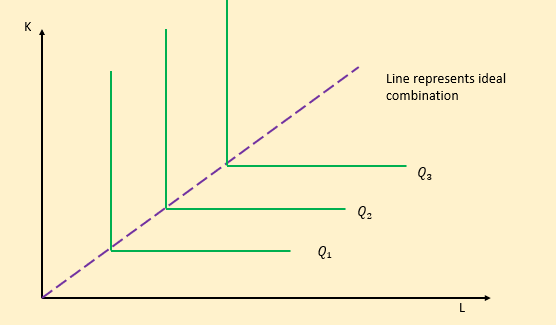
inputs must be used in fixed portions (perfect compliments)
short run production function
only one input is changing so Q=F(L,K ̅ )
average production
APL = Q(L,K)/L
marginal product
MPL = ΔQ/ΔL
as one input changes it will impact the MP of both goods if L increases MPL will decrease and MPK will increase
marginal product of labour
dQ/dL
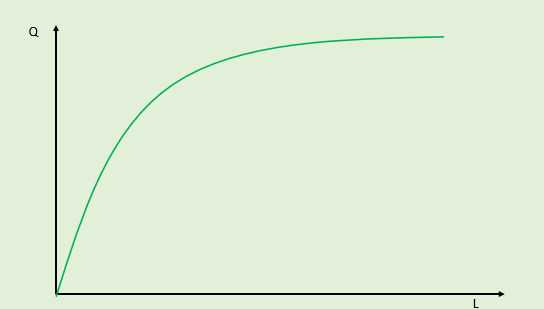
diminishing marginal returns
the next unit will not be as productive as the last
profit maximising input
occurs when the value of the marginal product is equal to the cost of the input
value of marginal product
P * MPL
keep hiring until the benefit is equal to the cost
assumptions and issues of production functions
full efficiency is assumed, but this is not realistic
estimations are hard
need inputs to make outputs
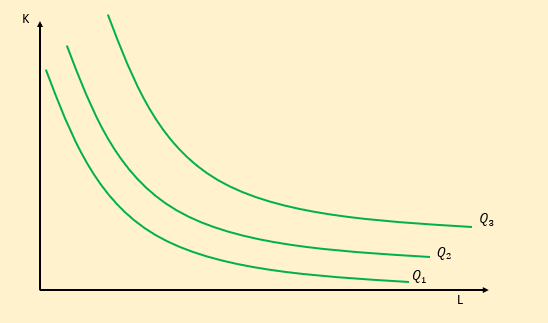
isoquants
like indifference curves, shows the efficient combinations of labour and capital that can produce the same level of output, the slope is the marginal rate of technical substitution
marginal rate of technical substitution
MRTS = MPL / MPK
how much of one input needs to increase to decrease the other input by one, maintaining the same output
isoquant - cobb douglas Q=L^α K^β
isoquant - perfect substitutes Q= αL+βK
isoquant - perfect compliments Q(L,K)=min{αL,βK}
returns to scale
increasing → increasing by x% output increase more than x%
decreasing → increasing by x% output increases but less than x%
constant → increase by x% means an equal output increase by x%
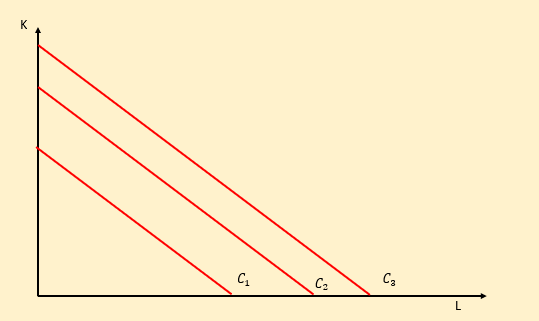
isocosts
shows every combination of inputs that yield the same cost
C (L,K) = wL + rK
r → rental
w → wage
cost minimisation
firms produce in the cheapest way possible
min wL + rK (subject to) Q = f(L,K)
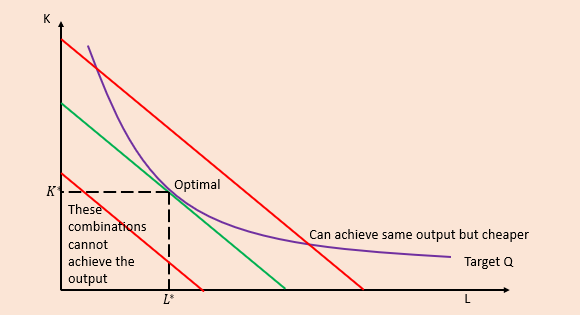
tangency point between the lowest isocost and isoquant
the point where
MRTS = w/r
MPL / MPK = w/r
cost of an input causes isocost to
pivot and will no longer hold MPL/MPK = w/r
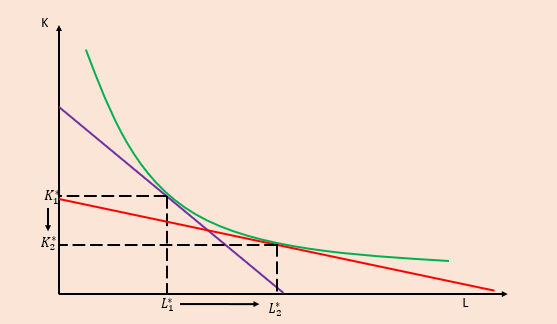
what happens to change in input costs if inputs are perfect substitute
inputs must be able to be used interchangeably eg. short and long wood or humans and robots
must find cheapest possible output
happy to have corner solutions
corner solutions
to minimise costs will only use one of the substitutable inputs and ignore the other
change in costs with perfect compliments
need to have a given ration eg recipes
need to find the minimum combination of goods that can achieve the output
types of costs
total
variable → vary with output
fixed costs → do not vary with output
marginal costs → how much do costs increase to increase output by 1
cost functions
how much does it cost to produce at a given amount
eg TC (Q) = 2Q2 + Q + 5
VC = 2Q2 + Q
FC = 5
deriving the cost function
find tangency conditions
make an input the subject and sub into output
rearrange for output
find both inputs in terms of output
sub to the TC function
multiple product cost functions
C(Q_1,Q_2 )=α+βQ_1 Q_2+δQ_1^2+γQ_2^2
C(Q_1,0)+C(0,Q_2 )>C(Q_1,Q_2 )
some inputs can be used in both goods
cost complementarity
the cost of producing good 1 declines with and increase in production of good 2
take derivative with respect to one output then take that with respect to the other output