Endocytosis
 Call Kai
 Learn
Learn Practice Test
 Spaced Repetition
 Match
Match Flashcards
 Knowt Play
1/62

There's no tags or description
Looks like no tags are added yet.
Name | Mastery | Learn | Test | Matching | Spaced | Call with Kai |
|---|
No analytics yet
Send a link to your students to track their progress
63 Terms
What contain acid hydrolases which can digest every type of biological molecule
lysosomes
The what pH optimum of these enzymes is maintained by a proton pump (H+-ATPase)
low
marker of aging
neurons
a mitochondrion and peroxisome enclosed in a double membrane wrapper
What is happening
Autophagy
autophagic vacuole (autophagosome) fuses with what
lysosome
uptake of macromolecules from extracellular fluid
Endocytosis
nonspecific uptake of extracellular fluids
Pinocytosis
uptake of specific extracellular ligands following their binding to receptors
Receptor-mediated endocytosis
uptake of large particulate matter (food, bacteria); specific to some cell types
Phagocytosis
Endocytic Pathway
• what is taken in from the extracellular space
Molecules
Endocytic Pathway
• What taken in from the plasma membrane and recycled back to the plasma membrane
Receptors
Endocytic Pathway
• Newly synthesized molecules coming from where and being sent to lysosomes
ER
Uptake of yolk lipoproteins by hen oocyte
Receptor-mediated endocytosis
Structure of coated pits due to structure of clathrin
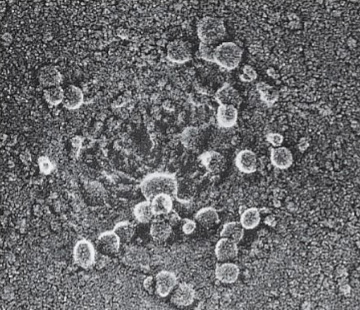
LDL-cholesterol droplets on extracellular surface
Structure of coated pits due to structure of clathrin
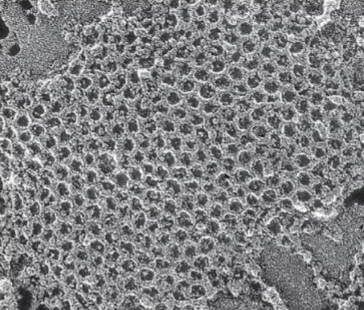
Clathrin-containing polygons on inner surface of cell
Structure of coated pits due to structure of clathrin
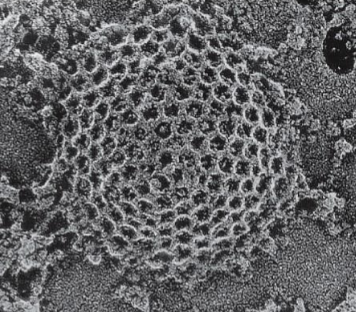
Cytosolic surface showing invagination of clathrin coated pit.
Triskelions: # heavy chains + # light chains
3, 3
36 overlapping triskelions
Clathrin cage
Endocytosis from plasma membrane
Adaptor:
AP2 complex
from Trans Golgi Network to lysosome
Adaptor:
GGA
AP2 adaptor: # polypeptides; binds accessory proteins
4
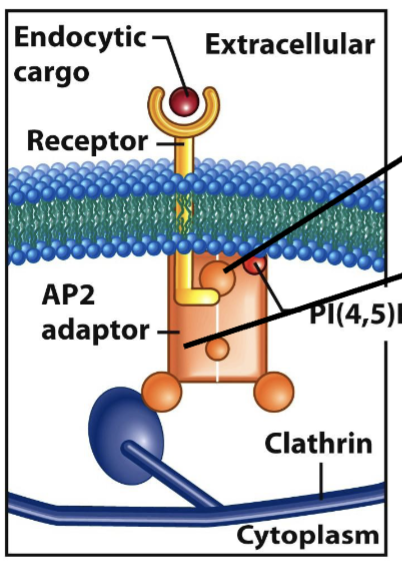
interacts with cytoplasmic tails of receptors (bound to cargos)
μ chain
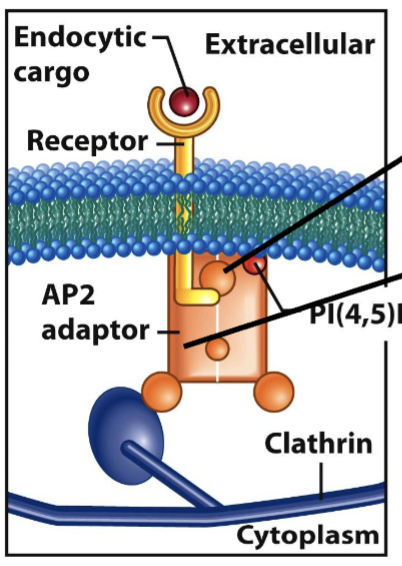
recruits clathrin
β-adaptin
recruits AP2 to the PM
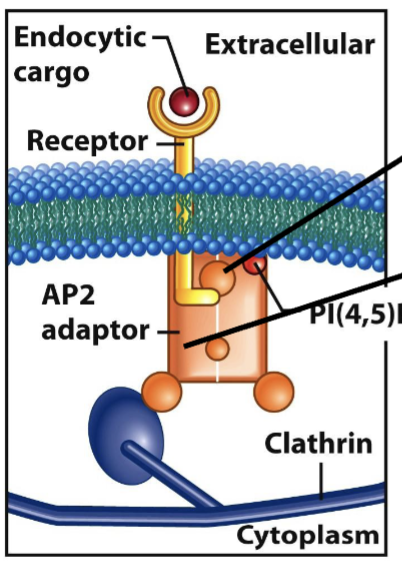
PI(4,5)P2
cytosolic proteins but must be recruited to correct organelle when needed
Adaptors
phospholipids unique to the specific organelle
Adaptor recruitment
Adaptor proteins provide what at each membrane
– PM : AP2; TGN : GGA (lysosomal enzymes)
specificity
headgroups that interact with specific protein domains
Phosphoinositide phosphate lipids (PIPs)
PIs provide modifiable/customizable what profiles unique to different organelles
lipid
Several PI and PIP kinases/phosphatases are localized to different organelles where they what the production/removal of these lipid species
catalyze
forms helical collar (polymerizes)
Dynamin
twisting motion in the helix; membrane fission
GTP hydrolysis
ATPase Hsc70, recruited by what, is required to dissociate the clathrin coat
auxillin
Clathrin Coat Formation
Cargo selection and clathrin recruitment via what
adaptors
Clathrin Coat Formation
Pinching off from membrane via what
dynamin
Clathrin Coat Formation
Uncoating of clathrin coated vesicle requires what
ATPase
vesicles and tubules that transport vesicle-bound material
endosomes
-near cell periphery
- sort materials and sends bound ligands
Early endosomes
-near the nucleus
-known as multivesicular bodies (MVBs)
Late endosomes
What happens to endocytosed materials? lysosomal degradation of what and transmembrane proteins
lipids
membranes, steroid hormone precursor; not water soluble
cholesterol
Cholesterol Made (and degraded) in the where and must be transported through the blood to cells
liver
~1500 esterified cholesterol molecules; phospholipids
protein: apolipoproteinB-100 (binds what receptors) carries from liver to cells
LDL:low density lipoprotein
protein: apolipoprotein A-I
carries excess cholesterol to liver
HDL:high density lipoprotein
bad
LDL
good
HDL
increased heart attack risk
high LDL
decreased heart attack risk
high HDL
Receptor-mediated Endocytosis: LDLs and Cholesterol Metabolism
LDL receptors are transported to where and bound to a coated pit
plasma membrane
Receptor-mediated Endocytosis: LDLs and Cholesterol Metabolism
LDLs are taken up by Receptor-mediated Endocytosis (RME) and taken to the lysosomes, releasing what for use by the cells
cholesterol
Receptor-mediated Endocytosis: LDLs and Cholesterol Metabolism
Uptake of what from blood is critical
LDL
Receptor-mediated Endocytosis: LDLs and Cholesterol Metabolism
Familial Hypercholesterolemia (FH)
• Mutation of what Receptor
LDL
high levels in the blood promote plaque build-up in blood vessels resulting in vessel obstruction & rupture (heart attack)
LDL
A model for atherosclerotic plaque formation
1)injury to what cells
endothelial
A model for atherosclerotic plaque formation
2) attracts leukocytes and macrophages; leads to chronic what
inflammation
A model for atherosclerotic plaque formation
3)macrophages engulf LDL; cholesterol rich fatty droplets form what
foam cell
A model for atherosclerotic plaque formation
4)smooth muscle cell proliferation is stimulated
firbrous cap
Why does LDL-cholesterol accumulate in the blood?
Level of LDL receptor for apo-Bprotein is regulated by the cell’s need for what.
Cells that have sufficient what stop making the receptor.
cholesterol
For the uptake of large particles
Phagocytosis
Phagocytosis
The plasma membrane takes up a particle and pinches off to form a what
phagosome
Phagocytosis
The phagosome fuses with what and the material is digested within the phagolysosome
lysosome
Listeria monocytogenes
food-borne bacterial infection
Listeriosis
Listeria monocytogenes
How do Listeria lyse what?
-protein secretion:
-PlcA and PlcB (phospholipases)
-listeriolysin O (LLO; pore-forming)
phagosomes