8.3 Basal ganglia loops in non-motor functions
 Call Kai
 Learn
Learn Practice Test
 Spaced Repetition
 Match
Match Flashcards
 Knowt Play
1/17

There's no tags or description
Looks like no tags are added yet.
Name | Mastery | Learn | Test | Matching | Spaced | Call with Kai |
|---|
No analytics yet
Send a link to your students to track their progress
18 Terms
Basal ganglia loops in non-motor functions
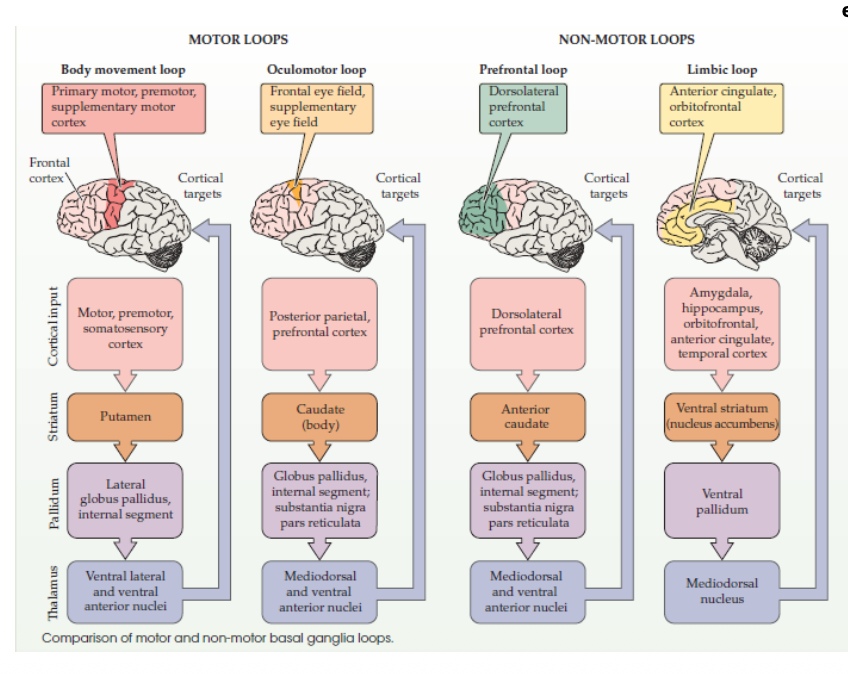
self-regulatory loops that the basal ganglia form with them cortex seem
includes: decision-making, habit information, & emotional regulation
non-motor functions
Prefrontal Loop
Limbic Loop
Prefrontal Loop
Planning, short-term memory, & attention regulation.
Limbic Loop
Emotional & motivated behavior regulation, mood state transitions.
Clinical Significance
Cognitive & emotional function deterioration in Parkinson’s & Huntington’s diseases is linked to non-motor loop disruption.
Obsessive-compulsive disorder, depression, & anxiety potentially involve limbic loop dysfunctions.
Tourette syndrome
Tourette syndrome
Undesired utterances due to excessive activity in cognitive regulatory loops.
CEREBELLUM
movement
coordination
balance
CEREBELLUM fact about the structure
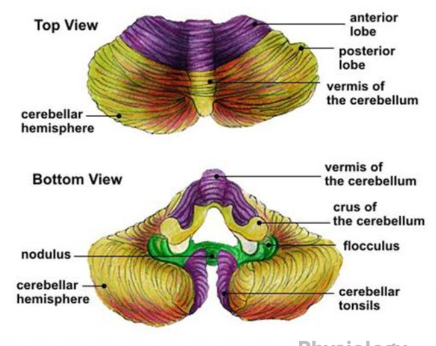
Second largest structure in the brain
High neural density: half of brain neurons
Divided into two hemispheres joined by the vermis
Grey matter outside / white matter inside (tree of life)
Center for motor modulation
correcting errors
Feedback circuit that allows the correction of movements
CEREBELLUM & detects errors in
execution of the movement that is in progress & sends orders to the motor cortex to adjust them
cerebellum participates in
motor learning through error-based adaptation
Functions of cerebellum
Motor learning → Play an instrument, ride a bike
Execution of accurate movements (carry a spoonful into your mouth)
Correction of a movement’s trajectory
Posture maintenance & balance
Cerebellar lesions cause
ATAXIA
DYSARTHRIA
UNSTEADY WALK
ALTERED VISUAL CONTROL
Ataxia
Disorder characterized by the reduced ability to coordinate voluntary movements
DYSARTHRIA
Slurred/slow speech
UNSTEADY WALK
Affects the control of the legs (e.g. drunken gait).
ALTERED VISUAL CONTROL
Lack of control in the eye fixation on objects.
Other pathologies affecting the cerebellum
Acute alcohol intoxication, involving cerebellar GABA receptors
Multiple sclerosis, tumors