physics 201 exam 4
 Call Kai
 Learn
Learn Practice Test
 Spaced Repetition
 Match
Match Flashcards
 Knowt Play
1/9

There's no tags or description
Looks like no tags are added yet.
Name | Mastery | Learn | Test | Matching | Spaced | Call with Kai |
|---|
No analytics yet
Send a link to your students to track their progress
10 Terms
same as Bonnie's
The angular velocity ω of any point on a solid object rotating about a fixed axis is the same. Both Bonnie & Klyde go around one revolution (2π radians) every two seconds.
Bonnie sits on the outer rim of a merry-go-round, and Klyde sits midway between the center and the rim. The merry-go-round makes one complete revolution every two seconds.
Klyde's angular velocity is:
1) same as Bonnie's
2) twice Bonnie's
3) half of Bonnie's
4) 1/4 of Bonnie's
5) four times Bonnie's
Bonnie
Their linear speeds v will be different since v=R ω and Bonnie is located further out (larger radius R) than Klyde.
Bonnie sits on the outer rim of a merry-go-round, and Klyde sits midway between the center and the rim. The merry-go-round makes one revolution every two seconds. Who has the larger (tangential) velocity?
1) Klyde
2) Bonnie
3) both the same
4) linear velocity is zero for both of them
1/4 θ
The angular displacement is θ = 1/2αt^2 (starting from rest), and there is a quadratic dependence on time. Therefore, in half the time, the object has rotated through one-quarter the angle
An object at rest begins to rotate with a constant angular acceleration. If this object rotates through an angle θ in the
time t, through what angle did it rotate in the time 1/2 t?
1) 1/2 θ
2) 1/4 θ
3) 3/4 θ
4) 2 θ
5) 4 θ
2
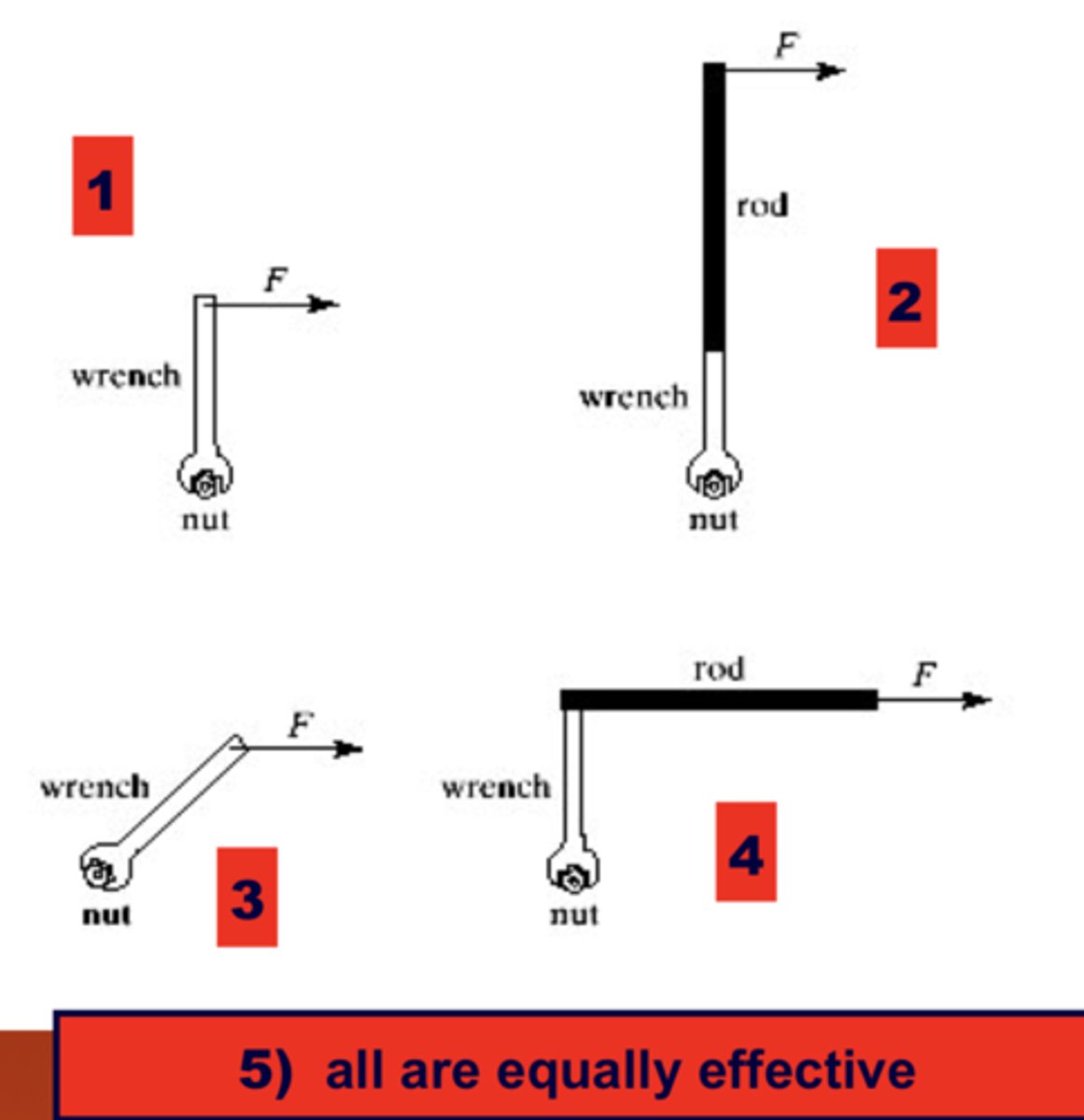
Since the forces are all the same, the only difference is the lever arm. The arrangement with the largest lever arm (case #2) will provide the largest torque.
You are using a wrench to loosen a rusty nut. Which arrangement will be the most effective in loosening the nut?
6 kg
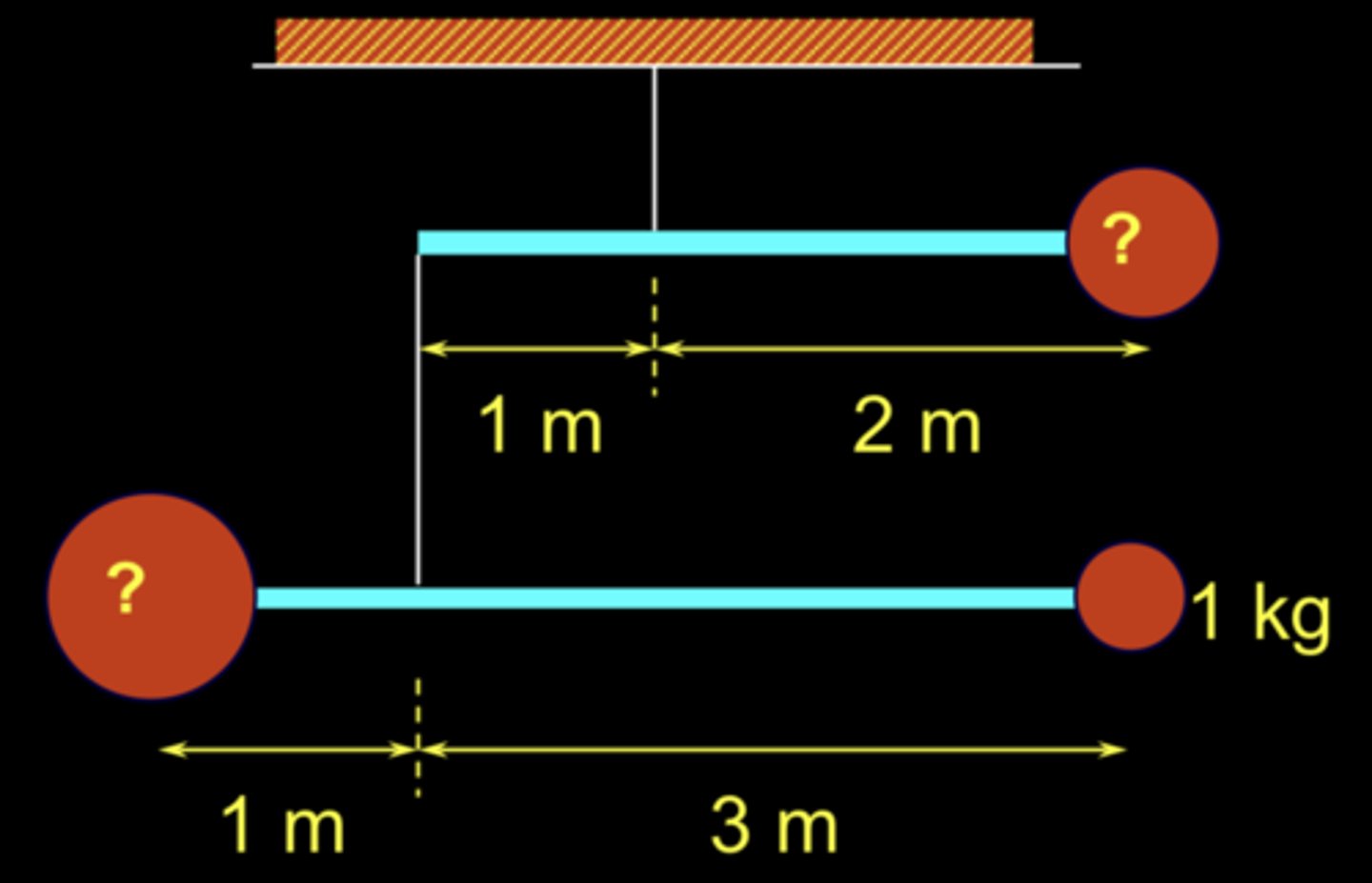
Use torques in two steps:
(1) find the big mass on the bottom left (lower rod only).
(2) use the entire lower rod assembly (with two masses) to find the mass on top right.
Finally, add up all the masses.
A (static) mobile hangs as shown below. The rods are massless and have lengths as indicated. The mass of the ball at the bottom right is 1 kg. What is the total mass of the mobile?
1) 5 kg
2) 6 kg
3) 7 kg
4) 8 kg
5) 9 kg
no difference
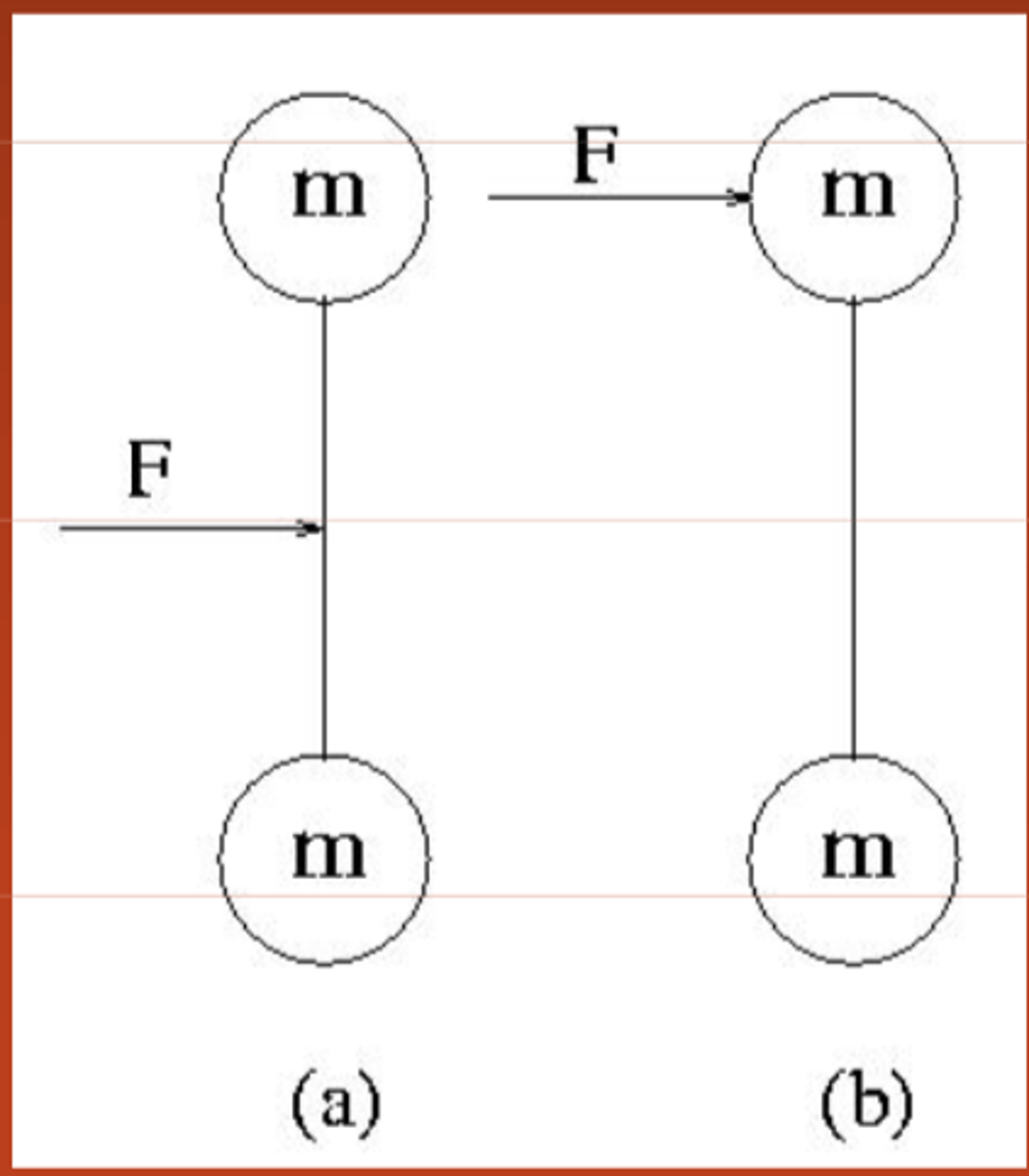
Because the same force acts for the same time interval in both cases, the change in momentum must be the same, thus the CM velocity must be the same.
A force is applied to a dumbbell for a certain period of time, first as in (a) and then as in (b). In which case does the dumbbell acquire the greater center-of- mass speed?
1) case (a)
2) case (b)
3) no difference
4) It depends on the rotational inertia of the dumbbell.
no
Because torque is the product of force times distance, two different forces that act at different distances could still give the same torque.
Two forces produce the same torque. Does it follow that they have the same magnitude?
1) yes
2) no
3) depends
hollow gold
Moment of inertia depends on mass and distance from axis squared. It is bigger for the shell since its mass is located farther from the center.
Two spheres have the same radius and equal masses. One is made of solid aluminum, and the other is made from a hollow shell of gold.
Which one has the bigger moment of inertia about an axis through its center?
a) solid aluminum
b) hollow gold
c) same
start to spin in the same direction as before flipping
The total angular momentum of the system is L upward, and it is conserved. So if the wheel has
-L downward, you and the table must have +2L upward.
You are holding a spinning bicycle wheel while standing on a stationary turntable. If you suddenly flip the wheel over so that it is spinning in the opposite direction, the turntable will
1) remain stationary
2) start to spin in the same direction as before flipping
3) start to spin in the same direction as after flipping
disk 2
KE=1/2 I ω2 = L2/(2 I)
(used L= I ω).
Since L is the same, bigger I means smaller KE.
Two different spinning disks have the same angular momentum, but disk 1 has more kinetic energy than disk 2. Which one has the bigger moment of inertia ?
1) disk 1
2) disk 2
3) not enough info