BioCHEM FINAL
 Call Kai
 Learn
Learn Practice Test
 Spaced Repetition
 Match
Match Flashcards
 Knowt Play
1/153

There's no tags or description
Looks like no tags are added yet.
Name | Mastery | Learn | Test | Matching | Spaced | Call with Kai | Chat |
|---|
No analytics yet
Send a link to your students to track their progress
154 Terms
How do enzymes function as biological catalysts?
Catalysts are characterized by two main properties: they reduce activation energy of a reaction, thus speeding up the reaction, and they are not used up in the course of the reaction. Enzymes improve the environment in which a particular reaction takes place, which lowers its activation energy. They are also regenerated at the end of the reaction to their original form.
What is enzyme specificity?
Enzyme specificity refers to the idea that a given enzyme will only catalyze a given reaction or type of reaction.
Eg: serine/threonine-specific protein kinases will only place a phosphate group onto the hydroxyl group of a serine or threonine residue
What are the names and main functions of the six different classes of enzymes?
Ligase: addition or synthesis reactions, generally between large moelcules often require ATP
Isomerase: rearrangement of bonds within a compound
Lyase: cleavage of a single molecule into two products, or synthesis of small organic molecule
Hydrolase: breaking of a compound into two molecules using the addition of water
Oxidoreductase: oxidation-reduction reactions (transferring electrons)
Transferase: movement of a functional group from one molecule to another
In what ways do enzymes affect the thermodynamics vs. the kinetics of a reaction?
Enzymes have no effect on the overall thermodynamics of the reaction; they have no effect on the (deltaG) or (deltaH) of the reaction, although they do lower the energy of the transition stat, thus lowering the activation energy. However, enzymes have a profound effect on the kinetics of a reaction. By lowering activation energy, equilibrium can be achieved faster (although the equilibrium position does not change)
How do the lock and key theory and induced fit model differ?
Lock and key theory:
A) active site of enzyme fits exactly around substrate
B) no alterations to tertiary or quaternary structure of enzyme
C) less accurate model
Induced fit model:
A) active site of enzyme molds itself around substrate only when substrate is present
B) tertiary and quanternary structure is modified for enzyme to function
C) more accurate model
What do cofactors and coenzymes do? How do they differ?
Cofactors and coenzymes both act as activators of enzymes. Cofactors tend to be inorganic (minerals), while coenzymes tend to be small inorganic compounds (vitamins). In both cases, these regulators induce a conformational change in the enzyme that promotes its activity. Tightly bound cofactors or coenzymes that are necessary for enzyme function are termed prosthetic groups.
What are the effects of increasing [S] on enzyme kinetics? What about increasing [E]?
Increasing [S]: has different effects depending on how much substrate is present to begin with. When the substrate concentration is low, an increase in [S] causes a proportional increase in enzyme activity. At high [S], however, when the enzyme is saturated, increasing [S] has no effect on activity because Vmax has already been attained.
Increasing [E]: will always increase Vmax, regardless of the starting concentration of enzyme.
How are the Michaelas-Menten and Lineweaver-Burk plots similar? How are they different?
Both the Michaelis-Menten and Lineweaver-Burk relationships account for the values of Km and Vmax under various conditions. They both provide simple graphical interpretations of these two variables and are derived Michaelis-Menten equation. However, the axes of the graphs and visual representation of this information is different between the two. The Michaelis-Menten plot is v vs [S], which creates a hyperbolic curve for monomeric enzymes. The Lineweaver-Burk plot, on the other hand, is 1/v vs 1/[S], which creates a straight line.
What does Km represent? What would an increase in Km signifiy?
Km is a measure of an enzyme’s affinity for its substrate, and is defined as the substrate concentration at which an enzyme is functioning at half of its maximal velocity. As Km increases, an enzyme’s affinity for its substrate decreases.
What fo the x- and y-intercepts in a Lineweaver-Burk plot represent?
The x-intercept represents -1/Km; the y-intercept represents 1/Vmax
What is enzyme cooperativity?
Cooperativity refers to the interactions between subunits in a multi subunit enzyme or protein. The binding of substrate to one subunit induces a change in the other subunits from the T (tense) state to the R (relaxed) state, which encourages binding of substrate to the other subunits. In the reverse direction, the unbinding of substrate from one subunit induces a change from R to T in the remaining subunits, promoting unbinding of substrate from the remaining subunits.
What are the effects of temperature, pH, and salinity on the function of enzymes?
As temperature increases, enzyme activity generally, increases (doubling approximately every 10 degrees C). Above body temperatures, however, enzyme activity quickly drops off as the enzyme denatures. Enzymes are maximally active within a small pH range; outside of this range, activity drops quickly with changes in pH as the ionization if the active site changes and the protein is denatured. Changes in salinity can disrupt bonds within an enzyme, causing disruption of tertiary and quaternary structure, which leads to loss of enzyme function.
What is the ideal tempature for most enzymes in the body? The ideal pH?
Ideal temperature: 37 degrees C; 98.6 degrees F; 310 K
Ideal pH (most enzymes): 7.4
Ideal pH (gastric enzymes): around 2
Ideal pH (pancreatic enzymes): around 8.5
What is feedback inhibition?
Feedback inhibition refers to the product of an enzymatic pathway turning of enzymes further back in that same pathway. This helps maintain homeostasis as product levels rise, the pathway creating that product is appropriately downregulated.
Of the four types of reversible inhibitors, which could potentially increase Km?
A competitive inhibitor increases Km because the substrate concentration has to be higher to reach half the maximum velocity in the presence of the inhibitor. A mixed inhibitor will increase Km only if the inhibitor preferentially binds to the enzyme over the enzyme-substrate complex.
What is irreversible inhibition?
Irreversible inhibition refers to the prolonged or permanent inactivation of an enzyme, such that it cannot be easily renatured to gain function.
What are some examples of transient and covalent enzyme modifications?
Examples of transient modifications: allosteric activation or inhibition
Examples of covalent modifications: phosphorylation and glycosylation
Why are some enzymes released as zymogens?
Zymogens are precursors of active enzymes. It is critical that certain enzymes (like digestive enzymes of pancreas) remain inactive until arriving at their target site.
Consider a biochemical reaction A—>B, which is catalyzed by A-B dehydrogenase. Which of the following statements is true?
A. The reaction will proceed until the enzyme concentration decreases.
B. The reaction will be most favorable at 0 degrees C.
C. A component of the enzyme is transferred from A to B.
D. The free energy change (delta G) of the catalyzed reaction is the same as for the uncatalyzed reaction.
D.
Which of the following statements about enzymes kinetics is FALSE?
A. An increase in the substrate concentration (at constant enzyme concentration) leads to proportional increases in the rate of the reaction.
B. Most enzymes operating in the human body work best at a temperature of 37 degrees C
C. An enzyme-substrate complex can either form a product or dissociate back into the enzyme and substrate
D. Maximal activity of many human enzymes occurs around pH 7.4
A.
Some enzymes require the presence of a nonprotein molecule to behave catalytically. An enzyme devoid of this molecule is called a(n):
A. Holoenzyme
B. Apoenzyme
C. Coenzyme
D. Zymoenzyme
B.
Which of the following factors determine an enzyme’s specificity?
A. The three-dimensional shape of the active site
B. The Michaelis constant
C. The type of cofactor required for the enzyme to be active
D. The prosthetic group on the enzyme
A
Human DNA polymerase is removed from the freezer and placed in a 60 degrees C water bath. Which of the following best describes the change in enzyme activity as the polymerase sample comes to thermal equilibrium with the water bath?
A. Increases then decreases
B. Decreases then plateaus
C. Increases then plateaus
D. Decreases then increases
A
In the enzyme below, substrate C is an allosteric inhibitor to enzyme 1. Which of the following is another mechanism necessarily caused by substrate C?
A——(E1)—> B—-(E2)—>C
A. Competitive inhibition
B. Irreversible inhibition
C. Feedback enhancement
D. Negative feedback
D
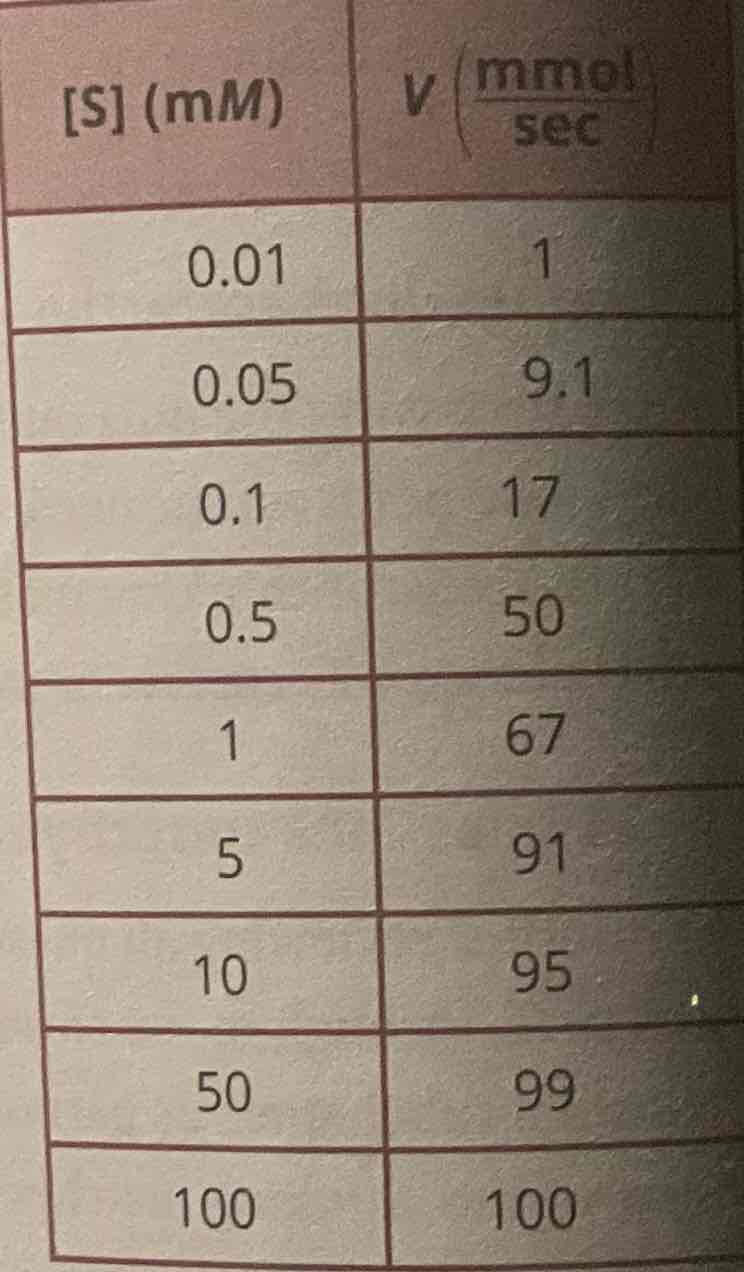
The activity of an enzyme is measured at several different substrate concentrations, and the data are shown in the table below:
Km for this enzyme is approximately:
A. 0.5
B. 1.0
C. 10.0
D. 50.0
A
Consider a reaction catalyzed by enzyme A with a Km value of 5 × 10^-6 M and Vmax of 20 mol/min.
At a concentration of 5 × 10^-6 M substrate, the rate of the reaction will be:
A. 10 mmol/min
B. 20 mmol/min
C. 30 mmol/min
D. 40 mmol/min
A
Consider a reaction catalyzed by enzyme A with a Km value of 5 × 10^-6 M and Vmax of 20 mol/min.
At a concentration of 5 × 10^-4 M substrate , the rate of the reaction will be:
A. 10 mmol/min
B. 15 mmol/min
C. 20 mmol/min
D. 30 mmol/min
C
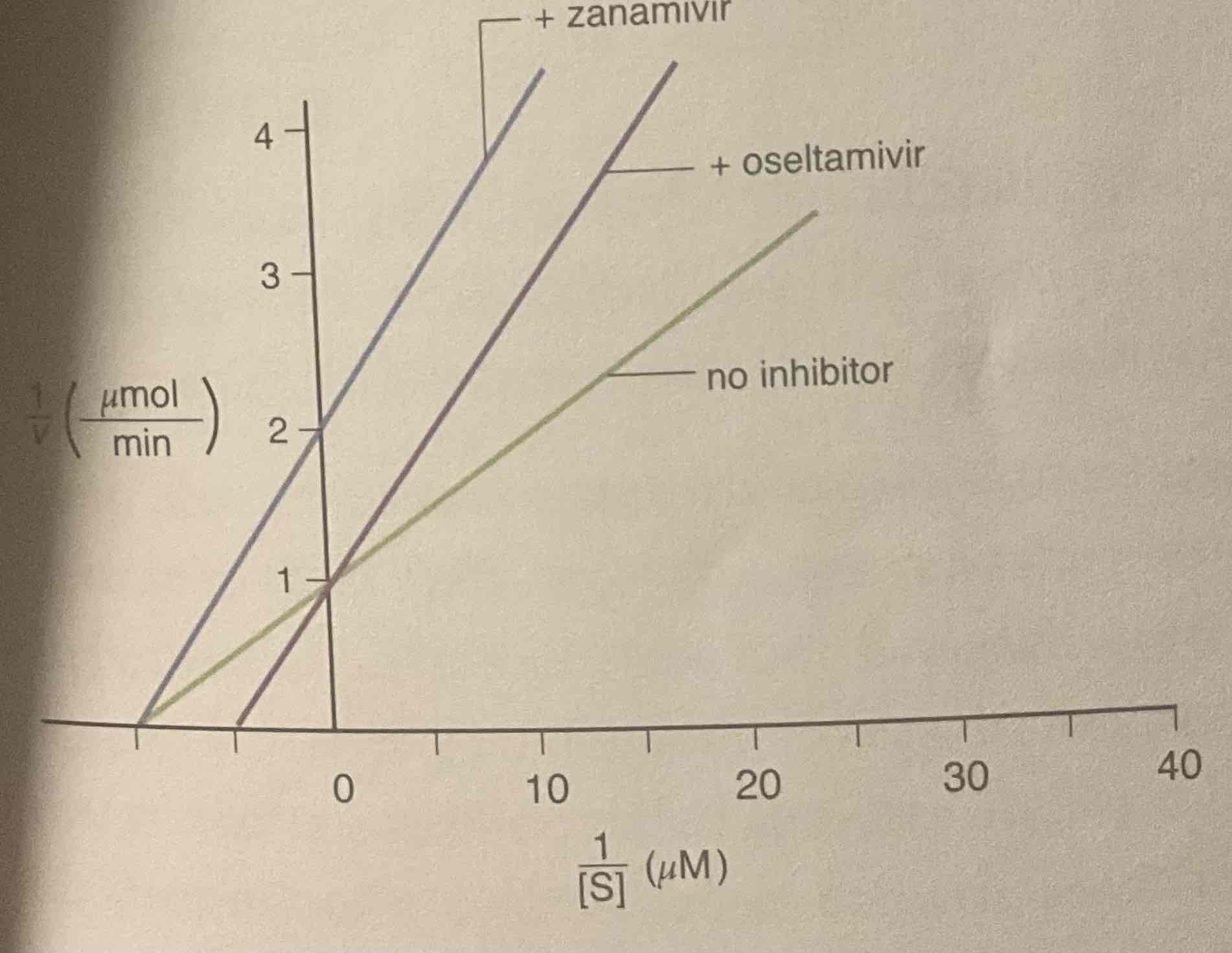
The graph below shows kinetic data obtained for flu virus enzyme activity as function of substrate concentration in the presence and absence of two antiviral drugs.
Based on the graph, which of the following statements is correct?
A. Both drugs are non competitive inhibitors of the viral enzyme
B. Oseltamivir increase the Km value for the substrate compared to Relenza
C. Zanamivir increases the Vmax value for the saubstrate compared to Tamiflu
D. Both drugs are competitive inhibitors of the viral enzyme.
B
The conversion of ATP to cyclic AMP and inorganic phosphate is most likely catalyzed by which class of enzyme?
A. Ligase
B. Hydrolase
C. Lyase
D. Transferase
C
Which of the following is NOT a method buy which enzymes decrease the activation energy for biological reactions?
A. Modifying the lcoal charge environment
B. Forming the transient covalent bonds
C. Acting as electron donors or receptors
D. Breaking bonds in the enzyme irreversibly to provide energy
D
A certain enzyme that displays positive cooperativity has four subunits, two of which are bound to substrate. Which of the following statements must be true?
A. The affinity of the enzyme for the substrate has just increased
B. The affinity of the enzyme for the substrate has just decreased
C. The affinity of the enzyme for the substrate is half of what it would be if four sites has substrate bound.
D. The affinity of the enzyme for the substrate is greater than with one substrate bound.
D
Which of the following is LEAST likely to be required for a series of metabolic reactions?
A. Triacglycerol acting as a coenzyme
B. Oxidoreductase enzymes
C. Magnesium acting as a cofactor
D. Transferase enzymes
A
How does the ideal temperature for a reaction change with and without an enzyme catalyst?
A. The ideal temperature is generally higher with a catalyst than without
B. The ideal temperature is generally lower with a catalyst than without
C. The ideal temperature is characteristic of the reaction, not the enzyme
D. No conclusion can be made without knowing the enzyme type
B
What is the difference between a nucleoside and nucleotide?
Nucleosides contain a 5-carbon sugar (pentose) and a nitrogenous base. Nucleotides are composed of a nucleoside plus one to three phosphate groups.
What are the base-pairing rules according to Watson-Crick model?
A pairs with T (in DNA) or U (in RNA), using two hydrogen bonds, C pairs with G, using three hydrogen bonds.
What are the three major structural difference between DNA and RNA?
DNA contains deoxyribose, while RNA contains ribose. DNA contains thymine, while RNA contains uracil. Usually, DNA is double stranded , while RNA is single-stranded.
If a strand of RNA contained 15% cytosine, 15% adenosine, 35% guanine, and 35% uracil, would this violate CHARGAFF’s rules? Why or why not?
This does not violate CHARGAFF’s rules. RNA is single-stranded, and thus the complementarity seen in DNA does not hold true. For single-stranded RNA, %C does not necessarily equal %G; %A does not necessarily equal %U
What are the five histone proteins in eukaryotic cells? Which one is not part of the histone core around which DNA wraps to form chromatin?
The five histone proteins are H1, H2A, H2B, H3, and H4. H1 is the only one not in the histone core.
Compare and contrast heterchromatin and euchromatin based on the following characteristics:
A) Density of chromatin packing
B) Appearance under light microscopy
C) Transcriptional activity
A) heterochromatin: dense; euchromatin: not dense (uncondensed)
B) heterochromatin: dark; euchromatin: light
C) heterochromatin: silent; euchromatin: active
What property of telomeres and centromeres allows them to stay tightly raveled, even when the rest of DNA is uncondensed?
High GC-content increases hydrogen bonding, making the association between DNA strands very strong at telomeres and centromeres.
For each of the enzymes listed below, list the function of the enzyme and if it is found in prokaryotes, eukaryotes, or both.
Helicase
Single-stranded DNA-binding protein
Primase
DNA polymerase III
DNA polymerase (alpha)
DNA polymerase I
RNase H
DNA ligase
DNA topoisomerases
Helicase: (prokaryotes and eukaryotes); function to unwind DNA double helix
Single-stranded DNA-binding protein: (prokaryotes and eukaryotes); function to prevent reannealing of DNA double helix during replication
Primase: (prokaryotes and eukaryotes); function to place approx 10 nucleotide RNA primer to begin DNA replication
DNA polymerase III: (prokaryotes); functions to add nucleotides to growing daughter strands
DNA polymerase (alpha): (eukaryotes); functions to add nucleotides to growing daughter strands
DNA polymerase I: (prokaryotes); functions to fill in gaps left behind after RNA primer excision
RNase H: (eukaryotes); functions to excise RNA primer
DNA ligase: (prokaryotes and eukaryotes); functions to join DNA strands (especially between Okazaki fragments)
DNA topoisomerases: (prokaryotes and eukaryotes); functions to reduce torsional strain from positive supercoils by introducing nicks in DNA strand
Between the leading strand and lagging strand, which is more prone to mutations? Why?
The lagging strand is more prone to mutations because it must constantly start and stop process of DNA replication. Additionally, it contains many more RNA primers, all of which must be removed and filled in with DNA.
What is the function of telomere?
Telomeres are the ends of eukaryotic chromosomes and contain repetitive sequences of noncoding DNA. These protect the chromosome from losing important genes from the incomplete replication to the 5’end of the DNA strand.
What is the difference between an oncogene and a tumor suppressor gene?
Oncogenes (or proto-oncogenes) code for cell cycle-promoting proteins; when mutated, a proto-oncogene becomes an oncogene, promoting rapid cell cycling. Tumor suppressor genes code for repair or cell cycle-inhibiting proteins; when mutated, the cell cycle is allowed to proceed unchecked. Oncogenes are like stepping on the gas pedal, mutated tumor suppressor genes are like cutting the brakes.
How does DNA polymerase recognize which strand is the template strand once the daughter is synthesized?
The parent strand is more heavily methylated, whereas the daughter strand is barely methylated at all. This allows DNA polymerase to distinguish between the two strands during proofreading.
For each of the repair mechanisms below, in which phase of the cell cycle does the repair mechanism function? What are the key enzymes or genes specifically associated with each mechanism?
DNA polymerase (proofreading)
Mismatch repair
Nucleotide excision repair
Base excision repair
DNA polymerase (proofreading): S phase of cell cycle; using DNA polymerase
Mismatch repair: G2 phase of cell cycle; using MSH2, MLH1 (MutS and MutL in prokaryotes)
Nucleotide excision repair: G1, G2 phases of cell cycle; using excision endonnuclease
Base excision repair: G1, G2 phases of cell cycle; using glycosylase, AP endonuclease
What is the structural difference in the types of lesions corrected by nucleotide excision repair vs. those corrected by base excision repair?
Nucleotide excision repair corrects lesions that are large enough to distort the double helix; base excision repair corrects lesions that are small enough not to distort the double helix.
What does PCR accomplish for a researcher? What about Southern blotting?
PCR: increases the number of copies of a given DNA sequence and can be used for a sample containing very few copies of the DNA sequence.
Southern Blotting: useful when searching for a particular DNA sequence because it separates DNA fragments by length and then probes for a sequence of interest
During DNA sequencing, why does the DNA polymer stop growing once a dideoxyribonucleotide is added?
Dideoxyribonucleotides lack the 3’-OH group that is required for DNA strand elongation. Thus, once a dideoxyribonucleotide is added to a growing DNA, no more nucleotides can be added because dideoxyribonucleotides have no 3’-OH group with which to form a bond.
What is the difference between a transgenic and a knockout mouse?
Transgenic mice have a gene introduced into their germ line or embryonic stem cells to look at the effects of that gene; they are therefore best suited for studying the effects of dominant alleles. Knockout mice are those in which a gene of interest has been removed, rather than added.
In a single-strand of a nucleic acid, nucleotides are linked by:
A) hydrogen bonds
B) phosphodiester bonds
C) ionic bonds
D) van der Waals forces
B
Which of the following statements regarding differences between DNA and RNA is FALSE?
A) In cells, DNA is double-stranded; whereas RNA is single-stranded
B) DNA uses the nitrogenous base thymine; RNA uses uracil
C) The sugar in DNA is deoxyribose; the sugar in RNA is ribose
D) DNA strands replication in a 5’ to 3’ direction. Whereas RNA is synthesized in a 3’ to 5’ direction
D
Which of the folllwing DNA sequences would have the highest melting temperature?
A) CGCAACCATCCG
B) CGCAATAATACA
C) CGTAATAATACA
D) CATAACAAATCA
A
Which of the following biomolecules is LEAST likely to contain an aromatic ring?
A) Proteins
B) Purines
C) Carbohydrates
D) Pyrimidines
C
For a compound to be aromatic, all of the following must be true EXCEPT:
A) the moelcule is cyclic
B) the molecule contains 4n+2 pi electrons
C) the molecule contains alternating single and double bonds
D) the molecule is planar
C
Which of the following enzymes is NOT involved in DNA replication?
A) Primase
B) DNA ligase
C) RNA polyermase I
D) Telomerase
C
How is cDNA best characterized?
A) cDNA results from a DNA transcript with noncoding regions removed
B) cDNA results from the reverse transcription of processed mRNA
C) cDNA is the abbreviation for deoxycytosine
D) cDNA is the circular DNA molecule that forms the bacterial genome
B
Which of the following statements regarding polymerase chain reaction is FALSE?
A) Human DNA polymerase is used because it is the most accurate
B) A primer must be prepared with a complementary sequence to part of the DNA of interest
C) Repeated heating and cooling cycles allow the enzymes to act specifically and replaces helicase
D) Each cycle of the polymerase chain reaction doubles the amount of DNA of interest
A
Endonuclease are used for which of the following?
I. Gene therapy
II. Southern Blotting
III. DNA repair
A) I only
B) II only
C) II and III only
D) I, II, and III only
D
How does prokaryotic DNA differ from eukaryotic DNA?
I. Prokaryotic DNA lacks nucleosomes
II. Eukaryotic DNA has telomeres
III. Prokaryotic DNA is replicated by a different DNA polymerase
IV. Eukaryotic DNA is circular when not restricted by centromeres
A) I only
B) IV only
C) II and III only
D) I, II, and III only
D
Why might uracil be excluded from DNA but NOT RNA?
A) Uracil is much more difficult to synthesize than thymine
B) Uracil binds adenine too strongly for replication
C) Cytosine degredation results in uracil
D) Uracil is used as a DNA synthesis activator
C
Tumor suppressor genes are most likely to result in cancer through:
A) loss of function mutations
B) gain of function mutations
C) over expression
D) proto-oncogene formation
A
Which of the following is an ethical concern of gene sequencing?
A) Gene sequencing is invasive, thus the potential health risks must be throughly explained.
B) Gene sequencing impacts relatives, thus privacy concerns may be raised
C) Gene sequencing is very inaccurate, which increases anxiety related to findings
D) Gene sequencing can provide false-negative results, giving a false sense of security
B
Which of the following is NOT a difference between heterochromatin and euchromatin?
A) Euchromatin has areas that can be transcribed, whereas heterochromatin is silent
B) Heterochromatin is tightly packed, whereas euchromatin is less dense
C) Heterochromatin stains darkly, whereas euchromatin stains lightly
D) Heterochromatin is found in the nucleus, whereas euchromatin is in the cytoplasm
D
During which phase of the cell cycle are DNA repair mechanisms least active?
A) G1
B) S
C) G2
D) M
D
What are the roles of the three main types of RNA?
mRNA, tRNA, rRNA
MRNA: carries info from DNA by traveling from the nucleus (where it is transcribed) to the cytoplasm (where it is translated)
TRNA: translates nucleus acids to amino acids by pairing its anticodon with mRNA codons; it is charged with an amino acid, which can be added to the growing peptide chain
RRNA: forms much of the structural and catalytic component of the ribosome, and acts as a ribozyme to create peptide bonds between amino acids
The three-base sequences listed below are DNA sequences. Using figure 7.5, which amino acid is encoded by each of these sequences, after transcription and translation?
GAT: mRNA codon= AUC; (Ile)
ATT: mRNA codon= AAU; (Asn)
CGC: mRNA codon= GCG; (Ala)
CCA: mRNA codon= UGG; (Trp)
Which mRNA codon is the start codon, and what amino acid does it code for? Which mRNA codons are the stop codons?
Start codon: AUG codes for Met
Stop codons: UAA, UGA, and UAG
What is wobble, and what role does it serve?
Wobble refers to the fact that the third base in a codon often plays no role in determining which amino acid is translated from that codon.
Eg: any codon starting with “CC” codes for proline, regardless of which base is in the third (wobble) position. This is protective because mutations in the wobble position will not have any effect on the protein translated from that gene.
For each of the mutations listed below, what changes in DNA sequence are observed, and what effect do they have on the encoded peptide?
Silent (Degenerate): Substitution of bases in the wobble position, introns, or noncoding DNA; no change observed on encoded protein
Missense: substitution of one base, creating an mRNA codon that matches a different amino acid; change on encoded protein is that one amino acid is changed in the protein; variable function effects on function depending on specific change
Nonsense: substitution of one base, creating a stop codon; change on encoded protein allows for early trunctation of protein; variable effects on function but usually more severe than missense mutations
Frameshift: insertions or deletion of bases, creating a shift in the reading frame of the mRNA; change on encoded protein is change is most amino acids after the site of insertion or deletion; usually the most severe of the types listed here
What is the role of each eukaryotic RNA polymerase?
RNA polymerase I: synthesizes most rRNA
RNA polymerase II: synthesizes mRNA (hnRNA ) and snRNA
RNA polymerase III: synthesizes tRNA and some rRNA
When starting transcription, where does RNA polymerase bind?
RNA polymerase II binds to the TATA box, which is located within the promoter region of a relevant gene at about -25
What are the three major posttranslational modifications that turn hnRNA into mature mRNA?
1) Splicing: removal of introns, joining of exons; uses snRNA and snRNPs in the spliceosome to create a lariat, which is then degraded; exons are ligated together
2) 5’ cap: addition of a 7-methylguanylate triphosphate cap to the 5’ end of the transcript
3) 3’ poly-A tail: addition of adenosine bases to the 3’ end to protect against degredation
What is alternative splicing, and what does it accomplish?
Alternative splicing is the ability of some genes to use various combinations of exons to create multiple proteins from one hnRNA transcript. This increases protein diversity and allows a species to maximize the number of proteins it can create from a limited number of genes.
What are the three steps of translation?
Initiation, elongation, and termination
What are the roles of each site in the ribosome?
A site: binds incoming aminoacyl-tRNA using codon-anticodon pairing
P site: holds growing polypeptide until peptidyl transferase forms peptide bond and polypeptide is handed to A site
E site: transiently holds uncharged tRNA as it exits the ribosome
What are the major posttranslational modifications that occur in proteins?
Posttranslational modifications include proper folding by chaperones, formation of quaternary structure, cleavage of proteins or signal sequences, and addition of other biomolecules (phosphorylations, carboxylation,m glycosylation, prenylation)
From 5’ to 3’, what are the components of the operon, and what are their roles?
1) Regulator gene: transcribed to form repressor protein
2) Promotor site: site of RNA polymerase binding (similar to promoters in eukaryotes)
3) Operator site: binding site for repressor protein
4) Structural gene: the gene of interest; its transcription is dependent on the repressor being absent from the operator site
What is positive control system? What is a negative control system?
Positive control system: require the binding of a protein to the operator site to increase transcription
Negative control system: require the binding of a protein to the operator site to decrease transcription
In an enhancer, what are the differences between signal moelcules, transcription factors, and response elements?
Signal molecules include steroid hormones and second messengers, which bind to their receptors in the nucleus. These receptors are transcription factors that use their DNA-binding domain to attach to a particular sequence in DNA called a response element. Once bonded to the response element, these transcription factors can then promote increased expression of the relevant gene.
By what histone and DNA modifications can genes be silenced in eukaryotic cells? Would these processes increase the proportion of heterochromatin or euchromatin?
Histone deacetylation and DNA methylation will both down regulate the transcription of a gene. These processes allow the relevant DNA to be clumped more tightly, increasing the proportion of heterchromatin.
What role does peptidyl transferase play in protein synthesis?
A) It transports the initiator aminoacyl-tRNA complex
B) It helps the ribosome to advance three nucleotides along the mRNA in the 5’ to 3’ direction
C) It holds the protein in its tertiary structure
D) It catalyzes the formation of a peptide bond
D
A mutation in which of the following components of the lac operon would lead to a significant reduction in the expression of lactase ( one of the structural genes)?
A) Operator
B) Regulatory gene
C) Promoter
D) Structural gene
C
Topoisomerases are enzymes involved in:
A) DNA replication and transcription
B) posttranscriptional processing
C) RNA synthesis and translation
D) posttranslational processing
A
Val-tRNA is the tRNA that carries valine to the ribosome during translation. Which of the following sequences gives an appropriate anticodon for this tRNA?
A. CAU
B. AUC
C. UAC
D. GUG
C
Enhancers are transcriptional regulatory sequences that function by enhancing the activity of:
A) RNA polymerase at a single promoter site
B) RNA polymerase at multiple promoter sites.
C) Spliceosomes and lariat formation in the ribosome
D) Trancription factors that bind to the promoter but not to RNA polymerase
A
In the genetic code of human nuclear DNA, one of the codons specifying the amino acid tyrosine is UAC. If one nucleotide is changed and the codon is mutated to UAG, what type of mutation will occur?
A) Silent mutation
B) Missense mutation
C) Nonsense mutation
D) Frameshift mutation
C
Which of the following is NOT used by eukaryotes to increase the transcription of a gene?
A) Gene duplication
B) Histone acetylation
C) DNA methylation
D) Enhancers
C
When trypsin converts, chymotrypsinogen to chymotrypsin, some molecules of chymotrypsin bind to a repressor, which in turn binds to an operator region and prevents further transcription of trypsin. This is most similar to which of the following operon?
A) trp operon during lack of tryptophan
B) trp operon during abundance of tryptophan
C) lac operon during lack of lactose
D) lac operon during abundance of lactose
B
Which of the following RNA molecules or proteins is NOT found in the spliceosome during intron excision?
A) snRNA
B) hnRNA
C) shRNA
D) snRNPs
C
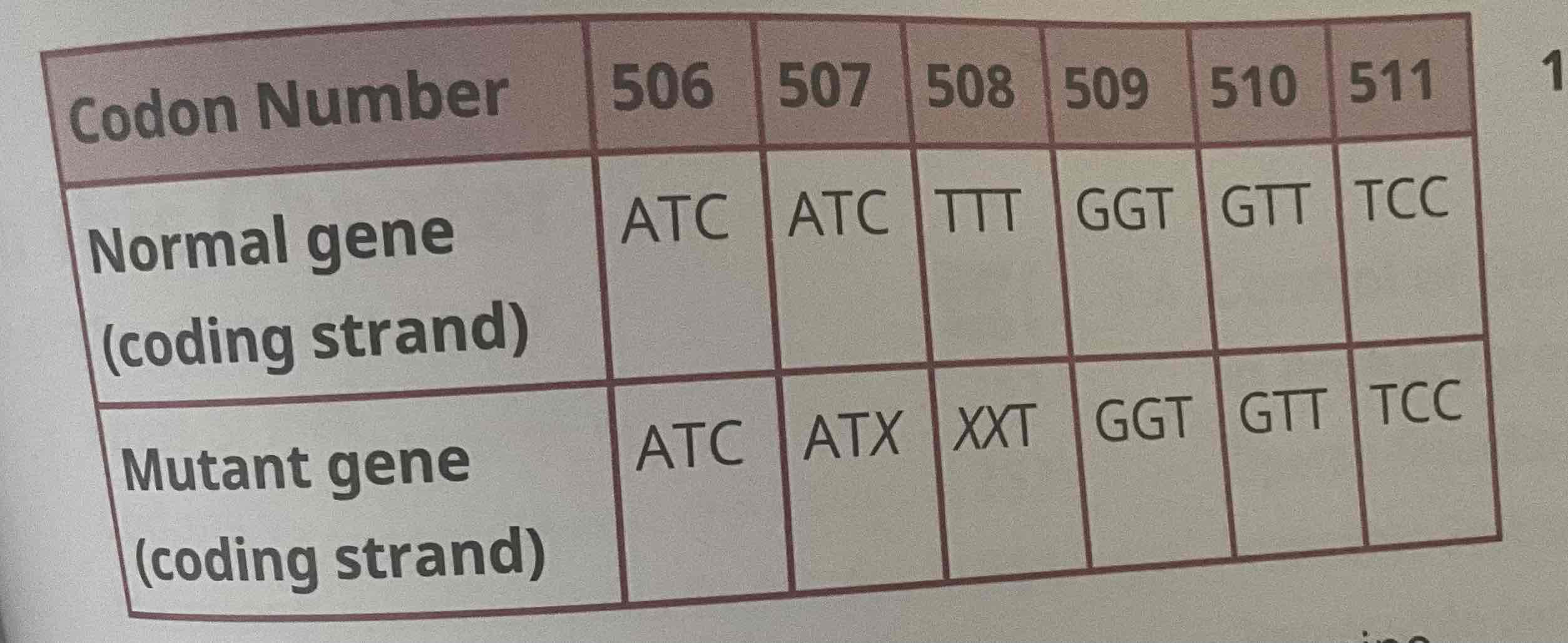
A 4-year-old toddler with cystic fibrosis (CF) is seen by his physician for an upper respiratory infection. Prior genetic testing has shown that there has been a deletion of three base pairs in exon 10 of the CFTR gene that affects codons 507 and 508. The nucleotide sequence in this region for normal and mutant alleles is shown below (X denotes the missing nucleotide):
What effect will this mutation have on the amino acid sequence of the protein encoded by the CFTR gene?
A) Deletion of a phenylalanine residue with no change in the C-terminus sequence
B) Deletion of a leucine residue with no change in the C-terminus sequence
C) Deletion of a phenylalanine residue with a change in the C-terminus sequence
D) Deletion of a leucine residue with a change in the C-terminus sequence
A
A gene encodes a protein with 150 amino acids. There is one intron of 1000 base pairs (bp), a 5’-untranslated region of 100 bp, and a 3’-untranslated region of 200 bp. In the final mRNA, about how many bases lie between the start AUG codon and final termination codon?
A) 150
B) 450
C) 650
D) 1750
B
Peptidyl transferase connects the carboxylate group of one amino acid to the amino group of an incoming amino acid. What type of linkages is created in this peptide bond?
A) Ester
B) Amide
C) Anhydride
D) Ether
B
You have just sequenced a piece of DNA that reads as follows:
5’—TCTTTGAGACATCC—3’
What would the base sequence of the mRNA transcribed from this DNA be?
A) 5’—AGAAACUCUGUAGG—3’
B) 5’—GGAUGUCUCAAAGA—3’
C) 5’—AGAAACTCTGTAGG—3’
D) 5’—GGATCTCTCAAAGA—3’
B
Double stranded RNA cannot be translated by the ribosome and is marke for degredation in the cell. Which of the following strands of RNA would prevent mature mRNA in the cytoplasm from being translated?
A) Idenitical mRNA to the one produced
B) Antisense mRNA to the one produced
C) mRNA with thymine substituted for uracil
D) Sense mRNA to the one produced
B
Describe the role of flippases and lipid rafts in biological membranes.
Flippases: responsible for the movement of phospholipids between the layers of the plasma membrane because it is otherwise energetically unfavorable
Lipid rafts: aggregates of specific lipids in the membrane that function as attachment points for other biomolecules and play roles in signaling
List the following membrane components in order from most plentiful to least plentiful: carbohydrates, lipids, proteins, nucleic acids.
Lipids, including phospholipids, cholesterol, and others, are most plentiful; proteins, including transmembrane proteins (channels and receptors), membrane-associated proteins, and embedded proteins, are next most plentiful; carbohydrates, including glycoprotein coat and signaling molecules, are next; nucleic acids are essentially absent.
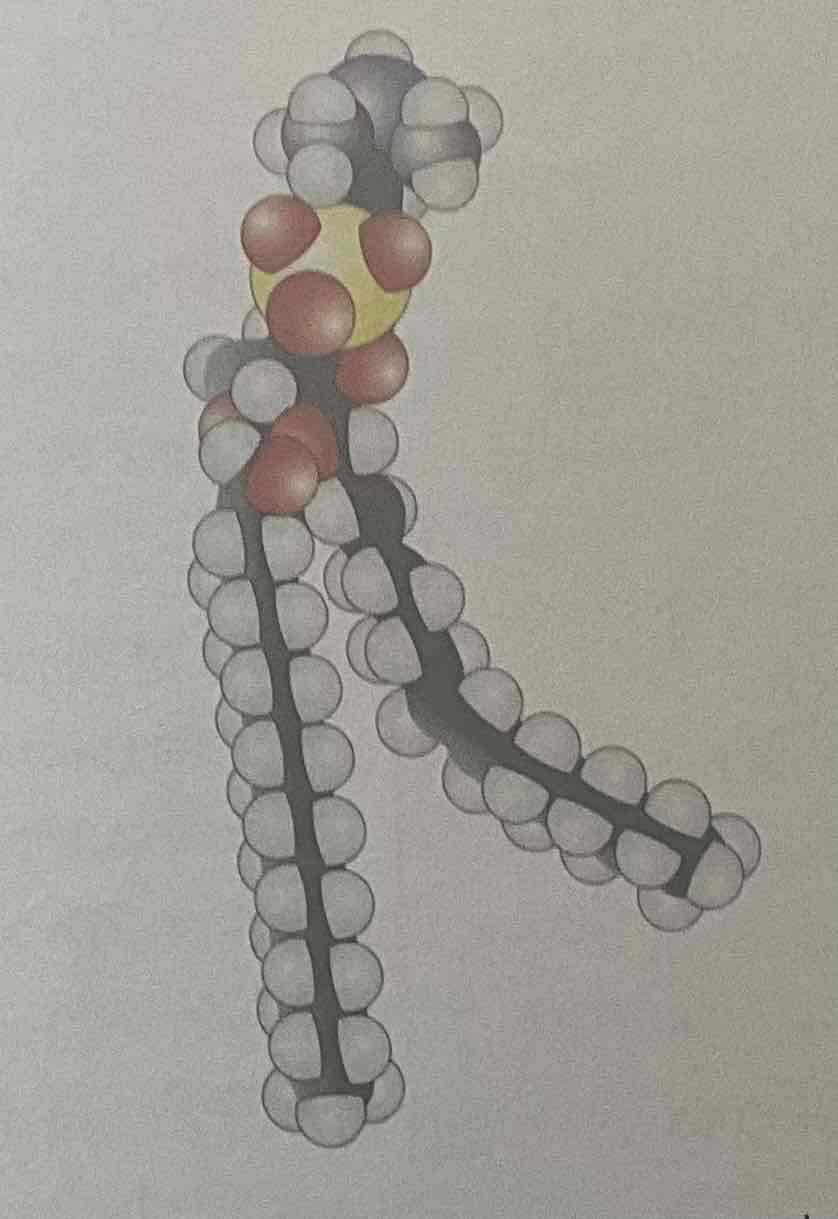
In the following phospholipid, determine whether the fatty acids are saturated and unsaturated and label their hydrophobic and hydrophilic regions.
The hydrophilic regions is at the top of this diagram. While you needs not be able to recognize it, the head group is phosphatidylcholine in this example. The hydrophobic region is at the bottom and is composed of two fatty acid tails. The tail on the left is saturated; the tail on the right is unsaturated, as evidenced by the kink in its chain.
How does cholesterol play a role in the fluidity and stability of the plasma membrane?
Cholesterol moderates membrane fluidity by interfering with the crystal structure of the cell membrane and occupying space between phospholipid molecules at low temperatures, and by restricting excessive movement of phospholipids at high temperatures. Cholesterol also provides stability by cross-linking adjacent phospholipids through interactions at the polar head group and hydrophobic interactions at the nearby fatty acid tail.
What are the three classes of membrane proteins? How are they each most likely to function?
Transmembrane proteins are most likely to serve as channels or receptors. Embedded membrane proteins are most likely to have catalytic activity linked to nearby enzymes. Membrane associated (peripheral) proteins are most likely to be involved in signaling or are recognition molecules on the extracellular surface.