Eukaryotic gene expression

0.0(0)
Studied by 0 people
call kaiCall Kai
learnLearn
examPractice Test
spaced repetitionSpaced Repetition
heart puzzleMatch
flashcardsFlashcards
GameKnowt Play
Card Sorting

1/55

encourage image

There's no tags or description

Looks like no tags are added yet.

Last updated 8:40 AM on 6/3/26
Name
Mastery
Learn
Test
Matching
Spaced
Call with Kai

No analytics yet

Send a link to your students to track their progress

56 Terms

1
New cards

Gene expression

  • DNA carries the information for protein (specifically polypeptide) synthesis

  • information is transferred to the mRNA by transcription and is in turn transferred to the polypeptide by translation occurring on ribosomes

  • heredity: ability of cells to use the information in their DNA to produce particular proteins, which will affect cellular functions

  • gene expression: process by which the information within a gene is used, first to synthesise RNA (transcription) and then to synthesise a polypeptide (translation) eventually to affect the phenotype of an organism

2
New cards

Overview of gene expression

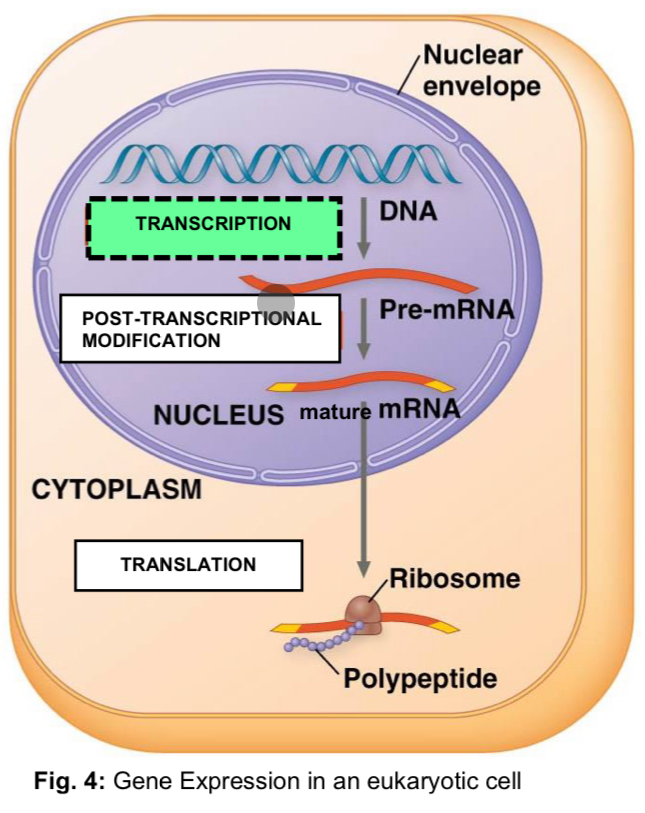
Transcription

  • location: nucleus

  • DNA is used as a template for the synthesis of mRNA in the nucleus

Translation

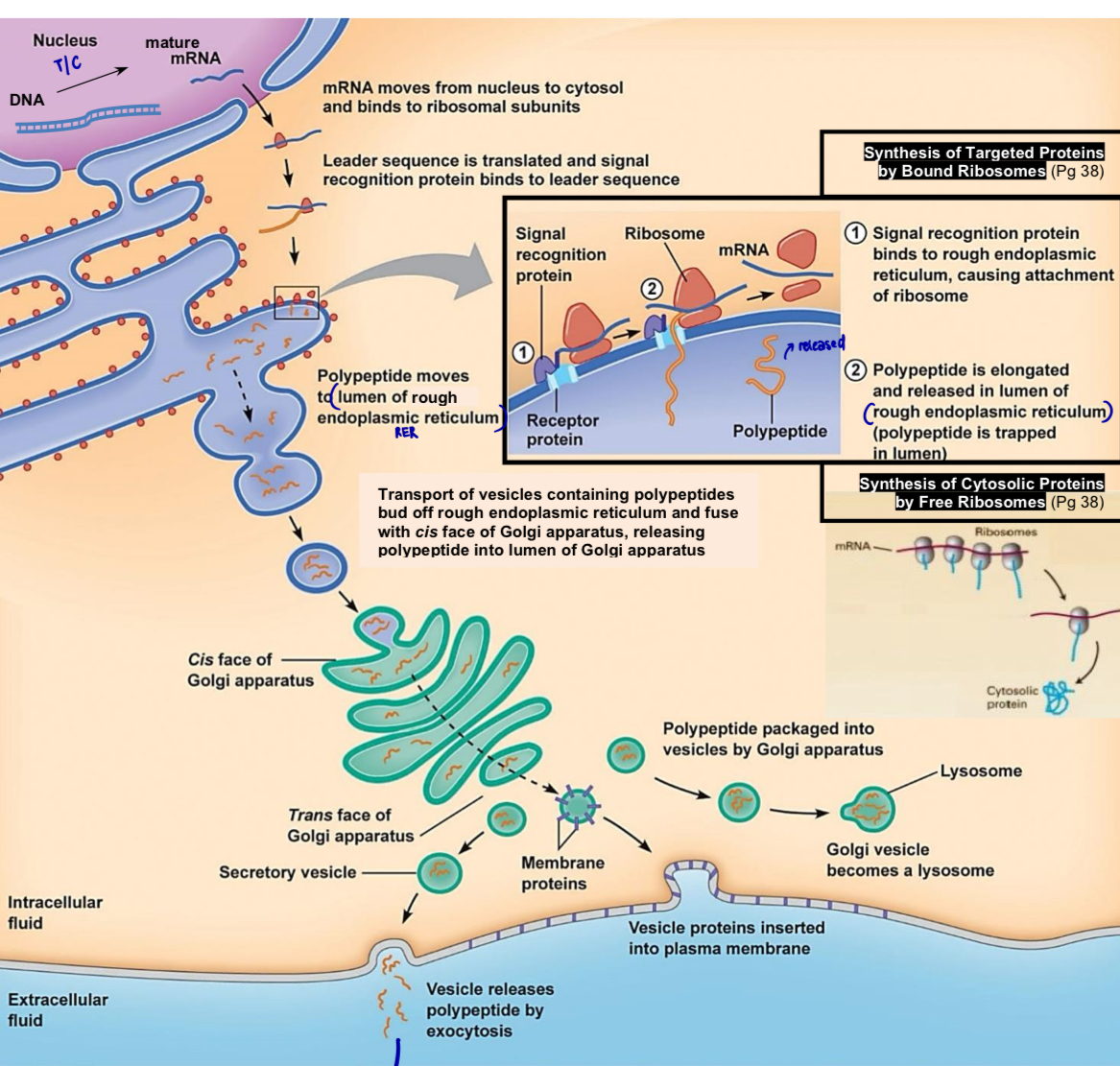
  • location: free ribosomes in cytoplasm, bound ribosomes on rough endoplasmic reticulum (rER)

  • mature mRNA is used as a template for the synthesis of polypeptides at the free ribosomes or at the bound ribosomes

Post-translational modification of polypeptides

  • location: rER, Golgi apparatus and cytoplasm

  • processes

  1. attachment of biochemical functional groups

  2. structural changes of proteins

  3. removal of amino acid sequence

  4. attachment of ubiquitin for proteolytic degradation by proteosome
<p>Transcription </p><ul><li><p>location: <strong>nucleus</strong> </p></li><li><p>DNA is used as a template for the synthesis of mRNA in the nucleus </p></li></ul><p></p><p>Translation </p><ul><li><p>location: <u>free</u> <strong>ribosomes</strong> in cytoplasm, <u>bound</u> <strong>ribosomes</strong> on rough endoplasmic reticulum (rER) </p></li><li><p>mature mRNA is used as a template for the synthesis of polypeptides at the free ribosomes or at the bound ribosomes </p></li></ul><p></p><p>Post-translational modification of polypeptides </p><ul><li><p>location: rER, Golgi apparatus and cytoplasm </p></li><li><p>processes </p></li></ul><ol><li><p>attachment of <strong>biochemical functional groups </strong></p></li><li><p>structural <strong>changes</strong> of <strong>proteins</strong> </p></li><li><p><strong>removal</strong> of amino acid sequence </p></li><li><p><strong>attachment of ubiquitin</strong> for proteolytic degradation by proteosome </p></li></ol><p></p><p></p>
3
New cards

Central Dogma

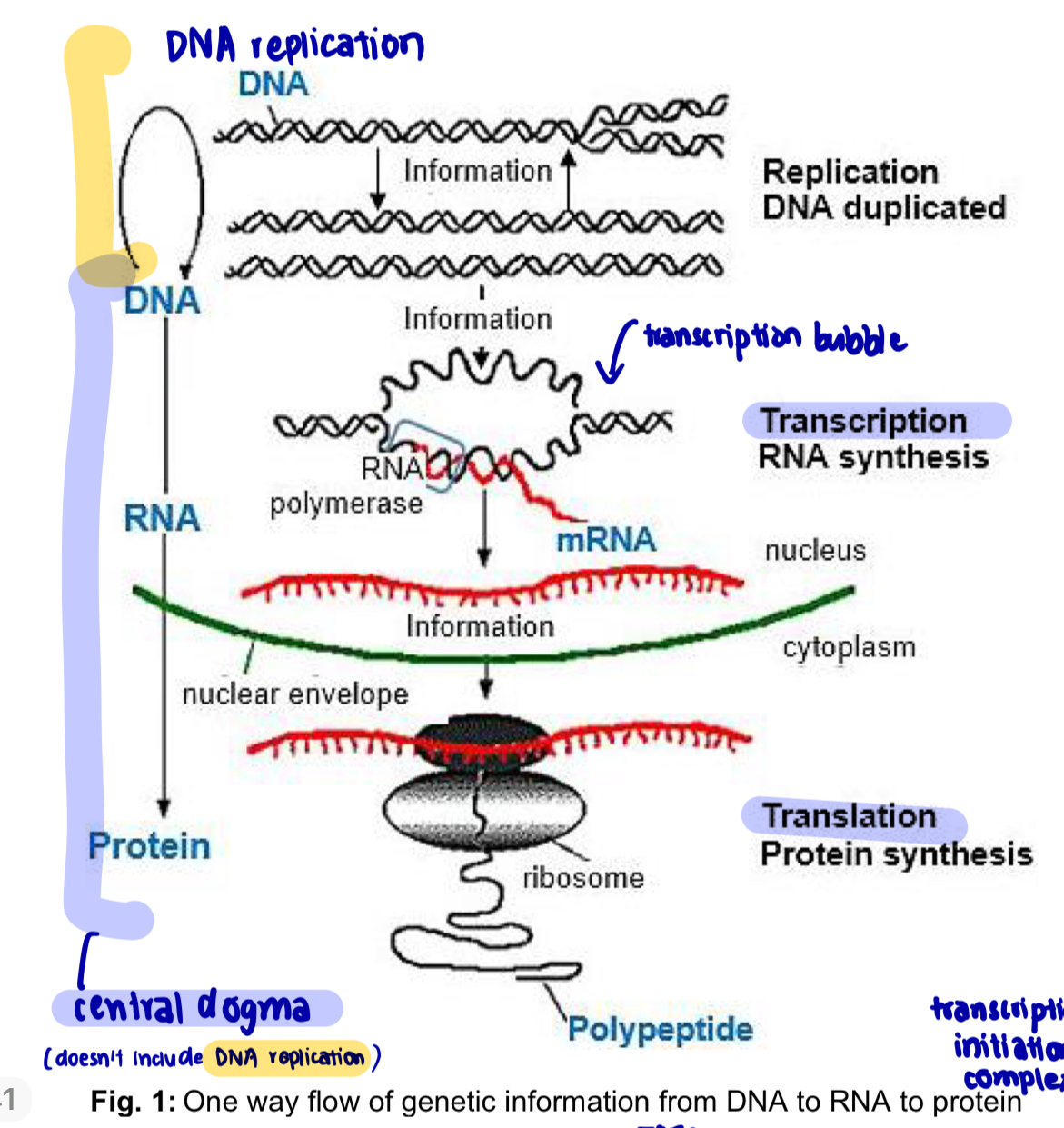
  • flow of genetic information proceeds from DNA to RNA (t/c) to polypeptide (t/l)

  • unidirectional information flow —> Central Dogma

2 stages of gene expression

  1. Transcription: DNA —> RNA

  • DNA is used as a template for the synthesis of mRNA in the nucleus

  • DNA base sequence is transcribed into a complementary mRNA base sequence

  1. Translation: RNA —> polypeptide

  • mRNA is used as a template for the synthesis of polypeptides in the cytoplasm

  • mRNA codon sequence is translated into the amino acid sequence of. polypeptide chain

NOTE: DNA replication VS transcription

  • DNA replication —> both parental strands are templates

  • transcription —> only template strand is template
<ul><li><p>flow of genetic information proceeds from DNA to RNA (t/c) to polypeptide (t/l)</p></li><li><p>unidirectional information flow —&gt; Central Dogma</p></li></ul><p>2 stages of gene expression </p><ol><li><p><mark data-color="yellow" style="background-color: yellow; color: inherit;">Transcription: DNA —&gt; RNA</mark></p></li></ol><ul><li><p><strong>DNA</strong> is used as a <strong>template</strong> for the <strong>synthesis</strong> of <strong>mRNA</strong> in the nucleus </p></li><li><p>DNA base sequence is transcribed into a <strong>complementary</strong> mRNA base sequence </p></li></ul><ol start="2"><li><p><mark data-color="blue" style="background-color: blue; color: inherit;">Translation: RNA —&gt; polypeptide </mark></p></li></ol><ul><li><p><strong>mRNA</strong> is used as a <strong>template</strong> for the <strong>synthesis</strong> of <strong>polypeptides</strong> in the cytoplasm </p></li><li><p>mRNA codon sequence is translated into the amino acid sequence of. polypeptide chain </p></li></ul><p></p><p>NOTE: DNA replication VS transcription </p><ul><li><p>DNA replication —&gt; both parental strands are templates </p></li><li><p>transcription —&gt; only template strand is template </p></li></ul><p></p>
4
New cards

Gene expression through RNA

  • RNA is an intermediate in protein synthesis

  • its function depends on complementary base pairing, which dictates its interactions specifically with other RNA molecules

*DNA is permanent and will not leave nucleus, while RNA is temporary and leaves nucleus via nuclear pore protein complexes and enters the cytoplasm

5
New cards

Similarities btw RNA & DNA*****

  1. Both RNA and DNA are polynucleotides

  • components of each nucleotide monomer are

    • phosphate group

    • pentose sugar

    • nitrogenous base

  1. A strand of RNA and a strand of DNA has a sugar-phosphate backbone joined by phosphodiester bonds

  2. Both RNA and DNA make use of 3 nitrogenous bases: A and G (purines), C (pyrimidine)

  3. Both RNA and DNA sequences are determined by complementary base pairing of nucleotides with a template

  4. Both RNA and DNA polynucleotide chains are formed via condensation reaction in which a water molecule is removed

6
New cards

Difference btw RNA and DNA

  1. Molecular mass

  • RNA is smaller

  • DNA is larger

  1. Number of polynucleotide chains

  • RNA: single stranded (1 chain)

  • DNA: double stranded (2 chains)

  1. Secondary structure

  • RNA: almost always a single-stranded helical molecule, which can be folded into a complex tertiary structure

  • DNA: always a double-stranded helical molecule

  1. Monomers

  • RNA: ribonucleotides

  • DNA: deoxyribonucleotides

  1. Pentose sugar

  • RNA: Ribose (OH group attached to 2’ carbon)

  • DNA: Deoxyribose (H attached to 2’ carbon)

  1. Chemical stability

  • RNA: less stable - ribose has an additional reactive 2’ OH group

  • DNA: more stable - deoxyribose lacks 2’ OH group

  1. Nitrogenous bases

  • RNA: Adenine (A), Guanine (G), Cytosine (C), Uracil (U)

  • DNA: A, G, C, Thymine (T)

  1. Ratio of bases

  • RNA: A:U ≠ G:C ≠ 1:1

  • DNA: A:T = C:G = 1: !

  1. Basic forms

  • RNA: several different kinds and sizes of RNA, each with its own function

    • messenger RNA

    • transfer RNA

    • ribosomal RNA

    • small nuclear RNA (snRNA)

    • small interfering RNA (siRNA)

  • DNA: only one basic form

  1. Location

  • RNA: synthesised in the nucleus but found throughout the cell

  • DNA: found almost exclusively in the nucleus with exceptions of mitochondria and chloroplasts

  1. Amount per cell

  • RNA: amount varies from cell to cell and, within a cell according to metabolic activity

  • DNA: amount is constant for all somatic cells of a species

7
New cards

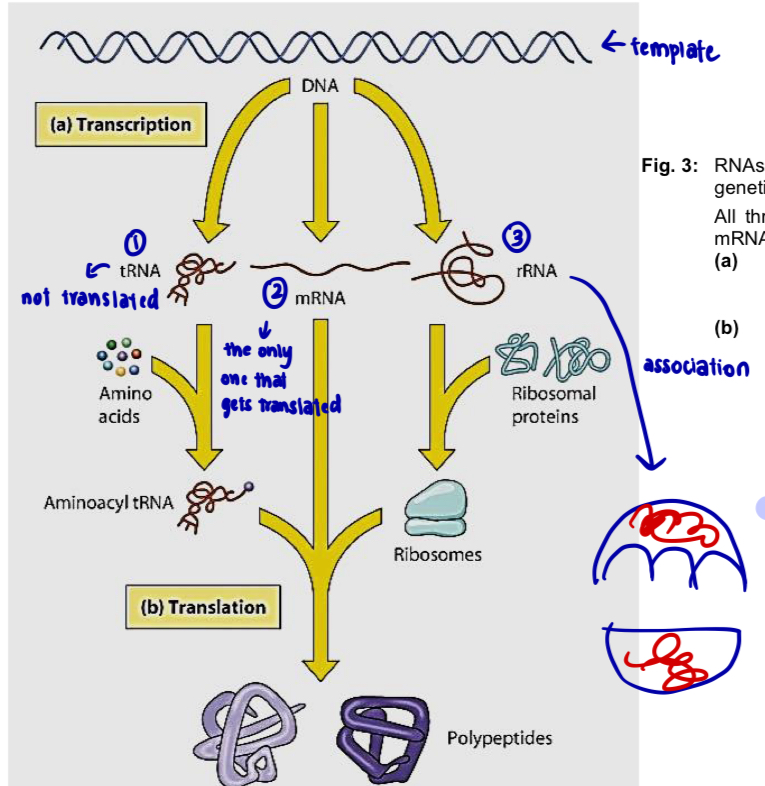
Roles of RNA

Types of RNA & their functions

  1. Messenger RNA (mRNA)

  • carries information, which codes for amino acid sequences, from DNA to ribosomes

  1. Transfer RNA (tRNA)

  • serves as an adaptor molecule in protein synthesis

  • translates mRNA codon sequence into amino acid sequence

  1. Ribosomal RNA (rRNA)

  • plays catalytic and structural roles in ribosomes

*not all enzymes are proteins

  1. Small nuclear RNA (snRNA)

  • plays catalytic and structural roles in spliceosomes, the complexes of protein and RNA that carry out splicing of pre-mRNA

  1. Small interfering RNA (siRNA) & microRNA (miRNA)

  • involved in regulation of gene expression
<p>Types of RNA &amp; their functions</p><ol><li><p><mark data-color="yellow" style="background-color: yellow; color: inherit;">Messenger RNA (mRNA)</mark></p></li></ol><ul><li><p><strong>carries</strong> <strong><u>information</u></strong>, which <strong><u>codes</u></strong> for <strong>amino acid sequences</strong>, from DNA to ribosomes</p></li></ul><ol start="2"><li><p><mark data-color="blue" style="background-color: blue; color: inherit;">Transfer RNA (tRNA)</mark></p></li></ol><ul><li><p>serves as an <strong>adaptor molecule</strong> in protein synthesis</p></li><li><p><strong><u>translates</u> mRNA codon sequence</strong> into <strong>amino acid </strong>sequence</p></li></ul><ol start="3"><li><p><mark data-color="red" style="background-color: red; color: inherit;">Ribosomal RNA (rRNA)</mark></p></li></ol><ul><li><p>plays <strong>catalytic</strong> and <strong>structural</strong> roles in ribosomes</p></li></ul><p>*not all enzymes are proteins</p><p></p><ol start="4"><li><p>Small nuclear RNA (snRNA)</p></li></ol><ul><li><p>plays <strong>catalytic</strong> and <strong>structural</strong> roles in <strong>spliceosomes</strong>, the complexes of protein and RNA that carry out splicing of pre-mRNA</p></li></ul><ol start="5"><li><p>Small interfering RNA (siRNA) &amp; microRNA (miRNA)</p></li></ol><ul><li><p>involved in regulation of gene expression</p></li></ul><p></p>
8
New cards

Transcription

  • Transcription: process by which a complementary RNA copy is made under the direction of the template strand of a specific region of the DNA molecule, catalysed by the enzyme RNA polymerase
<ul><li><p><strong>Transcription</strong>: process by which a <strong>complementary RNA copy</strong> is made under the direction of the<strong> template strand</strong> of a <strong>specific region of the DNA molecule</strong>, catalysed by the enzyme <strong>RNA polymerase </strong></p></li></ul><p></p>
9
New cards

Components of the transcription machinery

  1. Gene

  2. RNA polymerase

  3. General/basal transcription factors

  4. Ribonucleotides (or more specifically ribonucleoside triphosphate )

10
New cards

Gene

  • A gene is a section of DNA that encodes information in the form of a specific base sequence to direct the synthesis of one polypeptide chain or RNA molecule

  • it is a unit of inheritance located in a fixed position (locus) on the chromosome which specifies a particular character of an organism

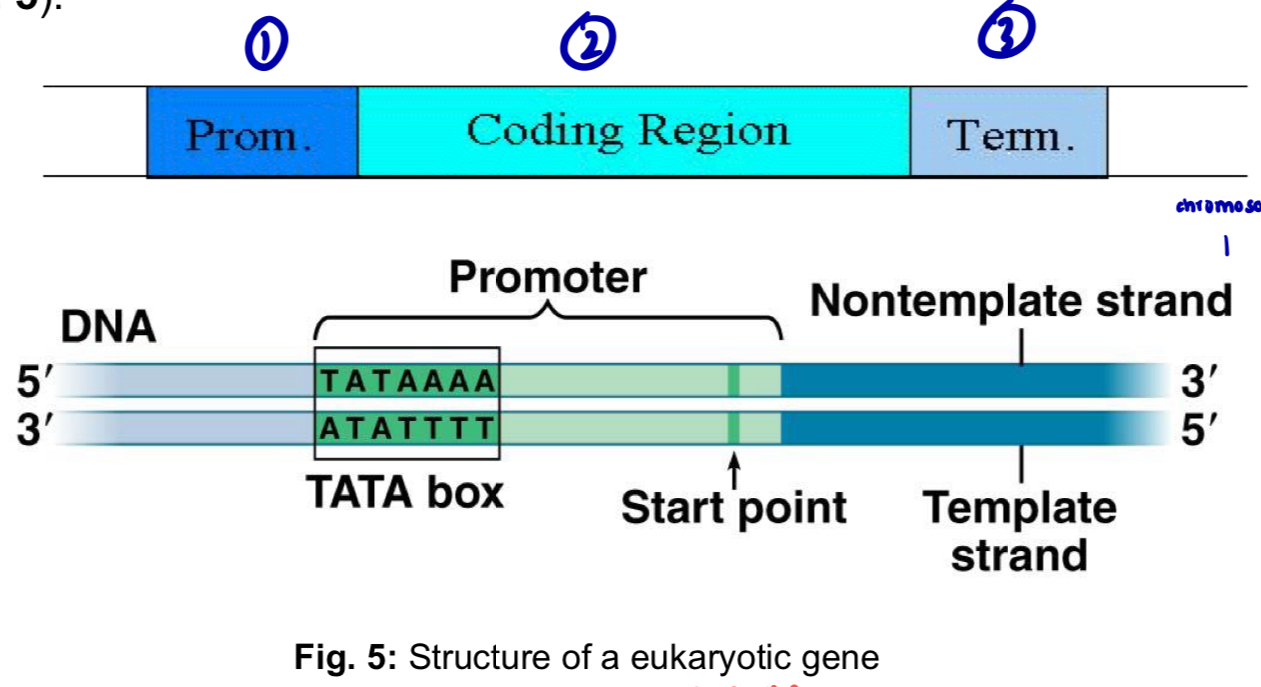
  • 3 components of eukaryotic gene

  1. Promoter

  1. Coding region

  2. Termination sequence

11
New cards

illustration of GTF and RNA polymerase
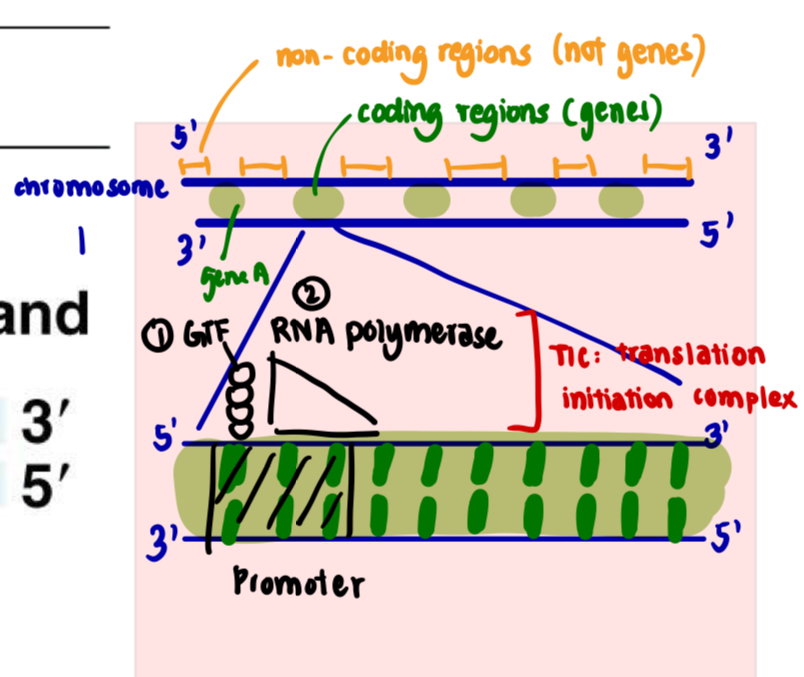
knowt flashcard image
12
New cards

Promoter

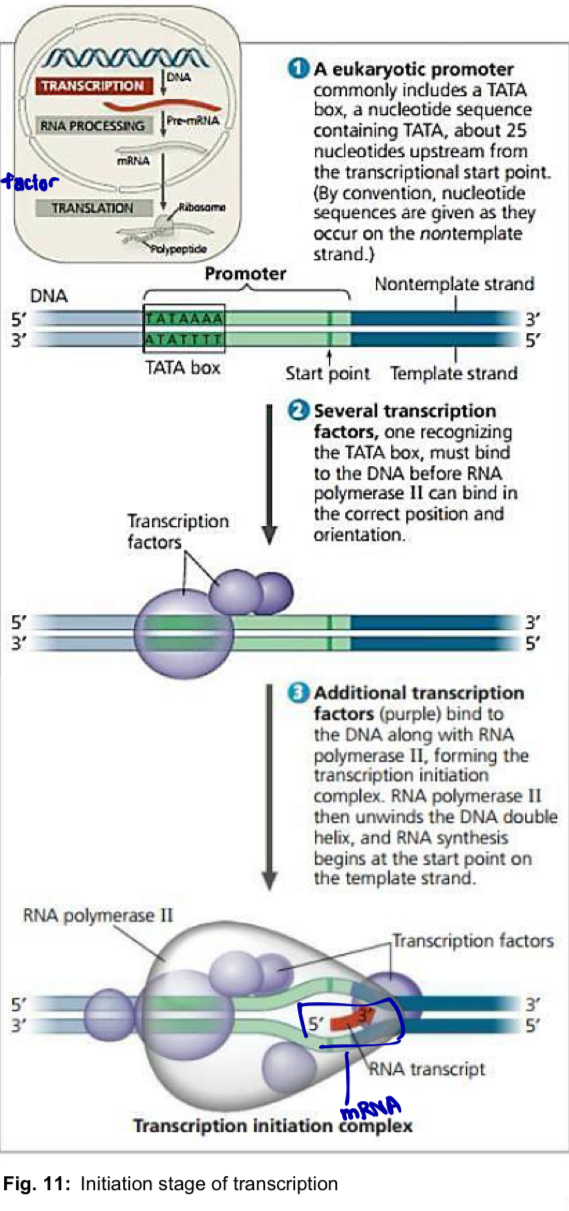
  • contains TATA box and transcription start site (+1: nucleotide where RNA synthesis begins)

  • TATA box is binding site for a general transcription factor (GTF) i.e. TFIID —> facilitates binding of RNA polymerase

  • TATA box is usually located 25bp upstream of transcription start site

  • RNA polymerase + GTF = transcription initiation complex
<ul><li><p><span>contains </span><strong><span>TATA box</span></strong><span> and </span><strong><span>transcription start site</span></strong><span> (+1: nucleotide where RNA synthesis begins)</span></p></li><li><p><span>TATA box is </span><strong><span>binding site for a general transcription factor </span></strong><span>(GTF) i.e. TFIID —&gt; facilitates </span><strong><span>binding of RNA polymerase</span></strong></p></li><li><p><span>TATA box is usually located 25bp upstream of transcription start site</span></p></li><li><p><span>RNA polymerase + GTF = </span><u><span>transcription</span></u><span> initiation complex</span></p></li></ul><p></p>
13
New cards

Coding region

  • the segment of DNA that is transcribed into a single-stranded RNA molecule (i.e. single primary transcript known as pre-mRNA or primary transcript)

  • bounded by the transcription start site and termination site

  • only 1 of the 2 strands serves as the template for transcription

  • template DNA strand is read in the 3’ to 5’ direction to facilitate synthesis of RNA in the 5’ to 3’ direction

  • template strand

    • DNA strand that is transcribed

    • sequence on this strand is complementary to that of the RNA

    • template to direct the synthesis of the RNA molecule

  • non-template strand

    • not transcribed

    • sequence on the DNA strand is exactly the same as that of the RNA (except thymine is replaced with uracil in RNA)

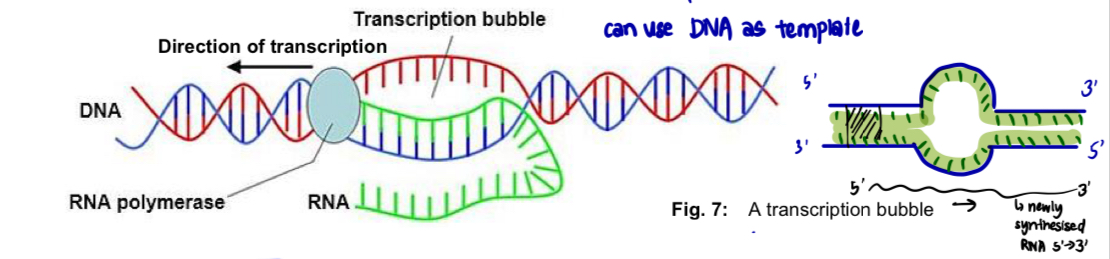
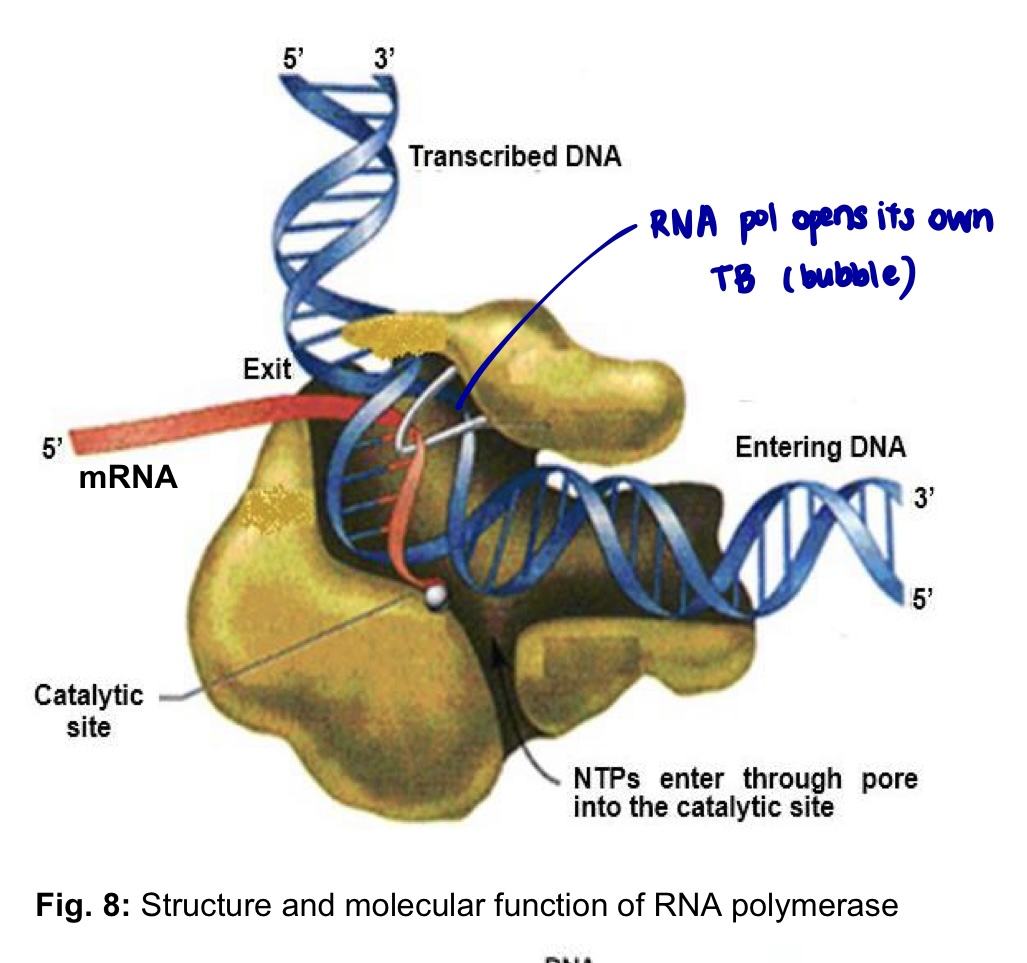
  • RNA synthesis occurs within a transcription bubble in which DNA is transiently separated into its single strands, one of which will be used as template
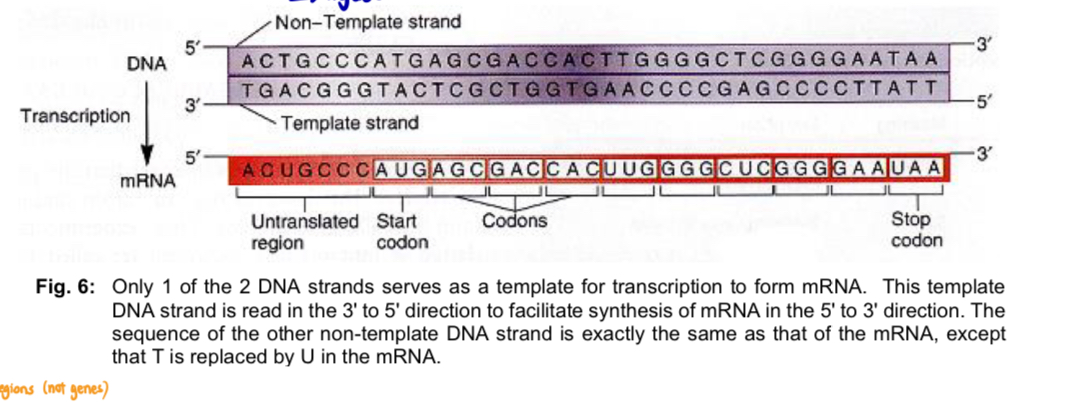
<ul><li><p>the segment of DNA that is <strong>transcribed</strong> into a <strong>single-stranded RNA molecule </strong>(i.e. single primary transcript known as pre-mRNA or primary transcript)</p></li><li><p>bounded by the transcription start site and termination site</p></li><li><p>only 1 of the 2 strands serves as the template for transcription</p></li><li><p>template DNA strand is read in the 3’ to 5’ direction to facilitate <strong>synthesis of RNA in the 5’ to 3’ direction</strong></p></li><li><p>template strand</p><ul><li><p>DNA strand that is transcribed</p></li><li><p>sequence on this strand is complementary to that of the RNA</p></li><li><p>template to direct the synthesis of the RNA molecule</p></li></ul></li><li><p>non-template strand</p><ul><li><p>not transcribed</p></li><li><p>sequence on the <u>DNA</u> strand is <u>exactly the same</u> as that of the <u>RNA</u> (except thymine is replaced with uracil in RNA)</p></li></ul></li><li><p>RNA synthesis occurs within a <strong>transcription bubble</strong> in which DNA is transiently separated into its single strands, one of which will be used as template</p></li></ul><p></p>
14
New cards

transcription bubble

knowt flashcard image
15
New cards

comparison btw RNA polymerase (transcription) and DNA polymerase (DNA replication)

  1. DNA pol needs helicase (to unwind and separate the DNA strands first); RNA pol requires just itself

  2. DNA pol needs primase (to form RNA primer); RNA pol itself can start transcription

  3. DNA pol needs SSB to keep template open; RNA pol itself

  4. DNA pol needs topoisomerases, ligase; RNA itself

16
New cards

Termination sequence

  • at the end of a gene and it codes for a polyadenylation signal sequence (AAUAAA) in the pre-mRNA

  • the whole termination sequence is transcribed —> transcription termination i.e. formation of phosphodiester bonds stops

17
New cards

RNA polymerase

  1. RNA polymerase is an enzyme comprising of several protein subunits and is found in the nucleoplasm

  • can bind the following to initiate transcription: template and nucleotide

  1. RNA pol responsible for RNA synthesis using ribonucleoside triphosphate (NTP) as its substrate

  1. During t/c, RNA polymerase reads the DNA template in the 3’ to 5’ direction, catalysing

  • the assembly of ribonucleotides, which form complementary base pairs with the template

  • formation of phosphodiester bond btw the free 5’ phosphate group of the incoming ribonucleotide/ribonucleoside triphosphate (NTP) and the free 3’ OH group of the growing RNA polynucleotide chain

  1. RNA is synthesised in the 5’ to 3’ direction

  1. Simultaneous transcription from the same DNA template strand is possible

  • many RNA polymerase molecules can be transcribing different parts of the same gene simultaneously

NOTE:

  • in prokaryotes, there is only 1 type of RNA polymerase

  • in eukaryotes, there are 3 types of RNA polymerases

    • RNA pol 1 transcribes genes encoding rRNA (nucleus)

    • RNA pol II transcribes most genes including all those that encode proteins, synthesised mRNA** (nucleoplasm)

    • RNA pol III transcribes genes encoding tRNA (nucleoplasm)
<ol><li><p>RNA polymerase is an <strong>enzyme</strong> comprising of <strong>several protein subunits</strong> and is found in the <strong>nucleoplasm</strong></p></li></ol><ul><li><p>can bind the following to <u>initiate</u> transcription: <u>template</u> and <u>nucleotide</u></p></li></ul><p></p><ol start="2"><li><p>RNA pol responsible for <strong>RNA synthesis</strong> using <strong>ribonucleoside triphosphate (NTP</strong>) as its <strong>substrate</strong></p></li></ol><p></p><ol start="2"><li><p>During t/c, RNA polymerase <strong>reads</strong> the DNA template in the <strong>3’ to 5’ direction</strong>, catalysing</p></li></ol><ul><li><p>the<strong> assembly of ribonucleotides</strong>, which form<strong> </strong><u>complementary base pairs</u><strong> </strong>with the template</p></li><li><p>formation of phosphodiester bond btw the free 5’ phosphate group of the incoming ribonucleotide/ribonucleoside triphosphate (NTP) and the free 3’ OH group of the growing RNA polynucleotide chain</p></li></ul><p></p><ol start="4"><li><p>RNA is synthesised in the<strong> 5’ to 3’ direction</strong></p></li></ol><p></p><ol start="5"><li><p><strong>Simultaneous transcription</strong> from the same DNA template strand is possible</p></li></ol><ul><li><p>many RNA polymerase molecules can be transcribing different parts of the same gene simultaneously</p></li></ul><p></p><p>NOTE:</p><ul><li><p>in prokaryotes, there is only 1 type of RNA polymerase</p></li><li><p>in eukaryotes, there are 3 types of RNA polymerases</p><ul><li><p>RNA pol 1 transcribes genes encoding rRNA (nucleus)</p></li><li><p>RNA pol II transcribes most genes including all those that encode proteins, synthesised mRNA** (nucleoplasm)</p></li><li><p>RNA pol III transcribes genes encoding tRNA (nucleoplasm)</p></li></ul></li></ul><p></p>
18
New cards

illustration of RNA polymerase catalysing formation of CBP
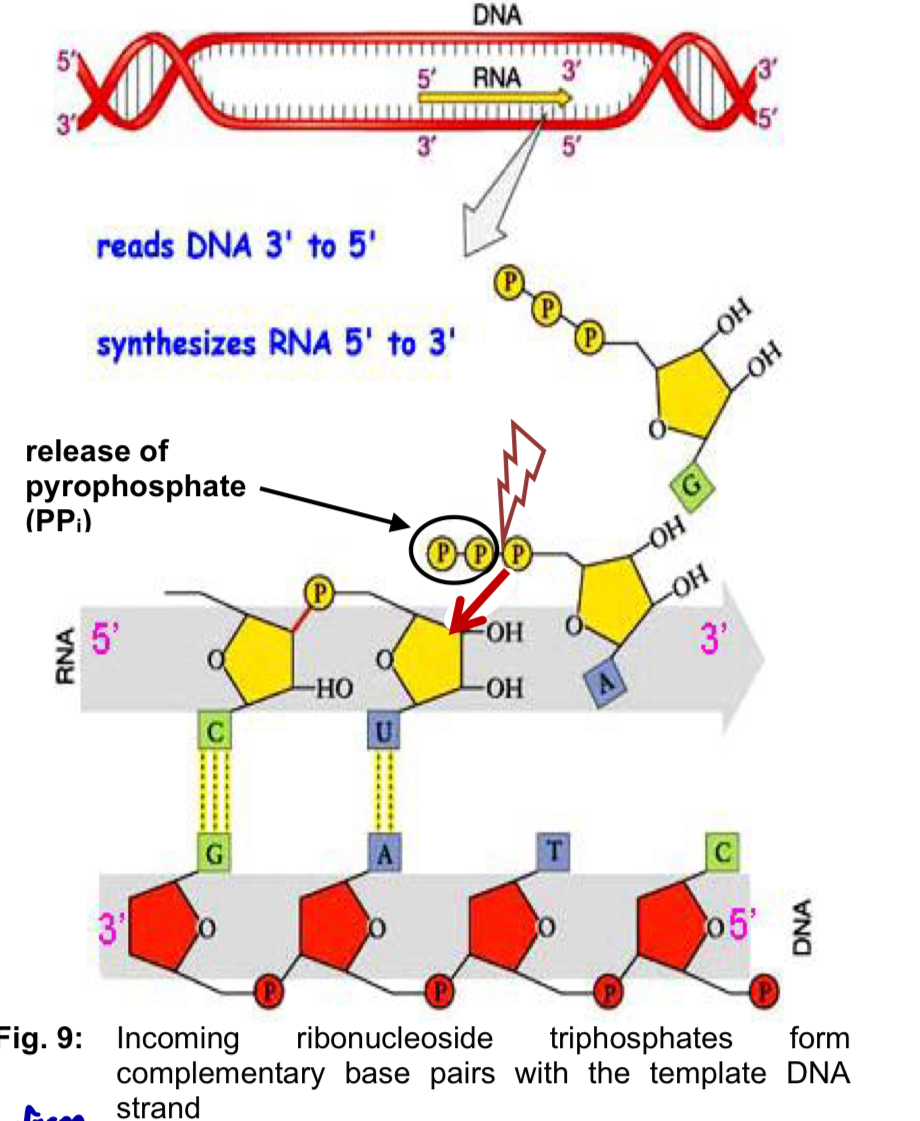
knowt flashcard image
19
New cards

illustration of RNA polymerase catalysing formation of CBP
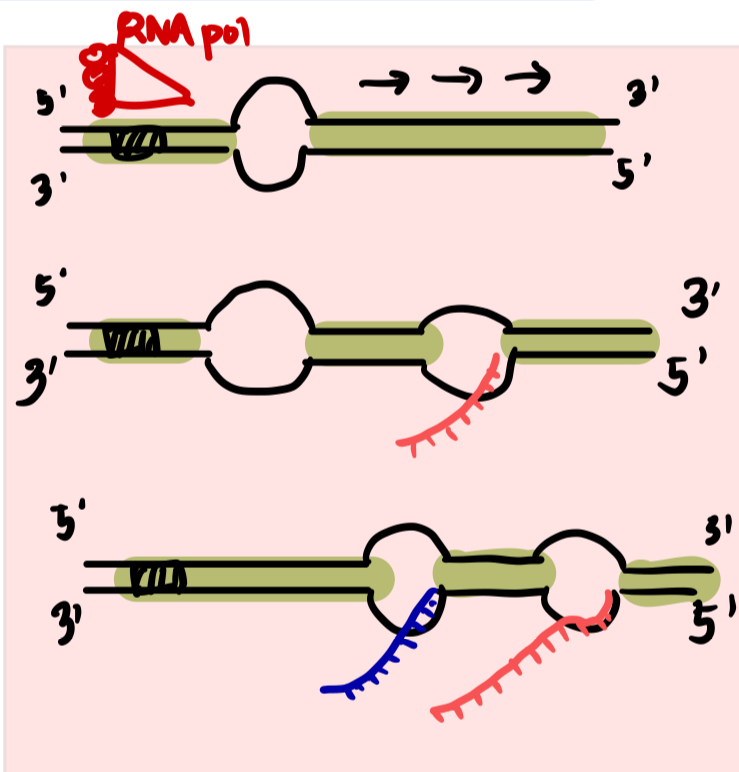
knowt flashcard image
20
New cards

General transcription factors

  • protein that is required for an RNA polymerase molecule to bind to its promoter and initiate transcription

  • roles

    • ***position RNA polymerase correctly at the promoter

    • release RNA polymerase from the promoter to begin elongating the RNA against the DNA template once t/c has begun

GTF bind first —> call RNA pol —> RNA pol binds —> TIC

21
New cards

Steps involved in t/c

  1. Initiation

  2. Elongation

  3. Termination

*all are mediated by RNA polymerase itself (unwinding, initiating RNA synthesis, reforming the double helix)
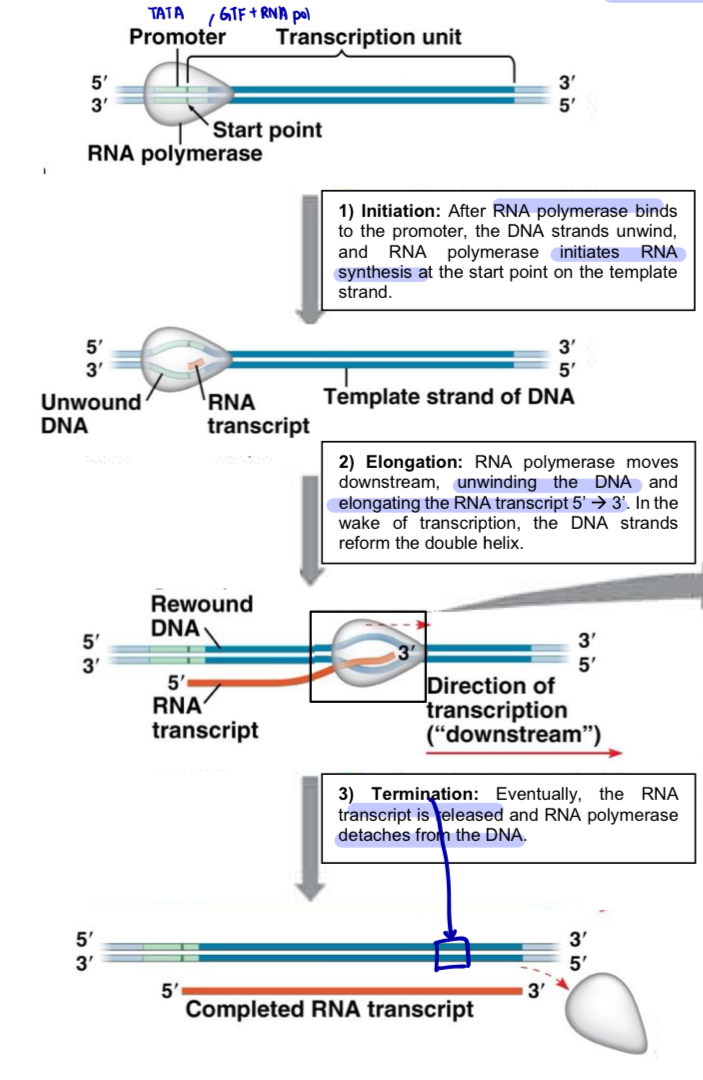
<ol><li><p>Initiation</p></li><li><p>Elongation</p></li><li><p>Termination</p></li></ol><p>*all are mediated by RNA polymerase itself (unwinding, initiating RNA synthesis, reforming the double helix)</p>
22
New cards

Initiation

Step 1: Formation of Transcription Initiation Complex

  • General transcription factors assembled along the promoter

  • TFIID binds to the TATA box found within the promoter

  • GTF mediate the binding of RNA polymerase to the promoter, forming a complex known as transcription initiation complex

Step 2: Unwinding of DNA helix and separation of 2 strands

  • Binding of RNA polymerase to the promoter causes the DNA double helix to unwind and the 2 strands separate

  • during this process

    • hydrogen bonds btw complementary base pairs are disrupted

    • transcription bubble exposing a short stretch of nucleotides on each strand is created

Step 3: Assembly of Ribonucleotides & Formation of 1st Phosphodiester Bond

  • one of the two exposed DNA strands acts as a template for CBP to direct the assembly of incoming ribonucleotides (nucleoside triphosphates)

    • RNA polymerase catalyses the formation of the first phosphodiester bond = marks the end of transcription initiation

23
New cards

Initiation illustration

knowt flashcard image
24
New cards

Elongation

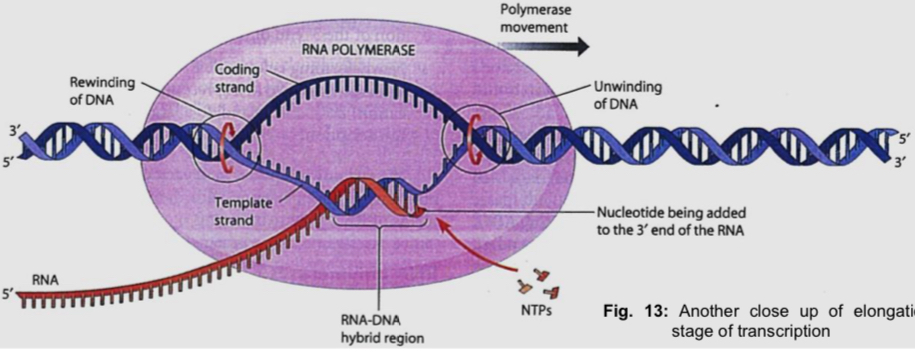
Step 1: Movement of the transcription bubble

  • As RNA polymerase moves along the template DNA in the 3’ to 5’ direction, DNA double helix continues to transiently unwind

*****Step 2: Elongation of polynucleotide

  • Ribonucleotides (i.e. monomers) form CBP with the DNA template

    • As each ribonucleoside triphosphate is brought in, its two terminal phosphates are removed

    • the remaining free 5’-phosphate group is added to the free 3’-hydroxyl group of the growing RNA chain via the formation of a phosphodiester bond catalysed by RNA polymerase

    • i.e. mRNA is synthesised in the 5’ to 3’ direction

Step 3: Re-annealing of DNA and proofreading

  • RNA polymerase reanneals the unwound DNA behind it, dissociating the growing RNA chain from the template

  • RNA polymerase carries out proofreading functions and is responsible for the removal of any incorrectly inserted ribonucleotide
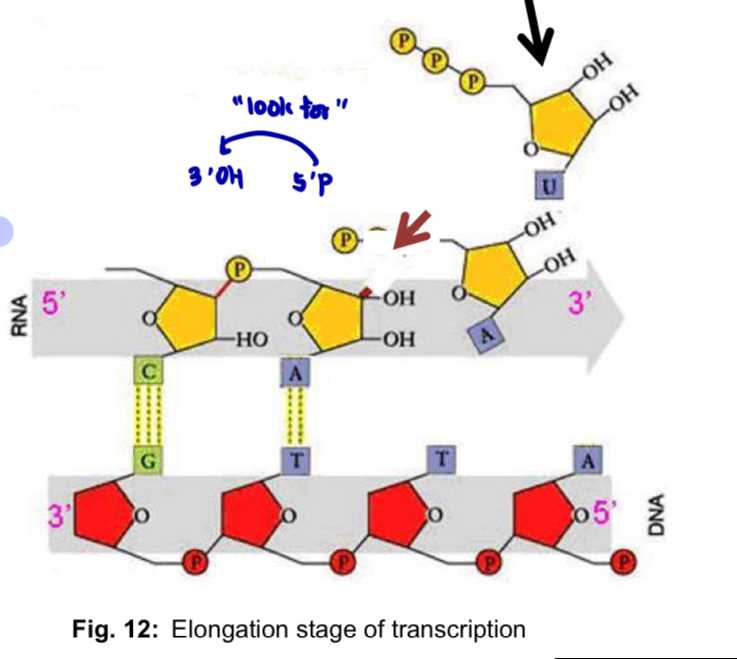
<p><mark data-color="purple" style="background-color: purple; color: inherit;">Step 1: Movement of the transcription bubble</mark></p><ul><li><p>As RNA polymerase moves along the template DNA in the 3’ to 5’ direction, DNA double helix continues to <strong>transiently unwind</strong></p></li></ul><p></p><p><span style="color: red;"><strong><mark data-color="green" style="background-color: green; color: inherit;"><span>*****</span></mark></strong></span><mark data-color="green" style="background-color: green; color: inherit;">Step 2: Elongation of polynucleotide</mark></p><ul><li><p>Ribonucleotides (i.e. monomers) form <strong>CBP</strong> with the <strong>DNA</strong> <strong>template</strong></p><ul><li><p>As each ribonucleoside triphosphate is brought in, its <strong>two terminal phosphates are removed</strong></p></li><li><p>the remaining <strong>free 5’-phosphate group </strong>is added to the <strong>free 3’-hydroxyl group</strong> of the growing RNA chain via the formation of a <strong>phosphodiester bond </strong>catalysed by <strong>RNA polymerase</strong></p></li><li><p>i.e. mRNA is synthesised in the 5’ to 3’ direction</p></li></ul></li></ul><p></p><p><mark data-color="yellow" style="background-color: yellow; color: inherit;">Step 3: Re-annealing of DNA and proofreading</mark></p><ul><li><p>RNA polymerase <strong>reanneals</strong> the <strong>unwound DNA</strong> behind it, dissociating the growing RNA chain from the template</p></li><li><p>RNA polymerase carries out <strong>proofreading</strong> functions and is responsible for the <strong>removal of any incorrectly inserted ribonucleotide</strong></p></li></ul><p></p><p></p>
25
New cards

Elongation illustration

knowt flashcard image
26
New cards

Termination

  • Transcription proceeds until after the RNA polymerase transcribes a termination sequence in the DNA

  • triggers the release of the RNA chain and the dissociation of the RNA polymerase from the DNA

  • the transcribed terminator - RNA sequence - codes for a polyadenylation signal sequence (AAUAAA)

  • in eukaryotic cell, the RNA polymerase continues transcription until at a point about 10 to 35 nucleotides downstream of the polyadenylation signal sequence

    • proteins bind at this point to cut and free the pre-mRNA from the RNA polymerase

  • cleavage site on the mRNA is also the site of addition of poly (A) tail

27
New cards

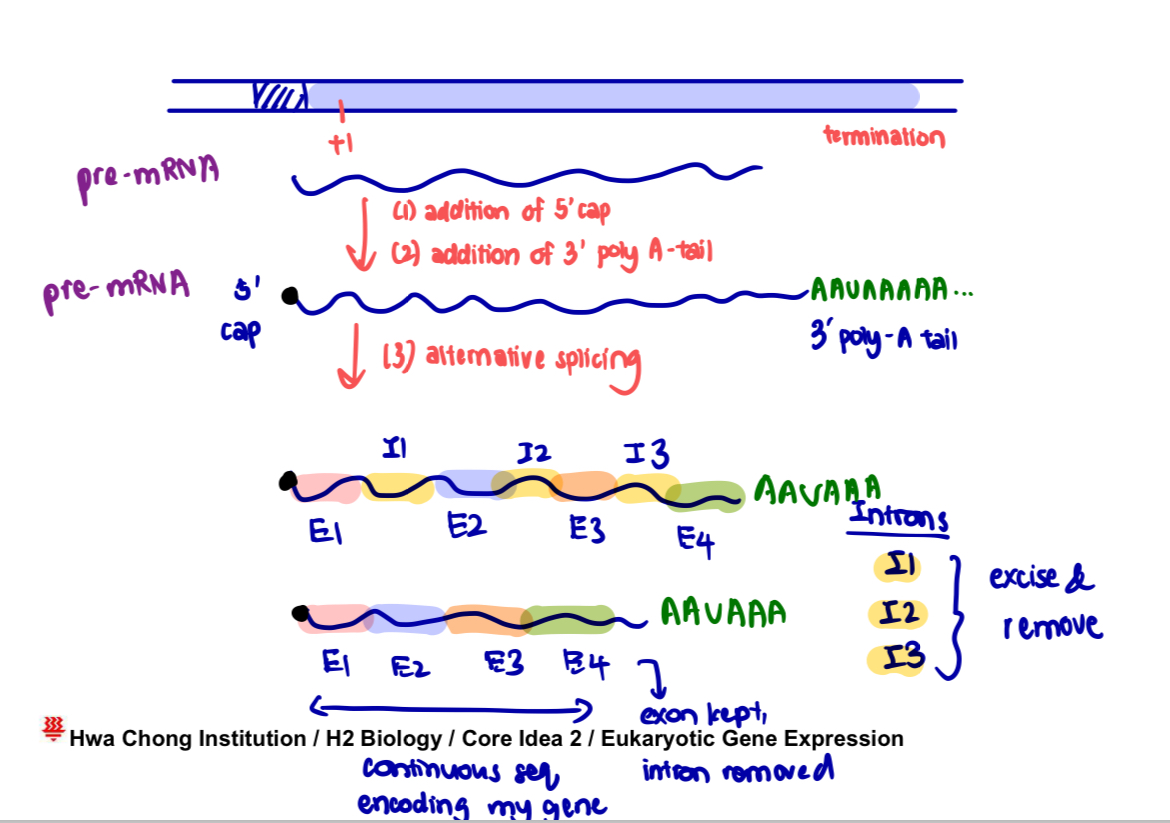
Post-transcriptional modification of mRNA

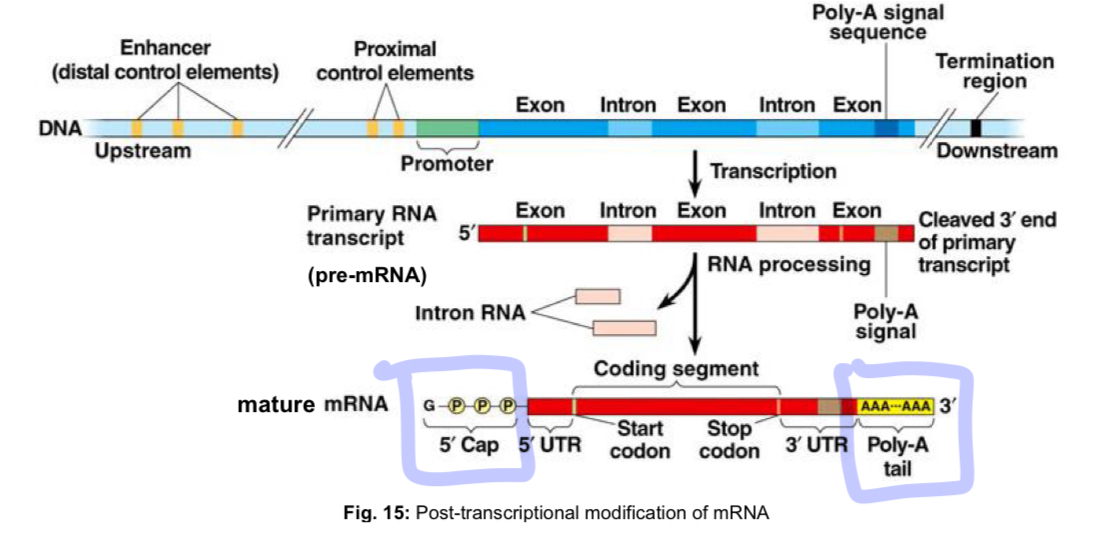
  • all the pre-mRNA transcribed in the eukaryotic nucleus must undergo processing to produce functional mature RNA molecules for export to the cytosol, where they will be used as templates for translation to form polypeptides

  • 3 steps

pre-mRNA

  1. addition of 5’ cap

  2. RNA splicing

  3. addition of 3’ poly (A) tail

mature mRNA (only mature mRNA can exit the nucleus via nuclear pores)

  • structure-function relationship of mature mRNA

    • transport across nuclear envelope

    • stability (yet so stable, yet so unstable)

    • facilitation of translation

<ul><li><p>all the pre-mRNA transcribed in the eukaryotic nucleus must undergo processing to produce <strong>functional mature RNA molecules </strong>for<strong> export to the cytosol</strong>, where they will be used as templates for translation to form polypeptides</p></li><li><p>3 steps</p></li></ul><p>pre-mRNA</p><ol><li><p>addition of 5’ cap</p></li><li><p>RNA splicing</p></li><li><p>addition of 3’ poly (A) tail</p></li></ol><p>mature mRNA (only mature mRNA can exit the nucleus via nuclear pores)</p><ul><li><p>structure-function relationship of mature mRNA</p><ul><li><p>transport across nuclear envelope</p></li><li><p>stability (yet so stable, yet so unstable)</p></li><li><p>facilitation of translation</p></li></ul></li></ul><p></p>
28
New cards

Addition of 5’ Cap

  • 5’ end of the new RNA molecule is modified by addition of a cap that consists of a methylated guanine (G) nucleotide/methylguanosine triphosphate

  • Functions of the 5’ cap

    • 5’ cap protects the mRNA from degradation by hydrolysis enzymes such as nucleases

    • 5’ cap defines the 5’ end of the mRNA, which serves to recruit the small subunit of the ribosome for translation initiation

    • 5’ cap distinguishes mRNAs from the other types of RNA molecules (e.g. tRNAs, rRNAs)

29
New cards

drawing of post-transcriptional modification
knowt flashcard image
30
New cards

RNA splicing

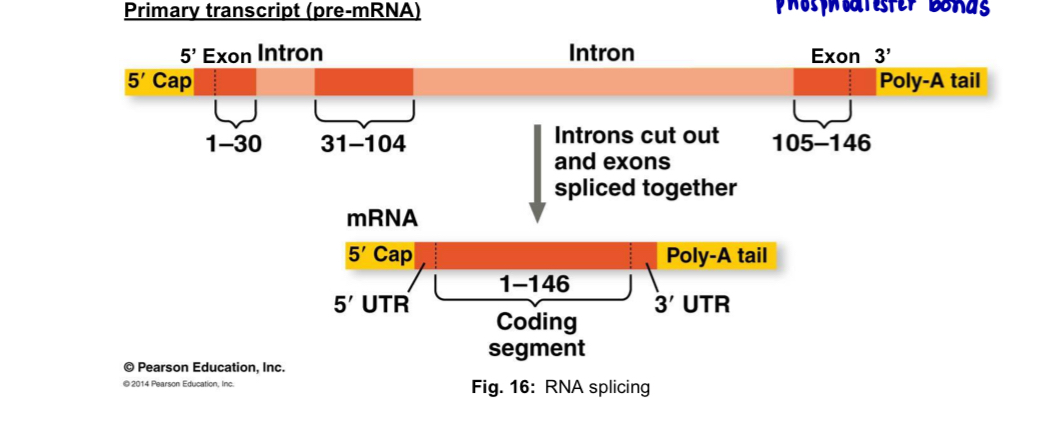
  • eukaryotic genes contain

    • exons, which are protein-coding sequences in the gene

    • introns, which are long stretches of nucleotides inserted btw exons that do not code for any portion of the polypeptide i.e. non-coding sequences

  • both intron and exon sequences are transcribed into pre-mRNA

  • RNA splicing occurs after the release of pre-mRNA from RNA polymerase

  • during this process, introns are removed while the remaining exons are spliced/joined together to form mature mRNA - require hydrolysis of ATP (breaking and joining phosphodiester bonds)

  • splicing is carried out by spliceosome which is a large complex comprising of several subunits known as small nuclear ribonucleoproteins (snRNPs)

  • each snRNP contains small nuclear RNAs (snRNAs) and a set of proteins
<ul><li><p>eukaryotic genes contain </p><ul><li><p><strong>exons</strong>, which are <strong>protein-coding sequences</strong> in the gene </p></li><li><p><strong>introns</strong>, which are long stretches of nucleotides inserted btw exons that<u> do not code for any portion of </u>the <u>polypeptide</u> i.e. <strong>non-coding sequences </strong></p></li></ul></li><li><p><u>both intron and exon</u> sequences are transcribed into<strong> pre-mRNA </strong></p></li><li><p><strong>RNA splicing </strong>occurs <u>after</u> the <u>release of pre-mRNA </u>from RNA polymerase </p></li><li><p>during this process, <strong>introns</strong> are <strong>removed</strong> while the remaining<strong> exons are spliced/joined together</strong> to form mature mRNA - require<strong> hydrolysis of ATP </strong>(breaking and joining phosphodiester bonds) </p></li><li><p>splicing is carried out by <strong>spliceosome</strong> which is a large complex comprising of several subunits known as <strong>small nuclear ribonucleoproteins (snRNPs) </strong></p></li><li><p>each snRNP contains <strong>small nuclear RNAs (snRNAs) </strong>and a set of <strong>proteins</strong> </p></li></ul><p></p><p></p>
31
New cards

Addition of 3’ Poly (A) Tail

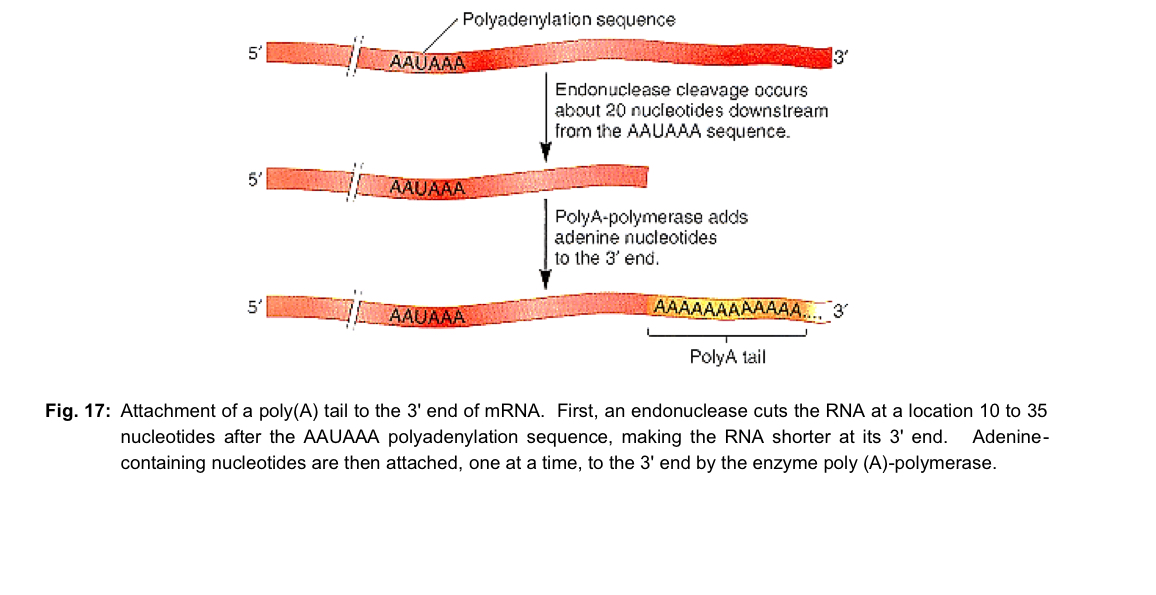
  • immediately after the pre-mRNA is cleaved by an endonuclease at a site 10-35 nucleotides after the AAUAAA polyadenylation sequence, the 3’ end of the pre-mRNA is modified by addition of a series of approximately 200 adenine (A) nucleotides - poly (A) tail

  • addition of adenine nucleotides at this cleavage site is catalysed by the enzyme poly (A) - polymerase

  • Functions

    • 3’ poly (A) tail protects the mRNA from degradation by nucleases; 3’ poly (A) tail makes the mRNA more stable template for translation in the cytoplasm

    • 3’ poly (A) tail is required to facilitate export of mRNA out of the nucleus via nuclear pores
<ul><li><p>immediately after the pre-mRNA is cleaved by an endonuclease at a site 10-35 nucleotides after the AAUAAA polyadenylation sequence, the <strong>3’ end </strong>of the pre-mRNA is modified by <strong>addition</strong> of a series of <strong>approximately</strong> <strong>200 adenine (A) nucleotides - poly (A) tail </strong></p></li><li><p>addition of adenine nucleotides at this cleavage site is catalysed by the enzyme poly (A) - polymerase </p></li><li><p>Functions </p><ul><li><p>3’ poly (A) tail <strong>protects</strong> the mRNA from <strong>degradation</strong> by nucleases; 3’ poly (A) tail makes the mRNA more stable template for translation in the cytoplasm </p></li><li><p>3’ poly (A) tail is required to facilitate <strong>export</strong> of mRNA out of the nucleus via nuclear pores </p></li></ul></li></ul><p></p>
32
New cards

The Genetic Code

  • proteins are linear polymers of amino acids

  • sequence of bases along the DNA strand determines the sequence of amino acids in polypeptides

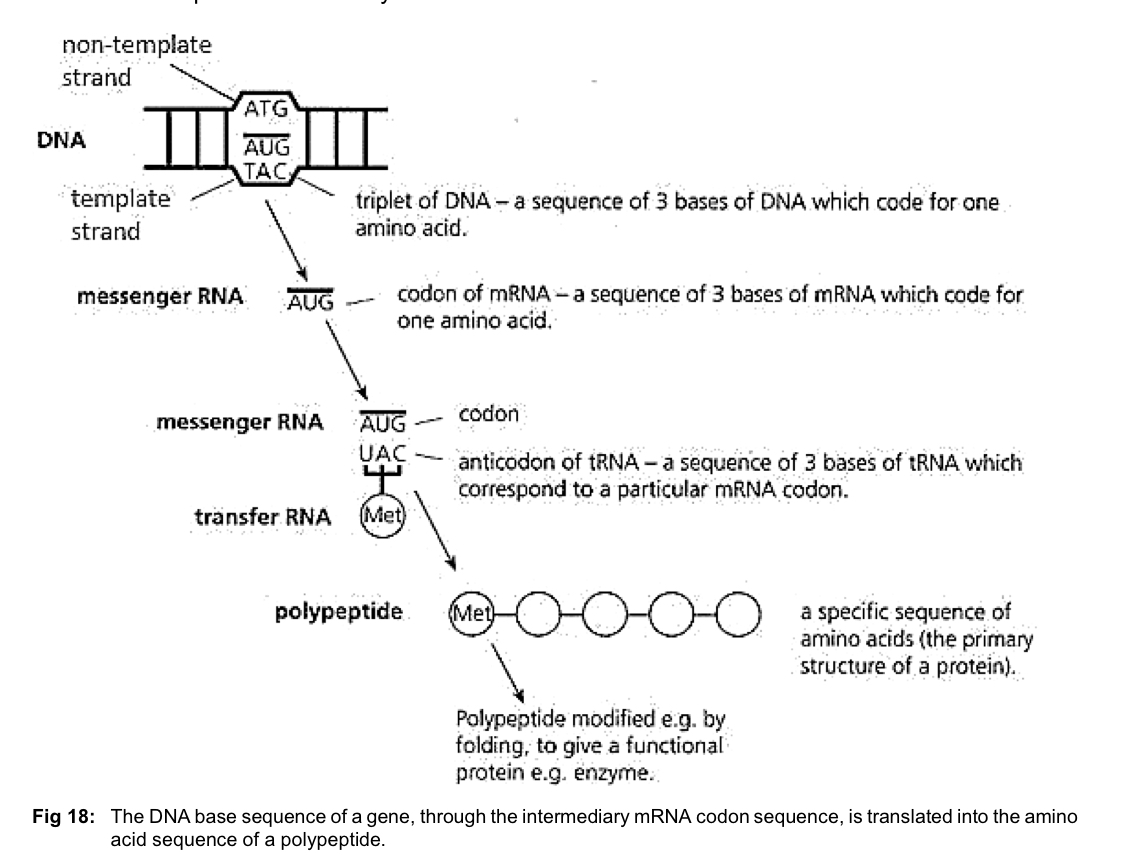
  • DNA base sequence of a gene, through the intermediary mRNA codon sequence, is translated into the amino acid sequence of a polypeptide by genetic code
<ul><li><p>proteins are linear polymers of amino acids</p></li><li><p>sequence of bases along the DNA strand determines the sequence of amino acids in polypeptides</p></li><li><p><strong>DNA base sequence</strong> of a gene, through the intermediary<strong> mRNA codon sequence</strong>, is translated into the <strong>amino acid sequence</strong> of a <strong>polypeptide</strong> by <strong>genetic code</strong></p></li></ul><p></p>
33
New cards

The Triplet Code

  • 20 different amino acids in proteins, but only 4 different bases in DNA (A, G, C and T)

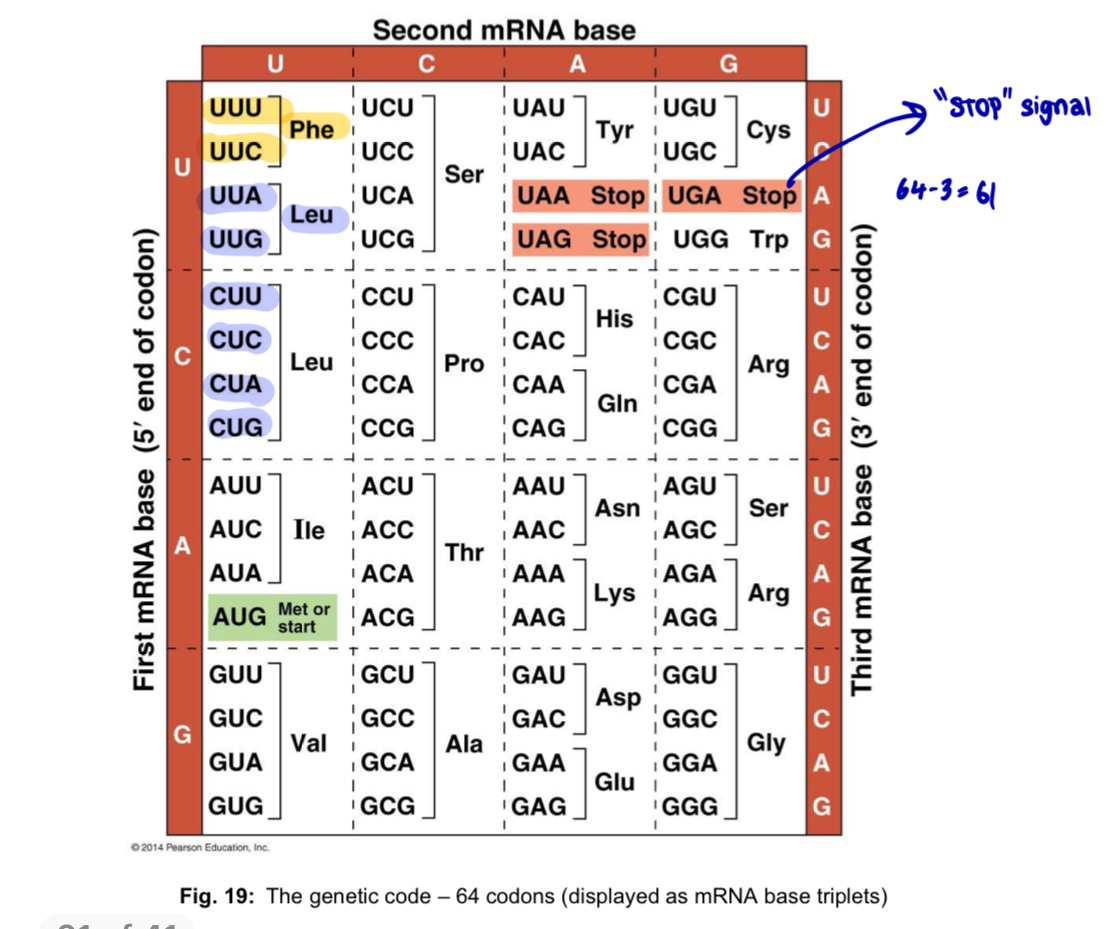
  • each amino acid is specified by a codon, a base triplet

  • 3-nucleotide codon (triplet code): 4³ = 64 different codons possible (more than enough to code for all 20 a.a)
<ul><li><p>20 different amino acids in proteins, but only 4 different bases in DNA (A, G, C and T)</p></li><li><p>each amino acid is specified by a <strong>codon, a base triplet</strong></p></li><li><p>3-nucleotide codon (triplet code): 4³ = <strong>64 different codons </strong>possible (more than enough to code for all 20 a.a)</p></li></ul><p></p>
34
New cards

Features of the genetic code

General features

  • sequence of triplet bases in the non-template/non-transcribed strand of DNA

  • 64 possible codons

  • 61 code for amino acids and include a start signal (start codon)

  • 3 serve as termination signals of polypeptide synthesis (stop codons) —> do not code for any a.a

Key features

*TUND - Triple, Universal, Non-overlapping, Degenerate code

  1. The genetic code is a triplet code

  • each mRNA codon that specifies an amino acid in a polypeptide chain consists of 3 nucleotide bases

  1. The genetic code is (almost) universal

  • same code is used by almost all organisms

  • for instance, the codon AGA specifies the amino acid arginine in bacteria, human and all other organisms whose genetic code has been studied

  1. The genetic code is continuous and non-overlapping

  • each codon is read as a triplet in the 5’ to 3’ direction

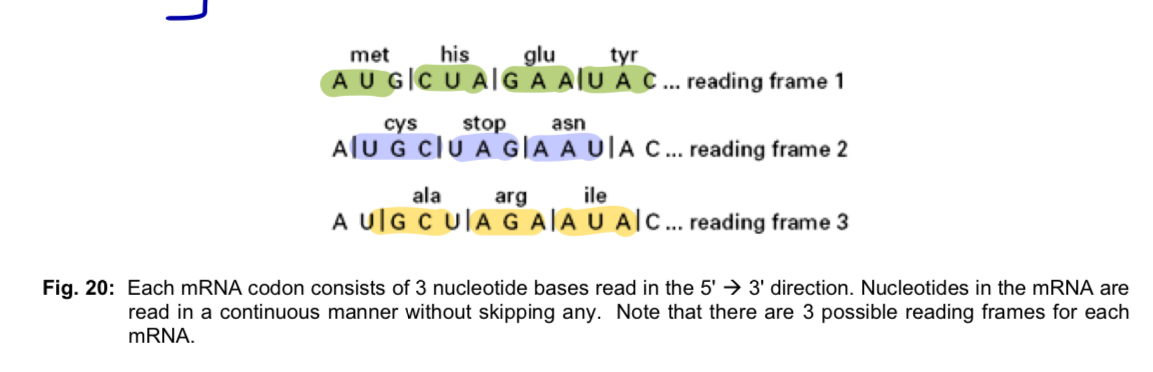
  • nucleotides in the mRNA are read continuously as successive groups of 3 nucleotides, one codon at a time without skipping any nucleotides

  • as the genetic code is read in blocks of 3 nucleotides, there can be 3 possible reading frames for every mRNA sequence

  1. The genetic code is degenerate but unambiguous

  • a single amino acid can be coded by more than one different codon (e.g. UUU and UUC code for the same amino acid, phenylalanine)

  • in the genetic code, there are more codons than amino acids

  • only 2 amino acids - methionine (AUG) and tryptophan (UGG) are coded for by a single codon each

  • however, each codon codes for just one amino acid, thus the code is unambiguous

  • most of the amino acids are encoded by degenerate codons that differ in the 3rd position (3rd base) of the codon; thus mutations can arise in this position of the codon without altering amino acid sequences —> silent mutations

    • e.g. arginine is coded for by 4 degenerate codons - CGU, CGC, CGA, CGG (differ only in 3rd base)

  1. Wobble base phenomenon occurs

  • a single tRNA can recognise 2 or more of the degenerate codons

    • phenylalanine tRNA with the anticodon AAG recognises not only the complementary mRNA codon UUC but also UUU

  • violation of the usual rules of base-pairing at the 3rd nucleotide of a codon is called wobble

  • base pairing at the 3rd base is not so specific - change in the 3rd base by a mutation may still permit the correct incorporation of a given amino acid in a polypeptide

  1. The genetic code has punctuation codons - start and stop codons

  • start codon

    • within an mRNA message, the start signal for protein synthesis is the start codon AUG, which codes for the incorporation of methionine

    • start codon defines

      • the first amino acid of the polypeptide chain

      • reading frame used from that point on

  • stop codon

    • 3 stop codons UAA, UAG and UGA are stop signals in the mRNA message marking the end of the protein synthesis - do not code for any amino acid

    • there is no tRNA with an anticodon complementary to these 3 codons
<p>General features</p><ul><li><p><strong>sequence of triplet bases</strong> in the <strong>non-template/non-transcribed strand</strong> of DNA</p></li><li><p>64 possible codons</p></li><li><p>61 code for amino acids and include a start signal (start codon)</p></li><li><p>3 serve as termination signals of polypeptide synthesis (stop codons) —&gt; do not code for any a.a</p></li></ul><p></p><p>Key features</p><p>*TUND - Triple, Universal, Non-overlapping, Degenerate code</p><ol><li><p><mark data-color="yellow" style="background-color: yellow; color: inherit;">The genetic code is </mark><strong><mark data-color="yellow" style="background-color: yellow; color: inherit;">a </mark><u><mark data-color="yellow" style="background-color: yellow; color: inherit;">triplet</mark></u><mark data-color="yellow" style="background-color: yellow; color: inherit;"> code</mark></strong></p></li></ol><ul><li><p>each mRNA codon that specifies an amino acid in a polypeptide chain consists of<u> 3 nucleotide bases</u></p></li></ul><ol start="2"><li><p><mark data-color="blue" style="background-color: blue; color: inherit;">The genetic code is (almost) </mark><strong><mark data-color="blue" style="background-color: blue; color: inherit;">universal</mark></strong></p></li></ol><ul><li><p>same code is used by <strong>almost all organisms</strong></p></li><li><p>for instance, the codon AGA specifies the amino acid arginine in bacteria, human and all other organisms whose genetic code has been studied</p></li></ul><ol start="3"><li><p><mark data-color="red" style="background-color: red; color: inherit;">The genetic code is continuous and </mark><strong><mark data-color="red" style="background-color: red; color: inherit;">non-overlapping</mark></strong></p></li></ol><ul><li><p>each codon is read as a triplet in the<strong> 5’ to 3’ direction</strong></p></li><li><p>nucleotides in the mRNA are read continuously as <strong>successive groups of 3 nucleotides</strong>, one codon at a time <strong>without skipping any nucleotides</strong></p></li><li><p>as the genetic code is read in blocks of 3 nucleotides, there can be 3 possible <strong>reading frames</strong> for every mRNA sequence</p></li></ul><ol start="4"><li><p><mark data-color="purple" style="background-color: purple; color: inherit;">The genetic code is </mark><strong><mark data-color="purple" style="background-color: purple; color: inherit;">degenerate</mark></strong><mark data-color="purple" style="background-color: purple; color: inherit;"> but </mark><strong><mark data-color="purple" style="background-color: purple; color: inherit;">unambiguous</mark></strong></p></li></ol><ul><li><p>a single amino acid can be coded by more than one different codon (e.g. UUU and UUC code for the same amino acid, phenylalanine)</p></li><li><p>in the genetic code, there are more codons than amino acids</p></li><li><p>only 2 amino acids - methionine (AUG) and tryptophan (UGG) are coded for by a single codon each</p></li><li><p>however, each codon codes for just one amino acid, thus the code is unambiguous</p></li><li><p>most of the amino acids are encoded by <strong>degenerate codons</strong> that <strong>differ</strong> in the<strong> 3rd position</strong> (3rd base) of the codon; thus mutations can arise in this position of the codon without altering amino acid sequences —&gt; <strong>silent mutations</strong></p><ul><li><p>e.g. arginine is coded for by 4 degenerate codons - CGU, CGC, CGA, CGG (differ only in 3rd base)</p></li></ul></li></ul><ol start="5"><li><p><strong><mark data-color="green" style="background-color: green; color: inherit;">Wobble base phenomenon</mark></strong><mark data-color="green" style="background-color: green; color: inherit;"> occurs</mark></p></li></ol><ul><li><p>a <strong>single tRNA</strong> can recognise <strong>2 or more of the degenerate codons</strong></p><ul><li><p>phenylalanine tRNA with the anticodon AAG recognises not only the complementary mRNA codon UUC but also UUU</p></li></ul></li><li><p>violation of the usual rules of base-pairing at the 3rd nucleotide of a codon is called <strong>wobble</strong></p></li><li><p><strong>base pairing at the 3rd base</strong> is <strong>not so specific</strong> - change in the 3rd base by a mutation may still permit the correct incorporation of a given amino acid in a polypeptide</p></li></ul><ol start="6"><li><p><mark data-color="yellow" style="background-color: yellow; color: inherit;">The genetic code has punctuation codons - </mark><strong><mark data-color="yellow" style="background-color: yellow; color: inherit;">start and stop codons</mark></strong></p></li></ol><ul><li><p>start codon</p><ul><li><p>within an mRNA message, the <strong>start signal</strong> for protein synthesis is the <strong>start codon AUG</strong>, which codes for the incorporation of <strong>methionine</strong></p></li><li><p>start codon defines</p><ul><li><p>the <strong>first amino acid </strong>of the polypeptide chain</p></li><li><p><strong>reading frame</strong> used from that point on</p></li></ul></li></ul></li><li><p>stop codon</p><ul><li><p>3 stop codons <strong>UAA, UAG and UGA </strong>are <strong>stop signals</strong> in the mRNA message marking the end of the protein synthesis - <strong>do not </strong>code for any amino acid</p></li><li><p>there is no tRNA with an anticodon complementary to these 3 codons</p></li></ul></li></ul><p></p>
35
New cards

Translation

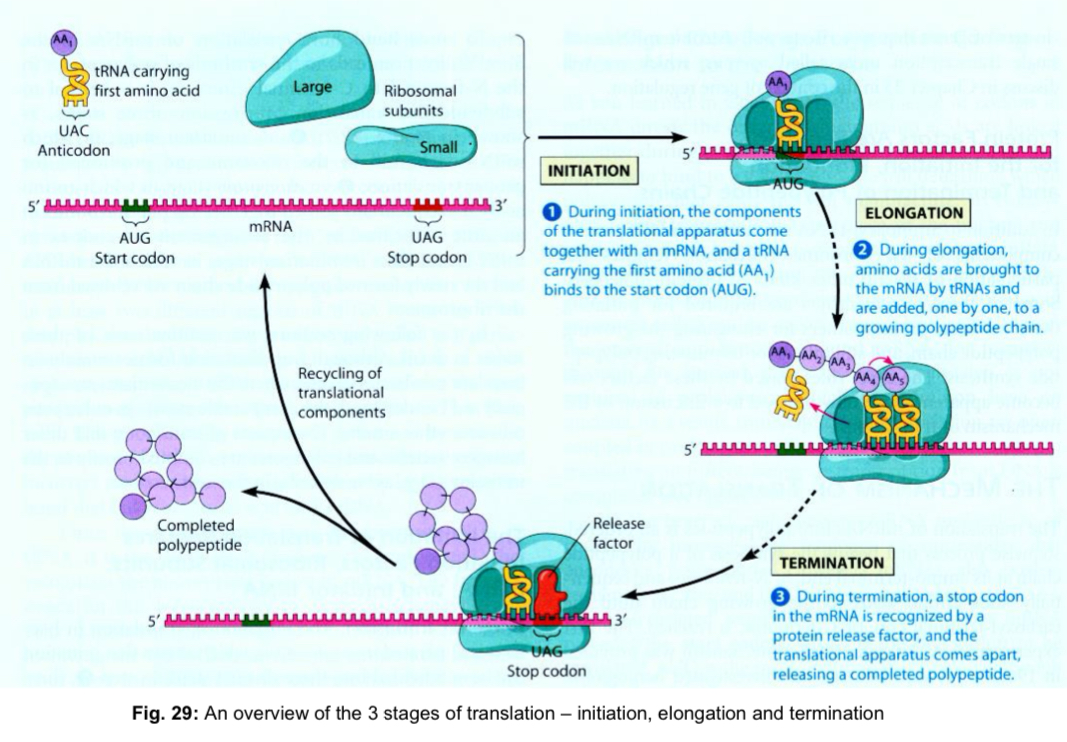
  • Translation: Process in which a polypeptide chain is synthesised by ribosomes using genetic information encoded in a mature mRNA template

  • mRNA contains a series of codons that interact with the anticodons of aminoacyl-tRNAs so that a corresponding series of amino acids is incorporated into a polypeptide chain

  • ribosomes provide the environment for controlling the interaction via CBP btw mRNA and aminoacyl-tRNA

  • ribosome travels along the template mRNA in the 5’ to 3’ direction, engaging in peptide bond synthesis

    • polypepide is assembled by the sequential addition of amino acids beginning from the N-terminal to the C-terminal

36
New cards

Components of the translation machinery

Components

  1. mature messenger RNA (mRNA)

  2. transfer RNA (tRNA)

  3. amino acids

  4. aminoacyl-tRNA synthetase

  5. ribosomal RNA (rRNA) and ribosome

  6. translation factors

37
New cards

Mature messenger RNA (mRNA)

Structure

  • mature mRNA is a single RNA strand that exists for a relatively short time as it is continuously being synthesised and degraded

  • mature mRNA is obtained after the pre-mRNA undergoes post-transcriptional modification (5’ cap, 3’ poly A tail, RNA splicing)

  • then mRNA is transported to cytoplasm via nuclear pores

mature mRNA contains two regions

  • protein-coding region: consists of a series of codons representing the amino acid sequence of the polypeptide, starting with the start codon AUG and ending with a stop codon UAA/UAG/UGA

  • untranslated regions (UTRs): additional sequence at the 5’ end, preceding the start codon, known as the leader sequence or 5’ UTR; and following the stop codon - trailer sequence or 3’ UTR

*only the protein-coding regions starting from the start codon till the stop codon is translated
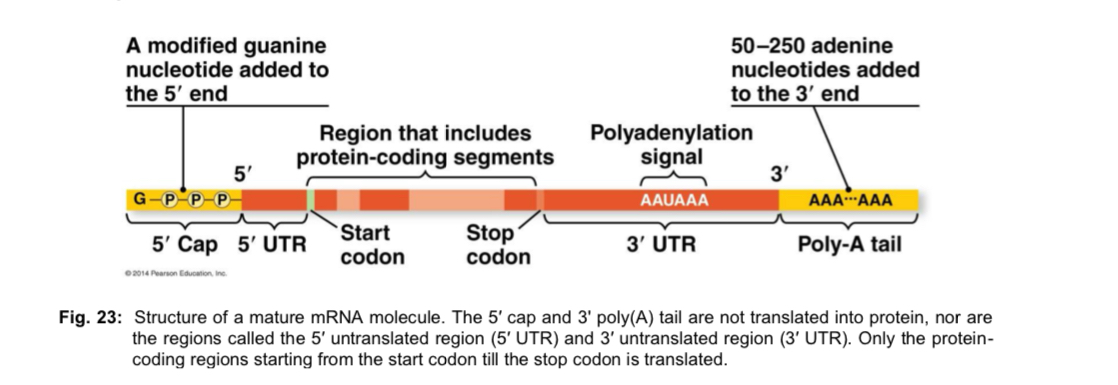
<p>Structure </p><ul><li><p>mature mRNA is a single RNA strand that exists for a <strong>relatively short time</strong> as it is continuously being synthesised and degraded </p></li><li><p>mature mRNA is obtained after the pre-mRNA undergoes post-transcriptional modification (5’ cap, 3’ poly A tail, RNA splicing) </p></li><li><p>then mRNA is <strong>transported</strong> to <strong>cytoplasm</strong> via <strong>nuclear pores</strong> </p></li></ul><p>mature mRNA contains two regions </p><ul><li><p><strong>protein-coding region</strong>: consists of a series of codons representing the <strong>amino acid sequence</strong> of the polypeptide, starting with the start codon AUG and ending with a stop codon UAA/UAG/UGA </p></li><li><p><strong>untranslated regions (UTRs)</strong>: additional sequence at the 5’ end, preceding the start codon, known as the leader sequence or 5’ UTR; and following the stop codon - <strong>trailer sequence or 3’ UTR </strong></p></li></ul><p></p><p>*only the protein-coding regions starting from the start codon till the stop codon is translated </p>
38
New cards

Role of mRNA

  1. mature mRNA serves as an intermediate that carries the copy of DNA sequence information that encodes proteins

  • each codon within the coding region of the mRNA represents an amino acid in the corresponding amino acid sequence in the protein

  1. mature mRNA acts as a template for translation i.e. guides the assembly of amino acids into a polypeptide chain

39
New cards

Transfer RNA (tRNA)

Structure

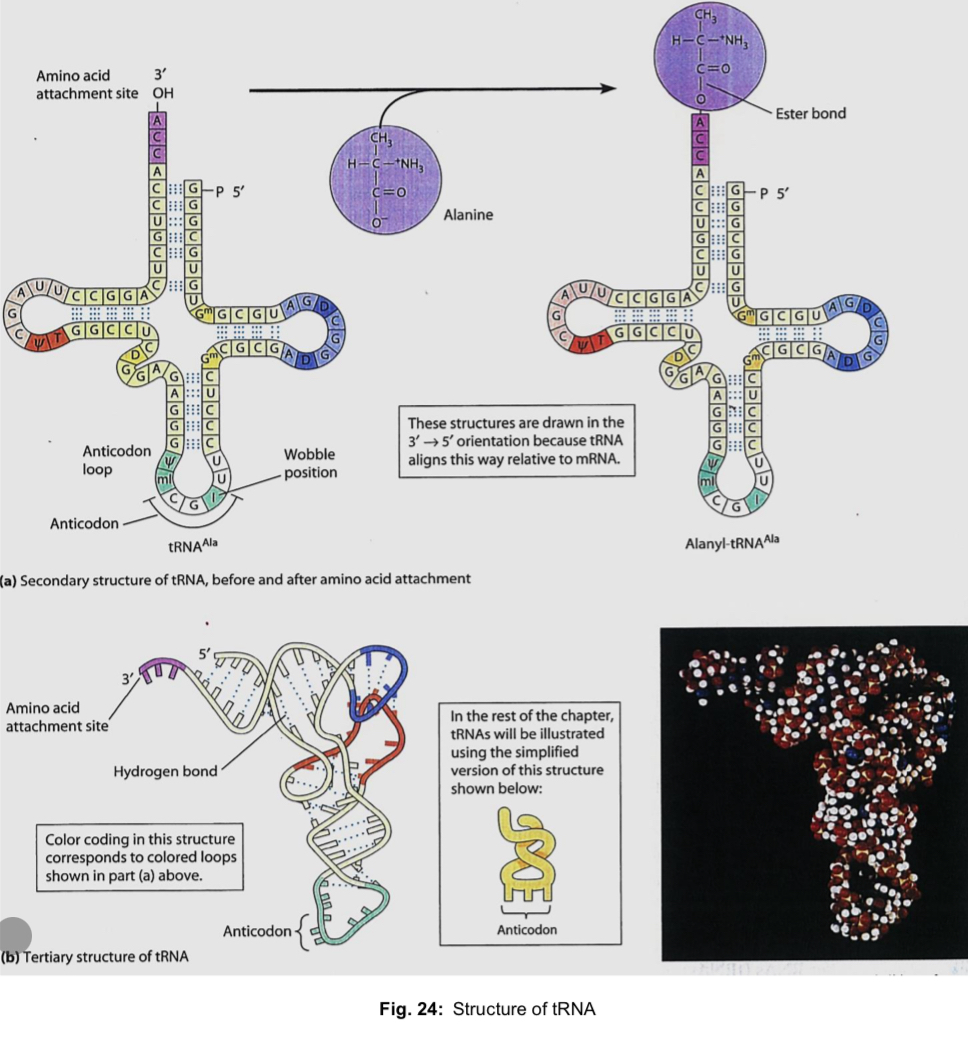
  • tRNA molecules are small, containing only about 80 nucleotides

  • the secondary structure takes the form of a 2D cloverleaf, held by CBP within the single-stranded molecule

    • 3 loops

    • on the anticodon loop, 3 unpaired bases form an anticodon, which binds to a specific mRNA codon via CBP

  • tertiary structure is the result of actual twisting and folding of the secondary structure into a compact 3D L-shaped structure maintained by hydrogen bonds

  • 3’ end (CCA stem) of a tRNA molecule is the attachment site for a specific amino acid

    • around 45 different tRNAs in a typical eukaryotic cell, thus each amino acid can be carried by more than 1 type of tRNA

    • 3D structure of tRNA is recognised by the enzyme aminoacyl-tRNA synthetase that catalyses the formation of an ester linkage (covalent bond) btw the CCA stem and the specific amino acid

      • when a tRNA has its 3’ CCA stem attached to the amino acid corresponding to its anticodon —> aminoacyl-tRNA
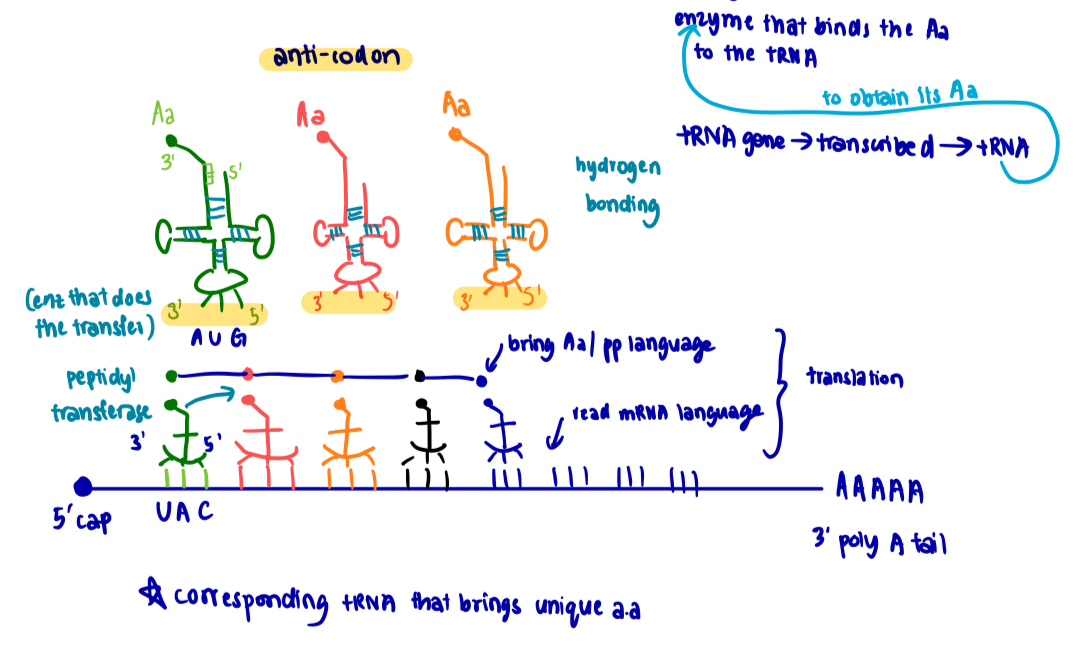
<p>Structure</p><ul><li><p>tRNA molecules are small, containing only about 80 nucleotides</p></li><li><p>the <u>secondary structure</u> takes the form of a <strong>2D cloverleaf</strong>, held by CBP within the <strong>single-stranded molecule</strong></p><ul><li><p>3 loops</p></li><li><p>on the anticodon loop, 3 unpaired bases form an anticodon, which binds to a specific mRNA codon via CBP</p></li></ul></li><li><p><u>tertiary structure</u> is the result of actual twisting and folding of the secondary structure into a <strong>compact 3D L-shaped structure</strong> maintained by <strong>hydrogen bonds</strong></p></li><li><p><strong>3’ end (CCA stem) </strong>of a tRNA molecule is the <strong>attachment site for a specific amino acid</strong></p><ul><li><p>around <u>45 different tRNAs</u> in a typical eukaryotic cell, thus each amino acid can be carried by more than 1 type of tRNA</p></li><li><p>3D structure of tRNA is recognised by the enzyme <strong>aminoacyl-tRNA synthetase </strong>that catalyses the formation of an<strong> ester linkage</strong> (covalent bond) btw the <strong>CCA stem and the specific amino acid</strong></p><ul><li><p>when a <strong>tRNA</strong> has its 3’ CCA stem attached to the <strong>amino acid </strong>corresponding to its anticodon —&gt; <strong>aminoacyl-tRNA</strong></p></li></ul></li></ul></li></ul><p></p><p></p>
40
New cards

Structure of tRNA illustration

knowt flashcard image
41
New cards

Role of tRNA

  1. tRNA serves as an adaptor molecule in the translation of an mRNA nucleotide sequence into the amino acid sequence in a polypeptide

  2. they are used to bring in specific amino acids in a sequence corresponding to the sequence of codons in mRNA

*a.a corresponds to the codons (not the anticodons)

tRNA’s ability to act as an adaptor is due to

  • anticodon being able to determine the specific amino acid attached to the CCA stem

  • anticodon being able to form complementary base pairs with the mRNA codon

42
New cards

Amino acid activation by Aminoacyl-tRNA synthetase

  • before a tRNA molecule can bring its amino acid to the ribosome, that amino acid must be attached covalently to the tRNA

    • enzyme responsible for linking a.a to their corresponding tRNAs —> aminoacyl-tRNA synthetases

  • cells produce 20 different synthetase enzymes, one for each of the 20 distinct amino acids

    • one particular synthetase enzyme attaches glycine to all tRNAs that recognise codons for glycine

    • each of the 20 different synthetase enzymes must recognise the specific anticodon on a tRNA as well as a specific amino acid

  • each of the 20 different synthetase enzyme covalently attaches a specific amino acid to the 3’ CCA stem of its appropriate set of tRNA molecules via an ester linkage, (between carboxyl group of a.a and 3’ OH of tRNA) forming aminoacyl-tRNA, requires hydrolysis of ATP (basically enzyme joins a.a to tRNA via ester linkage)

    • active site of each aminoacyl-tRNA synthetase must be complementary to 3D conformation of the specific amino acid and specific anticodon sequence of the tRNA in order for them to bind

  • the resulting aminoacyl-tRNA is released from the synthetase enzyme and delivers its amino acid to a growing polypeptide chain on a ribosome
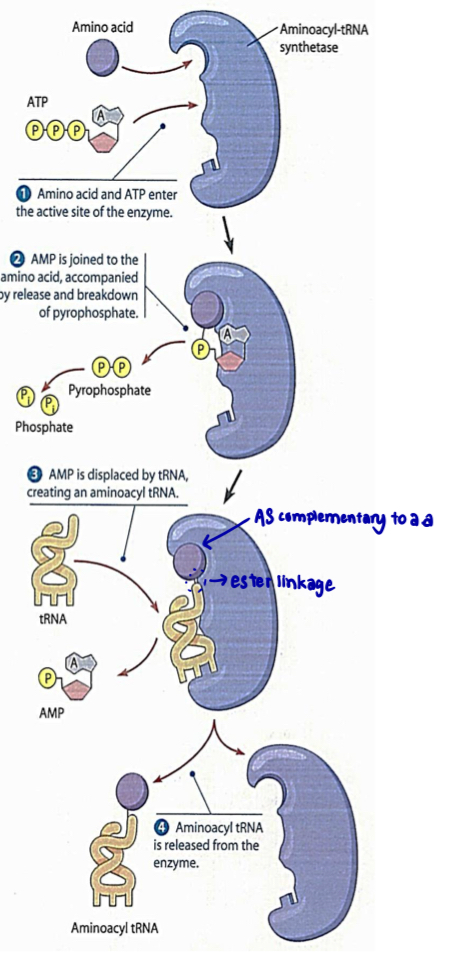
<ul><li><p>before a tRNA molecule can bring its amino acid to the ribosome, that amino acid must be <strong>attached covalently to the tRNA </strong></p><ul><li><p>enzyme responsible for linking a.a to their corresponding tRNAs —&gt; <strong>aminoacyl-tRNA synthetases </strong></p></li></ul></li><li><p>cells produce <strong>20 different synthetase </strong>enzymes, <strong>one</strong> for <strong>each</strong> of the 20 distinct amino acids </p><ul><li><p>one particular synthetase enzyme attaches glycine to all tRNAs that recognise codons for glycine </p></li><li><p>each of the 20 different synthetase enzymes must recognise the<strong> specific anticodon on a tRNA</strong> as well as a <strong>specific amino acid</strong></p></li></ul></li><li><p>each of the 20 different synthetase enzyme <strong>covalently attaches </strong>a specific amino acid to the 3’ CCA stem of its appropriate set of <strong>tRNA</strong> molecules via an <strong>ester linkage</strong>, (between carboxyl group of a.a and 3’ OH of tRNA) forming <span style="color: blue;"><strong>aminoacyl-tRNA</strong></span>, requires hydrolysis of ATP (basically enzyme joins a.a to tRNA via ester linkage) </p><ul><li><p><strong>active site</strong> of each aminoacyl-tRNA synthetase must be <strong>complementary</strong> to <strong>3D conformation</strong> of the specific amino acid and<strong> specific anticodon sequence of the tRNA</strong> in order for them to <strong>bind</strong></p></li></ul></li><li><p>the resulting aminoacyl-tRNA is <strong>released</strong> from the synthetase enzyme and <strong>delivers its amino acid</strong> to a growing polypeptide chain on a ribosome </p></li></ul><p></p>
43
New cards

Ribosomal RNA (rRNA)

Structure

  • the most abundant RNA in cells are rRNA (80% of RNA in rapidly dividing cells)

  • rRNA genes are transcribed (by RNA pol I) and the rRNA is processed and assembled with proteins imported from the cytoplasm in the nucleolus - completed ribosomal subunits are exported via nuclear pores to the cytoplasm

  • 4 types of eukaryotic rRNA (1 copy of each type per ribosome)

    • 3 of the 4 rRNA (18S, 5.8S and 28S) are made by chemically modifying and cleaving a single large precursor rRNA

  • each modification is made at a specific position in the precursor rRNA, function of modification probably regarding folding and assembly of final rRNA

  • 5S rRNA is synthesised from a separate cluster of genes (by RNA pol III), does not require chemical modification
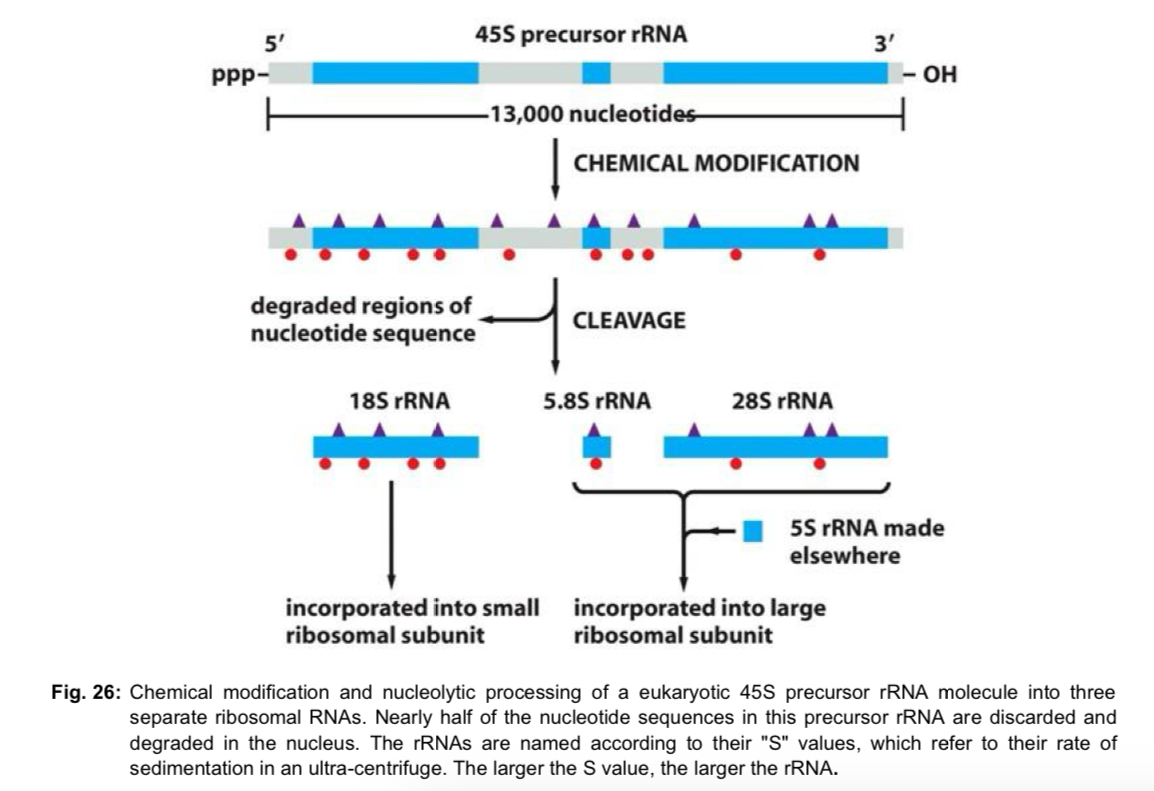
<p>Structure </p><ul><li><p>the most abundant RNA in cells are rRNA (80% of RNA in rapidly dividing cells) </p></li><li><p><strong>rRNA genes are transcribed</strong> (by RNA pol I) and the <strong>rRNA</strong> is <strong>processed</strong> and <strong>assembled</strong> <strong>with proteins</strong> imported from the cytoplasm in the <strong>nucleolus</strong> - completed ribosomal subunits are exported via nuclear pores to the cytoplasm </p></li><li><p>4 types of eukaryotic rRNA (1 copy of each type per ribosome)</p><ul><li><p>3 of the 4 rRNA (18S, 5.8S and 28S) are made by <strong>chemically modifying</strong> and <strong>cleaving a single large precursor rRNA </strong></p></li></ul></li><li><p>each modification is made at a specific position in the precursor rRNA, function of modification probably regarding folding and assembly of final rRNA </p></li><li><p><strong>5S rRNA</strong> is synthesised from a separate cluster of genes (by RNA pol III), does <strong>not require chemical modification </strong></p></li></ul><p></p><p></p>
44
New cards

Role of rRNA

  1. rRNA forms the core of the ribosome - it is the main constituent of the A and P sites and of the interface between the large and small ribosomal subunits

  1. rRNA in the large ribosomal subunit has peptidyl transferase activity

  • catalyses the formation of peptide bonds btw amino acids

45
New cards

Ribosome

Structure

  • ribosome is a large ribonucleoprotein complex composed of ribosomal proteins and ribosomal RNA (rRNA)

  • bacteria ribosomes are ~70S while eukaryotic ribosomes are larger at ~80S

  • each eukaryotic ribosome consists of 2 subunits

    • small subunit (40S) contains an mRNA binding site, where the mRNA binds - mRNA binding site is associated along the surface close to the junction of the subunits

    • large subunit (60S) - 3 binding sites for tRNA

      • A site (aminoacyl-tRNA site): holds the incoming tRNA carrying the next amino acid to be added

      • P site (peptidyl-tRNA site): holds the tRNA carrying the growing polypeptide chain

      • E site (exit site): site of release of the deacylated tRNA (tRNA without amino acid attached)
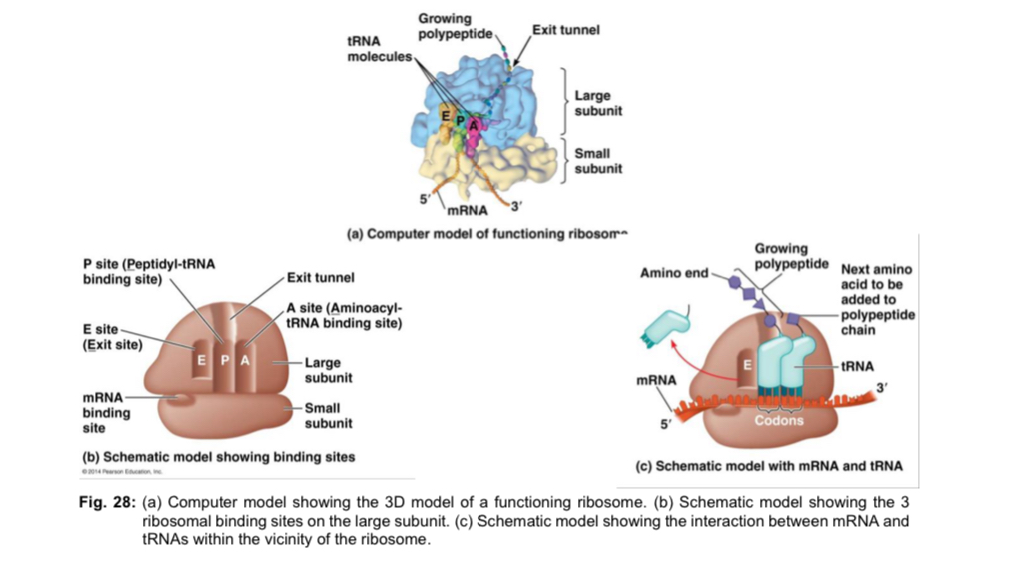
<p>Structure</p><ul><li><p>ribosome is a large ribonucleoprotein complex composed of <strong>ribosomal proteins</strong> and<strong> ribosomal RNA </strong>(rRNA)</p></li><li><p>bacteria ribosomes are ~70S while eukaryotic ribosomes are larger at ~80S</p></li></ul><p></p><ul><li><p>each eukaryotic ribosome consists of 2 subunits</p><ul><li><p>small subunit (40S) contains an mRNA binding site, where the mRNA binds - mRNA binding site is associated along the surface close to the junction of the subunits </p></li><li><p>large subunit (60S) - 3 binding sites for tRNA </p><ul><li><p><mark data-color="yellow" style="background-color: yellow; color: inherit;">A site</mark> (aminoacyl-tRNA site): holds the <strong>incoming tRNA carrying the next amino acid</strong> to be added </p></li><li><p><mark data-color="blue" style="background-color: blue; color: inherit;">P site</mark> (peptidyl-tRNA site): holds the <strong>tRNA</strong> carrying the <strong>growing polypeptide chain </strong></p></li><li><p><mark data-color="red" style="background-color: red; color: inherit;">E site</mark> (exit site): site of <strong>release of the deacylated tRNA</strong> (tRNA without amino acid attached)  </p></li></ul></li></ul></li></ul><p></p>
46
New cards

role of the ribosomes

  • ribosomes are the organelles where the synthesis of polypeptides under the direction of mRNA occurs

  1. in protein synthesis, the ribosome provides an environment for specific recognition between a codon of mRNA and an anticodon of tRNA

  2. the ribosome holds the tRNA and mRNA in close proximity - the ribosome positions the new amino acid for addition to the growing polypeptide

  3. rRNA in the large ribosomal subunit has peptidyl transferase activity - catalyses the formation of peptide bonds btw amino acids

  • ribosome begins translation at the 5’ end of the coding region of mRNA and proceeds towards the 3’ end (5’ —> 3’ direction)

47
New cards

Translation factors

  1. initiation factors: required for assembly of mRNA, the first tRNA and ribosomal subunits

  2. elongation factors: required for synthesis of polypeptide chains

  3. release factors: required for recognition of the stop codon and disassembly of the translation machinery

  • several translation factors use GTP (guanosine triphosphate) as an energy source to carry out their functions
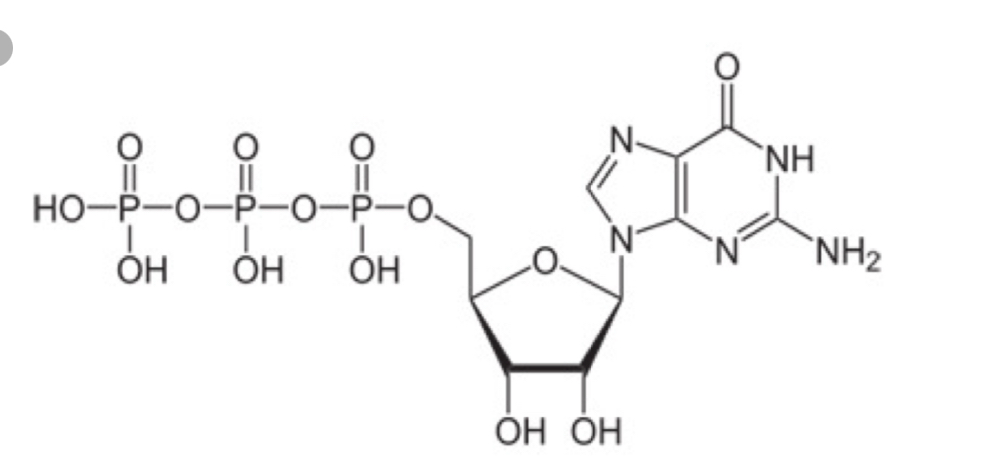
<ol><li><p><mark data-color="yellow" style="background-color: yellow; color: inherit;">initiation factors</mark>: required for <strong>assembly of mRNA</strong>, the <strong>first tRNA</strong> and <strong>ribosomal</strong> <strong>subunits </strong></p></li><li><p><mark data-color="blue" style="background-color: blue; color: inherit;">elongation factors</mark>: required for <strong>synthesis</strong> of <strong>polypeptide chains</strong> </p></li><li><p><mark data-color="red" style="background-color: red; color: inherit;">release factors</mark>: required for <strong>recognition</strong> of the <strong>stop codon</strong> and <strong>disassembly</strong> of the translation machinery </p></li></ol><ul><li><p>several translation factors use <strong>GTP</strong> (guanosine triphosphate) as an <strong>energy source</strong> to carry out their functions </p></li></ul><p></p>
48
New cards

Steps involved in translation

  1. Initiation

  2. Elongation

  3. Termination

<ol><li><p>Initiation</p></li><li><p>Elongation</p></li><li><p>Termination</p></li></ol><p></p>
49
New cards

Stage 1: Initiation

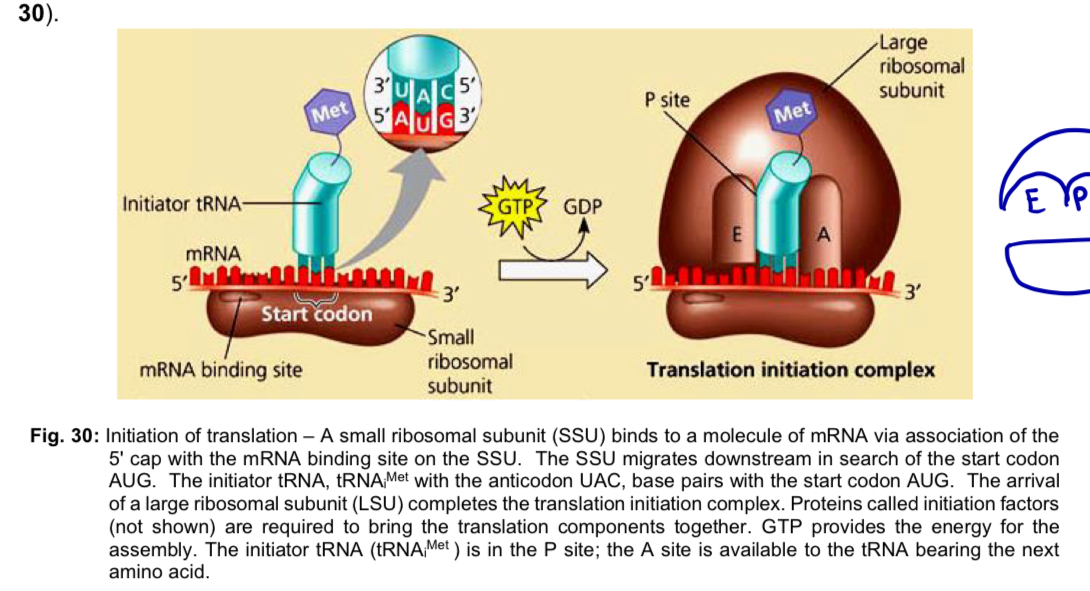
  • initiation stage of translation brings together mRNA, the initiator tRNA and the 2 subunits (large and small) of a ribosome

  • involves the reactions preceding the formation of the 1st peptide bond

Step 1A: Binding of initiation factors to small subunit

  • eukaryotic initiation factors (eIFs) bind to small subunit of ribosome and position the initiator tRNA which carries a methionine to its P site

  • requires GTP

Step 1B: Binding of small subunit to mRNA

  • small subunit binds to the mRNA by recognition of its 5’ cap

  • small ribosomal subunit then moves downstream in the 5’ to 3’ direction along the mRNA in search of the start codon AUG (start site of translation)

Step 1C: Association of tRNAMet

and formation of initiation complex

  • anticodon on initiator tRNA associates with the start codon on mRNA through CBP

  • methionine is always the first amino acid in a newly formed polypeptide

    • initiator tRNA has a unique anti-codon loop that is distinct from that of the tRNA that normally carries methionine

  • followed by the dissociation of eIFs (hydrolysis of GTP), which allows for the binding of the large ribosomal subunit, completing a eukaryotic 80S translation initiation complex

  • initiator tRNA sits in the P site of the ribosome, and the initial methionine forms the N-terminus of the polypeptide

  • A site is vacant, waiting for entry of the next aminoacyl-tRNA complementary to the second codon of the mRNA
<ul><li><p>initiation stage of translation brings together mRNA, the initiator tRNA and the 2 subunits (large and small) of a ribosome</p></li><li><p>involves the reactions preceding the formation of the 1st peptide bond</p></li></ul><p></p><p><mark data-color="yellow" style="background-color: yellow; color: inherit;">Step 1A: Binding of initiation factors to small subunit</mark></p><ul><li><p><strong>eukaryotic initiation factors (eIFs) </strong>bind to <strong>small subunit </strong>of ribosome and position the <strong>initiator tRNA</strong> which carries a methionine to its<strong> P site</strong></p></li><li><p>requires GTP</p></li></ul><p><mark data-color="blue" style="background-color: blue; color: inherit;">Step 1B: Binding of small subunit to mRNA </mark></p><ul><li><p>small subunit <strong>binds to the mRNA </strong>by recognition of its<strong> 5’ cap </strong></p></li><li><p>small ribosomal subunit then moves downstream in the 5’ to 3’ direction along the mRNA in search of the start codon AUG (start site of translation) </p></li></ul><p></p><p>Step 1C: Association of <span><span>tRNA</span></span><sup>Met</sup></p><p>and formation of initiation complex </p><ul><li><p><strong>anticodon</strong> on initiator tRNA associates with the <strong>start codon on mRNA</strong> through CBP </p></li><li><p><strong>methionine</strong> is always the <strong>first amino acid</strong> in a newly formed polypeptide </p><ul><li><p><strong>initiator tRNA </strong>has a <strong>unique anti-codon </strong>loop that is <u>distinct</u> from that of the <u>tRNA</u> that <u>normally carries methionine </u></p></li></ul></li><li><p>followed by the dissociation of eIFs (hydrolysis of GTP), which allows for the binding of the large ribosomal subunit, completing a eukaryotic 80S <strong>translation initiation complex </strong></p></li><li><p><strong>initiator tRNA </strong>sits in the<strong> P site </strong>of the ribosome, and the <strong>initial</strong> <strong>methionine</strong> forms the <strong>N-terminus</strong> of the polypeptide </p></li><li><p><strong>A site is vacant</strong>, waiting for entry of the next aminoacyl-tRNA complementary to the second codon of the mRNA </p></li></ul><p></p>
50
New cards

Elongation and Translocation

  • each amino acid is added to the C terminal end of the growing polypeptide by means of a cycle of 3 sequential steps

    • codon recognition and aminoacyl-tRNA binding

    • peptide bond formation

    • translocation

  • elongation: synthesis of the 1st peptide bond to the addition of the last amino acid

Step 2A: Codon recognition and aminoacyl-tRNA binding

  • after the initiation complex has formed, an aminoacyl-tRNA carrying the 2nd amino acid in the chain binds to the ribosomal A site via CBP btw its anticodon and the codon in the mRNA exposed at the A site

  • held in place by hydrogen bonds

  • tRNAs are brought in by elongation factors

  • energy is expended with hydrolysis of GTP

Step 2B: Peptide bond formation

  • when the second tRNA is bound to the ribosome, its amino acid is placed directly adjacent to the initial methionine

    • peptidyl transferase in the large ribosomal subunit catalyses the formation of a peptide bond btw carboxyl end of methionine and the amino group of the 2nd amino acid

    • methionine is transferred to the 2nd amino acid carried by the aminoacyl-tRNA at the A site

    • ester bond btw the initial methionine and the tRNA is broken to release the initial methionine (P site)

    • deacylated tRNA (lacking an amino acid) lies in the P site, while the new peptidyl-tRNA (tRNA carrying the growing polypeptide ) has been created in the A site

Step 2C: Translocation

  • ribosome is translocated one codon or 3 nucleotides at a time in the 5’ to 3’ direction, guided by elongation factors, with the hydrolysis of GTP to provide energy

  • this movement

    • relocates the initial deacylated tRNA (from the P site) to the E site from where it diffuses out of the ribosome

    • repositions the peptidyl-tRNA at the P site (from the A site)

    • exposes the next codon (3rd codon) on the mRNA at the A site

Steps 2A to 2C are repeated with a new incoming aminoacyl-tRNA entering A site, cycle will be repeated until a stop codon is encountered at the A site

51
New cards

Termination

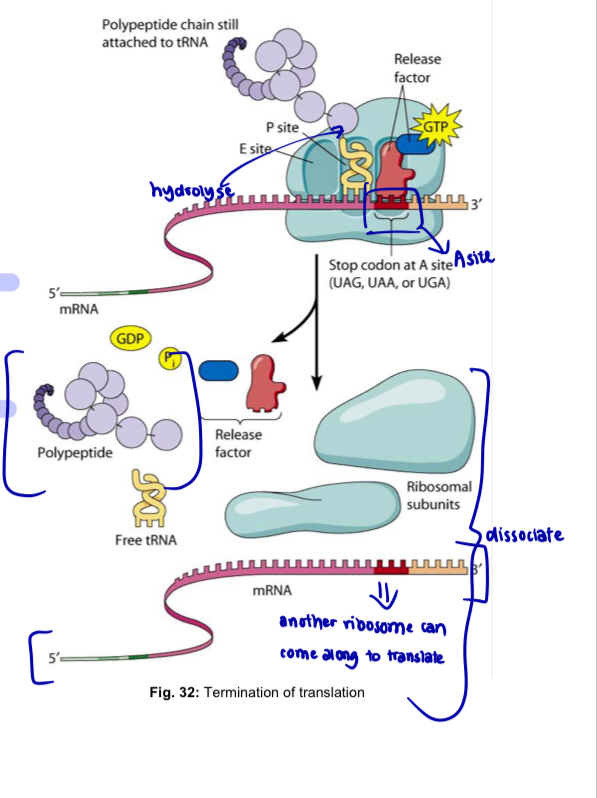
  • Termination occurs when a stop codon in the mRNA reaches the A site of the ribosome

    • base triplets UAG, UAA and UGA are stop codons that do not code for amino acids but act as signals to stop translation

  • Release factor (protein) binds directly to the stop codon in the A site

  • release factor causes the addition of a water molecule instead of an amino acid to the polypeptide chain

    • this reaction frees the carboxyl end of the completed polypeptide from the tRNA in the P site by hydrolysis

    • polypeptide is released through the exit tunnel of the ribosomal large subunit

  • ribosome then releases the mRNA and separates into large and small subunits i.e. the translation complex comes apart

  • tRNA molecules may then be recycled and used to form new aminoacyl-tRNA
<ul><li><p>Termination occurs when a <strong>stop codon </strong>in the mRNA reaches the <strong>A site</strong> of the ribosome</p><ul><li><p>base triplets UAG, UAA and UGA are stop codons that do not code for amino acids but act as signals to stop translation</p></li></ul></li><li><p><strong>Release factor</strong> (protein) <strong>binds directly </strong>to the <strong>stop codon in the A site</strong></p></li><li><p>release factor causes the <strong>addition of a water molecule</strong> instead of an amino acid to the polypeptide chain</p><ul><li><p>this reaction frees the carboxyl end of the completed polypeptide from the tRNA in the P site by hydrolysis</p></li><li><p>polypeptide is released through the exit tunnel of the ribosomal large subunit</p></li></ul></li><li><p>ribosome then releases the mRNA and separates into large and small subunits i.e. the translation complex comes apart</p></li><li><p>tRNA molecules may then be recycled and used to form new aminoacyl-tRNA</p></li></ul><p></p>
52
New cards

Polyribosomes/Polysomes

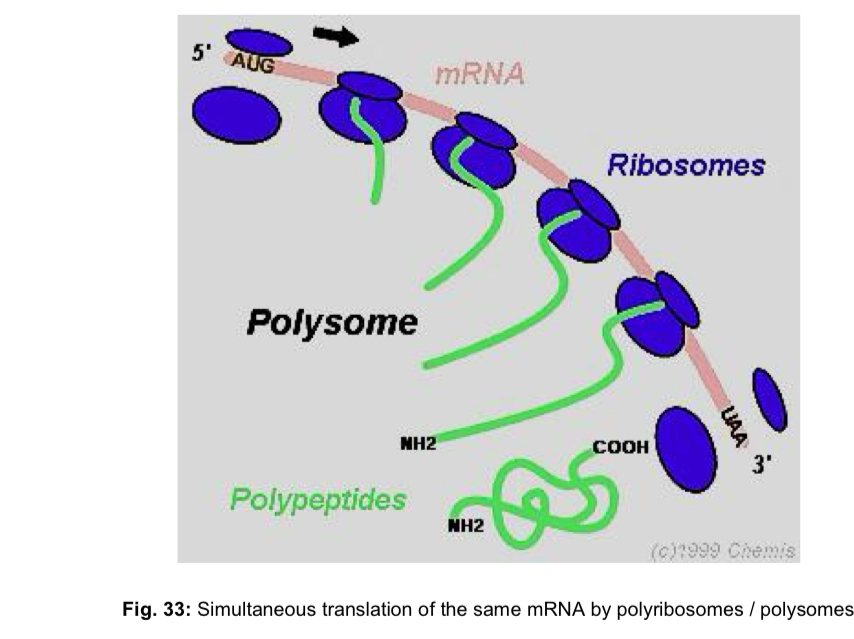
  • ribosomes are often seen to occur in clusters known as polyribosomes or polysomes

  • when ribosomes occur as such aggregates, they are simultaneously translating polypeptides from the same mRNA strand

  • each ribosome in the polysome independently synthesised a single polypeptide during its translation of the mRNA sequence

  • advantage: these multiple initiations mean that many more polypeptide molecules can be made in a given time than would be possible if each had to be completed before the synthesis of the next could start
<ul><li><p>ribosomes are often seen to occur in clusters known as <strong>polyribosomes</strong> or <strong>polysomes</strong></p></li><li><p>when ribosomes occur as such aggregates, they are <strong>simultaneously translating </strong>polypeptides from the <strong><u>same</u></strong> mRNA strand </p></li><li><p>each ribosome in the polysome independently synthesised a single polypeptide during its translation of the mRNA sequence </p></li><li><p>advantage: these multiple initiations mean that many <strong>more polypeptide molecules</strong> can be made in a <strong>given time</strong> than would be possible if each had to be completed before the synthesis of the next could start </p></li><li><p></p></li></ul><p></p>
53
New cards

Free ribosomes

  • free ribosomes are suspended in the cytoplasm

  • mostly synthesise proteins that dissolve in and exert their effects in the cytosol

54
New cards

Bound ribosomes

  • attached to the cytoplasmic side of the endoplasmic reticulum (ER)

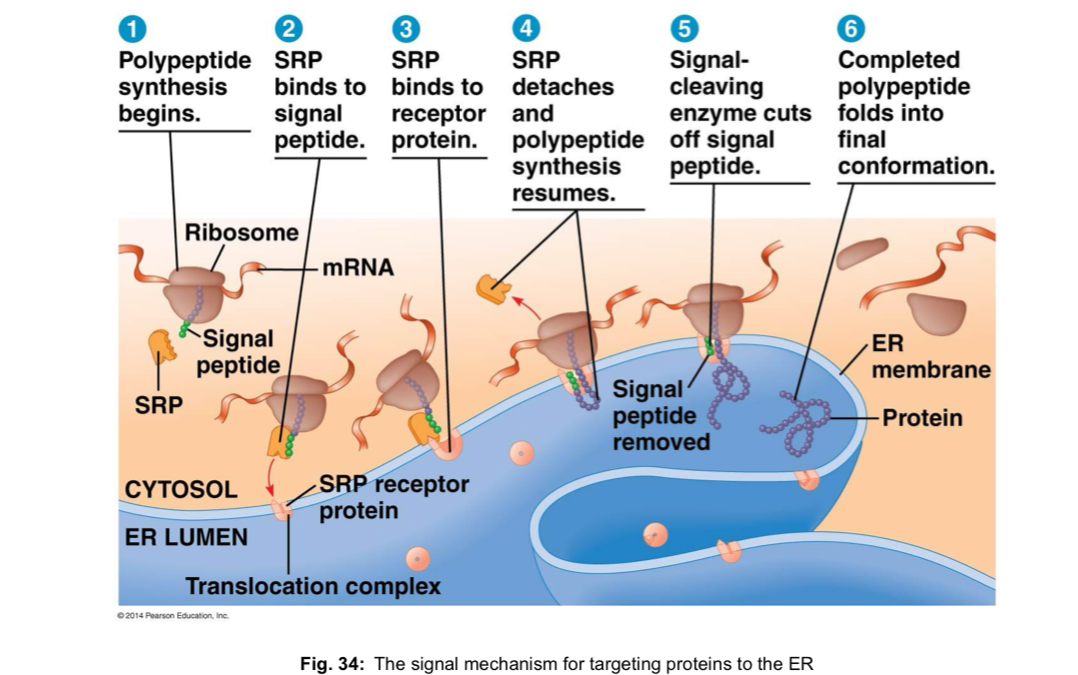
  • synthesise proteins of the nuclear envelope, ER, Golgi apparatus, lysosomes, vacuoles, and plasma membrane, as well as proteins to be secreted from the cell

  • polypeptides of proteins destined for the endomembrane system or for secretion are marked by a signal peptide, which targets the polypeptides to the ER

  • signal peptide - sequence of about 20 a.a at or near the N-terminal of the polypeptide, is recognised as it emerges from the ribosome by a protein-RNA complex called a signal-recognition particle (SRP)

    • SRP functions as an adaptor that brings the ribosome to a receptor protein built into the ER membrane

    • polypeptide synthesis continues there, and the growing polypeptide snakes across the ER membrane into the cisternal space via protein pore
<ul><li><p>attached to the cytoplasmic side of the <strong>endoplasmic reticulum (ER) </strong></p></li><li><p>synthesise proteins of the <strong>nuclear envelope, ER, Golgi apparatus, lysosomes, vacuoles, and plasma membrane</strong>, as well as proteins to be <strong>secreted</strong> from the cell </p></li><li><p>polypeptides of proteins destined for the endomembrane system or for secretion are marked by a <strong>signal peptide</strong>, which targets the polypeptides to the ER </p></li><li><p>signal peptide - sequence of about 20 a.a at or near the N-terminal of the polypeptide, is recognised as it emerges from the ribosome by a protein-RNA complex called a <strong>signal-recognition particle (SRP) </strong></p><ul><li><p>SRP functions as an <strong>adaptor</strong> that brings the ribosome to a<strong> receptor protein</strong> built into the ER membrane</p></li><li><p>polypeptide synthesis continues there, and the <strong>growing polypeptide snakes across the ER membrane</strong> into the cisternal space via <strong>protein pore </strong></p></li></ul></li></ul><p></p>
55
New cards

Post-translational modification of polypeptides

  • immediate product of translation is actually not a protein, but a polypeptide chain

  • to become a functional protein, one or more such linear polypeptide chains must coil and fold in a precise, pre-determined manner to assume the specific three-dimensional conformation either in the cytoplasm or in the lumen of the RER

  • subsequent transport to the Golgi apparatus allows for the modification of these proteins —> necessary for biological activity

range of functions of the protein may be modified by

  1. attaching to it biochemical functional groups e.g. acetate, methyl, phosphate, various lipids and carbohydrates

  • glycosylation - addition of specific short-chain carbohydrate/oligosaccharide is very common in membrane proteins

    • glycoproteins - important in e.g. signal recognition, and activation of an immune response

  • reversible phosphorylation of threonine, serine, or tyrosine residues by enzymes called kinases (which add a phosphate) and phosphatases (which remove the phosphate) plays an important role in the signal transduction processes regulating growth and cell cycle control

  • Phosphorylation may occur sequentially from one protein to another, resulting in a series of activations called a “phosphorylation cascade”

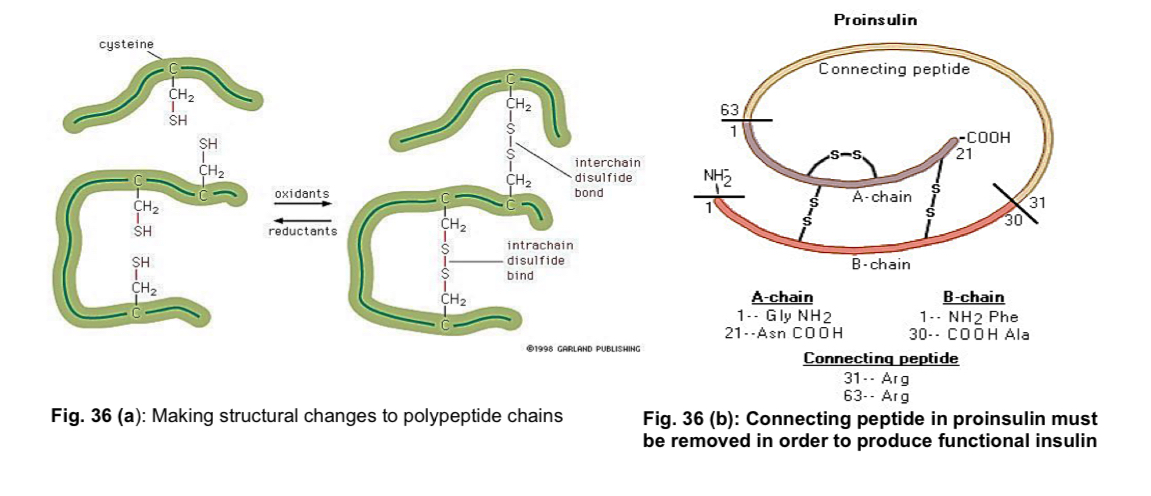
  1. Making structural changes, like the formation of disulfide linkages

  1. Removing a sequence of amino acids from the protein, or cutting the peptide chain in the middle

  • e.g. peptide hormone insulin is cut twice after disulfide bonds are formed, and a connecting peptide is removed from the middle of the chain —> proteolytic cleavage

  • resulting protein consists of two polypeptide chains connected by disulfide bonds

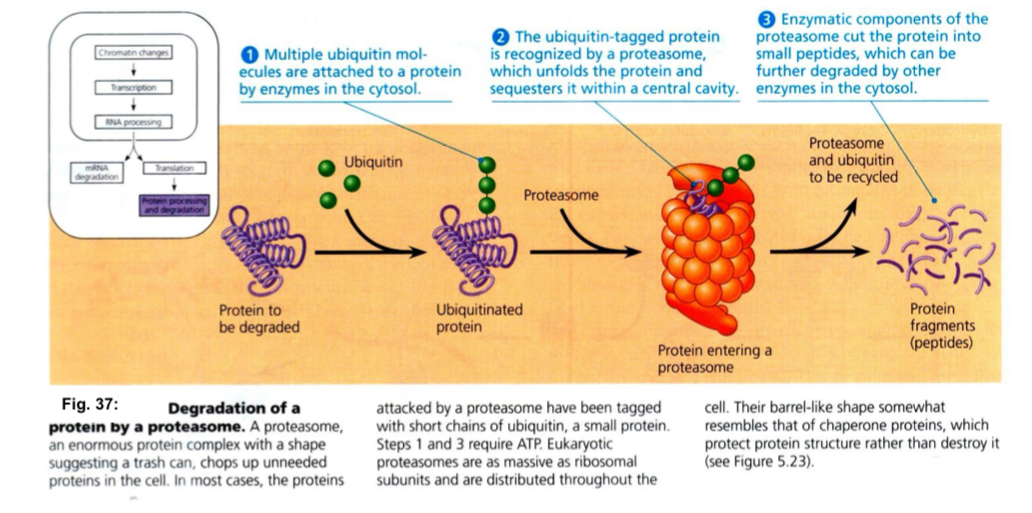
  1. attaching to it ubiquitin

  • ubiquitin marks proteins for proteolysis by the proteasome

  • at least 4 ubiquitin are required on the substrate before a proteasome can bind to it

  • polyubiquitin chain on a target protein is recognised by a specific receptor in the proteasome

  • selective degradation of proteins allows for the control of the length of time in which a protein can function
<ul><li><p>immediate product of translation is actually not a protein, but a <strong>polypeptide chain</strong></p></li><li><p>to become a <strong>functional protein</strong>, one or more such linear polypeptide chains must <strong>coil</strong> and <strong>fold</strong> in a precise, pre-determined manner to assume the <strong>specific three-dimensional conformation</strong> either in the cytoplasm or in the lumen of the RER</p></li><li><p>subsequent transport to the <strong>Golgi apparatus </strong>allows for the <strong>modification</strong> of these proteins —&gt; necessary for biological activity</p></li></ul><p>range of functions of the protein may be modified by</p><ol><li><p>attaching to it <strong>biochemical functional groups </strong>e.g. acetate, methyl, phosphate, various lipids and carbohydrates</p></li></ol><ul><li><p><strong>glycosylation</strong> - addition of specific short-chain carbohydrate/oligosaccharide is very common in <strong>membrane proteins</strong></p><ul><li><p><strong>glycoproteins</strong> - important in e.g. signal recognition, and activation of an immune response</p></li></ul></li><li><p>reversible <strong>phosphorylation</strong> of threonine, serine, or tyrosine residues by enzymes called <strong>kinases</strong> (which add a phosphate) and <strong>phosphatases</strong> (which remove the phosphate) plays an important role in the <strong>signal transduction</strong> processes regulating growth and cell cycle control</p></li><li><p>Phosphorylation may occur sequentially from one protein to another, resulting in a series of activations called a “phosphorylation cascade”</p></li></ul><p></p><ol start="2"><li><p><strong>Making structural changes,</strong> like the formation of <strong>disulfide linkages</strong></p></li></ol><p></p><ol start="3"><li><p><strong>Removing a sequence of amino acids</strong> from the protein, or cutting the peptide chain in the middle</p></li></ol><ul><li><p>e.g. peptide hormone insulin is cut twice after disulfide bonds are formed, and a connecting peptide is removed from the middle of the chain —&gt; <strong>proteolytic cleavage</strong></p></li><li><p>resulting protein consists of two polypeptide chains connected by disulfide bonds</p></li></ul><p></p><ol start="4"><li><p>attaching to it <strong>ubiquitin</strong></p></li></ol><ul><li><p>ubiquitin <strong>marks proteins for proteolysis</strong> by the proteasome</p></li><li><p>at least <u>4</u> ubiquitin are required on the substrate before a <strong>proteasome</strong> can bind to it</p></li><li><p>polyubiquitin chain on a target protein is recognised by a <strong>specific receptor</strong> in the proteasome</p></li><li><p><strong>selective degradation</strong> of proteins allows for the <strong>control of the length of time</strong> in which a <strong>protein can function</strong></p></li></ul><p></p>
56
New cards

Degradation of a protein by a proteasome
knowt flashcard image