2.1 origin
 Call Kai
 Learn
Learn Practice Test
 Spaced Repetition
 Match
Match Flashcards
 Knowt Play
1/42

There's no tags or description
Looks like no tags are added yet.
Name | Mastery | Learn | Test | Matching | Spaced | Call with Kai |
|---|
No analytics yet
Send a link to your students to track their progress
43 Terms
prebiotic atmosphere
free oxygen was nearly absent
gases such as methane CH4, carbon dioxide, CO2, ammonia NH3, water vapor H2O
these gases were released through volcanic activity and meteorite bombardment
ozone layer
no oxygen o2 = no ozone layer o3, meaning that earth was exposed to UV radiation, which provided energy for the formation of organic molecules
high co2 levels
because of high concentrations of co2, methane and ammonia, the environment was highly reactive
absence of oxygen
The absence of oxygen was essential because oxygen’s high reactivity would have destroyed the fragile organic molecules forming
formation of carbon compounds
- combination of these conditions enabled chemical processes that no longer occur today.
- Under these conditions, simple carbon-based molecules like aldehydes, carboxylic acids, and formaldehyde formed spontaneously.
-UV radiation provided the activation energy needed for chemical reactions that would not normally occur today.
what makes something alive
All living organisms share a set of functions that define life.
Cells are the smallest units capable of carrying out these functions independently.
functions of life
mr h gren - metabolism, reproduction, homeostasis, growth, response to stimuli, excretion, nutrition
self sustaining life
ability to perform and carry out all functions of life without the need for external agents
metabolic regulation within a cell
cells use energy ATP to maintain internal order. without energy they lose structure or die
why are organelles not alive
Organelles perform specialized tasks inside cells, but none can live independently, for example protein synthesis ar dar ka nors
spontaneous origin of cells required four key steps:
Catalysis: speeding up reactions. (they lower the activation energy needed for the reaction to occur)
Self-replication: passing on information.
Self-assembly: forming complex molecules.
Compartmentalization: creating membrane-bound environments.
prebiotic earth catalysts
metal ions, clays, mineral surfaces
catalysts in modern cells
enzymes for protein catalysts, ribozymes for rna catalysts
rna as the first self-replicating molecule
because it can
Store genetic information (like DNA).
Catalyse reactions (as ribozymes).
polymers
Once organic monomers (like amino acids, nucleotides, and fatty acids) formed, they needed to assemble into polymers.
Prebiotic conditions such as heat, mineral surfaces, drying cycles, and UV radiation could have driven this process.
Resulting polymers:
Proteins (from amino acids)
Nucleic acids (from nucleotides)
Polysaccharides and lipids (from simpler precursors)
eg amino acids form polypeptides
birth of protocells
for true cells to emerge, components of life had to be separated from external environment for protection
Lipids naturally self-organize into bilayers, forming vesicles (protocells).
Compartmentalization allowed:
Concentration of reactants inside membranes.
Protection from external fluctuations.
A distinct internal environment for controlled chemistry.
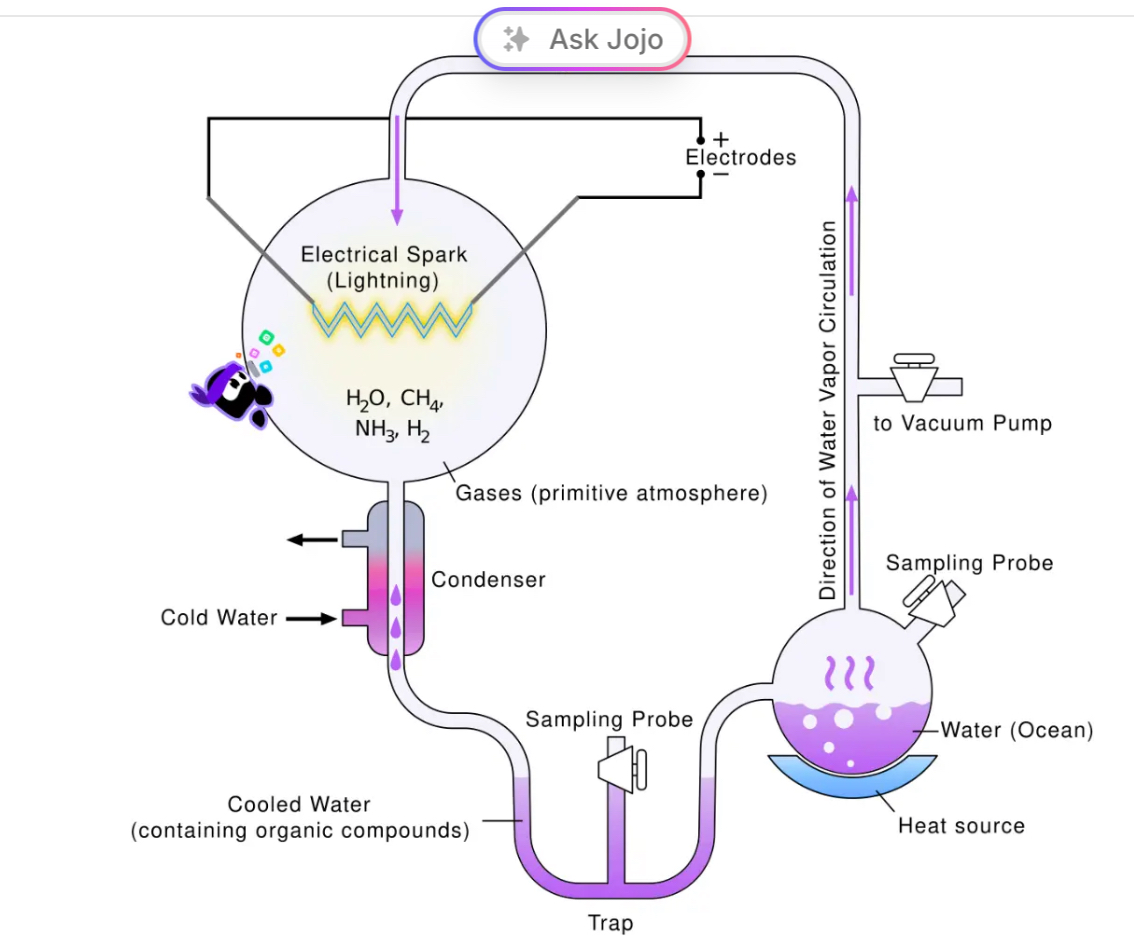
miller urey experiment
Miller and Urey proposed that Earth’s early atmosphere was reducing, containing gases such as methane (CH₄), ammonia (NH₃), hydrogen (H₂), and water vapor (H₂O).
They reasoned that these gases could react to form organic compounds when energy was supplied
abiogenesis
The origin of life from non-living matter, such as simple organic compounds.
miller-urey experiment steps
The experiment used a closed system of two connected flasks to simulate early Earth conditions.
Steps:
Evaporation: Water was boiled to create water vapor (simulating the ocean).
Gas Mixture: The vapor mixed with methane, ammonia, and hydrogen (simulating the atmosphere).
Energy Source: Electrical sparks represented lightning, providing energy for reactions.
Condensation: A condenser cooled the vapor, recycling liquid water back into the flask.
how to remember miller urey
The system continuously cycled water and gases, mimicking Earth’s natural evaporation–condensation–lightning cycle.
This constant recycling allowed ongoing chemical reactions, gradually producing more complex organic molecules over time.
miller - urey results
After several days, the solution turned reddish-brown and chemical analysis revealed over 20 amino acids and other simple organic molecules.
This demonstrated that organic compounds could form spontaneously under simulated early Earth conditions.
limitation of miller urey
Questionable Atmosphere Composition:
Later evidence suggests early Earth’s atmosphere was neutral or mildly oxidizing, dominated by CO₂ and N₂, not strongly reducing gases.
Under such conditions, amino acid formation is far less efficient.
No Direct Evidence for Life:
The experiment produced amino acids, but not nucleotides or self-replicating molecules.
It demonstrated chemical possibility, not the full origin of life.
Early Membranes and the Origin of Life
for life to emerge, internal chemistry had to be separated from external environment, therefore membranes provided this separation by compartmentalization
amphiphatic
A molecule with both hydrophilic (water-attracting) and hydrophobic (water-repelling) regions, such as a phospholipid.
Amphipathic Molecules and Bilayers
On prebiotic Earth, amphipathic molecules like fatty acids were likely present in the "soup" of organic compounds.
Fatty acids have:
Hydrophilic head: Polar, attracted to water
Hydrophobic tail: Non-polar, repelled by water
When placed in water, these molecules naturally arrange to minimize energy:
Polar heads face the water
Non-polar tails cluster together, away from water
This makes bilayer formation spontaneous and self-organizing.
vesicle formation
amphipathic molecules form vesicles, which enclosed surrounding molecules.
the hydrophobic core of the bilayer acts as a barrier, limiting the movement of polar molecules between inside and outside
how vesicles enabled lifes building blocks
concentration of molecules, catalysts that enhance reaction and energy storage via ion gradients, where differences in ion concentration across the membrane stored energy.
RNA World Hypothesis
The RNA World Hypothesis is a scientific theory that suggests that RNA served as both the genetic material (storing information) and a catalyst(facilitating chemical reactions) before the evolution of DNA and proteins.
Ribozyme
A ribozyme is an RNA molecule capable of catalyzing specific biochemical reactions, similar to how protein enzymes function.
catalytic activity in rna
RNA can fold into complex 3D structures, that help position substrates, lower activation energy and create catalytic centers
Ribozymes (catalytic RNAs) have been found to:
Join nucleotides.
Catalyze peptide bond formation in ribosomes.
RNA’s Versatility in Laboratory Conditions
RNA molecules can evolve in laboratory settings to perform new catalytic functions.
This adaptability supports RNA's potential for diverse roles in the prebiotic world.
transition from rna to dna and proteins
modern life relies on dna for information storage and proteins for catalysts.
dna is chemically more stable due to absence of a hydroxyl group -OH
proteins are more versatile and efficient catalysts
specialization of roles and division of labor
Additional Evidence For The RNA World Hypothesis
RNA viruses (e.g., influenza, coronaviruses) use RNA as genetic material, demonstrating RNA alone can carry heredity.
Ribosomes rely on RNA for catalysis, showing RNA still retains ancient catalytic roles.
Deoxyribose (DNA) is derived enzymatically from ribose (RNA), suggesting DNA evolved later.
Laboratory studies show ribose and RNA nucleotides can form abiotically.
luca
it is believed that it is a common ancestor because everyone has the same genetic code, where dna sequences ATCG are translated into amino acids by creating codons
life appearance
formed 4.5 bln years ago
used fossil, isotopic, molecular evidence to estimate when life began
formation of earth
Earth emerged from a cloud of gas and dust in the early solar system.
primordial soup
Early Earth’s conditions enabled the formation of simple organic molecules, which accumulated in oceans, lakes, and pools.
This chemical "soup" set the stage for the emergence of life’s building blocks.
oldest evidence of life
stromatolites - fossils, which are layered rock structures formed by cyanobacteria
Their layered pattern resembles modern cyanobacterial mats.
Carbon isotope ratios (¹³C/¹²C) in these rocks suggest biological carbon fixation
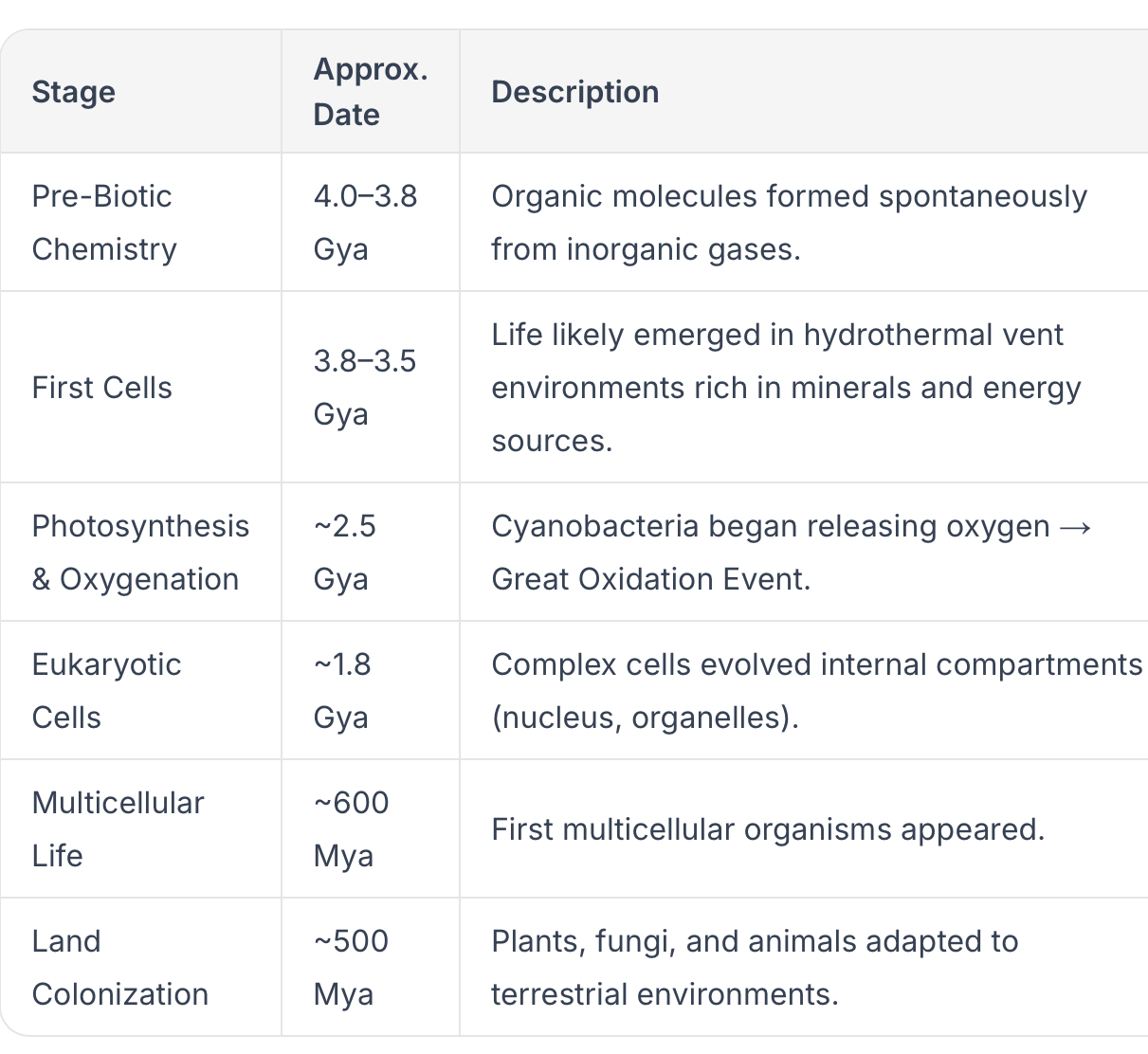
timeline
genomic and molecular clock evidence
Molecular clocks estimate divergence times by comparing genetic differences between species.
Since DNA and proteins mutate at steady rates, scientists can back-calculate when two lineages shared a common ancestor.
Recent analyses suggest that LUCA existed between 4.2 and 4.5 Gya, close to when Earth stabilized after its formation.
hydrothermal vents
Hydrothermal vents are extraordinary environments where superheated water interacts with cold seawater, precipitating minerals like iron sulfides and silicates.
Fossils found in these rocks provide critical clues about microbial life on early Earth.
conditions in hydrothermal vents match conditions needed for adaption to an environment rich in hydrogen has h2, co2, iron compounds, 60-90 temperatures
conserved gene
a gene sequence that has remained largely unchanged across species due to its essential role in survival
functions of genes that are present in life inherited from luca
Anaerobic metabolism (energy generation without oxygen).
Carbon fixation (converting CO₂ into organic molecules).
Nitrogen fixation (reducing nitrogen to ammonia for amino acid synthesis).
Maintenance of ion gradients and primitive energy systems.