Nerve cell
 Call Kai
 Learn
Learn Practice Test
 Spaced Repetition
 Match
Match Flashcards
 Knowt Play
1/75

Earn XP
Description and Tags
lecture 8a
Name | Mastery | Learn | Test | Matching | Spaced | Call with Kai |
|---|
No analytics yet
Send a link to your students to track their progress
76 Terms
What does the word “innervates” mean?
Refers to a nerve supplying a muscle or organ. For
example, “The phrenic nerve innervates the diaphragm
muscle”.
3 parts of the Nervous System
1. Central Nervous System (CNS): brain and spinal
cord.
2. Peripheral Nervous System (PNS): nerves of the
body
3. Autonomic Nervous System (ANS): has parts of
the CNS and PNS.
What are the two parts of the CNS?
Brain and Spinal cord
What does the Autonomic Nervous System
control and what are its 2 divisions?
Controls autonomic function (blood pressure,
digestion, etc).
a. Sympathetic division
b. Parasympathetic division
What kinds of neurons enter the CNS?
Sensory (afferent) signals picked up by sensor
receptors. They are carried by nerve fibers of PNS to the
CNS
What kind of neurons leave the CNS?
Motor (efferent) signals are carried away from the CNS.
They innervate muscles and glands
What sheath covers the axon (not referring
to myelin)?
Endoneurium
What sheath covers a fascicle (bundle of
neurons)
Perineurium
What sheath covers a bunch of fascicles?
Epineurium
What is the neurolemma?
Outermost covering of a neuron (plasma membrane)
What is movement of nutrients, wastes, and
organelles between the cell body and axon
terminals
Axoplasmic transport
What three things do all neurons do?
1. Receive a signal. Can be any type of stimulus
(change in environment, signal from another neuron,
etc).
2. Transmit a signal to another location. E.g. finger
touching something → signal to spinal cord or brain.
3. Stimulate another cell
a. Another neuron → transmit signal
b. Muscle → contraction
c. Gland → secretion
What three characteristics do all neurons
share?
1. Longevity – can live and function for a lifetime
2. Do not divide – fetal neurons lose their ability to
undergo mitosis (the y lose their centrioles);
neural stem cells are an exception
3. High metabolic rate – require abundant oxygen
and glucose
Picture of Sensory vs Motor Neurons
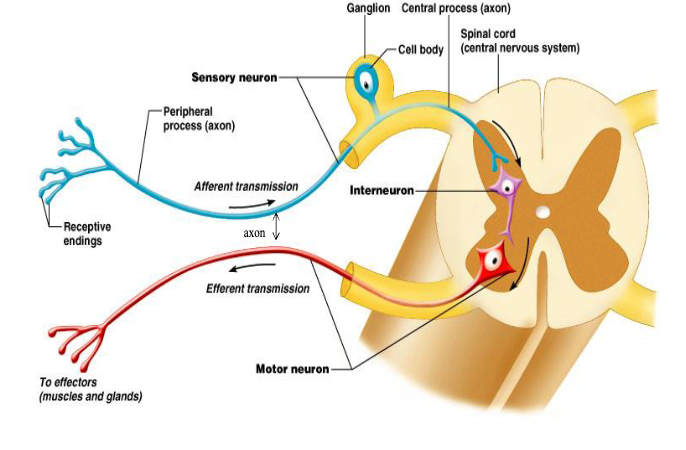
photo of neuron anatomy
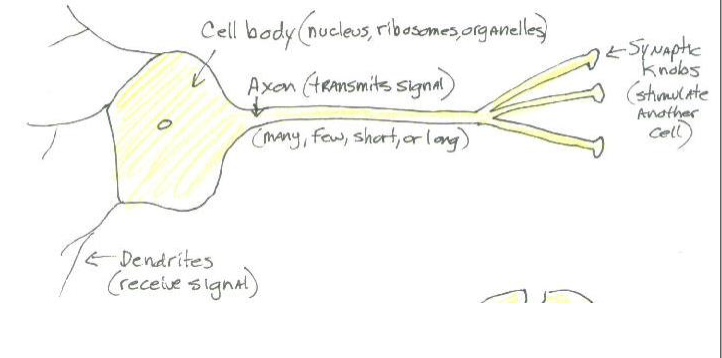
What receives the signal and carries the
nerve conduction toward the cell body?
DENDRITES
Where are the nucleus, ribosomes, and
most organelles located?
The CELL BODY
What has the function of transmitting
signals from the cell body to the area with
neurotransmitters?
AXON
What part of a neuron stimulates another
cell?
SYNAPTIC KNOBS
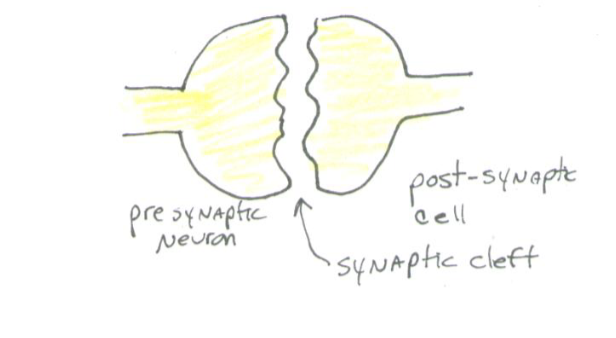
Describe the correct path an impulse takes
across a synapse
Axon of presynaptic neuron → SYNAPTIC CLEFT →
dendrite of post synaptic neuron
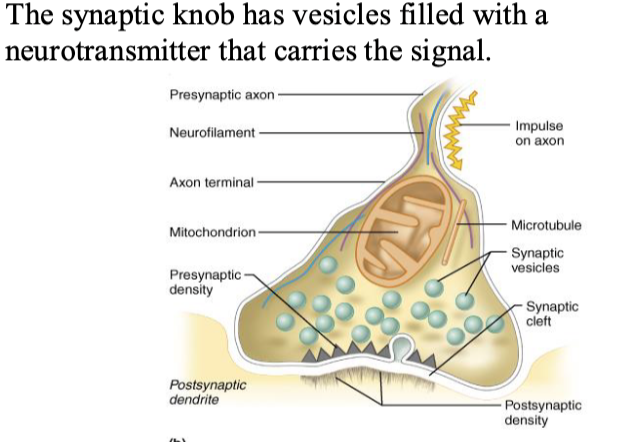
What are synaptic knobs filled with?
What are 4 types of glia cells?
Oligodendrocyte
Schwann Cell
Astrocyte
Microglia
What is the function of glia cells?
They support the neurons
Do glia cells carry nerve impulses?
No. The impulses jump over the oligodendrocytes and
Schwann cells, and astrocytes and microglia are not
involved in nerve impuses at all.
Do glia cells process information in the
nervous system?
No, the interneurons do that
What are the supporting cells of the nervous
system?
GLIA
Where do most tumors originate from?
Most tumors of the brain originate from glial cells
What is Wallerian Degeneration?
process that results when a nerve fiber is cut or crushed,
in which the part of the axon separated from the
neuron's cell body degenerates distal to the injury.
What are the types of synapses?
axosomatic
neuroeffector synapses
axodendritic
axoaxonic
photo of 2 types of the b4 types of glial cells
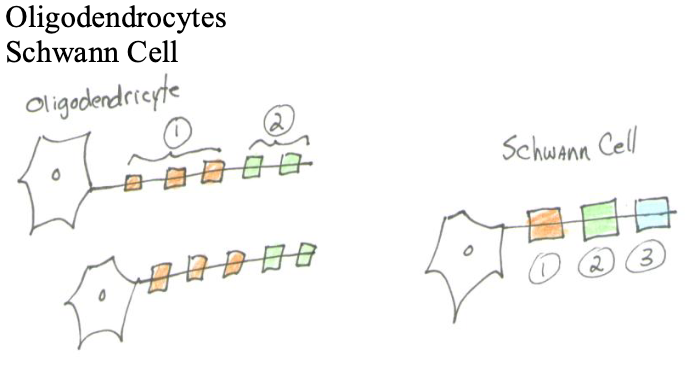
Which cells provide the myelin sheath for
neurons in the CNS?
OLIGODENDROCYTES
Which cells provide the myelin sheath for
neurons in the PNS?
SCHWANN CELLS
What is the function of MYELIN
SHEATHS
to speed up the rate of nerve impulse conduction.
What are the BARE regions of axonal
membranes found only in myelinated axons
called?
NODES OF RANVIER
What conducts impulses faster – myelinated
or unmyelinated axon?
Myelinated
Where are unmyelinated axons found?
Neuron cell bodies, dendrites, and unmyelinated axons in
the PNS and CNS.
Are unmyelinated axons thinner or thicker
than myelinated?
Unmyelinated axons are thinner
What is myelin made of?
Mostly lipid
What is an autoimmune disease where the
oligodendrocytes (the myelin sheaths) are
destroyed, interfering with the neuron
functions in the CNS and brain?
MULTIPLE SCLEROSIS
What is the most common neurological
disease of young adults?
MULTIPLE SCLEROSIS
What are the two differences between
SCHWANN CELLS and
OLIGODENDRICYTES?
Schwann cells are in PNS and each cell only forms one
myelin sheath.
Oligodendricytes are in CNS and each cell can form more
than one myelin sheaths.
What are the 3 functions of an
ASTROCYTE?
a. Physically supports the neurons
b. Transmits materials from capillaries to neurons
c. Forms blood-brain barrier (BBB), which keeps out
harmful substances and many medicines
What is the only function of the blood-brain
barrier BBB?
The only function of the blood-brain barrier is to help
protect the central nervous system
Define MICROGLIA and their function
They are macrophages
They pick up bacteria and debris
What are ependymal cells?
Cells that line the ventricles of the brain and produce
cerebral spinal fluid (CSF)
What is the portion of the CNS that is
unmyelinated (cell bodies of neurons, glia, and
dendrites)?
GREY MATTER
What is the portion of the CNS with myelin
WHITE MATTER
What is a collection of axons in the PNS?
NERVE; No cell bodies, dendrites, or synapses; just
axons.
What is a collection of axons in the CNS
TRACT
Where is most information processed?
SYNAPSES in the CNS
What is a collection of cell bodies in the
PNS?
Ganglion
What is a network of nerves called?
NERVE PLEXUS
What are the neurons that leave the CNS to
effect a muscle or gland?
MOTOR NEURONS
What neurons go from body to CNS,
carrying sensory information?
SENSORY NEURON
What is a small neuron found only in the
CNS?
INTERNEURON
What is the function of interneuron?
it connects two other neurons in the spinal cord
What makes the CNS complex?
The large number of interneurons in the CNS
Where are the cell bodies of motor neurons
and interneurons located?
In gray matter
Gray matter in the CNS contains what
structures?
Neuroglia, neuron cell bodies, dendrites. Everything
except myelinated neurons
For a substance to diffuse across a
semipermiable membrane, what two
conditions must be met?
a) The membrane must be permeable to the substance
b) The substance must have a concentration gradient
At resting membrane potential, is the inside
of the cell membrane positive or negative?
What about the outside of the cell
membrane?
Inside is negative, outside is positive
Inside is negative, outside is positive
Proteins inside the cell make it negative
What changes the overall charge on the
inside and outside of the cell membrane?
The charges change when sodium channels open
during neuron stimulation
When a cell is at resting membrane potential
and is then stimulated by a neuron, what is the
first thing that happens to start the change in
the overall charge on the inside of the cell?
Sodium channels open and sodium enters the cell.
Does potassium leave the cell because of
neuron stimulation?
No, it can leave anytime because its channel is leaky
Why does sidedness exist (inside of cell
negative, outside positive)?
a) The cell membrane has different permeabilities to
each ion
b) Pumps exist which force particular ions into or out of
the cell
c) Channels made out of protein selectively allow
particular ions into or out of the cell.
Why does potassium constantly want to leave a
cell?
It wants to leave to diffuse down its concentration gradient
Why does potassium want to get back into a
cell?
It wants to get back into a cell because it is attracted to the
negative charges on the protein inside the cell
What is the resting membrane potential of a
cell? Why does potassium constantly want to
leave a cell?
The resting membrane potential is how negative or positive
the charge of the cell membrane is when it is not being
stimulated by a neuron. The resting membrane potential is
Minus 70-minus 90 mV
When does Depolarization occur?
Enough sodium ions flow into the cell to make the membrane
potential become positive
When does Repolarization occur?
Enough sodium ions flow out of the cell to make the
membrane potential become negative
What is an action potential?
Action Potential = depolarization + repolarization
What is the correct sequence of events at a
synapse?
The nerve impulse arrives at the synaptic knob of the
presynaptic cell, then the neurotransmitter is released. The
NT binds to receptors on the postsynaptic cell, generating an
action potential in the postsynaptic cell axon. Then the NT is
removed from the receptors of the postsynaptic cell, either by
an enzyme, or they are taken back up into the presynaptic
terminal knob and recycled.
What are the three structural classifications of
neurons?
1. Unipolar
2. Bipolar
3. Multipolar
What are the structural classification of
neurons based on ?
the number of processes that project from the cell body.
What happens if a neuron’s supply of
neurotransmitters is exhausted?
It might be temporarily unable to transmit an impulse to
another cell