3.2.1 Powers of Protection
 Call Kai
 Learn
Learn Practice Test
 Spaced Repetition
 Match
Match Flashcards
 Knowt Play
1/69

There's no tags or description
Looks like no tags are added yet.
Name | Mastery | Learn | Test | Matching | Spaced | Call with Kai |
|---|
No analytics yet
Send a link to your students to track their progress
70 Terms
What are the six major types of infectious agents?
Prions
Viruses
Bacteria
Protists
Fungi
Helminths
Pathogen
Any infectious agent that can cause a disease. Pathogens can be non-living or living and can be visible to the naked eye or only visible with a microscope
Prions (what they are, how they infect, treatment, prevention, & example)
Non-living, submicroscopic proteins
Causes normal proteins in the brain to fold abnormally
Viruses (what they are, how they infect, treatment, prevention, & example)
Non-living microscopic agents made up of an outer protein shell (capsid) and either DNA or RNA
May occur through touch, saliva, blood, or sexual contact
They cannot replicate on their own; they need a host
The host’s cells and tissues are destroyed
Bacteria (what they are, how they infect, treatment, prevention, & example)
Living, microscopic, unicellular, prokaryotic organisms
Can occur through the nose, eyes, mouth, through a wound, or by ingesting contaminated food or water
Bacteria can invade cells, cause tissue damage, and produce harmful toxins
Protists (what they are, how they infect, treatment, prevention, & example)
Living, microscopic, single-celled, eukaryotic, animal-like organisms
Infection typically results from ingestion of food or water contaminated with feces from an infected organism
Infects the digestive tract, blood, or organs of the body, depriving the host of essential nutrients found in food (may also cause tissue & organ damage)
Helminths (what they are, how they infect, treatment, prevention, & example)
Living, multicellular, eukaryotic worms. Both microscopic and macroscopic varieties exist
Infection may occur from the consumption of contaminated food or water, or getting bitten by an infected insect
Depriving the host of essential nutrients found in food can cause tissue & organ damage
Fungi (what they are, how they infect, treatment, prevention, & example)
Living, multicellular, eukaryotic organisms (yeasts, mildew, molds, and mushrooms). Both microscopic and macroscopic varieties exist
Some forms infect when the spores of the fungi, the reproductive cells, are inhaled or land on a host
Infection can result in tissue damage
Parasites
Living things that use other living things for food and a place to live
How does the skin protect the body?
It is the first layer of defense for the body and is an immediate barrier to outside invaders
How does the immune system protect the body?
It acts as an army to fight and destroy pathogens
How does the lymphatic system protect the body?
It drains and filter excess fluid while the immune system is fighting and destroying pathogens
How does mucus protect the body?
It covers cells that line our respiratory and digestive systems and helps trap pathogens that enter the body
How is mucus expelled?
It is either swallowed to be destroyed by the stomach or released when you blow your nose
What are the 3 layers of the skin from surface to deepest?
Epidermis
Dermis
Subcutaneous fatty tissue
What does the skin act as a protective barrier between?
Internal structures and the outside world
Epidermis
The top layer of the skin that provides a barrier, makes new skin, and provides skin color
Dermis
The middle layer of skin that contains collagen and elastin, grows hair, makes oil and sweat, and contains blood vessels and nerve endings
Subcutaneous Fatty Tissue
The bottom layer of the skin, consisting of fat that cushions muscles and bones and helps to regulate body temperature
What is the unique environment that the skin represents?
Immune cells interact with skin cells to maintain tissue homeostasis and induce immune responses
What does normal flora have beneficial effects for?
The protection against pathogens and in wound healing
What is the epidermis composed of?
Highly specialized epithelial cells known as kertinocytes
How are keratinocytes continuously replenished?
From just one layer of basal keratinocytes, which divide frequently
Dead cells (corneocytes)
Largely responsible for the barrier function of the skin
How is the dense extracellular matrix formed?
In the dermis, cells known as fibroblasts secrete elastin and collagen fibers
What do blood capillaries do in the skin?
They irrigate the dermis
Where is lymph fluid drained?
Through lymphatic vessels to lymph nodes
Sepsis
The body’s immune system overreacts to an infection, causing inflammation
Severe Sepsis
Organs in the body begin to malfunction, blood pressure is low, and inflammation continues
Septic Shock
Extremely low blood pressure that does not respond to IV fluids
TIME
T~ Temperature (higher or lower than normal)
I~ Infection (signs and symptoms, such as swollen lymph nodes)
M~ Mental decline (confused, sleepy, difficult to rouse)
E~ Extremely ill (severe pain or discomfort)
What is the lymphatic system made up of?
Organs, ducts, and lymph nodes
What fluid does the lymphatic system transport?
A clear watery fluid called lymph
Lymph Node
Any of the rounded masses of lymphoid tissue that are surrounded by a capsule of connective tissue, are distributed along the lymphatic vessels, and contain numerous lymphocytes, which filter the flow of lymph passing through the node
Lymph
A usually clear fluid that passes from the intercellular spaces of body tissue into the lymphatic vessels
What does the lymphatic system absorb, protect your body from, and do with lymph fluid?
It absorbs fat from the digestive tract, protects your body from pathogens, and transports and removes waste from the lymph fluid
List one thing from the lymphatic system, digestive system, and skeletal system that protect your body from outside invaders
Lymph nodes (lymphatic system)
Liver (digestive system)
Bone marrow (skeletal system)
What does the immune system do to anything that is non-self?
It works to fight off and destroy anything that is non-self
What do white blood cells do?
Circulate through the blood and lymph to fight off invaders such as viruses, bacteria, or abnormal cells, such as cancer cells, and protect the body while it’s under attack
Tonsils
Help to stop germs from entering the body through the mouth or the nose. They contain white blood cells which help kill germs. You can live a healthy life without tonsils
Lymph Nodes
Glands in the immune system that usually enlarge in response to a bacterial or viral infection, or cancer
Thymus
Helps in the development of T-cells. T-cells are a type of white blood cell that help fight infections. It is especially important in newborns; without a thymus, a baby’s immune system will not develop properly. Adults can live without a thymus
Bone Marrow
Produces new blood cells, both red and white. The types of cells that make antibodies, B cells, are formed here. All mammals need bone marrow to live healthy lives
Liver
The liver contributes to your immune defense by collecting and eliminating foreign compounds from the large volume of blood that passes through it. You cannot survive without a liver
Spleen
Filters the blood of foreign cells and old red blood cells in need of replacement. A person missing their spleen gets sick much more often than someone with a spleen
How does the lymphatic system transport substances?
Lymph fluid is not pressurized
Lymph fluids are pushed through the body by normal body motions
The lymphatic vessels have a series of valves that help keep the fluid moving in one direction
How does the cardiovascular system transport substances?
Blood is pressurized
Blood moves due to the pumping of the heart
How many lymph nodes does the average adult have, and where are they typically clustered?
600-800, typically clustered in the groin, armpit, and neck areas
How are nodes connected, and what do they do?
They are connected by lymphatic vessels that carry excess lymph away from the tissues toward larger collecting ducts
What happens where the vessels reach the nodes?
The lymph moves through the sinuses and white blood cells attack any pathogens. It then flows out of the node through the efferent vessel to be returned to the bloodstream
What do swollen lymph nodes indicate?
That you have an infection
Where does bacteria reside when it enters your body?
Between cells in the intercellular fluid
What does the lymph system do concerning intercellular fluid?
Drains and filters intercellular fluid and detects and removes bacteria
What do small lymph vessels collect?
Intercellular fluid & moves it toward larger vessels
Where does the lymph fluid move after the larger vessels?
Into the lymph nodes for processing
What kind of cells do lymph nodes contain?
Filtering tissue and lymph cells
What happens to lymph nodes when fighting infections?
The nodes swell with bacteria and the cells fighting the bacteria
What happens after lymph is filtered through the lymph nodes?
It re-enters the bloodstream
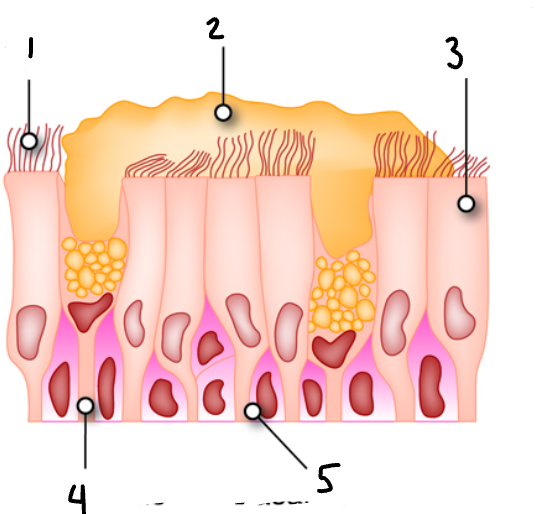
Label the diagram
Cilia
Mucus
Columnar Epithelium
Goblet Cells
Basal Cells
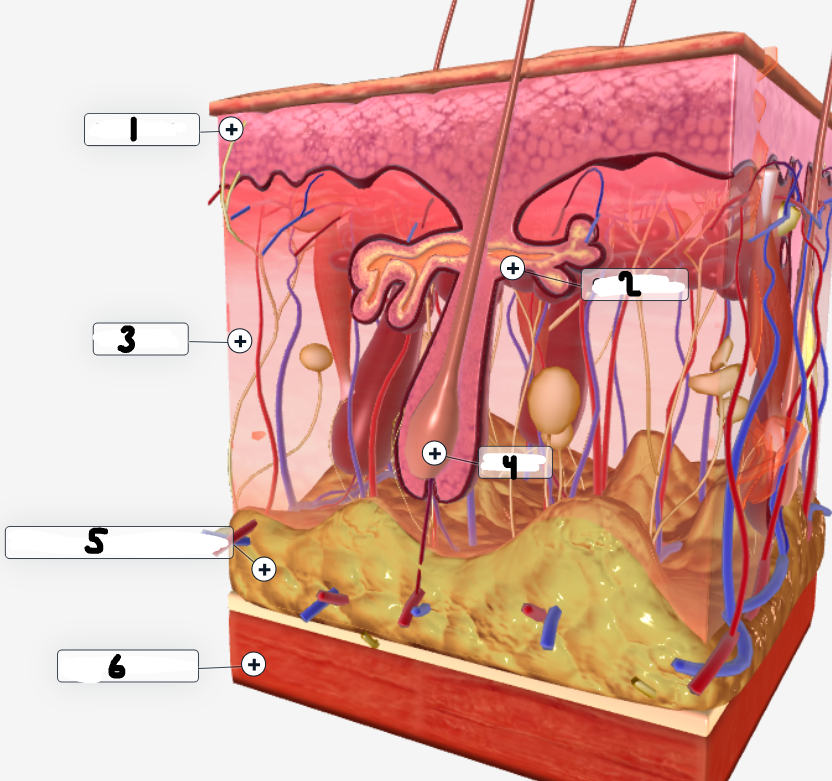
Label the diagram
Epidermis
Oil gland (sebaceous gland)
Dermis
Hair
Subcutaneous fatty tissue (hypodermis)
Muscle fibers
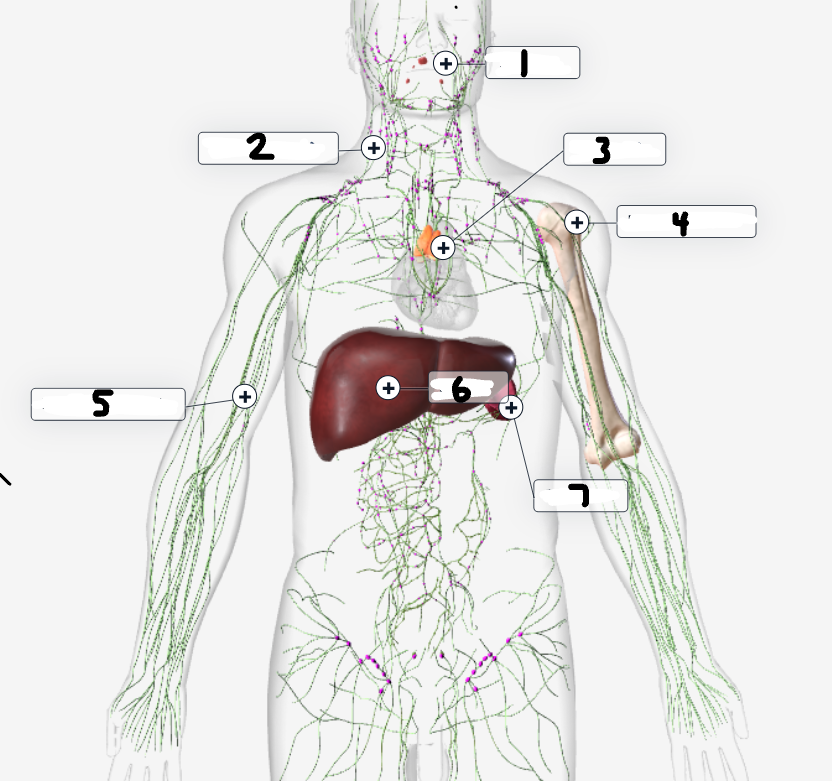
Label the diagram
Tonsils
Lymph nodes
Thymus
Bone marrow
Lymph vessels
Liver
Spleen
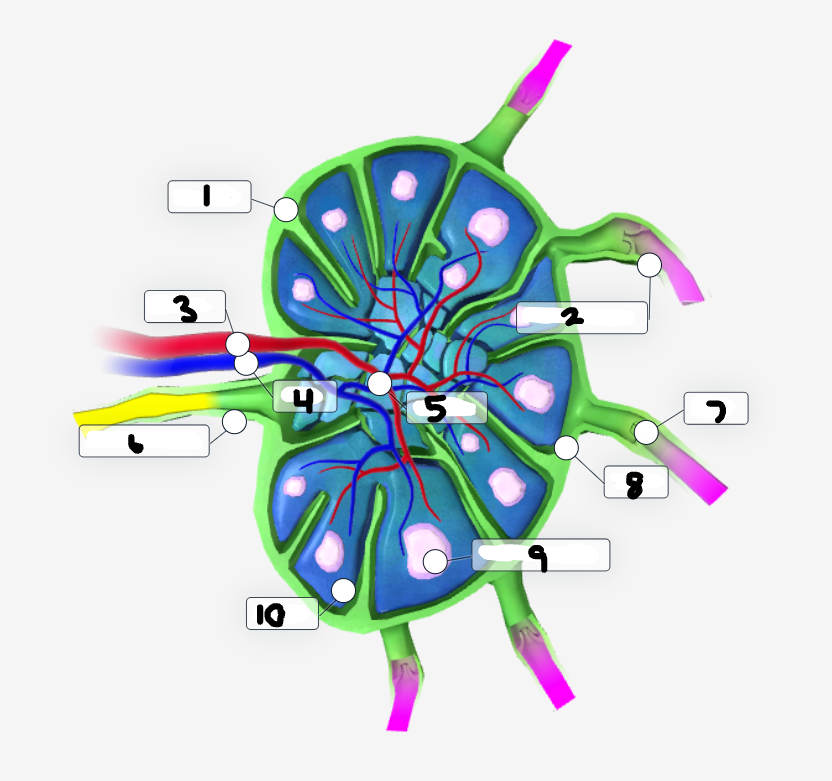
Label the diagram
Capsule
Afferent vessel
Arteries
Veins
Medulla
Efferent vessel
Valve
Sinus
Germinal center
Cortex
Why are cilia important for your trachea and bronchiole tubes?
The cilia pushes any material breathed in from the air to the back of your throat
When do bacteria officially enter your body?
When it enters your bloodstream
What is the job of epithelial tissue?
Protect
Is epithelial tissue avascular or vascular?
Avascular
What is the job of connective tissue?
Connect
Is connective tissue avascular or vascular?
Vascular
Give examples of connective tissue
Subcutaneous fatty tissue
Dermis
Lymph
Blood
What is another name for subcutaneous tissue?
Hypodermis