Comprehensive Psychology: Emotions, Stress, Disorders, Sensation & Perception
 Call Kai
 Learn
Learn Practice Test
 Spaced Repetition
 Match
Match Flashcards
 Knowt Play
1/103

There's no tags or description
Looks like no tags are added yet.
Name | Mastery | Learn | Test | Matching | Spaced | Call with Kai |
|---|
No analytics yet
Send a link to your students to track their progress
104 Terms
What is Dissociative Identity Disorder?
A rare disorder where a person exhibits two or more distinct personalities.
What are the biological characteristics of Antisocial Personality Disorder?
Hyper-reactive dopamine reward system, frontal lobe deficits, low autonomic nervous system arousal.
What characterizes Avoidant Personality Disorder?
Fearful sensitivity to rejection.
What characterizes Schizotypal Personality Disorder?
Eccentric behaviors and emotional disengagement.
What is the James-Lange theory of emotion?
Emotions arise from our awareness of our specific bodily responses to emotion-arousing stimuli.
What does the Cannon-Bard theory state about emotions?
Emotion-arousing stimuli trigger our bodily responses and simultaneous subjective experience.
What are the two factors in the Schachter-Singer theory that lead to our experience of emotion?
Physiological arousal and cognitive appraisal.
How does the two-tracked brain process sensory input?
Sensory input may be routed to the cortex for analysis or directly to the amygdala for an instant emotional reaction.
How does the sympathetic division of the autonomic nervous system affect emotional response?
It arouses us for intense experiences of emotion, pumping out stress hormones.
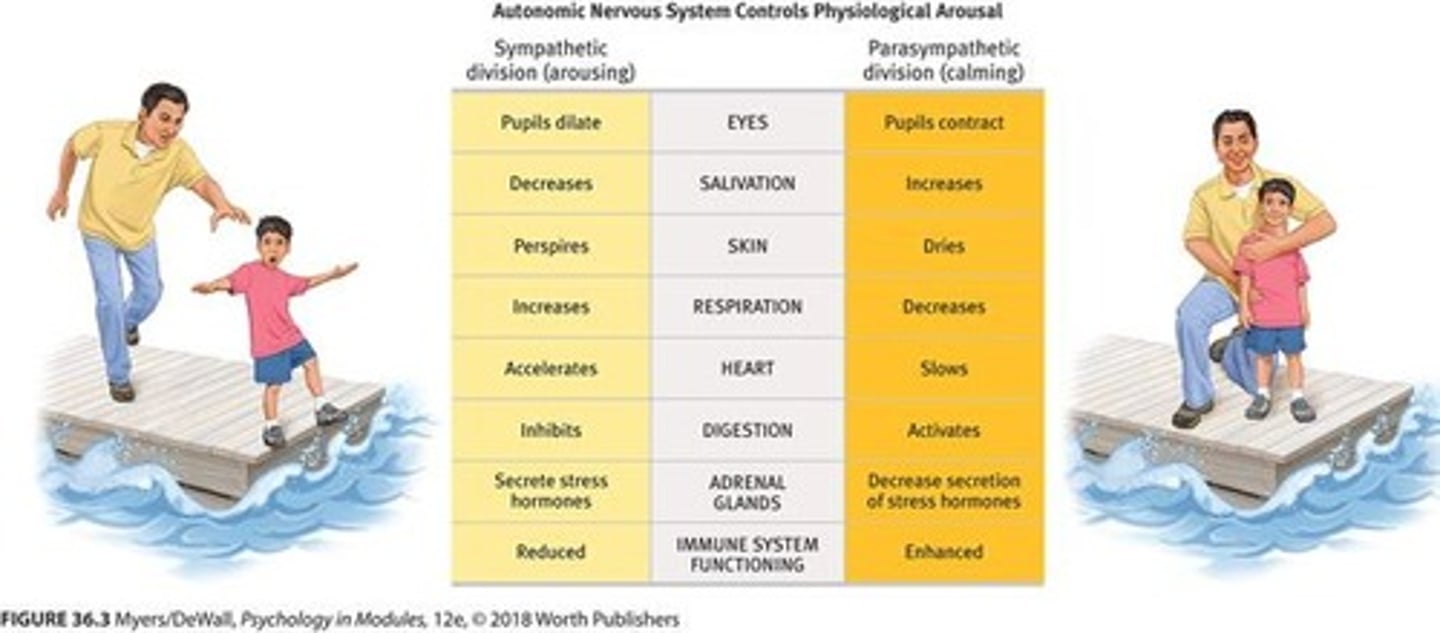
What is the role of the parasympathetic division of the autonomic nervous system?
It restores the body to a calm physiological and emotional state after a crisis.
How does stress affect DNA?
Persistent stress can shorten telomeres, making cells appear older.
What is the facial feedback effect?
The tendency of facial muscle states to trigger corresponding feelings.
What is the behavior feedback effect?
The tendency of behavior to influence our own and others' thoughts, feelings, and actions.
What are common causes of anger?
Perceived misdeeds, small hassles, and blameless annoyances.
What are the consequences of chronic hostility?
It is linked to heart disease.
What is catharsis in psychology?
The idea that releasing aggressive energy relieves aggressive urges.
What are three ways to manage anger?
Wait, find a healthy distraction or support, and distance yourself from the situation.
What is the feel-good, do-good phenomenon?
People's tendency to be helpful when in a good mood.
What is positive psychology?
The scientific study of human flourishing and strengths that help individuals and communities thrive.
What are the three pillars of positive psychology?
Positive well-being, positive character, and positive groups, communities, and cultures.
What is the adaptation-level phenomenon?
Happiness is relative to our own experience.
What is relative deprivation?
Happiness is relative to others' success.
What are characteristics of happy people?
High self-esteem, optimism, positive relationships, and engaging work.
How does stress make us vulnerable to disease?
It affects the immune system through the nervous and endocrine systems.
What five factors affect immune system activity?
Age, nutrition, genetics, body temperature, and stress.
What are evidence-based suggestions for a happier life?
Take control of your time, act happy, seek engaging work and leisure, and buy shared experiences.
What is the shared experience of a college education according to Art Buchwald?
The best things in life aren't things.
How can aerobic exercise affect mental health?
It can relieve mild depression and anxiety.
What is the importance of sleep for happiness?
Happy people reserve time for renewing sleep and solitude.
What are the consequences of sleep debt?
Fatigue, diminished alertness, and gloomy moods.
How do happy people engage in conversations?
They engage in more meaningful conversations and less superficial small talk.
What should you do to nurture close relationships?
Give kindness and affirmation to loved ones.
How does performing acts of kindness affect happiness?
Happiness increases helpfulness, and doing good makes us feel good.
What is the benefit of keeping a gratitude journal?
It heightens well-being.
What does nurturing your spiritual self provide?
A support community and a sense of purpose.
What are the two ways the immune system can err?
1. Responding too strongly, causing allergic reactions. 2. Underreacting, allowing infections or cancer to develop.
What are three examples of immune system suppression in humans?
1. Surgical wounds heal slowly in stressed people. 2. Stressed people are more vulnerable to colds. 3. Stress can hasten disease progression.
What does psychoimmunology study?
The mind-body interactions affecting the immune system and overall health.
What general effect does stress have on health?
It reduces the immune system's ability to function properly.
What characterizes a Type A personality?
Pessimistic, reactive, competitive, impatient, and verbally aggressive.
What health outcome is linked to Type A personalities?
Coronary heart disease.
What are the three main types of stressors?
1. Catastrophes, 2. Significant life changes, 3. Daily hassles.
What are three health outcomes associated with persistent stress?
1. Heart disease, 2. Inflammation of body tissues, 3. Cancer.
What are the three phases of General Adaptation Syndrome (GAS)?
1. Alarm reaction, 2. Resistance, 3. Exhaustion.
What is the tend-and-befriend response?
Providing support to others and seeking support from others under stress.
What is problem-focused coping?
Attempting to alleviate stress directly by changing the stressor.
What is emotion-focused coping?
Attempting to alleviate stress by avoiding or ignoring a stressor.
How do optimism and pessimism affect health outcomes?
Optimism generally leads to better health outcomes than pessimism.
How does social support promote good health?
1. Calms us and reduces blood pressure. 2. Fosters stronger immune functioning. 3. Provides opportunities for confiding feelings.
What is the Medical Model of psychological disorders?
It asserts that psychological disorders have physical causes that can be diagnosed and treated.
What is the BioPsychoSocial Approach?
It considers biology, psychology, and socio-cultural influences on thoughts, feelings, and behaviors.
Why do clinicians classify psychological disorders?
To provide a common language for communication and research.
What are some criticisms of diagnostic labels in psychology?
They may pathologize normal behaviors and create biases.
What makes behavior abnormal?
Violation of social norms, statistical rarity, personal distress, and maladaptive behavior.
What characterizes Social Anxiety Disorder?
Extreme anxiety in social interactions due to fear of being judged.
What is Generalized Anxiety Disorder?
Excessive and uncontrollable worry lasting for 6+ months, causing jitteriness, agitation, and sleep deprivation.
What are the symptoms of Panic Disorder?
Unpredictable panic attacks lasting minutes, accompanied by chest pain, choking sensations, and fear of future attacks.
What are Phobias?
Persistent, irrational fear and avoidance of a specific object, activity, or situation.
What is Obsessive-Compulsive Disorder?
Unwanted repetitive thoughts (obsessions) and/or actions (compulsions).
What is Posttraumatic Stress Disorder?
Symptoms include haunting memories, nightmares, hypervigilance, and social withdrawal that persist for four weeks or more after trauma.
What brain areas are overaroused in anxiety disorders?
Amygdala for PTSD and anterior cingulate cortex for OCD.
What is the obsession and compulsion in Daniel's behavior?
Obsession: 'Dirty' floor; Compulsion: Vacuum until it's clean enough.
What is the difference between rumination and dissociation?
Rumination is compulsive overthinking, while dissociation is a disconnect from conscious awareness of painful memories.
What is an example of epigenetics?
One twin experiences trauma, leading to symptoms of bipolar disorder, while the other twin does not.
What gender differences are found in mental illness?
Women are more vulnerable to anxiety/depression; men are more vulnerable to external behaviors like drug abuse.
What are the symptoms of Major Depressive Disorder?
Depressed mood, loss of interest, sleep/appetite challenges, feelings of worthlessness, suicidal thoughts.
What characterizes Bipolar Disorder?
Alternating between depressive hopelessness and overexcited mania.
What is the Biological perspective on mental illness?
Focuses on genetic predispositions and biochemical imbalances.
What are the characteristics of schizophrenia?
Delusions, hallucinations, disorganized speech, and diminished emotional expression.
What is the difference between chronic and acute schizophrenia?
Chronic appears in late adolescence with shorter recovery; acute can begin at any age and follows emotionally traumatic events.
What brain abnormalities are associated with schizophrenia?
Dopamine overactivity, low frontal lobe activity, increased amygdala activity, and enlarged ventricles.
What prenatal events increase the risk of schizophrenia?
Low birth weight, maternal diabetes, older paternal age, oxygen deprivation during delivery.
What are positive symptoms of schizophrenia?
Hallucinations, disorganized speech, inappropriate laughter, tears, or rage.
What are negative symptoms of schizophrenia?
Toneless voice, expressionless face, mute or rigid bodies.
What is Antisocial Personality Disorder?
Lack of conscience for wrongdoing, aggressive behavior, or clever con artistry.
What characterizes Borderline Personality Disorder?
Dramatic or impulsive behaviors for attention.
What characterizes Narcissistic Personality Disorder?
Self-focused and self-inflating behavior.
What is Attention-Deficit/Hyperactivity Disorder?
Extreme inattention and/or hyperactivity and impulsivity, often co-existing with learning disorders.
What is Anorexia Nervosa?
An eating disorder where a person maintains a starvation diet despite being significantly underweight.
What is sensation?
The process by which our sensory receptors and nervous system receive and represent stimulus energies from our environment.
What is perception?
The process of organizing and interpreting sensory information, enabling us to recognize meaningful objects and events.
What are the three basic steps that are a part of all sensory systems?
Receive, Transform, Deliver.
What is transduction?
The conversion of one form of energy into another, transforming stimulus energies into sights, sounds, and smells that can be interpreted.
What is psychophysics?
The study of relationships between the physical characteristics of stimuli and our psychological experience of them.
What is priming?
The activation, often unconsciously, of certain associations, thus predisposing one's perception, memory, or response.
What is subliminal stimulation?
Stimulation below one's absolute threshold for conscious awareness.
How does our perceptual set influence perception?
It reflects our experiences, assumptions, and expectations.
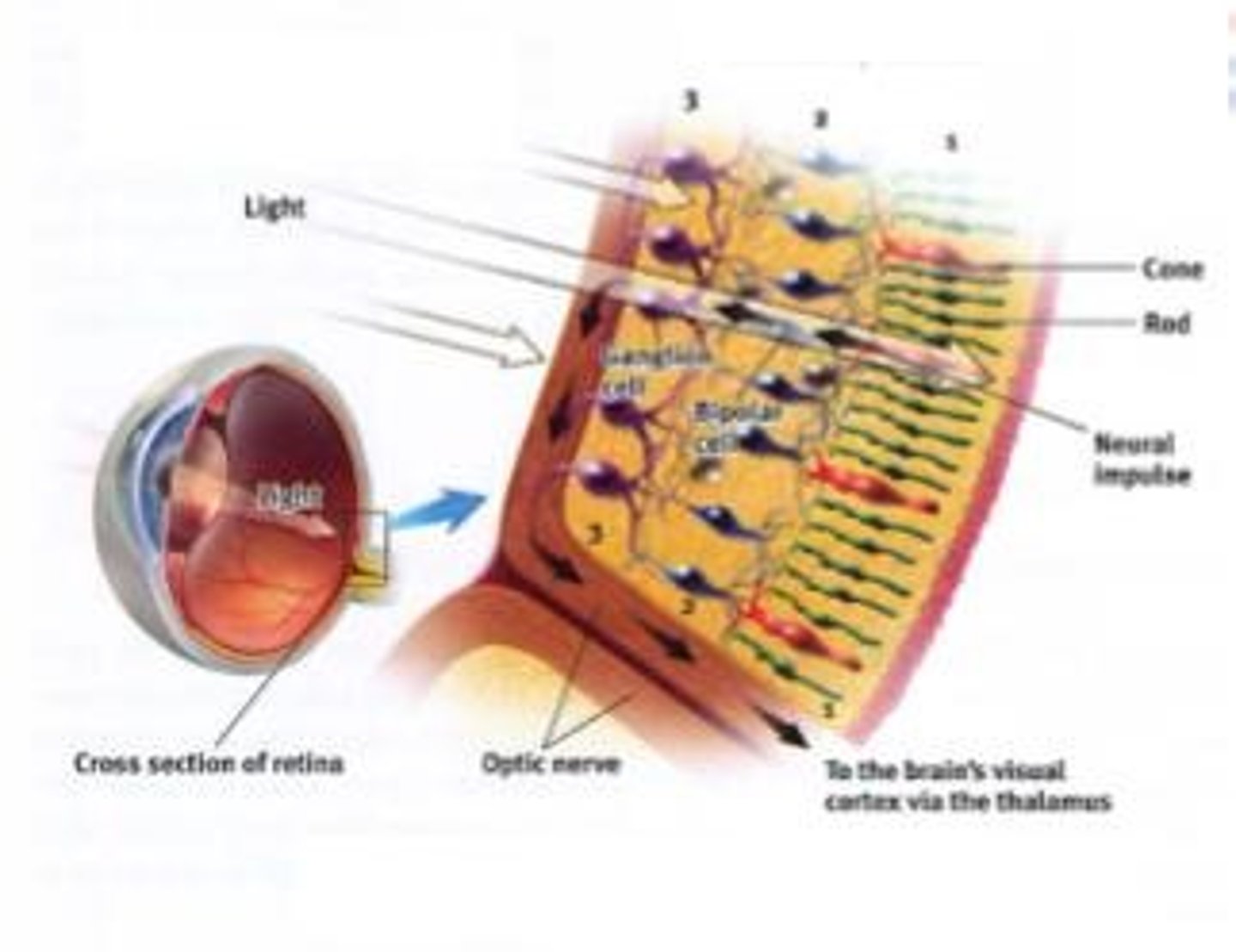
What are rods and cones?
Rods detect black, white, and grey; cones detect fine detail and color.
What is the difference between long-wavelength and short-wavelength light?
Long wavelengths are more reddish, while short wavelengths are more bluish.
What does amplitude determine in sound waves?
The loudness of the sound.
What does frequency determine in sound waves?
The pitch we experience.
What is feature detection?
Nerve cells in the brain that respond to specific features of a stimulus, such as shape, angle, or movement.
What is the middle ear?
The chamber between the eardrum and the cochlea that amplifies sound vibrations.
What do cochlear implants do?
Restore hearing for some people by converting sound into electrical signals.
What is the role of the optic nerve?
Carries neural impulses from the eye to the brain.
What is perceptual constancy?
The ability to recognize objects as the same even when they change in appearance.
What is the function of the retina?
Multilayered tissue on the eyeball's inner surface that processes visual information.
What is the role of the pupil?
A small adjustable opening that controls the amount of light entering the eye.
What is the function of the iris?
A colored muscle that dilates or constricts in response to light intensity.
What is the function of the cornea?
Bends light to provide focus.