Lecture 19 - Conservation Genetics
 Call Kai
 Learn
Learn Practice Test
 Spaced Repetition
 Match
Match Flashcards
 Knowt Play
1/40

There's no tags or description
Looks like no tags are added yet.
Name | Mastery | Learn | Test | Matching | Spaced | Call with Kai |
|---|
No analytics yet
Send a link to your students to track their progress
41 Terms
All techniques examine _________
portions of DNA at some scale.
________: biparentally inherited, found in cell nucleus, evolves slowly (yet some regions evolve rapidly).
Nuclear genome:
_________: maternally inherited, housed in mitochondrion, much smaller than nuclear genome, evolves quickly, well mapped in many species.
Mitochondrial genome:
Some techniques consider gene products (e.g. proteins) while others examine _______
variation at the nucleotide level (e.g., DNA sequencing, fragment analysis)
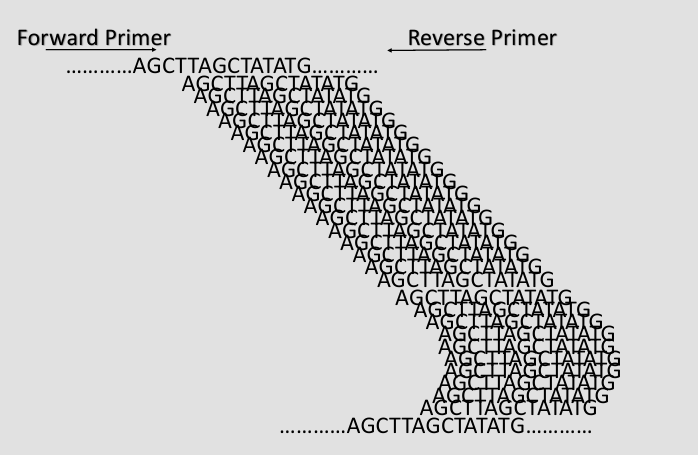
_______: a region of DNA is targeted and amplified exponentially
Polymerase Chain Reaction (PCR)
Proteins are a series of _______
amino acids joined by peptide bonds.
Mutations cause changes in ________ in electrophoresis.
shape, charge, and migration rates
Variation can be detected among ___________.
individuals, populations, or species
Can only examine a small proportion of variation present in ____________
DNA that codes for proteins.
______: Genetic techniques that explore variation indirectly by comparing the size of DNA fragment electrophoretically.
Examples include RFLP, AFLP, Minisatellites and microsatellites.
Fragment Analysis
The most widely used for wildlife studies are ________.
microsatellites
Microsatellites examine Regions in the nuclear genome characterized by __________
PCR based technique that identifies diploid genotypes for specific loci.
short tandem repeats (e.g., CT repeated 20 times).
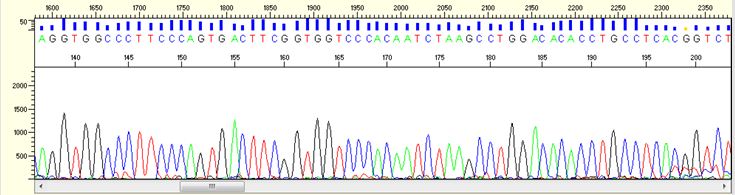
_________ involves targeting a certain region of the genome, amplifying it, and reading the DNA sequence in that region
DNA sequencing
_________: Emerging marker that is a specific site in a DNA sequence in which a single nucleotide varies.
Single Nucleotide Polymorphisms
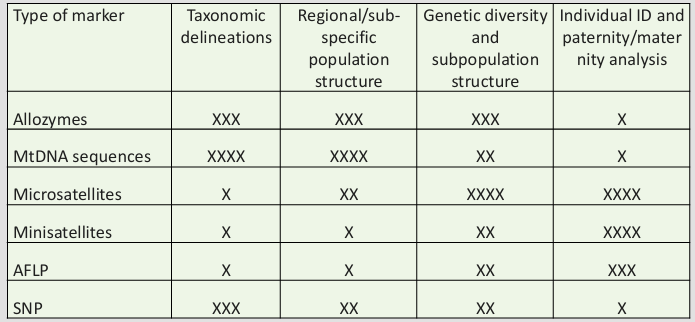
Number of Xs indicates the relative applicability of each technique to a specific question
Applicability of Common Types of Molecular Markers for Wildlife Biologists
DNA can be extracted from a variety of tissues including ___________
muscle, heart, liver, blood, skin, hair, feathers, saliva, feces, urine, scales, bone, fins, eggshell membranes and potentially cervid antlers.
_________ – when an organism is killed during the process of sampling.
Destructive sampling
____________ – when a genetic sample can be obtained without sacrificing the animal.
Nondestructive sampling
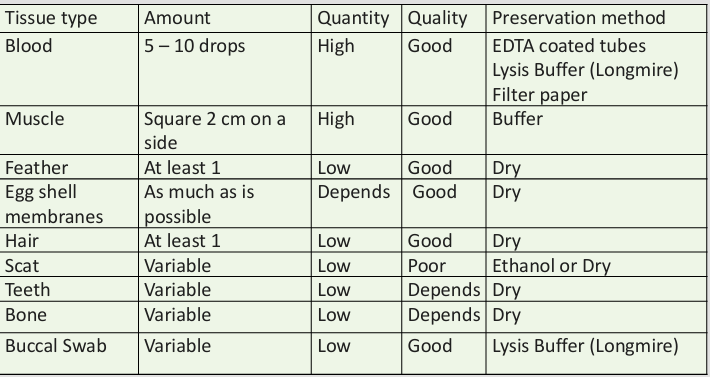
Sources of DNA and How Samples Should Be Collected
While most _______ classes are somewhat arbitrary (subspecies, genera, order) the species classification is perceived to be based on real, evolutionary units.
Species definition is integral to the Endangered Species Act.
Two most common and applied species concepts are Biological (BSC) and Phylogenetic (PSC).
BSC emphasizes reproductive isolation.
PSC uses the criterion of reciprocal monophyly and typically relies solely on genetic data.
Gunnison sage grouse were recognized as a new species in 2000 based on differences in morphology, behavior, and genetics.
Taxonomy
Genetic methods can be used to document _________
hybridization, introgression, and taxonomic status.
Molecular techniques can also be used to determine __________
the maternity and paternity of hybrids.
Genetic methods can be used to objectively prioritize conservation and management value below the species level.
Evolutionary Significant Units (ESU) and Management Units (MU) allow for that prioritization.
Four main forces affect Genetic Diversity
Mutation
Gene Flow
Genetic drift
Natural Selection
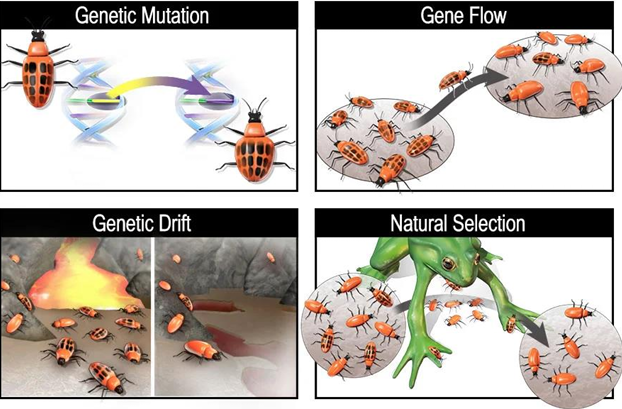
___________: Changes in the DNA sequence that result in new genetic variation.
Usually, management actions have little affect on this process.
_______ can be increased by some environmental contaminants.
_________ are low frequency events and thus have been hard to detect; this is changing with the development of better screening technologies
Mutation
___________: Results from individuals moving from their natal population to a new one, where they successfully reproduce.
Often reported as Nm, the number of migrants per generation, where N is the average size of the populations and m is the migration rate between them.
______ is negatively related to the amount of differentiation observed between populations.
Population differentiation is often expressed as the FST, which can be defined as the proportion of the total variance in allele frequencies due to differences among populations.
The greater the exchange of individuals between populations the more that genetic similarity of the populations will increase.
Equilibrium relationship of genetic differentiation among subpopulations (as measured by FST) and number of migrants per generation
Gene Flow
___________: Random changes in the frequencies of alleles.
Increases with decreasing population size.
Increases genetic differences among small, isolated populations.
Gene flow counteracts the influence of drift.
The rate of loss of variation in a population is to a population’s effective size (Ne).
Ne is often smaller than the number of breeding adults in a population.
Ne can be reduced below the census population size by many factors, including unequal sex ratios, temporal differences in population size, and large variation among the number of young produced by the adults in the population.
Genetic Drift
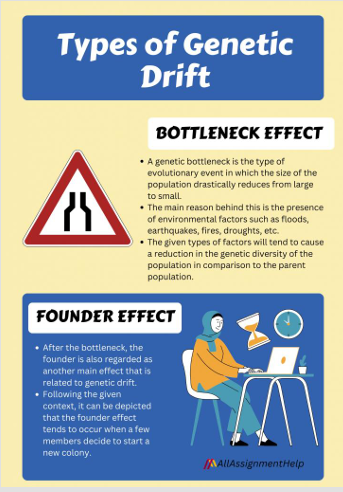
Bottleneck effect vs. Founder effect
________: Differential survival and fecundity of genotypes can have complex effects on genetic diversity.
Typically, selection plays only a minor role in discussions about of management of genetic diversity.
Technological advances are allowing better monitoring of selection in nature.
Some harvest practices have been shown to have the potential for producing unintended selective changes in populations.
Natural Selection
Interest in preserving genetic diversity stems from the relationship between genetic diversity and __________
Population Viability
Small populations that lose genetic diversity due to inbreeding can suffer from _____________
inbreeding depression reducing survival and fecundity.
Genetic diversity lost via drift is ________ for adaptation to changing environmental conditions.
not available
Because most _________ are small, they are subject to inbreeding and drift.
To prevent loss of variation, _________ should be established with a large number of unrelated individuals and be maintained at large population sizes.
Efforts should be made to prevent adaptation to ________ conditions, so that reintroduction into the wild remains a viable possibility.
Captive Breeding Programs
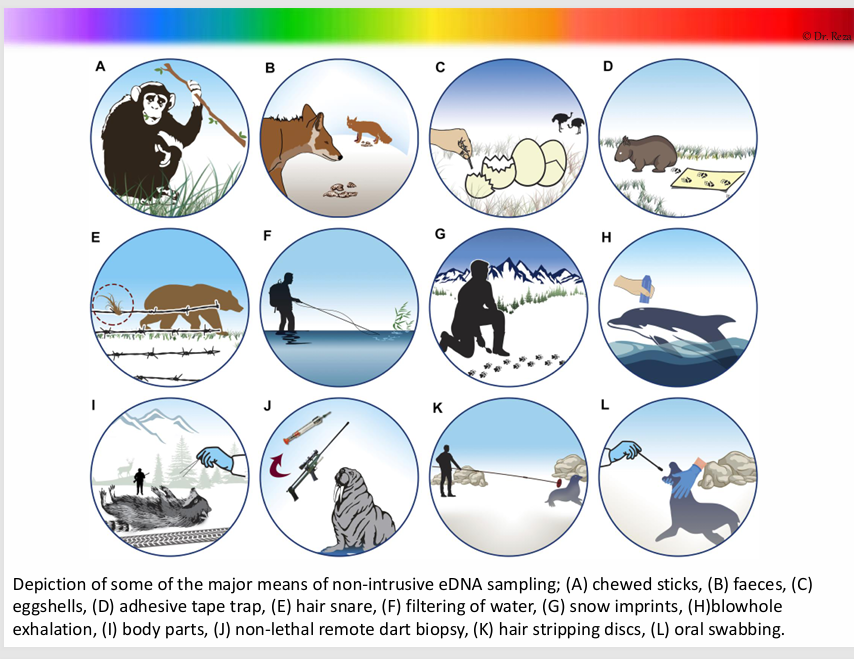
As DNA can be extracted from a variety of material, ____________ allows samples to be collected without handling or disturbing animals.
Because each individual has its own unique genetic fingerprint, DNA can be used a unique ‘mark’ for mark and recapture methods.
This type of _________ also can be used to identify species, estimate sex ratios, and provide genetic material for population and landscape genetic studies.
Depiction of some of the major means of non-intrusive eDNA sampling; (A) chewed sticks, (B) faeces, (C)
eggshells, (D) adhesive tape trap, (E) hair snare, (F) filtering of water, (G) snow imprints, (H)blowhole
exhalation, (I) body parts, (J) non-lethal remote dart biopsy, (K) hair stripping discs, (L) oral swabbing.
Noninvasive Sampling
__________: Requires a set of markers polymorphic enough to distinguish among individuals (microsatellites).
DNA from non-invasively collected samples is low quantity and can be degraded.
Contamination is an issue.
Allelic dropout can be a problem (when only 1 of 2 alleles of template DNA is amplified, looks like a homozygote when it is a heterozygote).
Estimating Population Size and Survival
_________: As individuals can be uniquely identified with genetic markers, movement data can be obtained by “recapturing” individuals at different times in different locations.
Tracking Individual Movements
_________: when breeding populations differ genetically, it is possible to identify dispersing or migrating individuals.
Genetic stock identification
________: Wildlife “sign” such as feces, tufts of hair, feathers, blood and even frozen urine are often found and need to be identified to species.
This can be particularly important for monitoring programs that don’t need individual identification but need to confirm the species that left the sign.
MtDNA sequencing can be used to identify species.
Species Identification
________: Molecular probes can be used to examine food habits (in the absence of recognizable remnants of plant and animal parts).
Such work can be conducted on feces, stomach contents, and bird regurgitate.
DNA analysis of scat can trace multiple food items to a given individual and can even be quantified.
Dietary Analysis
_______: For some species it is difficult to determine gender without invasive procedures.
Gender of the individual who left a wildlife “sign” is often unknown as well but important for survival and population estimates as well as sex ratios.
Molecular techniques can easily determine gender.
Procedures for mammals and birds are slightly
different .
In mammals, males are heterogametic sex (X,Y).
In birds, females are heterogametic sex (W,Z).
Both techniques amplify regions on the sex chromosomes.
Gender Identification
___________ represent a powerful set of tools for wildlife science.
They can be used to identify species and appropriate units for conservation, document effective population sizes, and levels of connectivity among areas.
Noninvasive collection of DNA has been used to estimate sex ratios, food habits, population sizes, survival rates, and mating systems.
Rapid development of DNA-based technologies will revolutionize wildlife research in the future.
Molecular genetic techniques