Feed processing and additives
 Call Kai
 Learn
Learn Practice Test
 Spaced Repetition
 Match
Match Flashcards
 Knowt Play
1/20

There's no tags or description
Looks like no tags are added yet.
Name | Mastery | Learn | Test | Matching | Spaced | Call with Kai |
|---|
No analytics yet
Send a link to your students to track their progress
21 Terms
Additives - animal feed
Substances, micro-organisms or preparations, …, intentionally added to feed or water in order to perform one or more certain favourable functions
Authorisation by EU (register of feed additives)
Authorisation for sale/use in the EU requires evaluation by the EFSA
Main categories feed additives
technological, such as preservatives, antoxidants, emulsifiers
sensory (colourants, flavours)
nutritional, vitamins, trace elements, amino acids, urea
zootechnical, e.g. digestiblity enhancers, gut flora stabilizers
prevent diseases (coccidiostats and histomonostats)
additives animal feed - incorporation
low level
Mixability, what is homogeneity
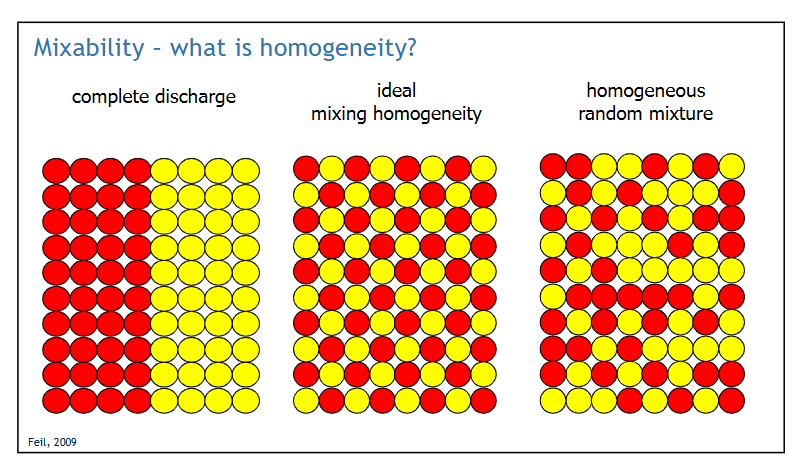
Mixability - segregatuin
after mixing many opportunities for de-mixing (segregation)
in factory and transportation
spontaneous stratification - particles of different sizes
sifting of fine particles - percolation
brazil nut effect
aerodynamic dust segregation
Mixability
many operations in feed processing/ handling/storage can prevent good mixing or may lead to segregation
form/physical properties of importance
particle size, particle shape, weight/density, hygroscopy, susceptibility to electrostatic charges, adhesiveness to surfaces, or specific compouns (oil)
compatability to carier (premix)
compatability to feed (particles)
Big differences in particle size of ingredients results in more variation
CV - calculation
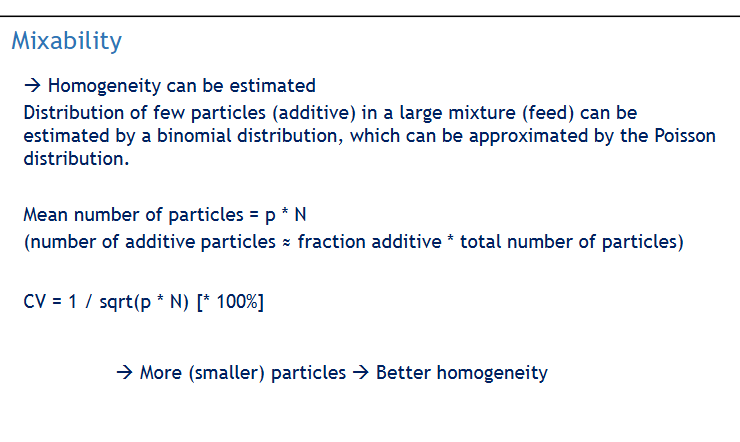
coarse particles lead to a higher ..
cv
Mixability - analytical variation
within-lab variation is less than among-lab variability
Homogenous distribution affected by mixing process
machinery characteristics, type of mixer, size of mixer
process characteristics, mixing time, fillling of mixer, speed of mixing, keep in mind: carry over
Mixability - variation due to sapling
testing mixability/homogeneity?
location of sampling, timing of sampling, how take the sample, multiple points?, how large, how many samples, how to analyse it
sTABILITY
different stages in feed production affecting recovery (stability) and/or activity of additives
production of additive
storage of additive
mixing in premix
mixing in feed
storage of premix
storage of feed
feed processing
feeding process
production of additive - sensitivity of unprotected vitamins to external factors, e.g
heat, oxygen, humidity, light, pH
different for vitamins, sometimes contradictory
instability vitamin A
form of Vitamin A, antioxidants, airtight, waterproff
formulated vitamin A, higher retention than non-formulated vitamin A
Enzymes in animal nutrition
proteins (long chains of amino acids)
structure (#D) deines function and stability
catalyse chemical reactions
involved in all reactions related to life
present in every living organism
are very specific
activity depends stronly on environment (pH, T)
inactivation partly by Msillard reactiosn
big activity loss due to moisture teperature, time (pelleting, extrusion0
enzymes in animal nutrition - stability
good fomrulation (form, coating) improves
pelleting stability
enzymes in animal nutrition - stability
stability of enzymes (during storage and processing) can be improved through
enzyme production (often, relatively simple and cheap, limited effect)
enzyme engineering (effective, complex, long time, expensive (legislation, acceptance)
formulation (form, coating), (visibility, relatively cheap, magnitude of effect)e
enzymes in animal nutrition
often
dusty
inhomogenous particle size distribution
lower stability (storage and pelleting)e
enzyme stability is the sum of different steps in the feed manufacturing process
this formulation
stable throughout complete feed process (up to 95 degrees)
free-flowing (accurate dosing)
high particle number (homogeneity)
virtually dust free (safe handling)
handling
electrostatic charing, stickiness, hygroscopy
inhomogeniety, carryover
allergens
low dust products, inhalation
SUMMARY
additives are a group of highly potent/active substances
it is a technological challenge to combine the cotractidory requirements
the formulation of the additive may protect against hostile influences
storage of additives, premix, feed
premix composition, homogeneity, mixability
feed processing
handling (product characteristics, health of workers)
especially the combination of temperature, moisture, time can be a negative influence, to take into account in premix and feed production
it has to workin the animal - bioavailability