learning, memory and amnesia, NMDAR-dependent synaptic plasticity
 Call Kai
 Learn
Learn Practice Test
 Spaced Repetition
 Match
Match Flashcards
 Knowt Play
1/35

Earn XP
Description and Tags
https://www.science.org/doi/10.1126/science.aah7011
Name | Mastery | Learn | Test | Matching | Spaced | Call with Kai |
|---|
No analytics yet
Send a link to your students to track their progress
36 Terms
whats habituation vs sensitisation?
Habituation — decreased behavioural response to a sensory stimulus
Sensitization — increased response to a sensory stimulus.
whats associative vs non-associative learning
Associative learning involves a paired stimulus (neutral, positive or negative)
Non-associative learning does not involve a paired stimulus
both lead to change in response/ behaviour
how could you define plasiticy
-yeilding to change, not yielding instantly or wholly, never quite recovering the original form (fancy man voice)
what did Cajal (1852-1934) think caused plasticity
-mental exercise -> facilitation of a greater development of the protoplasmic apparatus & nervous collaterals & preexisting connections reinforced by formation of new collaterals
whats an engram
the enduring after effect of the brain stimulation
-a unit of cognitive info imprinted in a physical substance
what did Konorski (1903-1973) think might cause plasticity
functional changes- excitability, permanent functional transformations
what evidence of engrams did LAshley find (1890-1958)
not much- did lesions partially separating visual area from motor areas w/o disturbing visual learning- even though found little evidence of it admitted ‘learning does sometimes occur’
why did HM end up getting anterograde memory loss? (Henry molaison 1926-2008)
in treatment of his epilepsy Scoville removed his hippocampus, as well as the parahippocampal gyrus, the uncus, the anterior temporal cortex, and the almond-shaped amygdala
-he did show improvement in mirror drawing task even if he didn’t remember doing it b4
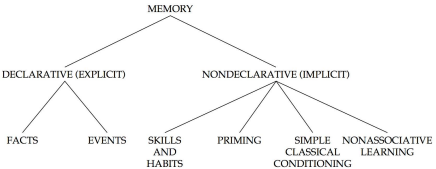
how were long-term memory systems fractioned in 1992 (Squire, LR)
(declarative )explicit- facts & events
(non-declaritive) implicit- skills & habits, priming, simple classical conditioning, nonassociative learning
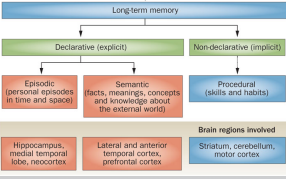
What brain regions are involved in declarative vs non-declaritive long term memory procedures
declaritive- episodic (personal episodes in time & space)- hippocampus, medial temporal lobe, semantic (facts, meanings, knowledge about external world)- lateral & anterior temporal cortex, prefrontal cortex
non-declaritive- procedural (skills & habits) - striatum, cerebellum & motor cortex
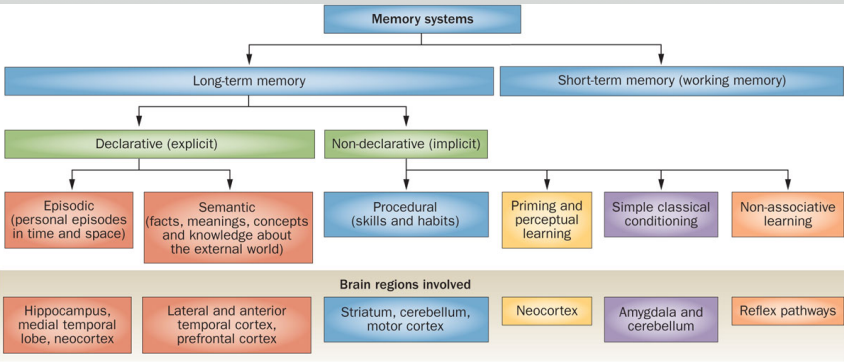
what brain areas are involved in simple classical conditioning, non-associative learning, & priming perceptual learning
simple classical conditioning- amygdala & cerebellum
priming and perceptual learning- neocortex
non-associative learning- reflex pathways
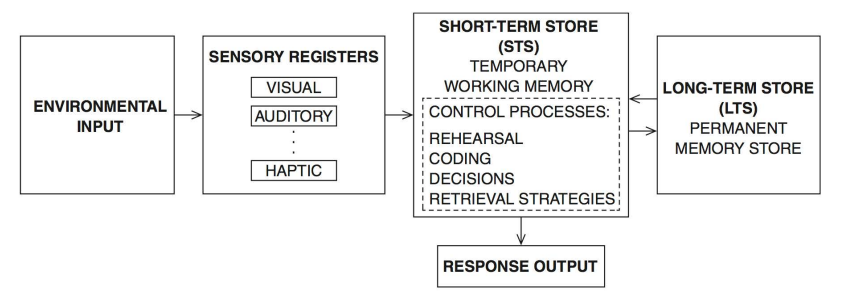
whats a linear system for encoding of memory
environmental input -> sensory registers (visual, auditory) -> short-term store (working memory, rehearsal/ coding/ decisions/ retrieval affect where goes next) -> long term store & response output
what did patient K.F struggle with
selective short term auditory memory- lesions
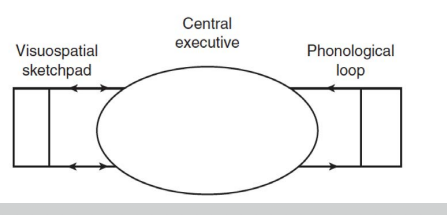
1974- idea that working memory replaces short term memory -what could this looks like
visuo-spatial sketchpad -> <- central executive -> <- phonological loop (speech)
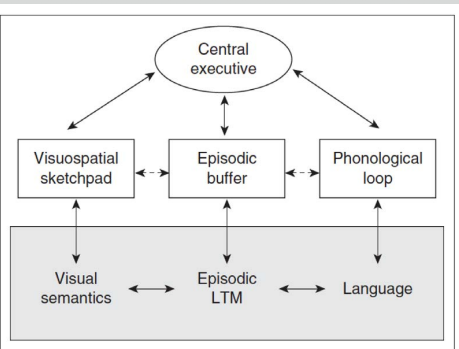
200- revised model of working memory - what did it look like?
central executive
^
visuo-spatial sketchpad <—> episodic buffer <—> phonological loop
^
visual semantics <—> episodic long term emmory <—> language
(episodic buffer main difference)
what are differences btwn patients memory w frontal vs temporal lobe lesions shows
stores can be dissociated on basis of temporal aspects of memory & brain regions involve, frontal & temporal provide evidence for existence of independent short/ long term memory stores
differences between immediate memory, working memory and long term
immediate- fractions of second to seconds
working memory/ STM? -seconds to minutes
long term- days to years
whats anterograde vs retrograde vs dissociative amnesia
Anterograde amnesia = new events are not transferred to long-term memory. Anterograde amnesia is a deficit in learning subsequent to the onset of the disorder. Henry M (with damage to hippocampus) had profound anterograde amnesia.
Retrograde amnesia = unable to recall events that occurred before the onset of amnesia
Dissociative amnesia = blocking out of critical personal information, usually of a traumatic or stressful nature (psychogenic).
what are some causes of amnesia
physical trauma,
infections (damage brain tissue, including encephalitis and herpes, can also cause amnesia),
drug and alcohol abuse,
reduced blood flow to the brain (vascular insufficiency)
Anoxia, ECT, epilepsy can affect short term / working memory
neurodegenerative disorder- e.g. alzheimers (hippocampal and cortical atrophy)
define learning, memory, learning and memory
Learning: a process by means of which organisms acquire new knowledge or skills
Memory: the maintenance of such learning across time
Learning and memory are inferred from changes in behaviour
define the processes input, hold, output & forgetting
Input = Acquisition (perception, encoding)
Hold = Storage (consolidation, maintenance)
Output = Retrieval (performance; recall, recognition)
Forgetting = This may be due to temporal decay or interference from the learning of other information. (However, most input is immediately forgotten and has little (or no) effect on behaviour)
whats some evidence of the hippocampus as a spatial map?
rats w hippocampal damage more hyperactive in novel environment, ‘perseverative’ & resistant on tasks they learned- even if drastic changes in environment
poor at spatial tasks- e.g. mazes & tasks that need alteration of responses on successive trials
how were LTPs discovered
in 1973 looking perforant path to dendate gyrus in rabbits (caused hebbs postulate to be revised)
why are hippocampal slices usually transverse?
hippocampus and facia dentata are organised in a series of parallel lamellae orientated transversely to the longitudinal axis of the hippocampus- can isolate and study lamellae in vitro
what are other names for glutamate?
MSG (monosodium glutamate), Vestin, E621
who first discovered glutamate as major neurotransmitter
Hayashi 1953- cells of extrapyramidal system and produce clonic convulsions, and that glutamic acid is found in normal brain of higher animals - all suggest chemical initiator or mediator in the CNS, especially in motor system, mjust be related to a substance, if any, allied to glutamic acid
Curtis & phillis- 1960s (‘were not aware’ of Hayashi’s work)- particular type interneuron -inhibitory Renshaw cell excited by L-Glutamate (also known to be excited cholinergic inputs), investigates NMDA receptors
what types of potentiations are NMDAR dependent
-STP & LTP1, 2, 3
what types of potentaitions are NMDAR independent
paired pulse facilitation, post-tetanic potentiation, mossy fibre LTP
what are the types of Activity-dependent depression of synaptic efficiency
NMDAR-LTD & mGluR-LTD
what neurotransmitters do CA3 to CA1 synapses use
glutamate
what does UBP145 do (ketamine also)
GluN2D antagonist
what are the basic properties of CA3 -> CA1 LTP?
-longevity (a single high freq stim- persistent Inc in response size- recorded in dendate gyrus)
-input specificity (only one synapse affected, strengthened- hebb)
-cooperativity (there’s a threshold for LTP induction e.g. 20 stim at 10hz not enough but 100 stimuli at 100hz is)
-associativity (if weak tetanus at one input + strong tetanus delivered to a 2nd input = subtheshold tetanus now induces LTP- act associatively)
+reversibility (LTP effects can be reversed) & saturation (maximal LTP can be induced— has a ceiling)
what disproved the long-standing view that working memory depends on sustained, elevated activity?
-humans can hold information in working memory via ‘activity-silent’ synaptic mehcanisms- targeted pulses of transcranial magnetic stimulation made the item reemerge (briefly) in concurrently measured brain activity
HOWEVER only reactivated & influenced memory when it was possibly relevant later in the trail (so representation is dynamic and modifiable via cognitive control)
why are LTPS cooperative?
stimulus must be strong enough to depolarise postsynaptic cell enough to remove magnesium block of NMDARs (sodium & calcium can then enter cell)
describe the process of LTP in CA3 -> CA1
-induction is NMDAR dependent (remove Mg block)
-requires postsynaptic calcium rise
-involves multiple kinases (e.g. PKA, CaMKII, PKC, MAPK, PTK, PI3K)
-possible post-synaptic AMPA receptor number change (2nd messengers)
-may involve presynaptic increase in glutamate release (retrograde messengers)
what are the differences between STP, LTP 1, 2, & 3
STP- 30min/ variable duration
early LTP- few hours- protein synthesis independent
late LTP- protein synthesis dependent