Hominid Fossil Study Guide
 Call Kai
 Learn
Learn Practice Test
 Spaced Repetition
 Match
Match Flashcards
 Knowt Play
1/26

There's no tags or description
Looks like no tags are added yet.
Name | Mastery | Learn | Test | Matching | Spaced | Call with Kai |
|---|
No analytics yet
Send a link to your students to track their progress
27 Terms
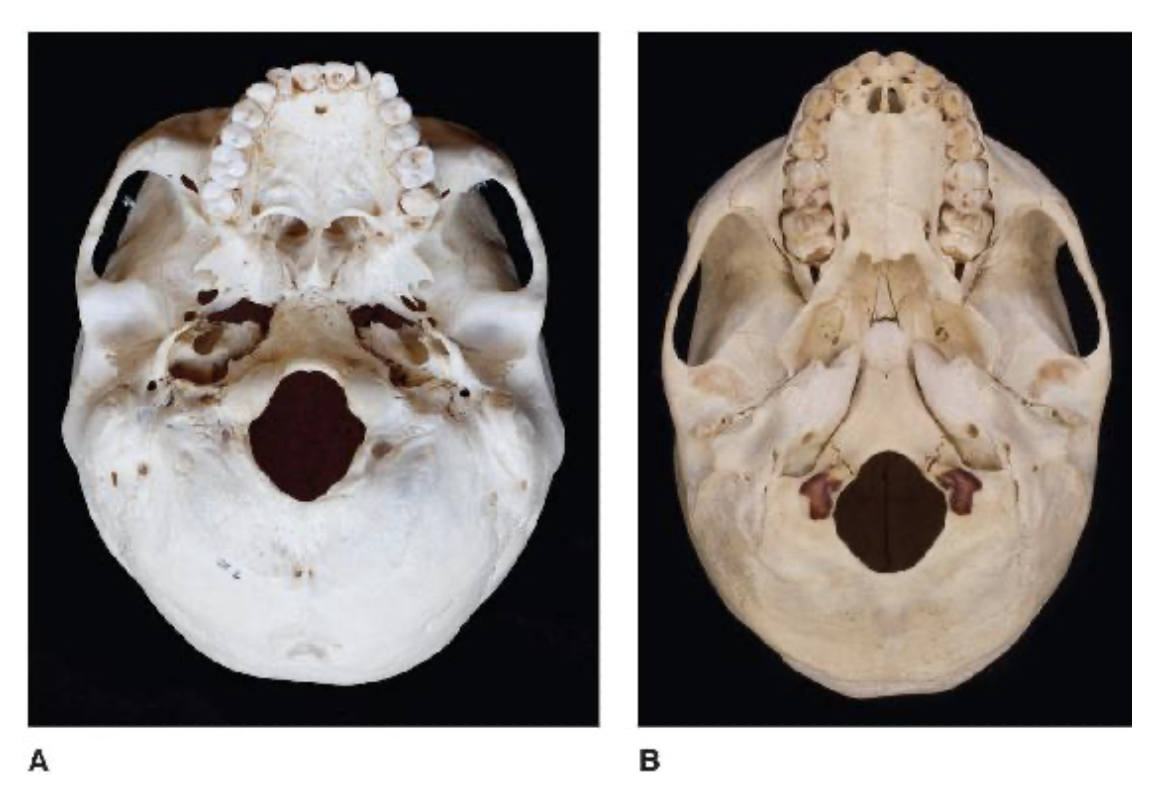
Pre-Australopiths
7 - 4.4 mya
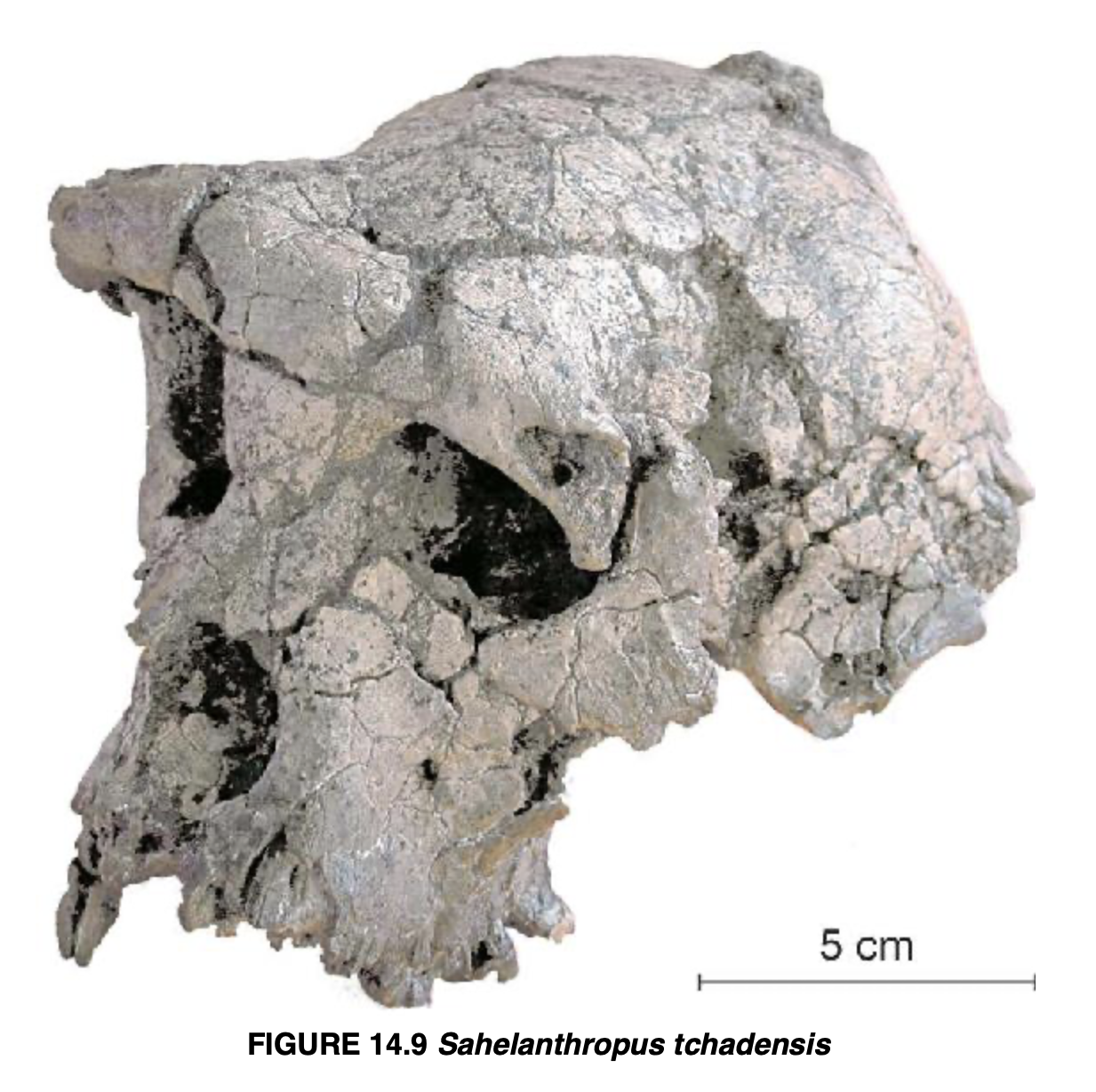
Sahelanthropus tchadensis
Dates: 7-6 mya (late miocene)
Location: Chad, Africa
Key Features:
Pronounced brow ridge & small cranial capacity (350 cc)
More anterior foramen magnum (bipedalism) w/ small, less prognathic head
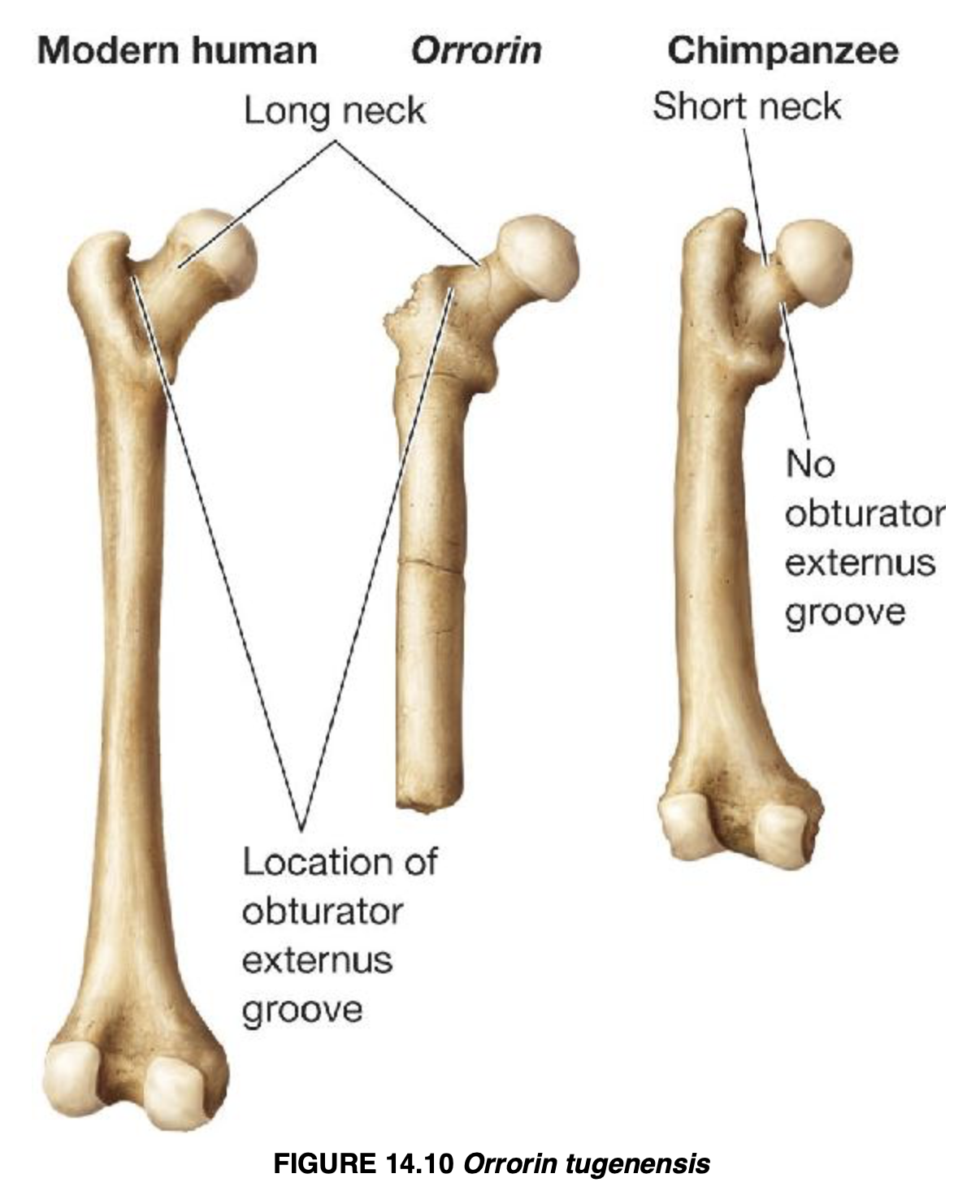
Orrorin tugenensis
Dates: ~6 mya
Location: Tugen Hills, Kenya, Eastern Africa
Key Features:
Ends of femurs have bipedal traits (long necks & groove for obturator externus)
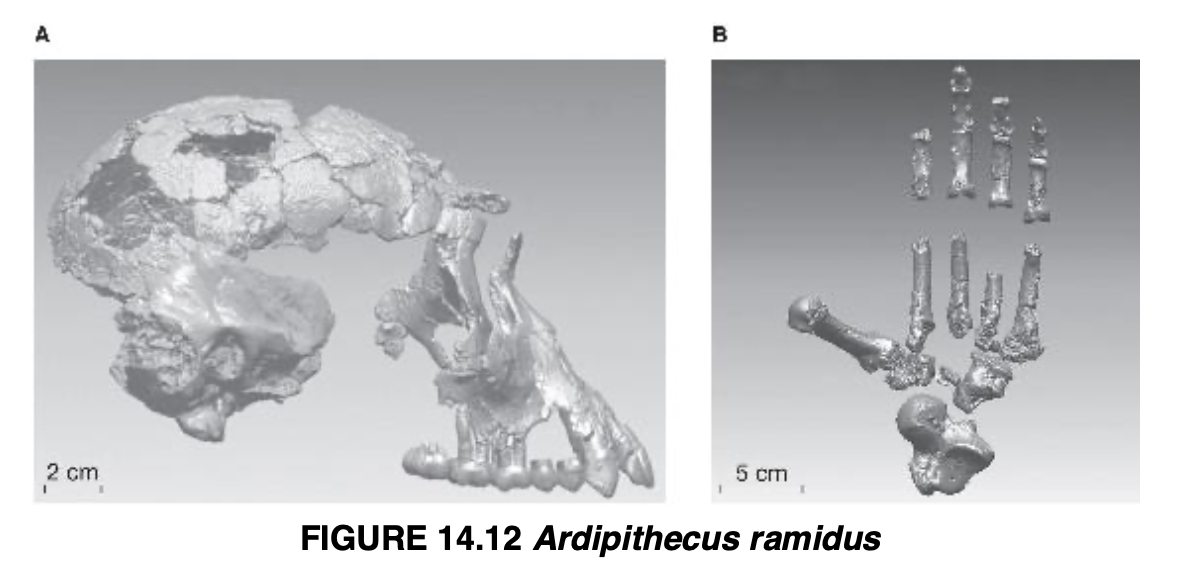
Ardipithecus ramidus
Dates: 4.4 mya
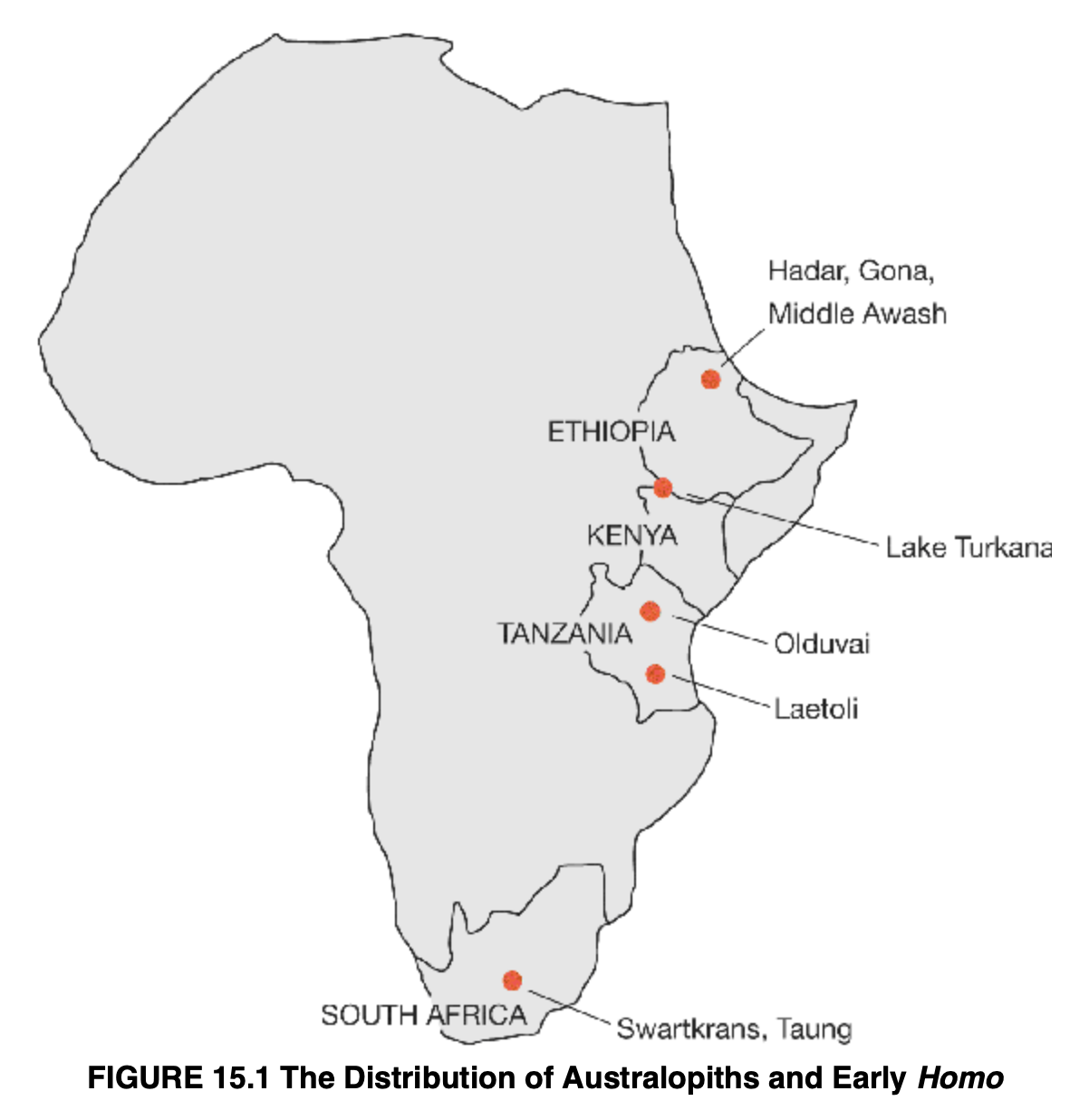
Location: Middle Awash, Ethiopia (eastern Africa)
Key Features:
35 individuals recovered
Short canines w/ wear on tips
Small cranial capacity
4ft
Long arms w/ curved fingers
Arboreal climbing over suspensory locomotion
Short/broad pelvis
Long toes w/ diverged hallux
Bones of feet more suited for pushing off in bipedal walking
Australopiths
4 mya - 1 mya, early Pliocene to early Pleistocene
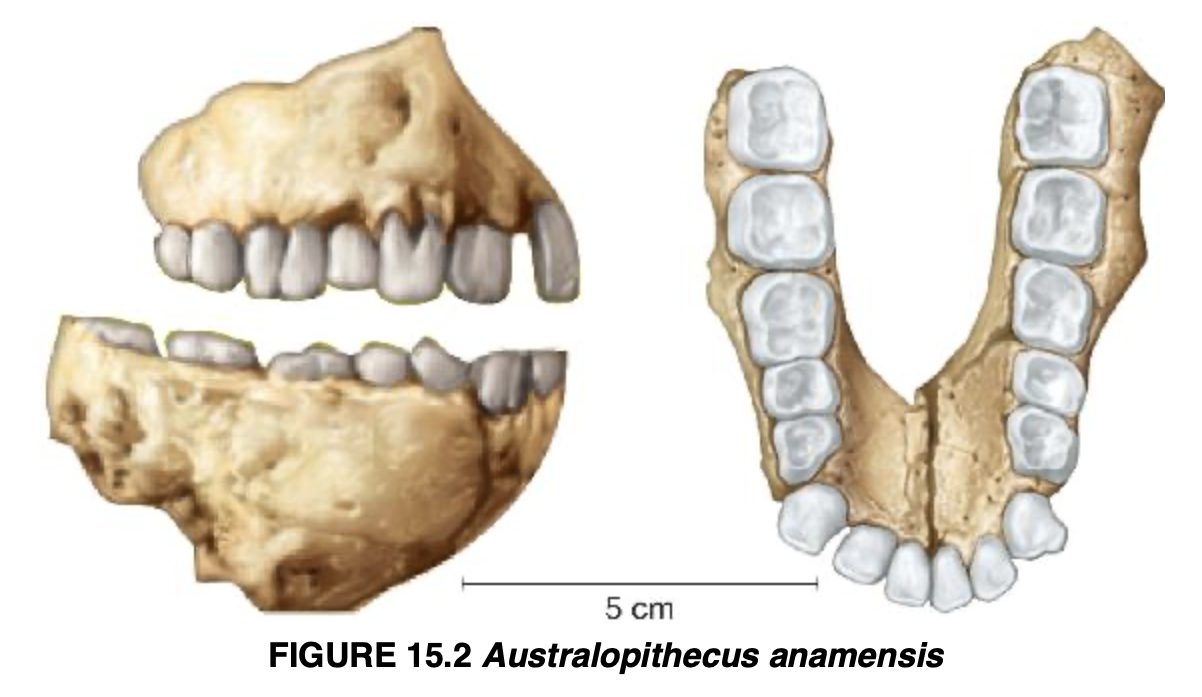
Australopithecus anamensis
Dates: 4 mya, Pliocene
Location: Eastern Africa
Key Features:
Ape-like traits (large canines, parallel upper tooth rows, asymmetrical lower premolars, large outer tooth cusps)
Post-cranial remains indicate habitual bipedalism with some adaptations for this
Likely a direct ancestor to Ardipithecus
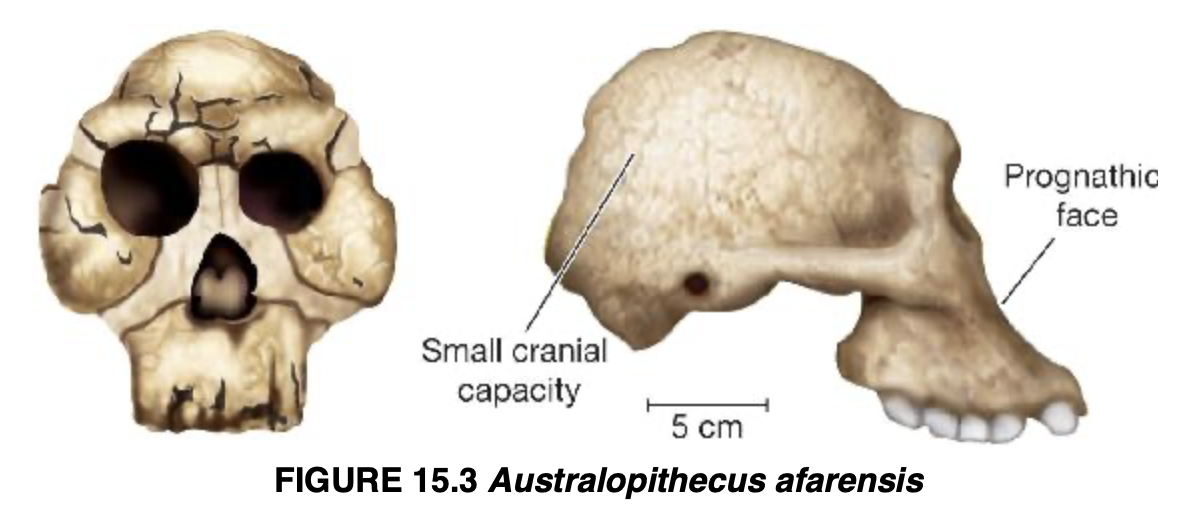
Australopithecus afarensis
Dates: 3.6 - 3 mya, late Pliocene
Location: Eastern Africa
Key Features:
350 - 500 cc cranial capacity (small compared to us)
More prognathic (protruding) faces than humans but flatter than chimps
Larger canines than humans but smaller than chimps
Share direct ancestor-descendant relationship with Au. anamensis
Equally sized lower premolar cusps
Arched tooth rows like humans (not parallel)
Wide range of plant diet (more than living like chimps than Au, anamensis)
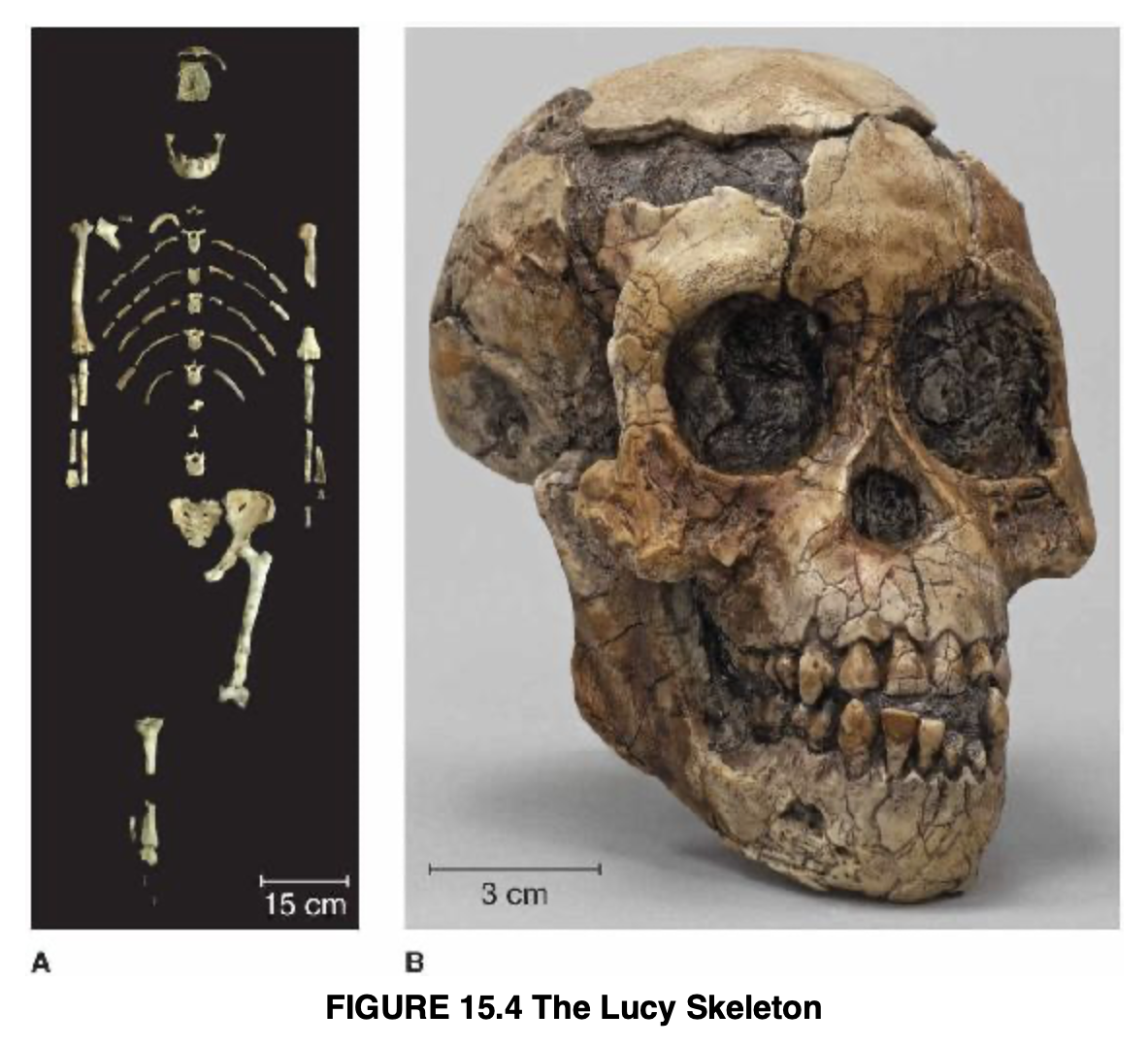
Lucy! & Selam (Dikika site, Ethiopia)
Angled femurs, short/broad pelvis (not as bowl shaped), diverged hallux, arched feet
More bipedal with some arboreal traits (broad shoulders, curved fingers)
Polygynous
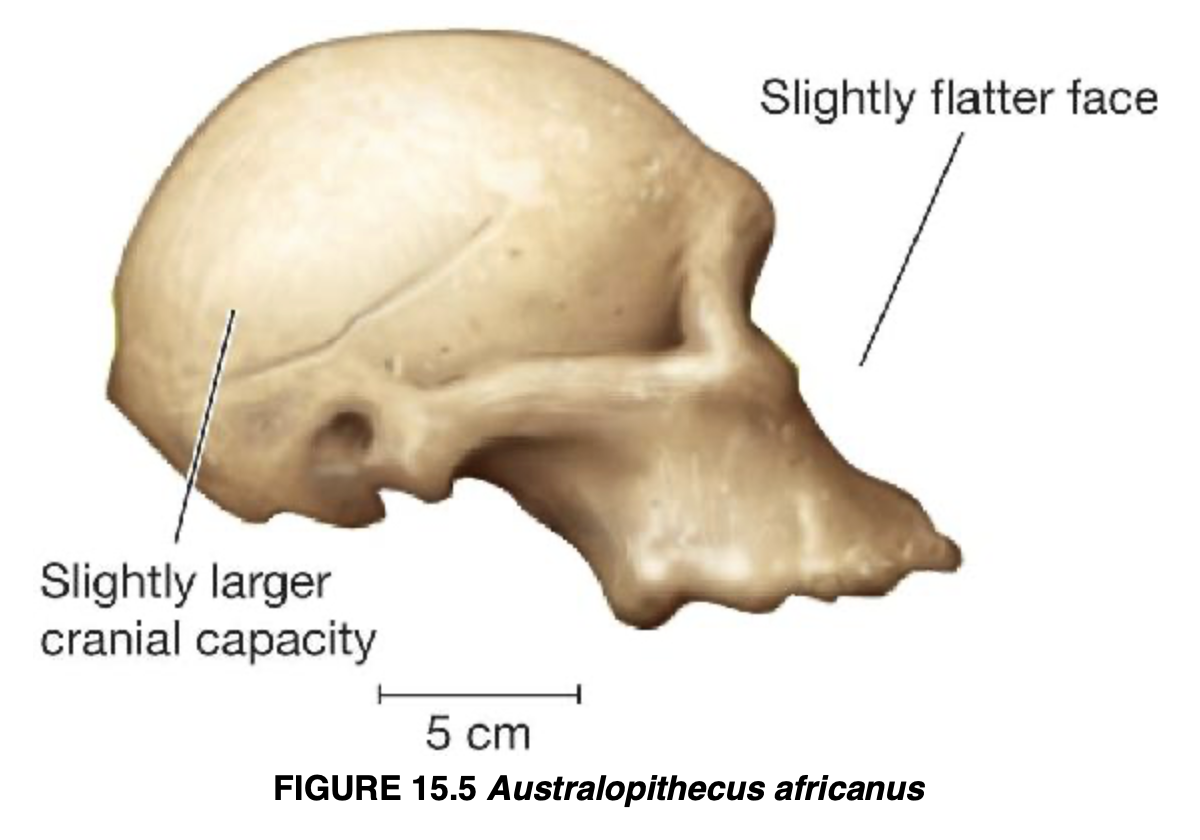
Australopithecus africanus
Dates: 3 - 2 mya, late Pliocene to early Pleistocene
Location: Southern Africa
Key Features:
First species of australopith discovered
Cranial capacity 450 - 550 cc
Smaller incisors, canines, and larger premolars + molars
Flatter face
Similar diet, postcranial traits (long arms, short/broad pelvis), social structure and degree of sexual dimorphism as Au. afarensis
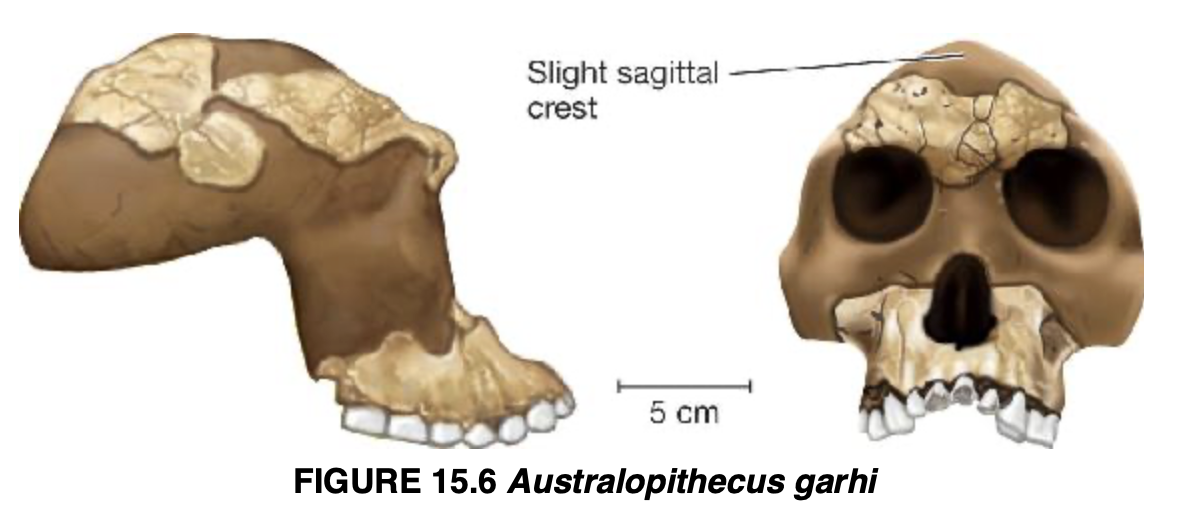
Australopithecus garhi
Dates: 2.5 mya, end of the Pliocene
Location: Eastern Africa
Key Features:
~450 cc cranial capacity
Prognathic face (protruding)
Small sagittal crest
Larger canines, premolars & molars compared to earlier australopiths
Longer legs (potentially indicating more bipedalism but inconclusive)
Potentially ancestors of the homo genus
Suggested earliest users of tool use
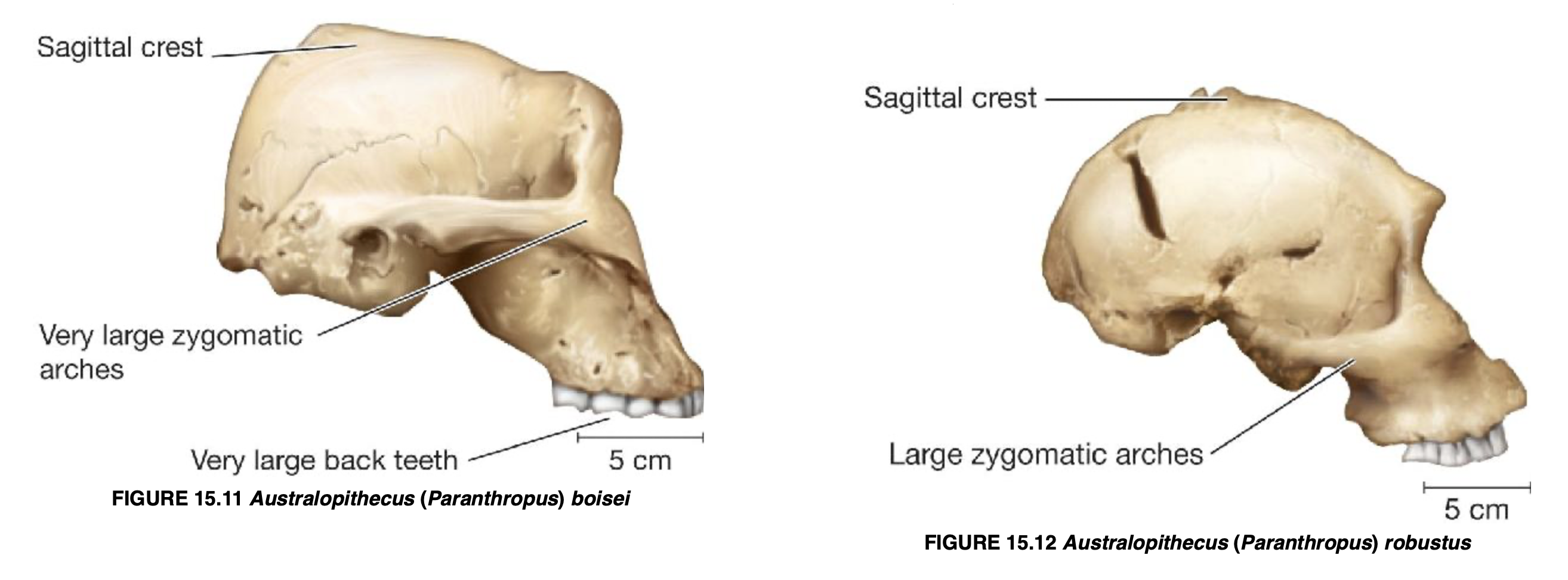
Paranthropithecus (Au.) bosei/robustus
Dates: Boisei: 2.3 - 1.2 mya, Pleistocene & Robustus: 2 - 1.5 mya late Pleistocene
Location: Boisei: Eastern Africa & Robustus: Southern Africa
Key Features:
Boisei:
510 cc cranial capacity
Most robust w/ largest molars, sagittal crest, large zygomatic arches
Heavy chewing diet (tough vegetation)
Robustus:
410 - 530 cc cranial capacity
Large sagittal crest, molars & zygomatic arches
Broader diet than Au. boisei
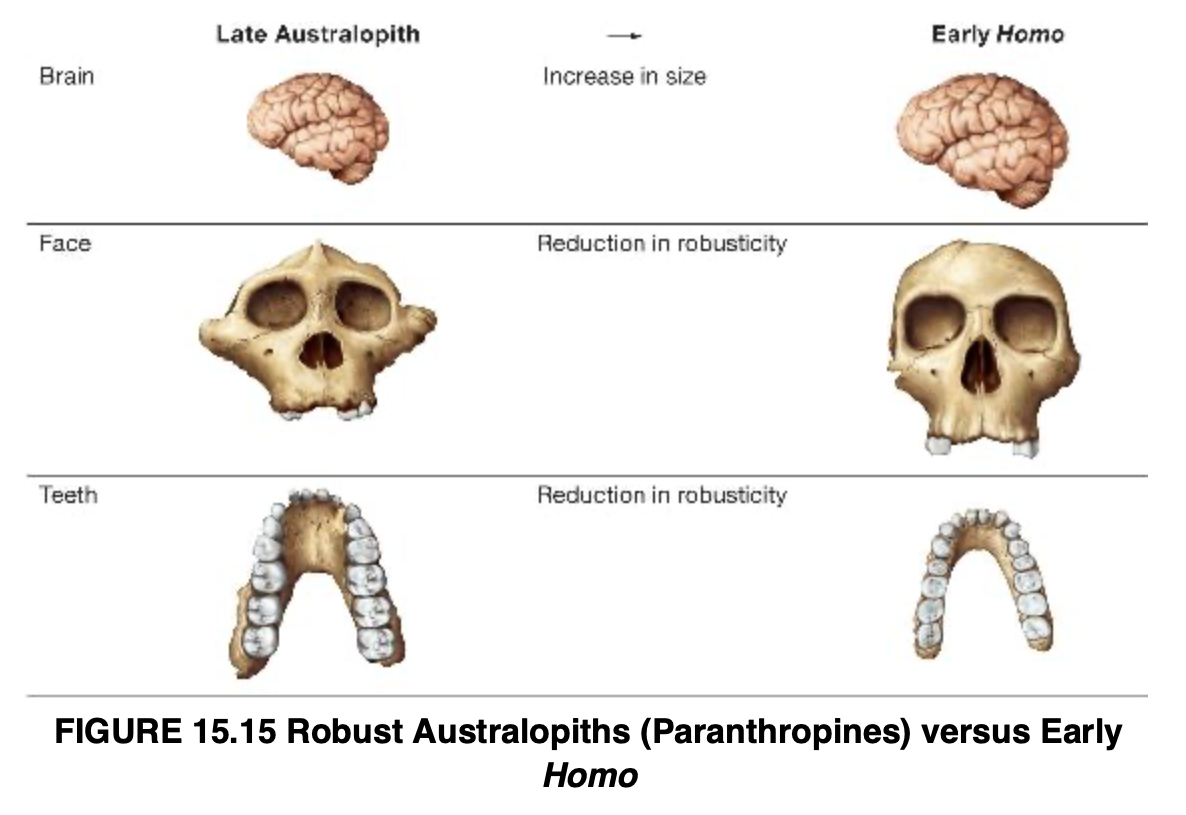
Early Members of the Genus Homo
2.5 mya - 1.8 mya, early Pleistocene
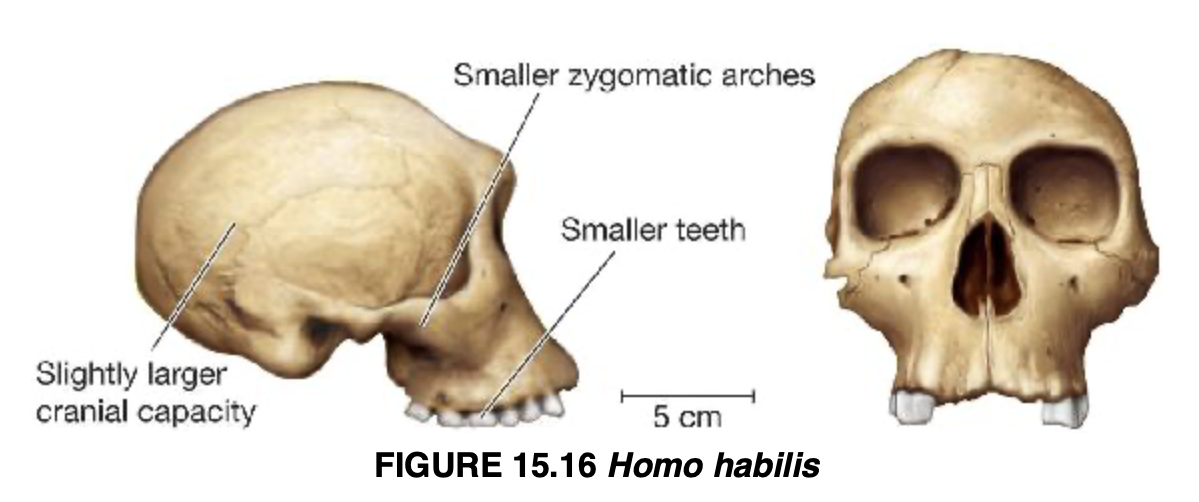
Homo habilis
Dates: 2.5 - 1.8 mya, early Pleistocene
Location: Eastern & Southern Africa
Key Features:
“Handy man”
Less robusticity (small teeth, face), larger brain size
Probably habitual biped but also believed to be the first obligatory biped (no opposable hallux or longitudinal arch)
650 cc cranial capacity
More gracile cranial & dental features (smaller teeth, mandibles, & zygomatic arches w/ no sagittal crest)
Diversified diet (wide range of plants in diet)
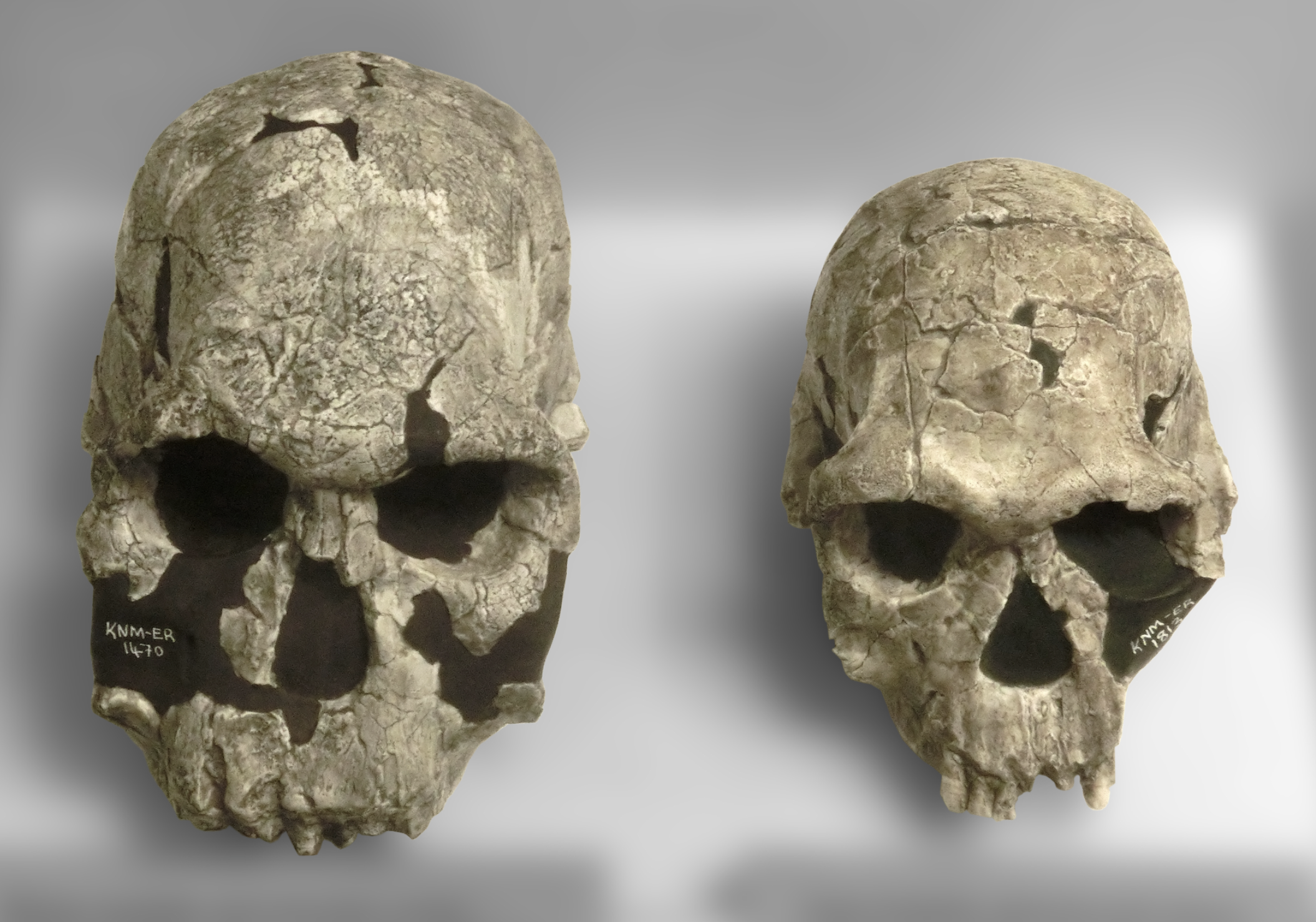
Homo rudolfensis
Dates: 2 mya, early Pleistocene
Location: East Africa
Key Features:
Basically H. habilis but with larger cranial capacity & more robust traits (some scientists disagreed w/ this & blamed it on sexual dimophism)
Koobi Fora, Kenya fossils (smaller H. rudolfensis fossils proving its its own species)
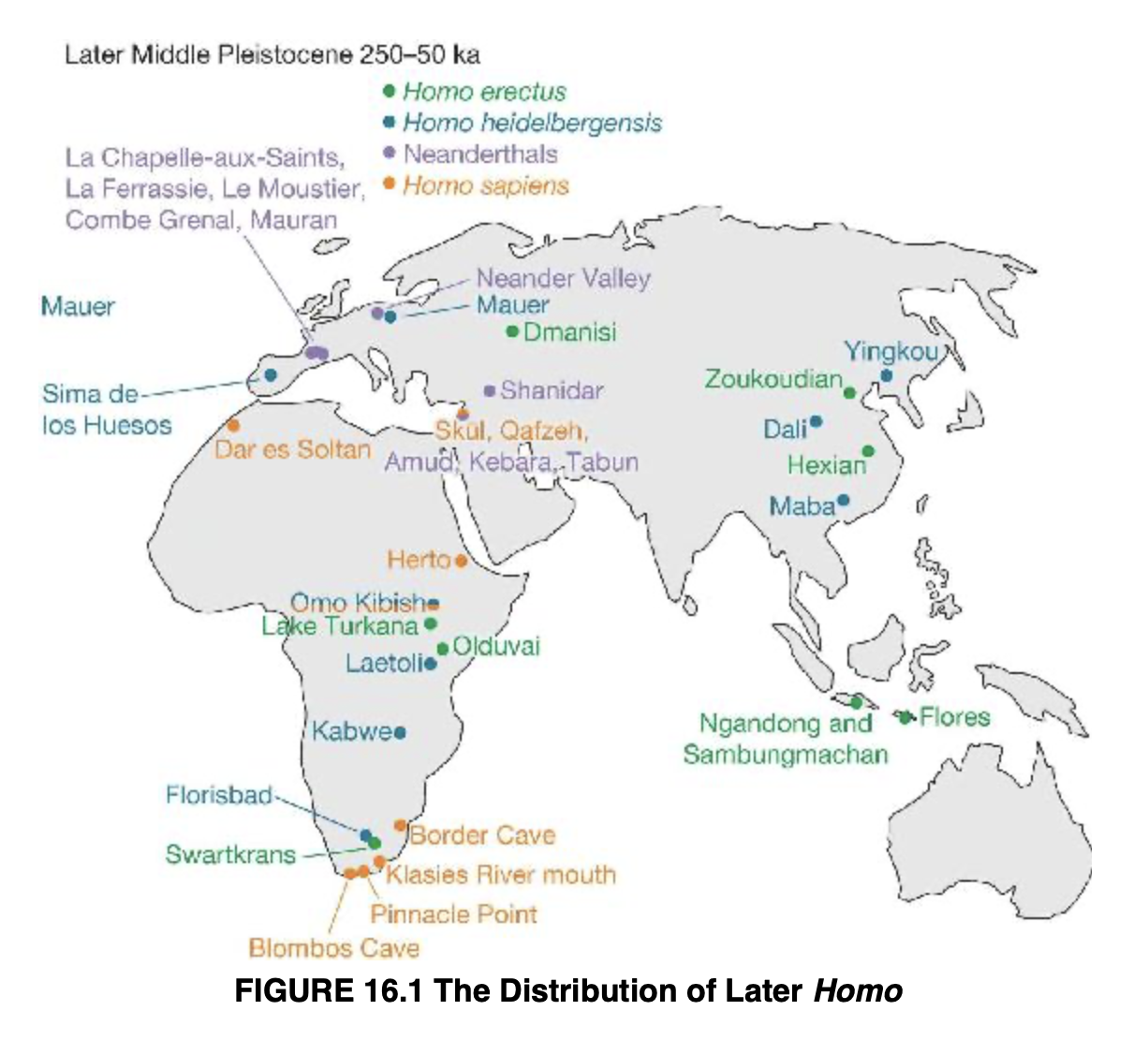
Later Members of the Genus Homo
1.8 mya - present day
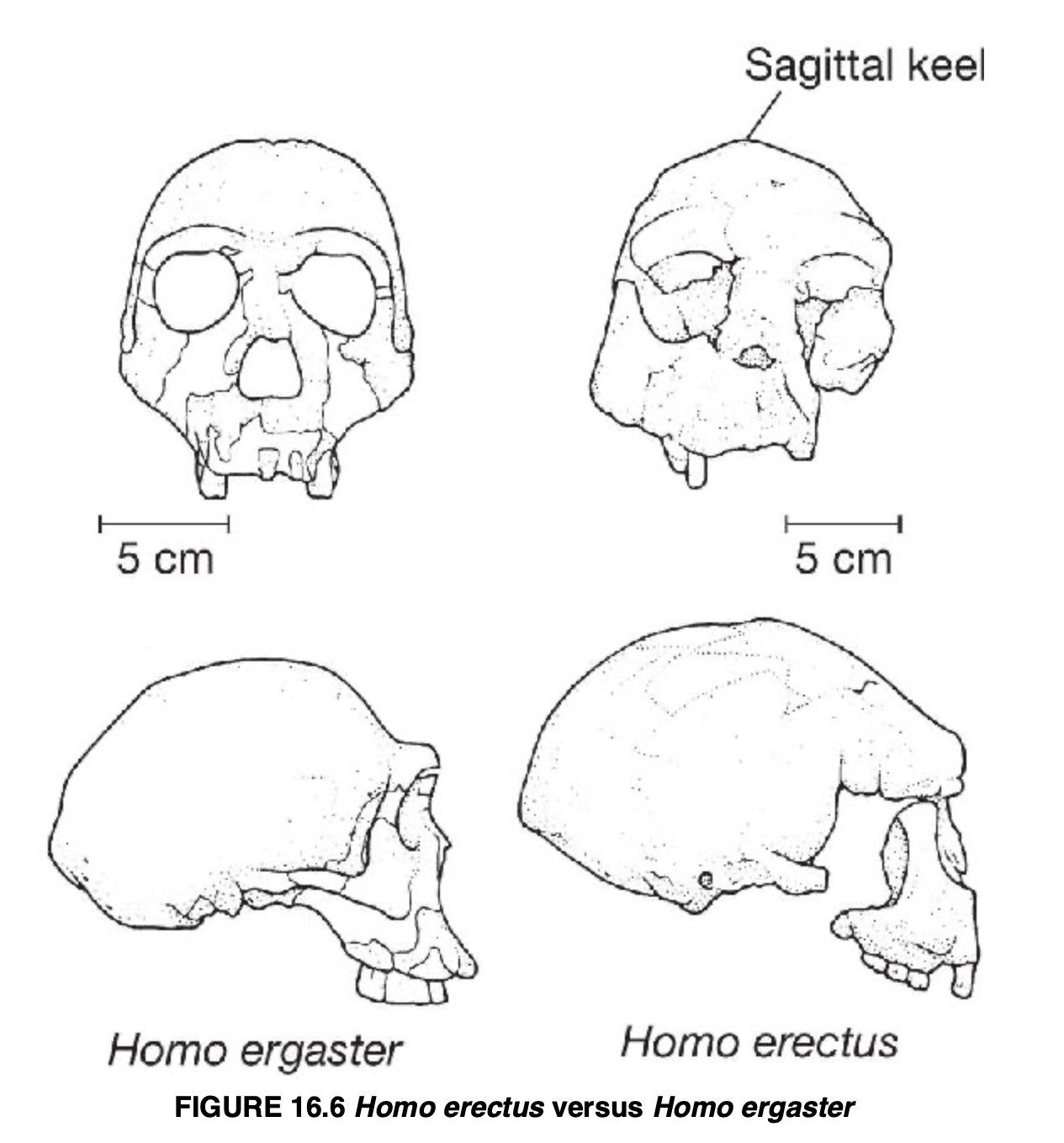
Homo ergaster
Dates: 1.8 - 1.3 mya, early Pleistocene
Location: Eastern & Southern Africa
Key Features:
African group of H. erectus
Sagittal keel (bone that runs along mid-side of the cranium + less pronounced than a sagittal crest)
Thinner cranial bones, not as low/long cranium
Less pronounced brow ridges/occipital torus
Taller/less stocky
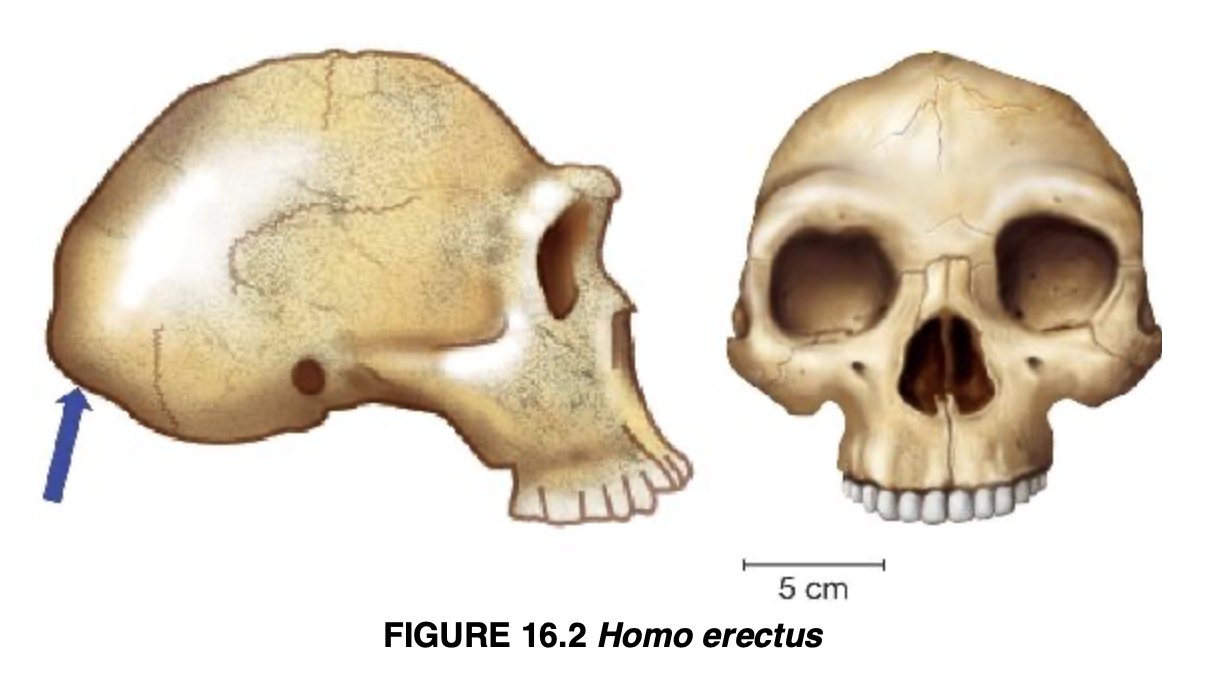
Homo erectus
Dates: 1.8 mya - 300 kya (A + A), late Pleistocene & 1.8 mya - 400 kya (E)
Location: Asia + Africa, Europe
Key Features:
950 cc w/ variation between groups (600 cc - 1,200 cc)
Long/low head like football
Pronounced brow ridge, flat face, occipital torus (ridge bone along occipital bone that sticks out when seen from the side)
Smaller premolars & molars than australopiths (more biting & tearing)
Obligate bipeds (long legs, short arms, barrel shaped rib cage angled femurs)
Oldowan tools + Acheulean technology
First species in our genus to leave Africa (environmental shifts & changing food availability)
Shorter, stockier
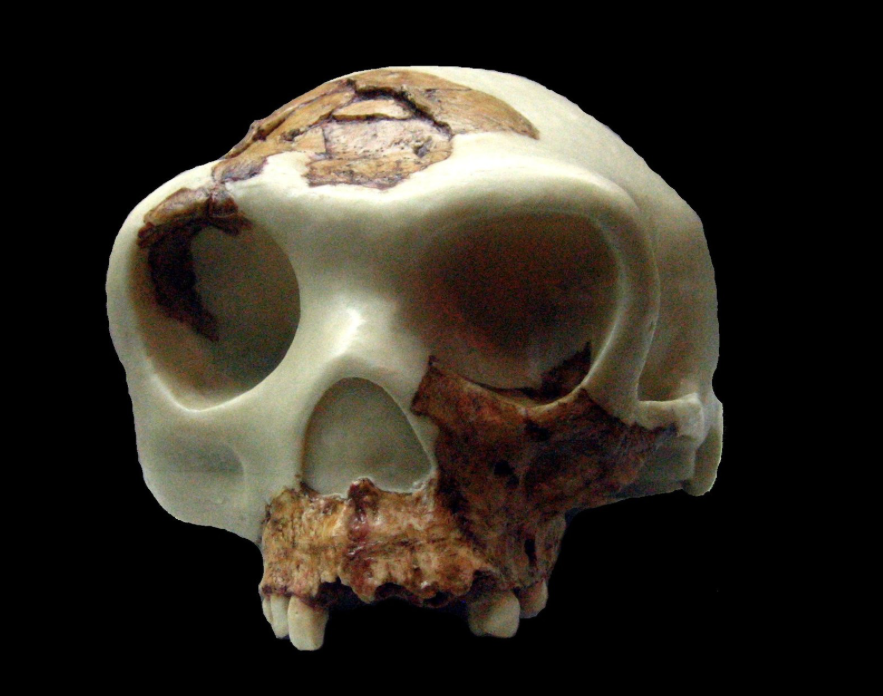
Homo antecessor
Dates: 1.2 mya - 780 kya
Location: Gran Dolina site, Atapuerca, Spain
Key Features:
Debate on whether it should be considered H. erectus (only fragmented juveniles found so no fully mature bones)
Stone tool use unknown
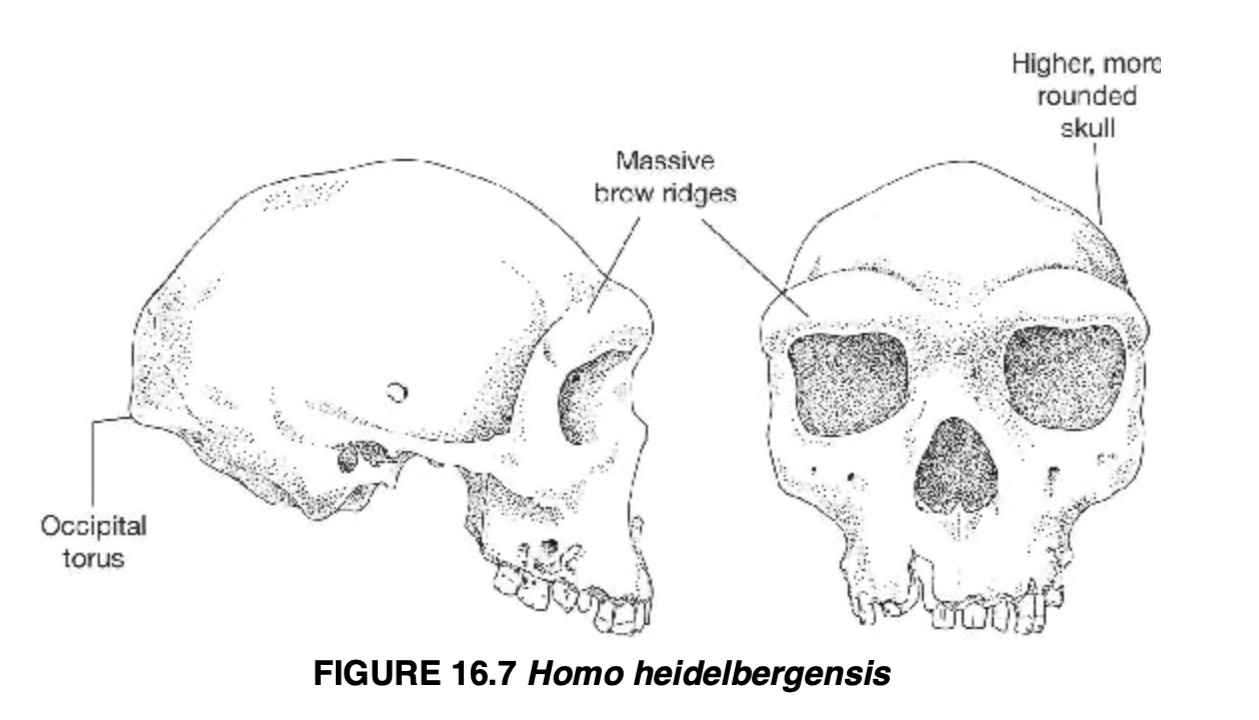
Homo heidelbergensis
Dates: 600 - 130 kya
Location: Africa, Asia, & Europe
Key Features:
Shared many traits with H. erectus (long & low crania, large brow ridges, small occipital torus)
Larger cranial capacity 1,200 - 1,300 cc
Smaller premolars & molars
Wear on teeth potentially indicated teeth used as tools
Debate on whether they should be classified as their own species or an earlier (archaic) version of the homo sapien
Diet included meat from large animals
First members of the genus homo to use Mousterian technology + used Archeulean tools
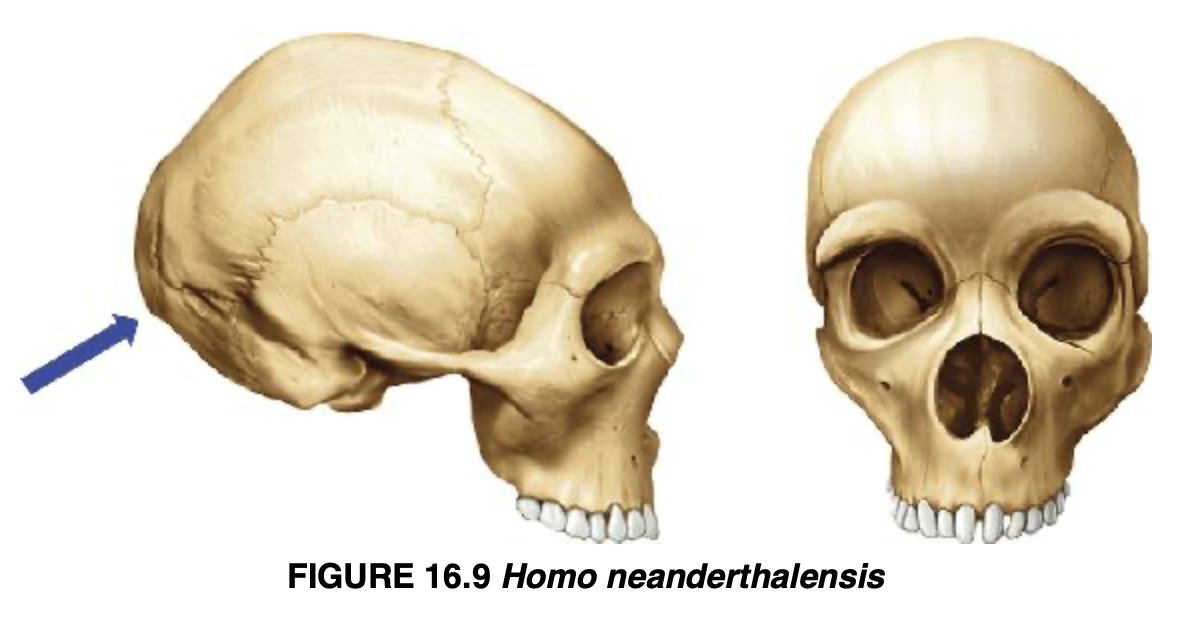
Homo neanderthalensis
Dates: 130 - 30 kya
Location: Europe & Western Asia
Key Features:
Similarities with H. heidelbergensis (long & low cranium, large brow ridges, small molars & premolars with wear)
Large cranial capacity, 1,245 - 1,740 cc
Large cranial capacity but brain to body ratio is lower than humans
Occipital bun on back of skull (round bump like thing on back of head)
Cold weather adaptations (arge nasal openings to help warm inhaled air & stocky bodies to retain heat)
Built fires, used caves as shelter, rudimentary clothing, buried their dead, created nonfunctional objects
Diet consisted of large animals hunted by Mousterian tools
Often injured bc of hunting tendencies
Potentially used languaged & had complex thinking (shown by them eating non nutritious plants & the fox p2 gene)
Classified as early (archaic) homo sapiens
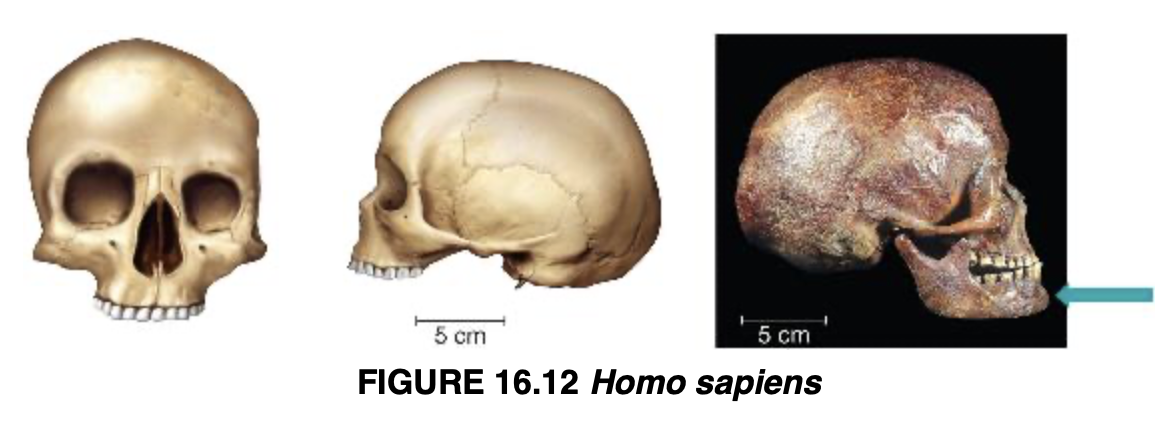
Homo sapiens
Dates: 200 - 15 kya
Location: Europe, Asia, Africa, Australia, Americas
Key Features:
More gracile than earlier homo species but more robust than the modern human
Small orthognathic (flat) faces with small brow ridges, small front and back teeth
Pronounced chin on the front of the mandible
Tall and rounded cranial shape (vertical forehead)
Large cranial capacity 1,350 cc
Rounded occipital area (without specialized structures like occipital torus or bun)
Gracile postcrania were relatively (long and lean body type suitable for many environments)
Diets with a wider range of prey (medium-sized game animals like deer, & smaller game like birds and fish)
Complex clothing using needles & shelters that required building (no naturally formed caves)
Complex thinking, ritualistic burials (buried dead with special tools, jewelry, and other grave goods), symbolic objects, like carved figurines and cave paintings
Used upper paleolithic technology
Coexisted w/ neanderthals & likely interbred
The assimilation model explains that humans spread to other parts of the world & interbred with the species living there creating the modern day human
Unusual members of the genus homo
H. florensis, Denisovans, H. naledi
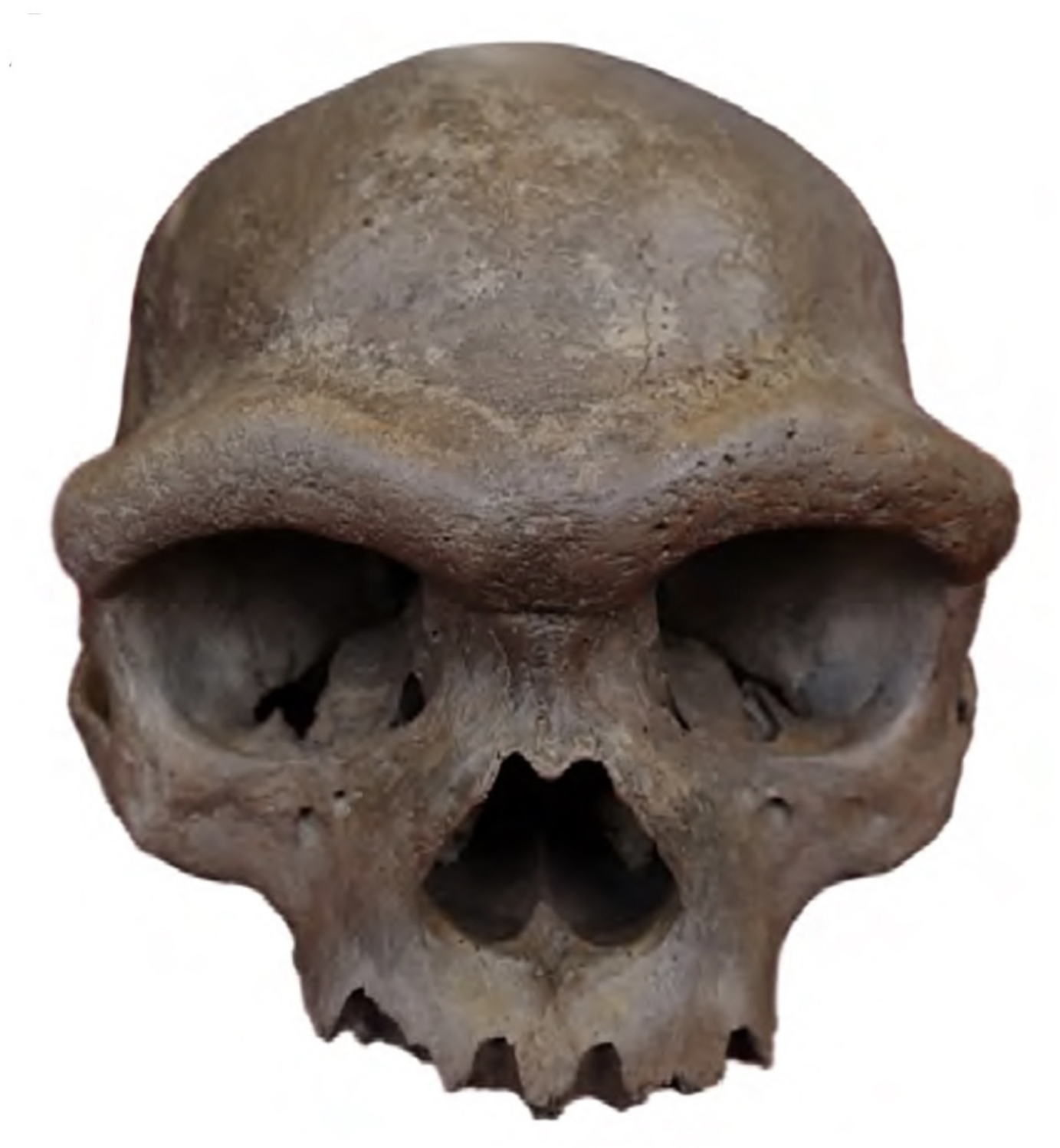
Denisovans
Dates: 30 - 48 kya
Location: Siberia
Key Features:
More closely related to H. neanderthalensis than to humans (diverged from the human lineage as long ago as 700 kya)
Interbred w/ humans (seen in ancient DNA evidence & in our own DNA)
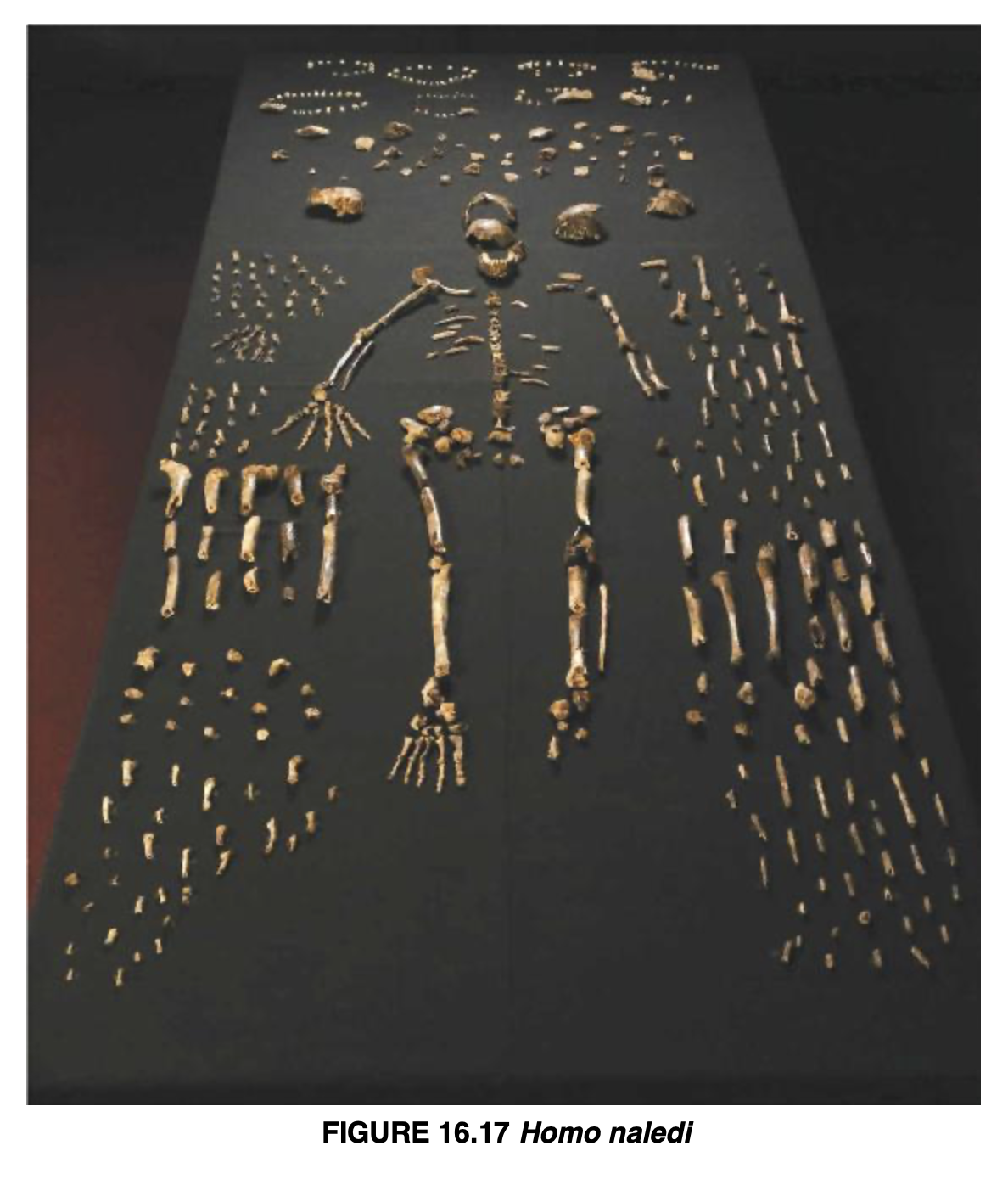
Homo naledi
Dates: 335 - 236 kya
Location: Rising Star Cave in the Republic of South Africa
Key Features:
Similarities w/ early australopiths (small cranial capacity 465 - 560 cc & arboreal climbing shoulders)
More similarities w/ homo erectus (sagittal keel, large brow ridge, small teeth & mandible, human like feet for bipedalism)
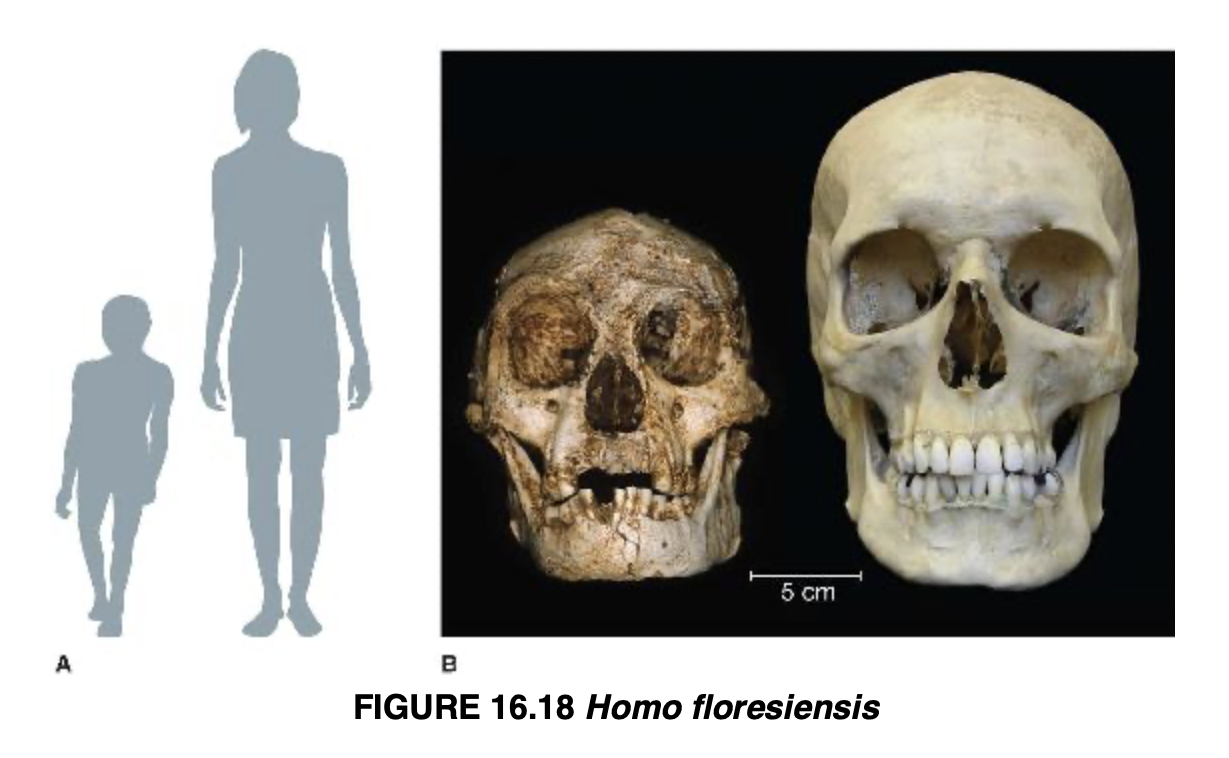
Homo floresiensis
Dates: 100 - 60 kya
Location: Indonesian island of Flores
Key Features:
Small teeth & orthognathic faces but w/ more primitive locomotor adaptations like long arms and flat feet
Used flake tools
Super short with small cranial capacities of 400 cc
Probably a lineage of early Homo erectus that became a tiny after settling on the island of Flores
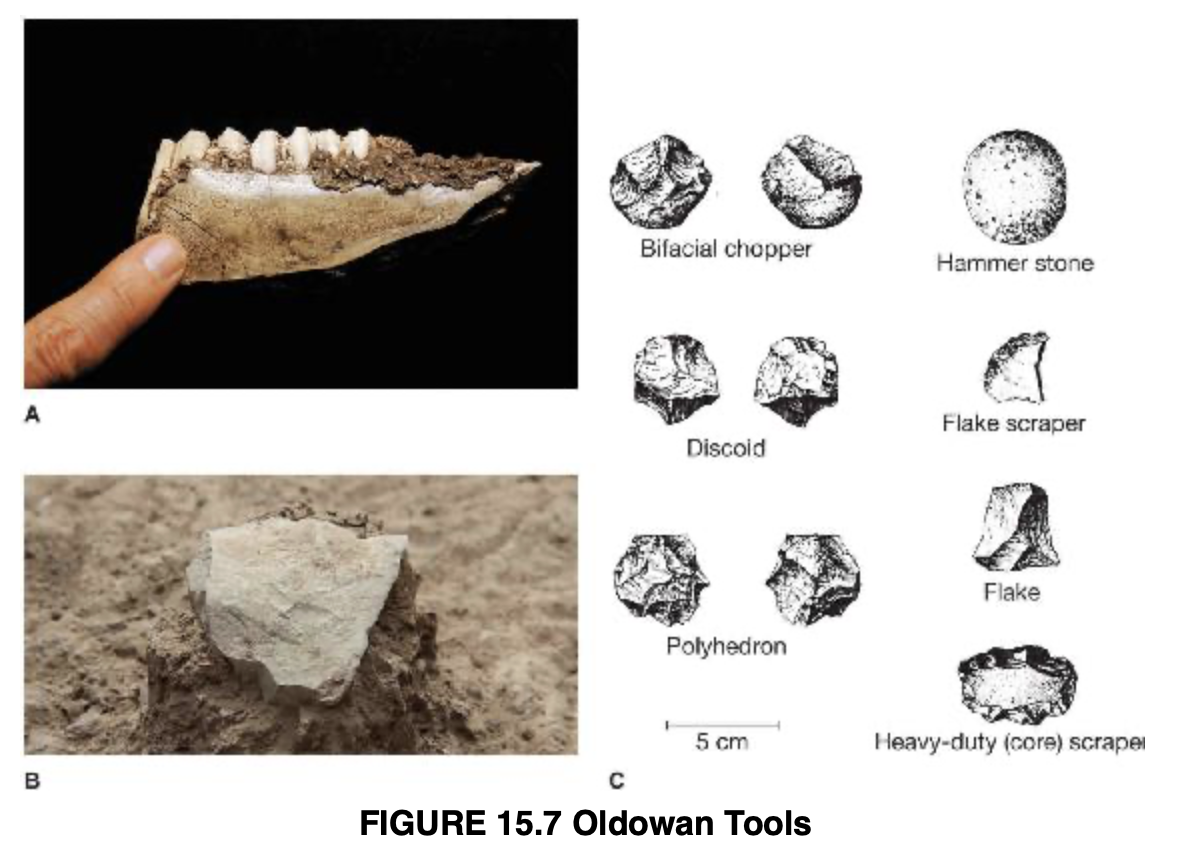
Oldowan Tools
Named after earliest ones being found in Olduvai Gorge
Au. garhi potentially used some of these (animal bones with cut marks found in Au. garhi site in Ethiopia + stone tools found dated around the same time as Au. garhi)
Two main types of tools
Choppers → large, heavy tools with a small sharp edges, used to break bones
Flakes → bits of rock that are removed from choppers, used to scrape meat
Produced by “direct percussion” (two stones are hit together to break off flakes)
Vary in size, shape, & raw material
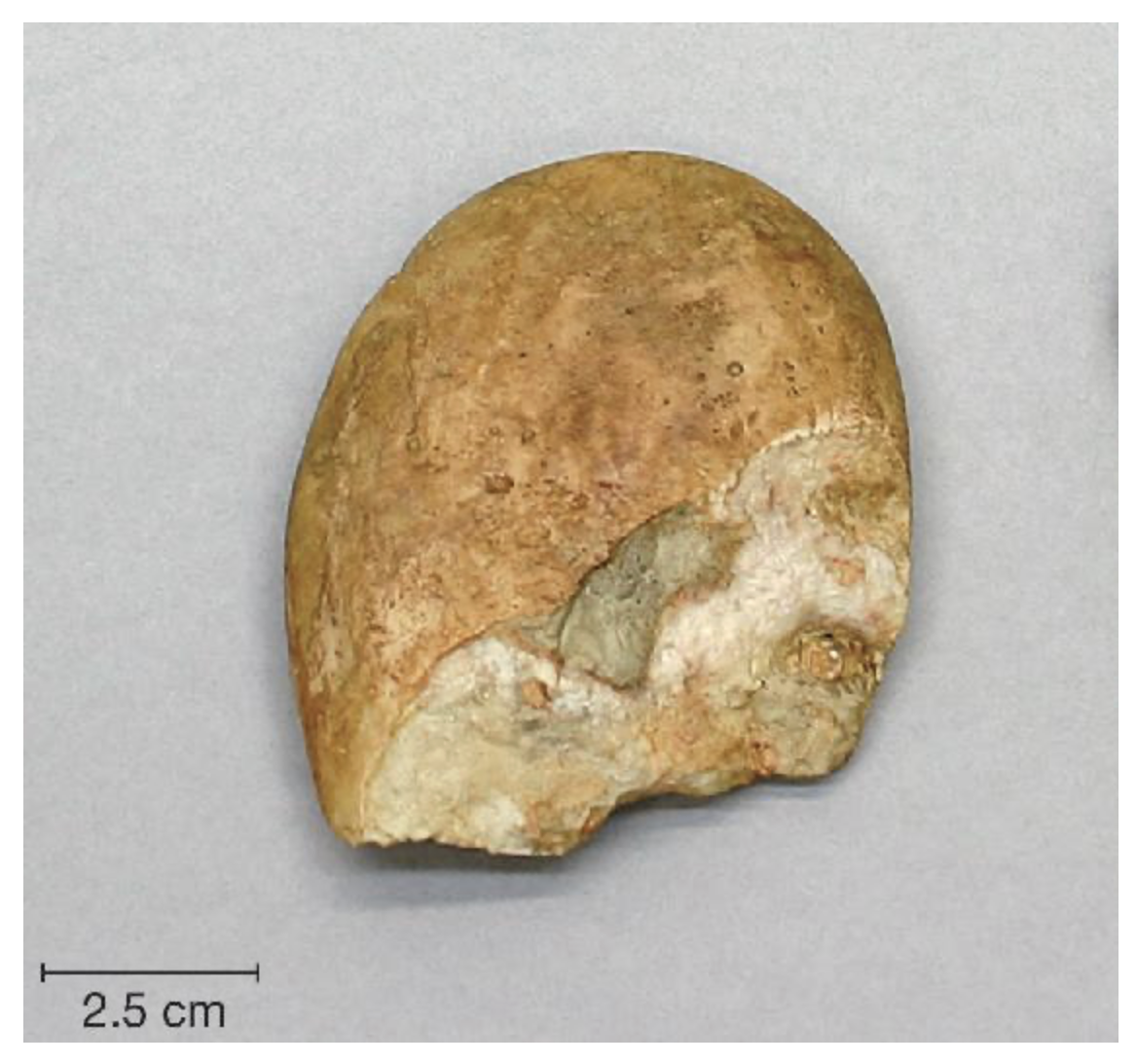
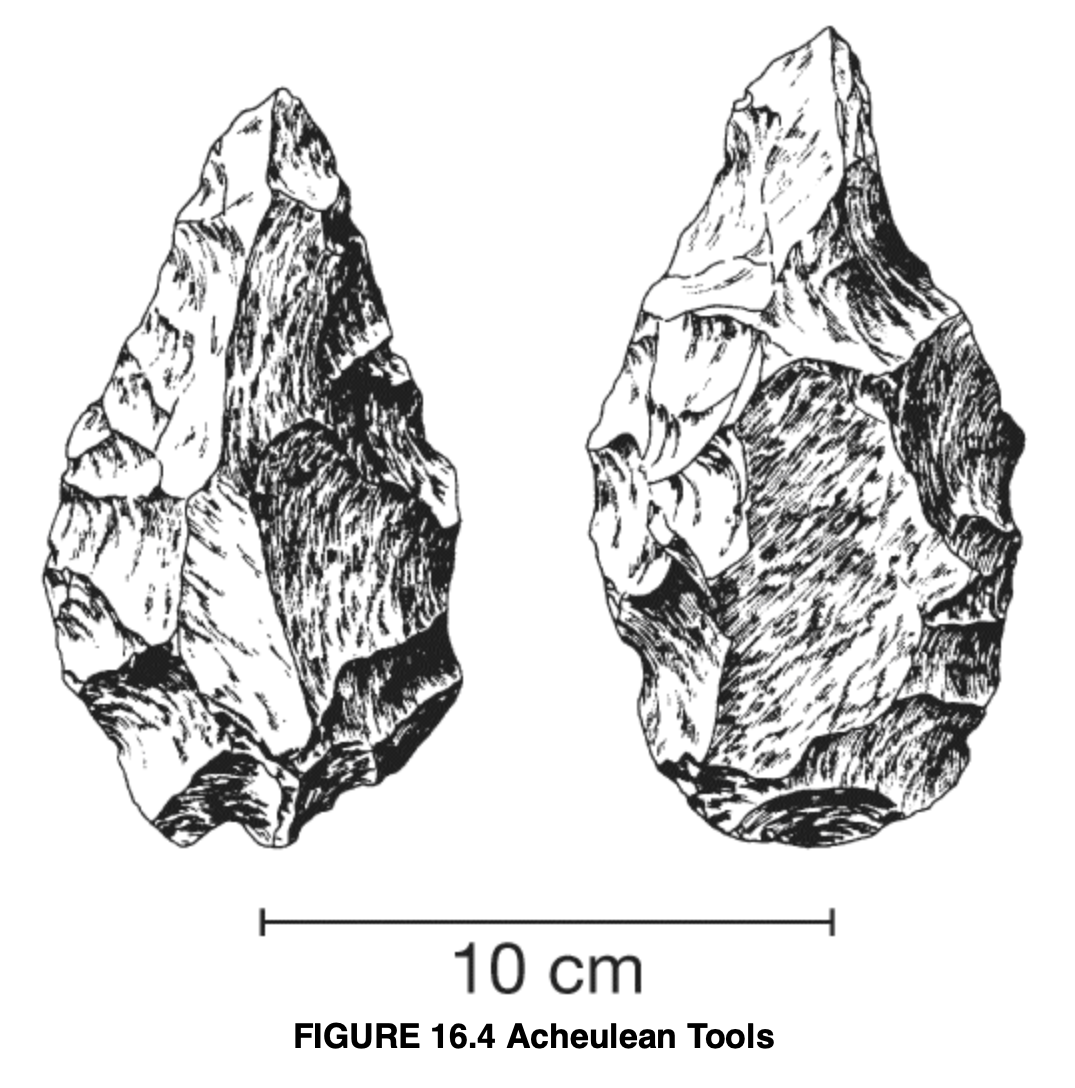
Archeulean (Acheulian) Tools
Created by H. erectus
Named after Saint Acheul, France where these tools were discovered in the mid-1800
Biface tool (stone tool w/ flakes removed from side)
Handaxe → biface shaped like a tear drop with a large rounded edge & narrow pointed edge used for butchering/digging up underground plants
Less variation than Oldowan tools (roughly same size/shape)
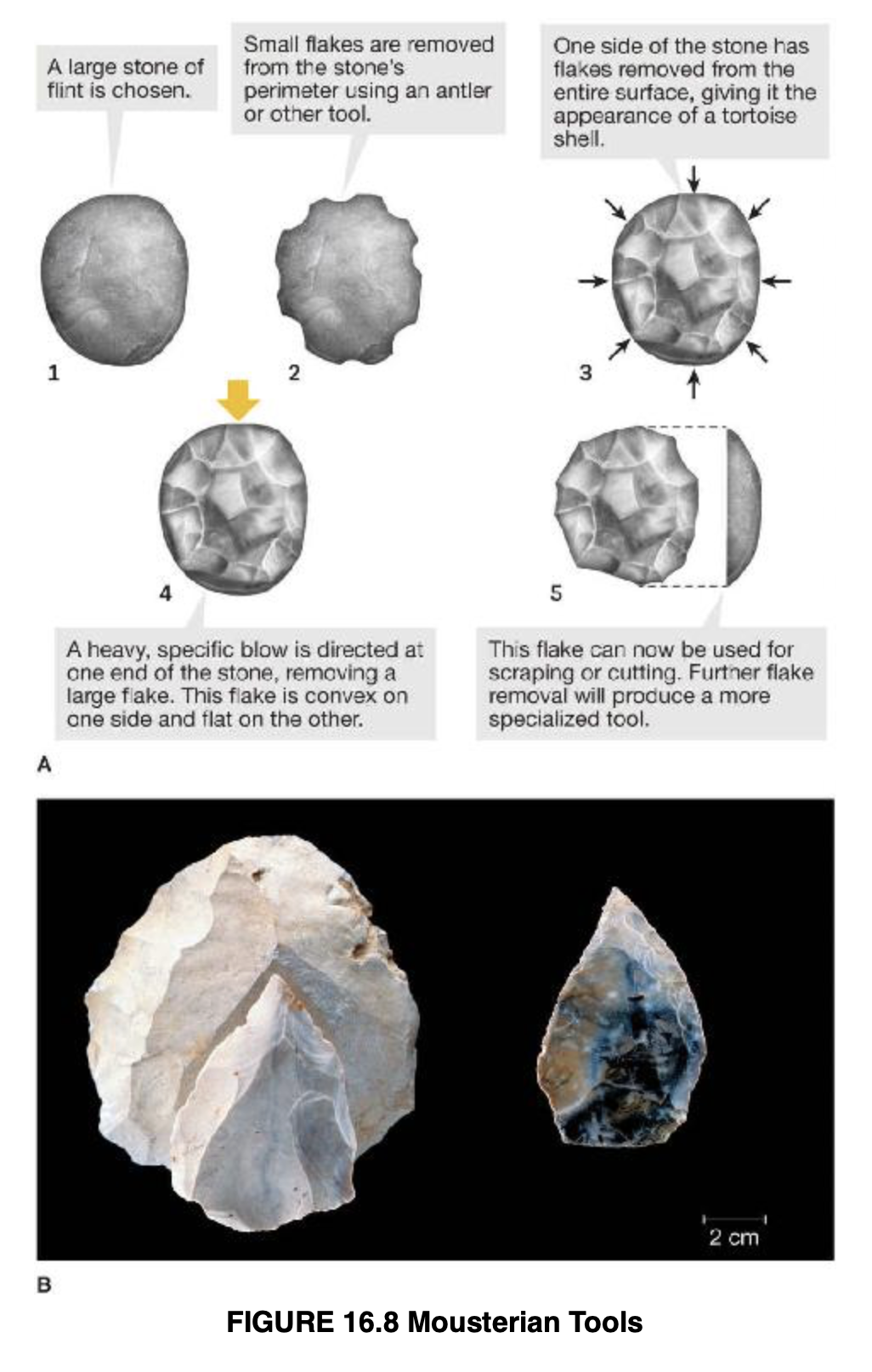
Mousterian Tools
Named after site in France, Le Moustier
Mostly associated with Neanderthals
Core tools < Flake tools
Core tools → tools left when small flakes are removed
Flake tools → Flakes are the important part of the tool (modified into certain shapes of specific functions
Stone tipped spears
Levallois technique
Remove small flakes from core of rock
Create a platform on one end of the rock to break off a large flake
Flake is modified for a specific function
Create multiple flakes from one tool