MT2 Microeconomics
 Call Kai
 Learn
Learn Practice Test
 Spaced Repetition
 Match
Match Flashcards
 Knowt Play
1/32

There's no tags or description
Looks like no tags are added yet.
Name | Mastery | Learn | Test | Matching | Spaced | Call with Kai |
|---|
No analytics yet
Send a link to your students to track their progress
33 Terms
The Production Decisions of a Firm (term and key steps)
The production decisions of firms are analogous to the purchasing decisions of consumers, and can likewise be understood in three steps:
1. Production Technology
2. Cost Constraints
3. Input Choices
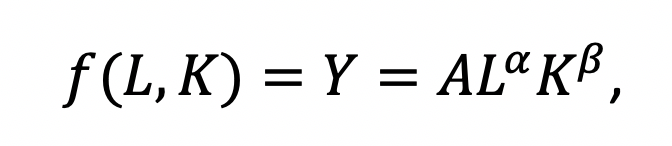
The Cobb-Douglas Production function (term and formula)
Represents the relationship between two or more inputs - typically physical capital and labour - and the number of outputs that can be produced by those inputs
Short run vs long run diff
Short run (capital is fixed; labour is variable) and long run input (both are variables)
Average (AP) and marginal product (MP) formulas
AP=QL
Q=TP
MPl=QL=Q2-Q1L2-L1
Incr labour and incr quantity
MPl=dQdL
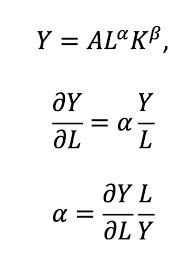
Eq,l=QLLQ=MPl1APl=MPlAPl
Average product of labour
Law of diminishing marginal returns
principle that as the use of an input increases with other inputs fixed, the resulting additions to output will eventually decrease.
Technology is constant; but if we have an improvement - it
Three stages of a production with one variable input
APl=MPl; stage of increasing returns to the factor of production (pos) MPl>0;MPk<0
MP incr and then decr
AP incr throughout this stage
TP incr sharply
APl=max stage of diminishing returns (diminishing)
MR decr, each additional variable input will still produce add units, but at a decr rate.
AP starts to diminish
MP cont to diminish but still posit
TP incr at diminishing rate till max
MPl=0 stage of negative returns (neg) MOl<0 neg; MPk>0
MR start to become neg - more new inputs - counterproductive , more labour - lessen overall production
TP curve goes down
AP curve cont to decr
MP becomes neg
Labour productivity
average product of labor for an entire industry or for the economy as a whole
Stock of capital
Total amount of capital available for use in production
Isoquant + map
defines that different combination of inputs (L,K) that produce the same level of input.
Look like an indifference curve. Isoquant - production in the long-run : L=var; K=var
Short run: L=var; K=fixed (one of them should be fixed) - increasing in dinimishng rate
Slope for isoquant: negative; convex; cannot intersect; if its far from the origin, it has more level of output ( its better to have more) MRS=MUx/MYy; =delta y/delta x (always 1)
Isoquant map – graph combining a number of isoquants, used to describe a production function.
Isocost
defines the different combination of inputs (L,K) where cost is the same.
● Slope of Isocost = Slope of Isoquant =-w/r
Kapital and Labour examples
Kapital - physical (equipment, machineries, facilities)
Labour - workers / working hours
Cost optimisation input rule
The cost optimisation input rule suggests that, optimal combinations of factors of production should be at the point where:
Slope of isocost = slope of isoquant
Fixed production function
production function with L-shaped isoquats, so that only one combination of labour and capital can be used to produce each level of output. It describes situations in which methods of production are limited.
Returns to scale
rate at which output increases as inputs are increased proportionately.
Returns to scale (эффект масштаба) — это то, как изменяется выпуск (output), если ты пропорционально увеличиваешь все факторы производства (капитал, труд и т.д.).
Increasing returns to scale
situation in which output more than doubles when all inputs are doubled.
Constant returns to scale
Situation in which output doubles when all inputs are doubled.
Decreasing returns to scale
Situation in which output less than doubles when all inputs are doubled.
Product transformation curve
Curve showing the various combinations of two different outputs (products) that can be produced with a given set of inputs.
Economies of scope
Situation in which joint output of a single firm is greater than output that could be achieved by two different firms when each produces a single product.
Diseconomies of scope
Situation in which joint output of a single firm is less than could be achieved by separate firms when each produces a single product.
The marginal rate of transformation (MRT)
is the rate at which one good must be sacrificed in order to produce a single extra unit (or marginal unit) of another good, assuming that both goods require the same scarce inputs.
Degree of economies of scope (SC)
Percentage of cost savings resulting when two or more products are produced jointly rather than Individually.
Economic Cost versus Accounting Cost
Accounting cost - Actual expenses plus depreciation charges for capital equipment.
Economic cost - Cost to a firm of utilizing economic resources in production, including opportunity cost.
Opportunity Cost - cost associated with opportunities that are forgone when a firm’s resources are not put to their best alternative use.
Sunk cost - Expenditure that has been made and cannot be recovered.
Accounting costs = only explicit costs (actual payments like wages, rent, materials).
Economic costs = explicit costs + implicit costs, where implicit costs include the opportunity cost of using the firm’s own resources (for example, the owner’s time, owned capital, or foregone rent).
Fixed cost (FC)
Cost that does not vary with the level of output and that can be eliminated only by shutting down.
Average fixed costs – always decline as output increases.
Variable cost (VC)
Cost that varies as output varies.
Marginal cost (MC)
Increase in cost resulting from the production of one extra unit of
output.
Amortization
Policy of treating a one-time expenditure as an annual cost spread out over some number of years.
Amortisation (амортизация) — это постепенное распределение стоимости актива во времени.
Проще: если компания покупает что-то дорогое (например, оборудование), она не списывает всю стоимость сразу, а делит её на части и учитывает как расход в течение нескольких лет.
MP (term)
the additional output created by employing one extra unit of a specific input (like labor or capital), while keeping all other inputs constant.
Average product (AP)
is a key economics metric measuring the average output produced per unit of variable input (typically labor)
Isocost line
Graph showing all possible combinations of labor and capital that can be purchased for a given total cost. Slope is w/r = MRTS
Expansion path
Curve passing through points of tangency between a firm’s isocost lines and its isoquants.
Cost curves: long vs short run
● long-run average cost curve (LAC) Curve relating average cost of production to output
when all inputs, including capital, are variable.
● short-run average cost curve (SAC) Curve relating average cost of production to output when level of capital is fixed.
● long-run marginal cost curve (LMC) Curve showing the change in long-run total cost as output is increased incrementally by 1 unit.
Diseconomies of scale
Situation in which a doubling of output requires more than doubling of cost.
Economies of scale
Situation in which output can be doubled for less than a doubling of cost.