Health sci 1300B midterm
 Call Kai
 Learn
Learn Practice Test
 Spaced Repetition
 Match
Match Flashcards
 Knowt Play
1/661

There's no tags or description
Looks like no tags are added yet.
Name | Mastery | Learn | Test | Matching | Spaced | Call with Kai |
|---|
No analytics yet
Send a link to your students to track their progress
662 Terms
What is anatomy?
Scientific study of the bodies structure and components
What is physiology?
scientific study of the boides functions and activities
what is the importance of human anatomy?
-guiding treatments and therapies
- improving patient care
- promoting health and wellness
What are the impacts of stress?
- elvated cortisol impairs memory
- disruptions consolidation
- acute stress impairs working memroy
- moderate stress activate fight or flight and sharpen focus
What are the subdisciplines of anatomy?
1. gross anatomy
2. regional anatomy
3. systemic anatomy
4. surface anatomy
5. microscopic anatomy/histology
What is gross anatomy?
study of the structures of the body that can be seen with the naked eye
What is regional anatomy?
focused on structures within a specific body area
What is systemic anatomy?
focused on individual body systems
What is surface anatomy?
study of the general form and external body landmarks to relate to internal structures
What is microscopic anatomy/histology?
study of the tissues and cells to understand organ structure and function
What is developmental anatomy?
studies structures changes from fertilization to childhood
What is embryology?
studies structural chances from fertilization to 8 weeks of development; formation of major body structures
What is pathological anatomy?
studies structural changes due to disease
What is radiographic anatomy?
studies changes in internal structures with imaging techniques
What is functional morphology?
relationship between anatomy structures and their functional roles in the body
What is the strucutral organization of the body?
1. chemical level
2. cellular level
3. tissue level
4. organ level
5. organ system level
6. organismal level
What are all the main systems of the body?
1. integumentary system
2. skeletal system
3. muscular system
4. nervous system
5. lymphatic system
6. respiratory system
7. digestive system
8.cardiovascular system
9.endocrine system
10. urinary system
11. reporductive system
What is the integumentary system?
Responsible for Forming external body covering,
Protecting deep tissues and Synthesizes vitamin D. It is the site of cutaneous receptors and
Includes accessory structures like Nails and hair glands.
What is the skeletal system purpose?
Protects and supports body organs
Provides a framework for muscles
Blood cells formed within bones
Stores minerals
What is the purpose the muscular system?
Enables movement
Manipulation of environment
Facial expression
Maintains posture
Produces heat
What is the nervous system?
Fast acting control system
Processes sensory information
Responds to internal and external changes
Activates muscles and glands
What is the purpose the lymphatic system/immunity?
Maintain fluid balance
Transport nutrients
Filters and remove waste
Houses white blood cells
Mounts attack against foreign substances in the body
What is the purpose the digestive system?
Breaks down food into absorbable units
Process waste for elimination as feces
Involves in metabolism and energy production
What is the purpose the cardiovascular system?
Circulates blood throughout body
Heart pumps blood through blood vessels
blood Delivers oxygen and carbon dioxide
provides nutrients and removes wastes
What is the purpose the endocrine system?
Regulates bodily functions
Glands secrete hormones that regulate: Growth, Reproduction, Nutrient use, Metabolism and Mood
What is urinary system purpose?
Eliminates waste from the blood
Produce and excrete urine
Regulates water, electrolyte, and acid base balance of the blood
What is the male and famle repoductive system purpose?
Produce offspring
Gamete production
Produce sex hormones
Male ducts and glands deliver sperm
Female structures support fertilization and fetal development
Mammary glands produce milk
What are the units of measurement in anatomy?
1. meter
2. centimeter
3. micrometer
4.liter
5. milliliter
6.kilogram
7. gram
What is antomical terminology?
Standardized language to describe body structures, positions and locations
Based on ancient greek or latin
What is the anatomical position?
Most common visual reference point
Stands erect with feet together and eyes forward
Palms face anteriorly
Thumbs pointed away from the body
What are the regional terms?
Axial region: axis of body- head, neck, and trunk
appendicular : appendages
What are the directional terms?
Precise location of body structures in relation to another
Terms paired with their opposite
superior/inferior
anterior(ventral)/Posterior (dorsal)
Medial/lateral
superficial/deep
What is the superior or cranial mean?
towards the head end or upper part of structure or the body;above
What is the inferior or caudal?
away from the head end or towards the lower part of a structure of the body below
What is medial?
toward or at the midline of the body: on the inner side of
What is lateral?
away from the midline of the body: on the outside of
What is proximal?
closer to the origin
WHat does distal mean?
father from the origin of a body part or the point of attachment of a limb to the body trunk
What is isolateral?
on the same side
What is contralateral?
on opposite sides
What is anterior (ventral)?
toward or at the front of the body
What is posterior (dorsal)
toward or at the back of the body
What is superficial (external)
tward or at the body surface
What is deep (internal)?
away from the body surface; more internal
What are the body and planes?
1.Saggital planes
2.Frontal (coronal) plane
3. Transverse plane
What is the Sagittal plane?
Vertical plane
Divide body into right and left
Median (midsagittal) plane rules along the midline
Parasagittal planes are offset from the midline
What is frontal/coronal plane?
Vertical plane
Divides body into anterior and posterior parts
What is the transverse plane?
Horizontal plane
Divides body into superior and inferior parts
What is the Body cavities and membranes?
1. Dorsal body cavity
- Cranial cavity
- Vertbral cavity
2. Ventral body cavity
- Thoracic cavity
- Abdominopelvic cavity
What is Cranial cavity?
Located in the skull
Houses the brain, brainstem, and cranial nerves
Protects brain from injury
Contains cerebrospinal fluid (CSF) for cushioning and pressure regulation
What is the vertebral Cavity?
Extends along the spine
Encloses the spinal cord, spinal nerves and meninges
Protects spinal cord from injury
CSF cushions and nourishes the spinal cord
What is the Thoracic cavity?
Located above the diaphragm
2 lateral pleural cavities (surround each lung)
Central mediastinum (contains the hera, great vessels, treachea and esphagus)
Supports breathing protects vital organs
what is abdominopelivic cavity?
Extends from diagrpham to pelvic floor
Abdominal cavity: Liver, stoamch, kidneys, pangcreas, spleeen
Pelvic cavity: bladder, repoductive organs, rectum
Supports digestion, waste elimiantion and repoductions
Protects organs
Point to where all the cavity are on your body?
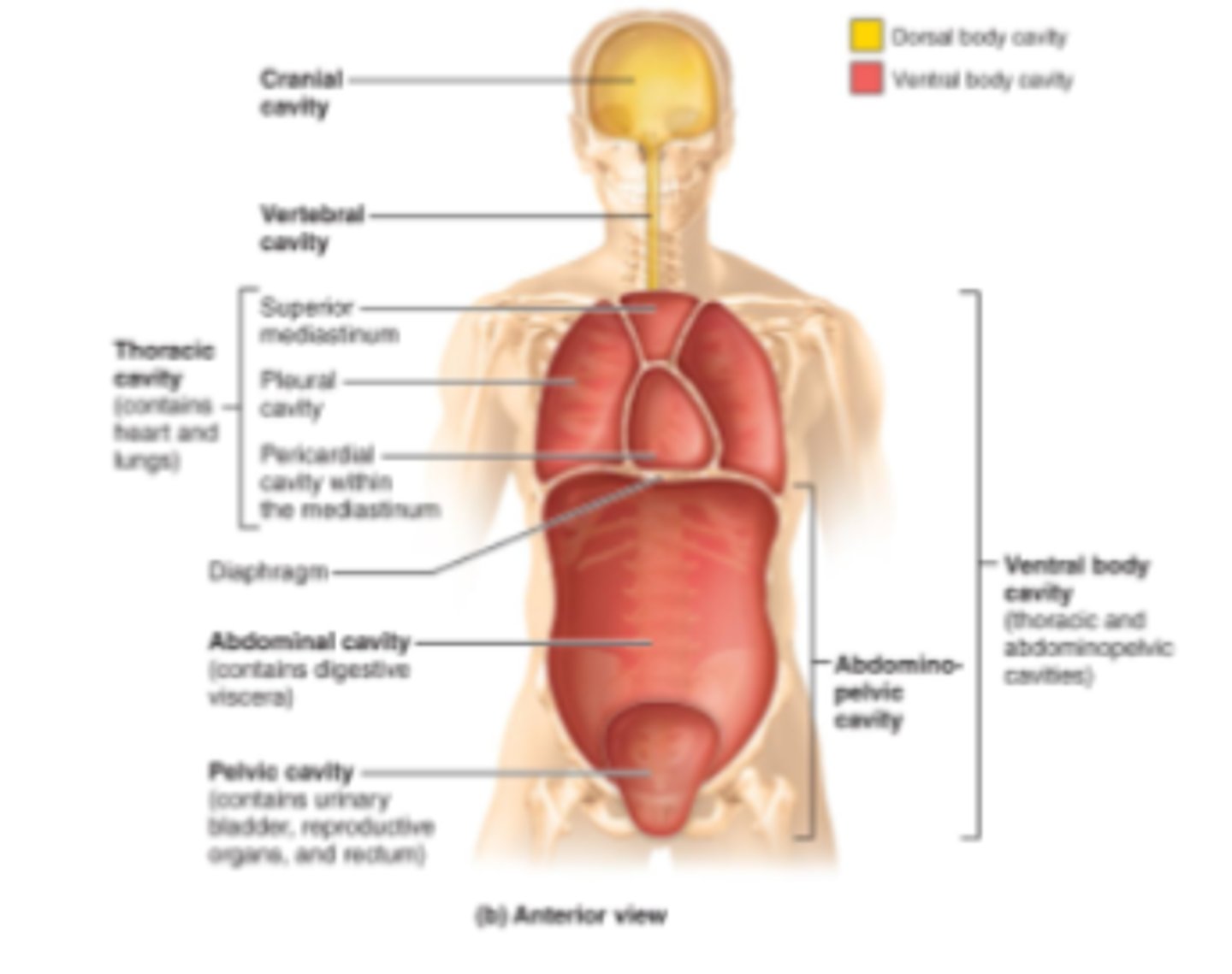
What is the serious cavities?
Fluid filled spaces lined withs serous membranes
Secrete lubricating serous fluid
Reduce frictions and provide protection
What are the layers serosa?
1.Parietal serosa
- outer layer lining body cavity walls
- reduces friction and anchors organs
2. Visceral serosa
-inner layer covering isceral organs
- provides a smooth, lubricated surface for movement
- continous at organ edges
what are the types of serous cavities?
1.Pleural cavity
2. Pericardial cavity
3. Peritoneal cavity
What is pleural cavity?
Serous cavity surrounding each lung
Contains pleural fluid for smooth lung movement during respiration
What is the cardial cavity?
- Surrounds the heart
- Contains pericardial fluid
- Provides lubrication and reduces as the heart beats
What Peritoneal cavity?
Located within the abdominal cavity
Surround abdominal organs
Contains peritoneal fluid for organ movement and expansion
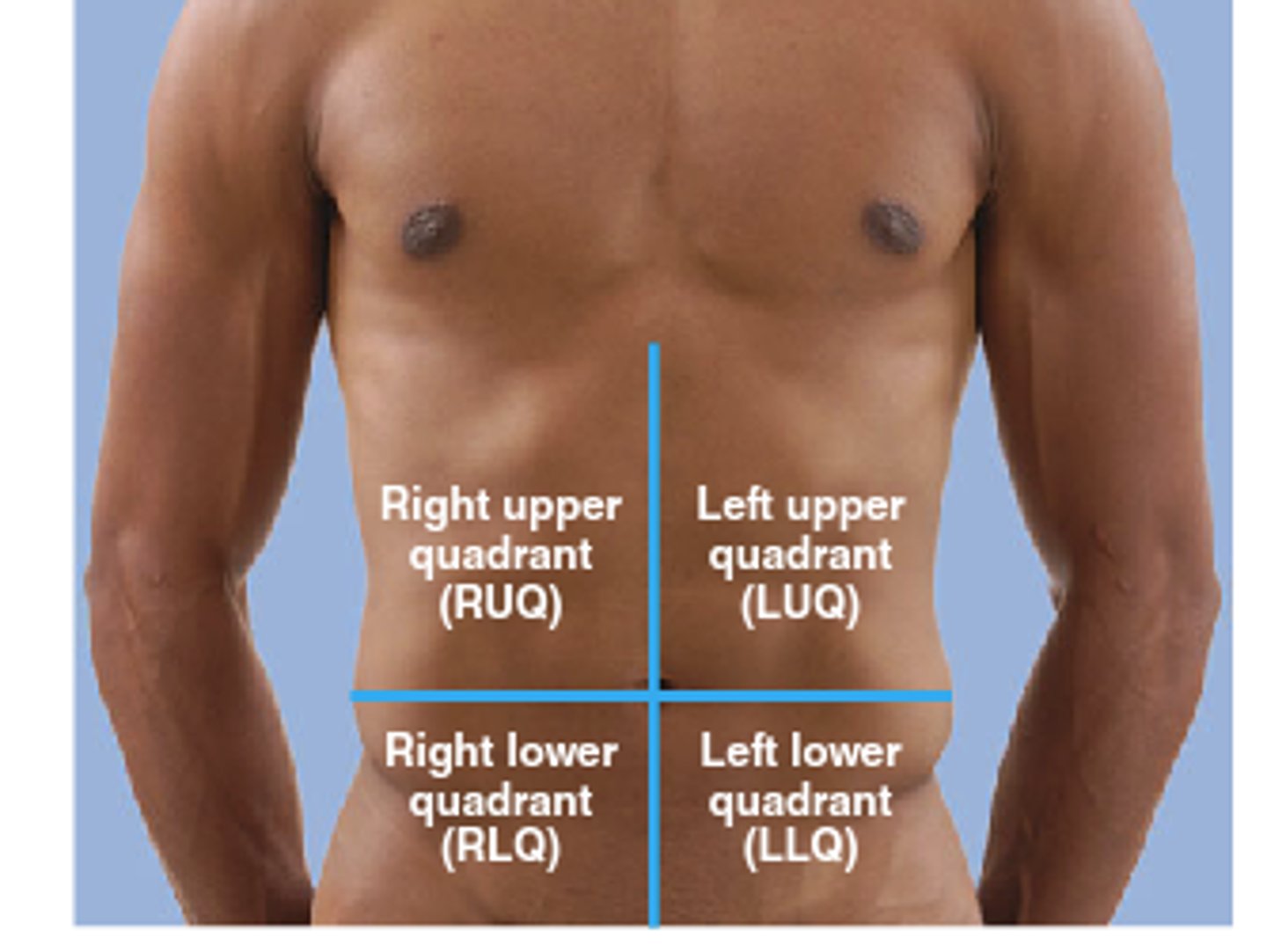
What are the abdominal quadrants?
Right upper and left upper quadrants
Right lower and left lower quadrants
What is Microscopic anatomy?
Specimen is fixed, sectioned and stained to highlight anatomical structures
What is x ray?
X ray: uses short electromagnetic waves
Best for visualizing bones and dense structures
What is CAT Scan?
Computed axial tomography
- Takes succesive x rays around the body
- Computer creates detailed cross sectional images
What is angiography?
Contrast medium highlight vessels
Digital subtraction angiography (DSA) subtracts pre-contrast images
What is Positron Emisson Tomography?
Ultrasound imaging
Pusles of high frequency sound waves echo off body tissues
Visualize tissue and developing fetuses
What is Magnetic Resonance imaging?
- Produces high contrast images of soft tissues
- Distinguishes tissues by water content
What is the skin?
Largest body organ
7 percent of body weight
1.5 to 4.4 mm thick
2 layers
Epdiermis
Dermis
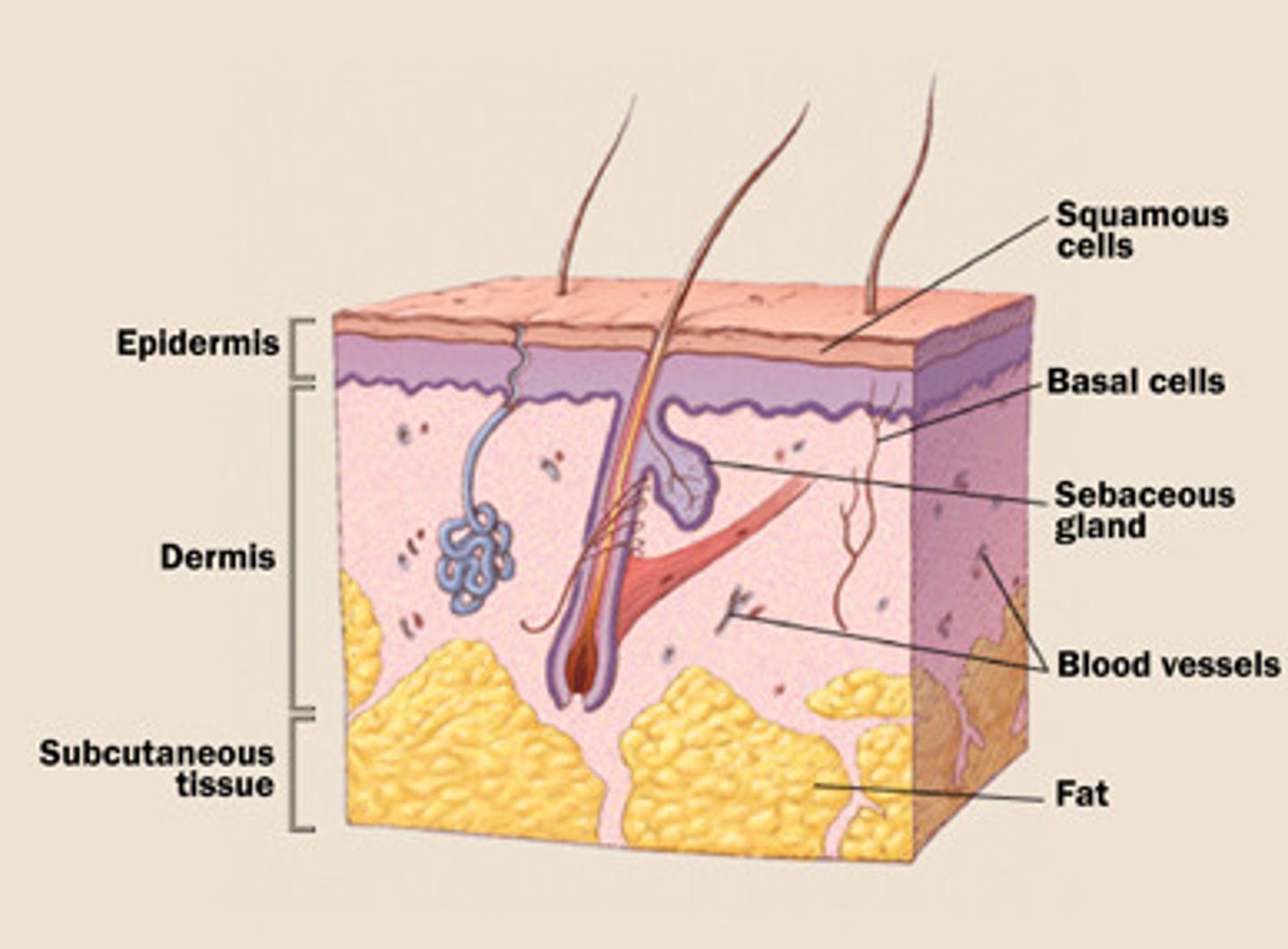
What is the hypodermis?
Subcutaneous layer, lies deep to the dermis
Composed of areolar and adipose tissues
1. Insulation
2. Shock absorption
3. Energy storage
4. Anchoring
What are the 5 functions of the skin?
1. Protection
2. Body temperature regulation
3. Excretion
4. Production of vitamin D
5. Sensory reception
What is the epidermis?
Outermost skin layer
Protective barrier between body and environment
Made from Keratinized stratified squamous epithelium
Avascular
Regnerationsers every 28-30 days in adults
Epi means upon and dermis means skin
What are the main cell types of the epidermis?
1. Keratinocytes
2. melanocytes
3. tactile epithelial cells
4. dendritic cells
What are keratinocytyes?
Most abundant epiderma; cells
Produced in the deepest layer
Create keratin for strength and water resistance
Produce antibiotics and enzymes
Dead at the skins surface
What is a melanocytes
Found in the stratum basel, hair follicles, inner ear, and eye
Protective from UV damage
Determines skin, hair and eye colour
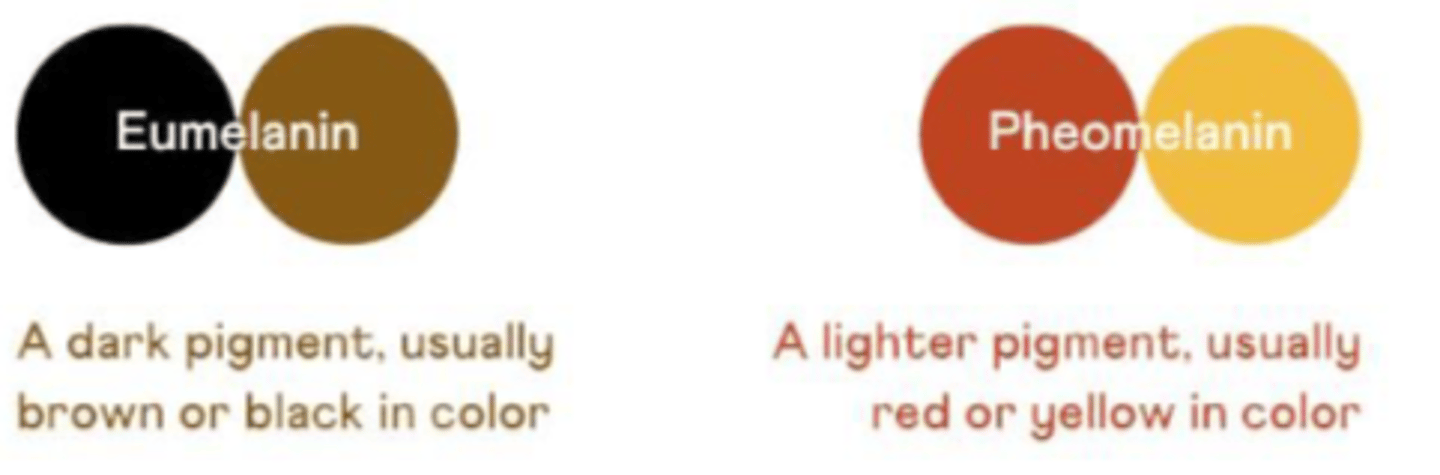
Types of eumelanin and pheomelanin
- Impacted by genetic sun exposure and hormones
What is eumelanin and pheomelanin?
What are the two melanocyte disorders?
- hyperpigmentation: overactive melanocytes
- hypopigmentation: underactive melanocytes
What is the tactile epithelial cells?
Merkel cells
Mechanoreceptors for light touch and pressure
In basal layer (fingertips/ palms)Transmit tactile signals to sensory nerve ending
Alert to harmful stimuli
what is the dendritic cells?
Largerhans cells
Found in the stratum spinosum
Part of the immune system
Monitor and process pathogens
Protect against infections and skin diseases
What are the layers of the epidermis
Stratum corneum
Stratum lucidum (only in thick skin)
Stratum granulosum
Stratum spinosum
Stratum basale (stratum geminativum)
"Come Lets Get Sun Burned"
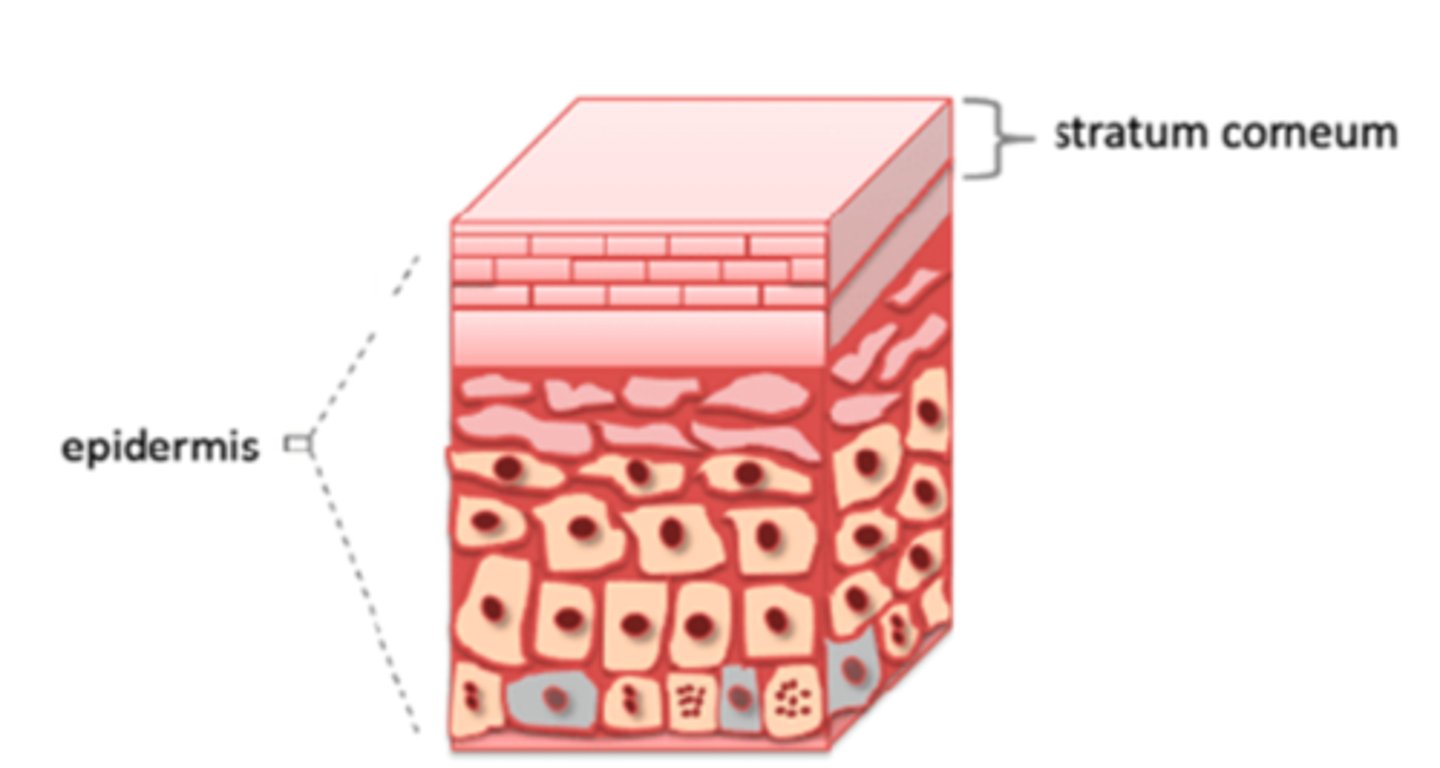
What is the Stratum corneum?
Horny layer
Thick layer of dead keratinocytes
Protects against abrasion and penetration
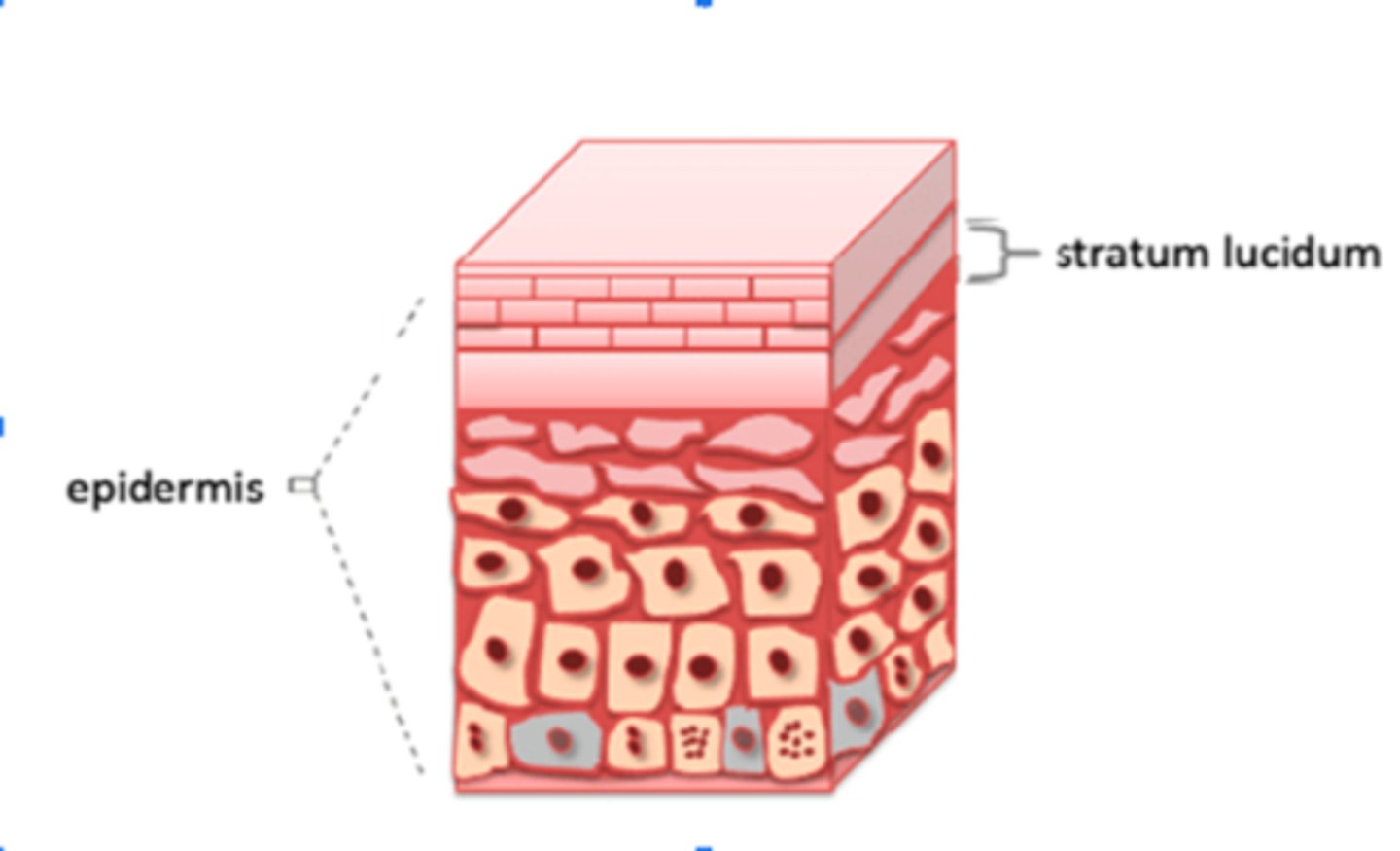
What is the stratum Lucidum?
Clear layer
Found only in thick skin (palms, soles)
Few rows of flat, dead keratinocytes
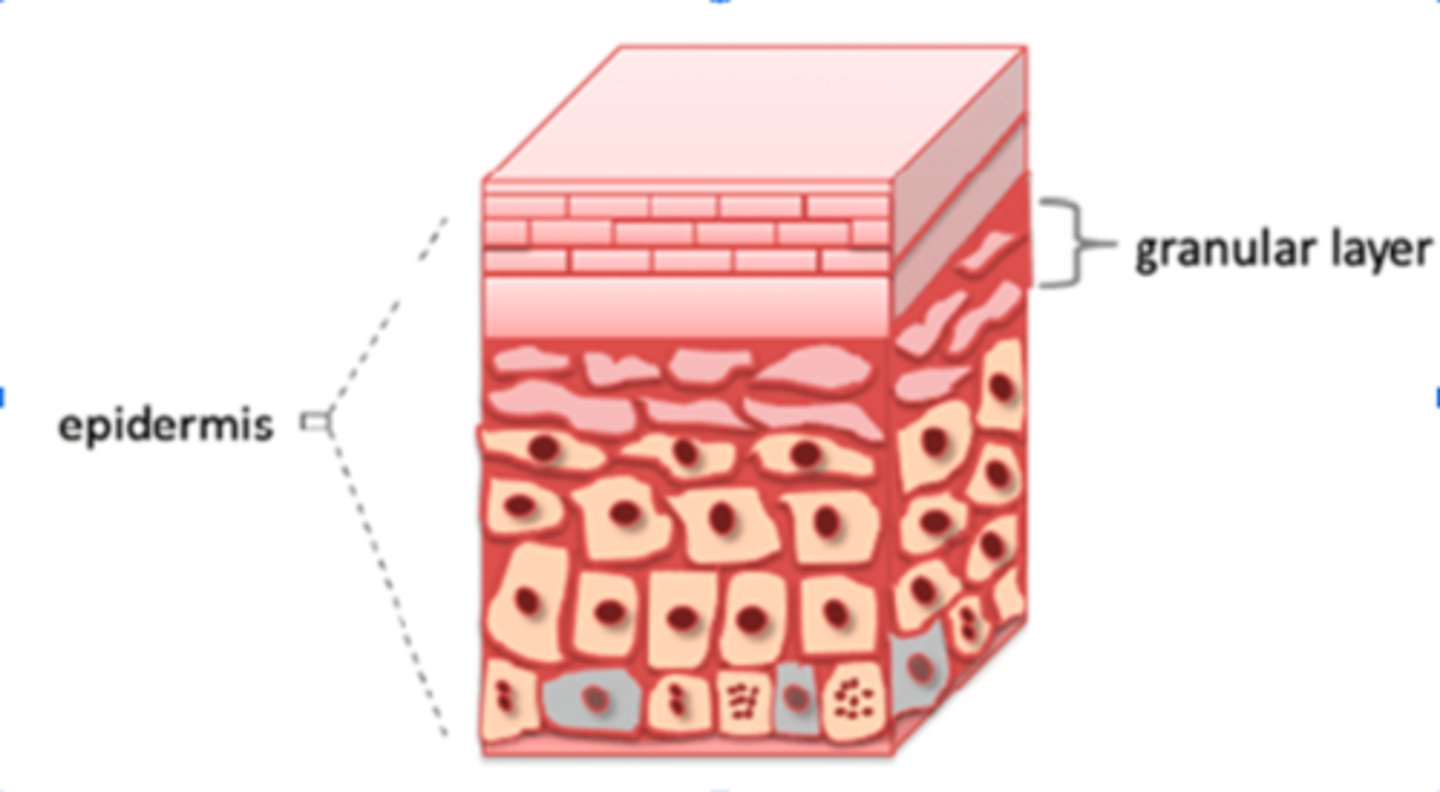
What is the stratum granulosum?
Few layer of keratinocytes
Keratohyalin granules form keratin
Lamellar granules contain waterproofing glycolipid
Cells above this layer lack nutrient access
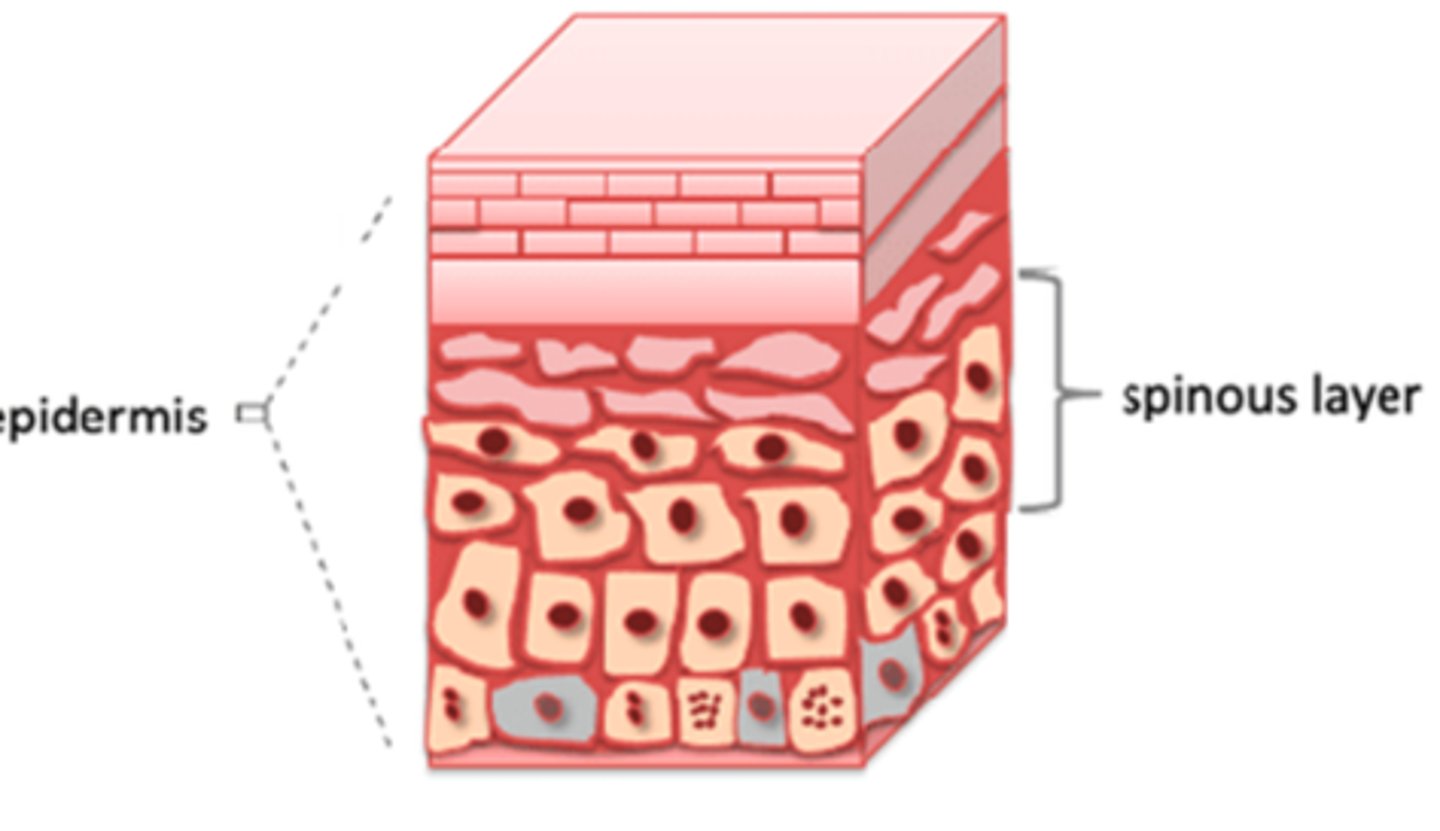
What is the stratum spinosum?
"Spiny" appearance
Contains intermediate filaments for strength and flexibility
Houses keratinocytes and dendritic cells
Provides mechanical stress resistance
What is the stratum basale?
Deepest epidermal layer, attached to dermis
Cells actively divide
Contains tactile epithelial cells and melanocytes
What is the dermis?
Strong, flexible connective tissue
Rich with blood vessels and nerves
Layeres
1. Papillary dermis
Superficial layer
2. Reticular
Deeper layer
What is the papillary dermis?
Includes dermal papillae
Increases surface area for gas, nutrient and waste exchange
Nourishes epidermis via capillaries
Receptors for light touch and vibration
Regulate body temperature
What is the epidermal ridges?
Friction ridges
Dermal elections that increase grip
Fingerprints, unique pattern for identification
What is the reticular dermis?
80 percent of dermis
Dense irregular connective tissue
Rich nerve supply for pressure and pain sensation
Vascular plexuses for nutrient delivery and temperature regulation
comprises of Dermal plexus and Subpapillaiary plexus
What is the cleavage lines and flexure lines?
Cleavage lines:
Separation between collagen fibers
Provide skin strength
In the dermis
Flexure lines:
Deep creases in palms, wrists, soles, fingers, and toes
What is the hypodermis?
Beneath the skin, this layer of areolar and adipose tissue anchors the skin, insulates, stores energy, cushions, and varies in distribution by sex.
How is skin colour determined?
Melanin: main pigment, made from tyrosine
Carotene: yellow-orange pigment from foods, adds warm hue
Hemoglobin: oxygenated blood gives rosy undertone in light skinned individuals
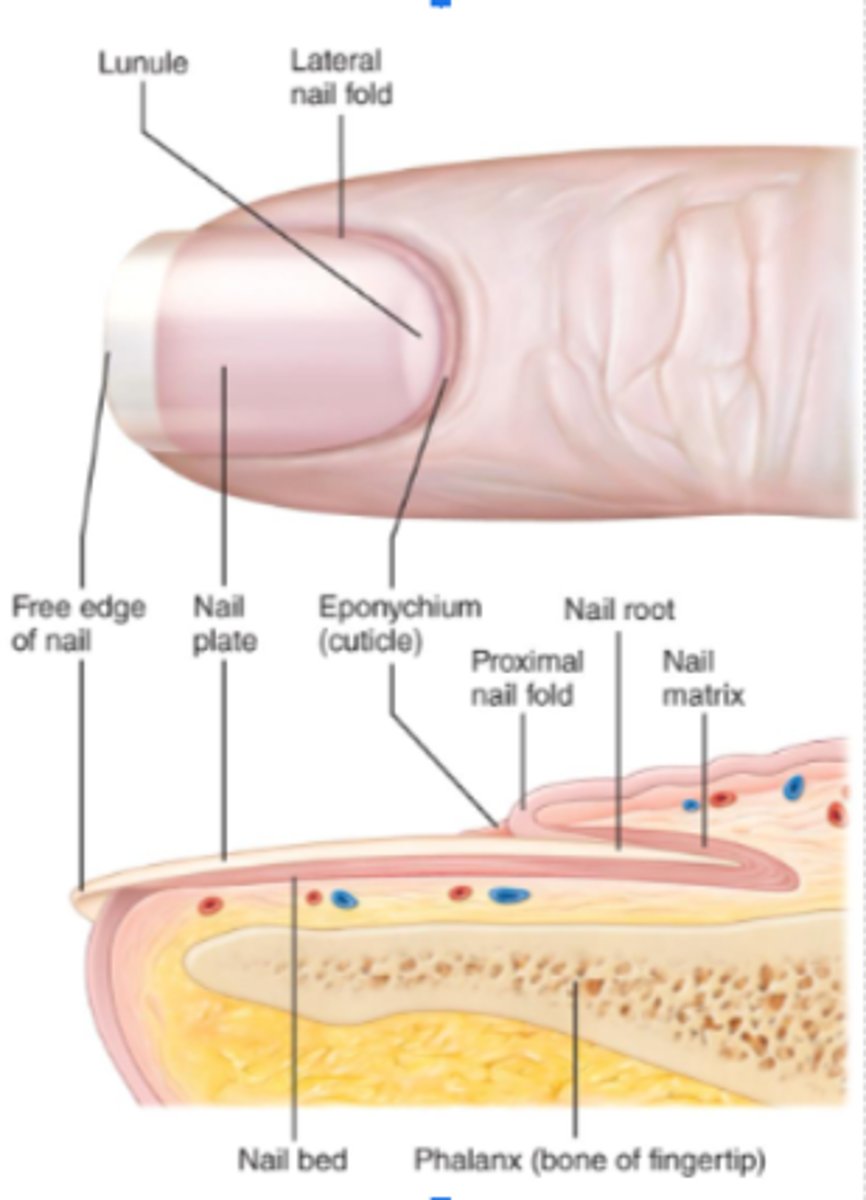
What is the nail?
Scalelike epidermal modification made of hard keratin
What is the parts of the nail?
Free edge: extends past fingertip
Nail plate: covers nail bed
Root: base of nail
Nail folds: skin around nail
Eponychium: cuticle
What is hair?
Found everywhere except palms and soles
Flexible strand of dead, keratinized cells
What is the parts of the hair?
Root: embedded in skin
Shaft: projects above skins surface
Made of tough, durable hard keratin
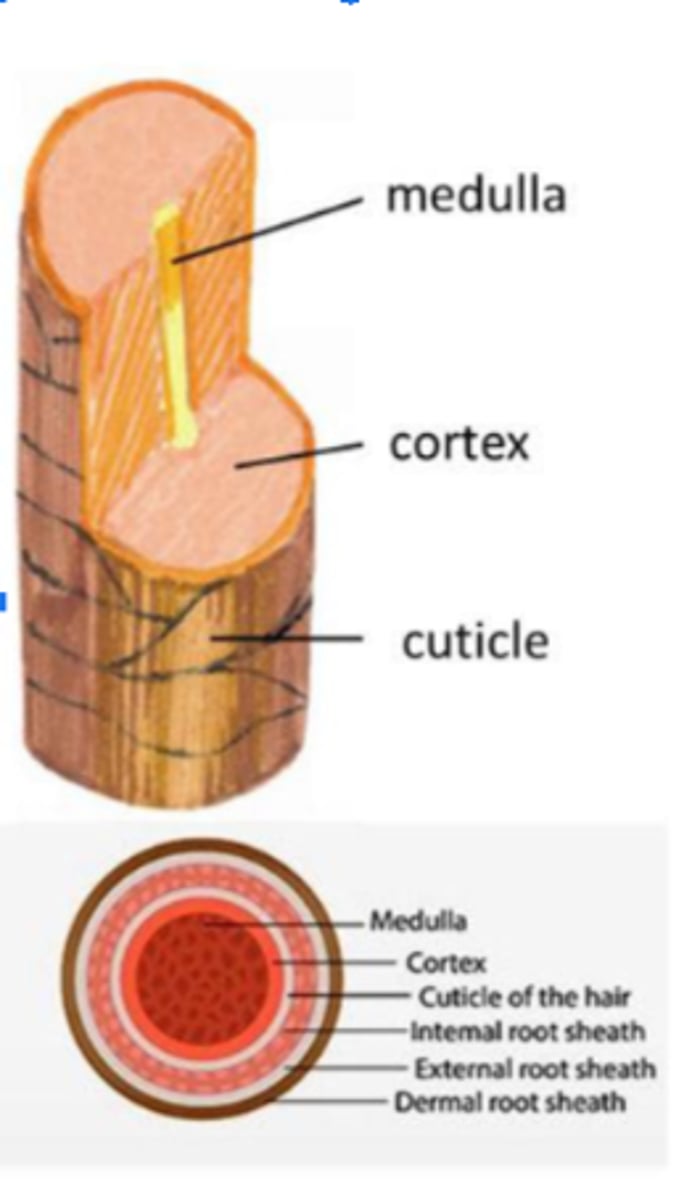
What is the hair structure?
3 concentric layer of keratinized cells
1.Medulla -central core
2. cortex - surrounds medulla
3. Cuticle - outermost layer
What is the additional hair strucutres?
Hair follicles: structure in skin where hair grows
Hair bulb: base contain matrix for hair and pigment production
Root plexus: sensory nerve network around hair bulb
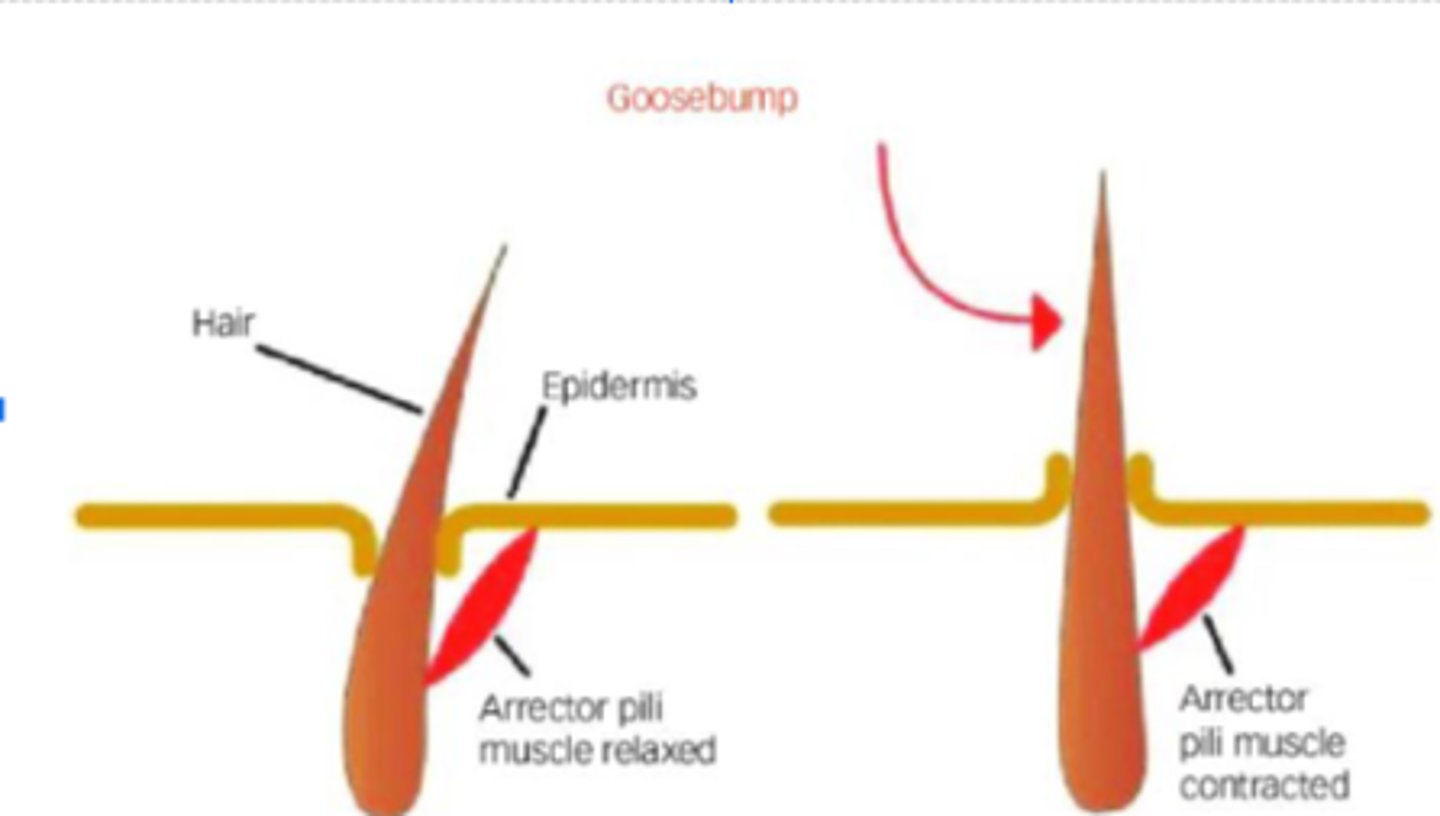
What is the arrector pili muscle?
Smooth muscle attached to hair follicle
Hair stand erect when arrector pili contracts
Goosebumps
Thermoregulation and protection
What are the types of growth of hair?
1. Vellus hairs
2. Terminal hairs
3. Lanugo
What is vellus hair?
- Fine, short, lightly pigmented
- Covered body, especially face, neck, arms
- Light insulation and sensory perception (airflow, touch)
- Present in children and adults